Prose
       What You Should Already Know


Wri tten in Pa ragra ph s
Types of Prose

Nonfiction (based on fact rather than on the
imagination, although may can contain fictional
elements) -essay, biography, letter, diary,
journal, account, autobiography, argument,
complaint, etc.

Fiction (created from the imagination, not
presented as fact, although it may be a true story
or situation) -short story, novella, novel, fable,
fairy tale, myth, etc.
Close Reading of Prose

Deciphering Prose

SOAPSTone (subject, occasion, audience,
purpose, speaker, tone)

Prose Chart

Data Sheet
Prose: Elements of Language/
        Rhetorical Devices


Repetition: alliteration, anadiplosis, anaphora,
antimetabole, assonance, catalog, chiasmus,
epanalepsis, epistrophe, internal rhyme,
parallelism, sibilance
Prose: Elements of Language/
         Rhetorical Devices
Rhetorical/Organizational/Reasoning:
ambiguity, analogy, anecdote, aphorism,
aposiopesis, catalog, didactic, digression, epithet,
ethos, pathos, logos, hendiadys, juxtaposition,
understatement/litotes, oxymoron, paradox,
parallelism, rhetorical question, shift, syllogism,
zeugma, organizational pattern (chronological,
spatial, climactic, cause/effect, comparison/
contrast, deductive/inductive reasoning,
classification, problem-solution)
Prose: Elements of Diction

Levels of Diction
high/formal-contains language that creates an elevated tone. It is free
of slang, idioms, colloquialisms, and contractions. It often contains
polysyllabic words, sophisticated syntax and elegant words.

neutral- uses standard language and vocabulary without elaborate words
and may include contractions

informal/low- language of everyday use; relaxed and conversational;
common and simple words, idioms, slang, jargon and contractions
Prose: Elements of Diction
Types of Diction
slang-recently coined words that come and go quickly; used in informal
situations

colloquial- nonstandard expressions, often regional, used in informal or
conversational speech and writing

jargon-words characteristic to a particular profession

dialect- nonstandard subgroup of language with its own vocabulary and
grammatics; can reveal region, economics, class; words are misspelled to
accentuate the way the words sound

abstract- denotes intangible ideas, emotions, conditions, or concepts

concrete- specific words that describe physical qualities/conditions
denotation
connotation
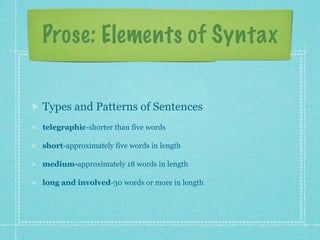
Prose: Elements of Syntax


Types and Patterns of Sentences
telegraphic-shorter than five words

short-approximately five words in length

medium-approximately 18 words in length

long and involved-30 words or more in length
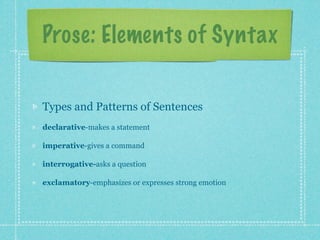
Prose: Elements of Syntax


Types and Patterns of Sentences
declarative-makes a statement

imperative-gives a command

interrogative-asks a question

exclamatory-emphasizes or expresses strong emotion
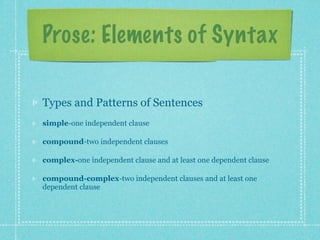
Prose: Elements of Syntax

Types and Patterns of Sentences
simple-one independent clause

compound-two independent clauses

complex-one independent clause and at least one dependent clause

compound-complex-two independent clauses and at least one
dependent clause
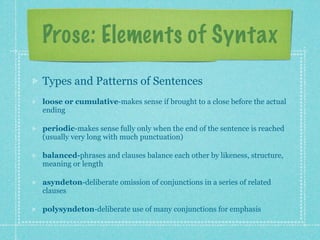
Prose: Elements of Syntax
Types and Patterns of Sentences
loose or cumulative-makes sense if brought to a close before the actual
ending

periodic-makes sense fully only when the end of the sentence is reached
(usually very long with much punctuation)

balanced-phrases and clauses balance each other by likeness, structure,
meaning or length

asyndeton-deliberate omission of conjunctions in a series of related
clauses

polysyndeton-deliberate use of many conjunctions for emphasis
Prose: Elements of Syntax


Types and Patterns of Sentences
natural order-subject comes before the predicate

inverted order-predicate comes before the subject

rhetorical fragment-fragment used deliberately for purpose/effect

rhetorical question-not meant to be answered
Prose: Elements of Syntax


Syntactical Devices-parallelism, juxtaposition,
repetition, anaphora, chiasmus, antimetabole,
zeugma
Prose: Elements of Structure/
     Storytelling Techniques


 Elements of Plot: the series of related events
 in a story; it must involve conflict and resolution
 of conflict; must figure out protagonist,
 antagonist, type of conflict, exposition, rising
 action, climax, falling action, denouement,
 turning point
Prose: Elements of Structure/
     Storytelling Techniques
 Point of View: vantage point from which a
 story is told; can be participant or
 nonparticipant; can change throughout story

 Participant Points of View: first-person;
 innocent eye

 Nonparticipant Points of View: third-person;
 third-person omniscient, third-person limited
 omniscient, third-person objective, second-
 person
Prose: Elements of Structure/
     Storytelling Techniques


 Structural Elements for Storytelling:
 flashback, foreshadowing, framing device, shift,
 chapters, books, paragraphs, paragraph supports
 (quotations, citations, details, diction, etc.),
 motif, parody
Prose: Elements of
         Characterization
Characterization: the process by which the
writer reveals the personality of the character

indirect characterization-what the character
says, does, thinks, has, wears; where they are;
the people with whom they associate; what
others say and think about them

direct characterization-author’s direct
statements
Prose: Elements of
         Characterization


Types of Character: narrator, flat, round,
static, dynamic, major, minor, protagonist,
antagonist, archetypal
Prose: Elements of Setting
Setting: the historical time and place, and the social
circumstances in the “world” of the literature; rarely
isolated; can affect structure, symbol, irony, tone, mood,
archetype and character

geographic location-topography, scenery, room layout/furniture,
buildings, stage set or design; physical dimensions

cultural backdrop/social context/time period-occupations/working
conditions, way of life, way of talking and behaving, clothing, gender
roles, traditions, habits, attitudes, customs, beliefs, values, speech
patterns, laws, past present and future

artificial environment-rooms, buildings, cities, towns, villages, futuristic
settings

props-tools, implements, gadgets, clothing/costumes, furniture
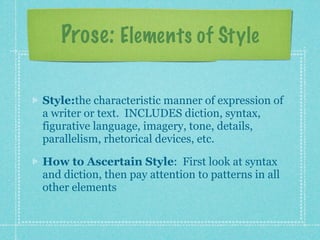
Prose: Elements of Style

Style:the characteristic manner of expression of
a writer or text. INCLUDES diction, syntax,
figurative language, imagery, tone, details,
parallelism, rhetorical devices, etc.

How to Ascertain Style: First look at syntax
and diction, then pay attention to patterns in all
other elements
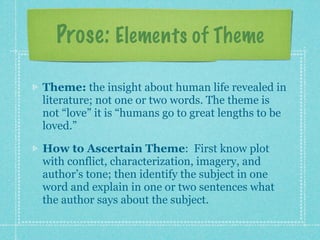
Prose: Elements of Theme

Theme: the insight about human life revealed in
literature; not one or two words. The theme is
not “love” it is “humans go to great lengths to be
loved.”

How to Ascertain Theme: First know plot
with conflict, characterization, imagery, and
author’s tone; then identify the subject in one
word and explain in one or two sentences what
the author says about the subject.
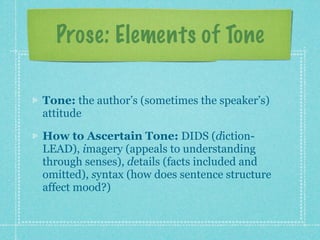
Prose: Elements of Tone

Tone: the author’s (sometimes the speaker’s)
attitude

How to Ascertain Tone: DIDS (diction-
LEAD), imagery (appeals to understanding
through senses), details (facts included and
omitted), syntax (how does sentence structure
affect mood?)
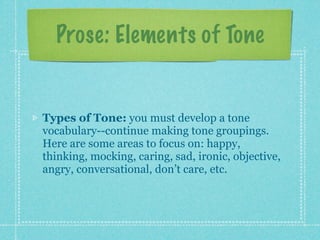
Prose: Elements of Tone


Types of Tone: you must develop a tone
vocabulary--continue making tone groupings.
Here are some areas to focus on: happy,
thinking, mocking, caring, sad, ironic, objective,
angry, conversational, don’t care, etc.
Prose: Figurative Language


adynaton, allegory, apostrophe, cliche, conceit,
euphemism, hyperbole, idiom, imagery,
synesthesia, metaphor, metonymy,
personification, pun, simile, synecdoche
Prose: General Literary
          Devices


aesthetics, allusion, archetype, dramatic
situation, irony, mood, motivation, satire, style,
symbol, theme, tone, sarcasm

Prose PPT

  • 1.
    Prose What You Should Already Know Wri tten in Pa ragra ph s
  • 2.
    Types of Prose Nonfiction(based on fact rather than on the imagination, although may can contain fictional elements) -essay, biography, letter, diary, journal, account, autobiography, argument, complaint, etc. Fiction (created from the imagination, not presented as fact, although it may be a true story or situation) -short story, novella, novel, fable, fairy tale, myth, etc.
  • 3.
    Close Reading ofProse Deciphering Prose SOAPSTone (subject, occasion, audience, purpose, speaker, tone) Prose Chart Data Sheet
  • 4.
    Prose: Elements ofLanguage/ Rhetorical Devices Repetition: alliteration, anadiplosis, anaphora, antimetabole, assonance, catalog, chiasmus, epanalepsis, epistrophe, internal rhyme, parallelism, sibilance
  • 5.
    Prose: Elements ofLanguage/ Rhetorical Devices Rhetorical/Organizational/Reasoning: ambiguity, analogy, anecdote, aphorism, aposiopesis, catalog, didactic, digression, epithet, ethos, pathos, logos, hendiadys, juxtaposition, understatement/litotes, oxymoron, paradox, parallelism, rhetorical question, shift, syllogism, zeugma, organizational pattern (chronological, spatial, climactic, cause/effect, comparison/ contrast, deductive/inductive reasoning, classification, problem-solution)
  • 6.
    Prose: Elements ofDiction Levels of Diction high/formal-contains language that creates an elevated tone. It is free of slang, idioms, colloquialisms, and contractions. It often contains polysyllabic words, sophisticated syntax and elegant words. neutral- uses standard language and vocabulary without elaborate words and may include contractions informal/low- language of everyday use; relaxed and conversational; common and simple words, idioms, slang, jargon and contractions
  • 7.
    Prose: Elements ofDiction Types of Diction slang-recently coined words that come and go quickly; used in informal situations colloquial- nonstandard expressions, often regional, used in informal or conversational speech and writing jargon-words characteristic to a particular profession dialect- nonstandard subgroup of language with its own vocabulary and grammatics; can reveal region, economics, class; words are misspelled to accentuate the way the words sound abstract- denotes intangible ideas, emotions, conditions, or concepts concrete- specific words that describe physical qualities/conditions denotation connotation
  • 8.
    Prose: Elements ofSyntax Types and Patterns of Sentences telegraphic-shorter than five words short-approximately five words in length medium-approximately 18 words in length long and involved-30 words or more in length
  • 9.
    Prose: Elements ofSyntax Types and Patterns of Sentences declarative-makes a statement imperative-gives a command interrogative-asks a question exclamatory-emphasizes or expresses strong emotion
  • 10.
    Prose: Elements ofSyntax Types and Patterns of Sentences simple-one independent clause compound-two independent clauses complex-one independent clause and at least one dependent clause compound-complex-two independent clauses and at least one dependent clause
  • 11.
    Prose: Elements ofSyntax Types and Patterns of Sentences loose or cumulative-makes sense if brought to a close before the actual ending periodic-makes sense fully only when the end of the sentence is reached (usually very long with much punctuation) balanced-phrases and clauses balance each other by likeness, structure, meaning or length asyndeton-deliberate omission of conjunctions in a series of related clauses polysyndeton-deliberate use of many conjunctions for emphasis
  • 12.
    Prose: Elements ofSyntax Types and Patterns of Sentences natural order-subject comes before the predicate inverted order-predicate comes before the subject rhetorical fragment-fragment used deliberately for purpose/effect rhetorical question-not meant to be answered
  • 13.
    Prose: Elements ofSyntax Syntactical Devices-parallelism, juxtaposition, repetition, anaphora, chiasmus, antimetabole, zeugma
  • 14.
    Prose: Elements ofStructure/ Storytelling Techniques Elements of Plot: the series of related events in a story; it must involve conflict and resolution of conflict; must figure out protagonist, antagonist, type of conflict, exposition, rising action, climax, falling action, denouement, turning point
  • 15.
    Prose: Elements ofStructure/ Storytelling Techniques Point of View: vantage point from which a story is told; can be participant or nonparticipant; can change throughout story Participant Points of View: first-person; innocent eye Nonparticipant Points of View: third-person; third-person omniscient, third-person limited omniscient, third-person objective, second- person
  • 16.
    Prose: Elements ofStructure/ Storytelling Techniques Structural Elements for Storytelling: flashback, foreshadowing, framing device, shift, chapters, books, paragraphs, paragraph supports (quotations, citations, details, diction, etc.), motif, parody
  • 17.
    Prose: Elements of Characterization Characterization: the process by which the writer reveals the personality of the character indirect characterization-what the character says, does, thinks, has, wears; where they are; the people with whom they associate; what others say and think about them direct characterization-author’s direct statements
  • 18.
    Prose: Elements of Characterization Types of Character: narrator, flat, round, static, dynamic, major, minor, protagonist, antagonist, archetypal
  • 19.
    Prose: Elements ofSetting Setting: the historical time and place, and the social circumstances in the “world” of the literature; rarely isolated; can affect structure, symbol, irony, tone, mood, archetype and character geographic location-topography, scenery, room layout/furniture, buildings, stage set or design; physical dimensions cultural backdrop/social context/time period-occupations/working conditions, way of life, way of talking and behaving, clothing, gender roles, traditions, habits, attitudes, customs, beliefs, values, speech patterns, laws, past present and future artificial environment-rooms, buildings, cities, towns, villages, futuristic settings props-tools, implements, gadgets, clothing/costumes, furniture
  • 20.
    Prose: Elements ofStyle Style:the characteristic manner of expression of a writer or text. INCLUDES diction, syntax, figurative language, imagery, tone, details, parallelism, rhetorical devices, etc. How to Ascertain Style: First look at syntax and diction, then pay attention to patterns in all other elements
  • 21.
    Prose: Elements ofTheme Theme: the insight about human life revealed in literature; not one or two words. The theme is not “love” it is “humans go to great lengths to be loved.” How to Ascertain Theme: First know plot with conflict, characterization, imagery, and author’s tone; then identify the subject in one word and explain in one or two sentences what the author says about the subject.
  • 22.
    Prose: Elements ofTone Tone: the author’s (sometimes the speaker’s) attitude How to Ascertain Tone: DIDS (diction- LEAD), imagery (appeals to understanding through senses), details (facts included and omitted), syntax (how does sentence structure affect mood?)
  • 23.
    Prose: Elements ofTone Types of Tone: you must develop a tone vocabulary--continue making tone groupings. Here are some areas to focus on: happy, thinking, mocking, caring, sad, ironic, objective, angry, conversational, don’t care, etc.
  • 24.
    Prose: Figurative Language adynaton,allegory, apostrophe, cliche, conceit, euphemism, hyperbole, idiom, imagery, synesthesia, metaphor, metonymy, personification, pun, simile, synecdoche
  • 25.
    Prose: General Literary Devices aesthetics, allusion, archetype, dramatic situation, irony, mood, motivation, satire, style, symbol, theme, tone, sarcasm