 Proposal arguments are the most common type of
  argument, particularly, in the real-world environment
  of jobs.
 There are two types of proposal:
o Practical Proposal
o Policy Proposal
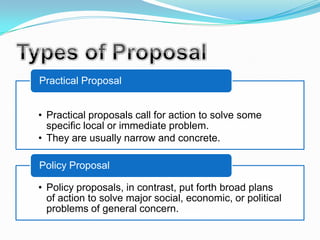
Practical Proposal


• Practical proposals call for action to solve some
  specific local or immediate problem.
• They are usually narrow and concrete.

Policy Proposal

• Policy proposals, in contrast, put forth broad plans
  of action to solve major social, economic, or political
  problems of general concern.
 A proposal is by definition a persuasive message .
 General purpose is to convince reader
 To convince someone of your point of view, you have
  to prove that your suggestion is appropriate and
  adoptable.
 Therefore we use arguments in proposal
There are six main Strategies to strengthen proposal
 argument
 Demonstrate your Knowledge
 Provide Concrete Information
 Research the Competition
 Prove its Feasibility
 Adapt “You” Attitude
 Make it attractive and readable
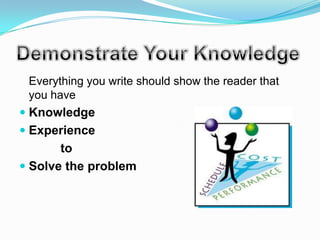
Everything you write should show the reader that
 you have
 Knowledge
 Experience
       to
 Solve the problem
 Avoid vague unsupported generalization.
 Provide quantifiable details.
 Describe the problem by answering What Why
  Where When & How .
 Tell how much money the proposed solution can
  save.
 Give details on how job will be done.
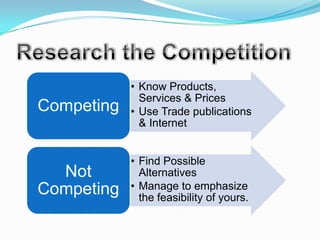
• Know Products,
              Services & Prices
Competing   • Use Trade publications
              & Internet


            • Find Possible
  Not         Alternatives
Competing   • Manage to emphasize
              the feasibility of yours.
Customer has to choose between

 BUYING solution from external party
 BUILDING Their own


Here you are effectively competing
 Proposal should be:
o Appropriate
o Feasible
o Workable
 It should be according to the audience capabilities
 and resources
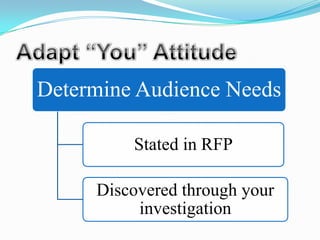
Determine Audience Needs

         Stated in RFP

     Discovered through your
          investigation
Describe qualities or benefits of your product,
service or personnel in relation to your audience
needs.
 Make sure your proposal is letter perfect, inviting and
  readable.
 The quality of your offer is pre-judged by your
  proposal
 Errors , omissions or inconsistencies may cost you
  important career and business opportunities.
 Follow the three-part proposal structure:
o DESCRIPTION of the problem,
o Proposed SOLUTION
o JUSTIFICATION for the proposed solution
 Give your argument immediacy through
o Details
o Scenes
o Examples
 Consider conservatism of people and use strategies
  to overcome it
 Predict consequences and evaluate consequences
  of certain courses of action
 Identify important, controversial problems that need
  solving in the various communities to which you
  belong
 Consider who has the power to act on your proposal
  and what are the constraints preventing action
 Use the claim-type strategy to generate ideas for your
  proposal argument by thinking out claims of category,
  cause, and resemblance that can support your
  proposal claim
Choose an effective way to organize your proposal
    argument that
   CONVINCES your audience of the problem
   PROPOSES your solution
   JUSTIFIES your proposal
   CONFRONTS opposing views
Revise your proposal argument by:
 Answering objections that
 o Deny the problem
 o Protest the effectiveness or cost of your solution
 Anticipating counter-proposals
 Proposal Arguments
 Types of proposals
 Strategies to strengthen arguments
 Techniques to write arguments

Proposal Arguments

  • 2.
     Proposal argumentsare the most common type of argument, particularly, in the real-world environment of jobs.  There are two types of proposal: o Practical Proposal o Policy Proposal
  • 3.
    Practical Proposal • Practicalproposals call for action to solve some specific local or immediate problem. • They are usually narrow and concrete. Policy Proposal • Policy proposals, in contrast, put forth broad plans of action to solve major social, economic, or political problems of general concern.
  • 4.
     A proposalis by definition a persuasive message .  General purpose is to convince reader  To convince someone of your point of view, you have to prove that your suggestion is appropriate and adoptable.  Therefore we use arguments in proposal
  • 5.
    There are sixmain Strategies to strengthen proposal argument  Demonstrate your Knowledge  Provide Concrete Information  Research the Competition  Prove its Feasibility  Adapt “You” Attitude  Make it attractive and readable
  • 6.
    Everything you writeshould show the reader that you have  Knowledge  Experience to  Solve the problem
  • 7.
     Avoid vagueunsupported generalization.  Provide quantifiable details.  Describe the problem by answering What Why Where When & How .  Tell how much money the proposed solution can save.  Give details on how job will be done.
  • 8.
    • Know Products, Services & Prices Competing • Use Trade publications & Internet • Find Possible Not Alternatives Competing • Manage to emphasize the feasibility of yours.
  • 9.
    Customer has tochoose between  BUYING solution from external party  BUILDING Their own Here you are effectively competing
  • 10.
     Proposal shouldbe: o Appropriate o Feasible o Workable  It should be according to the audience capabilities and resources
  • 11.
    Determine Audience Needs Stated in RFP Discovered through your investigation
  • 12.
    Describe qualities orbenefits of your product, service or personnel in relation to your audience needs.
  • 13.
     Make sureyour proposal is letter perfect, inviting and readable.  The quality of your offer is pre-judged by your proposal  Errors , omissions or inconsistencies may cost you important career and business opportunities.
  • 14.
     Follow thethree-part proposal structure: o DESCRIPTION of the problem, o Proposed SOLUTION o JUSTIFICATION for the proposed solution  Give your argument immediacy through o Details o Scenes o Examples
  • 15.
     Consider conservatismof people and use strategies to overcome it  Predict consequences and evaluate consequences of certain courses of action  Identify important, controversial problems that need solving in the various communities to which you belong
  • 16.
     Consider whohas the power to act on your proposal and what are the constraints preventing action  Use the claim-type strategy to generate ideas for your proposal argument by thinking out claims of category, cause, and resemblance that can support your proposal claim
  • 17.
    Choose an effectiveway to organize your proposal argument that  CONVINCES your audience of the problem  PROPOSES your solution  JUSTIFIES your proposal  CONFRONTS opposing views
  • 18.
    Revise your proposalargument by:  Answering objections that o Deny the problem o Protest the effectiveness or cost of your solution  Anticipating counter-proposals
  • 19.
     Proposal Arguments Types of proposals  Strategies to strengthen arguments  Techniques to write arguments

Editor's Notes

  • #2 Najam 1-4Haseeb 5-9Salman 10-13Ali 14-16Naoman 17-19
  • #3 There are two types of proposals based on type of arguments.
  • #4 There are two types of proposals based on type of arguments.
  • #9 A proposal may be written in two scenarios1 you are competing against other firms for a potential customerUse Trade publications & Internet to get information about competitorKnow Products, Services & Prices of competitor2 you are not competingFind Possible Alternatives that client may choose instead of yoursManage to emphasize the feasibility of yours.
  • #10 Sometimes costomer face a buy or build situation in which:
  • #12 First you should determine your customer’s needsEither stated in RFP or discovered through your own investigation.