RESOURCE, CAPABILITIES,
CORE COMPETENCIES, AND ACTIVITY
ANALYSIS
The fundamental building
blocks for building
winning strategies
Key Elements of Business Strategies:
Understanding Resources, Capabilities, and
Competencies is the key
 Selecting a business strategy that exploits valuable
resources and distinctive competencies (ie.
competitive advantages)
 Ensuring that all resources and capabilities are fully
employed and exploited
 Building and regenerating valuable resources and
distinctive competencies -- competitive advantages
Rationale for the Resource-based
Approach to Strategy
 When the external environment is subject to
rapid change, internal resources and
capabilities offer a more secure basis for
strategy than market focus
 Resources and capabilities are the primary
source of profitability. Firm-specific strategic
differences account for 50-70 percent of
observed differences in firms’ profits
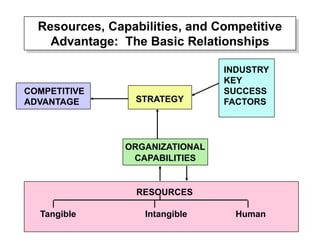
Resources, Capabilities, and Competitive
Advantage: The Basic Relationships
COMPETITIVE
ADVANTAGE STRATEGY
INDUSTRY
KEY
SUCCESS
FACTORS
ORGANIZATIONAL
CAPABILITIES
RESOURCES
Tangible Intangible Human
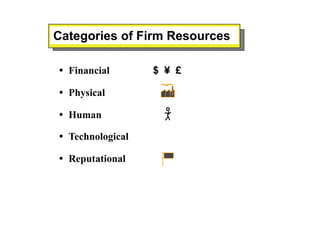
Categories of Firm Resources
• Financial
• Physical
• Human
• Technological
• Reputational
$ ¥ £
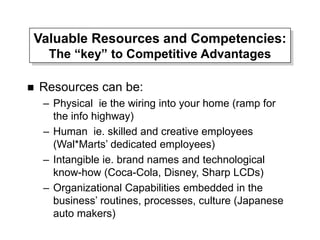
Valuable Resources and Competencies:
The “key” to Competitive Advantages
 Resources can be:
– Physical ie the wiring into your home (ramp for
the info highway)
– Human ie. skilled and creative employees
(Wal*Marts’ dedicated employees)
– Intangible ie. brand names and technological
know-how (Coca-Cola, Disney, Sharp LCDs)
– Organizational Capabilities embedded in the
business’ routines, processes, culture (Japanese
auto makers)
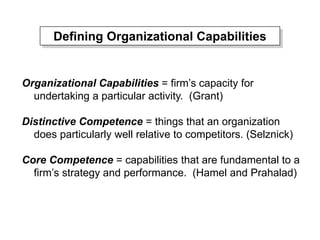
Defining Organizational Capabilities
Organizational Capabilities = firm’s capacity for
undertaking a particular activity. (Grant)
Distinctive Competence = things that an organization
does particularly well relative to competitors. (Selznick)
Core Competence = capabilities that are fundamental to a
firm’s strategy and performance. (Hamel and Prahalad)
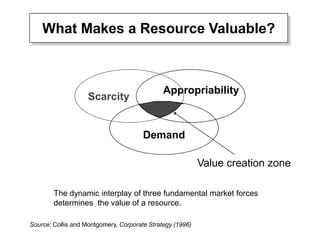
Appropriability
Scarcity
Demand
Value creation zone
The dynamic interplay of three fundamental market forces
determines the value of a resource.
Source: Collis and Montgomery, Corporate Strategy (1996)
What Makes a Resource Valuable?
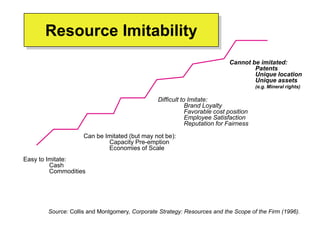
Easy to Imitate:
Cash
Commodities
Can be Imitated (but may not be):
Capacity Pre-emption
Economies of Scale
Difficult to Imitate:
Brand Loyalty
Favorable cost position
Employee Satisfaction
Reputation for Fairness
Cannot be imitated:
Patents
Unique location
Unique assets
(e.g. Mineral rights)
Source: Collis and Montgomery, Corporate Strategy: Resources and the Scope of the Firm (1996).
Resource Imitability
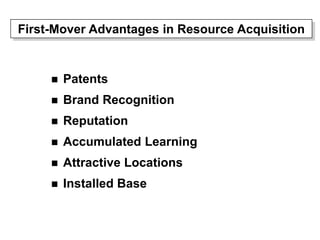
First-Mover Advantages in Resource Acquisition
 Patents
 Brand Recognition
 Reputation
 Accumulated Learning
 Attractive Locations
 Installed Base
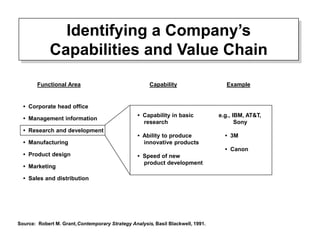
Identifying a Company's Capabilities
Source: Robert M. Grant,Contemporary Strategy Analysis, Basil Blackwell, 1991.
• Corporate head office
• Management information
• Research and development
• Manufacturing
• Product design
• Marketing
• Sales and distribution
• Capability in basic
research
• Ability to produce
innovative products
• Speed of new
product development
e.g., IBM, AT&T,
Sony
• 3M
• Canon
Functional Area Capability Example
Identifying a Company’s
Capabilities and Value Chain
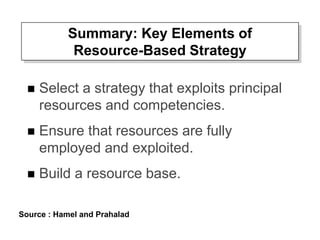
Summary: Key Elements of
Resource-Based Strategy
 Select a strategy that exploits principal
resources and competencies.
 Ensure that resources are fully
employed and exploited.
 Build a resource base.
Source : Hamel and Prahalad
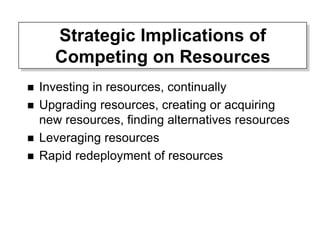
Strategic Implications of
Competing on Resources
 Investing in resources, continually
 Upgrading resources, creating or acquiring
new resources, finding alternatives resources
 Leveraging resources
 Rapid redeployment of resources

Resources and Capabilities.ppt

  • 1.
    RESOURCE, CAPABILITIES, CORE COMPETENCIES,AND ACTIVITY ANALYSIS The fundamental building blocks for building winning strategies
  • 2.
    Key Elements ofBusiness Strategies: Understanding Resources, Capabilities, and Competencies is the key  Selecting a business strategy that exploits valuable resources and distinctive competencies (ie. competitive advantages)  Ensuring that all resources and capabilities are fully employed and exploited  Building and regenerating valuable resources and distinctive competencies -- competitive advantages
  • 3.
    Rationale for theResource-based Approach to Strategy  When the external environment is subject to rapid change, internal resources and capabilities offer a more secure basis for strategy than market focus  Resources and capabilities are the primary source of profitability. Firm-specific strategic differences account for 50-70 percent of observed differences in firms’ profits
  • 4.
    Resources, Capabilities, andCompetitive Advantage: The Basic Relationships COMPETITIVE ADVANTAGE STRATEGY INDUSTRY KEY SUCCESS FACTORS ORGANIZATIONAL CAPABILITIES RESOURCES Tangible Intangible Human
  • 5.
    Categories of FirmResources • Financial • Physical • Human • Technological • Reputational $ ¥ £
  • 6.
    Valuable Resources andCompetencies: The “key” to Competitive Advantages  Resources can be: – Physical ie the wiring into your home (ramp for the info highway) – Human ie. skilled and creative employees (Wal*Marts’ dedicated employees) – Intangible ie. brand names and technological know-how (Coca-Cola, Disney, Sharp LCDs) – Organizational Capabilities embedded in the business’ routines, processes, culture (Japanese auto makers)
  • 7.
    Defining Organizational Capabilities OrganizationalCapabilities = firm’s capacity for undertaking a particular activity. (Grant) Distinctive Competence = things that an organization does particularly well relative to competitors. (Selznick) Core Competence = capabilities that are fundamental to a firm’s strategy and performance. (Hamel and Prahalad)
  • 8.
    Appropriability Scarcity Demand Value creation zone Thedynamic interplay of three fundamental market forces determines the value of a resource. Source: Collis and Montgomery, Corporate Strategy (1996) What Makes a Resource Valuable?
  • 9.
    Easy to Imitate: Cash Commodities Canbe Imitated (but may not be): Capacity Pre-emption Economies of Scale Difficult to Imitate: Brand Loyalty Favorable cost position Employee Satisfaction Reputation for Fairness Cannot be imitated: Patents Unique location Unique assets (e.g. Mineral rights) Source: Collis and Montgomery, Corporate Strategy: Resources and the Scope of the Firm (1996). Resource Imitability
  • 10.
    First-Mover Advantages inResource Acquisition  Patents  Brand Recognition  Reputation  Accumulated Learning  Attractive Locations  Installed Base
  • 11.
    Identifying a Company'sCapabilities Source: Robert M. Grant,Contemporary Strategy Analysis, Basil Blackwell, 1991. • Corporate head office • Management information • Research and development • Manufacturing • Product design • Marketing • Sales and distribution • Capability in basic research • Ability to produce innovative products • Speed of new product development e.g., IBM, AT&T, Sony • 3M • Canon Functional Area Capability Example Identifying a Company’s Capabilities and Value Chain
  • 12.
    Summary: Key Elementsof Resource-Based Strategy  Select a strategy that exploits principal resources and competencies.  Ensure that resources are fully employed and exploited.  Build a resource base. Source : Hamel and Prahalad
  • 13.
    Strategic Implications of Competingon Resources  Investing in resources, continually  Upgrading resources, creating or acquiring new resources, finding alternatives resources  Leveraging resources  Rapid redeployment of resources

Editor's Notes