CS-370: Artificial Intelligence
Lecture # 4: Properties of Environment
Recap
• Concept of Rationality
• Percept, Percept Sequence
• Rational Agent: concerned with consequence of agent’s action
• Difference between Rationality and Omniscience
• Risks of AI
• Benefits of AI
Properties of Environment
Why do we study range of task environments?
Because,
• Categorization of task environment
• Agent Design
How can we categorize them?
• Fully Observable vs. Partially Observable
• Single-Agent vs. Multi-Agent
• Deterministic vs. non-deterministic
• Episodic vs. Sequential
• Static vs. Dynamic
• Discrete vs. Continuous
• Known vs. Unknown
Fully Observable vs. Partially Observable
• If an agent’s sensors give it access to the complete state of the
environment at each point in time => Fully observable
• Sensors detect all aspects that are relevant to the choice of
action which depends on the performance measure.
• Do not need to maintain any internal state to keep track of the
world.
• If an agent’s sensors do not give it access to the complete state
of the environment because of noisy and inaccurate sensors or
because parts of the state are simply missing from the sensor
data.
• Vacuum agent with only local dirt sensor cannot tell whether
there is dirt in other squares.
• An automated taxi agent cannot see what other drivers are
thinking.
Single-Agent vs. Multi-Agent
Self explanatory
• An agent solving a crossword puzzle by itself is in single agent
environment
• An agent playing chess is in a two-agent environment.
• Automated Taxi Agent Example
• Does Taxi, agent ‘A’, have to treat an object (vehicle) as agent
‘B’?
• The key distinction is whether B’s behavior is best described as
maximizing a performance measure whose value depends on
agent A’s behavior.
• Chess Example => Competitive Multi-agent Environment
• Taxi Example => Partially Cooperative Multi-agent Environment
• Agent-design problems in multi-agent environments.
Deterministic vs. Nondeterministic
• If the next state of the environment is completely determined by
the current state and the action executed by an agent
• If the next state of the environment is not completely/partially
determined.
• Most real-life situations are so complex that it is impossible to
keep track of all the unobserved aspects, they are treated as
nondeterministic.
• Taxi driving is nondeterministic.
• Vacuum Agent example environment is deterministic.
• Difference between stochastic vs. nondeterministic
• A model of the environment is stochastic if it explicitly deals with
probabilities (e.g., “there is a 25% chance of rain tomorrow”) and
nondeterministic if the possibilities are listed without being
quantified (e.g., “there is a chance of rain tomorrow”)
Episodic vs. Sequential
• The agent’s experience is divided into episodes. In each episodes,
the agent receives a percept and then performs a single action. The
next episode does not depend on the action taken on the previous
episodes.
• In sequential environments, the current decision could affect all
future decisions.
• An agent that has to spot defective parts on an assembly line bases
each decision on the current part, regardless of previous decisions.
• Chess and Taxi examples, both are sequential: short term actions
can have long term consequences.
• Episodic environments are much simpler. Agent does not need to
think ahead
Static vs. Dynamic
• If an environment can change while an agent is deliberating,
then the environment is termed as dynamic.
• Otherwise, it is a static environment.
• Static environments are easy to deal
• Dynamic environments are continuously asking the agent what
it wants to do if the agent has not decided.
• If the environment is static but the performance score of the
agent is changing over time, the environment is termed as
semi-dynamic.
• Chess Example => Semi-dynamic when played with a clock
• Taxi Example => Dynamic
• Crossword Puzzle => Static
Discrete vs. Continuous
• The continuous/discrete distinction applies to the state of the
environment, to the way time is handled, and to the percepts
and actions of the agents.
• Chess => Discrete (finite states, discrete percepts and actions)
• Taxi driving => Continuous (Why??)
• Continuous sequence, speed, time, location of the taxi
• Actions: steering, braking, acceleration
• Percepts: cameras (can be treated as discrete but normally
continuous feed with varying intensity and locations)
Known vs. Unknown
This distinction refers not the environment itself but to the agent's
state of knowledge about the “laws of physics” of the
environment.
• It is a known environment if the outcomes (or outcome
probabilities of the environment is nondeterministic) for all
actions are given.
• If the environment is unknown, then the agent must learn how it
works in order to make good decisions.
• Not similar to fully observable vs. partially observable
• Known environment can be partially observable => solitaire
game
• Unknown environment can be fully observable => in a new
video game, the screen show the entire game state, but you
still don’t know what the buttons until you try them.
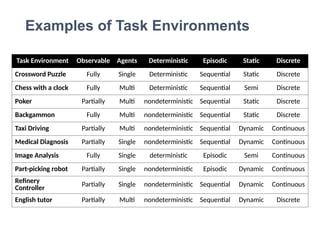
Examples of Task Environments
Task Environment Observable Agents Deterministic Episodic Static Discrete
Crossword Puzzle Fully Single Deterministic Sequential Static Discrete
Chess with a clock Fully Multi Deterministic Sequential Semi Discrete
Poker Partially Multi nondeterministic Sequential Static Discrete
Backgammon Fully Multi nondeterministic Sequential Static Discrete
Taxi Driving Partially Multi nondeterministic Sequential Dynamic Continuous
Medical Diagnosis Partially Single nondeterministic Sequential Dynamic Continuous
Image Analysis Fully Single deterministic Episodic Semi Continuous
Part-picking robot Partially Single nondeterministic Episodic Dynamic Continuous
Refinery
Controller
Partially Single nondeterministic Sequential Dynamic Continuous
English tutor Partially Multi nondeterministic Sequential Dynamic Discrete

Lecture 3 - Properties of Task Environment.pptx

  • 1.
    CS-370: Artificial Intelligence Lecture# 4: Properties of Environment
  • 2.
    Recap • Concept ofRationality • Percept, Percept Sequence • Rational Agent: concerned with consequence of agent’s action • Difference between Rationality and Omniscience • Risks of AI • Benefits of AI
  • 3.
    Properties of Environment Whydo we study range of task environments? Because, • Categorization of task environment • Agent Design How can we categorize them? • Fully Observable vs. Partially Observable • Single-Agent vs. Multi-Agent • Deterministic vs. non-deterministic • Episodic vs. Sequential • Static vs. Dynamic • Discrete vs. Continuous • Known vs. Unknown
  • 4.
    Fully Observable vs.Partially Observable • If an agent’s sensors give it access to the complete state of the environment at each point in time => Fully observable • Sensors detect all aspects that are relevant to the choice of action which depends on the performance measure. • Do not need to maintain any internal state to keep track of the world. • If an agent’s sensors do not give it access to the complete state of the environment because of noisy and inaccurate sensors or because parts of the state are simply missing from the sensor data. • Vacuum agent with only local dirt sensor cannot tell whether there is dirt in other squares. • An automated taxi agent cannot see what other drivers are thinking.
  • 5.
    Single-Agent vs. Multi-Agent Selfexplanatory • An agent solving a crossword puzzle by itself is in single agent environment • An agent playing chess is in a two-agent environment. • Automated Taxi Agent Example • Does Taxi, agent ‘A’, have to treat an object (vehicle) as agent ‘B’? • The key distinction is whether B’s behavior is best described as maximizing a performance measure whose value depends on agent A’s behavior. • Chess Example => Competitive Multi-agent Environment • Taxi Example => Partially Cooperative Multi-agent Environment • Agent-design problems in multi-agent environments.
  • 6.
    Deterministic vs. Nondeterministic •If the next state of the environment is completely determined by the current state and the action executed by an agent • If the next state of the environment is not completely/partially determined. • Most real-life situations are so complex that it is impossible to keep track of all the unobserved aspects, they are treated as nondeterministic. • Taxi driving is nondeterministic. • Vacuum Agent example environment is deterministic. • Difference between stochastic vs. nondeterministic • A model of the environment is stochastic if it explicitly deals with probabilities (e.g., “there is a 25% chance of rain tomorrow”) and nondeterministic if the possibilities are listed without being quantified (e.g., “there is a chance of rain tomorrow”)
  • 7.
    Episodic vs. Sequential •The agent’s experience is divided into episodes. In each episodes, the agent receives a percept and then performs a single action. The next episode does not depend on the action taken on the previous episodes. • In sequential environments, the current decision could affect all future decisions. • An agent that has to spot defective parts on an assembly line bases each decision on the current part, regardless of previous decisions. • Chess and Taxi examples, both are sequential: short term actions can have long term consequences. • Episodic environments are much simpler. Agent does not need to think ahead
  • 8.
    Static vs. Dynamic •If an environment can change while an agent is deliberating, then the environment is termed as dynamic. • Otherwise, it is a static environment. • Static environments are easy to deal • Dynamic environments are continuously asking the agent what it wants to do if the agent has not decided. • If the environment is static but the performance score of the agent is changing over time, the environment is termed as semi-dynamic. • Chess Example => Semi-dynamic when played with a clock • Taxi Example => Dynamic • Crossword Puzzle => Static
  • 9.
    Discrete vs. Continuous •The continuous/discrete distinction applies to the state of the environment, to the way time is handled, and to the percepts and actions of the agents. • Chess => Discrete (finite states, discrete percepts and actions) • Taxi driving => Continuous (Why??) • Continuous sequence, speed, time, location of the taxi • Actions: steering, braking, acceleration • Percepts: cameras (can be treated as discrete but normally continuous feed with varying intensity and locations)
  • 10.
    Known vs. Unknown Thisdistinction refers not the environment itself but to the agent's state of knowledge about the “laws of physics” of the environment. • It is a known environment if the outcomes (or outcome probabilities of the environment is nondeterministic) for all actions are given. • If the environment is unknown, then the agent must learn how it works in order to make good decisions. • Not similar to fully observable vs. partially observable • Known environment can be partially observable => solitaire game • Unknown environment can be fully observable => in a new video game, the screen show the entire game state, but you still don’t know what the buttons until you try them.
  • 11.
    Examples of TaskEnvironments Task Environment Observable Agents Deterministic Episodic Static Discrete Crossword Puzzle Fully Single Deterministic Sequential Static Discrete Chess with a clock Fully Multi Deterministic Sequential Semi Discrete Poker Partially Multi nondeterministic Sequential Static Discrete Backgammon Fully Multi nondeterministic Sequential Static Discrete Taxi Driving Partially Multi nondeterministic Sequential Dynamic Continuous Medical Diagnosis Partially Single nondeterministic Sequential Dynamic Continuous Image Analysis Fully Single deterministic Episodic Semi Continuous Part-picking robot Partially Single nondeterministic Episodic Dynamic Continuous Refinery Controller Partially Single nondeterministic Sequential Dynamic Continuous English tutor Partially Multi nondeterministic Sequential Dynamic Discrete