Increase Your Profits With
Management Accounting
Dennis L. Thompson, CPA, CFE
206-390-9432
www.dlthompsoncpa.com
What is Financial Accounting
• Production of Financial Statements
– Income Statement
– Balance Sheet
• Bookkeeping
• Used for Tax Returns
• Designed for External Audience
– Bankers
– Tax Collectors
– Creditors and Investors
• Backword Looking
What Is Management Accounting
• Analysis of Costs - Breakeven
• Projection of Cash Flows
• Budgets
• Ratio Analysis
• Designed for Internal Audience
• Forward Looking
• The Information comes from your
Accounting System and Reports
How Can Management
Accounting Increase Profits?
• What Products/Services Most Profitable?
• Who are Best Customers?
• Are You Generating Cash on Operations?
• Are You Having Cash Flow Problems?
• Are Your Margins Shrinking?
Financial Statements-Compass
For Your Business
•Ultimate Goal of Accounting System
•Best Friend or Worst Enemy
•Tells You Where Your Company
– Has Been
– Where It Is Now
– Where It Is Going
Financial Statements-Compass
For Your Business
• Think of Your Business as a Small Plane
• Think of Your Accounting System as an
Instrument Panel
• Two Potential Problems
– Your Accounting Info is Wrong
– You Don’t Use Your Accounting Info
Categories of Financial
Statements
• Income Statement
– Where You Have Been
• Balance Sheet
– Where You Are Now
• Cash Flow Projection & Budgets
– Where You Are Going
Profit & Loss
• Measures Business Activity Over a Period
of Time
• Income & Expense Accounts Are
Temporary & Closed to Retained Earnings
• Expenses Can Be Classified As Variable or
Fixed
• Most Useful If Compared to Different
Periods
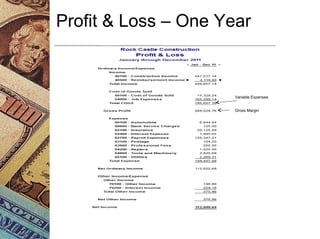
Profit & Loss – One Year
Variable Expenses
Gross Margin
Analysis of Costs - Breakeven
• Sales Price Per Unit or Service
– How much Gross Income per product or
service.
• Variable Cost Per Unit or Service
– What are the Directs Costs associated
with the product or service
• Fixed Costs (Overhead)
– Costs that need to be paid whether you
make a Sale or not, e.g. Rent, Insurance
Breakeven - Example
• Sales Price Per Unit $10
• Variable Cost Per Unit 7
• Contribution Margin Per Unit $3
• Fixed Costs $15,000
• Contribution Margin Ratio
– $3/$10 = 30%
• Sales to Breakeven = Fixed Cost/CM Ratio
• $15,000/30% = $50,000
• $50,000 - $35,000-$15,000 = $0
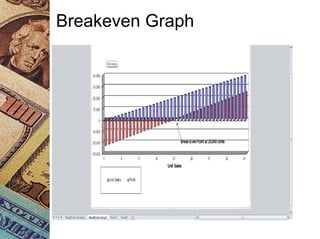
Breakeven Graph
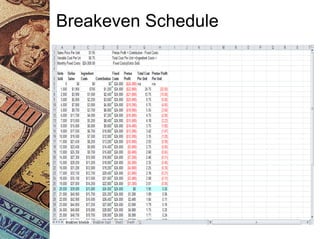
Breakeven Schedule
Never Run Out of Cash
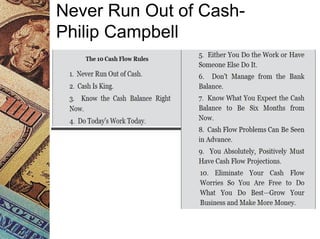
Never Run Out of Cash-
Philip Campbell
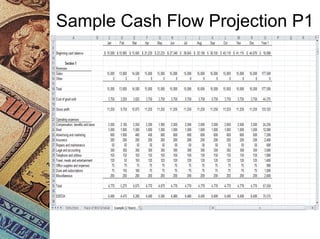
Sample Cash Flow Projection P1
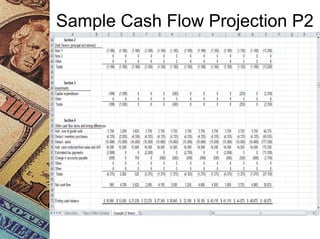
Sample Cash Flow Projection P2
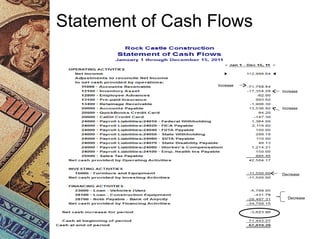
Statement of Cash Flows
Increase
Increase
Increase
Decrease
Decrease
Management Accounting
Reports
• Sales By Customers
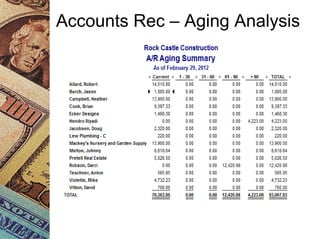
• A/R – Aging Analysis
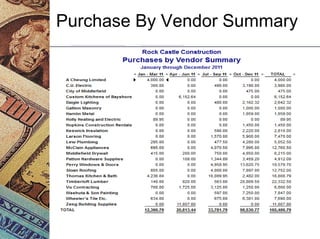
• Purchases By Vendor
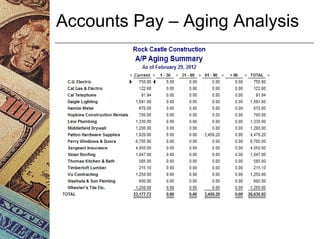
• A/P – Aging Analysis
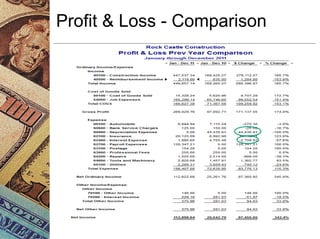
• Profit & Loss – Comparison
• Balance Sheet - Comparison
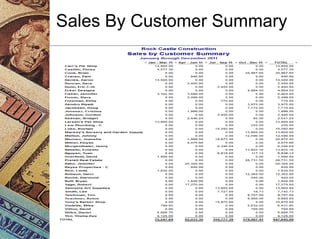
Sales By Customer Summary
Accounts Rec – Aging Analysis
Purchase By Vendor Summary
Accounts Pay – Aging Analysis
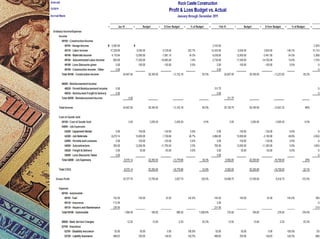
Profit & Loss - Comparison
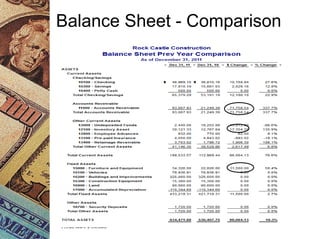
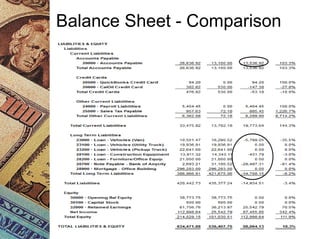
Balance Sheet - Comparison
Budgets
• Why Budget?
– Forces you to think strategically about
your business and goals
– Can help you anticipate problems
– Can help detect Fraud
– Sets Expectations for Employees
What is Ratio Analysis
• Comparing different line items of the
Balance Sheet and Income Statement to
each other.
• For example, Current Ratio = Current
Assets/Current Liablilities
Ratio Analysis – Why Care
• Banks use Ratio Analysis in deciding to
extend Credit
• Ratio Analysis can serve as an Early
Warning System for your company
• It is useful to compare your Ratios to
Industry Standards
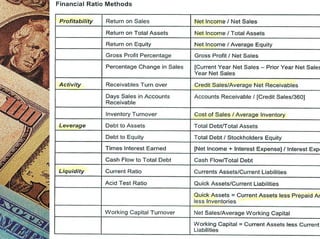
Ratio Analysis - Categories
• Profitability – e.g. Return on Equity
• Activity – e.g. A/R Turnover
• Leverage – e.g. Debt to Equity
• Liquidity – e.g. Current Ratio
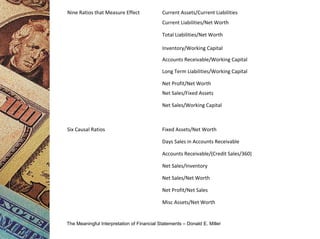
Nine Ratios that Measure Effect Current Assets/Current Liabilities
Current Liabilities/Net Worth
Total Liabilities/Net Worth
Inventory/Working Capital
Accounts Receivable/Working Capital
Long Term Liabilities/Working Capital
Net Profit/Net Worth
Net Sales/Fixed Assets
Net Sales/Working Capital
Six Causal Ratios Fixed Assets/Net Worth
Days Sales in Accounts Receivable
Accounts Receivable/(Credit Sales/360)
Net Sales/Inventory
Net Sales/Net Worth
Net Profit/Net Sales
Misc Assets/Net Worth
The Meaningful Interpretation of Financial Statements – Donald E. Miller
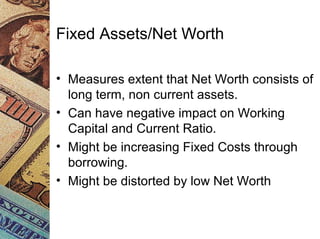
Fixed Assets/Net Worth
• Measures extent that Net Worth consists of
long term, non current assets.
• Can have negative impact on Working
Capital and Current Ratio.
• Might be increasing Fixed Costs through
borrowing.
• Might be distorted by low Net Worth
Accounts Receivable/(Credit
Sales/360)- Collection Period
• Measures efficiency of Company receivable
collections.
• Early warning system for delinquent
accounts.
• Important to measure against Industry
competitors.
• Need to subtract cash sales to arrive at net
Credit Sales.
• Low number can be indicative of restrictive
Credit Policy, thus reducing profit.
Net Sales/Inventory=Number of
Times
• Measures how quickly Inventory is turning
over.
• Low turnover indicates potential writeoffs.
• Also could indicate potential shrinkage.
• Could adversely impact Cash Flow.
• However, with Inventory management,
need to seek a balance of too much and
not enough.
Net Sales/Net Worth
• Measures extent Company’s sales are
supported by invested capital.
• High ratio can mean that Company is
supporting sales through debt, i.e., Fixed
Costs.
• Can negatively impact Break-Even point.
• Can increase chances of Company failure
because of Fixed Costs.
• Over emphasis on sales can lead to selling
to marginal customers.
Net Profit/Net Sales
• Impacts all the other ratios.
• Profits add to Net Worth
• Losses increase the need for Long Term
Borrowing, which can impact Working
Capital.
• Losses threaten Company’s ability to
survive.
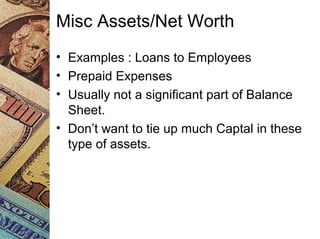
Misc Assets/Net Worth
• Examples : Loans to Employees
• Prepaid Expenses
• Usually not a significant part of Balance
Sheet.
• Don’t want to tie up much Captal in these
type of assets.
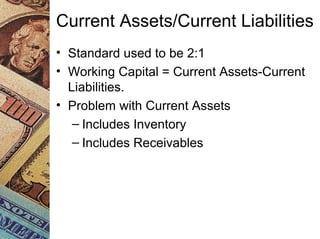
Current Assets/Current Liabilities
• Standard used to be 2:1
• Working Capital = Current Assets-Current
Liabilities.
• Problem with Current Assets
– Includes Inventory
– Includes Receivables
• Understanding Cost Structure and
Breakeven Analysis can help you manage
your business better.
• Cash Flow Projections can help you avoid
running out of cash and having to shut
down your business
• Budgeting forces you to plan and anticipate
problems
Summary
Summary
• Financial Ratio Analysis can serve as an
early warning system.
• Ratio Analysis assumes that Accounting
information is accurate.
• Improve your Company’s chances for
improved Profitability or even Survival by
conducting Ratio Analysis.
• Especially important to compare your
Company to Industry Standard Ratios.

Management accounting

  • 1.
    Increase Your ProfitsWith Management Accounting Dennis L. Thompson, CPA, CFE 206-390-9432 www.dlthompsoncpa.com
  • 2.
    What is FinancialAccounting • Production of Financial Statements – Income Statement – Balance Sheet • Bookkeeping • Used for Tax Returns • Designed for External Audience – Bankers – Tax Collectors – Creditors and Investors • Backword Looking
  • 3.
    What Is ManagementAccounting • Analysis of Costs - Breakeven • Projection of Cash Flows • Budgets • Ratio Analysis • Designed for Internal Audience • Forward Looking • The Information comes from your Accounting System and Reports
  • 4.
    How Can Management AccountingIncrease Profits? • What Products/Services Most Profitable? • Who are Best Customers? • Are You Generating Cash on Operations? • Are You Having Cash Flow Problems? • Are Your Margins Shrinking?
  • 5.
    Financial Statements-Compass For YourBusiness •Ultimate Goal of Accounting System •Best Friend or Worst Enemy •Tells You Where Your Company – Has Been – Where It Is Now – Where It Is Going
  • 6.
    Financial Statements-Compass For YourBusiness • Think of Your Business as a Small Plane • Think of Your Accounting System as an Instrument Panel • Two Potential Problems – Your Accounting Info is Wrong – You Don’t Use Your Accounting Info
  • 7.
    Categories of Financial Statements •Income Statement – Where You Have Been • Balance Sheet – Where You Are Now • Cash Flow Projection & Budgets – Where You Are Going
  • 8.
    Profit & Loss •Measures Business Activity Over a Period of Time • Income & Expense Accounts Are Temporary & Closed to Retained Earnings • Expenses Can Be Classified As Variable or Fixed • Most Useful If Compared to Different Periods
  • 9.
    Profit & Loss– One Year Variable Expenses Gross Margin
  • 10.
    Analysis of Costs- Breakeven • Sales Price Per Unit or Service – How much Gross Income per product or service. • Variable Cost Per Unit or Service – What are the Directs Costs associated with the product or service • Fixed Costs (Overhead) – Costs that need to be paid whether you make a Sale or not, e.g. Rent, Insurance
  • 11.
    Breakeven - Example •Sales Price Per Unit $10 • Variable Cost Per Unit 7 • Contribution Margin Per Unit $3 • Fixed Costs $15,000 • Contribution Margin Ratio – $3/$10 = 30% • Sales to Breakeven = Fixed Cost/CM Ratio • $15,000/30% = $50,000 • $50,000 - $35,000-$15,000 = $0
  • 12.
  • 13.
  • 14.
  • 15.
    Never Run Outof Cash- Philip Campbell
  • 16.
    Sample Cash FlowProjection P1
  • 17.
    Sample Cash FlowProjection P2
  • 18.
    Statement of CashFlows Increase Increase Increase Decrease Decrease
  • 19.
    Management Accounting Reports • SalesBy Customers • A/R – Aging Analysis • Purchases By Vendor • A/P – Aging Analysis • Profit & Loss – Comparison • Balance Sheet - Comparison
  • 20.
  • 21.
    Accounts Rec –Aging Analysis
  • 22.
  • 23.
    Accounts Pay –Aging Analysis
  • 24.
    Profit & Loss- Comparison
  • 25.
    Balance Sheet -Comparison
  • 26.
    Balance Sheet -Comparison
  • 27.
    Budgets • Why Budget? –Forces you to think strategically about your business and goals – Can help you anticipate problems – Can help detect Fraud – Sets Expectations for Employees
  • 29.
    What is RatioAnalysis • Comparing different line items of the Balance Sheet and Income Statement to each other. • For example, Current Ratio = Current Assets/Current Liablilities
  • 30.
    Ratio Analysis –Why Care • Banks use Ratio Analysis in deciding to extend Credit • Ratio Analysis can serve as an Early Warning System for your company • It is useful to compare your Ratios to Industry Standards
  • 31.
    Ratio Analysis -Categories • Profitability – e.g. Return on Equity • Activity – e.g. A/R Turnover • Leverage – e.g. Debt to Equity • Liquidity – e.g. Current Ratio
  • 33.
    Nine Ratios thatMeasure Effect Current Assets/Current Liabilities Current Liabilities/Net Worth Total Liabilities/Net Worth Inventory/Working Capital Accounts Receivable/Working Capital Long Term Liabilities/Working Capital Net Profit/Net Worth Net Sales/Fixed Assets Net Sales/Working Capital Six Causal Ratios Fixed Assets/Net Worth Days Sales in Accounts Receivable Accounts Receivable/(Credit Sales/360) Net Sales/Inventory Net Sales/Net Worth Net Profit/Net Sales Misc Assets/Net Worth The Meaningful Interpretation of Financial Statements – Donald E. Miller
  • 34.
    Fixed Assets/Net Worth •Measures extent that Net Worth consists of long term, non current assets. • Can have negative impact on Working Capital and Current Ratio. • Might be increasing Fixed Costs through borrowing. • Might be distorted by low Net Worth
  • 35.
    Accounts Receivable/(Credit Sales/360)- CollectionPeriod • Measures efficiency of Company receivable collections. • Early warning system for delinquent accounts. • Important to measure against Industry competitors. • Need to subtract cash sales to arrive at net Credit Sales. • Low number can be indicative of restrictive Credit Policy, thus reducing profit.
  • 36.
    Net Sales/Inventory=Number of Times •Measures how quickly Inventory is turning over. • Low turnover indicates potential writeoffs. • Also could indicate potential shrinkage. • Could adversely impact Cash Flow. • However, with Inventory management, need to seek a balance of too much and not enough.
  • 37.
    Net Sales/Net Worth •Measures extent Company’s sales are supported by invested capital. • High ratio can mean that Company is supporting sales through debt, i.e., Fixed Costs. • Can negatively impact Break-Even point. • Can increase chances of Company failure because of Fixed Costs. • Over emphasis on sales can lead to selling to marginal customers.
  • 38.
    Net Profit/Net Sales •Impacts all the other ratios. • Profits add to Net Worth • Losses increase the need for Long Term Borrowing, which can impact Working Capital. • Losses threaten Company’s ability to survive.
  • 39.
    Misc Assets/Net Worth •Examples : Loans to Employees • Prepaid Expenses • Usually not a significant part of Balance Sheet. • Don’t want to tie up much Captal in these type of assets.
  • 40.
    Current Assets/Current Liabilities •Standard used to be 2:1 • Working Capital = Current Assets-Current Liabilities. • Problem with Current Assets – Includes Inventory – Includes Receivables
  • 41.
    • Understanding CostStructure and Breakeven Analysis can help you manage your business better. • Cash Flow Projections can help you avoid running out of cash and having to shut down your business • Budgeting forces you to plan and anticipate problems Summary
  • 42.
    Summary • Financial RatioAnalysis can serve as an early warning system. • Ratio Analysis assumes that Accounting information is accurate. • Improve your Company’s chances for improved Profitability or even Survival by conducting Ratio Analysis. • Especially important to compare your Company to Industry Standard Ratios.