Pronunciation
of Past Simple
regular verbs
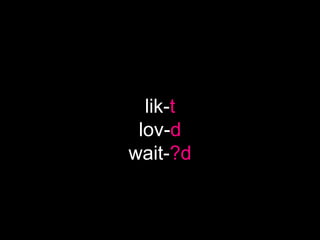
liked
loved
waited
lik-t
lov-d
wait-?d
voiceless and voiced
consonants
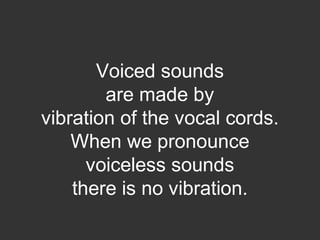
Voiced sounds
are made by
vibration of the vocal cords.
When we pronounce
voiceless sounds
there is no vibration.
RULE
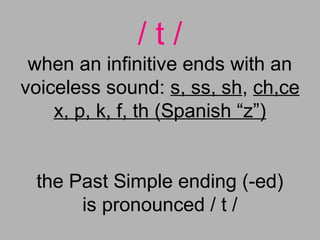
/ t /
when an infinitive ends with an
voiceless sound: s, ss, sh, ch,ce
x, p, k, f, th (Spanish “z”)
the Past Simple ending (-ed)
is pronounced / t /
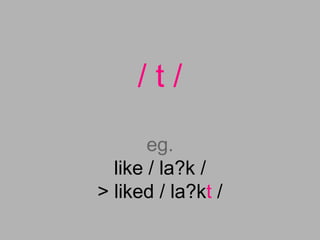
/ t /
eg.
like / la?k /
> liked / la?kt /
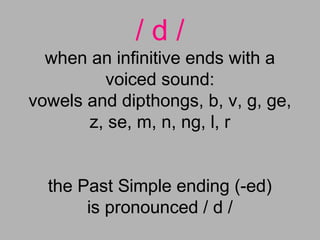
/ d /
when an infinitive ends with a
voiced sound:
vowels and dipthongs, b, v, g, ge,
z, se, m, n, ng, l, r
the Past Simple ending (-ed)
is pronounced / d /
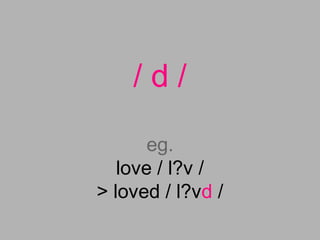
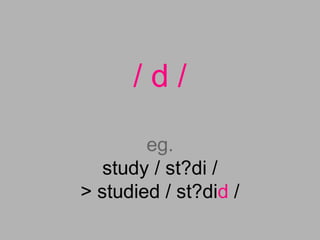
/ d /
eg.
love / l?v /
> loved / l?vd /
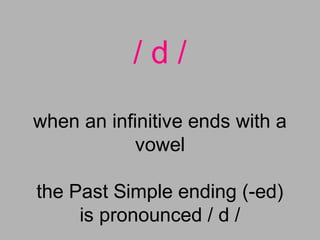
/ d /
when an infinitive ends with a
vowel
the Past Simple ending (-ed)
is pronounced / d /
/ d /
eg.
study / st?di /
> studied / st?did /
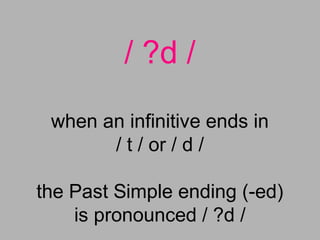
/ ?d /
when an infinitive ends in
/ t / or / d /
the Past Simple ending (-ed)
is pronounced / ?d /
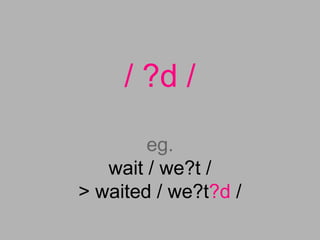
/ ?d /
eg.
wait / we?t /
> waited / we?t?d /
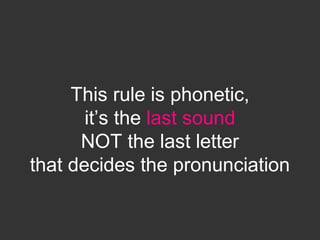
This rule is phonetic,
it’s the last sound
NOT the last letter
that decides the pronunciation
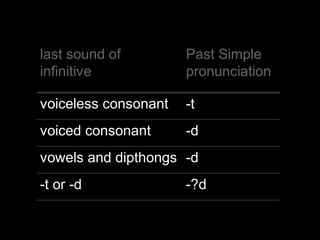
last sound of
infinitive
Past Simple
pronunciation
voiceless consonant -t
voiced consonant -d
vowels and dipthongs -d
-t or -d -?d
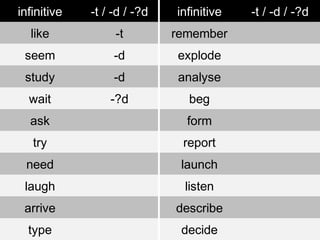
exercise
infinitive -t / -d / -?d infinitive -t / -d / -?d
like -t remember
seem -d explode
study -d analyse
wait -?d beg
ask form
try report
need launch
laugh listen
arrive describe
type decide
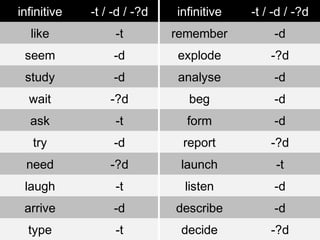
infinitive -t / -d / -?d infinitive -t / -d / -?d
like -t remember -d
seem -d explode -?d
study -d analyse -d
wait -?d beg -d
ask -t form -d
try -d report -?d
need -?d launch -t
laugh -t listen -d
arrive -d describe -d
type -t decide -?d

Pronunciation ed

  • 1.
  • 2.
  • 3.
  • 4.
  • 5.
    Voiced sounds are madeby vibration of the vocal cords. When we pronounce voiceless sounds there is no vibration.
  • 6.
  • 7.
    / t / whenan infinitive ends with an voiceless sound: s, ss, sh, ch,ce x, p, k, f, th (Spanish “z”) the Past Simple ending (-ed) is pronounced / t /
  • 8.
    / t / eg. like/ la?k / > liked / la?kt /
  • 9.
    / d / whenan infinitive ends with a voiced sound: vowels and dipthongs, b, v, g, ge, z, se, m, n, ng, l, r the Past Simple ending (-ed) is pronounced / d /
  • 10.
    / d / eg. love/ l?v / > loved / l?vd /
  • 11.
    / d / whenan infinitive ends with a vowel the Past Simple ending (-ed) is pronounced / d /
  • 12.
    / d / eg. study/ st?di / > studied / st?did /
  • 13.
    / ?d / whenan infinitive ends in / t / or / d / the Past Simple ending (-ed) is pronounced / ?d /
  • 14.
    / ?d / eg. wait/ we?t / > waited / we?t?d /
  • 15.
    This rule isphonetic, it’s the last sound NOT the last letter that decides the pronunciation
  • 16.
    last sound of infinitive PastSimple pronunciation voiceless consonant -t voiced consonant -d vowels and dipthongs -d -t or -d -?d
  • 17.
  • 18.
    infinitive -t /-d / -?d infinitive -t / -d / -?d like -t remember seem -d explode study -d analyse wait -?d beg ask form try report need launch laugh listen arrive describe type decide
  • 19.
    infinitive -t /-d / -?d infinitive -t / -d / -?d like -t remember -d seem -d explode -?d study -d analyse -d wait -?d beg -d ask -t form -d try -d report -?d need -?d launch -t laugh -t listen -d arrive -d describe -d type -t decide -?d