CRITICAL PROCESS
Thinking Systematically
OBJECTIVES
• Define the critical process
• List the steps in the process
• Develop tools to effectively evaluate
information
• Name important logical fallacies
• Practice the process
Rev 5/2014Critical Thinking-Process
2
DEFINITION
• Critical analysis is the objective assessment
of something
• Papers
• Books
• Movies
• Work place policies
• Scientific investigations
• Sports plays (arm chair quarter backing)
Rev 5/2014Critical Thinking-Process
3
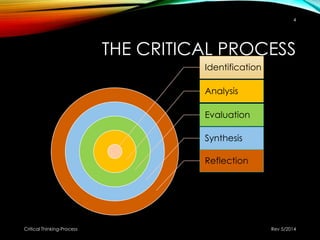
THE CRITICAL PROCESS
Identification
Analysis
Evaluation
Synthesis
Reflection
Rev 5/2014Critical Thinking-Process
4
IDENTIFICATION
Who, What, When and Where
Rev 5/2014Critical Thinking-Process 5
IDENTIFICATION
Who
created it?
What is it?
When was
it created?
Why was it
created?
• Abu Simbel (1224 BC) –
Temple built by Ramesses II
at the border of Egypt and
Nubia
Rev 5/2014Critical Thinking-Process
6
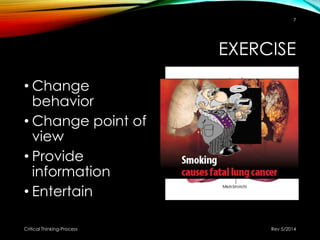
EXERCISE
• Change
behavior
• Change point of
view
• Provide
information
• Entertain
Rev 5/2014Critical Thinking-Process
7
ANALYSIS
Picking it Apart
Rev 5/2014Critical Thinking-Process 8
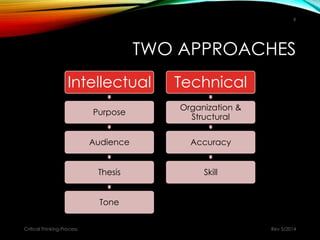
TWO APPROACHES
Rev 5/2014Critical Thinking-Process
9
Intellectual
Purpose
Audience
Thesis
Tone
Technical
Organization &
Structural
Accuracy
Skill
WHO IS THE AUDIENCE?
• Who is intended to
use it?
• Is it geared toward a
specific group of
people?
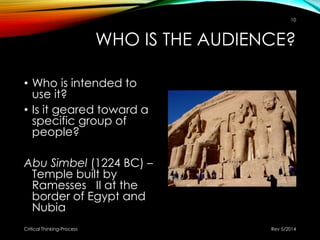
Abu Simbel (1224 BC) –
Temple built by
Ramesses II at the
border of Egypt and
Nubia
Rev 5/2014Critical Thinking-Process
10
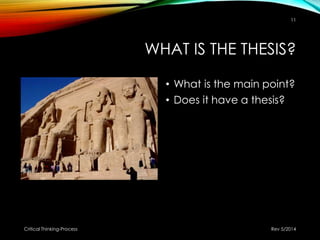
WHAT IS THE THESIS?
• What is the main point?
• Does it have a thesis?
Rev 5/2014Critical Thinking-Process
11
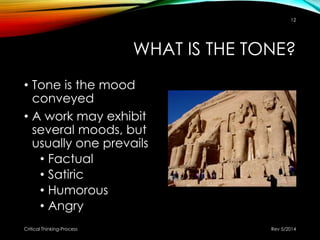
WHAT IS THE TONE?
• Tone is the mood
conveyed
• A work may exhibit
several moods, but
usually one prevails
• Factual
• Satiric
• Humorous
• Angry
Rev 5/2014Critical Thinking-Process
12
WHAT IS THE PURPOSE?
• Does it meet the
purpose?
Rev 5/2014Critical Thinking-Process
13
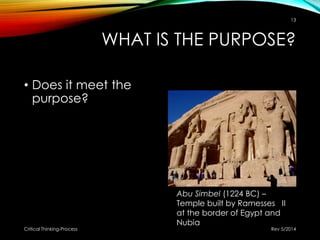
Abu Simbel (1224 BC) –
Temple built by Ramesses II
at the border of Egypt and
Nubia
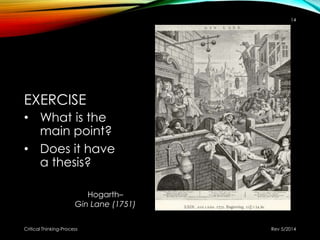
EXERCISE
• What is the
main point?
• Does it have
a thesis?
Rev 5/2014Critical Thinking-Process
14
Hogarth–
Gin Lane (1751)
EVALUATION
Testing Veracity
Rev 5/2014Critical Thinking-Process 15
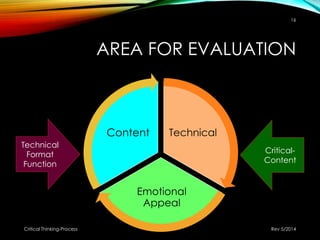
AREA FOR EVALUATION
Rev 5/2014Critical Thinking-Process
16
Technical
Emotional
Appeal
Content
Technical
Format
Function
Critical-
Content
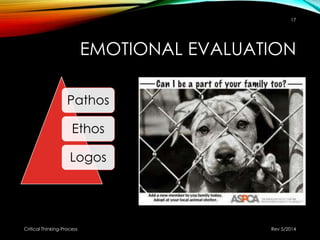
EMOTIONAL EVALUATION
Pathos
Ethos
Logos
Rev 5/2014Critical Thinking-Process
17
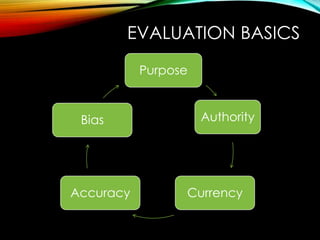
EVALUATION BASICS
Purpose
Authority
CurrencyAccuracy
Bias
PURPOSE
• Does the evidence match the purpose?
• Is there a hidden agenda?
Rev 5/2014Critical Thinking-Process
19
AUTHORITY
• Who wrote it?
• Are they qualified?
• What are the credentials?
• Do a Google search
Rev 5/2014Critical Thinking-Process
20
CURRENCY
• Does the date affect the relevance?
Rev 5/2014Critical Thinking-Process
21
ACCURACY
• Is the source objective
• Does it have bias
• All sites have a bias
• Is this information verifiable
Rev 5/2014Critical Thinking-Process
22
WHAT IS THE SUPPORTING
EVIDENCE?
• Does the evidence relate to the thesis?
• Is the evidence accurate?
• Is the evidence slanted?
• Is the evidence complete?
• Is similar evidence found in other sources?
Rev 5/2014Critical Thinking-Process
23
BIAS
• Is there a bias?
• What are the biases?
• Does the bias affect the accuracy?
Rev 5/2014Critical Thinking-Process
24
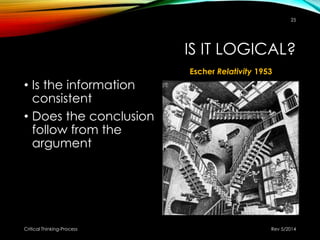
IS IT LOGICAL?
• Is the information
consistent
• Does the conclusion
follow from the
argument
Rev 5/2014Critical Thinking-Process
25
Escher Relativity 1953
FALLACIES
Errors in Logic
Rev 5/2014Critical Thinking-Process 26
FALLACIES
• Fallacies are errors
in reasoning
• They fall into several
main groups
• Faulty premise
• Hasty
Generalization
• Missing the point
• Slippery slope
• Appeal to _____
• Straw man
• Diversions
Rev 5/2014Critical Thinking-Process
27
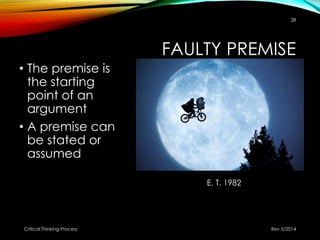
FAULTY PREMISE
• The premise is
the starting
point of an
argument
• A premise can
be stated or
assumed
Rev 5/2014Critical Thinking-Process
28
E. T. 1982
HASTY GENERALIZATION
• This is when people jump
to a conclusion which is
not supported by
evidence
• This can involve
stereotyping or bias
• Sam is riding her bike in
her home town in Maine,
minding her own
business. A station wagon
comes up behind her
and the driver starts
beeping his horn and
then tries to force her off
the road. As he goes by,
the driver yells "get on the
sidewalk where you
belong!" Sam sees that
the car has Ohio plates
and concludes that all
Ohio drivers are jerks.
Rev 5/2014Critical Thinking-Process
29
MISSING THE POINT
• Is discussing an issue
which has nothing to
do with the topic
Smoking is bad for your
health. My brother,
who smokes three
packs of cigarettes a
day, has been
divorced five times.
He has a terrible
problem keeping
committed. So
smoking is bad for his
marriage.
Rev 5/2014Critical Thinking-Process
30
APPEAL TO IGNORANCE
• Since the
conclusion is not
conclusive,
therefore it is not
true
Just because no one
has seen the Loch
Ness Monster does
not mean it doesn’t
exist. So any one
who doubts its
existence is hasty in
saying it does not
exist.
Rev 5/2014Critical Thinking-Process
31
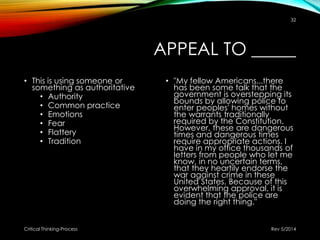
APPEAL TO _____
• This is using someone or
something as authoritative
• Authority
• Common practice
• Emotions
• Fear
• Flattery
• Tradition
• "My fellow Americans...there
has been some talk that the
government is overstepping its
bounds by allowing police to
enter peoples' homes without
the warrants traditionally
required by the Constitution.
However, these are dangerous
times and dangerous times
require appropriate actions. I
have in my office thousands of
letters from people who let me
know, in no uncertain terms,
that they heartily endorse the
war against crime in these
United States. Because of this
overwhelming approval, it is
evident that the police are
doing the right thing."
Rev 5/2014Critical Thinking-Process
32
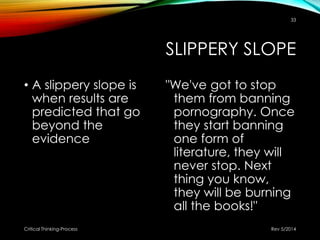
SLIPPERY SLOPE
• A slippery slope is
when results are
predicted that go
beyond the
evidence
"We've got to stop
them from banning
pornography. Once
they start banning
one form of
literature, they will
never stop. Next
thing you know,
they will be burning
all the books!"
Rev 5/2014Critical Thinking-Process
33
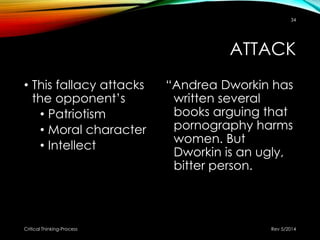
ATTACK
• This fallacy attacks
the opponent’s
• Patriotism
• Moral character
• Intellect
“Andrea Dworkin has
written several
books arguing that
pornography harms
women. But
Dworkin is an ugly,
bitter person.
Rev 5/2014Critical Thinking-Process
34
STRAW MAN
• Uses a weak version of the
opponents opinion
• Bill and Jill are arguing
about cleaning out their
closets:
Jill: "We should clean out
the closets. They are getting
a bit messy."
Bill: "Why, we just went
through those closets last
year. Do we have to clean
them out everyday?"
Jill: "I never said anything
about cleaning them out
every day. You just want too
keep all your junk forever,
which is just ridiculous."
Rev 5/2014Critical Thinking-Process
35
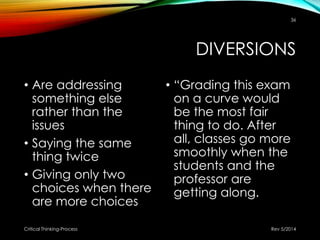
DIVERSIONS
• Are addressing
something else
rather than the
issues
• Saying the same
thing twice
• Giving only two
choices when there
are more choices
• “Grading this exam
on a curve would
be the most fair
thing to do. After
all, classes go more
smoothly when the
students and the
professor are
getting along.
Rev 5/2014Critical Thinking-Process
36
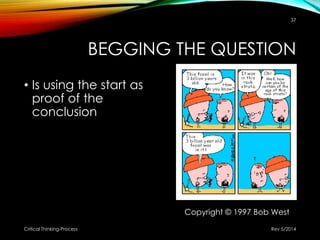
BEGGING THE QUESTION
• Is using the start as
proof of the
conclusion
Rev 5/2014Critical Thinking-Process
37
Copyright © 1997 Bob West
SYNTHESIS
Relationship to Others
Rev 5/2014Critical Thinking-Process 38
ELEMENTS
• Gather all information
• Look at the relationships of information
• Internal
• External
• What do other sources say?
• Are there contradictions?
Rev 5/2014Critical Thinking-Process
39
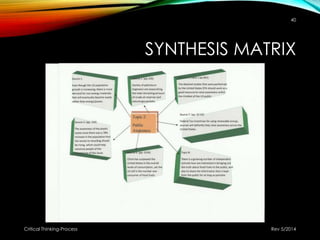
SYNTHESIS MATRIX
Rev 5/2014Critical Thinking-Process
40
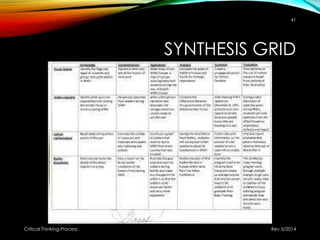
SYNTHESIS GRID
Rev 5/2014Critical Thinking-Process
41
REFLECTION
Relationship to Me
Rev 5/2014Critical Thinking-Process 42
THREE APPROACHES TO
REFLECTION
Mirror
•Self issue
Microscope
•Specific issue
Telescopes
•Global issue
Rev 5/2014Critical Thinking-Process
43
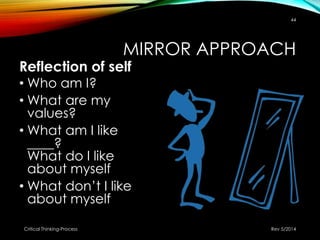
MIRROR APPROACH
Reflection of self
• Who am I?
• What are my
values?
• What am I like
____?
What do I like
about myself
• What don’t I like
about myself
Rev 5/2014Critical Thinking-Process
44
MIRROR EXERCISE
Give me 3 words that describe who you are
1.
2.
3.
Rev 5/2014Critical Thinking-Process
45
These years in silence and reflection made
me stronger and reminded me that
acceptance has to come from within and
that this kind of truth gives me the power to
conquer emotions I didn't even know
existed.
Ricky Martin
Rev 5/2014Critical Thinking-Process
46
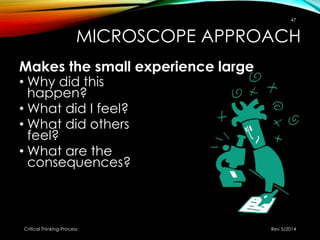
MICROSCOPE APPROACH
Makes the small experience large
• Why did this
happen?
• What did I feel?
• What did others
feel?
• What are the
consequences?
Rev 5/2014Critical Thinking-Process
47
MICROSCOPE EXERCISE
Why is this assignment important?
•
Rev 5/2014Critical Thinking-Process
48
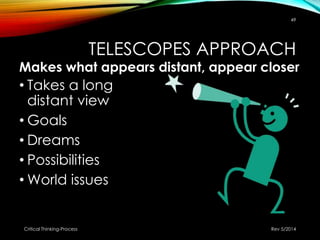
TELESCOPES APPROACH
Makes what appears distant, appear closer
• Takes a long
distant view
• Goals
• Dreams
• Possibilities
• World issues
Rev 5/2014Critical Thinking-Process
49
TELESCOPE EXERCISE
How can I take what I have learned to help others?
•
Rev 5/2014Critical Thinking-Process
50
I believe that our society is merely a
reflection of what is going on inside each
and every one of us.
Seal
Rev 5/2014Critical Thinking-Process
51
INTELLECTUAL
REFLECTION
• Issues • Global warming
• Health care
• Poverty
Rev 5/2014Critical Thinking-Process
52
The saddest aspect of life right now is that
science gathers knowledge faster than
society gathers wisdom.
Isaac Asimov
Rev 5/2014Critical Thinking-Process
53
SOCIETY AND CULTURE
REFLECTION
• Recognize our own
culture and
traditions while
gaining
understanding of
other cultures and
traditions.
• Marriage
• Family
• Faith and politics
Rev 5/2014Critical Thinking-Process
54
VALUE AND ETHICS
REFLECTION
• Opportunities to
clarify and develop
in order to make
informed choices.
• Good person
• Success
• Love
• Death
Rev 5/2014Critical Thinking-Process
55
Life can only be understood backwards; but
it must be lived forwards.
Søren Kierkegaard
Rev 5/2014Critical Thinking-Process
56
SUMMARY
• Critical analysis means thoughtfully
evaluation of opinions
• Look for logical flaws that taint an
argument
• Understand the purpose of the piece
• Evaluate the reasoning, technical,
emotional, and intellectual merits.
Rev 5/2014Critical Thinking-Process
57
RESOURCES
• The Nizkor Project. (2009). Fallacies.
http://www.nizkor.org/features/fallacies/
• University of North Carolina. (2010). Fallacies. The
writing center.
http://www.unc.edu/depts/wcweb/handouts/fallacies.
html
• University of Sussex. (2010). Critical analysis,
argument and opinion. Sussex Language Institute.
http://www.sussex.ac.uk/languages/1-6-8-2-3.html
• Logical Fallacies and the Art of Debate
http://www.csun.edu/~dgw61315/fallacies.html
Rev 5/2014Critical Thinking-Process
58

Critical process

  • 1.
  • 2.
    OBJECTIVES • Define thecritical process • List the steps in the process • Develop tools to effectively evaluate information • Name important logical fallacies • Practice the process Rev 5/2014Critical Thinking-Process 2
  • 3.
    DEFINITION • Critical analysisis the objective assessment of something • Papers • Books • Movies • Work place policies • Scientific investigations • Sports plays (arm chair quarter backing) Rev 5/2014Critical Thinking-Process 3
  • 4.
  • 5.
    IDENTIFICATION Who, What, Whenand Where Rev 5/2014Critical Thinking-Process 5
  • 6.
    IDENTIFICATION Who created it? What isit? When was it created? Why was it created? • Abu Simbel (1224 BC) – Temple built by Ramesses II at the border of Egypt and Nubia Rev 5/2014Critical Thinking-Process 6
  • 7.
    EXERCISE • Change behavior • Changepoint of view • Provide information • Entertain Rev 5/2014Critical Thinking-Process 7
  • 8.
    ANALYSIS Picking it Apart Rev5/2014Critical Thinking-Process 8
  • 9.
    TWO APPROACHES Rev 5/2014CriticalThinking-Process 9 Intellectual Purpose Audience Thesis Tone Technical Organization & Structural Accuracy Skill
  • 10.
    WHO IS THEAUDIENCE? • Who is intended to use it? • Is it geared toward a specific group of people? Abu Simbel (1224 BC) – Temple built by Ramesses II at the border of Egypt and Nubia Rev 5/2014Critical Thinking-Process 10
  • 11.
    WHAT IS THETHESIS? • What is the main point? • Does it have a thesis? Rev 5/2014Critical Thinking-Process 11
  • 12.
    WHAT IS THETONE? • Tone is the mood conveyed • A work may exhibit several moods, but usually one prevails • Factual • Satiric • Humorous • Angry Rev 5/2014Critical Thinking-Process 12
  • 13.
    WHAT IS THEPURPOSE? • Does it meet the purpose? Rev 5/2014Critical Thinking-Process 13 Abu Simbel (1224 BC) – Temple built by Ramesses II at the border of Egypt and Nubia
  • 14.
    EXERCISE • What isthe main point? • Does it have a thesis? Rev 5/2014Critical Thinking-Process 14 Hogarth– Gin Lane (1751)
  • 15.
  • 16.
    AREA FOR EVALUATION Rev5/2014Critical Thinking-Process 16 Technical Emotional Appeal Content Technical Format Function Critical- Content
  • 17.
  • 18.
  • 19.
    PURPOSE • Does theevidence match the purpose? • Is there a hidden agenda? Rev 5/2014Critical Thinking-Process 19
  • 20.
    AUTHORITY • Who wroteit? • Are they qualified? • What are the credentials? • Do a Google search Rev 5/2014Critical Thinking-Process 20
  • 21.
    CURRENCY • Does thedate affect the relevance? Rev 5/2014Critical Thinking-Process 21
  • 22.
    ACCURACY • Is thesource objective • Does it have bias • All sites have a bias • Is this information verifiable Rev 5/2014Critical Thinking-Process 22
  • 23.
    WHAT IS THESUPPORTING EVIDENCE? • Does the evidence relate to the thesis? • Is the evidence accurate? • Is the evidence slanted? • Is the evidence complete? • Is similar evidence found in other sources? Rev 5/2014Critical Thinking-Process 23
  • 24.
    BIAS • Is therea bias? • What are the biases? • Does the bias affect the accuracy? Rev 5/2014Critical Thinking-Process 24
  • 25.
    IS IT LOGICAL? •Is the information consistent • Does the conclusion follow from the argument Rev 5/2014Critical Thinking-Process 25 Escher Relativity 1953
  • 26.
    FALLACIES Errors in Logic Rev5/2014Critical Thinking-Process 26
  • 27.
    FALLACIES • Fallacies areerrors in reasoning • They fall into several main groups • Faulty premise • Hasty Generalization • Missing the point • Slippery slope • Appeal to _____ • Straw man • Diversions Rev 5/2014Critical Thinking-Process 27
  • 28.
    FAULTY PREMISE • Thepremise is the starting point of an argument • A premise can be stated or assumed Rev 5/2014Critical Thinking-Process 28 E. T. 1982
  • 29.
    HASTY GENERALIZATION • Thisis when people jump to a conclusion which is not supported by evidence • This can involve stereotyping or bias • Sam is riding her bike in her home town in Maine, minding her own business. A station wagon comes up behind her and the driver starts beeping his horn and then tries to force her off the road. As he goes by, the driver yells "get on the sidewalk where you belong!" Sam sees that the car has Ohio plates and concludes that all Ohio drivers are jerks. Rev 5/2014Critical Thinking-Process 29
  • 30.
    MISSING THE POINT •Is discussing an issue which has nothing to do with the topic Smoking is bad for your health. My brother, who smokes three packs of cigarettes a day, has been divorced five times. He has a terrible problem keeping committed. So smoking is bad for his marriage. Rev 5/2014Critical Thinking-Process 30
  • 31.
    APPEAL TO IGNORANCE •Since the conclusion is not conclusive, therefore it is not true Just because no one has seen the Loch Ness Monster does not mean it doesn’t exist. So any one who doubts its existence is hasty in saying it does not exist. Rev 5/2014Critical Thinking-Process 31
  • 32.
    APPEAL TO _____ •This is using someone or something as authoritative • Authority • Common practice • Emotions • Fear • Flattery • Tradition • "My fellow Americans...there has been some talk that the government is overstepping its bounds by allowing police to enter peoples' homes without the warrants traditionally required by the Constitution. However, these are dangerous times and dangerous times require appropriate actions. I have in my office thousands of letters from people who let me know, in no uncertain terms, that they heartily endorse the war against crime in these United States. Because of this overwhelming approval, it is evident that the police are doing the right thing." Rev 5/2014Critical Thinking-Process 32
  • 33.
    SLIPPERY SLOPE • Aslippery slope is when results are predicted that go beyond the evidence "We've got to stop them from banning pornography. Once they start banning one form of literature, they will never stop. Next thing you know, they will be burning all the books!" Rev 5/2014Critical Thinking-Process 33
  • 34.
    ATTACK • This fallacyattacks the opponent’s • Patriotism • Moral character • Intellect “Andrea Dworkin has written several books arguing that pornography harms women. But Dworkin is an ugly, bitter person. Rev 5/2014Critical Thinking-Process 34
  • 35.
    STRAW MAN • Usesa weak version of the opponents opinion • Bill and Jill are arguing about cleaning out their closets: Jill: "We should clean out the closets. They are getting a bit messy." Bill: "Why, we just went through those closets last year. Do we have to clean them out everyday?" Jill: "I never said anything about cleaning them out every day. You just want too keep all your junk forever, which is just ridiculous." Rev 5/2014Critical Thinking-Process 35
  • 36.
    DIVERSIONS • Are addressing somethingelse rather than the issues • Saying the same thing twice • Giving only two choices when there are more choices • “Grading this exam on a curve would be the most fair thing to do. After all, classes go more smoothly when the students and the professor are getting along. Rev 5/2014Critical Thinking-Process 36
  • 37.
    BEGGING THE QUESTION •Is using the start as proof of the conclusion Rev 5/2014Critical Thinking-Process 37 Copyright © 1997 Bob West
  • 38.
    SYNTHESIS Relationship to Others Rev5/2014Critical Thinking-Process 38
  • 39.
    ELEMENTS • Gather allinformation • Look at the relationships of information • Internal • External • What do other sources say? • Are there contradictions? Rev 5/2014Critical Thinking-Process 39
  • 40.
  • 41.
  • 42.
    REFLECTION Relationship to Me Rev5/2014Critical Thinking-Process 42
  • 43.
    THREE APPROACHES TO REFLECTION Mirror •Selfissue Microscope •Specific issue Telescopes •Global issue Rev 5/2014Critical Thinking-Process 43
  • 44.
    MIRROR APPROACH Reflection ofself • Who am I? • What are my values? • What am I like ____? What do I like about myself • What don’t I like about myself Rev 5/2014Critical Thinking-Process 44
  • 45.
    MIRROR EXERCISE Give me3 words that describe who you are 1. 2. 3. Rev 5/2014Critical Thinking-Process 45
  • 46.
    These years insilence and reflection made me stronger and reminded me that acceptance has to come from within and that this kind of truth gives me the power to conquer emotions I didn't even know existed. Ricky Martin Rev 5/2014Critical Thinking-Process 46
  • 47.
    MICROSCOPE APPROACH Makes thesmall experience large • Why did this happen? • What did I feel? • What did others feel? • What are the consequences? Rev 5/2014Critical Thinking-Process 47
  • 48.
    MICROSCOPE EXERCISE Why isthis assignment important? • Rev 5/2014Critical Thinking-Process 48
  • 49.
    TELESCOPES APPROACH Makes whatappears distant, appear closer • Takes a long distant view • Goals • Dreams • Possibilities • World issues Rev 5/2014Critical Thinking-Process 49
  • 50.
    TELESCOPE EXERCISE How canI take what I have learned to help others? • Rev 5/2014Critical Thinking-Process 50
  • 51.
    I believe thatour society is merely a reflection of what is going on inside each and every one of us. Seal Rev 5/2014Critical Thinking-Process 51
  • 52.
    INTELLECTUAL REFLECTION • Issues •Global warming • Health care • Poverty Rev 5/2014Critical Thinking-Process 52
  • 53.
    The saddest aspectof life right now is that science gathers knowledge faster than society gathers wisdom. Isaac Asimov Rev 5/2014Critical Thinking-Process 53
  • 54.
    SOCIETY AND CULTURE REFLECTION •Recognize our own culture and traditions while gaining understanding of other cultures and traditions. • Marriage • Family • Faith and politics Rev 5/2014Critical Thinking-Process 54
  • 55.
    VALUE AND ETHICS REFLECTION •Opportunities to clarify and develop in order to make informed choices. • Good person • Success • Love • Death Rev 5/2014Critical Thinking-Process 55
  • 56.
    Life can onlybe understood backwards; but it must be lived forwards. Søren Kierkegaard Rev 5/2014Critical Thinking-Process 56
  • 57.
    SUMMARY • Critical analysismeans thoughtfully evaluation of opinions • Look for logical flaws that taint an argument • Understand the purpose of the piece • Evaluate the reasoning, technical, emotional, and intellectual merits. Rev 5/2014Critical Thinking-Process 57
  • 58.
    RESOURCES • The NizkorProject. (2009). Fallacies. http://www.nizkor.org/features/fallacies/ • University of North Carolina. (2010). Fallacies. The writing center. http://www.unc.edu/depts/wcweb/handouts/fallacies. html • University of Sussex. (2010). Critical analysis, argument and opinion. Sussex Language Institute. http://www.sussex.ac.uk/languages/1-6-8-2-3.html • Logical Fallacies and the Art of Debate http://www.csun.edu/~dgw61315/fallacies.html Rev 5/2014Critical Thinking-Process 58