Group members
 MUREED HUSSAIN 2016-ME-30
 FURQAN NAJMI 2016-ME-31
 ASAD ABBAS 2016-ME-14-33
 JAMSHED SALEEM 2016-ME-14-53
 GUL SHER 2016-ME-27
 MUHAMMAD RASHID NAWAZ 2016-ME-51
 MUHAMMAD AMJAD 2016-ME-41
Topic of the
day
PRONOUN
POINTS OF DISCUSSION
 DEFINATION
 GENDERS OF PRONOUN
 TYPES OF PRONOUN
RULES FOR PERSONAL PRONOUN
 CASES OF PRONOUN
 IMPORTANCE OF PRONOUN
 USES OF PRONOUN
 QUESTIONS/ANSWERS
Pronoun:
 Pronoun is a word that takes place of noun or noun
phrase to avoid repetition of noun.
 The word pronoun is the combination of two words
“pro+noun”. “pro” means “instead of”, and noun
means any person, place and thing.
 Before replacing the noun we should see it’s status.
 Usually nouns are either numbers or genders.
 Numbers can be singular or plural.
 And genders may be male, female, common or
neuter.
Examples:
I, YOU, ME, HE, SHE, IT, WE, ETC.
 Examples:-
 I am a boy.
IN THIS EXAMPLE “I” IS THE PRONOUN
 He is going to school.
IN THIS EXAMPLE “HE” IS THE PRONOUN
 You are my best friend.
“YOU” IS THE PRONOUN
 We are all Muslims.
“WE” IS THE PRONOUN
 Ali has a pen. It is so beautiful.
“IT” IS THE PRONOUN
Genders of Pronoun
1.Masculine gender
2.Feminine gender
3.Common gender
4.Neuter gender
1. Masculine gender
 It denotes pronoun which is used for male gender.
 As Boy, Actor, Asad, etc.
 The pronoun which is used for them is “HE”
 FOR EXAMPLE
I met “Asad”. “He” was going to Lahore.
here “Asad” is replaced by the pronoun “He”
I like Furqan because he is my best friend.
Here “Furqan” is replaced by pronoun “He”
2. Feminine gender:
 It denotes pronoun which is used for female gender.
 As girl, lady, Ayesha, etc.
 The pronoun which is used for them is “She”
 FOR EXAMPLE
I love shumaila, because she is my daughter.
Here “shumaila” is replaced by “She”
I respect Ayesha because she is my elder sister.
in this example “Ayesha” is replaced by “She”
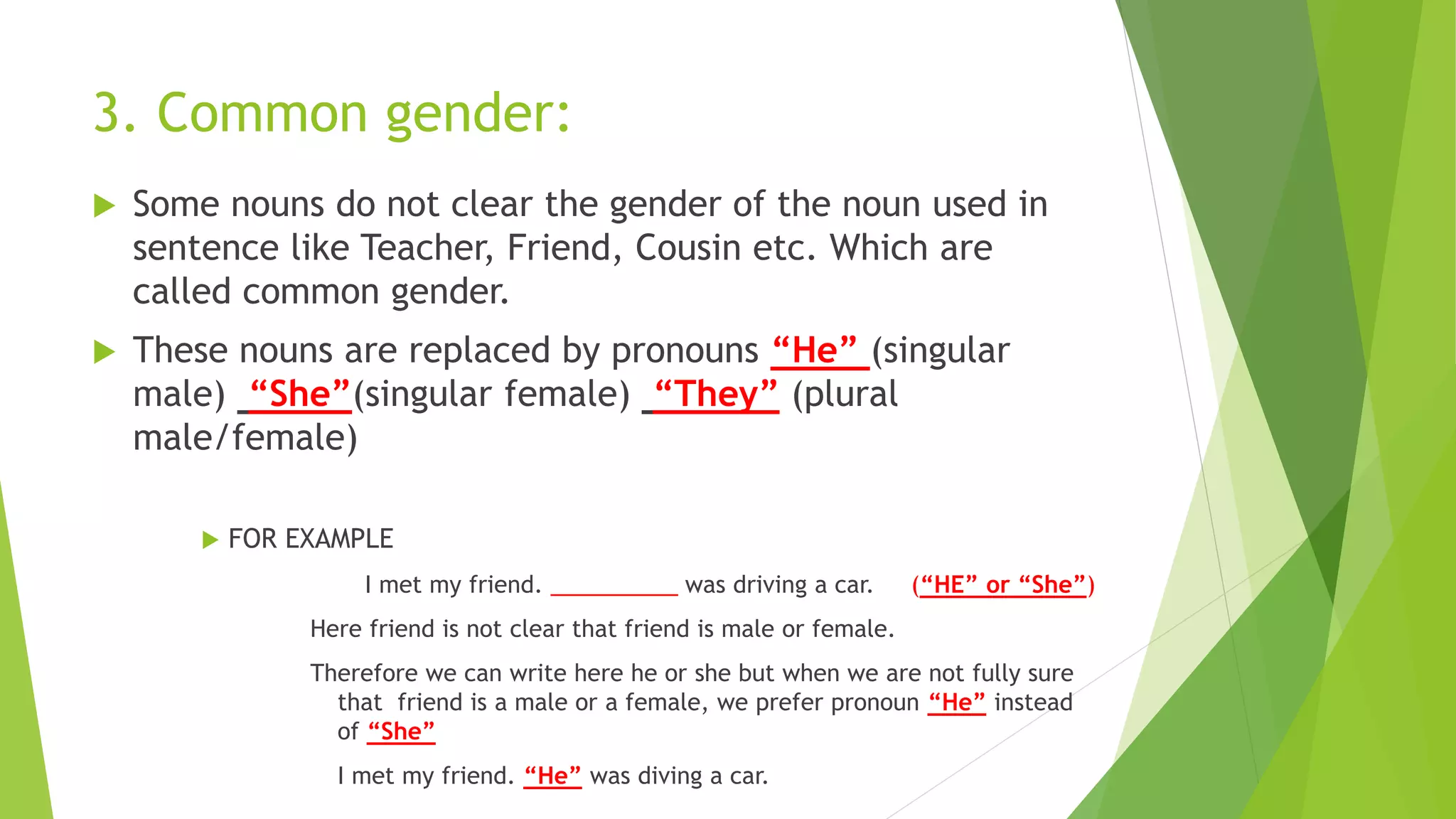
3. Common gender:
 Some nouns do not clear the gender of the noun used in
sentence like Teacher, Friend, Cousin etc. Which are
called common gender.
 These nouns are replaced by pronouns “He” (singular
male) “She”(singular female) “They” (plural
male/female)
 FOR EXAMPLE
I met my friend. __________ was driving a car. (“HE” or “She”)
Here friend is not clear that friend is male or female.
Therefore we can write here he or she but when we are not fully sure
that friend is a male or a female, we prefer pronoun “He” instead
of “She”
I met my friend. “He” was diving a car.
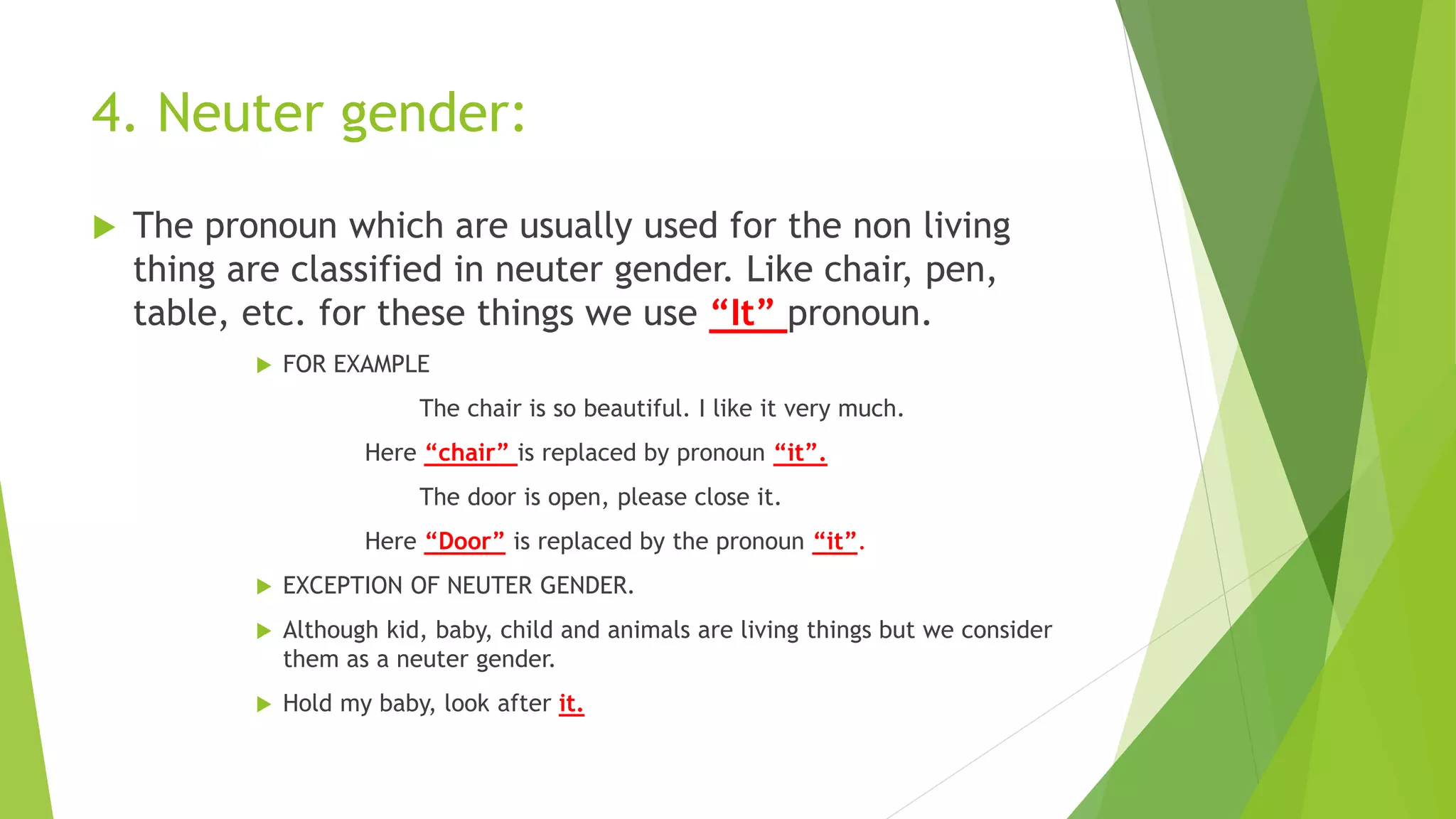
4. Neuter gender:
 The pronoun which are usually used for the non living
thing are classified in neuter gender. Like chair, pen,
table, etc. for these things we use “It” pronoun.
 FOR EXAMPLE
The chair is so beautiful. I like it very much.
Here “chair” is replaced by pronoun “it”.
The door is open, please close it.
Here “Door” is replaced by the pronoun “it”.
 EXCEPTION OF NEUTER GENDER.
 Although kid, baby, child and animals are living things but we consider
them as a neuter gender.
 Hold my baby, look after it.
Types of pronoun:
1. Personal pronoun
2. Reciprocal pronoun
3. Demonstrative pronoun
4. Relative pronoun
5. Interrogative pronoun
6. Indefinite pronoun
7. Distributive pronoun
1. PERSONAL PRONOUN
 Personal Pronouns are those which stand for the names of
persons.
 They take place of nouns and may be used as
subject/object in a sentence.
 They may also used to show the possession/ownership of a
noun.
Examples
 I got a free pass.
 My aim is high.
 This book is mine.
 Ahmad called me yesterday.
 Aisha loves her daughter.
 Ali looked at himself in the mirror.
 That house is ours.
 Teachers like us
 Our religion is ISLAM.
In the above examples, the underlined and colored words show pronouns.
CASES OF PERSONAL PRONOUN
i. NOMINATIVE/SUBJECTIVE CASE
ii. POSSESSIVE CASE
iii. OBJECTIVE CASE
iv. REFLEXIVE/INTENSIVE CASE
i. NOMINATIVE/SUBJECTIVE CASE
 When a pronoun is used as a subject , we
say that the pronoun is in the
nominative/subjective case.
 Like I, we, you, he, she, it, they or a
person name.
EXAMPLES:
 I am going to university.
 We are all Muslims.
 You are looking so pretty.
 He is an honest man.
 She belongs to a respected family.
 They watched a movie last night.
ii. POSSESSIVE CASE
 In possessive case, a pronoun shows the ownership
of a noun (person), in a sentence.
 Like my, our, your, his, her, their, mine, ours,
yours, hers, theirs.
EXAMPLES:
 My religion is Islam.
 Your room is fully decorated.
 His way of talking is very polite.
 The pen on the table is mine.
 This car is ours not theirs.
 I have lost my camera. May I use yours?
 That car is hers.
iii. OBJECTIVE CASE
 In objective case, we use a pronoun as a object.
 Like me, us, you, him, her, it, them.
EXAMPLES
 I love you!
 Farhan invited me.
 Jessie went with them.
 Give the envelope to him.
iv. REFLEXIVE/INTENSIVE CASE
 Reflexive Pronouns are those which are objects and which
refer to the same persons as the subjects of the verbs.
 Like myself, yourself, themselves, itself etc.
 They end in self / selves.
Examples:
 We organized the party by ourselves.
 Be careful not to cut yourself with that knife.
 You have all enjoyed yourselves.
 She cooked the dinner herself.
 They have proved themselves to be right.
 I love myself.
 You can do it yourself.
 He cooks himself.
Number Person Gender
Cases of pronoun
Subjective Possessive Objective Reflexive
Singular
1st
(SPEAKER) male/female I my/mine me Myself
2nd
(LISTENER) male/female you Your/yours you Yourself
3rd
(TALKED ABOUT)
male he His him himself
female she Her /hers her herself
neuter it its it itself
Plural
1st
(SPEAKER) male/female we Our/ours us ourselves
2nd
(LISTENER) male/female you Your/yours you yourselves
3rd
(TALKED ABOUT)
male/female/
neuter
they Their/theirs them themselves
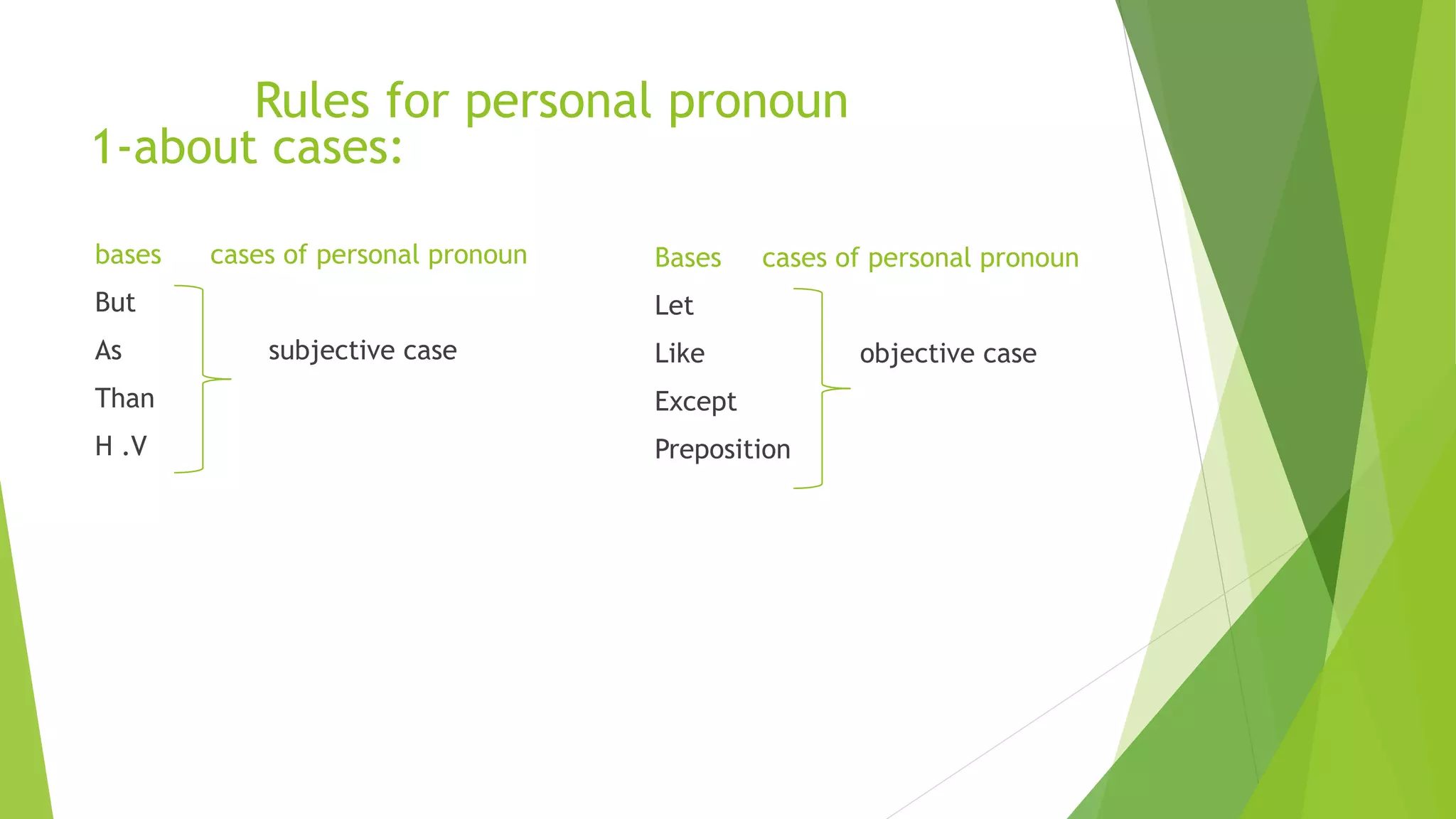
Rules for personal pronoun
1-about cases:
bases cases of personal pronoun
But
As subjective case
Than
H .V
Bases cases of personal pronoun
Let
Like objective case
Except
Preposition
Examples:
 No-one was ready for the meeting but us.
 no-one will rescue you except me.
 no-one was ready for the meeting but we.
 No-one will rescue you except me.
2-if more than one person:
 If more than one person is given in a sentence, we
follow two things:
 In rule a) all pronouns should be singular.
 In rule b) all pronouns should be plural.
a)2nd + 3rd + 1st = 231
b)1st + 2nd + 3rd = 123
EXAMPLES:
 He, you and I are going to a movie tonight.
 They, we and you are going for excursion.
 You, he and I are going to a movie tonight.
 We, you and they are going for excursion.
3-while pronouns except mistake:
 While pronouns except guilt/mistake be it singular or plural, we
follow 123…
 He, you and I are responsible for the mess.
 I, you and he are responsible for the mess.
2. RECIPROCAL PRONOUN
 The pronouns which are used to express an action that develops between two
are more persons.
 1.Eachother
 2.One-another
EXAMPLES: RECIPROCAL PRONOUN
 The students in the class co-operate with one-another.
 We love each other.
 They did not look at one-another.
 They helped to look after each other’s children.
 We sent each other eid cards.
 Peter and Mary helped one-another.
3. Demonstrative pronoun
 Demonstrative Pronouns are those which point out things, as this, these, that
and those.
 Because they convey a high degree of specificity and distinctiveness in
pointing out ("demonstrating") a referent; They are showing words.
Examples: Demonstrative pronoun
 This is my answer
 That was too much for me
 These are good mangoes
 Hand me those candles, please
 Are those flowers you picked?
 This is my house
 That was not good
 Those are fruits
 This is not right
 That was nice
4. Relative pronoun
 Relative Pronouns are those which relate to some noun going before in the
sentence as who, whose, whom, which, what, that.
 A relative pronoun does the work of a conjunction as well as a pronoun.
Examples:
 The man who stole the car has been caught.
 The man whom you accused is not guilt.
 The woman whose house I rented is my cousin.
 The house which you see was built long ago.
 I mean what I say.
 Take anything that you like.
 Here the girl whom you wanted to meet.
 The happy laughter that made me smile came from the three-year-old who lives
next door.
 I know the man who lives here.
 This is the boy / girl who works hard.
5. Interrogative pronoun
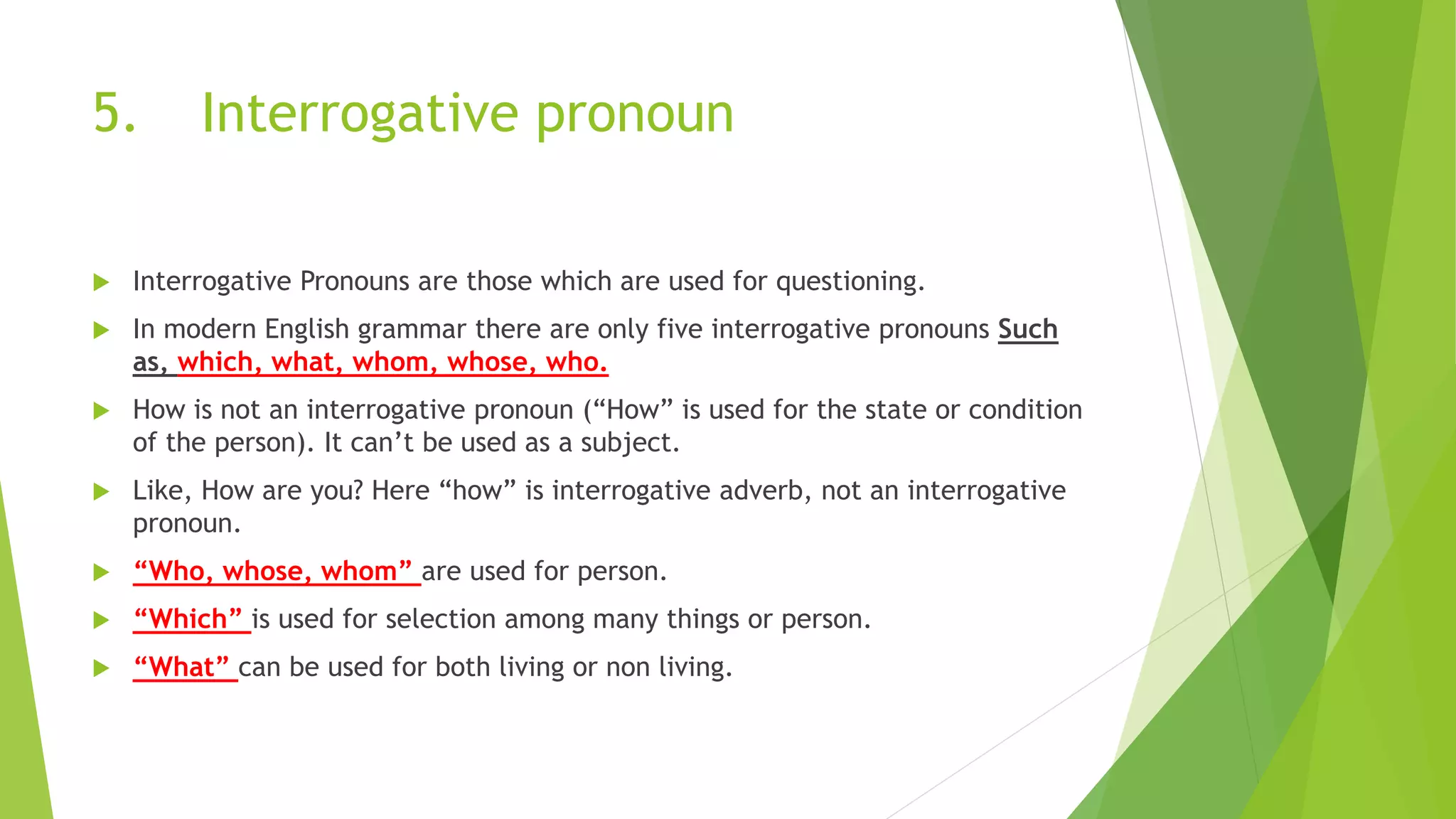
 Interrogative Pronouns are those which are used for questioning.
 In modern English grammar there are only five interrogative pronouns Such
as, which, what, whom, whose, who.
 How is not an interrogative pronoun (“How” is used for the state or condition
of the person). It can’t be used as a subject.
 Like, How are you? Here “how” is interrogative adverb, not an interrogative
pronoun.
 “Who, whose, whom” are used for person.
 “Which” is used for selection among many things or person.
 “What” can be used for both living or non living.
Examples:
 Who built that house?
 Whom do you want to meet ?
 Whose book is this?
 Which do you prefer, tea or coffee?
 Which is your favourite colour?
 Which is your brother among these?
 What is in your hand?
6. Indefinite pronoun
 indefinite Pronouns are those pronouns which refer to persons or things in
a general or indefinite way
 A pronoun that does not refer to a specific person, place or thing.
 Indefinite pronouns may be singular or plural.
 Singular indefinite pronouns are;
 Another, anybody, anyone, anything, everyone, somebody, some-one,
something.
 Plural indefinite pronouns are;
 Both, few, many, others, several.
Examples:
 All are quite safe.
 Many were rescued from the flood.
 Some are born great.
 Few mangoes were left in the basket.
 None of them is clever.
 I did not see any of them.
 Always respect others.
 Does anybody agree with me?
 Would you like something to drink?
7. DISTRIBUTIVE PRONOUN
 Distributive Pronouns are those which refer to persons or things taken one at
a time, as each, either, neither, every, any, none.
 For this reason they are always singular and as such followed by the verb in
the singular.
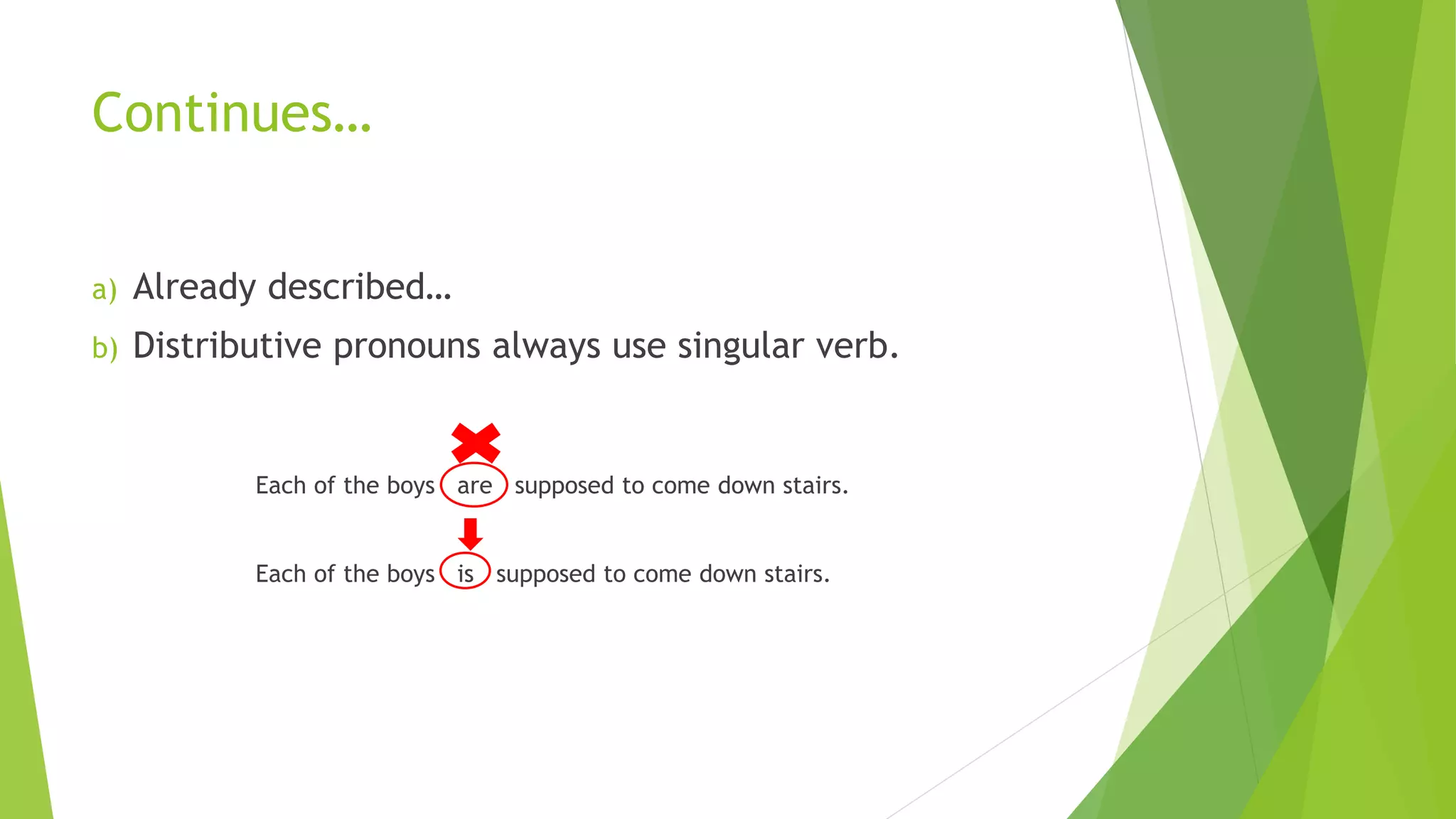
 Distributive pronouns always use singular verb.
EXAMPLES:
 We may take either of these two books
 Neither of them writes well
 Each of these girls deserved a reward
 You can either use it
 Each of you will be suspend
 You can either choose him
 He can neither speak
 You can either take
 Each of them will retain this
 Each of one can do
Rules for Distributive Pronouns
a) i. Each, either, none, neither, any, every + noun (singular)
Either student will be thrown out.
Each boy was present in the class.
ii. Each, either, none, neither, any, every + of the + noun
(plural)
Either of the students will be thrown out.
Each of the boys was present in the class.
Continues…
a) Already described…
b) Distributive pronouns always use singular verb.
Each of the boys are supposed to come down stairs.
Each of the boys is supposed to come down stairs.
Uses of pronoun
Subject pronoun
 Subject pronouns are used when the pronoun is subject in the
sentence. As I, He, She etc.
 FOR EXAMPLE
 Ali is a good boy.
 He is a good boy.
Subject pronoun continues…
 Subject pronouns are also used if they rename the
subject.
 They will be followed by verbs such as is, are, am, was,
were etc.
 FOR EXAMPLE
 This was He who stole my pen.
Uses of pronoun
 Object pronoun
 Many times, in a sentence, you have a person, a group of
people or a thing doing an action and a person, a group of
people or a thing receiving or being affected by that
action.
Uses of object pronoun
Let´s analyze our example again.
Jenny
Jack
Jenny loves Jack
Jenny loves Jack
Jenny does the actions.
Jenny is the subject of the
sentence.
Jack receives or is affected by the
action that Jenny does.
Jack is the object of the
sentence.
She = Subject Pronoun
He ? NO !
Because Jack doesn´t do the
actions. He receives the action.
Jenny loves Jack
She loves him
“Him” is the pronoun we use when
a man receives the action, when a
man is the object of the sentence.
These kind of pronouns are called “OBJECT PRONOUNS”
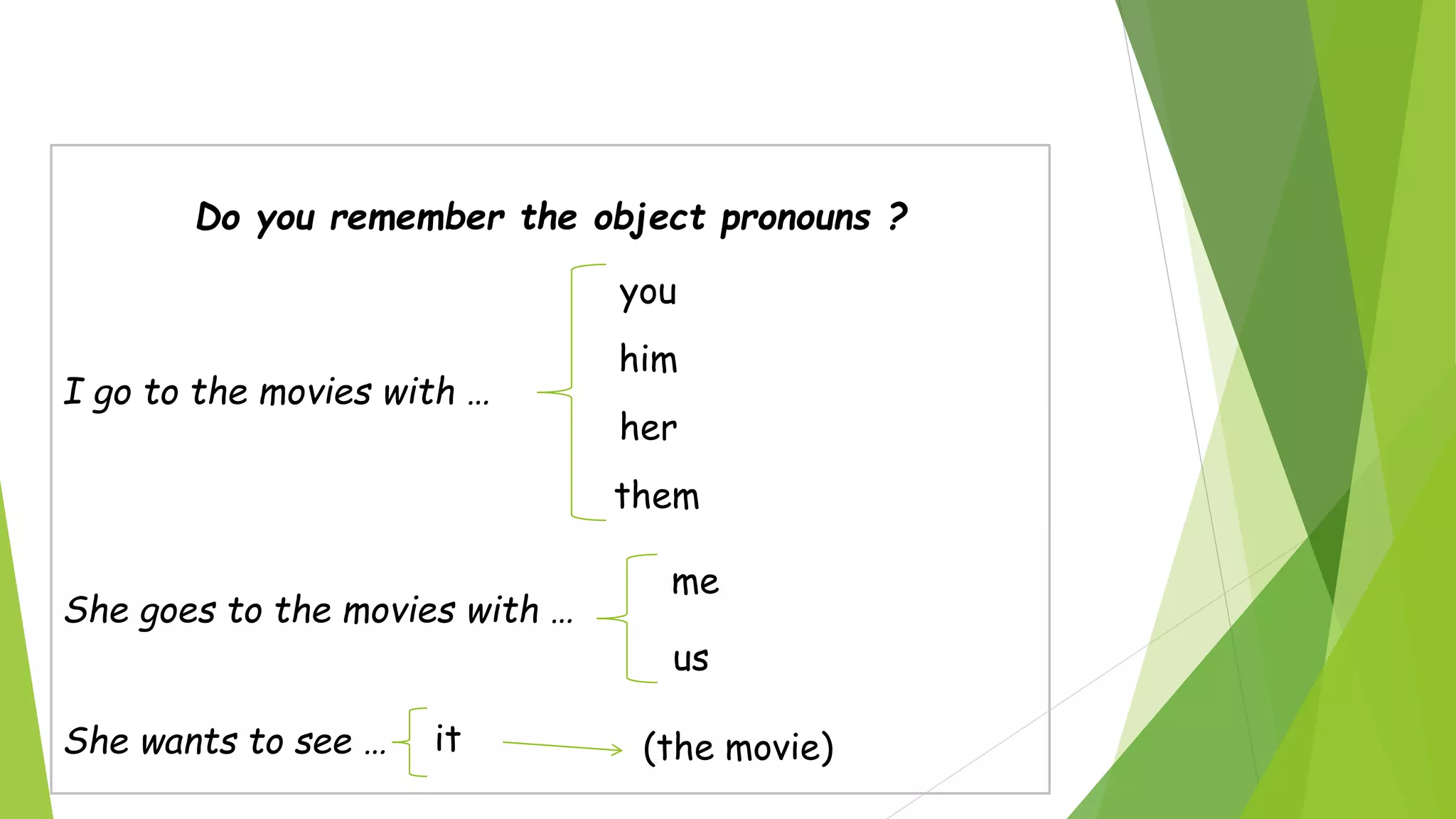
Do you remember the object pronouns ?
I go to the movies with …
She goes to the movies with …
She wants to see …
him
you
her
me
them
us
it (the movie)
More examples:
- She loves her parents = She loves them
- John is talking to Susan
= He is talking to her
OBJECT PRONOUNS CAN BE USE AS:
1. DIRECT OBJECTS
EX: She loves her parents
Direct Objects
John is playing the guitar
She loves them
Direct Objects
John is playing it (object pronouns)
OBJECT PRONOUNS CAN BE USE IN:
2. PREPOSITIONAL PHRASES
What is a prepositional phrase ?
A prepositional phrase is phrase that has
any preposition introducing the object of
the sentence.
LOOK AT THIS EXAMPLE:
“WE WANT TO GO WITH THEM”
This is a prepositional phrase
This is the object.
In this case the objet
pronoun
This is the preposition introducing the
object.
In this case the objet pronoun
More examples:
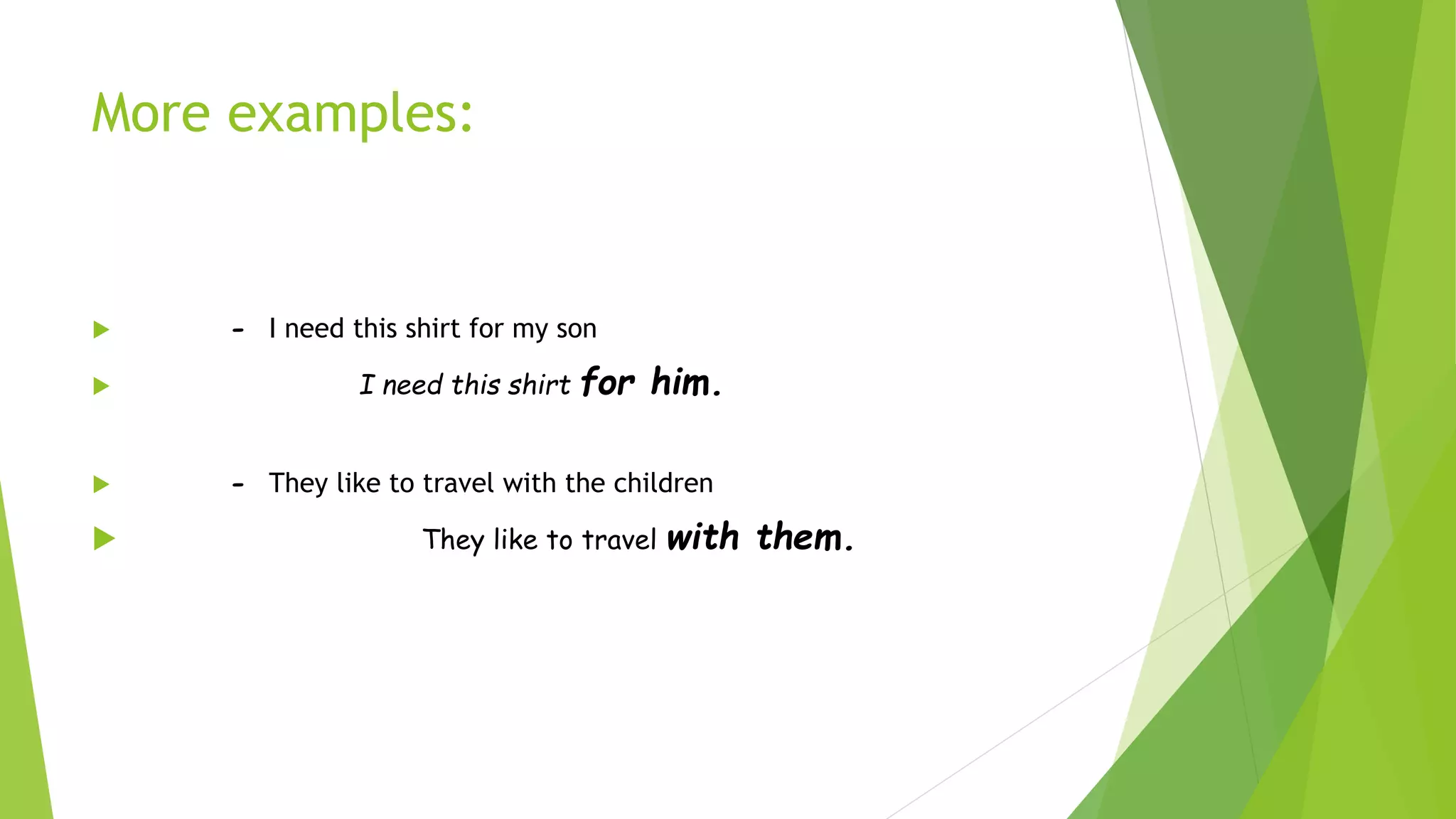
 - I need this shirt for my son
 I need this shirt for him.
 - They like to travel with the children
 They like to travel with them.
Importance of pronoun
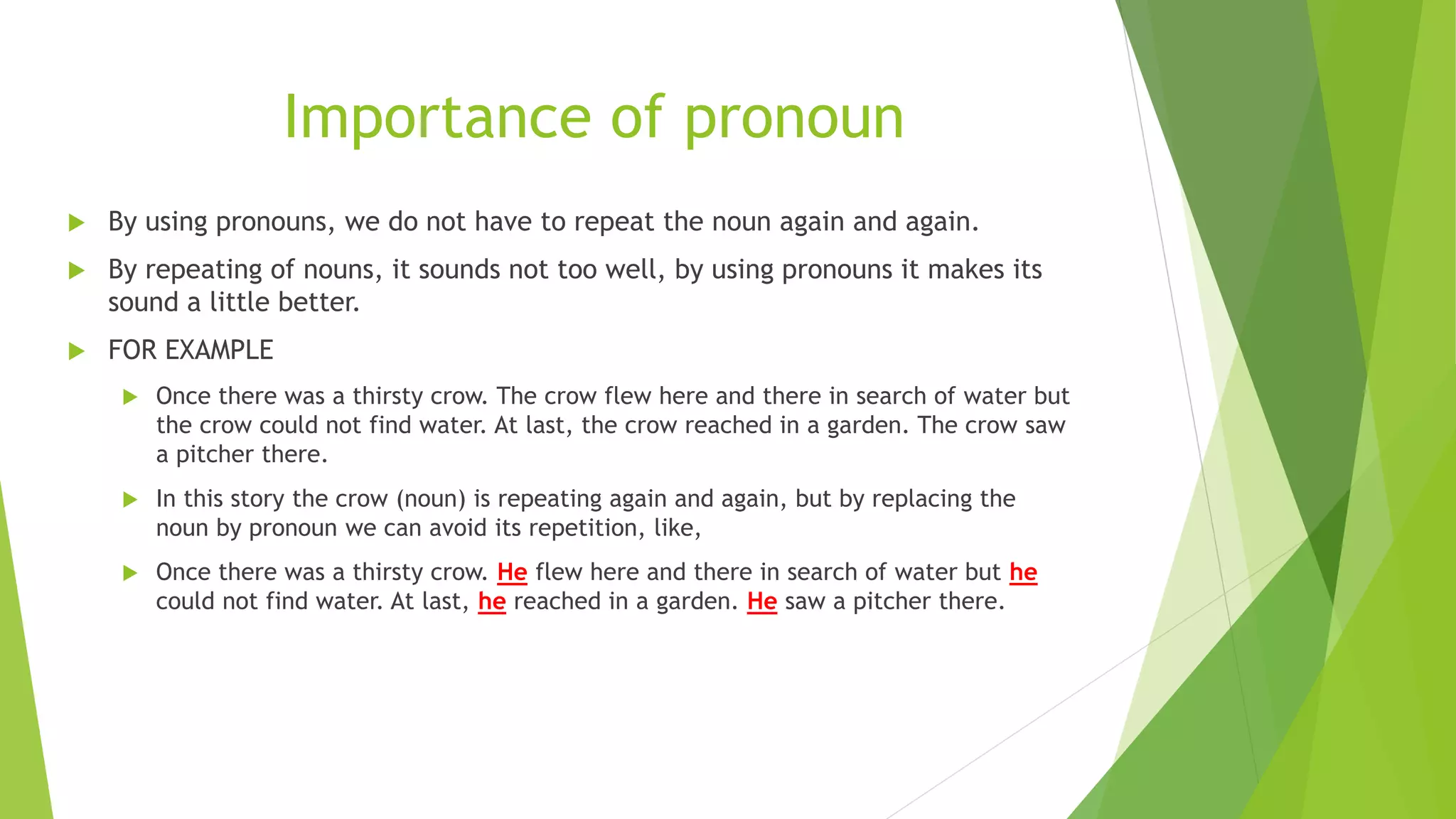
 By using pronouns, we do not have to repeat the noun again and again.
 By repeating of nouns, it sounds not too well, by using pronouns it makes its
sound a little better.
 FOR EXAMPLE
 Once there was a thirsty crow. The crow flew here and there in search of water but
the crow could not find water. At last, the crow reached in a garden. The crow saw
a pitcher there.
 In this story the crow (noun) is repeating again and again, but by replacing the
noun by pronoun we can avoid its repetition, like,
 Once there was a thirsty crow. He flew here and there in search of water but he
could not find water. At last, he reached in a garden. He saw a pitcher there.
Importance of pronoun continues…
 By using pronouns, we have ease to refer the genders of the nouns.
 In any language, it is extremely difficult not to refer to someone without
using pronouns, (he/his, she/her, they).
 Obviously when someone is born the doctors, find out the sex of the baby,
the biological status of what a male or female would have.
 FOR EXAMPLE
 Misbah is the captain of the Pakistani cricket team. He is a good
player.
 With out using pronoun “He”, we can not find out Misbah’s
gender.
End of the presentation.
Any questions?
 I, you and she must have a thread bare discussion on this issue.
 You, she and I must have a thread-bare discussion on this issue.
 Ahmad is physically stronger than me.
 Ahmad is physically stronger than I.
 How dare you come between he and me.
 How dare you come between him and me.
 Each of the boys and girls of this section describe the event in their own
way.
 Each of the and girls of this section of this section describes the event in his
own way.
 He is one of the most successful artists who has achieved his aim in such
a short time.
 He is one of the most successful artists that have achieved their aims in
such a short time.
Error detection in pronouns:
 My father does not like me going to movies everyday.
 My father does not like my going to movies everyday.
 I, who is your uncle, should be respected.
 I, who am your uncle should be respected.
 Both did not go.
 Neither went.
 The ruling party was ready to state their political issues.
 The ruling party was ready to state his political issues.

Complete Study Of Pronouns

  • 3.
    Group members  MUREEDHUSSAIN 2016-ME-30  FURQAN NAJMI 2016-ME-31  ASAD ABBAS 2016-ME-14-33  JAMSHED SALEEM 2016-ME-14-53  GUL SHER 2016-ME-27  MUHAMMAD RASHID NAWAZ 2016-ME-51  MUHAMMAD AMJAD 2016-ME-41
  • 4.
  • 5.
    POINTS OF DISCUSSION DEFINATION  GENDERS OF PRONOUN  TYPES OF PRONOUN RULES FOR PERSONAL PRONOUN  CASES OF PRONOUN  IMPORTANCE OF PRONOUN  USES OF PRONOUN  QUESTIONS/ANSWERS
  • 6.
    Pronoun:  Pronoun isa word that takes place of noun or noun phrase to avoid repetition of noun.  The word pronoun is the combination of two words “pro+noun”. “pro” means “instead of”, and noun means any person, place and thing.  Before replacing the noun we should see it’s status.  Usually nouns are either numbers or genders.  Numbers can be singular or plural.  And genders may be male, female, common or neuter.
  • 7.
    Examples: I, YOU, ME,HE, SHE, IT, WE, ETC.  Examples:-  I am a boy. IN THIS EXAMPLE “I” IS THE PRONOUN  He is going to school. IN THIS EXAMPLE “HE” IS THE PRONOUN  You are my best friend. “YOU” IS THE PRONOUN  We are all Muslims. “WE” IS THE PRONOUN  Ali has a pen. It is so beautiful. “IT” IS THE PRONOUN
  • 8.
    Genders of Pronoun 1.Masculinegender 2.Feminine gender 3.Common gender 4.Neuter gender
  • 9.
    1. Masculine gender It denotes pronoun which is used for male gender.  As Boy, Actor, Asad, etc.  The pronoun which is used for them is “HE”  FOR EXAMPLE I met “Asad”. “He” was going to Lahore. here “Asad” is replaced by the pronoun “He” I like Furqan because he is my best friend. Here “Furqan” is replaced by pronoun “He”
  • 10.
    2. Feminine gender: It denotes pronoun which is used for female gender.  As girl, lady, Ayesha, etc.  The pronoun which is used for them is “She”  FOR EXAMPLE I love shumaila, because she is my daughter. Here “shumaila” is replaced by “She” I respect Ayesha because she is my elder sister. in this example “Ayesha” is replaced by “She”
  • 11.
    3. Common gender: Some nouns do not clear the gender of the noun used in sentence like Teacher, Friend, Cousin etc. Which are called common gender.  These nouns are replaced by pronouns “He” (singular male) “She”(singular female) “They” (plural male/female)  FOR EXAMPLE I met my friend. __________ was driving a car. (“HE” or “She”) Here friend is not clear that friend is male or female. Therefore we can write here he or she but when we are not fully sure that friend is a male or a female, we prefer pronoun “He” instead of “She” I met my friend. “He” was diving a car.
  • 12.
    4. Neuter gender: The pronoun which are usually used for the non living thing are classified in neuter gender. Like chair, pen, table, etc. for these things we use “It” pronoun.  FOR EXAMPLE The chair is so beautiful. I like it very much. Here “chair” is replaced by pronoun “it”. The door is open, please close it. Here “Door” is replaced by the pronoun “it”.  EXCEPTION OF NEUTER GENDER.  Although kid, baby, child and animals are living things but we consider them as a neuter gender.  Hold my baby, look after it.
  • 13.
    Types of pronoun: 1.Personal pronoun 2. Reciprocal pronoun 3. Demonstrative pronoun 4. Relative pronoun 5. Interrogative pronoun 6. Indefinite pronoun 7. Distributive pronoun
  • 14.
    1. PERSONAL PRONOUN Personal Pronouns are those which stand for the names of persons.  They take place of nouns and may be used as subject/object in a sentence.  They may also used to show the possession/ownership of a noun.
  • 15.
    Examples  I gota free pass.  My aim is high.  This book is mine.  Ahmad called me yesterday.  Aisha loves her daughter.  Ali looked at himself in the mirror.  That house is ours.  Teachers like us  Our religion is ISLAM. In the above examples, the underlined and colored words show pronouns.
  • 16.
    CASES OF PERSONALPRONOUN i. NOMINATIVE/SUBJECTIVE CASE ii. POSSESSIVE CASE iii. OBJECTIVE CASE iv. REFLEXIVE/INTENSIVE CASE
  • 17.
    i. NOMINATIVE/SUBJECTIVE CASE When a pronoun is used as a subject , we say that the pronoun is in the nominative/subjective case.  Like I, we, you, he, she, it, they or a person name.
  • 18.
    EXAMPLES:  I amgoing to university.  We are all Muslims.  You are looking so pretty.  He is an honest man.  She belongs to a respected family.  They watched a movie last night.
  • 19.
    ii. POSSESSIVE CASE In possessive case, a pronoun shows the ownership of a noun (person), in a sentence.  Like my, our, your, his, her, their, mine, ours, yours, hers, theirs.
  • 20.
    EXAMPLES:  My religionis Islam.  Your room is fully decorated.  His way of talking is very polite.  The pen on the table is mine.  This car is ours not theirs.  I have lost my camera. May I use yours?  That car is hers.
  • 21.
    iii. OBJECTIVE CASE In objective case, we use a pronoun as a object.  Like me, us, you, him, her, it, them.
  • 22.
    EXAMPLES  I loveyou!  Farhan invited me.  Jessie went with them.  Give the envelope to him.
  • 23.
    iv. REFLEXIVE/INTENSIVE CASE Reflexive Pronouns are those which are objects and which refer to the same persons as the subjects of the verbs.  Like myself, yourself, themselves, itself etc.  They end in self / selves.
  • 24.
    Examples:  We organizedthe party by ourselves.  Be careful not to cut yourself with that knife.  You have all enjoyed yourselves.  She cooked the dinner herself.  They have proved themselves to be right.  I love myself.  You can do it yourself.  He cooks himself.
  • 25.
    Number Person Gender Casesof pronoun Subjective Possessive Objective Reflexive Singular 1st (SPEAKER) male/female I my/mine me Myself 2nd (LISTENER) male/female you Your/yours you Yourself 3rd (TALKED ABOUT) male he His him himself female she Her /hers her herself neuter it its it itself Plural 1st (SPEAKER) male/female we Our/ours us ourselves 2nd (LISTENER) male/female you Your/yours you yourselves 3rd (TALKED ABOUT) male/female/ neuter they Their/theirs them themselves
  • 26.
    Rules for personalpronoun 1-about cases: bases cases of personal pronoun But As subjective case Than H .V Bases cases of personal pronoun Let Like objective case Except Preposition
  • 27.
    Examples:  No-one wasready for the meeting but us.  no-one will rescue you except me.  no-one was ready for the meeting but we.  No-one will rescue you except me.
  • 28.
    2-if more thanone person:  If more than one person is given in a sentence, we follow two things:  In rule a) all pronouns should be singular.  In rule b) all pronouns should be plural. a)2nd + 3rd + 1st = 231 b)1st + 2nd + 3rd = 123
  • 29.
    EXAMPLES:  He, youand I are going to a movie tonight.  They, we and you are going for excursion.  You, he and I are going to a movie tonight.  We, you and they are going for excursion.
  • 30.
    3-while pronouns exceptmistake:  While pronouns except guilt/mistake be it singular or plural, we follow 123…  He, you and I are responsible for the mess.  I, you and he are responsible for the mess.
  • 31.
    2. RECIPROCAL PRONOUN The pronouns which are used to express an action that develops between two are more persons.  1.Eachother  2.One-another
  • 32.
    EXAMPLES: RECIPROCAL PRONOUN The students in the class co-operate with one-another.  We love each other.  They did not look at one-another.  They helped to look after each other’s children.  We sent each other eid cards.  Peter and Mary helped one-another.
  • 33.
    3. Demonstrative pronoun Demonstrative Pronouns are those which point out things, as this, these, that and those.  Because they convey a high degree of specificity and distinctiveness in pointing out ("demonstrating") a referent; They are showing words.
  • 34.
    Examples: Demonstrative pronoun This is my answer  That was too much for me  These are good mangoes  Hand me those candles, please  Are those flowers you picked?  This is my house  That was not good  Those are fruits  This is not right  That was nice
  • 35.
    4. Relative pronoun Relative Pronouns are those which relate to some noun going before in the sentence as who, whose, whom, which, what, that.  A relative pronoun does the work of a conjunction as well as a pronoun.
  • 36.
    Examples:  The manwho stole the car has been caught.  The man whom you accused is not guilt.  The woman whose house I rented is my cousin.  The house which you see was built long ago.  I mean what I say.  Take anything that you like.  Here the girl whom you wanted to meet.  The happy laughter that made me smile came from the three-year-old who lives next door.  I know the man who lives here.  This is the boy / girl who works hard.
  • 37.
    5. Interrogative pronoun Interrogative Pronouns are those which are used for questioning.  In modern English grammar there are only five interrogative pronouns Such as, which, what, whom, whose, who.  How is not an interrogative pronoun (“How” is used for the state or condition of the person). It can’t be used as a subject.  Like, How are you? Here “how” is interrogative adverb, not an interrogative pronoun.  “Who, whose, whom” are used for person.  “Which” is used for selection among many things or person.  “What” can be used for both living or non living.
  • 38.
    Examples:  Who builtthat house?  Whom do you want to meet ?  Whose book is this?  Which do you prefer, tea or coffee?  Which is your favourite colour?  Which is your brother among these?  What is in your hand?
  • 39.
    6. Indefinite pronoun indefinite Pronouns are those pronouns which refer to persons or things in a general or indefinite way  A pronoun that does not refer to a specific person, place or thing.  Indefinite pronouns may be singular or plural.  Singular indefinite pronouns are;  Another, anybody, anyone, anything, everyone, somebody, some-one, something.  Plural indefinite pronouns are;  Both, few, many, others, several.
  • 40.
    Examples:  All arequite safe.  Many were rescued from the flood.  Some are born great.  Few mangoes were left in the basket.  None of them is clever.  I did not see any of them.  Always respect others.  Does anybody agree with me?  Would you like something to drink?
  • 41.
    7. DISTRIBUTIVE PRONOUN Distributive Pronouns are those which refer to persons or things taken one at a time, as each, either, neither, every, any, none.  For this reason they are always singular and as such followed by the verb in the singular.  Distributive pronouns always use singular verb.
  • 42.
    EXAMPLES:  We maytake either of these two books  Neither of them writes well  Each of these girls deserved a reward  You can either use it  Each of you will be suspend  You can either choose him  He can neither speak  You can either take  Each of them will retain this  Each of one can do
  • 43.
    Rules for DistributivePronouns a) i. Each, either, none, neither, any, every + noun (singular) Either student will be thrown out. Each boy was present in the class. ii. Each, either, none, neither, any, every + of the + noun (plural) Either of the students will be thrown out. Each of the boys was present in the class.
  • 44.
    Continues… a) Already described… b)Distributive pronouns always use singular verb. Each of the boys are supposed to come down stairs. Each of the boys is supposed to come down stairs.
  • 45.
    Uses of pronoun Subjectpronoun  Subject pronouns are used when the pronoun is subject in the sentence. As I, He, She etc.  FOR EXAMPLE  Ali is a good boy.  He is a good boy.
  • 46.
    Subject pronoun continues… Subject pronouns are also used if they rename the subject.  They will be followed by verbs such as is, are, am, was, were etc.  FOR EXAMPLE  This was He who stole my pen.
  • 47.
    Uses of pronoun Object pronoun  Many times, in a sentence, you have a person, a group of people or a thing doing an action and a person, a group of people or a thing receiving or being affected by that action.
  • 48.
    Uses of objectpronoun Let´s analyze our example again. Jenny Jack Jenny loves Jack
  • 49.
    Jenny loves Jack Jennydoes the actions. Jenny is the subject of the sentence. Jack receives or is affected by the action that Jenny does. Jack is the object of the sentence. She = Subject Pronoun He ? NO ! Because Jack doesn´t do the actions. He receives the action.
  • 50.
    Jenny loves Jack Sheloves him “Him” is the pronoun we use when a man receives the action, when a man is the object of the sentence. These kind of pronouns are called “OBJECT PRONOUNS”
  • 51.
    Do you rememberthe object pronouns ? I go to the movies with … She goes to the movies with … She wants to see … him you her me them us it (the movie)
  • 52.
    More examples: - Sheloves her parents = She loves them - John is talking to Susan = He is talking to her
  • 53.
    OBJECT PRONOUNS CANBE USE AS: 1. DIRECT OBJECTS EX: She loves her parents Direct Objects John is playing the guitar She loves them Direct Objects John is playing it (object pronouns)
  • 54.
    OBJECT PRONOUNS CANBE USE IN: 2. PREPOSITIONAL PHRASES What is a prepositional phrase ?
  • 55.
    A prepositional phraseis phrase that has any preposition introducing the object of the sentence. LOOK AT THIS EXAMPLE: “WE WANT TO GO WITH THEM” This is a prepositional phrase This is the object. In this case the objet pronoun This is the preposition introducing the object. In this case the objet pronoun
  • 56.
    More examples:  -I need this shirt for my son  I need this shirt for him.  - They like to travel with the children  They like to travel with them.
  • 57.
    Importance of pronoun By using pronouns, we do not have to repeat the noun again and again.  By repeating of nouns, it sounds not too well, by using pronouns it makes its sound a little better.  FOR EXAMPLE  Once there was a thirsty crow. The crow flew here and there in search of water but the crow could not find water. At last, the crow reached in a garden. The crow saw a pitcher there.  In this story the crow (noun) is repeating again and again, but by replacing the noun by pronoun we can avoid its repetition, like,  Once there was a thirsty crow. He flew here and there in search of water but he could not find water. At last, he reached in a garden. He saw a pitcher there.
  • 58.
    Importance of pronouncontinues…  By using pronouns, we have ease to refer the genders of the nouns.  In any language, it is extremely difficult not to refer to someone without using pronouns, (he/his, she/her, they).  Obviously when someone is born the doctors, find out the sex of the baby, the biological status of what a male or female would have.  FOR EXAMPLE  Misbah is the captain of the Pakistani cricket team. He is a good player.  With out using pronoun “He”, we can not find out Misbah’s gender.
  • 59.
    End of thepresentation. Any questions?
  • 60.
     I, youand she must have a thread bare discussion on this issue.  You, she and I must have a thread-bare discussion on this issue.  Ahmad is physically stronger than me.  Ahmad is physically stronger than I.  How dare you come between he and me.  How dare you come between him and me.  Each of the boys and girls of this section describe the event in their own way.  Each of the and girls of this section of this section describes the event in his own way.  He is one of the most successful artists who has achieved his aim in such a short time.  He is one of the most successful artists that have achieved their aims in such a short time. Error detection in pronouns:
  • 61.
     My fatherdoes not like me going to movies everyday.  My father does not like my going to movies everyday.  I, who is your uncle, should be respected.  I, who am your uncle should be respected.  Both did not go.  Neither went.  The ruling party was ready to state their political issues.  The ruling party was ready to state his political issues.