Other uses of pronouns

Based on NEF Advanced, 1c
Eva María Suárez Guillén
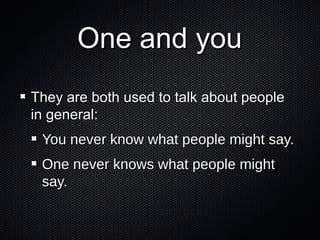
One and you
They are both used to talk about people
in general:
You never know what people might say.
One never knows what people might
say.
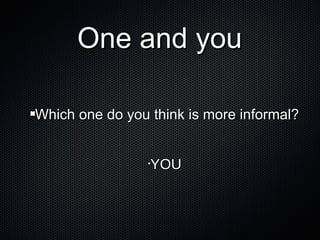
One and you
Which one do you think is more informal?
YOU

•
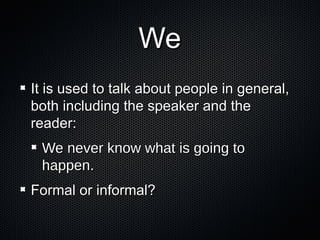
We
It is used to talk about people in general,
both including the speaker and the
reader:
We never know what is going to
happen.
Formal or informal?
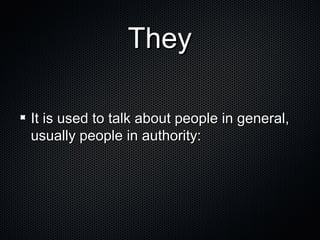
They
It is used to talk about people in general,
usually people in authority:
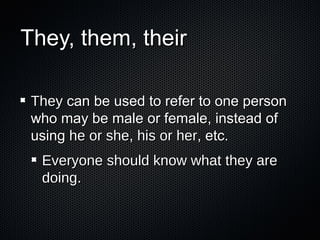
They, them, their
They can be used to refer to one person
who may be male or female, instead of
using he or she, his or her, etc.
Everyone should know what they are
doing.
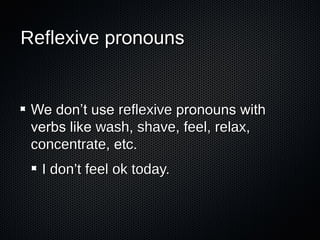
Reflexive pronouns

We don’t use reflexive pronouns with
verbs like wash, shave, feel, relax,
concentrate, etc.
I don’t feel ok today.
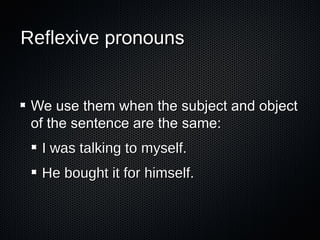
Reflexive pronouns

We use them when the subject and object
of the sentence are the same:
I was talking to myself.
He bought it for himself.
Reflexive pronouns
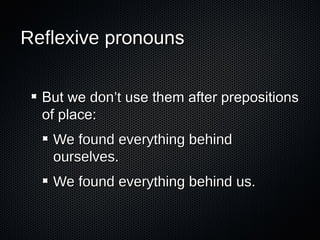
But we don’t use them after prepositions
of place:
We found everything behind
ourselves.
We found everything behind us.
Reflexive pronouns

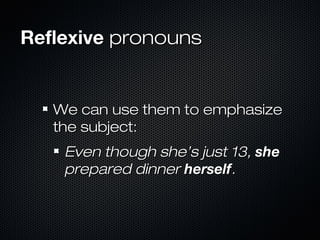
We can use them to emphasize
the subject:
Even though she’s just 13, she
prepared dinner herself.
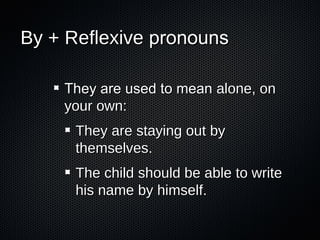
By + Reflexive pronouns
They are used to mean alone, on
your own:
They are staying out by
themselves.
The child should be able to write
his name by himself.
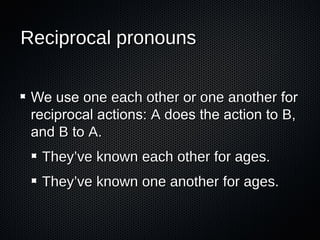
Reciprocal pronouns
We use one each other or one another for
reciprocal actions: A does the action to B,
and B to A.
They’ve known each other for ages.
They’ve known one another for ages.
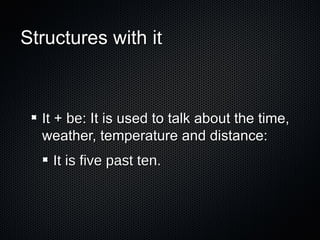
Structures with it

It + be: It is used to talk about the time,
weather, temperature and distance:
It is five past ten.
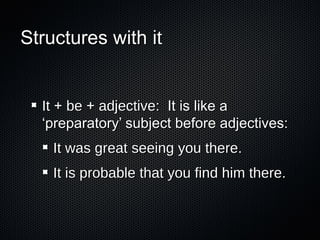
Structures with it

It + be + adjective: It is like a
‘preparatory’ subject before adjectives:
It was great seeing you there.
It is probable that you find him there.
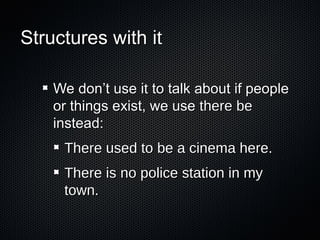
Structures with it
We don’t use it to talk about if people
or things exist, we use there be
instead:
There used to be a cinema here.
There is no police station in my
town.
Structures with it

There are more structures with it, but
we are not going to study them today.

Pronouns 1c

  • 1.
    Other uses ofpronouns Based on NEF Advanced, 1c Eva María Suárez Guillén
  • 2.
    One and you Theyare both used to talk about people in general: You never know what people might say. One never knows what people might say.
  • 3.
    One and you Whichone do you think is more informal? YOU •
  • 4.
    We It is usedto talk about people in general, both including the speaker and the reader: We never know what is going to happen. Formal or informal?
  • 5.
    They It is usedto talk about people in general, usually people in authority:
  • 6.
    They, them, their Theycan be used to refer to one person who may be male or female, instead of using he or she, his or her, etc. Everyone should know what they are doing.
  • 7.
    Reflexive pronouns We don’tuse reflexive pronouns with verbs like wash, shave, feel, relax, concentrate, etc. I don’t feel ok today.
  • 8.
    Reflexive pronouns We usethem when the subject and object of the sentence are the same: I was talking to myself. He bought it for himself.
  • 9.
    Reflexive pronouns But wedon’t use them after prepositions of place: We found everything behind ourselves. We found everything behind us.
  • 10.
    Reflexive pronouns We canuse them to emphasize the subject: Even though she’s just 13, she prepared dinner herself.
  • 11.
    By + Reflexivepronouns They are used to mean alone, on your own: They are staying out by themselves. The child should be able to write his name by himself.
  • 12.
    Reciprocal pronouns We useone each other or one another for reciprocal actions: A does the action to B, and B to A. They’ve known each other for ages. They’ve known one another for ages.
  • 13.
    Structures with it It+ be: It is used to talk about the time, weather, temperature and distance: It is five past ten.
  • 14.
    Structures with it It+ be + adjective: It is like a ‘preparatory’ subject before adjectives: It was great seeing you there. It is probable that you find him there.
  • 15.
    Structures with it Wedon’t use it to talk about if people or things exist, we use there be instead: There used to be a cinema here. There is no police station in my town.
  • 16.
    Structures with it Thereare more structures with it, but we are not going to study them today.