CONSUMER BEHAVIOUR
UNIT - V
CONSUMER BEHAVIOUR
Consumer behavior is the reaction of individuals in
obtaining, using goods & services of a particular type.




“It is the process where by individuals decide
whether, when, where, how, from & whom to purchase
goods & services”
- C.G. WALTER & G.W. PAUL
“Buyer behavior is all psychological, social & physical
behavior of potential customers as they become aware of
evaluate, purchase, consume & tell other people about the
products & services”.
- WEBSTER
FACTORS INFLUENCING CONSUMER DECISION /
BEHAVIOUR:
 CULTURAL FACTORS:
Sub – cultures, social class – caste, religion, languages
etc….
 SOCIAL FACTORS:
Reference groups, family, role and status {Buying roles –
initiators, decider, influencer, purchaser, consumer.}
 PERSONAL FACTORS:
The personal factors are age, life cycle stages,
occupation, economic situation [ income], life style, personality,
self – concept.
 PSYCHOLOGICAL FACTORS:
Motivation, perception, learning, beliefs & attitudes.
STAGES/ PROCESS/ DECISION MAKING OF CONSUMER
BEHAVIOUR:
NEED RECOGNITION
INFORMATION SEARCH
EVALUATING OF
ALTERNATIVES
[SCREENING]
PURCHASE DECISION

POST PURCHASE
BEHAVIOUR
MODELS OF CONSUMER BEHAVIOUR
I.

ECONOMIC MODEL { MARSHILLIAN MODEL }:

a. Price effect
b. Income effect
c. Substitution effect [ Cross demand ]
d. Variable proportions – Marginal utility
II. PSYCHOLOGICAL MODEL: [ MOTIVATION ]
{ABHRAHAM HEROLD} – MASLOWIAN/ NEED
HIERARCHY / MOTIVATION MODEL OF MASLOWIAN.

Higher level
needs

SelfActualization
Self- esteem
needs
Social needs

Lower / basic
needs

Safety / security needs

Physiological / physical needs
III. LEARNING / PAVLOVIAN MODEL :
•
•

Drive, drivers, triggering cues.
Non – triggering cues.

IV. INPUT – PROCESS – OUTPUT MODEL :
•
•
•
•
•

Need recognition.
Product awareness.
Evaluation.
Intention.
Post purchase behavior.
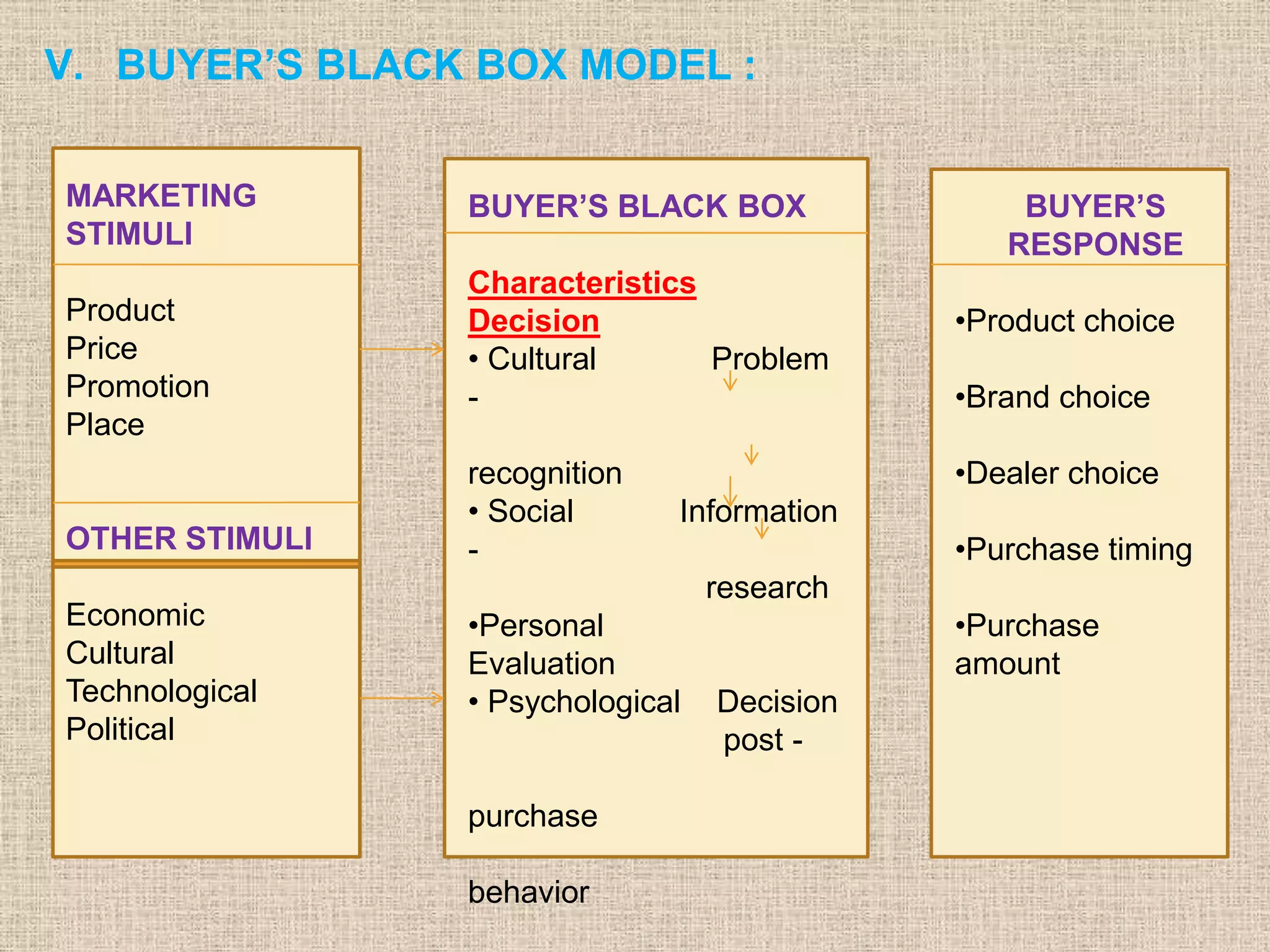
V. BUYER’S BLACK BOX MODEL :
MARKETING
STIMULI
Product
Price
Promotion
Place

OTHER STIMULI
Economic
Cultural
Technological
Political

BUYER’S BLACK BOX
Characteristics
Decision
• Cultural
Problem
recognition
• Social
-

BUYER’S
RESPONSE

•Product choice
•Brand choice
•Dealer choice

Information

•Purchase timing
research

•Personal
Evaluation
• Psychological

purchase
behavior

•Purchase
amount
Decision
post -
VI. SOCIOLOGICAL MODEL OF CONSUMER BEHAVIOUR:
This model is concerned with the society. A consumer is
a part of the society & he may be a member of many groups
in a society. His buying behavior is influenced by these
groups. By primary groups of family, friends & close
associates influence a lot on his buying behavior.
A consumer may be a member of political party.
Where his dress norms are different. Thus, he has to buy
things that confirmed to his life styles in different groups.
FRUEDIAN MODEL OF CONSUMER BEHAVIOUR –
SIGMUND FRUED
Psycho – analytical model:

ID – Which generates desire.
EGO – Ego gives the ways to fulfill your desire.
SUPER EGO – It will tell you what is good & what is bad for a
human being.
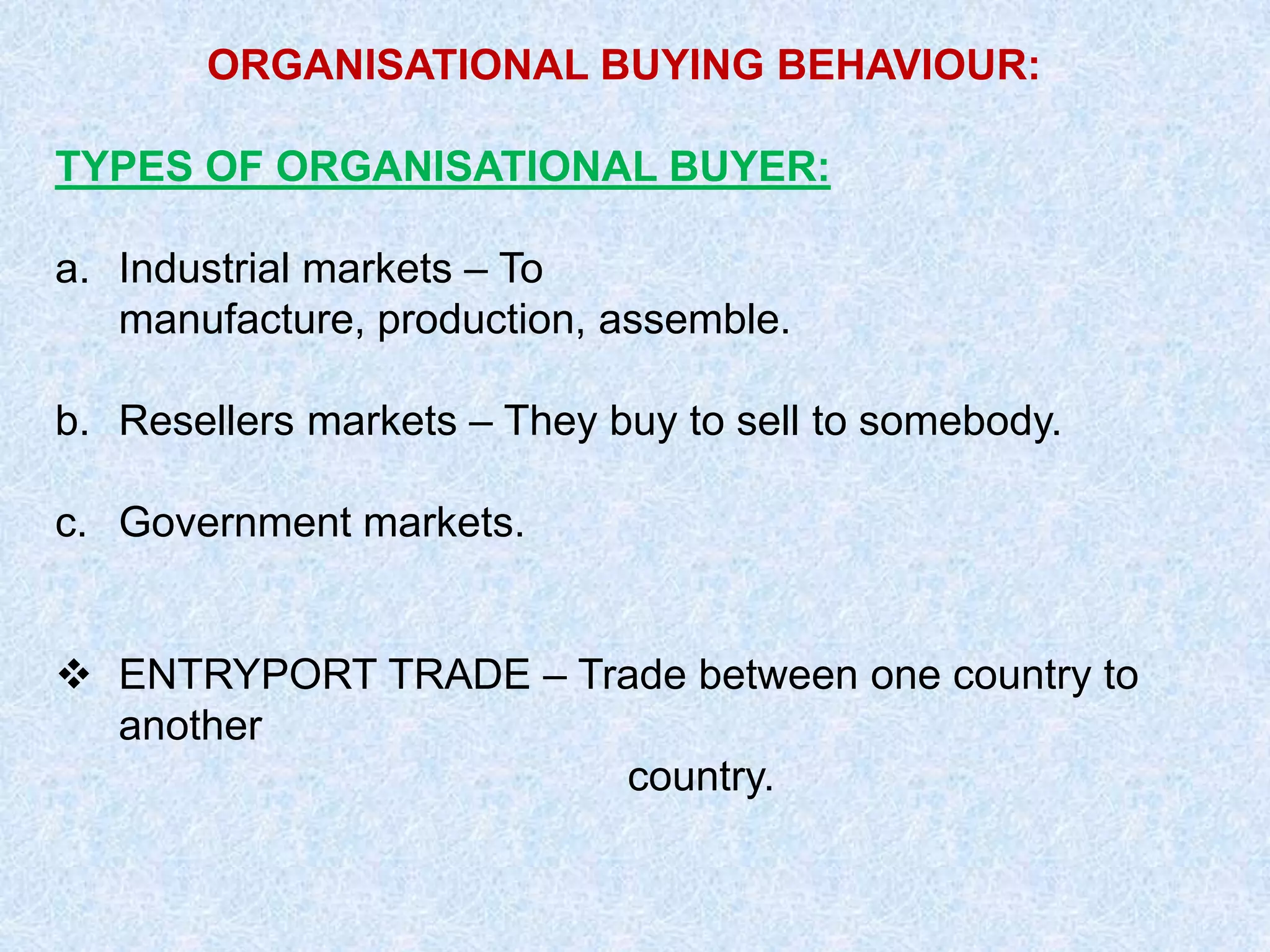
ORGANISATIONAL BUYING BEHAVIOUR:
TYPES OF ORGANISATIONAL BUYER:
a. Industrial markets – To
manufacture, production, assemble.
b. Resellers markets – They buy to sell to somebody.

c. Government markets.
 ENTRYPORT TRADE – Trade between one country to
another
country.
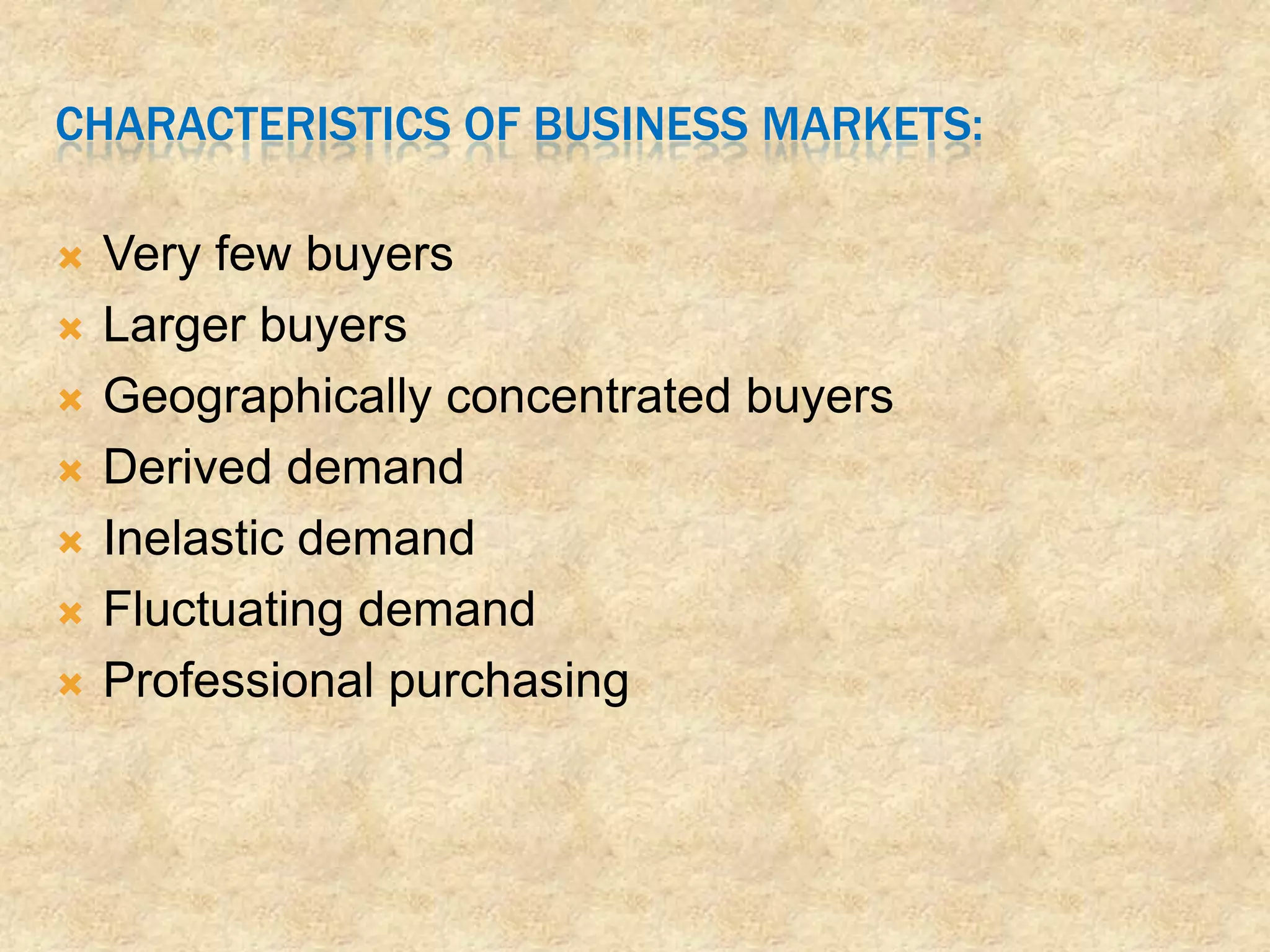
CHARACTERISTICS OF BUSINESS MARKETS:








Very few buyers
Larger buyers
Geographically concentrated buyers
Derived demand
Inelastic demand
Fluctuating demand
Professional purchasing
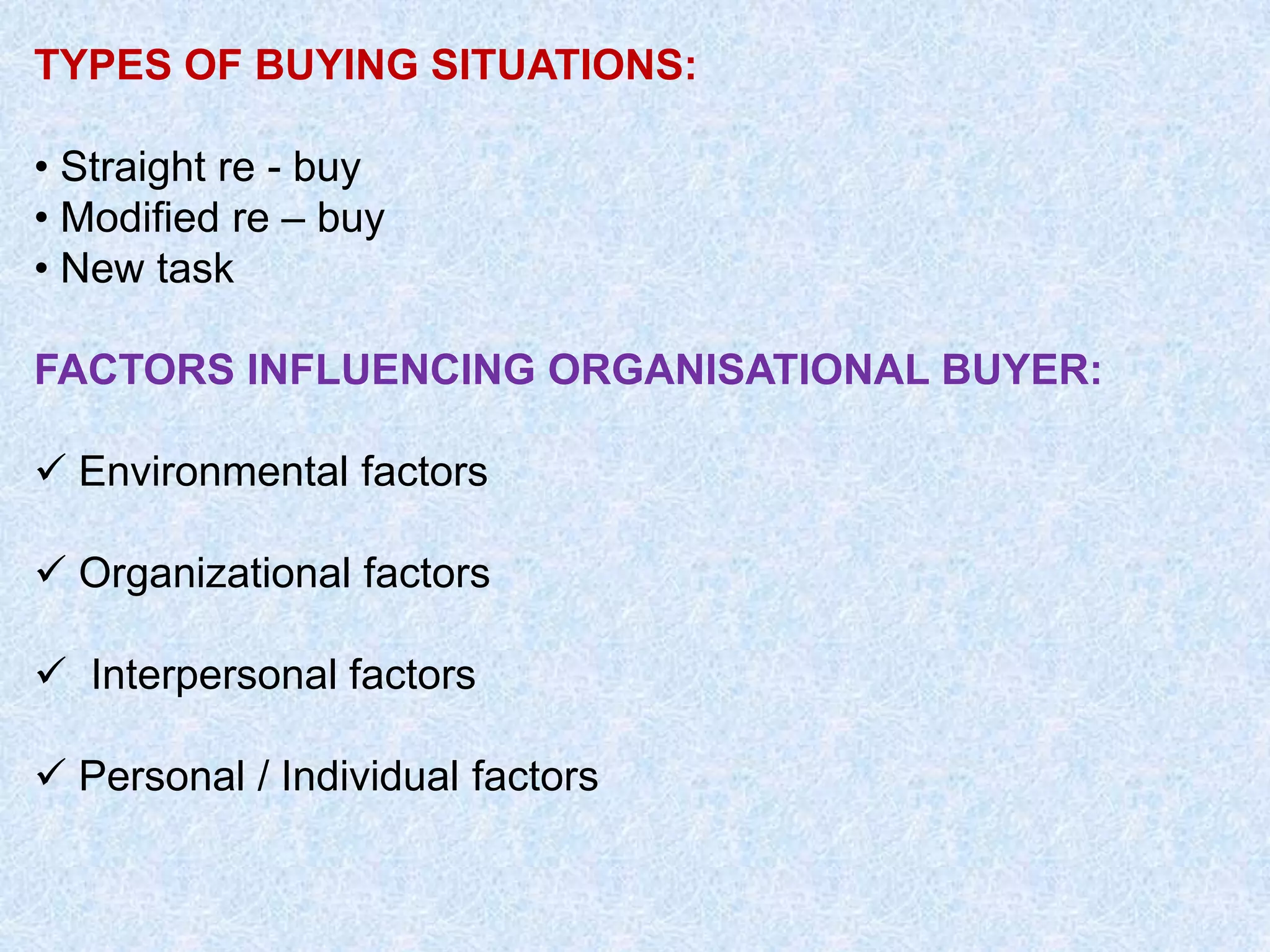
TYPES OF BUYING SITUATIONS:
• Straight re - buy
• Modified re – buy
• New task
FACTORS INFLUENCING ORGANISATIONAL BUYER:
 Environmental factors
 Organizational factors
 Interpersonal factors
 Personal / Individual factors
ORGANIZATIONAL BUYING PROCESS:
Problem recognition / Need recognition
 General need recognition
 Product specification
 Suppliers search
 Proposal solicitation
 Order routine – specification
 Performance review


Consumer behaviour

  • 1.
  • 2.
    CONSUMER BEHAVIOUR Consumer behavioris the reaction of individuals in obtaining, using goods & services of a particular type.   “It is the process where by individuals decide whether, when, where, how, from & whom to purchase goods & services” - C.G. WALTER & G.W. PAUL “Buyer behavior is all psychological, social & physical behavior of potential customers as they become aware of evaluate, purchase, consume & tell other people about the products & services”. - WEBSTER
  • 3.
    FACTORS INFLUENCING CONSUMERDECISION / BEHAVIOUR:  CULTURAL FACTORS: Sub – cultures, social class – caste, religion, languages etc….  SOCIAL FACTORS: Reference groups, family, role and status {Buying roles – initiators, decider, influencer, purchaser, consumer.}  PERSONAL FACTORS: The personal factors are age, life cycle stages, occupation, economic situation [ income], life style, personality, self – concept.  PSYCHOLOGICAL FACTORS: Motivation, perception, learning, beliefs & attitudes.
  • 4.
    STAGES/ PROCESS/ DECISIONMAKING OF CONSUMER BEHAVIOUR: NEED RECOGNITION INFORMATION SEARCH EVALUATING OF ALTERNATIVES [SCREENING] PURCHASE DECISION POST PURCHASE BEHAVIOUR
  • 5.
    MODELS OF CONSUMERBEHAVIOUR I. ECONOMIC MODEL { MARSHILLIAN MODEL }: a. Price effect b. Income effect c. Substitution effect [ Cross demand ] d. Variable proportions – Marginal utility
  • 6.
    II. PSYCHOLOGICAL MODEL:[ MOTIVATION ] {ABHRAHAM HEROLD} – MASLOWIAN/ NEED HIERARCHY / MOTIVATION MODEL OF MASLOWIAN. Higher level needs SelfActualization Self- esteem needs Social needs Lower / basic needs Safety / security needs Physiological / physical needs
  • 7.
    III. LEARNING /PAVLOVIAN MODEL : • • Drive, drivers, triggering cues. Non – triggering cues. IV. INPUT – PROCESS – OUTPUT MODEL : • • • • • Need recognition. Product awareness. Evaluation. Intention. Post purchase behavior.
  • 8.
    V. BUYER’S BLACKBOX MODEL : MARKETING STIMULI Product Price Promotion Place OTHER STIMULI Economic Cultural Technological Political BUYER’S BLACK BOX Characteristics Decision • Cultural Problem recognition • Social - BUYER’S RESPONSE •Product choice •Brand choice •Dealer choice Information •Purchase timing research •Personal Evaluation • Psychological purchase behavior •Purchase amount Decision post -
  • 9.
    VI. SOCIOLOGICAL MODELOF CONSUMER BEHAVIOUR: This model is concerned with the society. A consumer is a part of the society & he may be a member of many groups in a society. His buying behavior is influenced by these groups. By primary groups of family, friends & close associates influence a lot on his buying behavior. A consumer may be a member of political party. Where his dress norms are different. Thus, he has to buy things that confirmed to his life styles in different groups.
  • 10.
    FRUEDIAN MODEL OFCONSUMER BEHAVIOUR – SIGMUND FRUED Psycho – analytical model: ID – Which generates desire. EGO – Ego gives the ways to fulfill your desire. SUPER EGO – It will tell you what is good & what is bad for a human being.
  • 11.
    ORGANISATIONAL BUYING BEHAVIOUR: TYPESOF ORGANISATIONAL BUYER: a. Industrial markets – To manufacture, production, assemble. b. Resellers markets – They buy to sell to somebody. c. Government markets.  ENTRYPORT TRADE – Trade between one country to another country.
  • 12.
    CHARACTERISTICS OF BUSINESSMARKETS:        Very few buyers Larger buyers Geographically concentrated buyers Derived demand Inelastic demand Fluctuating demand Professional purchasing
  • 13.
    TYPES OF BUYINGSITUATIONS: • Straight re - buy • Modified re – buy • New task FACTORS INFLUENCING ORGANISATIONAL BUYER:  Environmental factors  Organizational factors  Interpersonal factors  Personal / Individual factors
  • 14.
    ORGANIZATIONAL BUYING PROCESS: Problemrecognition / Need recognition  General need recognition  Product specification  Suppliers search  Proposal solicitation  Order routine – specification  Performance review 