PHOTO
Theimagepartwith relationshipID rId2 wasnotfoundinthefile.
Title: Dolore magna aliqua ut enim ad
minim veniam quis nostrud exercitation
Dolore magna aliqua
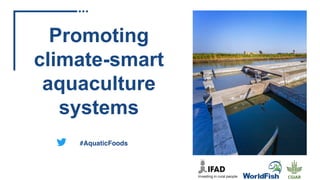
Promoting
climate-smart
aquaculture
systems
#AquaticFoods
Integrated Aquaculture-Agriculture,
with emphasis on Egypt
Abdel-Fattah M. El-Sayed
Oceanography Department, Faculty of
Science, Alexandria University, Alexandria,
Egypt
E mail: abdelfatah.yousif@alex.edu.eg
afmelsayed@gmail.com
Rationale:
ØEgypt is mostly desert and has the lowest percentage of agricultural land to
total area in the MENA region (3.7%).
ØAgriculture, consumes over 85 percent of available freshwater resources
ØEgypt faces severe water scarcity
ØThe continuous increase in Egyptian population makes the problem worse.
ØAccording to the FAO Regional Initiative on Water Scarcity for the Near East
and North Africa (WSI), the NENA region will be exposed to further severe
water scarcity issues in coming decades.
ØPer capita freshwater availability will likely decrease by about 50% by 2050.
ØAgriculture will need to face tough challenges
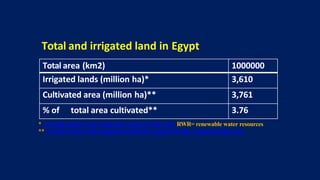
Total and irrigated land in Egypt
Total area (km2) 1000000
Irrigated lands (million ha)* 3,610
Cultivated area (million ha)** 3,761
% of total area cultivated** 3.76
* www.fao.org/nr/water/aquastat/countries/index.stm. RWR= renewable water resources
** www.fao.org/nr/water/aquastat/countries_regions/Profile_segments/index.stm
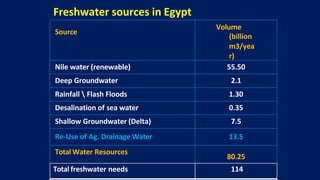
Freshwater sources in Egypt
Source
Volume
(billion
m3/yea
r)
Nile water (renewable) 55.50
Deep Groundwater 2.1
Rainfall  Flash Floods 1.30
Desalination of sea water 0.35
Shallow Groundwater (Delta) 7.5
Re-Use of Ag. Drainage Water 13.5
Total Water Resources
80.25
Total freshwater needs 114
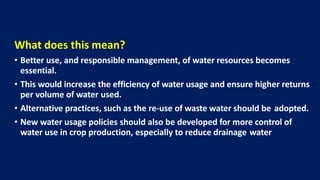
What does this mean?
• Better use, and responsible management, of water resources becomes
essential.
• This would increase the efficiency of water usage and ensure higher returns
per volume of water used.
• Alternative practices, such as the re-use of waste water should be adopted.
• New water usage policies should also be developed for more control of
water use in crop production, especially to reduce drainage water
Therefore:
The integration of aquaculture with other agricultural
and rural activities is an ideal solution
What is integrated aquaculture?
• Farming fish and shellfish with land crops and domestic animals.
• It leads to diversification of farm outputs, through the full utilization of
available resources and wastes.
• The outputs of one crop can be used as inputs for other crops.
• Diversified products … double cropping.
• This sytem is economically feasible and environmentally friendly.
• This system can enhance livelihoods and reduce poverty of rural
communities
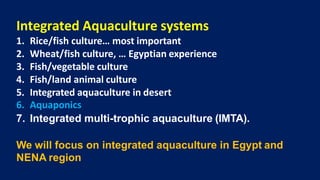
Integrated Aquaculture systems
1. Rice/fish culture… most important
2. Wheat/fish culture, … Egyptian experience
3. Fish/vegetable culture
4. Fish/land animal culture
5. Integrated aquaculture in desert
6. Aquaponics
7. Integrated multi-trophic aquaculture (IMTA).
We will focus on integrated aquaculture in Egypt and
NENA region
Integrated aquaculture/agriculture in Egypt,
and other NENA region
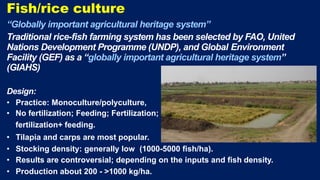
Fish/rice culture
“Globally important agricultural heritage system”
Traditional rice-fish farming system has been selected by FAO, United
Nations Development Programme (UNDP), and Global Environment
Facility (GEF) as a “globally important agricultural heritage system”
(GIAHS)
Design:
• Practice: Monoculture/polyculture,
• No fertilization; Feeding; Fertilization;
fertilization+ feeding.
• Tilapia and carps are most popular.
• Stocking density: generally low (1000-5000 fish/ha).
• Results are controversial; depending on the inputs and fish density.
• Production about 200 - >1000 kg/ha.
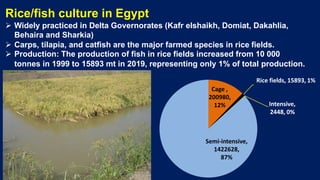
Cage ,
200980,
12% Intensive,
2448, 0%
Semi-intensive,
1422628,
87%
Rice/fish culture in Egypt
Ø Widely practiced in Delta Governorates (Kafr elshaikh, Domiat, Dakahlia,
Behaira and Sharkia)
Ø Carps, tilapia, and catfish are the major farmed species in rice fields.
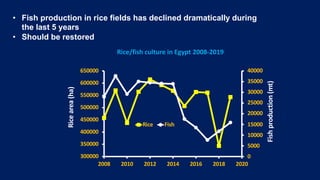
Ø Production: The production of fish in rice fields increased from 10 000
tonnes in 1999 to 15893 mt in 2019, representing only 1% of total production.
Rice fields, 15893, 1%
40000
35000
30000
25000
20000
15000
10000
5000
0
300000
350000
400000
450000
500000
550000
600000
650000
2008 2010 2012 2014 2016 2018 2020
Fish
production
(mt)
Rice
area
(ha)
Rice Fish
• Fish production in rice fields has declined dramatically during
the last 5 years
• Should be restored
Rice/fish culture in Egypt 2008-2019
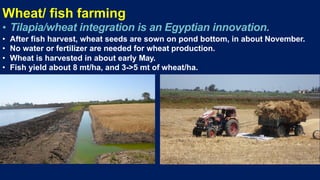
Wheat/ fish farming
• Tilapia/wheat integration is an Egyptian innovation.
• After fish harvest, wheat seeds are sown on pond bottom, in about November.
• No water or fertilizer are needed for wheat production.
• Wheat is harvested in about early May.
• Fish yield about 8 mt/ha, and 3->5 mt of wheat/ha.
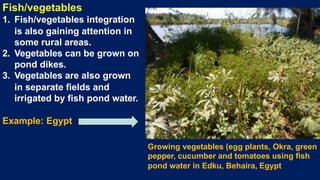
Fish/vegetables
1. Fish/vegetables integration
is also gaining attention in
some rural areas.
2. Vegetables can be grown on
pond dikes.
3. Vegetables are also grown
in separate fields and
irrigated by fish pond water.
Example: Egypt
Growing vegetables (egg plants, Okra, green
pepper, cucumber and tomatoes using fish
pond water in Edku, Behaira, Egypt
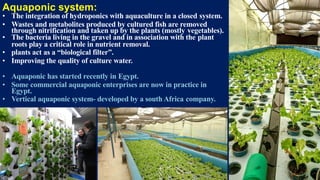
Aquaponic system:
• The integration of hydroponics with aquaculture in a closed system.
• Wastes and metabolites produced by cultured fish are removed
through nitrification and taken up by the plants (mostly vegetables).
• The bacteria living in the gravel and in association with the plant
roots play a critical role in nutrient removal.
• plants act as a “biological filter”.
• Improving the quality of culture water.
• Aquaponic has started recently in Egypt.
• Some commercial aquaponic enterprises are now in practice in
Egypt.
• Vertical aquaponic system- developed by a south Africa company.
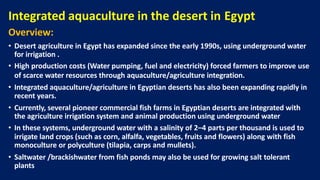
Integrated aquaculture in the desert in Egypt
Overview:
• Desert agriculture in Egypt has expanded since the early 1990s, using underground water
for irrigation .
• High production costs (Water pumping, fuel and electricity) forced farmers to improve use
of scarce water resources through aquaculture/agriculture integration..
• Integrated aquaculture/agriculture in Egyptian deserts has also been expanding rapidly in
recent years.
• Currently, several pioneer commercial fish farms in Egyptian deserts are integrated with
the agriculture irrigation system and animal production using underground water
• In these systems, underground water with a salinity of 2–4 parts per thousand is used to
irrigate land crops (such as corn, alfalfa, vegetables, fruits and flowers) along with fish
monoculture or polyculture (tilapia, carps and mullets).
• Saltwater /brackishwater from fish ponds may also be used for growing salt tolerant
plants
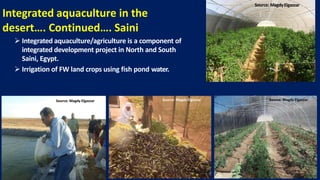
Integrated aquaculture in the
desert…. Continued…. Saini
Ø Integrated aquaculture/agriculture is a component of
integrated development project in North and South
Saini, Egypt.
Ø Irrigation of FW land crops using fish pond water.
Source: Magdy Elgazzar
Source: MagdyElgazzar
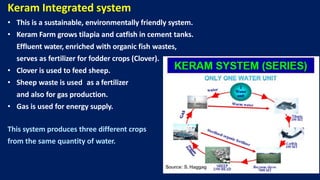
Keram Integrated system
• This is a sustainable, environmentally friendly system.
• Keram Farm grows tilapia and catfish in cement tanks.
Effluent water, enriched with organic fish wastes,
serves as fertilizer for fodder crops (Clover).
• Clover is used to feed sheep.
• Sheep waste is used as a fertilizer
and also for gas production.
• Gas is used for energy supply.
This system produces three different crops
from the same quantity of water.
Source: S. Haggag
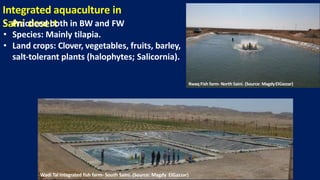
Rwaq Fish farm- North Saini. (Source: MagdyElGazzar)
Wadi Tal Integrated fish farm- South Saini. (Source: Magdy ElGazzar)
Integrated aquaculture in
Saini desert
• Practiced both in BW and FW
• Species: Mainly tilapia.
• Land crops: Clover, vegetables, fruits, barley,
salt-tolerant plants (halophytes; Salicornia).
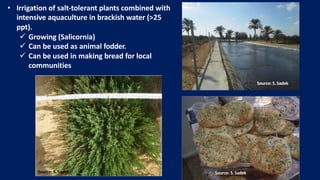
• Irrigation of salt-tolerant plants combined with
intensive aquaculture in brackish water (>25
ppt).
ü Growing (Salicornia)
ü Can be used as animal fodder.
ü Can be used in making bread for local
communities
Source: S.Sadek
Source: S.Sadek
Source: S.Sadek
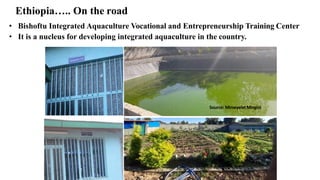
• Bishoftu Integrated Aquaculture Vocational and Entrepreneurship Training Center
• It is a nucleus for developing integrated aquaculture in the country.
Ethiopia….. On the road
Source: MinwyeletMingist
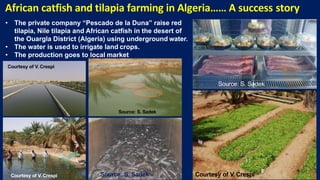
African catfish and tilapia farming in Algeria…… A success story
Courtesy of V.Crespi Courtesy of V. Crespi
• The private company “Pescado de la Duna” raise red
tilapia, Nile tilapia and African catfish in the desert of
the Ouargla District (Algeria) using underground water.
• The water is used to irrigate land crops.
• The production goes to local market
Courtesy of V. Crespi
Source: S. Sadek
Source: S. Sadek
Source: S. Sadek
Conclusion
• Aquaculture/agriculture integration is an excellent option for
rational and responsible use of the already scarce water sources in
NENA region.
• This system is economically feasible and environmentally friendly.
• This system can enhance livelihoods and reduce poverty in rural
communities, through crops diversification.
• This system can also be successfully adopted in aridlands, where
water is scarce and food production is limited.
Thank you
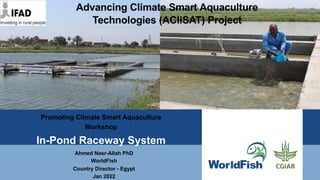
Promoting Climate Smart Aquaculture
Workshop
In-Pond Raceway System
Ahmed Nasr-Allah PhD
WorldFish
Country Director - Egypt
Jan 2022
Advancing Climate Smart Aquaculture
Technologies (ACliSAT) Project
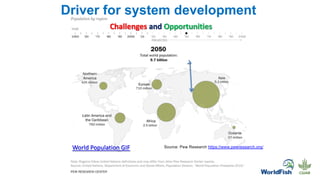
Source: Pew Research https://www.pewresearch.org/
World Population GIF
Challenges and Opportunities
Driver for system development
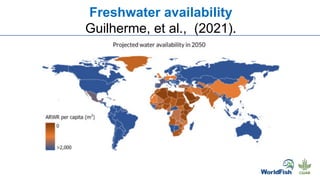
Freshwater availability
Guilherme, et al., (2021).
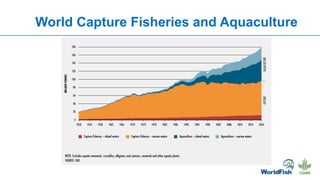
World Capture Fisheries and Aquaculture
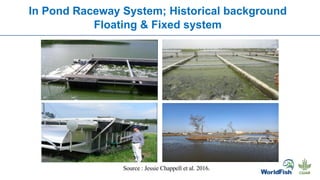
In Pond Raceway System; Historical background
Floating & Fixed system
Source : Jessie Chappell et al. 2016.
Advantages of IPRS
• Increase production per unit of land and
water
• Easier fish health management; and
apply biosecurity measures
• Capture of nutrients for removal and use
in plant production farms, methane
• Produce high quality product and easy to
market life fish
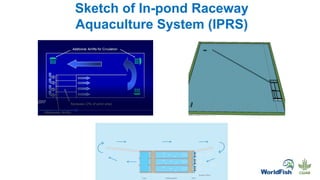
Sketch of In-pond Raceway
Aquaculture System (IPRS)
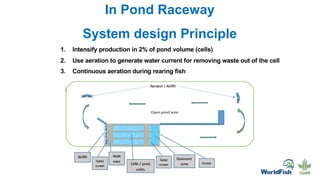
In Pond Raceway
System design Principle
1. Intensify production in 2% of pond volume (cells)
2. Use aeration to generate water current for removing waste out of the cell
3. Continuous aeration during rearing fish
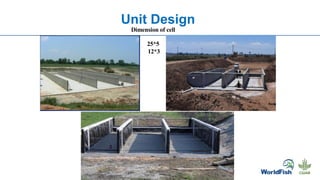
Unit Design
Dimension of cell
25*5
12*3
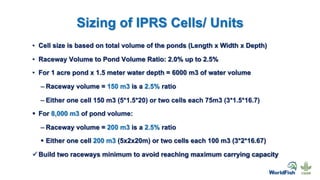
Sizing of IPRS Cells/ Units
• Cell size is based on total volume of the ponds (Length x Width x Depth)
• Raceway Volume to Pond Volume Ratio: 2.0% up to 2.5%
• For 1 acre pond x 1.5 meter water depth = 6000 m3 of water volume
– Raceway volume = 150 m3 is a 2.5% ratio
– Either one cell 150 m3 (5*1.5*20) or two cells each 75m3 (3*1.5*16.7)
§ For 8,000 m3 of pond volume:
– Raceway volume = 200 m3 is a 2.5% ratio
§ Either one cell 200 m3 (5x2x20m) or two cells each 100 m3 (3*2*16.67)
üBuild two raceways minimum to avoid reaching maximum carrying capacity
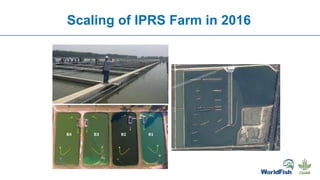
Scaling of IPRS Farm in 2016
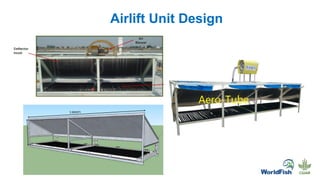
Airlift Unit Design
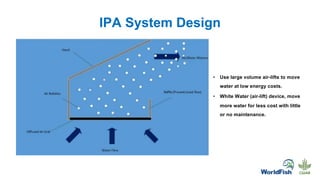
IPA System Design
• Use large volume air-lifts to move
water at low energy costs.
• White Water (air-lift) device, move
more water for less cost with little
or no maintenance.
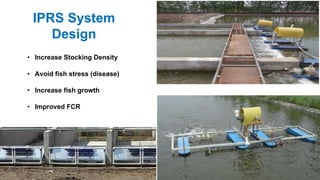
IPRS System
Design
• Increase Stocking Density
• Avoid fish stress (disease)
• Increase fish growth
• Improved FCR
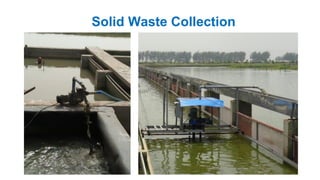
Solid Waste Collection
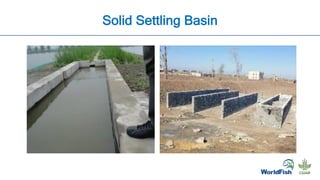
Solid Settling Basin
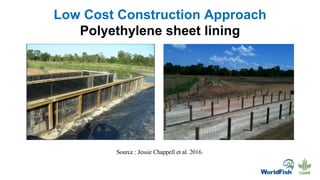
Low Cost Construction Approach
Polyethylene sheet lining
Source : Jessie Chappell et al. 2016.
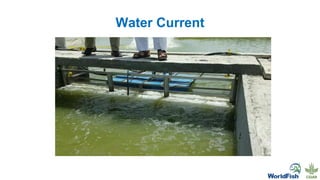
Water Current
43
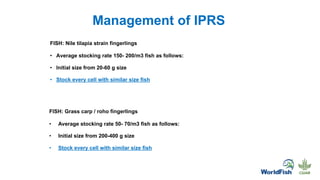
Management of IPRS
FISH: Nile tilapia strain fingerlings
• Average stocking rate 150- 200/m3 fish as follows:
• Initial size from 20-60 g size
• Stock every cell with similar size fish
FISH: Grass carp / roho fingerlings
• Average stocking rate 50- 70/m3 fish as follows:
• Initial size from 200-400 g size
• Stock every cell with similar size fish
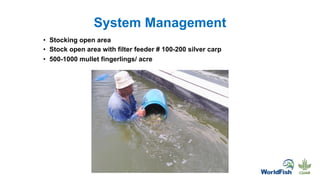
System Management
• Stocking open area
• Stock open area with filter feeder # 100-200 silver carp
• 500-1000 mullet fingerlings/ acre
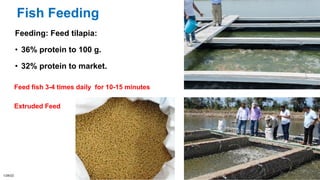
Fish Feeding
Feeding: Feed tilapia:
• 36% protein to 100 g.
• 32% protein to market.
1/28/22 46
Feed fish 3-4 times daily for 10-15 minutes
Extruded Feed
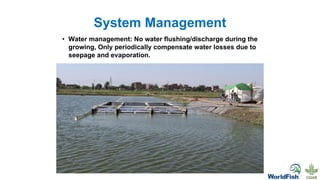
System Management
• Water management: No water flushing/discharge during the
growing, Only periodically compensate water losses due to
seepage and evaporation.
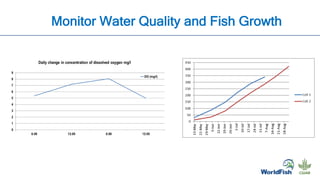
Monitor Water Quality and Fish Growth
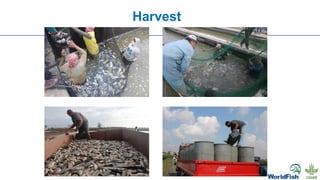
Harvest
Thank You
Theimagepartwith relationshipID rId2 wasnotfoundinthefile.
This work was undertaken as part of
In partnership with
Theimagepartwith relationshipID rId2 wasnotfoundinthefile. Theimagepartwith relationshipID rId2 wasnotfoundinthefile.
Theimagepartwith relationshipID rId2 wasnotfoundinthefile.
Thank You

Promoting climate smart aquaculture systems

  • 1.
    PHOTO Theimagepartwith relationshipID rId2wasnotfoundinthefile. Title: Dolore magna aliqua ut enim ad minim veniam quis nostrud exercitation Dolore magna aliqua Promoting climate-smart aquaculture systems #AquaticFoods
  • 2.
    Integrated Aquaculture-Agriculture, with emphasison Egypt Abdel-Fattah M. El-Sayed Oceanography Department, Faculty of Science, Alexandria University, Alexandria, Egypt E mail: abdelfatah.yousif@alex.edu.eg afmelsayed@gmail.com
  • 3.
    Rationale: ØEgypt is mostlydesert and has the lowest percentage of agricultural land to total area in the MENA region (3.7%). ØAgriculture, consumes over 85 percent of available freshwater resources ØEgypt faces severe water scarcity ØThe continuous increase in Egyptian population makes the problem worse. ØAccording to the FAO Regional Initiative on Water Scarcity for the Near East and North Africa (WSI), the NENA region will be exposed to further severe water scarcity issues in coming decades. ØPer capita freshwater availability will likely decrease by about 50% by 2050. ØAgriculture will need to face tough challenges
  • 4.
    Total and irrigatedland in Egypt Total area (km2) 1000000 Irrigated lands (million ha)* 3,610 Cultivated area (million ha)** 3,761 % of total area cultivated** 3.76 * www.fao.org/nr/water/aquastat/countries/index.stm. RWR= renewable water resources ** www.fao.org/nr/water/aquastat/countries_regions/Profile_segments/index.stm
  • 5.
    Freshwater sources inEgypt Source Volume (billion m3/yea r) Nile water (renewable) 55.50 Deep Groundwater 2.1 Rainfall Flash Floods 1.30 Desalination of sea water 0.35 Shallow Groundwater (Delta) 7.5 Re-Use of Ag. Drainage Water 13.5 Total Water Resources 80.25 Total freshwater needs 114
  • 6.
    What does thismean? • Better use, and responsible management, of water resources becomes essential. • This would increase the efficiency of water usage and ensure higher returns per volume of water used. • Alternative practices, such as the re-use of waste water should be adopted. • New water usage policies should also be developed for more control of water use in crop production, especially to reduce drainage water
  • 7.
    Therefore: The integration ofaquaculture with other agricultural and rural activities is an ideal solution
  • 8.
    What is integratedaquaculture? • Farming fish and shellfish with land crops and domestic animals. • It leads to diversification of farm outputs, through the full utilization of available resources and wastes. • The outputs of one crop can be used as inputs for other crops. • Diversified products … double cropping. • This sytem is economically feasible and environmentally friendly. • This system can enhance livelihoods and reduce poverty of rural communities
  • 9.
    Integrated Aquaculture systems 1.Rice/fish culture… most important 2. Wheat/fish culture, … Egyptian experience 3. Fish/vegetable culture 4. Fish/land animal culture 5. Integrated aquaculture in desert 6. Aquaponics 7. Integrated multi-trophic aquaculture (IMTA). We will focus on integrated aquaculture in Egypt and NENA region
  • 10.
    Integrated aquaculture/agriculture inEgypt, and other NENA region
  • 11.
    Fish/rice culture “Globally importantagricultural heritage system” Traditional rice-fish farming system has been selected by FAO, United Nations Development Programme (UNDP), and Global Environment Facility (GEF) as a “globally important agricultural heritage system” (GIAHS) Design: • Practice: Monoculture/polyculture, • No fertilization; Feeding; Fertilization; fertilization+ feeding. • Tilapia and carps are most popular. • Stocking density: generally low (1000-5000 fish/ha). • Results are controversial; depending on the inputs and fish density. • Production about 200 - >1000 kg/ha.
  • 12.
    Cage , 200980, 12% Intensive, 2448,0% Semi-intensive, 1422628, 87% Rice/fish culture in Egypt Ø Widely practiced in Delta Governorates (Kafr elshaikh, Domiat, Dakahlia, Behaira and Sharkia) Ø Carps, tilapia, and catfish are the major farmed species in rice fields. Ø Production: The production of fish in rice fields increased from 10 000 tonnes in 1999 to 15893 mt in 2019, representing only 1% of total production. Rice fields, 15893, 1%
  • 13.
    40000 35000 30000 25000 20000 15000 10000 5000 0 300000 350000 400000 450000 500000 550000 600000 650000 2008 2010 20122014 2016 2018 2020 Fish production (mt) Rice area (ha) Rice Fish • Fish production in rice fields has declined dramatically during the last 5 years • Should be restored Rice/fish culture in Egypt 2008-2019
  • 14.
    Wheat/ fish farming •Tilapia/wheat integration is an Egyptian innovation. • After fish harvest, wheat seeds are sown on pond bottom, in about November. • No water or fertilizer are needed for wheat production. • Wheat is harvested in about early May. • Fish yield about 8 mt/ha, and 3->5 mt of wheat/ha.
  • 15.
    Fish/vegetables 1. Fish/vegetables integration isalso gaining attention in some rural areas. 2. Vegetables can be grown on pond dikes. 3. Vegetables are also grown in separate fields and irrigated by fish pond water. Example: Egypt Growing vegetables (egg plants, Okra, green pepper, cucumber and tomatoes using fish pond water in Edku, Behaira, Egypt
  • 16.
    Aquaponic system: • Theintegration of hydroponics with aquaculture in a closed system. • Wastes and metabolites produced by cultured fish are removed through nitrification and taken up by the plants (mostly vegetables). • The bacteria living in the gravel and in association with the plant roots play a critical role in nutrient removal. • plants act as a “biological filter”. • Improving the quality of culture water. • Aquaponic has started recently in Egypt. • Some commercial aquaponic enterprises are now in practice in Egypt. • Vertical aquaponic system- developed by a south Africa company.
  • 17.
    Integrated aquaculture inthe desert in Egypt Overview: • Desert agriculture in Egypt has expanded since the early 1990s, using underground water for irrigation . • High production costs (Water pumping, fuel and electricity) forced farmers to improve use of scarce water resources through aquaculture/agriculture integration.. • Integrated aquaculture/agriculture in Egyptian deserts has also been expanding rapidly in recent years. • Currently, several pioneer commercial fish farms in Egyptian deserts are integrated with the agriculture irrigation system and animal production using underground water • In these systems, underground water with a salinity of 2–4 parts per thousand is used to irrigate land crops (such as corn, alfalfa, vegetables, fruits and flowers) along with fish monoculture or polyculture (tilapia, carps and mullets). • Saltwater /brackishwater from fish ponds may also be used for growing salt tolerant plants
  • 18.
    Integrated aquaculture inthe desert…. Continued…. Saini Ø Integrated aquaculture/agriculture is a component of integrated development project in North and South Saini, Egypt. Ø Irrigation of FW land crops using fish pond water. Source: Magdy Elgazzar Source: Magdy Elgazzar Source: Magdy Elgazzar Source: MagdyElgazzar
  • 19.
    Keram Integrated system •This is a sustainable, environmentally friendly system. • Keram Farm grows tilapia and catfish in cement tanks. Effluent water, enriched with organic fish wastes, serves as fertilizer for fodder crops (Clover). • Clover is used to feed sheep. • Sheep waste is used as a fertilizer and also for gas production. • Gas is used for energy supply. This system produces three different crops from the same quantity of water. Source: S. Haggag
  • 20.
    Rwaq Fish farm-North Saini. (Source: MagdyElGazzar) Wadi Tal Integrated fish farm- South Saini. (Source: Magdy ElGazzar) Integrated aquaculture in Saini desert • Practiced both in BW and FW • Species: Mainly tilapia. • Land crops: Clover, vegetables, fruits, barley, salt-tolerant plants (halophytes; Salicornia).
  • 21.
    • Irrigation ofsalt-tolerant plants combined with intensive aquaculture in brackish water (>25 ppt). ü Growing (Salicornia) ü Can be used as animal fodder. ü Can be used in making bread for local communities Source: S.Sadek Source: S.Sadek Source: S.Sadek
  • 22.
    • Bishoftu IntegratedAquaculture Vocational and Entrepreneurship Training Center • It is a nucleus for developing integrated aquaculture in the country. Ethiopia….. On the road Source: MinwyeletMingist
  • 23.
    African catfish andtilapia farming in Algeria…… A success story Courtesy of V.Crespi Courtesy of V. Crespi • The private company “Pescado de la Duna” raise red tilapia, Nile tilapia and African catfish in the desert of the Ouargla District (Algeria) using underground water. • The water is used to irrigate land crops. • The production goes to local market Courtesy of V. Crespi Source: S. Sadek Source: S. Sadek Source: S. Sadek
  • 24.
    Conclusion • Aquaculture/agriculture integrationis an excellent option for rational and responsible use of the already scarce water sources in NENA region. • This system is economically feasible and environmentally friendly. • This system can enhance livelihoods and reduce poverty in rural communities, through crops diversification. • This system can also be successfully adopted in aridlands, where water is scarce and food production is limited.
  • 25.
  • 26.
    Promoting Climate SmartAquaculture Workshop In-Pond Raceway System Ahmed Nasr-Allah PhD WorldFish Country Director - Egypt Jan 2022 Advancing Climate Smart Aquaculture Technologies (ACliSAT) Project
  • 27.
    Source: Pew Researchhttps://www.pewresearch.org/ World Population GIF Challenges and Opportunities Driver for system development
  • 28.
  • 29.
    World Capture Fisheriesand Aquaculture
  • 30.
    In Pond RacewaySystem; Historical background Floating & Fixed system Source : Jessie Chappell et al. 2016.
  • 31.
    Advantages of IPRS •Increase production per unit of land and water • Easier fish health management; and apply biosecurity measures • Capture of nutrients for removal and use in plant production farms, methane • Produce high quality product and easy to market life fish
  • 32.
    Sketch of In-pondRaceway Aquaculture System (IPRS)
  • 33.
    In Pond Raceway Systemdesign Principle 1. Intensify production in 2% of pond volume (cells) 2. Use aeration to generate water current for removing waste out of the cell 3. Continuous aeration during rearing fish
  • 34.
  • 35.
    Sizing of IPRSCells/ Units • Cell size is based on total volume of the ponds (Length x Width x Depth) • Raceway Volume to Pond Volume Ratio: 2.0% up to 2.5% • For 1 acre pond x 1.5 meter water depth = 6000 m3 of water volume – Raceway volume = 150 m3 is a 2.5% ratio – Either one cell 150 m3 (5*1.5*20) or two cells each 75m3 (3*1.5*16.7) § For 8,000 m3 of pond volume: – Raceway volume = 200 m3 is a 2.5% ratio § Either one cell 200 m3 (5x2x20m) or two cells each 100 m3 (3*2*16.67) üBuild two raceways minimum to avoid reaching maximum carrying capacity
  • 36.
    Scaling of IPRSFarm in 2016
  • 37.
  • 38.
    IPA System Design •Use large volume air-lifts to move water at low energy costs. • White Water (air-lift) device, move more water for less cost with little or no maintenance.
  • 39.
    IPRS System Design • IncreaseStocking Density • Avoid fish stress (disease) • Increase fish growth • Improved FCR
  • 40.
  • 41.
  • 42.
    Low Cost ConstructionApproach Polyethylene sheet lining Source : Jessie Chappell et al. 2016.
  • 43.
  • 44.
    Management of IPRS FISH:Nile tilapia strain fingerlings • Average stocking rate 150- 200/m3 fish as follows: • Initial size from 20-60 g size • Stock every cell with similar size fish FISH: Grass carp / roho fingerlings • Average stocking rate 50- 70/m3 fish as follows: • Initial size from 200-400 g size • Stock every cell with similar size fish
  • 45.
    System Management • Stockingopen area • Stock open area with filter feeder # 100-200 silver carp • 500-1000 mullet fingerlings/ acre
  • 46.
    Fish Feeding Feeding: Feedtilapia: • 36% protein to 100 g. • 32% protein to market. 1/28/22 46 Feed fish 3-4 times daily for 10-15 minutes Extruded Feed
  • 47.
    System Management • Watermanagement: No water flushing/discharge during the growing, Only periodically compensate water losses due to seepage and evaporation.
  • 48.
    Monitor Water Qualityand Fish Growth
  • 49.
  • 50.
    Thank You Theimagepartwith relationshipIDrId2 wasnotfoundinthefile. This work was undertaken as part of In partnership with Theimagepartwith relationshipID rId2 wasnotfoundinthefile. Theimagepartwith relationshipID rId2 wasnotfoundinthefile. Theimagepartwith relationshipID rId2 wasnotfoundinthefile. Theimagepartwith relationshipID rId2 wasnotfoundinthefile. Thank You