01/24/18
1
Marine Fish Stock AssessmentMarine Fish Stock Assessment
Models & AnalysisModels & Analysis
M Srinath
 Overview of fish population model dynamics
 What is fish stock assessment
 Stock assessment process
 Assumptions
 Approach
 Holistic models
 Yield or yield per recruit model
 VPA(Cohort analysis)
 Length Cohort Analysis
 Time series analysis
 Ecological modeling
 Simulation modeling
 Worked examples of models
Marine Fish Stock AssessmentMarine Fish Stock Assessment
Models & AnalysisModels & Analysis
01/24/18
3
Fish Population Dynamics ModelFish Population Dynamics Model
01/24/18
4
Stock assessmentStock assessment
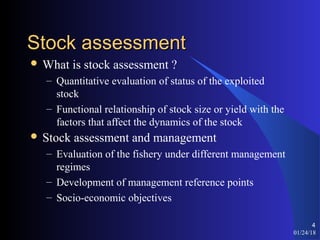
 What is stock assessment ?
– Quantitative evaluation of status of the exploited
stock
– Functional relationship of stock size or yield with the
factors that affect the dynamics of the stock
 Stock assessment and management
– Evaluation of the fishery under different management
regimes
– Development of management reference points
– Socio-economic objectives
01/24/18
5
A typical stock assessment processA typical stock assessment process
Ecosystem based
01/24/18
6
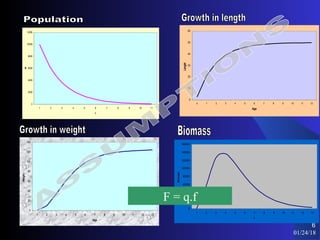
0
2000
4000
6000
8000
10000
12000
1 2 3 4 5 6 7 8 9 10 11
t
N
0
10
20
30
40
50
60
0 1 2 3 4 5 6 7 8 9 10 11 12
Age
Length
0
20
40
60
80
100
120
140
1 2 3 4 5 6 7 8 9 10 11 12 13
Age
Weight
0
20000
40000
60000
80000
100000
120000
140000
160000
1 2 3 4 5 6 7 8 9 10 11 12 13
t
Biomass
F = q.f
01/24/18
7
ApproachApproach
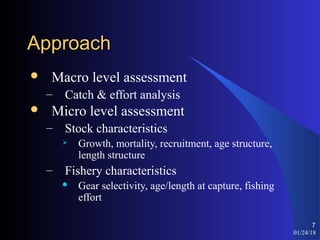
 Macro level assessment
– Catch & effort analysis
 Micro level assessment
– Stock characteristics
 Growth, mortality, recruitment, age structure,
length structure
– Fishery characteristics
 Gear selectivity, age/length at capture, fishing
effort
Summary of models & methods commonly used
Holistic or macro or surplus production models
 This approach involves methods of estimation of the past
and current level of biomass and the state of the stock,
from the analysis of the relationship between effort and
catch. It is based on a biomass growth equation, the
relationship F=q·E and the catch equation C=F· B, where
F is the fishing mortality, E is the fishing effort and q the
coefficient of catchability
 Holistic or macro models do not consider events within
the population and ignore growth and mortality of
individuals and the effect of mesh size on age of fish
capture
 These models consider mainly the four basic quantities
namely, population biomass (B), the catch (Y), fishing
effort (f) and net natural rate of increase
Summary of models & methods commonly used
Holistic or macro or surplus production models
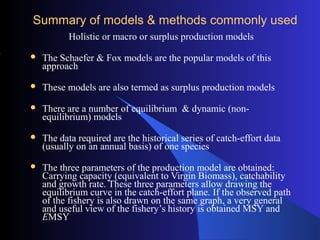
 The Schaefer & Fox models are the popular models of this
approach
 These models are also termed as surplus production models
 There are a number of equilibrium & dynamic (non-
equilibrium) models
 The data required are the historical series of catch-effort data
(usually on an annual basis) of one species
 The three parameters of the production model are obtained:
Carrying capacity (equivalent to Virgin Biomass), catchability
and growth rate. These three parameters allow drawing the
equilibrium curve in the catch-effort plane. If the observed path
of the fishery is also drawn on the same graph, a very general
and useful view of the fishery’s history is obtained MSY and
EMSY
Summary of models & methods commonly usedSummary of models & methods commonly used
Holistic or macro or surplus production models (contd)
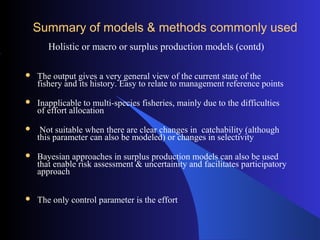
 The output gives a very general view of the current state of the
fishery and its history. Easy to relate to management reference points
 Inapplicable to multi-species fisheries, mainly due to the difficulties
of effort allocation
 Not suitable when there are clear changes in catchability (although
this parameter can also be modeled) or changes in selectivity
 Bayesian approaches in surplus production models can also be used
that enable risk assessment & uncertainity and facilitates participatory
approach
 The only control parameter is the effort
Summary of models & methods commonly used
Yield or Yield per Recruit Model
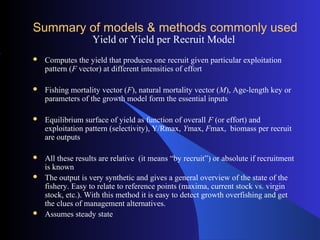
 Computes the yield that produces one recruit given particular exploitation
pattern (F vector) at different intensities of effort
 Fishing mortality vector (F), natural mortality vector (M), Age-length key or
parameters of the growth model form the essential inputs
 Equilibrium surface of yield as function of overall F (or effort) and
exploitation pattern (selectivity), Y/Rmax, Ymax, Fmax, biomass per recruit
are outputs
 All these results are relative (it means “by recruit”) or absolute if recruitment
is known
 The output is very synthetic and gives a general overview of the state of the
fishery. Easy to relate to reference points (maxima, current stock vs. virgin
stock, etc.). With this method it is easy to detect growth overfishing and get
the clues of management alternatives.
 Assumes steady state
Summary of models & methods commonly used
VPA (Virtual Population Analysis).
Cohort Analysis
 From catch-at-age data and some parameters, VPA reconstructs the past
history of stock in terms of number of individuals and fishing mortalities.
The VPA and its variants is the most standard and reliable method of stock
assessment
 Catch-at-age of several years by operational unit (this implies previous age
estimations and length composition of catches), M vector, Terminal Fs (this
implies tuning, through surveys or CPUEs) and length-weight relationship (if
biomasses are wanted in the output) are the inputs required
 Numbers of individuals and biomass at sea by year and age (thus series of
recruitment, total biomass at sea etc.), Fishing mortality by year, age and
operational unit are the outputs
 The most efficient standard assessment method requiring many parameters,
some of them assumed (M) and tuning of fishing effort
Summary of models & methods commonly usedSummary of models & methods commonly used
Summary of models & methods commonly used
LCA (Length Cohort Analysis)
 A modification of VPA, essentially is a VPA on a pseudo-
cohort that can be run also on the length frequency distribution
of the catch.
 Steady state is assumed
 A length or age frequency distribution of the catch representing
the pseudocohort, M vector, terminal Fs (this implies tuning,
through surveys or CPUEs), length-weight relationship (if
biomasses are wanted in the output), total catch in biomass by
operational unit are the inputs
 Numbers of individuals and biomass at sea by age or length
(recruitment, total biomass at sea etc.), fishing mortality by age
or length and operational unit
 With short data series (even one year) something can be said
about the state of the stock. Since the steady state is assumed
(pseudo-cohort), important biases can be estimated if this
hypothesis is far from reality.
Summary of models & methods commonly used
Time series analysis
 The standard ARIMA method is the analysis of a time series (usually
monthly structured) which is split off into trend (including cycles),
seasonality and noise. Some further developments, as transfer functions,
allow to associate these outputs with environmental or other external
variables, or intervention analysis to detect anomalous events
 Time series of data, usually catch, CPUE, effort, data on vessel
characteristics, environmental etc
 Most frequently the trend and seasonality of the variable analysed are
obtained. When additional information (i.e. environmental) is added, it is
possible to relate the behaviour of the dependent variable to other variables,
such as effects of environment and also enables short term forecasting
 Absence of underlying biological hypotheses has both pros and cons. It is a
powerful method to reveal hidden structures in the data. Useful for short term
forecasting, with due caution in its interpretation
Summary of models & methods commonly used
Ecological modeling
 Multispecies modeling
 Some approaches are extensions of the indirect assessment methods taking into
account the biological interaction between species (technical, or technological
interaction can be studied by the classical methods)
 Multispecies VPA or MSVPA belong to this group
 Ecological modeling based on mass balance and food webs approach –
ECOPATH & ECOSIM
 In addition to the single species analysis data needs, it requires the interaction
factors, particularly the quantification of the predator-prey relationships, diet
composition data etc
 Quantified pathways of matter and energy between the different species (in
steady state) and other parameters such as predation, technological and
biological interactions and indicators of health of fisheries ecosystem
 It approaches much better the real ecological system than the single species does
 Huge amount of biological information is required and so also the generated
outputs
 The number of interaction parameters to be estimated grows with the square of
species considered
Summary of models & methods commonly used
Simulation modeling
 Indirect (population dynamics) methods that reproduce in the computer aided
dynamics of a stock and a fishery
 Often with the aim to test the effects of different environmental situations or
alternative management actions
 All population dynamics parameters and stock-recruitment relationship
 Projection to the future of different variables (biomass, catch) and trends at
short and medium term
 In the case of stochastic models confidence intervals are provided
 Several management scenarios are created and depicted
 Very useful to analyse and compare the possible results of alternative
management measures at short and medium term
 Uncertainties in the projection, particularly because of the stock-recruitment
relationship are also quantified
 Useful to understand complex natural systems
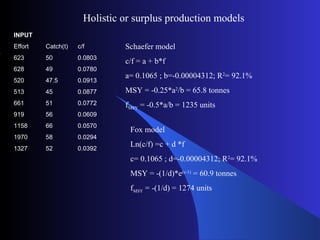
INPUT
Effort Catch(t) c/f
623 50 0.0803
628 49 0.0780
520 47.5 0.0913
513 45 0.0877
661 51 0.0772
919 56 0.0609
1158 66 0.0570
1970 58 0.0294
1327 52 0.0392
Holistic or surplus production models
Schaefer model
c/f = a + b*f
a= 0.1065 ; b=-0.00004312; R2
= 92.1%
MSY = -0.25*a2
/b = 65.8 tonnes
fMSY = -0.5*a/b = 1235 units
Fox model
Ln(c/f) =c + d *f
c= 0.1065 ; d=-0.00004312; R2
= 92.1%
MSY = -(1/d)*e(c-1)
= 60.9 tonnes
fMSY = -(1/d) = 1274 units
Beverton & Holt yield per recruit model
INPUT
L∞ 28.4cm
W∞ 286gm
K 0.37
M 1.1
Lc 10.2
Lr 2.03
tc 1
tr 0
tzero -0.2
a 0.0125
b 3
a & b denote length-
weight relationship
parameters
Y/R = F*exp(-M*(tc-tr))*W∞*[1/Z – 3S/(Z+K)+ 3S2
/(Z+2K) – S3
/(Z+3K)]
Where S= exp[-K*(tc-tzero)]
Yield per recruit model
0
1
2
3
4
5
6
0 0.1 0.2 0.3 0.4 0.5 0.6 0.7 0.8 0.9 1 1.1 1.2 1.3 1.4 1.5 1.6 1.7 1.8 1.9 2
F
Y/R
Biomass per recruit curve
0.00
2.00
4.00
6.00
8.00
10.00
12.00
14.00
16.00
0 0.5 1 1.5 2 2.5
F
B/R
Length Cohort Analysis(LCA)
INPUT
 Length frequency data (preferably, averaged over a period of time. Say,
over 3 to 5 years)
 Estimates of VBGF Growth in length parameters L∞ and K.
 Instantaneous rate of natural mortality M
 Estimates of parameters a and b of the l-w relationship w = a. Lb
 Formulation
Let
 C(L1,L2) be the numbers caught between lengths L1 and L2
 N(L1) be the numbers in sea that attain length L1
 N(L2) be the numbers in sea that attain length L2
 H(L1,L2) = [(L∞ - L1)/(L∞ - L2) ] (M/2K)
Length Cohort analysis(LCA)
Formulae used in the analysis
 N(L1) = [N(L2)*H(L1,L2) + C(L1,L2)]*H(L1,L2)
 C(L1,L2) = N(L1) *(F/Z)* [ 1 – exp(-z* Δt) ]
 Where Δt = (1/K) * ln [(L∞ - L1)/(L∞ - L2) ]
 Calculations
 Start with the last length group
 Compute H for each length group H(L1,L2) = [(L∞ - L1)/(L∞ - L2) ] (M/2K)
 Compute average weight for each length group as w(L1,L2)= a*[(L1+L2)/2]b
 Assume a value F/Z for the last length group ( how to choose terminal F/Z ?)
 Compute the numbers in sea for the last length group by dividing the catch in numbers by the terminal
F/Z
 Compute, recursively, N(L1) for each length group
 Compute F(L1,L2)/(Z(L1,L2) = C(L1,L2)/(N(L1) – N(L2))
 Compute F(L1,L2) = M*(F(L1,L2)(/Z(L1,L2)) / (1 – (F(L1,L2)/Z(L1,L2)))
 Compute Z(L1,L2) = F(L1,L2)+M
 Compute average annual numbers in the sea = [N(L1) – N(L2)]/Z(L1,l2)= avg.N(L1,L2)
 Catch(yield) in weight = C(L1,L2)*w(L1,L2)
 Mean biomass = avg.N(L1,L2)*w(L1,L2)
 Caution:: Approximation valid only when F* Δt is upto 1.2 and M* Δt upto 0.3
Output from LCA
Total mortality in each length group
Fishing mortality in each length group
Numbers in sea at the beginning of length group
Mean numbers in sea in each length group
Mean biomass(in weight) of each length group
Length Cohort Analysis(LCA)
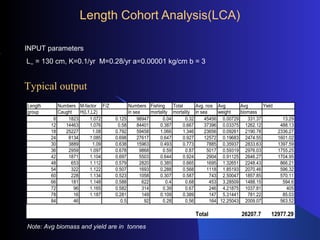
INPUT parameters
L∞ = 130 cm, K=0.1/yr M=0.28/yr a=0.00001 kg/cm b = 3
Note: Avg biomass and yield are in tonnes
Length Numbers M-factor F/Z Numbers Fishing Total Avg. nos Avg Avg Yield
group Caught H(L1,L2) in sea mortality mortality in sea weight biomass
6 1823 1.072 0.125 98947 0.04 0.32 45456 0.00729 331.37 13.29
12 14463 1.076 0.58 84401 0.387 0.667 37396 0.03375 1262.12 488.13
18 25227 1.08 0.792 59458 1.066 1.346 23656 0.09261 2190.78 2336.27
24 8134 1.085 0.698 27617 0.647 0.927 12572 0.19683 2474.55 1601.02
30 3889 1.09 0.638 15963 0.493 0.773 7885 0.35937 2833.63 1397.59
36 2959 1.097 0.678 9868 0.59 0.87 5017 0.59319 2976.03 1755.25
42 1871 1.104 0.697 5503 0.644 0.924 2904 0.91125 2646.27 1704.95
48 653 1.112 0.579 2820 0.385 0.665 1695 1.32651 2248.43 866.21
54 322 1.122 0.507 1693 0.288 0.568 1118 1.85193 2070.46 596.32
60 228 1.134 0.523 1058 0.307 0.587 743 2.50047 1857.85 570.11
66 181 1.148 0.588 622 0.4 0.68 453 3.28509 1488.15 594.6
72 96 1.165 0.582 314 0.39 0.67 246 4.21875 1037.81 405
78 16 1.187 0.281 149 0.109 0.389 147 5.31441 781.22 85.03
84 46 0.5 92 0.28 0.56 164 12.25043 2009.07 563.52
Total 26207.7 12977.29
Typical output
01/24/18
22
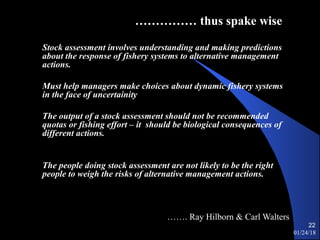
Stock assessment involves understanding and making predictions
about the response of fishery systems to alternative management
actions.
Must help managers make choices about dynamic fishery systems
in the face of uncertainity
The output of a stock assessment should not be recommended
quotas or fishing effort – it should be biological consequences of
different actions.
The people doing stock assessment are not likely to be the right
people to weigh the risks of alternative management actions.
……. Ray Hilborn & Carl Walters
…………… thus spake wise
Marine fish stock assessment_models

Marine fish stock assessment_models

  • 1.
    01/24/18 1 Marine Fish StockAssessmentMarine Fish Stock Assessment Models & AnalysisModels & Analysis M Srinath
  • 2.
     Overview offish population model dynamics  What is fish stock assessment  Stock assessment process  Assumptions  Approach  Holistic models  Yield or yield per recruit model  VPA(Cohort analysis)  Length Cohort Analysis  Time series analysis  Ecological modeling  Simulation modeling  Worked examples of models Marine Fish Stock AssessmentMarine Fish Stock Assessment Models & AnalysisModels & Analysis
  • 3.
    01/24/18 3 Fish Population DynamicsModelFish Population Dynamics Model
  • 4.
    01/24/18 4 Stock assessmentStock assessment What is stock assessment ? – Quantitative evaluation of status of the exploited stock – Functional relationship of stock size or yield with the factors that affect the dynamics of the stock  Stock assessment and management – Evaluation of the fishery under different management regimes – Development of management reference points – Socio-economic objectives
  • 5.
    01/24/18 5 A typical stockassessment processA typical stock assessment process Ecosystem based
  • 6.
    01/24/18 6 0 2000 4000 6000 8000 10000 12000 1 2 34 5 6 7 8 9 10 11 t N 0 10 20 30 40 50 60 0 1 2 3 4 5 6 7 8 9 10 11 12 Age Length 0 20 40 60 80 100 120 140 1 2 3 4 5 6 7 8 9 10 11 12 13 Age Weight 0 20000 40000 60000 80000 100000 120000 140000 160000 1 2 3 4 5 6 7 8 9 10 11 12 13 t Biomass F = q.f
  • 7.
    01/24/18 7 ApproachApproach  Macro levelassessment – Catch & effort analysis  Micro level assessment – Stock characteristics  Growth, mortality, recruitment, age structure, length structure – Fishery characteristics  Gear selectivity, age/length at capture, fishing effort
  • 8.
    Summary of models& methods commonly used Holistic or macro or surplus production models  This approach involves methods of estimation of the past and current level of biomass and the state of the stock, from the analysis of the relationship between effort and catch. It is based on a biomass growth equation, the relationship F=q·E and the catch equation C=F· B, where F is the fishing mortality, E is the fishing effort and q the coefficient of catchability  Holistic or macro models do not consider events within the population and ignore growth and mortality of individuals and the effect of mesh size on age of fish capture  These models consider mainly the four basic quantities namely, population biomass (B), the catch (Y), fishing effort (f) and net natural rate of increase
  • 9.
    Summary of models& methods commonly used Holistic or macro or surplus production models  The Schaefer & Fox models are the popular models of this approach  These models are also termed as surplus production models  There are a number of equilibrium & dynamic (non- equilibrium) models  The data required are the historical series of catch-effort data (usually on an annual basis) of one species  The three parameters of the production model are obtained: Carrying capacity (equivalent to Virgin Biomass), catchability and growth rate. These three parameters allow drawing the equilibrium curve in the catch-effort plane. If the observed path of the fishery is also drawn on the same graph, a very general and useful view of the fishery’s history is obtained MSY and EMSY
  • 10.
    Summary of models& methods commonly usedSummary of models & methods commonly used Holistic or macro or surplus production models (contd)  The output gives a very general view of the current state of the fishery and its history. Easy to relate to management reference points  Inapplicable to multi-species fisheries, mainly due to the difficulties of effort allocation  Not suitable when there are clear changes in catchability (although this parameter can also be modeled) or changes in selectivity  Bayesian approaches in surplus production models can also be used that enable risk assessment & uncertainity and facilitates participatory approach  The only control parameter is the effort
  • 11.
    Summary of models& methods commonly used Yield or Yield per Recruit Model  Computes the yield that produces one recruit given particular exploitation pattern (F vector) at different intensities of effort  Fishing mortality vector (F), natural mortality vector (M), Age-length key or parameters of the growth model form the essential inputs  Equilibrium surface of yield as function of overall F (or effort) and exploitation pattern (selectivity), Y/Rmax, Ymax, Fmax, biomass per recruit are outputs  All these results are relative (it means “by recruit”) or absolute if recruitment is known  The output is very synthetic and gives a general overview of the state of the fishery. Easy to relate to reference points (maxima, current stock vs. virgin stock, etc.). With this method it is easy to detect growth overfishing and get the clues of management alternatives.  Assumes steady state
  • 12.
    Summary of models& methods commonly used VPA (Virtual Population Analysis). Cohort Analysis  From catch-at-age data and some parameters, VPA reconstructs the past history of stock in terms of number of individuals and fishing mortalities. The VPA and its variants is the most standard and reliable method of stock assessment  Catch-at-age of several years by operational unit (this implies previous age estimations and length composition of catches), M vector, Terminal Fs (this implies tuning, through surveys or CPUEs) and length-weight relationship (if biomasses are wanted in the output) are the inputs required  Numbers of individuals and biomass at sea by year and age (thus series of recruitment, total biomass at sea etc.), Fishing mortality by year, age and operational unit are the outputs  The most efficient standard assessment method requiring many parameters, some of them assumed (M) and tuning of fishing effort Summary of models & methods commonly usedSummary of models & methods commonly used
  • 13.
    Summary of models& methods commonly used LCA (Length Cohort Analysis)  A modification of VPA, essentially is a VPA on a pseudo- cohort that can be run also on the length frequency distribution of the catch.  Steady state is assumed  A length or age frequency distribution of the catch representing the pseudocohort, M vector, terminal Fs (this implies tuning, through surveys or CPUEs), length-weight relationship (if biomasses are wanted in the output), total catch in biomass by operational unit are the inputs  Numbers of individuals and biomass at sea by age or length (recruitment, total biomass at sea etc.), fishing mortality by age or length and operational unit  With short data series (even one year) something can be said about the state of the stock. Since the steady state is assumed (pseudo-cohort), important biases can be estimated if this hypothesis is far from reality.
  • 14.
    Summary of models& methods commonly used Time series analysis  The standard ARIMA method is the analysis of a time series (usually monthly structured) which is split off into trend (including cycles), seasonality and noise. Some further developments, as transfer functions, allow to associate these outputs with environmental or other external variables, or intervention analysis to detect anomalous events  Time series of data, usually catch, CPUE, effort, data on vessel characteristics, environmental etc  Most frequently the trend and seasonality of the variable analysed are obtained. When additional information (i.e. environmental) is added, it is possible to relate the behaviour of the dependent variable to other variables, such as effects of environment and also enables short term forecasting  Absence of underlying biological hypotheses has both pros and cons. It is a powerful method to reveal hidden structures in the data. Useful for short term forecasting, with due caution in its interpretation
  • 15.
    Summary of models& methods commonly used Ecological modeling  Multispecies modeling  Some approaches are extensions of the indirect assessment methods taking into account the biological interaction between species (technical, or technological interaction can be studied by the classical methods)  Multispecies VPA or MSVPA belong to this group  Ecological modeling based on mass balance and food webs approach – ECOPATH & ECOSIM  In addition to the single species analysis data needs, it requires the interaction factors, particularly the quantification of the predator-prey relationships, diet composition data etc  Quantified pathways of matter and energy between the different species (in steady state) and other parameters such as predation, technological and biological interactions and indicators of health of fisheries ecosystem  It approaches much better the real ecological system than the single species does  Huge amount of biological information is required and so also the generated outputs  The number of interaction parameters to be estimated grows with the square of species considered
  • 16.
    Summary of models& methods commonly used Simulation modeling  Indirect (population dynamics) methods that reproduce in the computer aided dynamics of a stock and a fishery  Often with the aim to test the effects of different environmental situations or alternative management actions  All population dynamics parameters and stock-recruitment relationship  Projection to the future of different variables (biomass, catch) and trends at short and medium term  In the case of stochastic models confidence intervals are provided  Several management scenarios are created and depicted  Very useful to analyse and compare the possible results of alternative management measures at short and medium term  Uncertainties in the projection, particularly because of the stock-recruitment relationship are also quantified  Useful to understand complex natural systems
  • 17.
    INPUT Effort Catch(t) c/f 62350 0.0803 628 49 0.0780 520 47.5 0.0913 513 45 0.0877 661 51 0.0772 919 56 0.0609 1158 66 0.0570 1970 58 0.0294 1327 52 0.0392 Holistic or surplus production models Schaefer model c/f = a + b*f a= 0.1065 ; b=-0.00004312; R2 = 92.1% MSY = -0.25*a2 /b = 65.8 tonnes fMSY = -0.5*a/b = 1235 units Fox model Ln(c/f) =c + d *f c= 0.1065 ; d=-0.00004312; R2 = 92.1% MSY = -(1/d)*e(c-1) = 60.9 tonnes fMSY = -(1/d) = 1274 units
  • 18.
    Beverton & Holtyield per recruit model INPUT L∞ 28.4cm W∞ 286gm K 0.37 M 1.1 Lc 10.2 Lr 2.03 tc 1 tr 0 tzero -0.2 a 0.0125 b 3 a & b denote length- weight relationship parameters Y/R = F*exp(-M*(tc-tr))*W∞*[1/Z – 3S/(Z+K)+ 3S2 /(Z+2K) – S3 /(Z+3K)] Where S= exp[-K*(tc-tzero)] Yield per recruit model 0 1 2 3 4 5 6 0 0.1 0.2 0.3 0.4 0.5 0.6 0.7 0.8 0.9 1 1.1 1.2 1.3 1.4 1.5 1.6 1.7 1.8 1.9 2 F Y/R Biomass per recruit curve 0.00 2.00 4.00 6.00 8.00 10.00 12.00 14.00 16.00 0 0.5 1 1.5 2 2.5 F B/R
  • 19.
    Length Cohort Analysis(LCA) INPUT Length frequency data (preferably, averaged over a period of time. Say, over 3 to 5 years)  Estimates of VBGF Growth in length parameters L∞ and K.  Instantaneous rate of natural mortality M  Estimates of parameters a and b of the l-w relationship w = a. Lb  Formulation Let  C(L1,L2) be the numbers caught between lengths L1 and L2  N(L1) be the numbers in sea that attain length L1  N(L2) be the numbers in sea that attain length L2  H(L1,L2) = [(L∞ - L1)/(L∞ - L2) ] (M/2K)
  • 20.
    Length Cohort analysis(LCA) Formulaeused in the analysis  N(L1) = [N(L2)*H(L1,L2) + C(L1,L2)]*H(L1,L2)  C(L1,L2) = N(L1) *(F/Z)* [ 1 – exp(-z* Δt) ]  Where Δt = (1/K) * ln [(L∞ - L1)/(L∞ - L2) ]  Calculations  Start with the last length group  Compute H for each length group H(L1,L2) = [(L∞ - L1)/(L∞ - L2) ] (M/2K)  Compute average weight for each length group as w(L1,L2)= a*[(L1+L2)/2]b  Assume a value F/Z for the last length group ( how to choose terminal F/Z ?)  Compute the numbers in sea for the last length group by dividing the catch in numbers by the terminal F/Z  Compute, recursively, N(L1) for each length group  Compute F(L1,L2)/(Z(L1,L2) = C(L1,L2)/(N(L1) – N(L2))  Compute F(L1,L2) = M*(F(L1,L2)(/Z(L1,L2)) / (1 – (F(L1,L2)/Z(L1,L2)))  Compute Z(L1,L2) = F(L1,L2)+M  Compute average annual numbers in the sea = [N(L1) – N(L2)]/Z(L1,l2)= avg.N(L1,L2)  Catch(yield) in weight = C(L1,L2)*w(L1,L2)  Mean biomass = avg.N(L1,L2)*w(L1,L2)  Caution:: Approximation valid only when F* Δt is upto 1.2 and M* Δt upto 0.3 Output from LCA Total mortality in each length group Fishing mortality in each length group Numbers in sea at the beginning of length group Mean numbers in sea in each length group Mean biomass(in weight) of each length group
  • 21.
    Length Cohort Analysis(LCA) INPUTparameters L∞ = 130 cm, K=0.1/yr M=0.28/yr a=0.00001 kg/cm b = 3 Note: Avg biomass and yield are in tonnes Length Numbers M-factor F/Z Numbers Fishing Total Avg. nos Avg Avg Yield group Caught H(L1,L2) in sea mortality mortality in sea weight biomass 6 1823 1.072 0.125 98947 0.04 0.32 45456 0.00729 331.37 13.29 12 14463 1.076 0.58 84401 0.387 0.667 37396 0.03375 1262.12 488.13 18 25227 1.08 0.792 59458 1.066 1.346 23656 0.09261 2190.78 2336.27 24 8134 1.085 0.698 27617 0.647 0.927 12572 0.19683 2474.55 1601.02 30 3889 1.09 0.638 15963 0.493 0.773 7885 0.35937 2833.63 1397.59 36 2959 1.097 0.678 9868 0.59 0.87 5017 0.59319 2976.03 1755.25 42 1871 1.104 0.697 5503 0.644 0.924 2904 0.91125 2646.27 1704.95 48 653 1.112 0.579 2820 0.385 0.665 1695 1.32651 2248.43 866.21 54 322 1.122 0.507 1693 0.288 0.568 1118 1.85193 2070.46 596.32 60 228 1.134 0.523 1058 0.307 0.587 743 2.50047 1857.85 570.11 66 181 1.148 0.588 622 0.4 0.68 453 3.28509 1488.15 594.6 72 96 1.165 0.582 314 0.39 0.67 246 4.21875 1037.81 405 78 16 1.187 0.281 149 0.109 0.389 147 5.31441 781.22 85.03 84 46 0.5 92 0.28 0.56 164 12.25043 2009.07 563.52 Total 26207.7 12977.29 Typical output
  • 22.
    01/24/18 22 Stock assessment involvesunderstanding and making predictions about the response of fishery systems to alternative management actions. Must help managers make choices about dynamic fishery systems in the face of uncertainity The output of a stock assessment should not be recommended quotas or fishing effort – it should be biological consequences of different actions. The people doing stock assessment are not likely to be the right people to weigh the risks of alternative management actions. ……. Ray Hilborn & Carl Walters …………… thus spake wise