Second year – Group B
Morning classes
A presentation by:
Daban Nasih
Nura Omer
Shadiya Najmaddin
Nawzhin Tofiq
Supervised by:
Mrs. Shukrya Karim
Mrs. Daroon Osman
Nursing Department
Academic Year
2022-2023
Oxytocin &
Prolactin
hormones
Oxytocin
▶ Source of Secretion:
▶ Secreted mainly by paraventricular nucleus and partly
supraoptic nuclei.
▶ T
ransported from hypothalamusto posterior pituitary
through the nerve fibers of hypothalamo-hypophyseal
tract.
▶ In the posterior pituitary, the oxytocin is stored in the
nerve endings of hypothalamo-hypophyseal tract.
▶ When suitable stimuli reach the posterior pituitary from
hypothalamus, oxytocin is released into the blood.
▶ Oxytocin is secreted in both males and females.
▶ Actiononmammaryglands
▶ Causes ejection of milk from the mammary glands.
▶ Oxytocin causes contraction of the myoepithelial
cellsand flow of milk from alveoli of mammary
glands to the exterior through duct system and
nipple.
▶ The process by which the milk is ejected from alveoli
of mammary glands iscalled milk ejection reflex or
milk letdownreflex.
▶ It isone of the neuro-endocrine reflexes.
▶ ActiononUterus:
▶ Oxytocin actson:
1
. Pregnant uterus
2. Non-pregnant uterus.
⦁ On pregnant uterus:
▶ Throughout the period of pregnancy, oxytocin
secretion isinhibited by estrogen and progesterone.
▶ At the end of pregnancy, the secretion of these two
hormones decreases suddenly and the secretion of
oxytocin increases.
▶ Oxytocin causes contraction of uterus and helps in the
expulsion of fetus.
▶ Itis also an example of neuro-endocrine reflex and
positive feedback mechanism
▶ Onnon-pregnantutreus:
▶Action of oxytocin on non-pregnant uterus is to
facilitate the transport of sperms through female
genital tract up to the fallopian tube, by producing
the uterine contraction during sexual intercourse.
Prolactin
⯈Human prolactin is a single- chain polypeptide of
199 amino acids. It has a molecular weight of 23
kDa.
⯈ Prolactinis synthetizedin and secretedfrom
specializedcellsof the anterior pituitary gland, the
lactotrophcells.
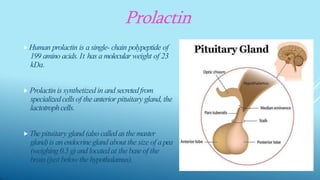
⯈ Thepituitary gland(also calledasthe master
gland)is an endocrinegland about the size of apea
(weighing0.5 g)and locatedat the baseof the
brain(just belowthe hypothalamus).
FUNCTION
⯈Prolactinis responsibleof:
 Primarily, initiating and sustaininglactation and
 Stimulation of breastdevelopment alongwith Estrogen during pregnancy.
Prolactinsecretioniscausedby;
• Prolactin releasinghormone (PRH)
• Estrogen (during stimulates lactotropes to secrete prolactin)
• Oxytocin (causes muscle contractions to expel milk)
• Vasoactiveintestinal peptide(VIP)
• Thyrotropin releasinghormone (TRH)
• Breast feeding
• Stress
• Sleep
• Dopamine antagonists (eg., antipsychotic drugs)
• Chest wall trauma
Hypoprolactinemia
⯈ Hypoprolactinemia - decreased prolactin hormone secretion by the anterior pituitary
gland.
⯈ Commoncausesof Hypoprolactinemia:
 Sheehan’ssyndrome
 Hypopituitarism
 Excessdopamine
 Autoimmunedisease
 Growth hormonedeficiency
 Head injury
 Infection
⯈ Symptoms:
 Ovarian diseases,delayedpuberty and infertility.
 Impotenceand abnormal spermatogenesis.
Hyperprolactinemia
⯈Hyperprolactinemia– increasedprolactin hormonesecretionbythe anterior pituitary
gland.
⯈ Commoncausesof Hyperprolactinemia:
 Stress
 Medications (e.g,Antipsychoticdrugs)
 Primaryhypothyroidism
 Pituitary glandtumour
 Prolactinoma
⯈ Symptoms:
• Oligomenorrhoea
• Amenorrhoea
• Galactorrhoea
• Infertility
• Hirsutism
• Osteoporosis
DIAGNOSIS
⯈Diagnosis:
• History(medication,oligomenorrhoea,hirsutism)
• Physical examination(Galactorrhoea)
• Laboratory
 Pregnancytest
 Prolactin
 Macroprolactin
 TSH, FreeT4
 U& Es
 Tes, LH andFSH
• MRI scan(Prolactinaemia)
• Visualfieldtests (optic nerve)
• HyperProlactinaemia:dopamineagonists
(e.g., Bromocryptine orCabergoline)
• Surgeryremovaland/or radiationtherapy
(largepituitary tumours)
• Thyroidabnormalities:thyroid hormone
replacement (e.g., levothyroxine)
• Ovarianinsufficiency:hormonaltherapy
(e.g., Estrogen andprogestins)
TREATMENT
Prolactin & Oxytocin.pptx

Prolactin & Oxytocin.pptx

  • 1.
    Second year –Group B Morning classes A presentation by: Daban Nasih Nura Omer Shadiya Najmaddin Nawzhin Tofiq Supervised by: Mrs. Shukrya Karim Mrs. Daroon Osman Nursing Department Academic Year 2022-2023 Oxytocin & Prolactin hormones
  • 2.
    Oxytocin ▶ Source ofSecretion: ▶ Secreted mainly by paraventricular nucleus and partly supraoptic nuclei. ▶ T ransported from hypothalamusto posterior pituitary through the nerve fibers of hypothalamo-hypophyseal tract. ▶ In the posterior pituitary, the oxytocin is stored in the nerve endings of hypothalamo-hypophyseal tract. ▶ When suitable stimuli reach the posterior pituitary from hypothalamus, oxytocin is released into the blood. ▶ Oxytocin is secreted in both males and females.
  • 3.
    ▶ Actiononmammaryglands ▶ Causesejection of milk from the mammary glands. ▶ Oxytocin causes contraction of the myoepithelial cellsand flow of milk from alveoli of mammary glands to the exterior through duct system and nipple. ▶ The process by which the milk is ejected from alveoli of mammary glands iscalled milk ejection reflex or milk letdownreflex. ▶ It isone of the neuro-endocrine reflexes.
  • 4.
    ▶ ActiononUterus: ▶ Oxytocinactson: 1 . Pregnant uterus 2. Non-pregnant uterus.
  • 5.
    ⦁ On pregnantuterus: ▶ Throughout the period of pregnancy, oxytocin secretion isinhibited by estrogen and progesterone. ▶ At the end of pregnancy, the secretion of these two hormones decreases suddenly and the secretion of oxytocin increases. ▶ Oxytocin causes contraction of uterus and helps in the expulsion of fetus. ▶ Itis also an example of neuro-endocrine reflex and positive feedback mechanism
  • 6.
    ▶ Onnon-pregnantutreus: ▶Action ofoxytocin on non-pregnant uterus is to facilitate the transport of sperms through female genital tract up to the fallopian tube, by producing the uterine contraction during sexual intercourse.
  • 7.
    Prolactin ⯈Human prolactin isa single- chain polypeptide of 199 amino acids. It has a molecular weight of 23 kDa. ⯈ Prolactinis synthetizedin and secretedfrom specializedcellsof the anterior pituitary gland, the lactotrophcells. ⯈ Thepituitary gland(also calledasthe master gland)is an endocrinegland about the size of apea (weighing0.5 g)and locatedat the baseof the brain(just belowthe hypothalamus).
  • 8.
    FUNCTION ⯈Prolactinis responsibleof:  Primarily,initiating and sustaininglactation and  Stimulation of breastdevelopment alongwith Estrogen during pregnancy.
  • 9.
    Prolactinsecretioniscausedby; • Prolactin releasinghormone(PRH) • Estrogen (during stimulates lactotropes to secrete prolactin) • Oxytocin (causes muscle contractions to expel milk) • Vasoactiveintestinal peptide(VIP) • Thyrotropin releasinghormone (TRH) • Breast feeding • Stress • Sleep • Dopamine antagonists (eg., antipsychotic drugs) • Chest wall trauma
  • 10.
    Hypoprolactinemia ⯈ Hypoprolactinemia -decreased prolactin hormone secretion by the anterior pituitary gland. ⯈ Commoncausesof Hypoprolactinemia:  Sheehan’ssyndrome  Hypopituitarism  Excessdopamine  Autoimmunedisease  Growth hormonedeficiency  Head injury  Infection ⯈ Symptoms:  Ovarian diseases,delayedpuberty and infertility.  Impotenceand abnormal spermatogenesis.
  • 11.
    Hyperprolactinemia ⯈Hyperprolactinemia– increasedprolactin hormonesecretionbytheanterior pituitary gland. ⯈ Commoncausesof Hyperprolactinemia:  Stress  Medications (e.g,Antipsychoticdrugs)  Primaryhypothyroidism  Pituitary glandtumour  Prolactinoma ⯈ Symptoms: • Oligomenorrhoea • Amenorrhoea • Galactorrhoea • Infertility • Hirsutism • Osteoporosis
  • 12.
    DIAGNOSIS ⯈Diagnosis: • History(medication,oligomenorrhoea,hirsutism) • Physicalexamination(Galactorrhoea) • Laboratory  Pregnancytest  Prolactin  Macroprolactin  TSH, FreeT4  U& Es  Tes, LH andFSH • MRI scan(Prolactinaemia) • Visualfieldtests (optic nerve)
  • 13.
    • HyperProlactinaemia:dopamineagonists (e.g., BromocryptineorCabergoline) • Surgeryremovaland/or radiationtherapy (largepituitary tumours) • Thyroidabnormalities:thyroid hormone replacement (e.g., levothyroxine) • Ovarianinsufficiency:hormonaltherapy (e.g., Estrogen andprogestins) TREATMENT