2-Dimensional Motion
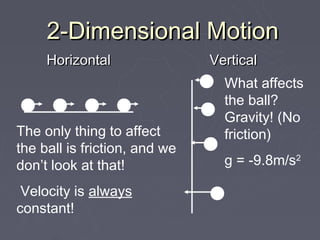
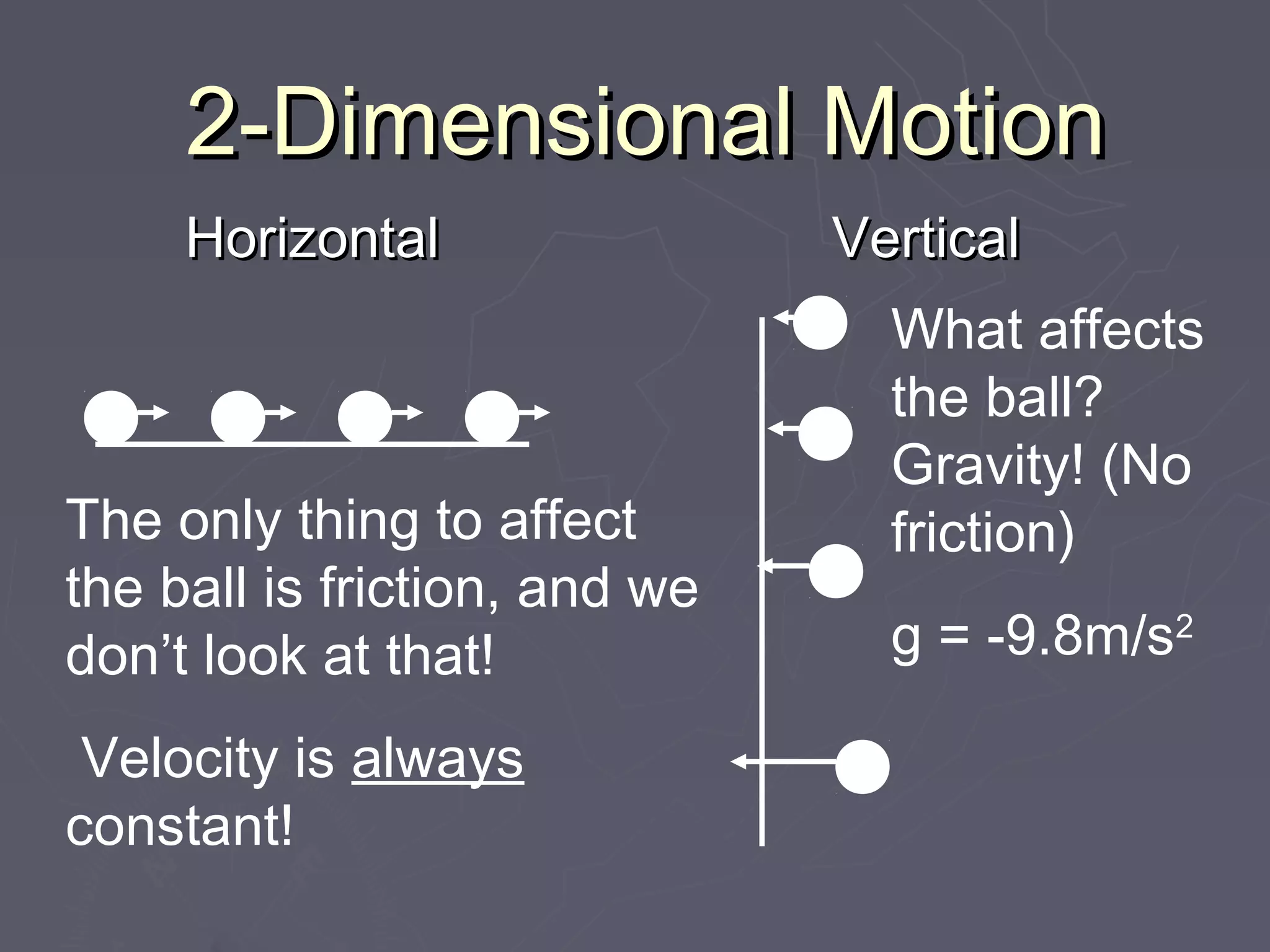
     Horizontal                Vertical
                                 What affects
                                 the ball?
                                 Gravity! (No
The only thing to affect         friction)
the ball is friction, and we
don’t look at that!              g = -9.8m/s2

 Velocity is always
constant!
Combine    Horizontal and Vertical
           components are independent!
 the two     (They don’t affect each
             other. It doesn’t matter how
             fast the object is going in the
             x direction, gravity still acts
             evenly on the object.)  [Quarters]


           So … all these problems are at
           least 2 steps: one step in the y
           direction, one step in the x
           direction.
           time is what combines the two.
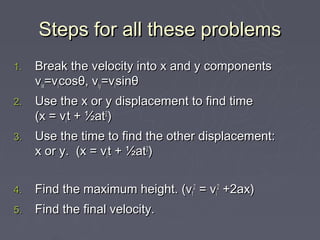
Steps for all these problems
1.   Break the velocity into x and y components
     vix=vicosθ, viy=visinθ
2.   Use the x or y displacement to find time
     (x = vit + ½at2)
3.   Use the time to find the other displacement:
     x or y. (x = vit + ½at2)


4.   Find the maximum height. (vf2 = vi2 +2ax)
5.   Find the final velocity.
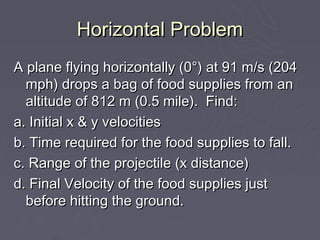
Horizontal Problem
A plane flying horizontally (0°) at 91 m/s (204
  mph) drops a bag of food supplies from an
  altitude of 812 m (0.5 mile). Find:
a. Initial x & y velocities
b. Time required for the food supplies to fall.
c. Range of the projectile (x distance)
d. Final Velocity of the food supplies just
  before hitting the ground.
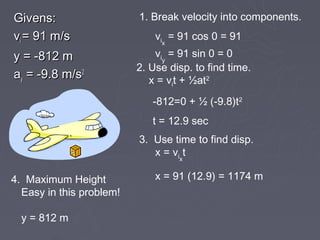
Givens:                   1. Break velocity into components.
vi = 91 m/s                   vix = 91 cos 0 = 91
y = -812 m                    viy = 91 sin 0 = 0
                          2. Use disp. to find time.
ay = -9.8 m/s2               x = vit + ½at2
                             -812=0 + ½ (-9.8)t2
                             t = 12.9 sec
                          3. Use time to find disp.
                             x = v ix t

4. Maximum Height             x = 91 (12.9) = 1174 m
  Easy in this problem!

  y = 812 m
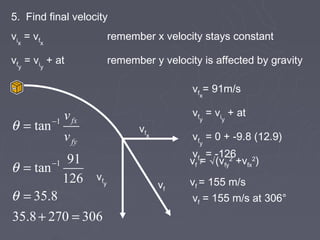
5. Find final velocity
vix = vfx            remember x velocity stays constant

vfy = viy + at       remember y velocity is affected by gravity

                                       vfx= 91m/s

              v                        vf = vi + at
                                        y     y
θ = tan     −1 fx
                           vfx
              v fy                     vfy = 0 + -9.8 (12.9)
                                      vfy = -126 2
        −1 91                         vf = √(vfy2 +vfx )
θ = tan
          126 vfy                vf   vf = 155 m/s
θ = 35.8                               vf = 155 m/s at 306°
35.8 + 270 = 306
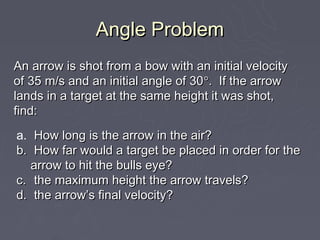
Angle Problem
An arrow is shot from a bow with an initial velocity
of 35 m/s and an initial angle of 30°. If the arrow
lands in a target at the same height it was shot,
find:
a. How long is the arrow in the air?
b. How far would a target be placed in order for the
   arrow to hit the bulls eye?
c. the maximum height the arrow travels?
d. the arrow’s final velocity?
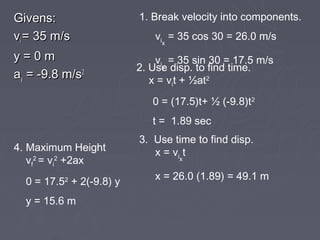
Givens:                   1. Break velocity into components.
vi = 35 m/s                  vix = 35 cos 30 = 26.0 m/s
y=0m                          vi = 35 sin 30 = 17.5 m/s
                          2. Use disp. to find time.
                                y
ay = -9.8 m/s2               x = vit + ½at2
                             0 = (17.5)t+ ½ (-9.8)t2
                             t = 1.89 sec
                          3. Use time to find disp.
4. Maximum Height            x = v ix t
   vf2 = vi2 +2ax
  0 = 17.52 + 2(-9.8) y      x = 26.0 (1.89) = 49.1 m

  y = 15.6 m
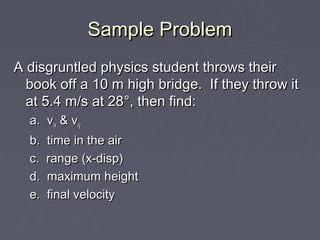
Sample Problem
A disgruntled physics student throws their
  book off a 10 m high bridge. If they throw it
  at 5.4 m/s at 28°, then find:
  a. vix & viy
  b.   time in the air
  c.   range (x-disp)
  d.   maximum height
  e.   final velocity
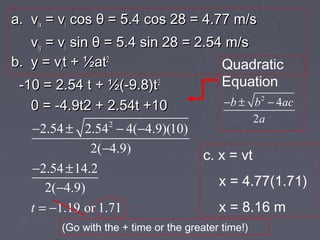
a. vix = vi cos θ = 5.4 cos 28 = 4.77 m/s
   viy = vi sin θ = 5.4 sin 28 = 2.54 m/s
b. y = vit + ½at2                    Quadratic
 -10 = 2.54 t + ½(-9.8)t2            Equation
   0 = -4.9t2 + 2.54t +10                  −b ± b 2 − 4ac
                                                2a
   −2.54 ± 2.542 − 4(−4.9)(10)
              2(−4.9)
                                       c. x = vt
   −2.54 ± 14.2
      2(−4.9)                             x = 4.77(1.71)
   t = −1.19 or 1.71                      x = 8.16 m
        (Go with the + time or the greater time!)
d. maximum height       e. final velocity
  vf2 = vi2 + 2ax          vfx = vix = 4.77 m/s
 0 = 2.542 +2(-9.8)y
                            vfy = viy + at
  y = 0.329 m
                                = 2.54 + -9.8 (1.71)
                            vfy = -14.2 m/s
        4.77
               vf = 4.77 2 + 14.22 = 15.0 m/s
14.2                    4.77 
               θ =tan-1      ÷ = 18.6° + 270 = 288°
                        14.2 

2 2-d kinematics notes

  • 1.
    2-Dimensional Motion Horizontal Vertical What affects the ball? Gravity! (No The only thing to affect friction) the ball is friction, and we don’t look at that! g = -9.8m/s2 Velocity is always constant!
  • 2.
    Combine Horizontal and Vertical components are independent! the two (They don’t affect each other. It doesn’t matter how fast the object is going in the x direction, gravity still acts evenly on the object.) [Quarters] So … all these problems are at least 2 steps: one step in the y direction, one step in the x direction. time is what combines the two.
  • 3.
    Steps for allthese problems 1. Break the velocity into x and y components vix=vicosθ, viy=visinθ 2. Use the x or y displacement to find time (x = vit + ½at2) 3. Use the time to find the other displacement: x or y. (x = vit + ½at2) 4. Find the maximum height. (vf2 = vi2 +2ax) 5. Find the final velocity.
  • 4.
    Horizontal Problem A planeflying horizontally (0°) at 91 m/s (204 mph) drops a bag of food supplies from an altitude of 812 m (0.5 mile). Find: a. Initial x & y velocities b. Time required for the food supplies to fall. c. Range of the projectile (x distance) d. Final Velocity of the food supplies just before hitting the ground.
  • 5.
    Givens: 1. Break velocity into components. vi = 91 m/s vix = 91 cos 0 = 91 y = -812 m viy = 91 sin 0 = 0 2. Use disp. to find time. ay = -9.8 m/s2 x = vit + ½at2 -812=0 + ½ (-9.8)t2 t = 12.9 sec 3. Use time to find disp. x = v ix t 4. Maximum Height x = 91 (12.9) = 1174 m Easy in this problem! y = 812 m
  • 6.
    5. Find finalvelocity vix = vfx remember x velocity stays constant vfy = viy + at remember y velocity is affected by gravity vfx= 91m/s v vf = vi + at y y θ = tan −1 fx vfx v fy vfy = 0 + -9.8 (12.9) vfy = -126 2 −1 91 vf = √(vfy2 +vfx ) θ = tan 126 vfy vf vf = 155 m/s θ = 35.8 vf = 155 m/s at 306° 35.8 + 270 = 306
  • 8.
    Angle Problem An arrowis shot from a bow with an initial velocity of 35 m/s and an initial angle of 30°. If the arrow lands in a target at the same height it was shot, find: a. How long is the arrow in the air? b. How far would a target be placed in order for the arrow to hit the bulls eye? c. the maximum height the arrow travels? d. the arrow’s final velocity?
  • 9.
    Givens: 1. Break velocity into components. vi = 35 m/s vix = 35 cos 30 = 26.0 m/s y=0m vi = 35 sin 30 = 17.5 m/s 2. Use disp. to find time. y ay = -9.8 m/s2 x = vit + ½at2 0 = (17.5)t+ ½ (-9.8)t2 t = 1.89 sec 3. Use time to find disp. 4. Maximum Height x = v ix t vf2 = vi2 +2ax 0 = 17.52 + 2(-9.8) y x = 26.0 (1.89) = 49.1 m y = 15.6 m
  • 11.
    Sample Problem A disgruntledphysics student throws their book off a 10 m high bridge. If they throw it at 5.4 m/s at 28°, then find: a. vix & viy b. time in the air c. range (x-disp) d. maximum height e. final velocity
  • 12.
    a. vix =vi cos θ = 5.4 cos 28 = 4.77 m/s viy = vi sin θ = 5.4 sin 28 = 2.54 m/s b. y = vit + ½at2 Quadratic -10 = 2.54 t + ½(-9.8)t2 Equation 0 = -4.9t2 + 2.54t +10 −b ± b 2 − 4ac 2a −2.54 ± 2.542 − 4(−4.9)(10) 2(−4.9) c. x = vt −2.54 ± 14.2 2(−4.9) x = 4.77(1.71) t = −1.19 or 1.71 x = 8.16 m (Go with the + time or the greater time!)
  • 13.
    d. maximum height e. final velocity vf2 = vi2 + 2ax vfx = vix = 4.77 m/s 0 = 2.542 +2(-9.8)y vfy = viy + at y = 0.329 m = 2.54 + -9.8 (1.71) vfy = -14.2 m/s 4.77 vf = 4.77 2 + 14.22 = 15.0 m/s 14.2  4.77  θ =tan-1 ÷ = 18.6° + 270 = 288°  14.2 