• Can you recall the different examples of
one-dimensional motion?
Let’s watch this!
• Boston_Celtics_vs_Philadelphia_Sixers_1
st_Qtr_Highlights___10.16.2018,_NBA_Se
aso.mp4
Questions
• If you are to tell how the ball moves when
the player scores a basket, how would you
describe it?
• Does the ball follow a straight path from
the player’s hand to the hoop?
Group Activity
DO’S
• Participate fairly
• Contribute meaningful ideas
• Assist other group members
DON’TS
• Horse playing is not allowed
• Avoid shouting
• Avoid gossiping nonsense
Analysis
(A. Match a Curve)
• In what direction or orientation did you know the
ball?
• How would you describe the ball’s path and
motion?
• How many tries did you make to match the
curved paths?
• How many tries did you make before you
matched the curves this time?
• What does this tell you regarding visuals or
imaginary targets in sports?
Analysis
B. What a curve-a-throw!
• In what direction or orientation did you throw the ball?
• How would you describe the ball’s path and motion?
• Aside from doing more trials or “practices”, for this
parabola where will you place the imaginary target to
aim for better matching results?
• Based on the activity, is it possible that the ball will end
at a higher elevation than its starting level?
• What force got the ball projected?
• What force continued to act on the ball when in mid-
air?
Analysis
C. Of curves . . .
• How will you compare or contrast the
horizontal and vertical spacing?
• What does the spacing in the set of vertical
lines indicate about the vertical
displacement and vertical velocity of the
projectile motion?
What is Projectile
Motion?
Projectile Motion
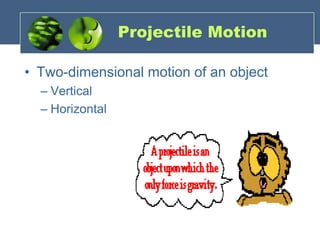
• Two-dimensional motion of an object
– Vertical
– Horizontal
Types of Projectile
Motion
• Horizontal
– Motion of a ball rolling freely along a
level surface
– Horizontal velocity is ALWAYS
constant
• Vertical
– Motion of a freely falling object
– Force due to gravity
– Vertical component of velocity
changes with time
• Parabolic
– Path traced by an object accelerating
only in the vertical direction while
moving at constant horizontal velocity
Examples of Projectile
Motion
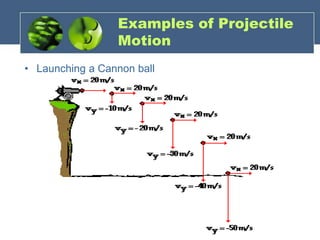
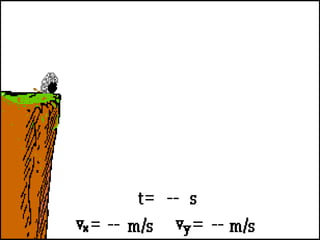
• Launching a Cannon ball
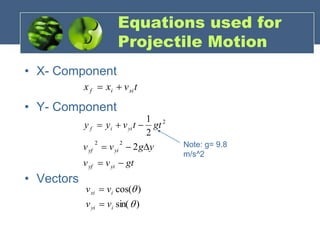
Equations used for
Projectile Motion
• X- Component
• Y- Component
• Vectors
t
v
x
x xi
i
f 

gt
v
v
y
g
v
v
gt
t
v
y
y
yi
yf
yi
yf
yi
i
f








2
2
1
2
2
2
)
sin(
)
cos(


i
yi
i
xi
v
v
v
v


Note: g= 9.8
m/s^2
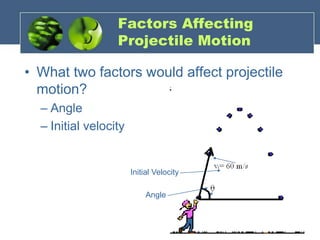
Factors Affecting
Projectile Motion
• What two factors would affect projectile
motion?
– Angle
– Initial velocity
Initial Velocity
Angle
Questions
• What are the components of projectile
motion?
• How will you differentiate the three types of
projectile motion?
• What are the factors that would affect
projectile motion?
Class Exercise
• A projectile is thrown with a speed of 100
ft/s in a direction of 30° above the
horizontal. Find the height to which it rises,
the time of flight and the horizontal range.
Enrichment
An object is fired from the ground at 100 m/s
at an angle of 30° with the horizontal.
• Calculate the horizontal and vertical
components of the initial velocity.
• After 2.0 seconds, how far has the object
traveled in the horizontal direction?
• How high is the object at this point?

Projectile Motion Science 9 Quarter 4.ppt

  • 1.
    • Can yourecall the different examples of one-dimensional motion?
  • 2.
    Let’s watch this! •Boston_Celtics_vs_Philadelphia_Sixers_1 st_Qtr_Highlights___10.16.2018,_NBA_Se aso.mp4
  • 3.
    Questions • If youare to tell how the ball moves when the player scores a basket, how would you describe it? • Does the ball follow a straight path from the player’s hand to the hoop?
  • 4.
    Group Activity DO’S • Participatefairly • Contribute meaningful ideas • Assist other group members DON’TS • Horse playing is not allowed • Avoid shouting • Avoid gossiping nonsense
  • 5.
    Analysis (A. Match aCurve) • In what direction or orientation did you know the ball? • How would you describe the ball’s path and motion? • How many tries did you make to match the curved paths? • How many tries did you make before you matched the curves this time? • What does this tell you regarding visuals or imaginary targets in sports?
  • 6.
    Analysis B. What acurve-a-throw! • In what direction or orientation did you throw the ball? • How would you describe the ball’s path and motion? • Aside from doing more trials or “practices”, for this parabola where will you place the imaginary target to aim for better matching results? • Based on the activity, is it possible that the ball will end at a higher elevation than its starting level? • What force got the ball projected? • What force continued to act on the ball when in mid- air?
  • 7.
    Analysis C. Of curves. . . • How will you compare or contrast the horizontal and vertical spacing? • What does the spacing in the set of vertical lines indicate about the vertical displacement and vertical velocity of the projectile motion?
  • 8.
  • 9.
    Projectile Motion • Two-dimensionalmotion of an object – Vertical – Horizontal
  • 10.
    Types of Projectile Motion •Horizontal – Motion of a ball rolling freely along a level surface – Horizontal velocity is ALWAYS constant • Vertical – Motion of a freely falling object – Force due to gravity – Vertical component of velocity changes with time • Parabolic – Path traced by an object accelerating only in the vertical direction while moving at constant horizontal velocity
  • 11.
    Examples of Projectile Motion •Launching a Cannon ball
  • 13.
    Equations used for ProjectileMotion • X- Component • Y- Component • Vectors t v x x xi i f   gt v v y g v v gt t v y y yi yf yi yf yi i f         2 2 1 2 2 2 ) sin( ) cos(   i yi i xi v v v v   Note: g= 9.8 m/s^2
  • 14.
    Factors Affecting Projectile Motion •What two factors would affect projectile motion? – Angle – Initial velocity Initial Velocity Angle
  • 15.
    Questions • What arethe components of projectile motion? • How will you differentiate the three types of projectile motion? • What are the factors that would affect projectile motion?
  • 16.
    Class Exercise • Aprojectile is thrown with a speed of 100 ft/s in a direction of 30° above the horizontal. Find the height to which it rises, the time of flight and the horizontal range.
  • 17.
    Enrichment An object isfired from the ground at 100 m/s at an angle of 30° with the horizontal. • Calculate the horizontal and vertical components of the initial velocity. • After 2.0 seconds, how far has the object traveled in the horizontal direction? • How high is the object at this point?