Projectile Motion
Grade 9 Science | DepEd Curriculum
Learning Competencies
• Describe projectile motion qualitatively
• Label parts of projectile motion
• Describe projectile motion quantitatively
What is Motion?
• Motion is the change in position of an object
• It can be straight or curved
• Projectile motion is a type of curved motion
What is Projectile Motion?
• Motion of an object thrown or launched into
the air
• Only gravity affects the motion (air resistance
ignored)
• Examples: thrown ball, kicked soccer ball
Key Idea
• Horizontal and vertical motions are
independent
• Gravity affects only the vertical motion
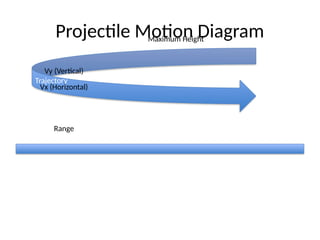
Projectile Motion Diagram
Trajectory
Range
Maximum Height
Vx (Horizontal)
Vy (Vertical)
Horizontal Motion
• Constant velocity (Vx)
• No horizontal acceleration
• Same speed throughout the motion
Vertical Motion
• Affected by gravity
• Acceleration is 9.8 m/s² downward
• Velocity changes with time
Qualitative Description
• Projectile moves forward while falling down
• Horizontal motion is uniform
• Vertical motion is accelerated
Quantitative Description
• Uses equations of motion
• Horizontal and vertical motions are solved
separately
Sample Problem 1
• A ball is thrown horizontally at 10 m/s.
• How far will it travel in 2 seconds?
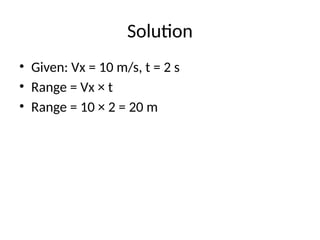
Solution
• Given: Vx = 10 m/s, t = 2 s
• Range = Vx × t
• Range = 10 × 2 = 20 m
Sample Problem 2
• What happens to vertical velocity at maximum
height?
Solution
• Vertical velocity becomes zero at maximum
height
Quick Quiz
• 1. What force affects vertical motion?
• 2. Is horizontal velocity constant?
• 3. What is the path of a projectile called?
• 4. Where is vertical velocity zero?
• 5. What motion is affected by gravity?
• 6. True or False: Horizontal and vertical
motions are independent
Quiz Answer Key
• 1. Gravity
• 2. Yes
• 3. Trajectory (parabola)
• 4. At maximum height
• 5. Vertical motion
• 6. True
For Different Learners
• Lower learners: Focus on diagrams and
concepts
• Average learners: Solve simple problems
• Advanced learners: Analyze effects of angle
and speed
Daily Lesson Log Alignment
• Objective: Describe projectile motion
• Materials: Slides, board, ball
• Procedure: Motivation → Lesson → Practice
→ Quiz
• Assessment: Quiz and oral recitation
Summary
• Projectile motion has horizontal and vertical
components
• Gravity affects only vertical motion
• The path is a parabola

Grade_9_Projectile_Motion_Enhanced_DepEd.pptx

  • 1.
    Projectile Motion Grade 9Science | DepEd Curriculum
  • 2.
    Learning Competencies • Describeprojectile motion qualitatively • Label parts of projectile motion • Describe projectile motion quantitatively
  • 3.
    What is Motion? •Motion is the change in position of an object • It can be straight or curved • Projectile motion is a type of curved motion
  • 4.
    What is ProjectileMotion? • Motion of an object thrown or launched into the air • Only gravity affects the motion (air resistance ignored) • Examples: thrown ball, kicked soccer ball
  • 5.
    Key Idea • Horizontaland vertical motions are independent • Gravity affects only the vertical motion
  • 6.
    Projectile Motion Diagram Trajectory Range MaximumHeight Vx (Horizontal) Vy (Vertical)
  • 7.
    Horizontal Motion • Constantvelocity (Vx) • No horizontal acceleration • Same speed throughout the motion
  • 8.
    Vertical Motion • Affectedby gravity • Acceleration is 9.8 m/s² downward • Velocity changes with time
  • 9.
    Qualitative Description • Projectilemoves forward while falling down • Horizontal motion is uniform • Vertical motion is accelerated
  • 10.
    Quantitative Description • Usesequations of motion • Horizontal and vertical motions are solved separately
  • 11.
    Sample Problem 1 •A ball is thrown horizontally at 10 m/s. • How far will it travel in 2 seconds?
  • 12.
    Solution • Given: Vx= 10 m/s, t = 2 s • Range = Vx × t • Range = 10 × 2 = 20 m
  • 13.
    Sample Problem 2 •What happens to vertical velocity at maximum height?
  • 14.
    Solution • Vertical velocitybecomes zero at maximum height
  • 15.
    Quick Quiz • 1.What force affects vertical motion? • 2. Is horizontal velocity constant? • 3. What is the path of a projectile called? • 4. Where is vertical velocity zero? • 5. What motion is affected by gravity? • 6. True or False: Horizontal and vertical motions are independent
  • 16.
    Quiz Answer Key •1. Gravity • 2. Yes • 3. Trajectory (parabola) • 4. At maximum height • 5. Vertical motion • 6. True
  • 17.
    For Different Learners •Lower learners: Focus on diagrams and concepts • Average learners: Solve simple problems • Advanced learners: Analyze effects of angle and speed
  • 18.
    Daily Lesson LogAlignment • Objective: Describe projectile motion • Materials: Slides, board, ball • Procedure: Motivation → Lesson → Practice → Quiz • Assessment: Quiz and oral recitation
  • 19.
    Summary • Projectile motionhas horizontal and vertical components • Gravity affects only vertical motion • The path is a parabola

Editor's Notes

  • #1 Introduce the topic using real-life examples such as throwing a ball.
  • #2 Read and explain each competency. Emphasize that today’s lesson covers both concepts and simple problem solving.
  • #3 Ask students to give examples of moving objects.
  • #4 Stress that gravity acts downward only.
  • #5 This is the most important concept in projectile motion.
  • #6 Explain each labeled part: trajectory, range, height, Vx and Vy.
  • #7 Relate this to uniform motion.
  • #8 Compare this with free fall motion.
  • #9 Ask students to describe the motion in their own words.
  • #10 Tell students this will involve simple computations only.
  • #11 Guide students to use distance = velocity × time.
  • #12 Show step-by-step solution.
  • #13 Encourage conceptual reasoning.
  • #14 Reinforce the concept of upward and downward motion.
  • #15 Let students answer orally or on paper.
  • #16 Check and discuss answers.
  • #17 Adjust questioning based on class ability.
  • #18 This slide aligns the lesson with DepEd DLL format.
  • #19 End with key takeaways.