Projectile Motion:
A particlemoves in a vertical plane
with some initial velocitybut its
acceleration is always the freefall
acceleration , which is downward.
Such a particle is called a
projectile (meaning that it is
projected or launched), and its
motion is called projectile motion.
Figure: The trajectory of an idealized
projectile.
Examples: A batted baseball, a thrown football, a package dropped from an
airplane, and a bullet shot from a rifle are all projectiles.
4.
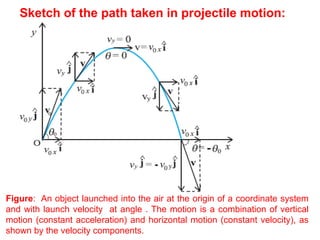
Sketch of thepath taken in projectile motion:
Figure: An object launched into the air at the origin of a coordinate system
and with launch velocity at angle . The motion is a combination of vertical
motion (constant acceleration) and horizontal motion (constant velocity), as
shown by the velocity components.
At a certaininstant, a fly ball has velocity (the x
axis is horizontal, the y axis is upward, and is in
meters per second). Has the ball passed its
highest point?
Check your understanding
7.
The adjacent figureis a
stroboscopic photograph of two
golf balls. One ball is released
from rest and the other ball is
shot horizontally at the same
instant. The golf balls have the
same vertical motion, both
falling through the same vertical
distance in the same interval of
time. The fact that one ball is
moving horizontally while it is
falling has no effect on its
vertical motion; that is, the
horizontal and vertical motions
are independent of each other.
8.
The Horizontal Motion:
Atany time t, the projectile’s horizontal displacement from an initial position is
given by
𝑥 − 𝑥0=𝑣0 𝑥 𝑡 +
1
2
𝑎𝑥 𝑡
2
Where
Using we can write
……….. (1)
At any time t, the projectile’s horizontal velocity 𝑣0 𝑥=𝑣𝑥
The Vertical Motion:
At any time t, the projectile’s vertical displacement from an initial position is
given by
[ where, ]
[ where, ]
……………………… (2)
9.
At any timet, the projectile’s vertical velocity
𝑣𝑦 =𝑣0 sin𝜃0−𝑔𝑡
And we can express
𝑣𝑦
2
=(𝑣0 sin 𝜃0)2
−2𝑔 (𝑦 − 𝑦0)
Show that the path of a projectile is a parabola.
From equation (1) we can write
𝑡=
𝑥 − 𝑥0
𝑣0 cos 𝜃0
Using the value of t in equation (2), we get
10.
For simplicity, welet
Therefore, the equation becomes
………………… (3)
Where
Equation (3) is of the form
This is the equation of a parabola, so the path is parabolic.
11.
Equations forthe horizontal range and the maximum
horizontal range of a projectile:
The horizontal range R of the projectile is the horizontal distance the
projectile has traveled when it returns to its initial height (the height at which
it is launched). That is
Using , we get
𝑅=¿ ¿
And
[From equation (1)]
[From equation (2)]
𝑜𝑟 ¿ ¿ 𝑜𝑟 𝑡=
2𝑣0 sin 𝜃0
𝑔
Therefore, 𝑅 =¿ ¿
𝑅=
𝑣0
2
sin 2𝜃0
𝑔
Caution: This equation does not give the
horizontal distance traveled by a projectile
when the final height is not the launch height.
……(3)
12.
The value ofR is maximum in equation (3) when sin 2 𝜃0=1
𝑜𝑟 2 𝜃0=sin−1
1
𝑜𝑟 2 𝜃0 =90 0
¿
𝜃0 =450
The Effects of the Air (in the projectile motion):
The launch angle is 60° and the launch speed is 44.7 m/s.
13.
Problem 22 (Bookchapter 4):
A small ball rolls horizontally off the
edge of a tabletop that is 1.20 m high.
It strikes the floor at a point 1.52 m
horizontally from the table edge. (a)
How long is the ball in the air? (b)
What is its speed at the instant it
leaves the table?
𝑦 − 𝑦0=−1.2𝑚
𝜃0=00
𝑎𝑛𝑑 𝑣0=?
𝑥0 𝑥
𝑥−𝑥0=1.52𝑚
𝑡=?
Answer:
𝑦 − 𝑦0 =¿ ¿
−1.20=0−4.9𝑡2
(a) We know
−1.20=(𝑣¿¿ 0𝑠𝑖𝑛00
)𝑡 −4.9𝑡2
¿
𝑡=
√1.2
4.9
=¿0.495𝑠¿
(b) We know
𝑥 − 𝑥0= ¿ ¿
0.495)
0.495)
1)(0.495)
𝑣0=
1.52
0.495
=3.07𝑚/𝑠
14.
You throw aball toward a wall at speed 25.0 m/s and at angle 40.0° above the
horizontal (as shown in the figure). The wall is distance d= 22.0 m from the release
point of the ball. (a) How far above the release point does the ball hit the wall? What
are the (b) horizontal and (c) vertical components of its velocity as it hits the wall?
(d) When it hits, has it passed the highest point on its trajectory?
Problem 32 (Book chapter 4):
Answer:(a) We know
Given ; 𝜃0 =400
(𝑎) 𝑦 − 𝑦0=?
(𝑏)𝑣𝑥=? 𝑎𝑛𝑑(𝑐)𝑣𝑦 =?
?
𝑦 − 𝑦0 =¿ ¿
𝑦 − 𝑦0 =( 25)¿
𝑦 − 𝑦0=(25) (0.6428)𝑡 − 4.9𝑡2
𝑦 − 𝑦0=16.07𝑡 − 4.9𝑡2
To find t we use the following formula,
𝑥 − 𝑥0= ¿ ¿
𝑡=
𝑥−𝑥0
𝑣0 cos 𝜃0
=
22
25𝑐𝑜𝑠 400
=
22
(25)(0.7660)
𝑦 − 𝑦0=(16.07) (1.149) −( 4.9) (1.149)2
=18.46− 6.469=11.99 𝑚
Therefore,
𝑡=1.149𝑠
15.
(b) We know𝑣𝑥=𝑣0 𝑥=𝑣0 cos 𝜃0=25cos 400
=(25)( 0.766)=19.15𝑚/𝑠
(c) We know 𝑣𝑦 =𝑣0 sin 𝜃0−𝑔𝑡=25sin 400
−(9.8)(1.149)
𝑣𝑦 =(25)(0.6428)−11.26=4.81m/ s
(d) Since
16.
1. [Chap 4- problem 21]: A dart is thrown horizontally with an initial speed of 10 m/s
toward point P, the bull’s-eye on a dart board. It hits at point Q on the rim,
vertically below P, 0.19 s later. (a) What is the distance PQ? (b) How far away from
the dart board is the dart?
2. A projectile is fired horizontally from a gun that is 45.0 m above flat ground,
emerging from the gun with a speed of 250 m/s. (a) How long does the projectile
remain in the air? (b) At what horizontal distance from the firing point does it
strike the ground? (c) What is the magnitude of the vertical component of its
velocity as it strikes the ground?
3. A soccer ball is kicked from the ground with an initial speed of 19.5 m/s at an
upward angle of 45°. A player 55 m away in the direction of the kick starts running
to meet the ball at that instant. What must be his average speed if he is to meet the
ball just before it hits the ground?
4. In Fig. 4-34, a stone is projected at a cliff of height h
with an initial speed of 42.0 m/s directed at angle
= 60.0° above the horizontal. The stone strikes
at A, 5.50 s after launching. Find (a) the height h
of the cliff, (b) the speed of the stone just before
impact at A, and (c) the maximum height H reached above the ground
Let’s Practice !!




![The Horizontal Motion:
At any time t, the projectile’s horizontal displacement from an initial position is
given by
𝑥 − 𝑥0=𝑣0 𝑥 𝑡 +
1
2
𝑎𝑥 𝑡
2
Where
Using we can write
……….. (1)
At any time t, the projectile’s horizontal velocity 𝑣0 𝑥=𝑣𝑥
The Vertical Motion:
At any time t, the projectile’s vertical displacement from an initial position is
given by
[ where, ]
[ where, ]
……………………… (2)](https://image.slidesharecdn.com/physics1lesson2midspring24-25-250911171943-f27789c2/85/Physics-1_LESSON-2-Mid_Spring-24-25-pptx-8-320.jpg)


![ Equations for the horizontal range and the maximum
horizontal range of a projectile:
The horizontal range R of the projectile is the horizontal distance the
projectile has traveled when it returns to its initial height (the height at which
it is launched). That is
Using , we get
𝑅=¿ ¿
And
[From equation (1)]
[From equation (2)]
𝑜𝑟 ¿ ¿ 𝑜𝑟 𝑡=
2𝑣0 sin 𝜃0
𝑔
Therefore, 𝑅 =¿ ¿
𝑅=
𝑣0
2
sin 2𝜃0
𝑔
Caution: This equation does not give the
horizontal distance traveled by a projectile
when the final height is not the launch height.
……(3)](https://image.slidesharecdn.com/physics1lesson2midspring24-25-250911171943-f27789c2/85/Physics-1_LESSON-2-Mid_Spring-24-25-pptx-11-320.jpg)


![1. [Chap 4 - problem 21]: A dart is thrown horizontally with an initial speed of 10 m/s
toward point P, the bull’s-eye on a dart board. It hits at point Q on the rim,
vertically below P, 0.19 s later. (a) What is the distance PQ? (b) How far away from
the dart board is the dart?
2. A projectile is fired horizontally from a gun that is 45.0 m above flat ground,
emerging from the gun with a speed of 250 m/s. (a) How long does the projectile
remain in the air? (b) At what horizontal distance from the firing point does it
strike the ground? (c) What is the magnitude of the vertical component of its
velocity as it strikes the ground?
3. A soccer ball is kicked from the ground with an initial speed of 19.5 m/s at an
upward angle of 45°. A player 55 m away in the direction of the kick starts running
to meet the ball at that instant. What must be his average speed if he is to meet the
ball just before it hits the ground?
4. In Fig. 4-34, a stone is projected at a cliff of height h
with an initial speed of 42.0 m/s directed at angle
= 60.0° above the horizontal. The stone strikes
at A, 5.50 s after launching. Find (a) the height h
of the cliff, (b) the speed of the stone just before
impact at A, and (c) the maximum height H reached above the ground
Let’s Practice !!](https://image.slidesharecdn.com/physics1lesson2midspring24-25-250911171943-f27789c2/85/Physics-1_LESSON-2-Mid_Spring-24-25-pptx-16-320.jpg)


