Leadership and Corporate
Culture
What is Leadership?
What is Leadership?
 Ability to
persuade others to do things for the
good of the organization
make difficult decisions
make unpopular decisions
deliver results
create long-term commitments
Why is the Leader Important to
An Organization?
Why is the Leader Important?
 Establishes vision
 Develops and implements strategies
 Allocates and controls resources
 Chooses key employees
 Shapes culture
 Affects organizational performance
 Projects image to the public
Levels of Leadership
(Jim Collins, HBR, Jan. 2001)
 Highly capable individual
 Contributing team member
 Competent manager
 Effective leader – catalyzes commitment to
and vigorous pursuit of a clear & compelling
vision, stimulate high performance
 Executive – builds enduring greatness
through humility and professional wills
What are the Leadership Traits of
Highly Productive Organizations?
Leadership Traits of Highly
Productive Organizations
 Attention to details
 Highly ethical and moral
 Embracing simplicity & disdain for waste
 Long-term focus
 Humility
 Coaching leadership style
 Trust and believe in others
Management Practices That
Work (Nohria, et al., HBR, 2003)
 Primary
Strategy, Execution, Culture, Structure
 Secondary (Two of Four)
Talent, Leadership, Innovation, Mergers
and Partnerships
Leadership Development
 Leadership skills
 Management skills
 Communication skills
 Problem identification and solving skills
 Strategic development and execution
skills
Leadership Strategies for
Productivity Improvement?
Leadership Strategies for
Productivity Improvement
 Create a clear and simple vision
 Build a culture supported by core values
 Assembles an effective management team
 Apply a consistent business strategy
 Avoid layoffs
 Develop a motivated workforce
 Use system’s approach to eliminate waste
Leadership Commitment
(Donald N. Sull, HBR, June 2003)
 Strategic frame
 Resources
 Processes
 Relationships
 Values
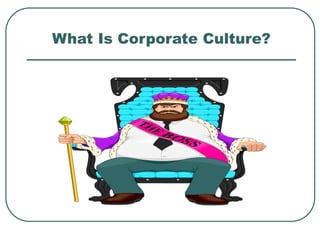
What Is Corporate Culture?
 Corporate culture is an organization’s value
system and its collection of guiding principles
 Values are often seen in conjunction with
mission or vision statement
 Culture is reflected by management policies
and actions
 Culture and values are strongly influenced by
the top executive
Purpose of Culture
 Organizational socialization
•Formal
•Informal
 Behavioral conformity
•Values and beliefs
•Behaviors
Definition of Culture
 Observable
•Artifacts and behaviors: symbols, awards,
stories, heroes, slogans, ceremonies
 Not Observable
•Values and beliefs
•Underlying assumptions
Dominant Orientation of Culture
 Market and financial-oriented: defined in terms of
customers needs and financial performance
 Materials- or product-oriented: defined in terms of
the material it works with or the product it makes
 Technology-oriented: defined in terms of the
technology that it uses
 People-oriented: defined in terms of how employees
are hired and treated
“Best” Values
 They have a “grab-you-by-the heart” quality
 They often precede and drive strategy
 They are put into place by living them
 They enable people at every level to become leaders
 They are consistent with the everyday values to which
most people aspire
 They get managed as proactively as strategies, plans,
and budgets.
Robert Waterman, What America Does Right
What Are the Foundations of A
Productivity-Focused Culture?
Foundations of A
Productivity-Focused Culture
 Survivor mentality
 Productivity through people
 Respect for people
 Creating reality from expectations
 Challenging targets with resource commitment
 Managing change
 Developing capabilities
Foundations of A Productivity-
Focused Culture (Continued)
 Committed to constant change, innovation,
and value-added operations - continuous
improvement: productivity improvement is a
direction, not a destination
 Committed to be a “world-class organization” -
to be better than the best
 Being prepared to keep moving on
Strategies to Create A Culture
for Productivity Improvement?
Strategies to Create A Culture
for Productivity Improvement
 Inspire all employees to achieve high
performance
 Empower employees to make decisions and
seek improvements
 Reward employees based on individual and
group performance
 Create a challenging but satisfying work
environment
 Follow a clear set of values
Managerial Culture
Reinforcement Actions
 The behaviors managers measure and control
 Managers’ reactions to crises
 Modeling and coaching of expected behaviors
 Criteria for allocation of rewards
 Criteria for selection, promotion, and
termination of employees
Actions to Change Culture
1. Change people’s behaviors through reward,
training, policies, etc.
2. Justify the new behaviors using new culture
artifacts: stories, symbols, rituals, heroes.
3. Communicate the new artifacts widely and
consistently
4. Hire new employees who match the new culture
5. Remove employees whose behaviors deviate
from the new culture values
Making Radical Change
 Anticipating,
 exploiting, and
 creating
“breakpoints”
Paul Strebel, Breakpoints
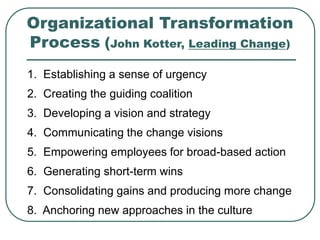
Organizational Transformation
Process (John Kotter, Leading Change)
1. Establishing a sense of urgency
2. Creating the guiding coalition
3. Developing a vision and strategy
4. Communicating the change visions
5. Empowering employees for broad-based action
6. Generating short-term wins
7. Consolidating gains and producing more change
8. Anchoring new approaches in the culture
Strategies to Help Employees
Embrace A PI Initiative?
 Senior Managers
 Middle Managers
 Front-Line Staff
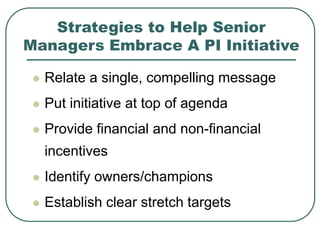
Strategies to Help Senior
Managers Embrace A PI Initiative
 Relate a single, compelling message
 Put initiative at top of agenda
 Provide financial and non-financial
incentives
 Identify owners/champions
 Establish clear stretch targets
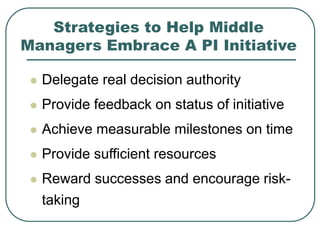
Strategies to Help Middle
Managers Embrace A PI Initiative
 Delegate real decision authority
 Provide feedback on status of initiative
 Achieve measurable milestones on time
 Provide sufficient resources
 Reward successes and encourage risk-
taking
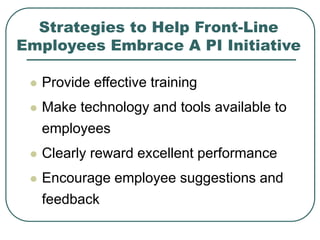
Strategies to Help Front-Line
Employees Embrace A PI Initiative
 Provide effective training
 Make technology and tools available to
employees
 Clearly reward excellent performance
 Encourage employee suggestions and
feedback
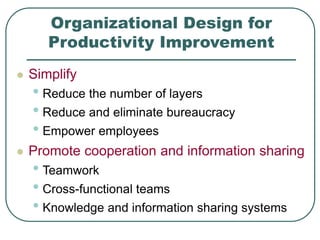
Organizational Design for
Productivity Improvement
 Simplify
• Reduce the number of layers
• Reduce and eliminate bureaucracy
• Empower employees
 Promote cooperation and information sharing
• Teamwork
• Cross-functional teams
• Knowledge and information sharing systems