Presented by Salem Idres  Alorfi          4274Salem .M. Elsubeihi       4260Saad .A. Al werfally         4191ِFarag .Y. Abd Alhade     4310Kaled .M. Alaribe           4239   Supervised byDr. Omar Gnaiber Quality Culture
بسم الله الرحمن الرحيموقل اعملوا فسيرى الله عملكم ورسوله والمؤمنون سورة التوبة
Understanding QualityQuality , Competitiveness and Customers whatever type of organization you work in .Basically competes on its reputation for quality, reliability, price and delivery and most people now recognize that quality is the most important of these competitive weapons . Some organizations, have used quality to take the  heads off their competitors.    And organizations from other countries have used quality strategically to win customers, steal business resources or funding, and be competitive.
There are several aspects of reputation which are important:It is built upon the competitive elements of quality, reliability, delivery, and price.
 Once an organization acquires a poor reputation for quality, it takes a very long time to change it.
 Reputations, good or bad, can quickly become national reputations.
 The management of the competitive weapons, such as quality, can be learned like any other skill,     and used to turn round a poor reputation, in time.
What is quality?A frequently used definition of quality is “Delighting the customer by fully meeting their needs andexpectations”. These may include performance, appearance, availability, delivery, reliability, maintainability, cost effectiveness and price. It is, therefore, imperative that the organization knows what these needs and expectations are. In addition, having identified them, the organization must understand them, and measureits own ability to meet them.
Quality starts with market research – to establish the true requirements for the product or service and the true needs of the customers. However, for an organization to be really effective, quality must span all functions, all people, all departments and all activities and be a common language for improvement. The cooperation of everyone at every interface is necessary to achieve a total quality organization, in the same way that the Japanese achieve this with company wide quality control
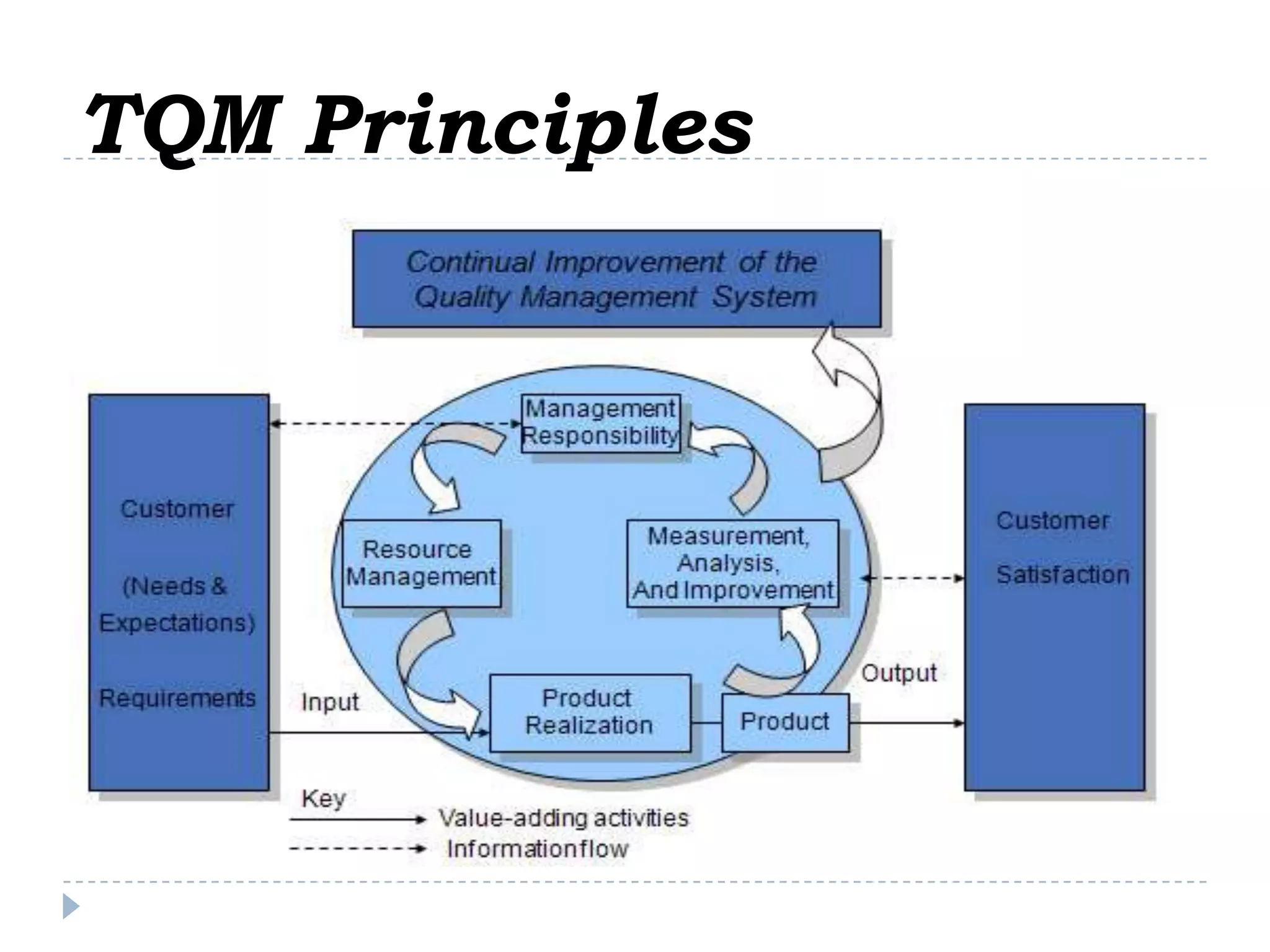
TQM is the way of managing for the future, and is far wider in its application than just assuring product or service quality – it is a way of managing people and business processes to ensure complete customer satisfaction at every stage, internally and externally. TQM, combined with effective leadership, results in an organization doing the right things right, first time .Total Quality Management (TQM)
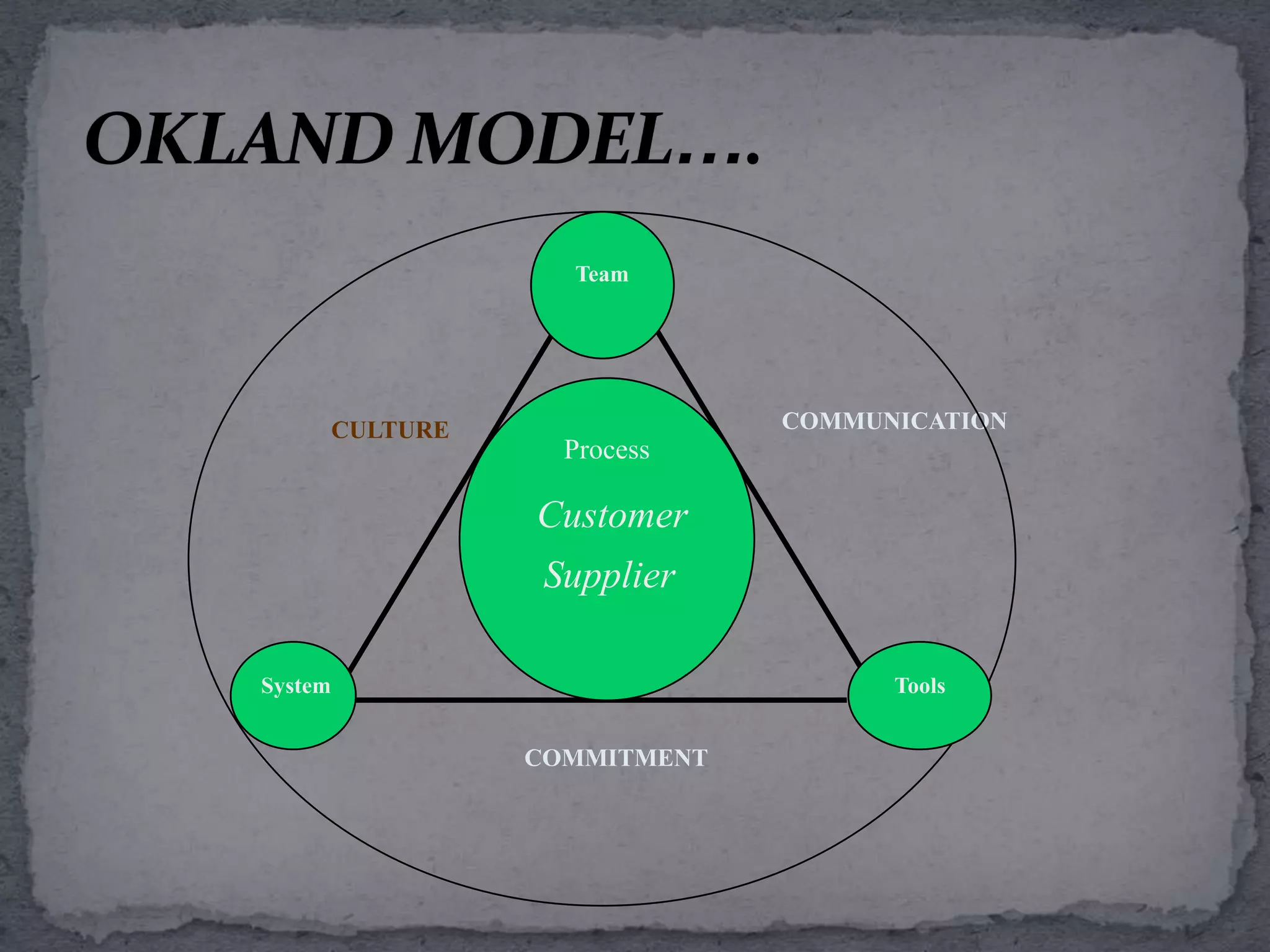
The core of TQM is the customer-supplier interfaces, both externally and internally, and at each interface       lie a number of process. This core must be surrounded by commitment to quality, communication of the quality message, and recognition of the need to change the culture of the     organization to create total quality.  These are the foundations of TQM, and they are supported by the key management functions of  people, processes and systems in the organization
TQM PrinciplesInternal customer supplier relationship
Continuous Improvement
Teamwork
Employee participation/ development
Training and education
 supplier and customer integrated into the process
Honesty, sincerity & careTQM Principles
The foundation of TQM modelThe core of TQM is the customer , supplier relationship , where the process must be managed.
 The ‘soft’ outcomes of TQM-the culture, communications, and commitment provide the foundation for the model.
The process core must be surrounded by the ‘hard’ management necessities of systems, tools and teams.
 The model provides a framework against which an organization’s progress towards TQM can be examined.TeamProcessCOMMUNICATIONCULTURECustomerSupplierToolsSystemCOMMITMENTOKLAND MODEL….
The meaning of cultureA fish only discovers its need for water when it is no longer in itOur own culture is like water to a fishit sustains us we live and breathe through it .
The meaning of cultureHenry Mintzberg on Culture“Culture is the soul of the organization ,the beliefs and values, and how they are manifested .   I think of the structure as the skeleton, and as the flesh and blood. And culture is the soul that holds the thing together and gives it life force.”
What is cultureIt is a pattern of shared basic assumptions that the group learned as it solved its problems of external adaptation and internal integration, that has worked well enough to be considered valid and, therefore, to be taught to new members as the correct way to perceive, think, and feel in relation to these problems.
Culture is built up through its continuing enhancement of an organization’s ability to deal with its problems in a way that fixes its identity.
While culture is a systemic phenomenon, its primary architects are those at the very top.Understanding What a Quality Culture Is To understand a Quality Culture, must first be  understand a Organizational Culture.Organizational CultureThe pattern of shared values, beliefs, and assumptions considered to be the appropriate way to think and act within an organization.Culture is shared.
Culture helps members to solve problems.
Culture is taught to newcomers.
Culture strongly influences behavior.A quality culture is An organizational value system that results in an environment that is conducive to the establishment and continual improvement of Quality.
Levels of CultureArtifacts      Aspects of an organization’s culture that      you see, hear, and feel.Beliefs  The understandings of how objects and   ideas relate to each other.Values  The stable, long-lasting beliefs about what   is important.Assumptions   The taken-for-granted notions of how   something should be in an organization.
Characteristics of Organizational CultureInnovation and risk-takingThe degree to which employees are encouraged to be innovative and take risks.Attention to detailThe degree to which employees are expected to exhibit precision, analysis, and attention to detail.Outcome orientationThe degree to which management focuses on results or outcomes rather than on technique and process.People orientationThe degree to which management decisions take into consideration the effect of outcomes on people within the organization.
Characteristics of Organizational CultureTeam orientationThe degree to which work activities are organized around teams rather than individuals.AggressivenessThe degree to which people are aggressive and competitive rather than easygoing.StabilityThe degree to which organizational activities emphasize maintaining the status quo in contrast to growth.

Culture presentation 1

  • 1.
    Presented by SalemIdres Alorfi 4274Salem .M. Elsubeihi 4260Saad .A. Al werfally 4191ِFarag .Y. Abd Alhade 4310Kaled .M. Alaribe 4239 Supervised byDr. Omar Gnaiber Quality Culture
  • 2.
    بسم الله الرحمنالرحيموقل اعملوا فسيرى الله عملكم ورسوله والمؤمنون سورة التوبة
  • 3.
    Understanding QualityQuality ,Competitiveness and Customers whatever type of organization you work in .Basically competes on its reputation for quality, reliability, price and delivery and most people now recognize that quality is the most important of these competitive weapons . Some organizations, have used quality to take the heads off their competitors. And organizations from other countries have used quality strategically to win customers, steal business resources or funding, and be competitive.
  • 4.
    There are severalaspects of reputation which are important:It is built upon the competitive elements of quality, reliability, delivery, and price.
  • 5.
    Once anorganization acquires a poor reputation for quality, it takes a very long time to change it.
  • 6.
    Reputations, goodor bad, can quickly become national reputations.
  • 7.
    The managementof the competitive weapons, such as quality, can be learned like any other skill, and used to turn round a poor reputation, in time.
  • 8.
    What is quality?Afrequently used definition of quality is “Delighting the customer by fully meeting their needs andexpectations”. These may include performance, appearance, availability, delivery, reliability, maintainability, cost effectiveness and price. It is, therefore, imperative that the organization knows what these needs and expectations are. In addition, having identified them, the organization must understand them, and measureits own ability to meet them.
  • 9.
    Quality starts withmarket research – to establish the true requirements for the product or service and the true needs of the customers. However, for an organization to be really effective, quality must span all functions, all people, all departments and all activities and be a common language for improvement. The cooperation of everyone at every interface is necessary to achieve a total quality organization, in the same way that the Japanese achieve this with company wide quality control
  • 10.
    TQM is theway of managing for the future, and is far wider in its application than just assuring product or service quality – it is a way of managing people and business processes to ensure complete customer satisfaction at every stage, internally and externally. TQM, combined with effective leadership, results in an organization doing the right things right, first time .Total Quality Management (TQM)
  • 11.
    The core ofTQM is the customer-supplier interfaces, both externally and internally, and at each interface lie a number of process. This core must be surrounded by commitment to quality, communication of the quality message, and recognition of the need to change the culture of the organization to create total quality. These are the foundations of TQM, and they are supported by the key management functions of people, processes and systems in the organization
  • 12.
    TQM PrinciplesInternal customersupplier relationship
  • 13.
  • 14.
  • 15.
  • 16.
  • 17.
    supplier andcustomer integrated into the process
  • 18.
    Honesty, sincerity &careTQM Principles
  • 19.
    The foundation ofTQM modelThe core of TQM is the customer , supplier relationship , where the process must be managed.
  • 20.
    The ‘soft’outcomes of TQM-the culture, communications, and commitment provide the foundation for the model.
  • 21.
    The process coremust be surrounded by the ‘hard’ management necessities of systems, tools and teams.
  • 22.
    The modelprovides a framework against which an organization’s progress towards TQM can be examined.TeamProcessCOMMUNICATIONCULTURECustomerSupplierToolsSystemCOMMITMENTOKLAND MODEL….
  • 23.
    The meaning ofcultureA fish only discovers its need for water when it is no longer in itOur own culture is like water to a fishit sustains us we live and breathe through it .
  • 24.
    The meaning ofcultureHenry Mintzberg on Culture“Culture is the soul of the organization ,the beliefs and values, and how they are manifested . I think of the structure as the skeleton, and as the flesh and blood. And culture is the soul that holds the thing together and gives it life force.”
  • 25.
    What is cultureItis a pattern of shared basic assumptions that the group learned as it solved its problems of external adaptation and internal integration, that has worked well enough to be considered valid and, therefore, to be taught to new members as the correct way to perceive, think, and feel in relation to these problems.
  • 26.
    Culture is builtup through its continuing enhancement of an organization’s ability to deal with its problems in a way that fixes its identity.
  • 27.
    While culture isa systemic phenomenon, its primary architects are those at the very top.Understanding What a Quality Culture Is To understand a Quality Culture, must first be understand a Organizational Culture.Organizational CultureThe pattern of shared values, beliefs, and assumptions considered to be the appropriate way to think and act within an organization.Culture is shared.
  • 28.
    Culture helps membersto solve problems.
  • 29.
    Culture is taughtto newcomers.
  • 30.
    Culture strongly influencesbehavior.A quality culture is An organizational value system that results in an environment that is conducive to the establishment and continual improvement of Quality.
  • 31.
    Levels of CultureArtifacts Aspects of an organization’s culture that you see, hear, and feel.Beliefs The understandings of how objects and ideas relate to each other.Values The stable, long-lasting beliefs about what is important.Assumptions The taken-for-granted notions of how something should be in an organization.
  • 32.
    Characteristics of OrganizationalCultureInnovation and risk-takingThe degree to which employees are encouraged to be innovative and take risks.Attention to detailThe degree to which employees are expected to exhibit precision, analysis, and attention to detail.Outcome orientationThe degree to which management focuses on results or outcomes rather than on technique and process.People orientationThe degree to which management decisions take into consideration the effect of outcomes on people within the organization.
  • 33.
    Characteristics of OrganizationalCultureTeam orientationThe degree to which work activities are organized around teams rather than individuals.AggressivenessThe degree to which people are aggressive and competitive rather than easygoing.StabilityThe degree to which organizational activities emphasize maintaining the status quo in contrast to growth.
  • 34.
    Culture’s FunctionsSocial gluethat helps hold organization together.Provides appropriate standards for what employees should say or do.Boundary-defining.
  • 35.
    Conveys a senseof identity for organization members.Culture’s FunctionsFacilitates commitment to something larger than one’s individual self-interest.
  • 36.
  • 37.
    Serves as a“sense-making” and control mechanism.
  • 38.
    Guides and shapesthe attitudes and behavior of employees.Creating and Sustaining Culture Keeping a Culture AliveSelectionIdentify and hire individuals who will fit in with the culture.Top ManagementSenior executives establish and communicate the norms of the organization.SocializationOrganizations need to teach the culture to new employees.
  • 39.
    Activating Cultural ChangeToattempt the implementation of total quality without creating a quality culture is to invite failure.Several primary reasons cultural change must either precede or at least parallel the implementation of total quality are:Change can not occur in a hostile environment
  • 40.
    Total Quality approachmight be radically different from what the management is accustomed to.Moving to Total Quality takes time
  • 41.
    In a conversionto Total Quality, positive results are rarely achieved in the short run.It can be difficult to overcome the pastEmployees might remember earlier fads and gimmicks and characterize total quality as being just the latest one Changing Leaders to Activate Cultural ChangeCultural change is one of the most difficult challenges an organization will ever face.Leadership from the top is essential.Sometimes, an organization’s culture simply cannot be changed without a change in leadership.Senior Executives who fail to comprehend the need to change, who fail to create a sense of urgency when needed and who fail to follow through the changes they initiated are poor candidates to lead an organization through a major culture change.
  • 42.
    Culture change requiressupport, ideas, and leadership from employees at all levels.Laying a groundwork for a Quality culture Establishing a Quality Culture is lot like constructing a building . According to Peter Scholtes Management should begin by developing understanding of “laws” of organizational change they are Understand the History behind the Current Culture
  • 43.
    Don’t Tamper withSystems – Improve Them
  • 44.
    Be prepared toListen and Observe
  • 45.
    Involve Everyone Affectedby Change in Making ItLearning What a Quality Culture looks likePart of laying the groundwork for a quality culture is understanding what one looks like.
  • 46.
    Any Executive teamthat hope to change the culture of its organization should
  • 47.
    Know thelaws of organizational change
  • 48.
    Understand thecharacteristics of organizations that have strong quality culture.
  • 49.
    Countering Resistance toCulture Change - 1Change is Resisted in any Organization.
  • 50.
  • 51.
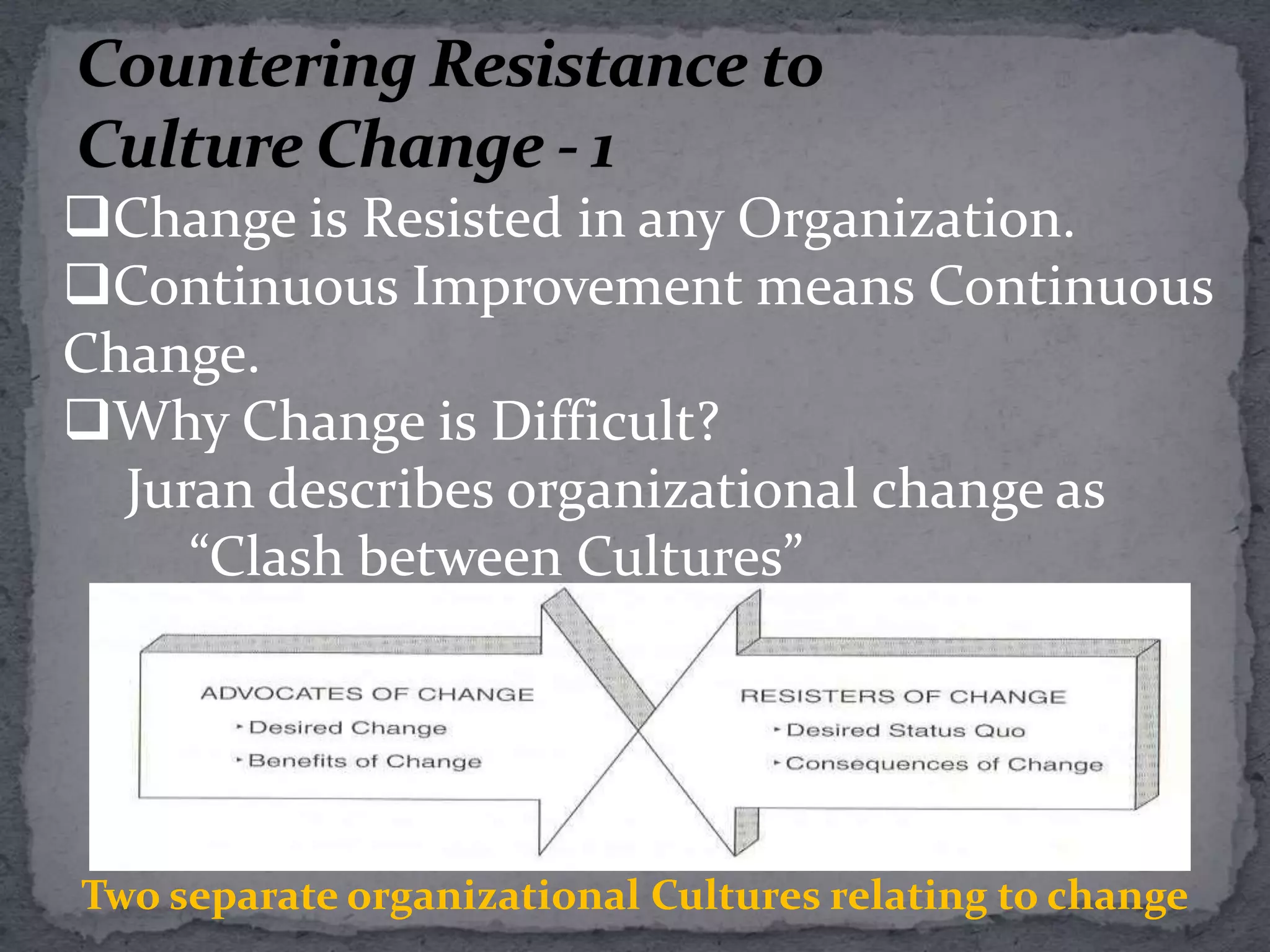
    Why Change isDifficult?Juran describes organizational change as “Clash between Cultures”Two separate organizational Cultures relating to change
  • 52.
    Countering Resistance toCulture Change - 2 How to Facilitate Change?
  • 53.
    The responsibility tofacilitate change necessarily falls to its advocates.Begin with a new advocacy Paradigm
  • 54.
    The first stepis to adopt a facilitating paradigm.
  • 55.
    Understand Concerns ofPotential Resisters
  • 56.
    Understand the concernsof resisters like fear, loss of control, uncertainty and more work.Implement Change Promoting Strategies
  • 57.
    Involve Potential Resisters,Avoid Surprises, Move slowly at first, Start Small and be flexible, create a positive environment, Incorporate the change, Respond Quickly and Positively, Work with Established leaders, Treat people with dignity & Respect, be Constructive.
  • 58.
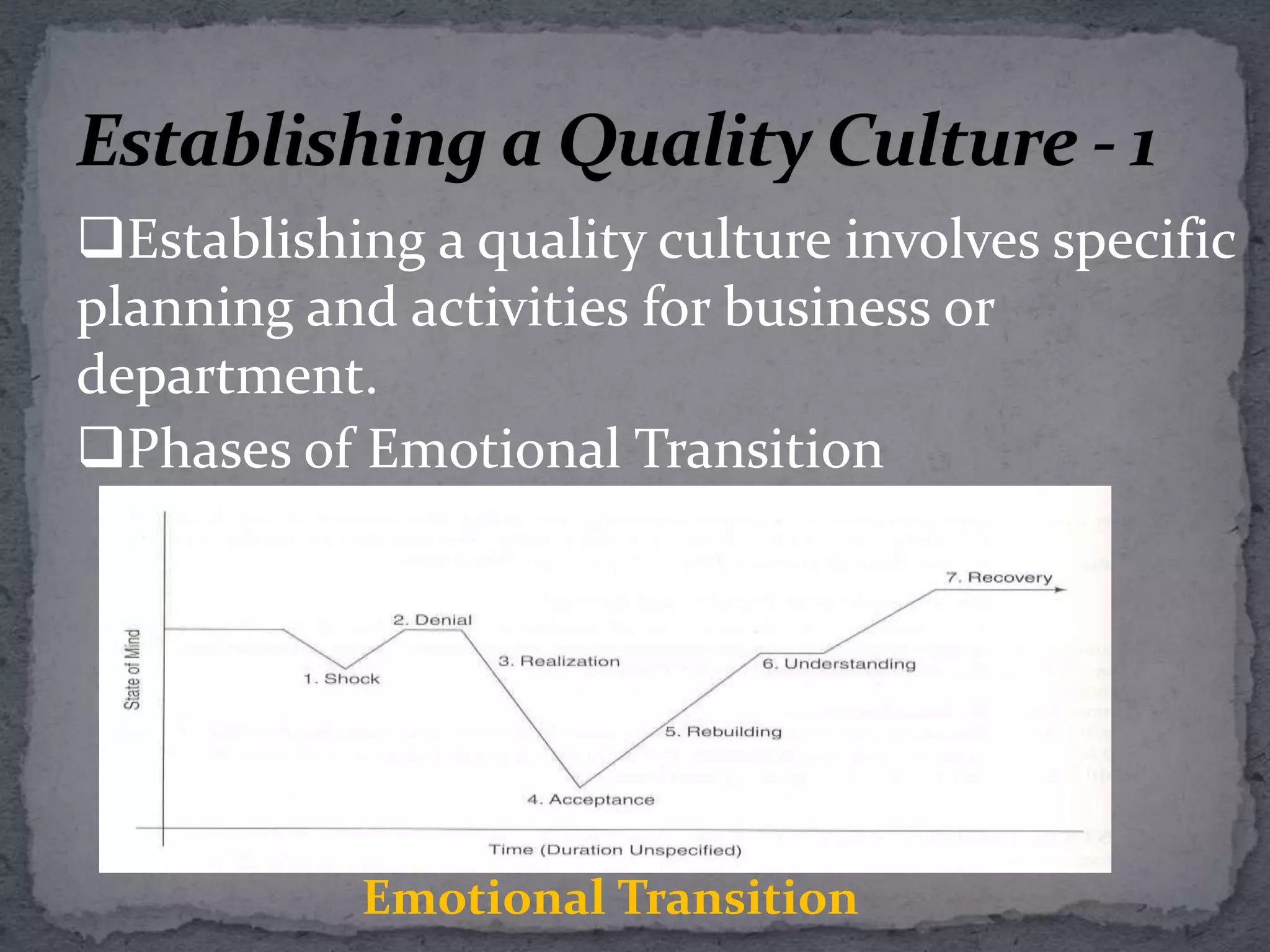
    Establishing a QualityCulture - 1Establishing a quality culture involves specific planning and activities for business or department.
  • 59.
    Phases of EmotionalTransitionEmotional Transition
  • 60.
    Establishing a QualityCulture - 2 Steps in Conversion to Quality:Identify the Changes needed
  • 61.
    Put the PlannedChanges in Writing
  • 62.
    Develop a Planfor Making the Changes
  • 63.
    Understand the EmotionalTransition process
  • 64.
    Identify Key Peopleand Make Them advocates
  • 65.
    Take a Heartsand Minds Approach
  • 66.
    Apply Courtship StrategiesMaintaininga Quality CultureEstablishing Quality Culture is a challenging undertaking for any organization. It is even more challenging to maintain it over time.
  • 67.
    In order tomaintain Quality Culture, organizations must foster the following behaviors Maintain awareness of Quality as a key cultural issue.
  • 68.
    Make sure thatthere is plenty of evidence of Management’s leadership.Empower Employees and encourage self-development and self-initiative.Recognize and reward the behaviors that tend to nurture and maintain Quality Culture.
  • 69.