



TURBOMACHINERY DESIGN
WITH CFD OPTIMIZATION
ARNAUD GIRIN
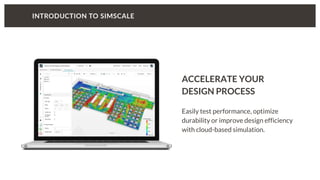
ACCELERATE YOUR
DESIGN PROCESS
Easily test performance, optimize
durability or improve design efficiency
with cloud-based simulation.
ALL-IN-ONE
Structural mechanics,
fluid dynamics, and
thermodynamics.
REAL-TIME SUPPORT
Chat, phone and email.
Consultancy, webinars,
and training.
COLLABORATION
Join the community,
benefit from public projects,
and share know-how.
FAST & EASY
Get results faster
on any device thanks
to cloud technology.
COST-EFFICIENT
Start risk-free without
an upfront investment.
SECURE
High security with
government-approved
Advanced Encryption
Standard (AES).
TURBOMACHINE DESIGN
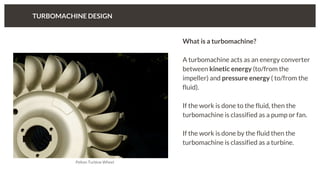
What is a turbomachine?
A turbomachine acts as an energy converter
between kinetic energy (to/from the
impeller) and pressure energy ( to/from the
fluid).
If the work is done to the fluid, then the
turbomachine is classified as a pump or fan.
If the work is done by the fluid then the
turbomachine is classified as a turbine.
Pelton Turbine Wheel
USING CFD TO ASSESS A TURBOMACHINE DESIGN
TOPIC OVERVIEW
Looking at improving the design of
turbomachinery, the key factor is reducing
losses ( recirculation, friction etc.).
Many parameters on the different
components of the machine can be altered
and their effects on the performance can be
measured.
CFD provides a great solution for carrying
out fast iterations in order to converge on an
optimum design without the need for
excessive physical prototyping.
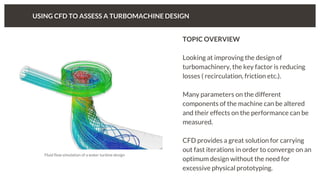
Fluid flow simulation of a water turbine design
TURBOMACHINE DESIGN EFFICIENCY
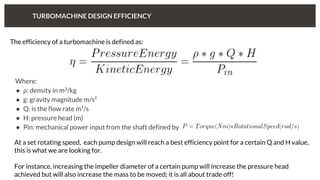
The efficiency of a turbomachine is defined as:
Where:
● ⍴: density in m3/kg
● g: gravity magnitude m/s²
● Q: is the flow rate m³/s
● H: pressure head (m)
● Pin: mechanical power input from the shaft defined by
At a set rotating speed, each pump design will reach a best efficiency point for a certain Q and H value,
this is what we are looking for.
For instance, increasing the impeller diameter of a certain pump will increase the pressure head
achieved but will also increase the mass to be moved; it is all about trade off!
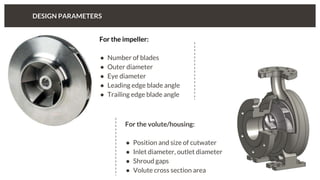
DESIGN PARAMETERS
For the impeller:
● Number of blades
● Outer diameter
● Eye diameter
● Leading edge blade angle
● Trailing edge blade angle
For the volute/housing:
● Position and size of cutwater
● Inlet diameter, outlet diameter
● Shroud gaps
● Volute cross section area
THE SIMSCALE CFD SIMULATION WORKFLOW
3) Design Decision
Simulation insights to make better design
decisions faster and earlier
2) Simulation Setup
Structural mechanics, fluid dynamics or
thermal analysis—all in one application.
1) CAD Import
CAD model upload or import from other
cloud services
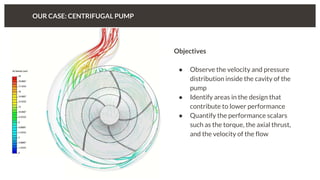
OUR CASE: CENTRIFUGAL PUMP
Objectives
● Observe the velocity and pressure
distribution inside the cavity of the
pump
● Identify areas in the design that
contribute to lower performance
● Quantify the performance scalars
such as the torque, the axial thrust,
and the velocity of the flow
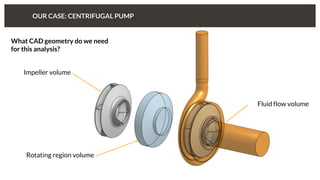
OUR CASE: CENTRIFUGAL PUMP
What CAD geometry do we need
for this analysis?
Impeller volume
Rotating region volume
Fluid flow volume
OUR CASE: CENTRIFUGAL PUMP
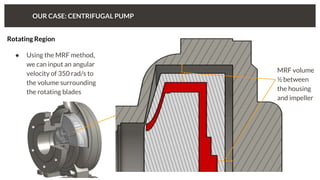
Rotating Region
● Using the MRF method,
we can input an angular
velocity of 350 rad/s to
the volume surrounding
the rotating blades
MRF volume
½ between
the housing
and impeller
MESH GENERATION
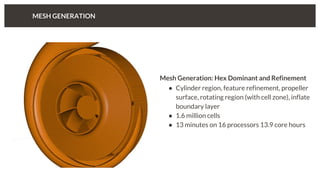
Mesh Generation: Hex Dominant and Refinement
● Cylinder region, feature refinement, propeller
surface, rotating region (with cell zone), inflate
boundary layer
● 1.6 million cells
● 13 minutes on 16 processors 13.9 core hours
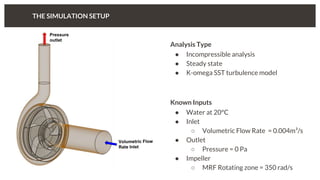
Analysis Type
● Incompressible analysis
● Steady state
● K-omega SST turbulence model
Known Inputs
● Water at 20°C
● Inlet
○ Volumetric Flow Rate = 0.004m³/s
● Outlet
○ Pressure = 0 Pa
● Impeller
○ MRF Rotating zone = 350 rad/s
THE SIMULATION SETUP
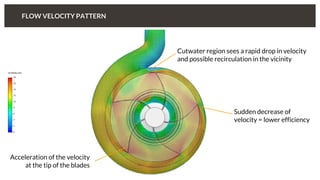
FLOW VELOCITY PATTERN
Sudden decrease of
velocity = lower efficiency
Acceleration of the velocity
at the tip of the blades
Cutwater region sees a rapid drop in velocity
and possible recirculation in the vicinity
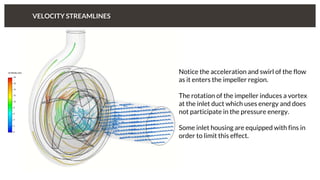
VELOCITY STREAMLINES
Notice the acceleration and swirl of the flow
as it enters the impeller region.
The rotation of the impeller induces a vortex
at the inlet duct which uses energy and does
not participate in the pressure energy.
Some inlet housing are equipped with fins in
order to limit this effect.
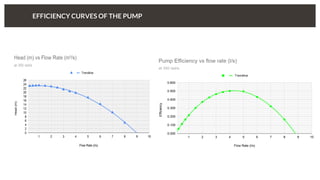
EFFICIENCY CURVES OF THE PUMP
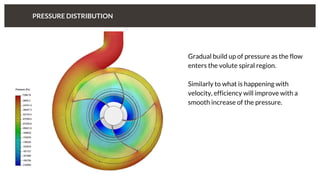
PRESSURE DISTRIBUTION
Gradual build up of pressure as the flow
enters the volute spiral region.
Similarly to what is happening with
velocity, efficiency will improve with a
smooth increase of the pressure.
Turbomachinery: Industrial Pump Design Optimization

Turbomachinery: Industrial Pump Design Optimization

  • 1.
    TURBOMACHINERY DESIGN WITH CFDOPTIMIZATION ARNAUD GIRIN
  • 3.
    ACCELERATE YOUR DESIGN PROCESS Easilytest performance, optimize durability or improve design efficiency with cloud-based simulation.
  • 4.
    ALL-IN-ONE Structural mechanics, fluid dynamics,and thermodynamics. REAL-TIME SUPPORT Chat, phone and email. Consultancy, webinars, and training. COLLABORATION Join the community, benefit from public projects, and share know-how. FAST & EASY Get results faster on any device thanks to cloud technology. COST-EFFICIENT Start risk-free without an upfront investment. SECURE High security with government-approved Advanced Encryption Standard (AES).
  • 6.
    TURBOMACHINE DESIGN What isa turbomachine? A turbomachine acts as an energy converter between kinetic energy (to/from the impeller) and pressure energy ( to/from the fluid). If the work is done to the fluid, then the turbomachine is classified as a pump or fan. If the work is done by the fluid then the turbomachine is classified as a turbine. Pelton Turbine Wheel
  • 7.
    USING CFD TOASSESS A TURBOMACHINE DESIGN TOPIC OVERVIEW Looking at improving the design of turbomachinery, the key factor is reducing losses ( recirculation, friction etc.). Many parameters on the different components of the machine can be altered and their effects on the performance can be measured. CFD provides a great solution for carrying out fast iterations in order to converge on an optimum design without the need for excessive physical prototyping. Fluid flow simulation of a water turbine design
  • 8.
    TURBOMACHINE DESIGN EFFICIENCY Theefficiency of a turbomachine is defined as: Where: ● ⍴: density in m3/kg ● g: gravity magnitude m/s² ● Q: is the flow rate m³/s ● H: pressure head (m) ● Pin: mechanical power input from the shaft defined by At a set rotating speed, each pump design will reach a best efficiency point for a certain Q and H value, this is what we are looking for. For instance, increasing the impeller diameter of a certain pump will increase the pressure head achieved but will also increase the mass to be moved; it is all about trade off!
  • 9.
    DESIGN PARAMETERS For theimpeller: ● Number of blades ● Outer diameter ● Eye diameter ● Leading edge blade angle ● Trailing edge blade angle For the volute/housing: ● Position and size of cutwater ● Inlet diameter, outlet diameter ● Shroud gaps ● Volute cross section area
  • 10.
    THE SIMSCALE CFDSIMULATION WORKFLOW 3) Design Decision Simulation insights to make better design decisions faster and earlier 2) Simulation Setup Structural mechanics, fluid dynamics or thermal analysis—all in one application. 1) CAD Import CAD model upload or import from other cloud services
  • 11.
    OUR CASE: CENTRIFUGALPUMP Objectives ● Observe the velocity and pressure distribution inside the cavity of the pump ● Identify areas in the design that contribute to lower performance ● Quantify the performance scalars such as the torque, the axial thrust, and the velocity of the flow
  • 12.
    OUR CASE: CENTRIFUGALPUMP What CAD geometry do we need for this analysis? Impeller volume Rotating region volume Fluid flow volume
  • 13.
    OUR CASE: CENTRIFUGALPUMP Rotating Region ● Using the MRF method, we can input an angular velocity of 350 rad/s to the volume surrounding the rotating blades MRF volume ½ between the housing and impeller
  • 14.
    MESH GENERATION Mesh Generation:Hex Dominant and Refinement ● Cylinder region, feature refinement, propeller surface, rotating region (with cell zone), inflate boundary layer ● 1.6 million cells ● 13 minutes on 16 processors 13.9 core hours
  • 15.
    Analysis Type ● Incompressibleanalysis ● Steady state ● K-omega SST turbulence model Known Inputs ● Water at 20°C ● Inlet ○ Volumetric Flow Rate = 0.004m³/s ● Outlet ○ Pressure = 0 Pa ● Impeller ○ MRF Rotating zone = 350 rad/s THE SIMULATION SETUP
  • 17.
    FLOW VELOCITY PATTERN Suddendecrease of velocity = lower efficiency Acceleration of the velocity at the tip of the blades Cutwater region sees a rapid drop in velocity and possible recirculation in the vicinity
  • 18.
    VELOCITY STREAMLINES Notice theacceleration and swirl of the flow as it enters the impeller region. The rotation of the impeller induces a vortex at the inlet duct which uses energy and does not participate in the pressure energy. Some inlet housing are equipped with fins in order to limit this effect.
  • 19.
  • 20.
    PRESSURE DISTRIBUTION Gradual buildup of pressure as the flow enters the volute spiral region. Similarly to what is happening with velocity, efficiency will improve with a smooth increase of the pressure.

Editor's Notes

  • #2 USE THIS SLIDE IN CASE YOUR TITLE DOES NOT FIT THE SINGLE LINE TITLE PLEASE USE A SHORT AND CLEAR TITLE
  • #4 // SIMSCALE BOLD & INSPIRATIONAL INTRO // !!DO NOT CHANGE!! TEXT: HEADLINE 20PT / CONTINUOUS TEXT 15 PT BOX IMAGE: TAKE THE BOX IMAGE AS AN INDICATION TO MAINTAIN MARGINS AND ALIGNMENT
  • #5 // SIMSCALE USPs DESCRIPTION // !!DO NOT CHANGE!! TEXT: HEADLINE 15PT / CONTINUOUS TEXT 15 PT BOX IMAGE: TAKE THE BOX IMAGE AS AN INDICATION TO MAINTAIN MARGINS AND ALIGNMENT
  • #7 // INTRODUCTION TO MAIN TOPIC / WHAT IS THE PROBLEM WE WANT TO SOLVE? // TEXT: HEADLINE 15PT / CONTINUOUS TEXT 15 PT BOX IMAGE: TAKE THE BOX IMAGE AS AN INDICATION TO MAINTAIN MARGINS AND ALIGNMENT
  • #8 // INTRODUCTION TO MAIN TOPIC / WHAT IS THE PROBLEM WE WANT TO SOLVE? // TEXT: HEADLINE 15PT / CONTINUOUS TEXT 15 PT BOX IMAGE: TAKE THE BOX IMAGE AS AN INDICATION TO MAINTAIN MARGINS AND ALIGNMENT
  • #9 // LIVE PROJECT // CHECKING ACTUAL RESULTS // TEXT: HEADLINE 15PT / CONTINUOUS TEXT 15 PT BOX IMAGE: TAKE THE BOX IMAGE AS AN INDICATION TO MAINTAIN MARGINS AND ALIGNMENT With this formula in mind, we can play with the design parameters in order to reduces energy losses and therefore increase this ratio.
  • #10 // LIVE PROJECT // CHECKING ACTUAL RESULTS // TEXT: HEADLINE 15PT / CONTINUOUS TEXT 15 PT BOX IMAGE: TAKE THE BOX IMAGE AS AN INDICATION TO MAINTAIN MARGINS AND ALIGNMENT
  • #11 // LIVE PROJECT // CHECKING ACTUAL RESULTS // TEXT: HEADLINE 15PT / CONTINUOUS TEXT 15 PT BOX IMAGE: TAKE THE BOX IMAGE AS AN INDICATION TO MAINTAIN MARGINS AND ALIGNMENT
  • #12 // RESULTS SUMMARY // CONCRETE BENEFIT EXPLANATION // WHAT DID WE IMPROVE? BOX 1: before BOX 2: After TEXT: HEADLINE 20PT / CONTINUOUS TEXT 15 PT BOX IMAGE: TAKE THE BOX IMAGE AS AN INDICATION TO MAINTAIN MARGINS AND ALIGNMENT
  • #13 // RESULTS SUMMARY // CONCRETE BENEFIT EXPLANATION // INITIAL DESIGN VS IMPROVED DESIGN // BOX 1: before BOX 2: After TEXT: HEADLINE 20PT / CONTINUOUS TEXT 15 PT BOX IMAGE: TAKE THE BOX IMAGE AS AN INDICATION TO MAINTAIN MARGINS AND ALIGNMENT
  • #14 This approach uses a ‘rotating frame of reference’ that modifies the governing equations in the rotating zone. Additional source terms that incorporate forces in the rotating reference frame are taken into account that simulate a rotation effect in the flow.
  • #15 // RESULTS SUMMARY // CONCRETE BENEFIT EXPLANATION // WHAT DID WE IMPROVE? BOX 1: before BOX 2: After TEXT: HEADLINE 20PT / CONTINUOUS TEXT 15 PT BOX IMAGE: TAKE THE BOX IMAGE AS AN INDICATION TO MAINTAIN MARGINS AND ALIGNMENT
  • #16 // RESULTS SUMMARY // CONCRETE BENEFIT EXPLANATION // WHAT DID WE IMPROVE? BOX 1: before BOX 2: After TEXT: HEADLINE 20PT / CONTINUOUS TEXT 15 PT BOX IMAGE: TAKE THE BOX IMAGE AS AN INDICATION TO MAINTAIN MARGINS AND ALIGNMENT
  • #18 // RESULTS SUMMARY // CONCRETE BENEFIT EXPLANATION // WHAT DID WE IMPROVE? BOX 1: before BOX 2: After TEXT: HEADLINE 20PT / CONTINUOUS TEXT 15 PT BOX IMAGE: TAKE THE BOX IMAGE AS AN INDICATION TO MAINTAIN MARGINS AND ALIGNMENT
  • #19 // RESULTS SUMMARY // CONCRETE BENEFIT EXPLANATION // WHAT DID WE IMPROVE? BOX 1: before BOX 2: After TEXT: HEADLINE 20PT / CONTINUOUS TEXT 15 PT BOX IMAGE: TAKE THE BOX IMAGE AS AN INDICATION TO MAINTAIN MARGINS AND ALIGNMENT
  • #20 // RESULTS SUMMARY // CONCRETE BENEFIT EXPLANATION // WHAT DID WE IMPROVE? BOX 1: before BOX 2: After TEXT: HEADLINE 20PT / CONTINUOUS TEXT 15 PT BOX IMAGE: TAKE THE BOX IMAGE AS AN INDICATION TO MAINTAIN MARGINS AND ALIGNMENT
  • #21 // RESULTS SUMMARY // CONCRETE BENEFIT EXPLANATION // WHAT DID WE IMPROVE? BOX 1: before BOX 2: After TEXT: HEADLINE 20PT / CONTINUOUS TEXT 15 PT BOX IMAGE: TAKE THE BOX IMAGE AS AN INDICATION TO MAINTAIN MARGINS AND ALIGNMENT
  • #23 THANK THE PARTICIPANTS AND INVITE THEM TO GET IN CONTACT