CONTENTS 
1. BUILDING 
1. Classification of building according to occupancy 1-3 
2. Detail of measurement 4-14 
2. FOUNDATION 
1. Classification of foundation 15-16 
2. Foundation Plan 17 
3. Excavation of Foundation 18 
4. Footing 19 
5. Columns 20-21 
3. RETAINING WALL 
1. Introduction 22 
2. Type of Retaining Wall 23 
3. Estimation of Retaining Wall 24 
4. BREAST WALL 
1. Introduction 25 
2. Estimation of Breast Wall 26-27 
5. ROAD 
1. Introduction 28 
2. Road Survey 29-30 
3. Importance of Roads 31-32 
4. Classification of Roads 32-37 
5. Gradients 38-40 
6. Constructed of cemented Road 41-42 
7. Tarring of Road 43
BUILDING 
Any relatively permanent and closed structure on a plot of land, having a rot and 
window. 
CLASSIFICATION OF BUILDING 
ACCORDING TO OCCUPANCY 
1. Residential building 
2. Industrial building 
3. Public building 
4. Commercial building 
5. Institutional building 
6. Hazardous building 
7. Storage building
CONSTRUCTION WORK OF A BUILDING 
1. LAYOUT : Firstly measured the outer dimension of building i.e. X. Then 
marked the centerline of each load bearing walls constructed. The thickness 
of brick masonry wall is 0.23 m etc. 
2. GROUND LEVEL :- The ground level has taken 190.0 cm. 
3. FOUNDATION LEVEL :- The founding level has taken 130.0 cm. 
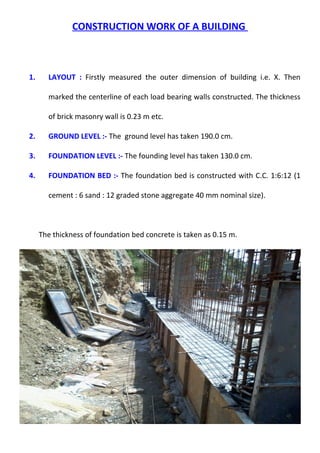
4. FOUNDATION BED :- The foundation bed is constructed with C.C. 1:6:12 (1 
cement : 6 sand : 12 graded stone aggregate 40 mm nominal size). 
The thickness of foundation bed concrete is taken as 0.15 m.
FOUNDATION 
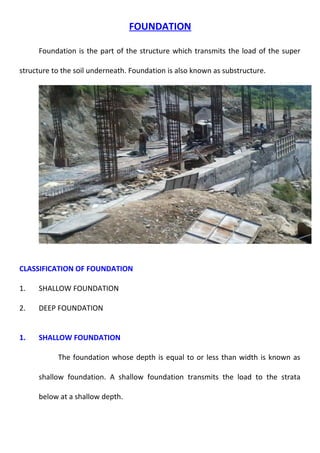
Foundation is the part of the structure which transmits the load of the super 
structure to the soil underneath. Foundation is also known as substructure. 
CLASSIFICATION OF FOUNDATION 
1. SHALLOW FOUNDATION 
2. DEEP FOUNDATION 
1. SHALLOW FOUNDATION 
The foundation whose depth is equal to or less than width is known as 
shallow foundation. A shallow foundation transmits the load to the strata 
below at a shallow depth.
Types of shallow foundation 
· Spread footing 
· Strip footing 
· Combined footing 
· Strap footing 
· Mat or raft footing 
· Isolated footing 
2. DEEP FOUNDATION 
The foundation whose depth is equal to or greater than width is known as deep 
foundation. When the soil at or near the surface of ground is not capable of 
supporting a structure, deep foundation are required to transfer the load to deeper 
strata. 
Types of deep foundation : 
· Well foundation 
· Pile foundation 
· Pier foundation
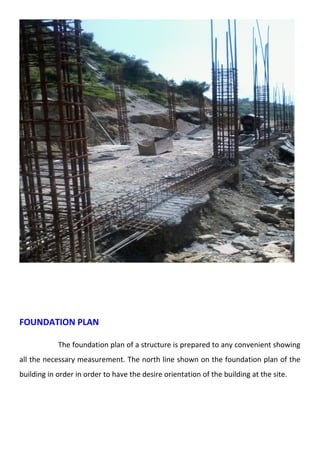
FOUNDATION PLAN 
The foundation plan of a structure is prepared to any convenient showing 
all the necessary measurement. The north line shown on the foundation plan of the 
building in order in order to have the desire orientation of the building at the site.
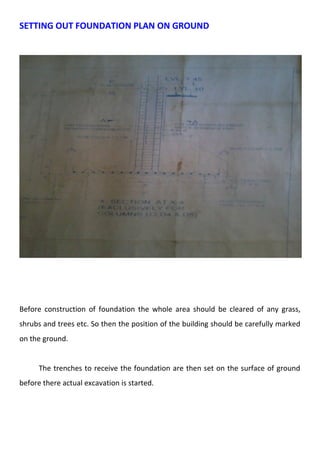
SETTING OUT FOUNDATION PLAN ON GROUND 
Before construction of foundation the whole area should be cleared of any grass, 
shrubs and trees etc. So then the position of the building should be carefully marked 
on the ground. 
The trenches to receive the foundation are then set on the surface of ground 
before there actual excavation is started.
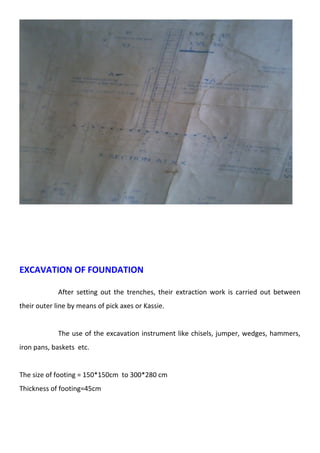
EXCAVATION OF FOUNDATION 
After setting out the trenches, their extraction work is carried out between 
their outer line by means of pick axes or Kassie. 
The use of the excavation instrument like chisels, jumper, wedges, hammers, 
iron pans, baskets etc. 
The size of footing = 150*150cm to 300*280 cm 
Thickness of footing=45cm
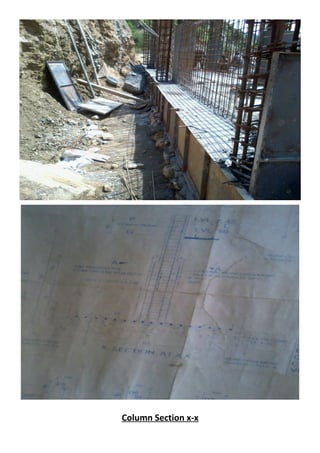
Column Section x-x
FOOTING 
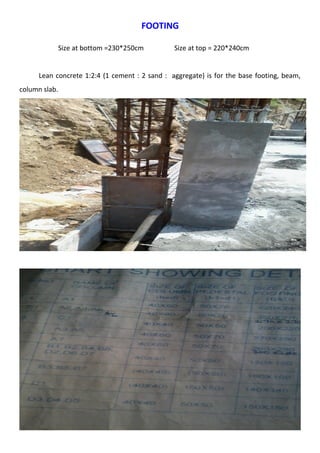
Size at bottom =230*250cm Size at top = 220*240cm 
Lean concrete 1:2:4 (1 cement : 2 sand : aggregate) is for the base footing, beam, 
column slab.
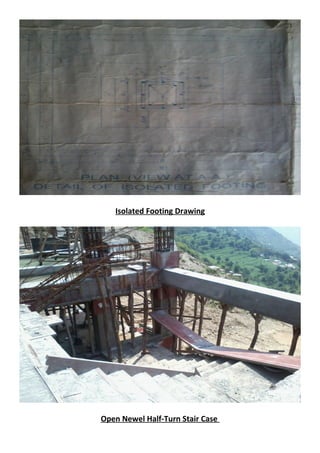
Isolated Footing Drawing 
Open Newel Half-Turn Stair Case
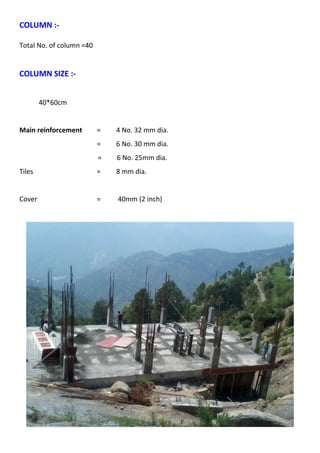
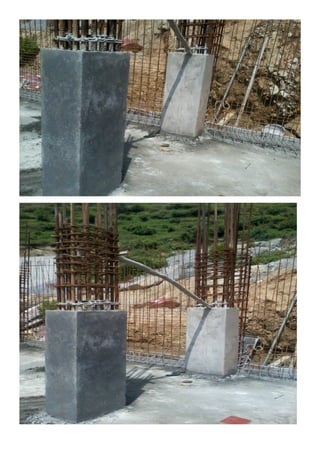
COLUMN :- 
Total No. of column =40 
COLUMN SIZE :- 
40*60cm 
Main reinforcement = 4 No. 32 mm dia. 
= 6 No. 30 mm dia. 
= 6 No. 25mm dia. 
Tiles = 8 mm dia. 
Cover = 40mm (2 inch)
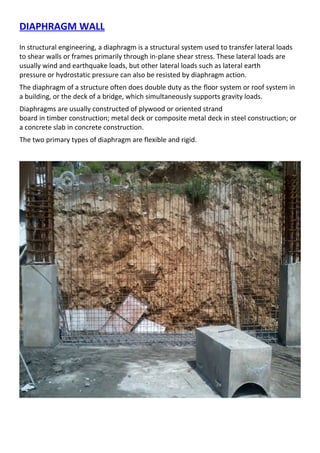
DIAPHRAGM WALL 
In structural engineering, a diaphragm is a structural system used to transfer lateral loads 
to shear walls or frames primarily through in-plane shear stress. These lateral loads are 
usually wind and earthquake loads, but other lateral loads such as lateral earth 
pressure or hydrostatic pressure can also be resisted by diaphragm action. 
The diaphragm of a structure often does double duty as the floor system or roof system in 
a building, or the deck of a bridge, which simultaneously supports gravity loads. 
Diaphragms are usually constructed of plywood or oriented strand 
board in timber construction; metal deck or composite metal deck in steel construction; or 
a concrete slab in concrete construction. 
The two primary types of diaphragm are flexible and rigid.
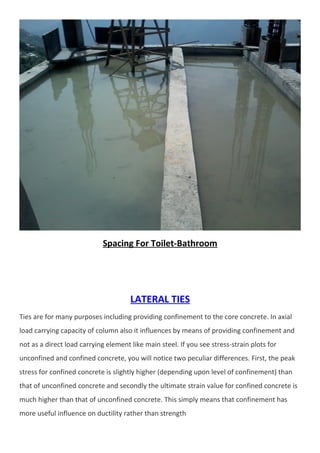
Spacing For Toilet-Bathroom 
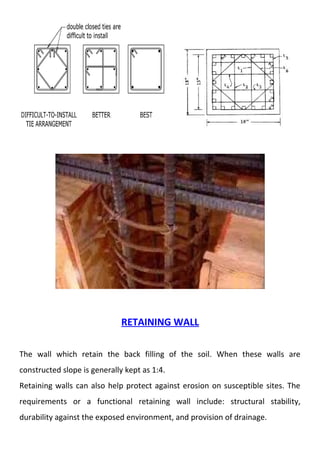
LATERAL TIES 
Ties are for many purposes including providing confinement to the core concrete. In axial 
load carrying capacity of column also it influences by means of providing confinement and 
not as a direct load carrying element like main steel. If you see stress-strain plots for 
unconfined and confined concrete, you will notice two peculiar differences. First, the peak 
stress for confined concrete is slightly higher (depending upon level of confinement) than 
that of unconfined concrete and secondly the ultimate strain value for confined concrete is 
much higher than that of unconfined concrete. This simply means that confinement has 
more useful influence on ductility rather than strength
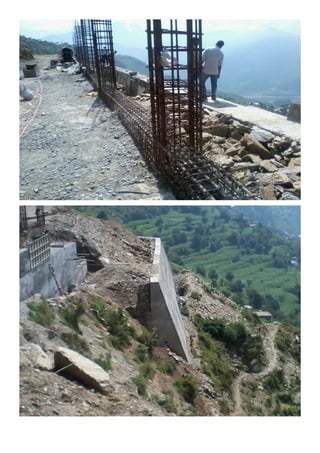
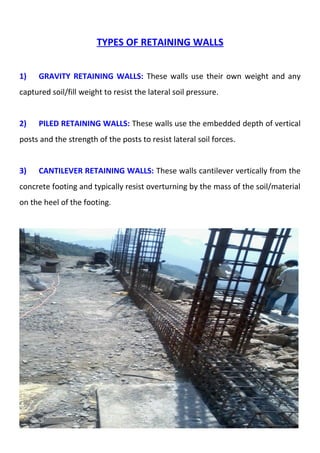
RETAINING WALL 
The wall which retain the back filling of the soil. When these walls are 
constructed slope is generally kept as 1:4. 
Retaining walls can also help protect against erosion on susceptible sites. The 
requirements or a functional retaining wall include: structural stability, 
durability against the exposed environment, and provision of drainage.
TYPES OF RETAINING WALLS 
1) GRAVITY RETAINING WALLS: These walls use their own weight and any 
captured soil/fill weight to resist the lateral soil pressure. 
2) PILED RETAINING WALLS: These walls use the embedded depth of vertical 
posts and the strength of the posts to resist lateral soil forces. 
3) CANTILEVER RETAINING WALLS: These walls cantilever vertically from the 
concrete footing and typically resist overturning by the mass of the soil/material 
on the heel of the footing.
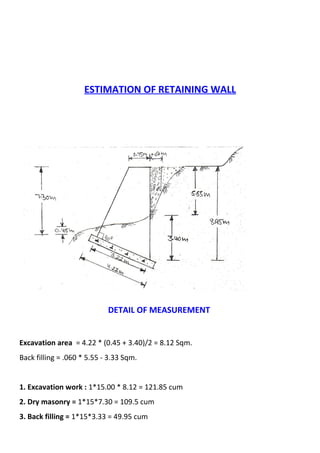
ESTIMATION OF RETAINING WALL 
DETAIL OF MEASUREMENT 
Excavation area = 4.22 * (0.45 + 3.40)/2 = 8.12 Sqm. 
Back filling = .060 * 5.55 - 3.33 Sqm. 
1. Excavation work : 1*15.00 * 8.12 = 121.85 cum 
2. Dry masonry = 1*15*7.30 = 109.5 cum 
3. Back filling = 1*15*3.33 = 49.95 cum
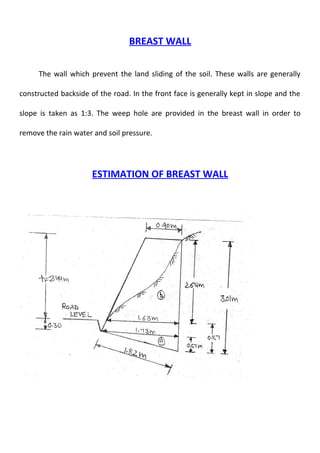
BREAST WALL 
The wall which prevent the land sliding of the soil. These walls are generally 
constructed backside of the road. In the front face is generally kept in slope and the 
slope is taken as 1:3. The weep hole are provided in the breast wall in order to 
remove the rain water and soil pressure. 
ESTIMATION OF BREAST WALL
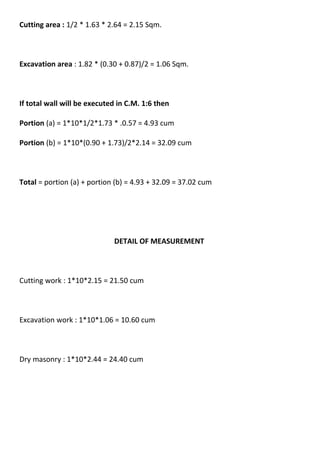
Cutting area : 1/2 * 1.63 * 2.64 = 2.15 Sqm. 
Excavation area : 1.82 * (0.30 + 0.87)/2 = 1.06 Sqm. 
If total wall will be executed in C.M. 1:6 then 
Portion (a) = 1*10*1/2*1.73 * .0.57 = 4.93 cum 
Portion (b) = 1*10*(0.90 + 1.73)/2*2.14 = 32.09 cum 
Total = portion (a) + portion (b) = 4.93 + 32.09 = 37.02 cum 
DETAIL OF MEASUREMENT 
Cutting work : 1*10*2.15 = 21.50 cum 
Excavation work : 1*10*1.06 = 10.60 cum 
Dry masonry : 1*10*2.44 = 24.40 cum
INTRODUCTION 
Road are the vital means of communication on land. The progress and 
entire progress of the country dependent upon the efficient and wide spread 
network of the roads. In this project we have done survey of the road and 
designed the road.
ROAD 
Road is a structure constructed of different material (earth, gravel, 
bitumen etc.) to facilitate movement of vehicle, cart, cyclist etc. from one place 
to another place. 
ROAD SURVEY 
The survey conducted to collect the important data and information for the 
location, design and construction of road. Various types of survey related to the 
road construction that we have done are: 
1. Reconnaissance 
2. Preliminary Survey 
3. Location Survey 
1. Reconnaissance Survey 
A preliminary and a rapid examination of the region with reference to its 
natural features without the help of instrument is known as reconnaissance and 
conducted to determine the location of the road with respect to local condition 
reconnaissance survey.
2) Preliminary Survey 
The accurate survey conducted along the desirable routes as 
recommended by reconnaissance survey in order to obtain a sufficient 
data for final location survey is termed 
3) Location Survey 
The survey carried along the finalized route after preliminary survey by 
transferring the proposed central line to the actual ground and collecting 
other related information termed as location survey. It includes following 
stages: 
· Location of central line 
· Detailed survey 
IMPORTANCE OF THE ROADS 
The importance of the roads can be easily judged from the following parts: 
1) Conveyance of Men & Material:- 
They facilitate conveyance of people, goods, raw material, manufactured 
items etc. 
2) Source of communication: 
They act as only source of communication in high altitude and mountains 
region.
3) In maintaining laws and order: 
They help in maintaining law and order in country. 
4) As a feeder: 
They act as a feeder for railway, waterways, and airways. 
5) Employment opportunity: 
They provides the more employments for the people. 
6) Social and cultural ties: 
They help in promoting social and ties along people living in different parts 
of the country. 
7) Play role in defence of country: 
They play very important role in defence of country war days.
CLASSIFICATION OF THE ROADS: 
1) According to the location 
2) According the importance 
3) According to the traffic 
4) According to tonnage 
1) Classification according to the location: 
According to the location and financial 
responsibility nonurban roads in India can be 
classified in to five categories: 
a) National Highway (NH) 
b) State highway (SH) 
c) Major district roads (MDR) 
d) Other district roads (ODR) 
e) Village roads (VR)
a) National Highway:- 
The main highway running through the length and breadth in the country 
connecting major parts, foreign highway and capital of state etc are known 
as national highway. 
These highways constitute the main arteries of transport in the country 
and are also of military importance. Nation highway would have 
carriageway of at least two lane width. They should have modern type of 
surfacing. 
b) State Highway:- 
The highway linking district headquarters, cities, within the state or 
connecting them with national highway of neighboring state are known as 
state highway. These highways are called provincial highways. These 
highways serve as internal route of traffic to and from district road within 
the state. They should have modern type of surfacing. 
c) Major district roads: 
The important roads within a district serving areas of production and 
market and connecting this place with each other or with the main 
highway are known as major district road. The road should be couple and
taking road traffic in the rural area throughout the year without any 
interruption due to bridge crossing. Major district road should have at 
least metaled single lane carriageway. 
d) Other district roads: 
The road serving rural areas & production and providing them without let 
to market centre, Tehsil headquarters, railways station etc are known as 
ODR. 
e) Village roads: 
The road connecting village or group & villages with each other and 
nearest road of category are known as village roads. These roads are very 
important from the rural point of view. They are generally not metaled 
and should have single lane width of stabilized soil or graved. 
2) Classification according to importance: 
According to importance of connecting holy places, stations of strategies, 
important roads are classified as following categories:
a) Class 1 roads 
b) Class 2 roads 
c) Class 3 roads 
3) Classification according to traffic: 
According to the traffic roads are classified into following categories: 
a) Very heavy traffic roads (which carries above 600 vehicle/day) 
b) Heavy traffic roads (which carries 251-600 vehicle/ day) 
c) Medium traffic roads (which carries 70-2500 vehicle/ day) 
d) Light traffic roads (which carries below 70 vehicle/day) 
4) Classification of the roads according to tonnage: 
According to total tonnage per day roads are classified into following 
categories: 
a) Very heavy traffic roads (which carries over 1524 metric tones/day) 
b) Heavy traffic roads (which caries over 1070 to 1524 metric tons/day)
GRADIENTS 
The rate of rise and fall provided to the formation of a road along its 
alignment is called grade or gradient. It is the longitudinal slope provided 
to the formation of a road along it’s alignments. 
Mathematically: 
Gradient = vertical distance/horizontal distance = H/D Objectives of 
providing gradients: 
· To connect terminal stations situated at different levels. 
· To make earthwork economically since perfectly level roads involves 
more cutting and filling. 
· To provide effective drainage of rainwater. 
· To construct side drain economically with the concrete depth below 
ground level. 
· To reduce maintenance cost of roads.
TYPES OF GRADIENT 
a) Ruling gradient: 
The gradient usually adopting while making the alignment of roads is 
called ruling gradient. 
b) Limiting gradient: 
The gradient steeps than the ruling gradients which ma be used in 
restricted road length when the later is not feasible is called maximum or 
limiting gradients. 
c) Exceptional gradients: 
The gradients than the limiting which may be used in short length of the 
road only in introductory situation is exception is exceptional gradient. 
d) Average gradients: 
The total rise and fall between any two points along the alignment of a 
road divided by the horizontal distances between them is called average 
gradients. 
e) Floating gradient: 
The gradient on which a motor vehicle moving with the same speed 
without any application of power or breaks is called floating gradient.
CONSTRUCTED OF CEMENTED ROADS 
Grade 
M30 
1:1:2 
Road thickness 30cm 
Width of roads 4m 
After concreting vibrator is used for comes and settle down of the concrete 
after 24m gap 2m steel roads are moved in the length wise. These are known as 
extension joints. In the end it is finished by straight edge or other wooden 
throats. 
Thick 7.5 cm and size 40 to 63 mm and last layer of course aggregate. Thick 7.5 
cm and size of aggregate is 20 mm. So layer is tempering by help of roller the to 
laid on bitumen thick 2 cm in centre and ½ cm side of the road and tempering 
by roller is 4 or 5 times.
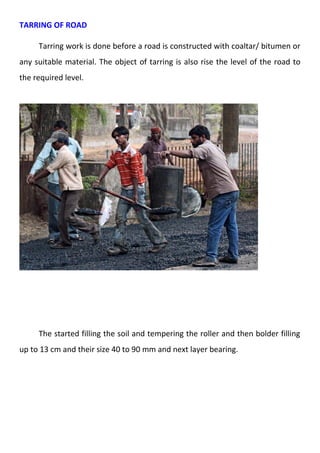
TARRING OF ROAD 
Tarring work is done before a road is constructed with coaltar/ bitumen or 
any suitable material. The object of tarring is also rise the level of the road to 
the required level. 
The started filling the soil and tempering the roller and then bolder filling 
up to 13 cm and their size 40 to 90 mm and next layer bearing.

project report on pwd work.....

  • 1.
    CONTENTS 1. BUILDING 1. Classification of building according to occupancy 1-3 2. Detail of measurement 4-14 2. FOUNDATION 1. Classification of foundation 15-16 2. Foundation Plan 17 3. Excavation of Foundation 18 4. Footing 19 5. Columns 20-21 3. RETAINING WALL 1. Introduction 22 2. Type of Retaining Wall 23 3. Estimation of Retaining Wall 24 4. BREAST WALL 1. Introduction 25 2. Estimation of Breast Wall 26-27 5. ROAD 1. Introduction 28 2. Road Survey 29-30 3. Importance of Roads 31-32 4. Classification of Roads 32-37 5. Gradients 38-40 6. Constructed of cemented Road 41-42 7. Tarring of Road 43
  • 2.
    BUILDING Any relativelypermanent and closed structure on a plot of land, having a rot and window. CLASSIFICATION OF BUILDING ACCORDING TO OCCUPANCY 1. Residential building 2. Industrial building 3. Public building 4. Commercial building 5. Institutional building 6. Hazardous building 7. Storage building
  • 3.
    CONSTRUCTION WORK OFA BUILDING 1. LAYOUT : Firstly measured the outer dimension of building i.e. X. Then marked the centerline of each load bearing walls constructed. The thickness of brick masonry wall is 0.23 m etc. 2. GROUND LEVEL :- The ground level has taken 190.0 cm. 3. FOUNDATION LEVEL :- The founding level has taken 130.0 cm. 4. FOUNDATION BED :- The foundation bed is constructed with C.C. 1:6:12 (1 cement : 6 sand : 12 graded stone aggregate 40 mm nominal size). The thickness of foundation bed concrete is taken as 0.15 m.
  • 4.
    FOUNDATION Foundation isthe part of the structure which transmits the load of the super structure to the soil underneath. Foundation is also known as substructure. CLASSIFICATION OF FOUNDATION 1. SHALLOW FOUNDATION 2. DEEP FOUNDATION 1. SHALLOW FOUNDATION The foundation whose depth is equal to or less than width is known as shallow foundation. A shallow foundation transmits the load to the strata below at a shallow depth.
  • 5.
    Types of shallowfoundation · Spread footing · Strip footing · Combined footing · Strap footing · Mat or raft footing · Isolated footing 2. DEEP FOUNDATION The foundation whose depth is equal to or greater than width is known as deep foundation. When the soil at or near the surface of ground is not capable of supporting a structure, deep foundation are required to transfer the load to deeper strata. Types of deep foundation : · Well foundation · Pile foundation · Pier foundation
  • 6.
    FOUNDATION PLAN Thefoundation plan of a structure is prepared to any convenient showing all the necessary measurement. The north line shown on the foundation plan of the building in order in order to have the desire orientation of the building at the site.
  • 7.
    SETTING OUT FOUNDATIONPLAN ON GROUND Before construction of foundation the whole area should be cleared of any grass, shrubs and trees etc. So then the position of the building should be carefully marked on the ground. The trenches to receive the foundation are then set on the surface of ground before there actual excavation is started.
  • 8.
    EXCAVATION OF FOUNDATION After setting out the trenches, their extraction work is carried out between their outer line by means of pick axes or Kassie. The use of the excavation instrument like chisels, jumper, wedges, hammers, iron pans, baskets etc. The size of footing = 150*150cm to 300*280 cm Thickness of footing=45cm
  • 9.
  • 10.
    FOOTING Size atbottom =230*250cm Size at top = 220*240cm Lean concrete 1:2:4 (1 cement : 2 sand : aggregate) is for the base footing, beam, column slab.
  • 12.
    Isolated Footing Drawing Open Newel Half-Turn Stair Case
  • 13.
    COLUMN :- TotalNo. of column =40 COLUMN SIZE :- 40*60cm Main reinforcement = 4 No. 32 mm dia. = 6 No. 30 mm dia. = 6 No. 25mm dia. Tiles = 8 mm dia. Cover = 40mm (2 inch)
  • 15.
    DIAPHRAGM WALL Instructural engineering, a diaphragm is a structural system used to transfer lateral loads to shear walls or frames primarily through in-plane shear stress. These lateral loads are usually wind and earthquake loads, but other lateral loads such as lateral earth pressure or hydrostatic pressure can also be resisted by diaphragm action. The diaphragm of a structure often does double duty as the floor system or roof system in a building, or the deck of a bridge, which simultaneously supports gravity loads. Diaphragms are usually constructed of plywood or oriented strand board in timber construction; metal deck or composite metal deck in steel construction; or a concrete slab in concrete construction. The two primary types of diaphragm are flexible and rigid.
  • 16.
    Spacing For Toilet-Bathroom LATERAL TIES Ties are for many purposes including providing confinement to the core concrete. In axial load carrying capacity of column also it influences by means of providing confinement and not as a direct load carrying element like main steel. If you see stress-strain plots for unconfined and confined concrete, you will notice two peculiar differences. First, the peak stress for confined concrete is slightly higher (depending upon level of confinement) than that of unconfined concrete and secondly the ultimate strain value for confined concrete is much higher than that of unconfined concrete. This simply means that confinement has more useful influence on ductility rather than strength
  • 17.
    RETAINING WALL Thewall which retain the back filling of the soil. When these walls are constructed slope is generally kept as 1:4. Retaining walls can also help protect against erosion on susceptible sites. The requirements or a functional retaining wall include: structural stability, durability against the exposed environment, and provision of drainage.
  • 19.
    TYPES OF RETAININGWALLS 1) GRAVITY RETAINING WALLS: These walls use their own weight and any captured soil/fill weight to resist the lateral soil pressure. 2) PILED RETAINING WALLS: These walls use the embedded depth of vertical posts and the strength of the posts to resist lateral soil forces. 3) CANTILEVER RETAINING WALLS: These walls cantilever vertically from the concrete footing and typically resist overturning by the mass of the soil/material on the heel of the footing.
  • 20.
    ESTIMATION OF RETAININGWALL DETAIL OF MEASUREMENT Excavation area = 4.22 * (0.45 + 3.40)/2 = 8.12 Sqm. Back filling = .060 * 5.55 - 3.33 Sqm. 1. Excavation work : 1*15.00 * 8.12 = 121.85 cum 2. Dry masonry = 1*15*7.30 = 109.5 cum 3. Back filling = 1*15*3.33 = 49.95 cum
  • 21.
    BREAST WALL Thewall which prevent the land sliding of the soil. These walls are generally constructed backside of the road. In the front face is generally kept in slope and the slope is taken as 1:3. The weep hole are provided in the breast wall in order to remove the rain water and soil pressure. ESTIMATION OF BREAST WALL
  • 22.
    Cutting area :1/2 * 1.63 * 2.64 = 2.15 Sqm. Excavation area : 1.82 * (0.30 + 0.87)/2 = 1.06 Sqm. If total wall will be executed in C.M. 1:6 then Portion (a) = 1*10*1/2*1.73 * .0.57 = 4.93 cum Portion (b) = 1*10*(0.90 + 1.73)/2*2.14 = 32.09 cum Total = portion (a) + portion (b) = 4.93 + 32.09 = 37.02 cum DETAIL OF MEASUREMENT Cutting work : 1*10*2.15 = 21.50 cum Excavation work : 1*10*1.06 = 10.60 cum Dry masonry : 1*10*2.44 = 24.40 cum
  • 23.
    INTRODUCTION Road arethe vital means of communication on land. The progress and entire progress of the country dependent upon the efficient and wide spread network of the roads. In this project we have done survey of the road and designed the road.
  • 24.
    ROAD Road isa structure constructed of different material (earth, gravel, bitumen etc.) to facilitate movement of vehicle, cart, cyclist etc. from one place to another place. ROAD SURVEY The survey conducted to collect the important data and information for the location, design and construction of road. Various types of survey related to the road construction that we have done are: 1. Reconnaissance 2. Preliminary Survey 3. Location Survey 1. Reconnaissance Survey A preliminary and a rapid examination of the region with reference to its natural features without the help of instrument is known as reconnaissance and conducted to determine the location of the road with respect to local condition reconnaissance survey.
  • 25.
    2) Preliminary Survey The accurate survey conducted along the desirable routes as recommended by reconnaissance survey in order to obtain a sufficient data for final location survey is termed 3) Location Survey The survey carried along the finalized route after preliminary survey by transferring the proposed central line to the actual ground and collecting other related information termed as location survey. It includes following stages: · Location of central line · Detailed survey IMPORTANCE OF THE ROADS The importance of the roads can be easily judged from the following parts: 1) Conveyance of Men & Material:- They facilitate conveyance of people, goods, raw material, manufactured items etc. 2) Source of communication: They act as only source of communication in high altitude and mountains region.
  • 26.
    3) In maintaininglaws and order: They help in maintaining law and order in country. 4) As a feeder: They act as a feeder for railway, waterways, and airways. 5) Employment opportunity: They provides the more employments for the people. 6) Social and cultural ties: They help in promoting social and ties along people living in different parts of the country. 7) Play role in defence of country: They play very important role in defence of country war days.
  • 27.
    CLASSIFICATION OF THEROADS: 1) According to the location 2) According the importance 3) According to the traffic 4) According to tonnage 1) Classification according to the location: According to the location and financial responsibility nonurban roads in India can be classified in to five categories: a) National Highway (NH) b) State highway (SH) c) Major district roads (MDR) d) Other district roads (ODR) e) Village roads (VR)
  • 28.
    a) National Highway:- The main highway running through the length and breadth in the country connecting major parts, foreign highway and capital of state etc are known as national highway. These highways constitute the main arteries of transport in the country and are also of military importance. Nation highway would have carriageway of at least two lane width. They should have modern type of surfacing. b) State Highway:- The highway linking district headquarters, cities, within the state or connecting them with national highway of neighboring state are known as state highway. These highways are called provincial highways. These highways serve as internal route of traffic to and from district road within the state. They should have modern type of surfacing. c) Major district roads: The important roads within a district serving areas of production and market and connecting this place with each other or with the main highway are known as major district road. The road should be couple and
  • 29.
    taking road trafficin the rural area throughout the year without any interruption due to bridge crossing. Major district road should have at least metaled single lane carriageway. d) Other district roads: The road serving rural areas & production and providing them without let to market centre, Tehsil headquarters, railways station etc are known as ODR. e) Village roads: The road connecting village or group & villages with each other and nearest road of category are known as village roads. These roads are very important from the rural point of view. They are generally not metaled and should have single lane width of stabilized soil or graved. 2) Classification according to importance: According to importance of connecting holy places, stations of strategies, important roads are classified as following categories:
  • 30.
    a) Class 1roads b) Class 2 roads c) Class 3 roads 3) Classification according to traffic: According to the traffic roads are classified into following categories: a) Very heavy traffic roads (which carries above 600 vehicle/day) b) Heavy traffic roads (which carries 251-600 vehicle/ day) c) Medium traffic roads (which carries 70-2500 vehicle/ day) d) Light traffic roads (which carries below 70 vehicle/day) 4) Classification of the roads according to tonnage: According to total tonnage per day roads are classified into following categories: a) Very heavy traffic roads (which carries over 1524 metric tones/day) b) Heavy traffic roads (which caries over 1070 to 1524 metric tons/day)
  • 31.
    GRADIENTS The rateof rise and fall provided to the formation of a road along its alignment is called grade or gradient. It is the longitudinal slope provided to the formation of a road along it’s alignments. Mathematically: Gradient = vertical distance/horizontal distance = H/D Objectives of providing gradients: · To connect terminal stations situated at different levels. · To make earthwork economically since perfectly level roads involves more cutting and filling. · To provide effective drainage of rainwater. · To construct side drain economically with the concrete depth below ground level. · To reduce maintenance cost of roads.
  • 32.
    TYPES OF GRADIENT a) Ruling gradient: The gradient usually adopting while making the alignment of roads is called ruling gradient. b) Limiting gradient: The gradient steeps than the ruling gradients which ma be used in restricted road length when the later is not feasible is called maximum or limiting gradients. c) Exceptional gradients: The gradients than the limiting which may be used in short length of the road only in introductory situation is exception is exceptional gradient. d) Average gradients: The total rise and fall between any two points along the alignment of a road divided by the horizontal distances between them is called average gradients. e) Floating gradient: The gradient on which a motor vehicle moving with the same speed without any application of power or breaks is called floating gradient.
  • 33.
    CONSTRUCTED OF CEMENTEDROADS Grade M30 1:1:2 Road thickness 30cm Width of roads 4m After concreting vibrator is used for comes and settle down of the concrete after 24m gap 2m steel roads are moved in the length wise. These are known as extension joints. In the end it is finished by straight edge or other wooden throats. Thick 7.5 cm and size 40 to 63 mm and last layer of course aggregate. Thick 7.5 cm and size of aggregate is 20 mm. So layer is tempering by help of roller the to laid on bitumen thick 2 cm in centre and ½ cm side of the road and tempering by roller is 4 or 5 times.
  • 34.
    TARRING OF ROAD Tarring work is done before a road is constructed with coaltar/ bitumen or any suitable material. The object of tarring is also rise the level of the road to the required level. The started filling the soil and tempering the roller and then bolder filling up to 13 cm and their size 40 to 90 mm and next layer bearing.