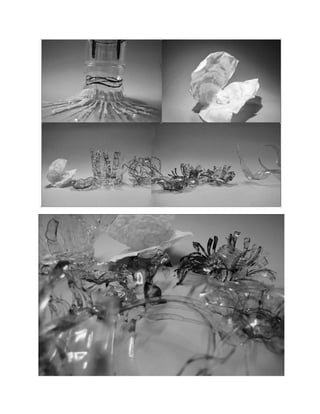
DD 304
Design Project 1

Plastic Fantastic
Creatively exploring the PET bottle life after use.


Guide
Prof. Ravi Mokashi Punekar


Submitted by
Nitish Meena       08020514
Paresh Joshi       08020515
Introduction - PET Plastic
The word plastic is derived from the Greek (plastikos) meaning capable of being shaped or
molded. PET (polyethylene terephthalate) is one of the most commonly used plastic used in
beverage, food and other liquid containers.

The project talks about the use of PET plastic resource and its possible hazards. It also takes
into consideration the different aspects for optimizing its consumption and possible after uses.

The project takes a leap from the recycling world into the world of reuse and tries to bring out
interesting ways by which people can incorporate used plastic ‘trash’ into their arts and other
useful accessories.
Inspiration for the Project
Motivation for the project was taken from the stories pertaining to the waste of plastic resource.

The present people are very techy and does really bother about the limitations that we have on
our resources, and that their insufficiency could possibly cause threat for future generations.
Sustainability comes here as a big question to answer.

We in our design project try to utilize the waste resource to make useful craft, thus evoking
emotions in people of their up comings and try to make them responsible for the present.
Identification of the design space
Plastics are now such an integral part of our daily lives that virtually everything we do and much
of the food and drink we consume involves the use of plastics in some form or other. The range
of fields and activities in which we use plastics is truly amazing from packaging, through
manufacture of a hugely wide range of products to healthcare and agriculture. It has become
the ultimate material for the 21st century and makes our lives possible in a way that could hardly
be imagined without it.

‘Plastic Fantastic’ started off with a very broad end considering every segment of society.
Insights were taken down to narrow down the design space. We have considered the 4R’s of
Plastic: Reduce, Reuse, Recycle, and Recover. And Focus on the Reuse Part.

Reuse is simply the act of finding a second (or third, or tenth or hundredth) use for a product to
prolong its life. Reuse is an important step after you’ve already reduced, but before you are
ready to recycle.The important thing to consider when you want to reuse is that creativity is king.
The creativity also provides the opportunity to be thrifty by reusing what you already have for
new, innovative purposes.

As many people know, reuse is a step up from recycling. In fact, reuse is the middle-man
between reduce and recycle, and some would be surprised at how many opportunities for reuse
there really are – once you start looking for them.

We’re not talking about simply covering a bottle in magazine cut-outs, sticking some flowers
inside and voilà- a masterpiece vase is born. There’s more to it. Though there is always room
for easy and fun projects, the reuse that we find most interesting is the kind you can’t tell is
reused. There are some quality results that can be achieved.
Aim and objective of Study:
Aim: To explore real time situations of PET bottle and providing apposite solutions for the same.

Objective of Study: This project analyses the situation for PET bottle and tries to provide
solutions for new ways to interact with the bottle i.e. tries to bring out interesting ways by which
people can incorporate used plastic ‘trash’ into their artifacts.

It also tries to spread awareness among the people falling under its design space regarding
sustainable design and less usage of the present limited resource.


The project is taken up in two phases:

   •   Explorations of the PET plastic industry and deriving solutions in the form of recover,
       recycle, reduce and reuse.
   •   Focusing on the reuse aspect and drawing creative ideations for the same.
DATA COLLECTION


Secondary Search
The secondary search that we undertook was in two phases:

Under phase one, study of life cycle for the PET bottle was carried out, right from the process of
manufacturing to consumption and possible after usages.

Different materials were studied and among them that were or are presently used in
manufacturing of bottle, PET is the most widely used for various reasons:

   •   It protects – preserves, secures and guarantees product hygiene and consumer health.
   •   It stands out – flexible and clear, easily shaped into any form.
   •   Its better – light weight, shatterproof and reclose able, it makes beverages easier to
       carry.
   •   It’s recyclable – PET is 100% recyclable, and there are well-developed applications for
       the recycled resin.


Phase two mainly included gathering information from the avaliable web resources. We visited
links to get statistics of usage and after use aspects of the PET bottle. Recycling aspect was
studied in-depth.

Primary Search
Secondary search was then followed by primary search in which interviews were done.
Regional bottle industries were targeted and statistics were taken of the production,
consumption and wastage of the material.

Also it was found out that some bottling plants had recycling section separate for the scrap. The
production was done taking into account the demands and varied from seasons to seasons.
User Study
The study of user involved targeting users of different age groups and varied professions.
Observations sessions were done for each user at various places. Study of user’s tendency
towards the PET bottle after consuming it was looked into.

Different inferences were drawn from different users. It was found out that some users collect
the old scrap of bottle and then return it to plastic industry while some others use the scrap to
make their general house items, which indeed in useful but also very playful.

The whole exercise ‘reuse of refuse’ was studied for user. Reusing aspect was taken as the
major topic of discussions.


Study of the present system
The present system study is as follows:

  •   Less than 1 percent of all plastics is recycled. Therefore, almost all plastics are
      incinerated or end up in a landfill.
  •   Recycled plastic bottles can be made into products such as clothing, carpeting, detergent
      bottles and lumber for outdoor decking.
  •   Producing new plastic products from recycled materials uses two-thirds less energy than
      required to make products from raw (virgin) materials. It also reduces greenhouse gas
      emissions.
  •   Plastic bottle recycling schemes currently operates in over 430 local authority areas.
  •   The majority of plastic bottles are made from PET or HDPE.
  •   Recycling a single plastic bottle can conserve enough energy to light a 60W light bulb for
      up to 6 hours.
  •   On average, every household uses 500 plastic bottles each year, of which just 130 are
      recycled.
  •   11% of household waste is plastic, 40% of which is plastic bottles.
  •   Up to 40% less fuel is used to transport drinks in plastic bottles compared to glass
      bottles.
  •   Plastic packaging uses only around 2% of all crude oil produced.

Inferences
On analysis from the statistics and observations, several inferences were drawn.

   1. The amount produced is much greater than the amount recycled.
   2. PET is 100% recyclable but due to less of recycling options, much is down cycled.
   3. From around the world, many awareness programs and experiments are going on for
      optimizing the waste and creating better options for the use of resource.

Much of the waste produced out of the PET bottle was either land filled, littered or incinerated.
Drawing conclusion, plastic industry is here to stay, we cannot replace the resource, neither can
we create more recycling options, so now it depends on us to become conscious about it and
start thinking over the most less thought off ‘reuse of refuse’.
FORMULATION OF NEW DESIGN BRIEF
The new design brief brings the apposite solutions in the form of reuse aspect of PET. Hence
the formulated design brief is as follows:

Creatively exploring the PET bottle life after use.
CREATIVE IDEATION
Now that the basic frameworks were established in terms of the redesigned project brief and the
user study surveys, creative ideation part aimed to explore the form of bottle and realize the
possible new solutions in the form of products applying the basic mathematic principles of
addition, subtraction, division and multiplication and different materialistic properties of PET.
DELIVERABLES
The final deliverables of the project are a line of products for all age groups made from the PET
plastic bottle. Also, a step by step guide for reference to these products containing line drawings
and step wise instructions.
Scope for future development
The idea of reuse can be implemented at larger levels through campaigns and workshops to
create awareness among the society for the use of PET bottle, and how they can make ‘reuse
out of refuse’. This can heavily influence the way people behave with PET.

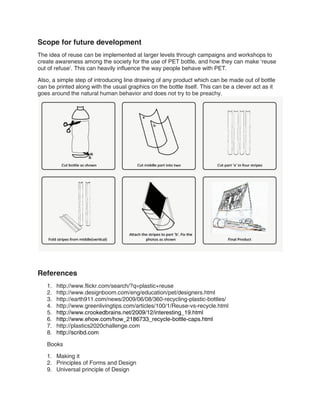
Also, a simple step of introducing line drawing of any product which can be made out of bottle
can be printed along with the usual graphics on the bottle itself. This can be a clever act as it
goes around the natural human behavior and does not try to be preachy.


References
   1.   http://www.flickr.com/search/?q=plastic+reuse
   2.   http://www.designboom.com/eng/education/pet/designers.html
   3.   http://earth911.com/news/2009/06/08/360-recycling-plastic-bottles/
   4.   http://www.greenlivingtips.com/articles/100/1/Reuse-vs-recycle.html
   5.   http://www.crookedbrains.net/2009/12/interesting_19.html
   6.   http://www.ehow.com/how_2186733_recycle-bottle-caps.html
   7.   http://plastics2020challenge.com
   8.   http://scribd.com

   Books

   1. Making it
   2. Principles of Forms and Design
   9. Universal principle of Design

Project report

  • 1.
    DD 304 Design Project1 Plastic Fantastic Creatively exploring the PET bottle life after use. Guide Prof. Ravi Mokashi Punekar Submitted by Nitish Meena 08020514 Paresh Joshi 08020515
  • 2.
    Introduction - PETPlastic The word plastic is derived from the Greek (plastikos) meaning capable of being shaped or molded. PET (polyethylene terephthalate) is one of the most commonly used plastic used in beverage, food and other liquid containers. The project talks about the use of PET plastic resource and its possible hazards. It also takes into consideration the different aspects for optimizing its consumption and possible after uses. The project takes a leap from the recycling world into the world of reuse and tries to bring out interesting ways by which people can incorporate used plastic ‘trash’ into their arts and other useful accessories.
  • 3.
    Inspiration for theProject Motivation for the project was taken from the stories pertaining to the waste of plastic resource. The present people are very techy and does really bother about the limitations that we have on our resources, and that their insufficiency could possibly cause threat for future generations. Sustainability comes here as a big question to answer. We in our design project try to utilize the waste resource to make useful craft, thus evoking emotions in people of their up comings and try to make them responsible for the present.
  • 4.
    Identification of thedesign space Plastics are now such an integral part of our daily lives that virtually everything we do and much of the food and drink we consume involves the use of plastics in some form or other. The range of fields and activities in which we use plastics is truly amazing from packaging, through manufacture of a hugely wide range of products to healthcare and agriculture. It has become the ultimate material for the 21st century and makes our lives possible in a way that could hardly be imagined without it. ‘Plastic Fantastic’ started off with a very broad end considering every segment of society. Insights were taken down to narrow down the design space. We have considered the 4R’s of Plastic: Reduce, Reuse, Recycle, and Recover. And Focus on the Reuse Part. Reuse is simply the act of finding a second (or third, or tenth or hundredth) use for a product to prolong its life. Reuse is an important step after you’ve already reduced, but before you are ready to recycle.The important thing to consider when you want to reuse is that creativity is king. The creativity also provides the opportunity to be thrifty by reusing what you already have for new, innovative purposes. As many people know, reuse is a step up from recycling. In fact, reuse is the middle-man between reduce and recycle, and some would be surprised at how many opportunities for reuse there really are – once you start looking for them. We’re not talking about simply covering a bottle in magazine cut-outs, sticking some flowers inside and voilà- a masterpiece vase is born. There’s more to it. Though there is always room for easy and fun projects, the reuse that we find most interesting is the kind you can’t tell is reused. There are some quality results that can be achieved.
  • 5.
    Aim and objectiveof Study: Aim: To explore real time situations of PET bottle and providing apposite solutions for the same. Objective of Study: This project analyses the situation for PET bottle and tries to provide solutions for new ways to interact with the bottle i.e. tries to bring out interesting ways by which people can incorporate used plastic ‘trash’ into their artifacts. It also tries to spread awareness among the people falling under its design space regarding sustainable design and less usage of the present limited resource. The project is taken up in two phases: • Explorations of the PET plastic industry and deriving solutions in the form of recover, recycle, reduce and reuse. • Focusing on the reuse aspect and drawing creative ideations for the same.
  • 6.
    DATA COLLECTION Secondary Search Thesecondary search that we undertook was in two phases: Under phase one, study of life cycle for the PET bottle was carried out, right from the process of manufacturing to consumption and possible after usages. Different materials were studied and among them that were or are presently used in manufacturing of bottle, PET is the most widely used for various reasons: • It protects – preserves, secures and guarantees product hygiene and consumer health. • It stands out – flexible and clear, easily shaped into any form. • Its better – light weight, shatterproof and reclose able, it makes beverages easier to carry. • It’s recyclable – PET is 100% recyclable, and there are well-developed applications for the recycled resin. Phase two mainly included gathering information from the avaliable web resources. We visited links to get statistics of usage and after use aspects of the PET bottle. Recycling aspect was studied in-depth. Primary Search Secondary search was then followed by primary search in which interviews were done. Regional bottle industries were targeted and statistics were taken of the production, consumption and wastage of the material. Also it was found out that some bottling plants had recycling section separate for the scrap. The production was done taking into account the demands and varied from seasons to seasons.
  • 7.
    User Study The studyof user involved targeting users of different age groups and varied professions. Observations sessions were done for each user at various places. Study of user’s tendency towards the PET bottle after consuming it was looked into. Different inferences were drawn from different users. It was found out that some users collect the old scrap of bottle and then return it to plastic industry while some others use the scrap to make their general house items, which indeed in useful but also very playful. The whole exercise ‘reuse of refuse’ was studied for user. Reusing aspect was taken as the major topic of discussions. Study of the present system The present system study is as follows: • Less than 1 percent of all plastics is recycled. Therefore, almost all plastics are incinerated or end up in a landfill. • Recycled plastic bottles can be made into products such as clothing, carpeting, detergent bottles and lumber for outdoor decking. • Producing new plastic products from recycled materials uses two-thirds less energy than required to make products from raw (virgin) materials. It also reduces greenhouse gas emissions. • Plastic bottle recycling schemes currently operates in over 430 local authority areas. • The majority of plastic bottles are made from PET or HDPE. • Recycling a single plastic bottle can conserve enough energy to light a 60W light bulb for up to 6 hours. • On average, every household uses 500 plastic bottles each year, of which just 130 are recycled. • 11% of household waste is plastic, 40% of which is plastic bottles. • Up to 40% less fuel is used to transport drinks in plastic bottles compared to glass bottles. • Plastic packaging uses only around 2% of all crude oil produced. Inferences On analysis from the statistics and observations, several inferences were drawn. 1. The amount produced is much greater than the amount recycled. 2. PET is 100% recyclable but due to less of recycling options, much is down cycled. 3. From around the world, many awareness programs and experiments are going on for optimizing the waste and creating better options for the use of resource. Much of the waste produced out of the PET bottle was either land filled, littered or incinerated. Drawing conclusion, plastic industry is here to stay, we cannot replace the resource, neither can we create more recycling options, so now it depends on us to become conscious about it and start thinking over the most less thought off ‘reuse of refuse’.
  • 8.
    FORMULATION OF NEWDESIGN BRIEF The new design brief brings the apposite solutions in the form of reuse aspect of PET. Hence the formulated design brief is as follows: Creatively exploring the PET bottle life after use.
  • 9.
    CREATIVE IDEATION Now thatthe basic frameworks were established in terms of the redesigned project brief and the user study surveys, creative ideation part aimed to explore the form of bottle and realize the possible new solutions in the form of products applying the basic mathematic principles of addition, subtraction, division and multiplication and different materialistic properties of PET.
  • 13.
    DELIVERABLES The final deliverablesof the project are a line of products for all age groups made from the PET plastic bottle. Also, a step by step guide for reference to these products containing line drawings and step wise instructions.
  • 14.
    Scope for futuredevelopment The idea of reuse can be implemented at larger levels through campaigns and workshops to create awareness among the society for the use of PET bottle, and how they can make ‘reuse out of refuse’. This can heavily influence the way people behave with PET. Also, a simple step of introducing line drawing of any product which can be made out of bottle can be printed along with the usual graphics on the bottle itself. This can be a clever act as it goes around the natural human behavior and does not try to be preachy. References 1. http://www.flickr.com/search/?q=plastic+reuse 2. http://www.designboom.com/eng/education/pet/designers.html 3. http://earth911.com/news/2009/06/08/360-recycling-plastic-bottles/ 4. http://www.greenlivingtips.com/articles/100/1/Reuse-vs-recycle.html 5. http://www.crookedbrains.net/2009/12/interesting_19.html 6. http://www.ehow.com/how_2186733_recycle-bottle-caps.html 7. http://plastics2020challenge.com 8. http://scribd.com Books 1. Making it 2. Principles of Forms and Design 9. Universal principle of Design