Plastic Container Manufacturing Process:
The Fundamentals
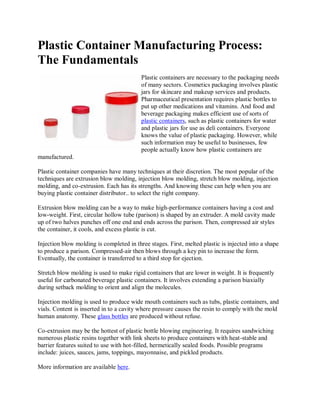
Plastic containers are necessary to the packaging needs
of many sectors. Cosmetics packaging involves plastic
jars for skincare and makeup services and products.
Pharmaceutical presentation requires plastic bottles to
put up other medications and vitamins. And food and
beverage packaging makes efficient use of sorts of
plastic containers, such as plastic containers for water
and plastic jars for use as deli containers. Everyone
knows the value of plastic packaging. However, while
such information may be useful to businesses, few
people actually know how plastic containers are
manufactured.
Plastic container companies have many techniques at their discretion. The most popular of the
techniques are extrusion blow molding, injection blow molding, stretch blow molding, injection
molding, and co-extrusion. Each has its strengths. And knowing these can help when you are
buying plastic container distributor.. to select the right company.
Extrusion blow molding can be a way to make high-performance containers having a cost and
low-weight. First, circular hollow tube (parison) is shaped by an extruder. A mold cavity made
up of two halves punches off one end and ends across the parison. Then, compressed air styles
the container, it cools, and excess plastic is cut.
Injection blow molding is completed in three stages. First, melted plastic is injected into a shape
to produce a parison. Compressed-air then blows through a key pin to increase the form.
Eventually, the container is transferred to a third stop for ejection.
Stretch blow molding is used to make rigid containers that are lower in weight. It is frequently
useful for carbonated beverage plastic containers. It involves extending a parison biaxially
during setback molding to orient and align the molecules.
Injection molding is used to produce wide mouth containers such as tubs, plastic containers, and
vials. Content is inserted in to a cavity where pressure causes the resin to comply with the mold
human anatomy. These glass bottles are produced without refuse.
Co-extrusion may be the hottest of plastic bottle blowing engineering. It requires sandwiching
numerous plastic resins together with link sheets to produce containers with heat-stable and
barrier features suited to use with hot-filled, hermetically sealed foods. Possible programs
include: juices, sauces, jams, toppings, mayonnaise, and pickled products.
More information are available here.
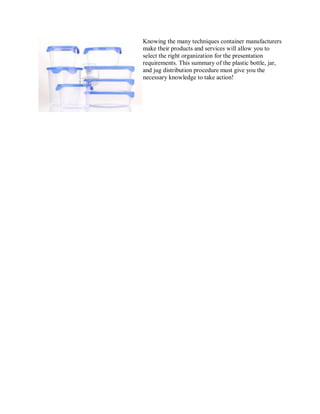
Knowing the many techniques container manufacturers
make their products and services will allow you to
select the right organization for the presentation
requirements. This summary of the plastic bottle, jar,
and jug distribution procedure must give you the
necessary knowledge to take action!

Plastic container manufacturing process

  • 1.
    Plastic Container ManufacturingProcess: The Fundamentals Plastic containers are necessary to the packaging needs of many sectors. Cosmetics packaging involves plastic jars for skincare and makeup services and products. Pharmaceutical presentation requires plastic bottles to put up other medications and vitamins. And food and beverage packaging makes efficient use of sorts of plastic containers, such as plastic containers for water and plastic jars for use as deli containers. Everyone knows the value of plastic packaging. However, while such information may be useful to businesses, few people actually know how plastic containers are manufactured. Plastic container companies have many techniques at their discretion. The most popular of the techniques are extrusion blow molding, injection blow molding, stretch blow molding, injection molding, and co-extrusion. Each has its strengths. And knowing these can help when you are buying plastic container distributor.. to select the right company. Extrusion blow molding can be a way to make high-performance containers having a cost and low-weight. First, circular hollow tube (parison) is shaped by an extruder. A mold cavity made up of two halves punches off one end and ends across the parison. Then, compressed air styles the container, it cools, and excess plastic is cut. Injection blow molding is completed in three stages. First, melted plastic is injected into a shape to produce a parison. Compressed-air then blows through a key pin to increase the form. Eventually, the container is transferred to a third stop for ejection. Stretch blow molding is used to make rigid containers that are lower in weight. It is frequently useful for carbonated beverage plastic containers. It involves extending a parison biaxially during setback molding to orient and align the molecules. Injection molding is used to produce wide mouth containers such as tubs, plastic containers, and vials. Content is inserted in to a cavity where pressure causes the resin to comply with the mold human anatomy. These glass bottles are produced without refuse. Co-extrusion may be the hottest of plastic bottle blowing engineering. It requires sandwiching numerous plastic resins together with link sheets to produce containers with heat-stable and barrier features suited to use with hot-filled, hermetically sealed foods. Possible programs include: juices, sauces, jams, toppings, mayonnaise, and pickled products. More information are available here.
  • 2.
    Knowing the manytechniques container manufacturers make their products and services will allow you to select the right organization for the presentation requirements. This summary of the plastic bottle, jar, and jug distribution procedure must give you the necessary knowledge to take action!