Download the full version and explore a variety of test banks
or solution manuals at https://testbankfan.com
Project Management Process Technology and Practice
1st Edition Vaidyanathan Solutions Manual
_____ Follow the link below to get your download now _____
https://testbankfan.com/product/project-management-process-
technology-and-practice-1st-edition-vaidyanathan-solutions-
manual/
Access testbankfan.com now to download high-quality
test banks or solution manuals
Here are some recommended products for you. Click the link to
download, or explore more at testbankfan.com
Project Management Process Technology and Practice 1st
Edition Vaidyanathan Test Bank
https://testbankfan.com/product/project-management-process-technology-
and-practice-1st-edition-vaidyanathan-test-bank/
Information Technology Project Management 9th Edition
Schwalbe Solutions Manual
https://testbankfan.com/product/information-technology-project-
management-9th-edition-schwalbe-solutions-manual/
Information Technology Project Management 4th Edition
Marchewka Solutions Manual
https://testbankfan.com/product/information-technology-project-
management-4th-edition-marchewka-solutions-manual/
Sonography Introduction to Normal Structure and Function
3rd Edition Curry Test Bank
https://testbankfan.com/product/sonography-introduction-to-normal-
structure-and-function-3rd-edition-curry-test-bank/
Intermediate Accounting 15th Edition Kieso Solutions
Manual
https://testbankfan.com/product/intermediate-accounting-15th-edition-
kieso-solutions-manual/
Digital Evidence and Computer Crime Forensic Science
Computers and the Internet 3rd Edition Casey Test Bank
https://testbankfan.com/product/digital-evidence-and-computer-crime-
forensic-science-computers-and-the-internet-3rd-edition-casey-test-
bank/
New Perspectives Microsoft Office 365 and Word 2016
Introductory 1st Edition Shaffer Solutions Manual
https://testbankfan.com/product/new-perspectives-microsoft-
office-365-and-word-2016-introductory-1st-edition-shaffer-solutions-
manual/
Nutrition and Diet Therapy 9th Edition DeBruyne Solutions
Manual
https://testbankfan.com/product/nutrition-and-diet-therapy-9th-
edition-debruyne-solutions-manual/
Better Business 4th Edition Solomon Test Bank
https://testbankfan.com/product/better-business-4th-edition-solomon-
test-bank/
Management Information Systems Managing the Digital Firm
15th Edition Laudon Test Bank
https://testbankfan.com/product/management-information-systems-
managing-the-digital-firm-15th-edition-laudon-test-bank/
Copyright 2013 Pearson Education, Inc. publishing as Prentice Hall. 7-1
Chapter 7
Quality and Performance
NOTES for the Instructor:
The study projects and the cases are posed as challenging assignments to students.
This study guide elaborates all the material needed to teach those study guides
and cases. The study projects can be assigned in two different ways:
a. If you want to evaluate the ability of the students to form assumptions,
research for materials, and understand the study projects, you can ask the
students to work on the study project without any additional information.
In this case, the students should be encouraged to obtain necessary
information using the Internet.
b. If you want to provide all the information, you can provide that
information shown in the following pages to solve the study projects.
Objectives
• Manage project quality as seen by quality gurus
• Determine how performance in projects are measured
• Define cost of quality
• Implement quality planning, assurance, and control in projects
• Measure project value, project performance, and project scope
Cases
• Information technology Case: SAP Project at NIBCO, Inc.
• Healthcare IT Case: Memorial Hospital of South Bend: Computerized Physician
Order Entry Project
• Financial Services IT Case: Syndicated Community Bank: Core Banking Systems
Replacement Project
• General Construction Case: Craig Constructions, Inc.: A Home Improvement
Project
Review Questions
1. Performance of a project can be defined as the execution or accomplishment of a
project to fulfill customer requirements in accordance with the project scope.
Copyright 2013 Pearson Education, Inc. publishing as Prentice Hall. 7-2
2. Project value is a relative worth or importance that is monetary in nature.
3. Quality is defined as conformance to requirements. Deming defined quality as a
predictable degree of uniformity and dependability at low cost suitable to the
market. Juran defined quality as something that satisfies customer needs. Project
quality is the degree to which a set of inherent characteristics of a project fulfill
project scope.
4. Some of the main differences are in the areas of responsibility of senior
management, SPC, and teamwork.
5. The major goal of quality management is to prevent defects. Quality management
eliminates the source of defects so that defect detection and rework do not happen
often during projects. Quality management complements project management,
which means that components of quality management including customer
satisfaction, defect prevention, continuous improvement, and management
responsibility to provide essential resources are important in project management.
Quality management is composed of quality planning, quality assurance, and
quality control. Quality management is more about process and is based on
problems related to processes.
6. The eight quality management principles include customer focus, leadership,
involvement of projects, process approach, systems approach, continual
improvement, decision making approach, and supplier relationships.
7. The quality model described in ISO/IEC 9126-1 addresses a framework for
software evaluation using the general characteristics of software. These are further
refined into sub-characteristics, which in turn are decomposed into attributes,
yielding a multilevel hierarchy. The characteristics in a quality model are non-
measurable quality factors and are used only to classify the sub-characteristics of
the model, which may be subjectively measured. The ISO/IEC 9126 standard
makes a distinction between internal quality and external quality and introduces
the quality in use.
Copyright 2013 Pearson Education, Inc. publishing as Prentice Hall. 7-3
8. Quality management is composed of quality planning, quality assurance, and
quality control.
9. Quality planning: The inputs for the quality planning are the scope document, the
requirements from stakeholders, the risk register, and the project schedule. By
using this input information, a project manager in cooperation with the quality
team can develop a quality plan for a project as the output.
Quality assurance: The inputs for quality assurance are quality planning, work
performance information, quality control measurements, and quality metrics. The
outputs of the process are asset updates, change requests, project management
plan updates, and project document updates.
Quality control: The inputs are quality metrics, approved change requests, and
organizational process assets. The outputs are quality control measurements,
validated changes, and updates to project management plans and other project
documents.
10. Benchmarking is a process to measure the performance of an organization and
compare that measure with other organizations in the same industry to understand
industry best practices.
11. A quality audit is a review of the quality plan to determine whether the project
activities comply with organizational and project policies, processes, and
procedures.
12. There are many tools and techniques used in quality control including:
• Cause-and-effect diagrams
• Run charts
• Scatter diagrams
• Histograms
• Pareto charts
• Six Sigma
• Process maps or flowcharts
• Control charts
• Statistical sampling
• Reviews, and
• Testing and inspection.
Copyright 2013 Pearson Education, Inc. publishing as Prentice Hall. 7-4
13. Testing is a procedure in which the system, product, or service is observed during
operation in order to determine whether it functions properly. Inspection is the
activity of examining the product, sub-components, or systems to determine if
they meet the design standards.
14. Process capability is a critical aspect of quality control and evaluates the ability of
a project process to meet or exceed the expectations or preset specifications.
15. Statistical sampling deals with the selection of a subset of a population in order to
gain knowledge about the whole population and to predict quality outcomes of the
population using statistics.
16. The three criteria are:
1. The level of precision
2. The level of confidence or risk, and
3. The level of variability in the attributes being measured.
17. There are a number of methods of quality reviews including:
• Expert reviews
• Peer reviews
• Team reviews
• Walk-through reviews
• Formal reviews
• Management reviews, and
• Process reviews.
18. Metrics are required in order to answer the following questions:
• Is the project is on track?
• Is the project manager sure about the progress of the project?
• Does the project manager understand the current status of the project,
schedule wise or cost wise?
• Can the project manager be sure of the performance of the project?
Teaching Points - Discussion Questions
Copyright 2013 Pearson Education, Inc. publishing as Prentice Hall. 7-5
1. What else may be considered for performance other than quality?
Performance measurement should consider many metrics that are listed in the chapter.
It should also consider measuring time and cost constraints and make sure that the
project is performing according to plan.
2. Do the three quality gurus preach the same message on quality?
Even though they preach the same message, there are variations to their quality
messages; See Table 7-1.
3. Quality audits have to be performed on each project.
Quality audits typically should be deployed in all projects large and small. However,
in reality it is not possible to do this because of added costs and time. Many industrial
projects, especially small projects, are not usually audited.
4. Is there one tool that may be used in all projects for quality control?
Analyzing using process maps is a very easy method that can be used in all projects
for quality control. The “as-is” process and the “to-be” process bring out the essence
of quality control in a very easy method especially in small projects.
5. Can we do without metrics when managing projects?
No; every project has to be measured against the measurements of selected metrics.
Proper metrics have to be identified and used. If metrics are not used in a project,
there is no way to know how a project is progressing and may not ensure the success
of the project.
6. There are differences between testing and inspection.
Yes; Testing helps to execute the software in order to test the functionality and
requirements while inspection analyzes the code based on a set of predefined rules.
7. Who decides which metrics are the best for a project: the project manager or
management?
Project manager should decide the metrics while management should help the project
manager by removing any obstacles in order to measure those metrics.
8. Should management be involved in quality management?
Yes; the management should provide leadership to encourage project managers to
manage the project quality.
Answers to Chapter Problems
Problem 1:
Observations
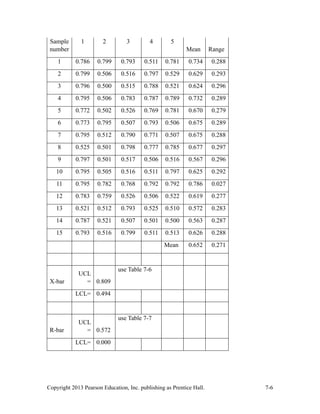
Copyright 2013 Pearson Education, Inc. publishing as Prentice Hall. 7-6
Sample
number
1 2 3 4 5
Mean Range
1 0.786 0.799 0.793 0.511 0.781 0.734 0.288
2 0.799 0.506 0.516 0.797 0.529 0.629 0.293
3 0.796 0.500 0.515 0.788 0.521 0.624 0.296
4 0.795 0.506 0.783 0.787 0.789 0.732 0.289
5 0.772 0.502 0.526 0.769 0.781 0.670 0.279
6 0.773 0.795 0.507 0.793 0.506 0.675 0.289
7 0.795 0.512 0.790 0.771 0.507 0.675 0.288
8 0.525 0.501 0.798 0.777 0.785 0.677 0.297
9 0.797 0.501 0.517 0.506 0.516 0.567 0.296
10 0.795 0.505 0.516 0.511 0.797 0.625 0.292
11 0.795 0.782 0.768 0.792 0.792 0.786 0.027
12 0.783 0.759 0.526 0.506 0.522 0.619 0.277
13 0.521 0.512 0.793 0.525 0.510 0.572 0.283
14 0.787 0.521 0.507 0.501 0.500 0.563 0.287
15 0.793 0.516 0.799 0.511 0.513 0.626 0.288
Mean 0.652 0.271
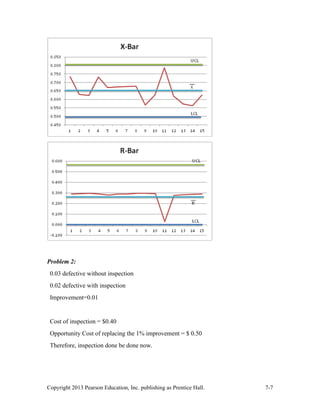
X-bar
UCL
= 0.809
use Table 7-6
LCL= 0.494
R-bar
UCL
= 0.572
use Table 7-7
LCL= 0.000
Copyright 2013 Pearson Education, Inc. publishing as Prentice Hall. 7-7
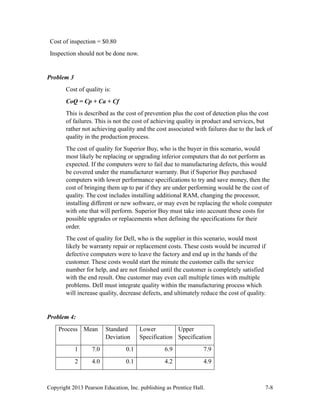
Problem 2:
0.03 defective without inspection
0.02 defective with inspection
Improvement=0.01
Cost of inspection = $0.40
Opportunity Cost of replacing the 1% improvement = $ 0.50
Therefore, inspection done be done now.
Copyright 2013 Pearson Education, Inc. publishing as Prentice Hall. 7-8
Cost of inspection = $0.80
Inspection should not be done now.
Problem 3
Cost of quality is:
CoQ = Cp + Ca + Cf
This is described as the cost of prevention plus the cost of detection plus the cost
of failures. This is not the cost of achieving quality in product and services, but
rather not achieving quality and the cost associated with failures due to the lack of
quality in the production process.
The cost of quality for Superior Buy, who is the buyer in this scenario, would
most likely be replacing or upgrading inferior computers that do not perform as
expected. If the computers were to fail due to manufacturing defects, this would
be covered under the manufacturer warranty. But if Superior Buy purchased
computers with lower performance specifications to try and save money, then the
cost of bringing them up to par if they are under performing would be the cost of
quality. The cost includes installing additional RAM, changing the processor,
installing different or new software, or may even be replacing the whole computer
with one that will perform. Superior Buy must take into account these costs for
possible upgrades or replacements when defining the specifications for their
order.
The cost of quality for Dell, who is the supplier in this scenario, would most
likely be warranty repair or replacement costs. These costs would be incurred if
defective computers were to leave the factory and end up in the hands of the
customer. These costs would start the minute the customer calls the service
number for help, and are not finished until the customer is completely satisfied
with the end result. One customer may even call multiple times with multiple
problems. Dell must integrate quality within the manufacturing process which
will increase quality, decrease defects, and ultimately reduce the cost of quality.
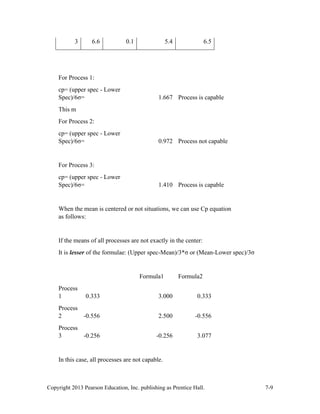
Problem 4:
Process Mean Standard
Deviation
Lower
Specification
Upper
Specification
1 7.0 0.1 6.9 7.9
2 4.0 0.1 4.2 4.9
Copyright 2013 Pearson Education, Inc. publishing as Prentice Hall. 7-9
3 6.6 0.1 5.4 6.5
For Process 1:
cp= (upper spec - Lower
Spec)/6σ= 1.667 Process is capable
This m
For Process 2:
cp= (upper spec - Lower
Spec)/6σ= 0.972 Process not capable
For Process 3:
cp= (upper spec - Lower
Spec)/6σ= 1.410 Process is capable
When the mean is centered or not situations, we can use Cp equation
as follows:
If the means of all processes are not exactly in the center:
It is lesser of the formulae: (Upper spec-Mean)/3*σ or (Mean-Lower spec)/3σ
Formula1 Formula2
Process
1 0.333 3.000 0.333
Process
2 -0.556 2.500 -0.556
Process
3 -0.256 -0.256 3.077
In this case, all processes are not capable.
Copyright 2013 Pearson Education, Inc. publishing as Prentice Hall. 7-10
The Cp should be at least equal to 1.33
Problem 5:
a. The metrics to show control over a project are scope variance hours, scope cost
increase, productivity, project cost deviation, and project progress deviation. The
variance and deviation metrics for scope, cost and progress indicates that these factors
are well defined and restrained within acceptable limitation. Meanwhile, productivity
reflects how well the individual processes are executed.
b. The metrics to show progress would be actual scope hours, productivity, and product
progress deviation. Actual scope hours provide evidence for completed tasks which
are related to the defined scope. Productivity and product progress deviation manifest
the consistency of project progress.
c. The metrics to charge a customer for changes are Scope Variance Hours, Scope Cost
Increase, Number of baseline Changes, Project Effort and Project Cost Deviation.
Number of baseline changes elicits additional requirements which have to be paid by
the customers. The project effort, project cost deviation, and scope cost increases are
used for calculating the amount of additional payment. Rescheduling of the project
should take into account the scope variance hours metric.
d. The metrics are Project Feature Enhancement Increase. This indicator measures the
efficiency of effort scheduling which should be governed to complete important
features.
e. The metrics to use to manage customer expectations are Project Merit and Project
Risk. The project merit communicates that expectations are consistently maintained
and transparent during project duration. Meanwhile, project risk conveys the plans for
securing and preserving expectations.
f. The metrics to understand how fast a team is performing tasks are Project Efficiency
and Project Effort. These metrics quantify the pace of task execution.
g. The metrics for how well a team is performing are Project Effectiveness, Productivity
and Project Effort. The three metrics are numerical presentations of quality of project
execution.
h. The metrics are removed are Removed Defects Efficiency. Removed Defects
Efficiency numerically measures defect detecting and removing capability.
i. The metrics are the Project Customer Commitment which completely evaluates
factors of customer involvement, communication, and availability.
Problem 6:
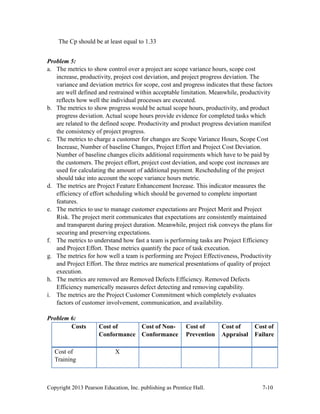
Costs Cost of
Conformance
Cost of Non-
Conformance
Cost of
Prevention
Cost of
Appraisal
Cost of
Failure
Cost of
Training
X
Copyright 2013 Pearson Education, Inc. publishing as Prentice Hall. 7-11
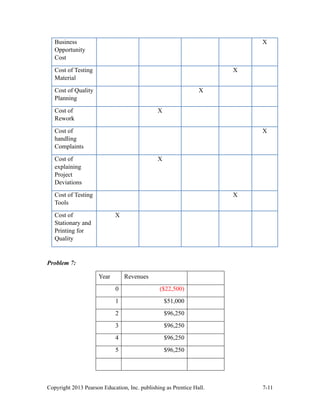
Business
Opportunity
Cost
X
Cost of Testing
Material
X
Cost of Quality
Planning
X
Cost of
Rework
X
Cost of
handling
Complaints
X
Cost of
explaining
Project
Deviations
X
Cost of Testing
Tools
X
Cost of
Stationary and
Printing for
Quality
X
Problem 7:
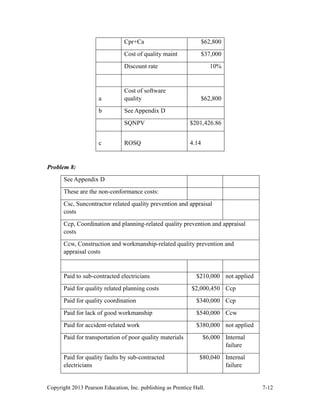
Year Revenues
0 ($22,500)
1 $51,000
2 $96,250
3 $96,250
4 $96,250
5 $96,250
Copyright 2013 Pearson Education, Inc. publishing as Prentice Hall. 7-12
Cpr+Ca $62,800
Cost of quality maint $37,000
Discount rate 10%
a
Cost of software
quality $62,800
b See Appendix D
SQNPV $201,426.86
c ROSQ 4.14
Problem 8:
See Appendix D
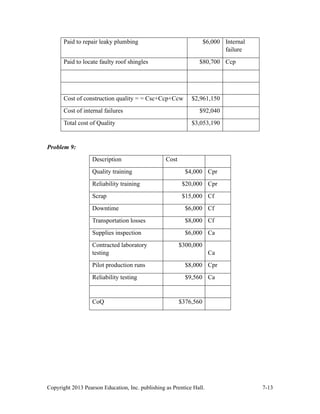
These are the non-conformance costs:
Csc, Suncontractor related quality prevention and appraisal
costs
Ccp, Coordination and planning-related quality prevention and appraisal
costs
Ccw, Construction and workmanship-related quality prevention and
appraisal costs
Paid to sub-contracted electricians $210,000 not applied
Paid for quality related planning costs $2,000,450 Ccp
Paid for quality coordination $340,000 Ccp
Paid for lack of good workmanship $540,000 Ccw
Paid for accident-related work $380,000 not applied
Paid for transportation of poor quality materials $6,000 Internal
failure
Paid for quality faults by sub-contracted
electricians
$80,040 Internal
failure
Copyright 2013 Pearson Education, Inc. publishing as Prentice Hall. 7-13
Paid to repair leaky plumbing $6,000 Internal
failure
Paid to locate faulty roof shingles $80,700 Ccp
Cost of construction quality = = Csc+Ccp+Ccw $2,961,150
Cost of internal failures $92,040
Total cost of Quality $3,053,190
Problem 9:
Description Cost
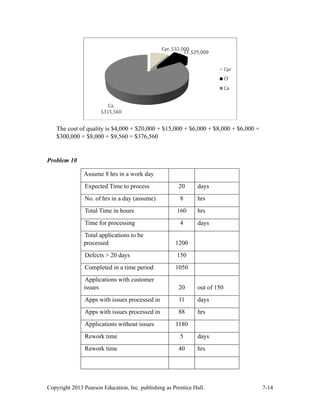
Quality training $4,000 Cpr
Reliability training $20,000 Cpr
Scrap $15,000 Cf
Downtime $6,000 Cf
Transportation losses $8,000 Cf
Supplies inspection $6,000 Ca
Contracted laboratory
testing
$300,000
Ca
Pilot production runs $8,000 Cpr
Reliability testing $9,560 Ca
CoQ $376,560
Copyright 2013 Pearson Education, Inc. publishing as Prentice Hall. 7-14
The cost of quality is $4,000 + $20,000 + $15,000 + $6,000 + $8,000 + $6,000 +
$300,000 + $8,000 + $9,560 = $376,560
Problem 10
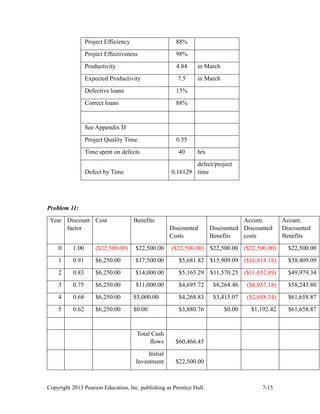
Assume 8 hrs in a work day
Expected Time to process 20 days
No. of hrs in a day (assume) 8 hrs
Total Time in hours 160 hrs
Time for processing 4 days
Total applications to be
processed 1200
Defects > 20 days 150
Completed in a time period 1050
Applications with customer
issues 20 out of 150
Apps with issues processed in 11 days
Apps with issues processed in 88 hrs
Applications without issues 1180
Rework time 5 days
Rework time 40 hrs
Copyright 2013 Pearson Education, Inc. publishing as Prentice Hall. 7-15
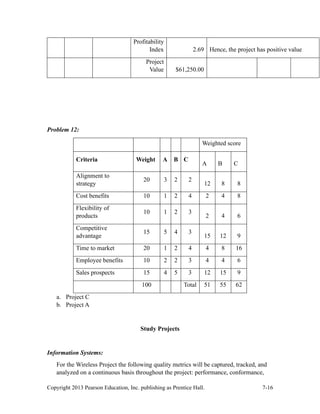
Project Efficiency 88%
Project Effectiveness 98%
Productivity 4.84 in March
Expected Productivity 7.5 in March
Defective loans 13%
Correct loans 88%
See Appendix D
Project Quality Time 0.55
Time spent on defects 40 hrs
Defect by Time 0.16129
defect/project
time
Problem 11:
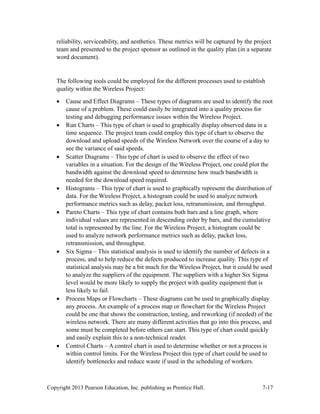
Year Discount
factor
Cost Benefits
Discounted
Costs
Discounted
Benefits
Accum.
Discounted
costs
Accum.
Discounted
Benefits
0 1.00 ($22,500.00) $22,500.00 ($22,500.00) $22,500.00 ($22,500.00) $22,500.00
1 0.91 $6,250.00 $17,500.00 $5,681.82 $15,909.09 ($16,818.18) $38,409.09
2 0.83 $6,250.00 $14,000.00 $5,165.29 $11,570.25 ($11,652.89) $49,979.34
3 0.75 $6,250.00 $11,000.00 $4,695.72 $8,264.46 ($6,957.18) $58,243.80
4 0.68 $6,250.00 $5,000.00 $4,268.83 $3,415.07 ($2,688.34) $61,658.87
5 0.62 $6,250.00 $0.00 $3,880.76 $0.00 $1,192.42 $61,658.87
Total Cash
flows $60,466.45
Initial
Investment $22,500.00
Copyright 2013 Pearson Education, Inc. publishing as Prentice Hall. 7-16
Profitability
Index 2.69 Hence, the project has positive value
Project
Value $61,250.00
Problem 12:
Weighted score
Criteria Weight A B C
A B C
Alignment to
strategy
20 3 2 2
12 8 8
Cost benefits 10 1 2 4 2 4 8
Flexibility of
products
10 1 2 3
2 4 6
Competitive
advantage
15 5 4 3
15 12 9
Time to market 20 1 2 4 4 8 16
Employee benefits 10 2 2 3 4 4 6
Sales prospects 15 4 5 3 12 15 9
100 Total 51 55 62
a. Project C
b. Project A
Study Projects
Information Systems:
For the Wireless Project the following quality metrics will be captured, tracked, and
analyzed on a continuous basis throughout the project: performance, conformance,
Copyright 2013 Pearson Education, Inc. publishing as Prentice Hall. 7-17
reliability, serviceability, and aesthetics. These metrics will be captured by the project
team and presented to the project sponsor as outlined in the quality plan (in a separate
word document).
The following tools could be employed for the different processes used to establish
quality within the Wireless Project:
• Cause and Effect Diagrams – These types of diagrams are used to identify the root
cause of a problem. These could easily be integrated into a quality process for
testing and debugging performance issues within the Wireless Project.
• Run Charts – This type of chart is used to graphically display observed data in a
time sequence. The project team could employ this type of chart to observe the
download and upload speeds of the Wireless Network over the course of a day to
see the variance of said speeds.
• Scatter Diagrams – This type of chart is used to observe the effect of two
variables in a situation. For the design of the Wireless Project, one could plot the
bandwidth against the download speed to determine how much bandwidth is
needed for the download speed required.
• Histograms – This type of chart is used to graphically represent the distribution of
data. For the Wireless Project, a histogram could be used to analyze network
performance metrics such as delay, packet loss, retransmission, and throughput.
• Pareto Charts – This type of chart contains both bars and a line graph, where
individual values are represented in descending order by bars, and the cumulative
total is represented by the line. For the Wireless Project, a histogram could be
used to analyze network performance metrics such as delay, packet loss,
retransmission, and throughput.
• Six Sigma – This statistical analysis is used to identify the number of defects in a
process, and to help reduce the defects produced to increase quality. This type of
statistical analysis may be a bit much for the Wireless Project, but it could be used
to analyze the suppliers of the equipment. The suppliers with a higher Six Sigma
level would be more likely to supply the project with quality equipment that is
less likely to fail.
• Process Maps or Flowcharts – These diagrams can be used to graphically display
any process. An example of a process map or flowchart for the Wireless Project
could be one that shows the construction, testing, and reworking (if needed) of the
wireless network. There are many different activities that go into this process, and
some must be completed before others can start. This type of chart could quickly
and easily explain this to a non-technical reader.
• Control Charts – A control chart is used to determine whether or not a process is
within control limits. For the Wireless Project this type of chart could be used to
identify bottlenecks and reduce waste if used in the scheduling of workers.
Copyright 2013 Pearson Education, Inc. publishing as Prentice Hall. 7-18
• Statistical Sampling – This type of analysis is used to gain a better knowledge of a
population of data using a smaller subset of data called a sample. This type of
sampling could be used in analyzing network performance metrics, and help to
identify the possible problem areas.
• Reviews – These are done to review a product, service, or system against quality
criteria set forth by the project team or organization. In the Wireless Project
nightly meetings with both the project team and project sponsor will be held to
review the activities of the day and to identify sub-quality items that need to be
addressed immediately.
• Testing and Inspection – This is done to promote quality in products and services.
In the Wireless Project a testing and inspection plan will be created for the
construction and implementation of the wireless network. This will ensure that the
various stages of the network are tested, and quality is established and maintained
throughout the life of the project.
Below is a table of the quality audit data for the Stafford Wireless Project. These data
points provided valuable insight into issues that need to be addressed immediately for
successful completion of the project.
Quality Audit (with arbitrary numbers)
Wireless Network Project Audit
Audit
Date
Auditor U
or
P
Non-Compliant Issues Elevated
to
Senior
Mgmt.
No of Hi-
Priority
Items
Hrs to
prepare
and
conduct
the
audit
Major Minor Closed
3/19/12 JS/PR P 0 2 0 0 0 2
3/20/12 JS/PR P 0 0 2 0 0 3
3/22/12 JS/PR U 1 1 0 1 1 2
U- Unplanned; P-Planned
Below is a testing and inspection plan for the Wireless Project. This plan will ensure
that the wireless network is tested throughout the project, and any failures or defects
are discovered and quickly addressed.
Copyright 2013 Pearson Education, Inc. publishing as Prentice Hall. 7-19
• Inspection
• Before installation, the wireless router will be inspected for damage.
• Before installation, the wireless access points will be individually
inspected for damage.
• Unit Tests
• Upon installation, the wireless router will be tested for functionality.
• Upon installation, the wireless access points will be individually tested for
functionality.
• Upon installation, the firewall will be tested for functionality.
• Upon installation, the internet services will be tested for functionality.
• Upon installation, the streaming internet services will be tested for
functionality.
• Integration Tests
• Once the individual components pass the unit tests, the wireless network
will be tested as a whole. Each piece will again be tested, but not for
individual functionality, but for interworking with the other components.
This will include the wireless network itself (router, wires, wireless access
points, firewalls), the Internet service, and the services provided through
the Internet (streaming television, streaming music, and VOIP services).
• Functional Requirements
• The wireless network as a whole will be tested end to end for
functionality. This will include the wireless network itself (router, wires,
wireless access points, firewalls), the Internet service, and the services
provided through the Internet (streaming television, streaming music, and
VOIP services).
• Performance Tests
• The network will be tested for issues such as download and upload speed,
uptime, signal strength, and bandwidth. This will include load testing, with
the estimated maximum number of users.
• The services will be tested for quality and reliability.
• Acceptance/Installation Tests
Copyright 2013 Pearson Education, Inc. publishing as Prentice Hall. 7-20
• The project sponsor and end users will test the network and services to
determine if the performance, quality, and value of the wireless network
and services are acceptable and meet the standards set forth in the project
documentation.
• The following metrics would be used to measure, track, and monitor the
progress of the Stafford Wireless with reference to project scope,
performance, and value.
• Scope – To monitor the scope of the project, the schedule (hours) of the
project participants can be used
• Performance – The wireless signal strength and upload/download speeds
are three metrics that can be used to adequately judge the performance of
the network in the project
• Value – To monitor the value that the project brings to the sponsor and end
users, the cost savings can be measured and tracked. This is the savings
which the sponsor will see by cancelling some of the now redundant
services. Also to measure value, customer satisfaction can be measured
and tracked on a daily basis.
New Product Development
a.
• Customer-focused: Understanding customers’ needs, meeting customers’
requirements and exceeding customers’ expectations
• Continual improvement: Continual improvement of the organization’s overall
performance should be a permanent objective of the organization
Quality assurance:
• Checking whether the quality is built into the project process
• Checking whether the project scope accurately reflects the needs of the customer
• Checking whether the project plan is followed
Quality control:
• Determining the metrics that will be used in this project
• Determining the audits and reviews
b.
The tools that will be employed for each of the three quality processes:
• Control charts
• Six sigma
• Statistical sampling
• Testing and inspection
c. Quality Audit (with arbitrary numbers)
Another Random Scribd Document
with Unrelated Content
with great courage and conduct, and with as great success, discovered the
utmost aversion to the sending his boat ashore whenever we lay wind-
bound in any of our harbours. This aversion did not arise from any fear of
wearing out his boat by using it, but was, in truth, the result of experience,
that it was easier to send his men on shore than to recal them. They
acknowledged him to be their master while they remained on shipboard, but
did not allow his power to extend to the shores, where they had no sooner
set their foot than every man became sui juris, and thought himself at full
liberty to return when he pleased. Now it is not any delight that these
fellows have in the fresh air or verdant fields on the land. Every one of
them would prefer his ship and his hammock to all the sweets of Arabia the
Happy; but, unluckily for them, there are in every seaport in England
certain houses whose chief livelihood depends on providing entertainment
for the gentlemen of the jacket. For this purpose they are always well
furnished with those cordial liquors which do immediately inspire the heart
with gladness, banishing all careful thoughts, and indeed all others, from
the mind, and opening the mouth with songs of chearfulness and
thanksgiving for the many wonderful blessings with which a sea-faring life
overflows.
For my own part, however whimsical it may appear, I confess I have
thought the strange story of Circe in the Odyssey no other than an ingenious
allegory, in which Homer intended to convey to his countrymen the same
kind of instruction which we intend to communicate to our own in this
digression. As teaching the art of war to the Greeks was the plain design of
the Iliad, so was teaching them the art of navigation the no less manifest
intention of the Odyssey. For the improvement of this, their situation was
most excellently adapted; and accordingly we find Thucydides, in the
beginning of his history, considers the Greeks as a sett of pirates or
privateers, plundering each other by sea. This being probably the first
institution of commerce before the Ars Cauponaria was invented, and
merchants, instead of robbing, began to cheat and outwit each other, and by
degrees changed the Metabletic, the only kind of traffic allowed by Aristotle
in his Politics, into the Chrematistic.
By this allegory then I suppose Ulysses to have been the captain of a
merchant-ship, and Circe some good ale-wife, who made his crew drunk
with the spirituous liquors of those days. With this the transformation into
swine, as well as all other incidents of the fable, will notably agree; and
thus a key will be found out for unlocking the whole mystery, and forging at
least some meaning to a story which, at present, appears very strange and
absurd.
Hence, moreover, will appear the very near resemblance between the
sea-faring men of all ages and nations; and here perhaps may be established
the truth and justice of that observation, which will occur oftener than once
in this voyage, that all human flesh is not the same flesh, but that there is
one kind of flesh of landmen, and another of seamen.
Philosophers, divines, and others, who have treated the gratification of
human appetites with contempt, have, among other instances, insisted very
strongly on that satiety which is so apt to overtake them even in the very act
of enjoyment. And here they more particularly deserve our attention, as
most of them may be supposed to speak from their own experience, and
very probably gave us their lessons with a full stomach. Thus hunger and
thirst, whatever delight they may afford while we are eating and drinking,
pass both away from us with the plate and the cup; and though we should
imitate the Romans, if, indeed, they were such dull beasts, which I can
scarce believe, to unload the belly like a dung-pot, in order to fill it again
with another load, yet would the pleasure be so considerably lessened that it
would scarce repay us the trouble of purchasing it with swallowing a bason
of camomile tea. A second haunch of venison, or a second dose of turtle,
would hardly allure a city glutton with its smell. Even the celebrated Jew
himself, when well filled with calipash and calipee, goes contentedly home
to tell his money, and expects no more pleasure from his throat during the
next twenty-four hours. Hence I suppose Dr South took that elegant
comparison of the joys of a speculative man to the solemn silence of an
Archimedes over a problem, and those of a glutton to the stillness of a sow
at her wash. A simile which, if it became the pulpit at all, could only
become it in the afternoon.
Whereas in those potations which the mind seems to enjoy, rather than
the bodily appetite, there is happily no such satiety; but the more a man
drinks, the more he desires; as if, like Mark Anthony in Dryden, his appetite
encreased with feeding, and this to such an immoderate degree, ut nullus sit
desiderio aut pudor aut modus. Hence, as with the gang of Captain Ulysses,
ensues so total a transformation, that the man no more continues what he
was. Perhaps he ceases for a time to be at all; or, though he may retain the
same outward form and figure he had before, yet is his nobler part, as we
are taught to call it, so changed, that, instead of being the same man, he
scarce remembers what he was a few hours before. And this transformation,
being once obtained, is so easily preserved by the same potations, which
induced no satiety, that the captain in vain sends or goes in quest of his
crew. They know him no longer; or, if they do, they acknowledge not his
power, having indeed as entirely forgotten themselves as if they had taken a
large draught of the river of Lethe.
Nor is the captain always sure of even finding out the place to which
Circe hath conveyed them. There are many of those houses in every port-
town. Nay, there are some where the sorceress doth not trust only to her
drugs; but hath instruments of a different kind to execute her purposes, by
whose means the tar is effectually secreted from the knowledge and pursuit
of his captain. This would, indeed, be very fatal, was it not for one
circumstance; that the sailor is seldom provided with the proper bait for
these harpies. However, the contrary sometimes happens, as these harpies
will bite at almost anything, and will snap at a pair of silver buttons, or
buckles, as surely as at the specie itself. Nay, sometimes they are so
voracious, that the very naked hook will go down, and the jolly young sailor
is sacrificed for his own sake.
In vain, at such a season as this, would the vows of a pious heathen have
prevailed over Neptune, Æolus, or any other marine deity. In vain would the
prayers of a Christian captain be attended with the like success. The wind
may change how it pleases while all hands are on shore; the anchor would
remain firm in the ground, and the ship would continue in durance, unless,
like other forcible prison-breakers, it forcibly got loose for no good
purpose.
Now, as the favour of winds and courts, and such like, is always to be
laid hold on at the very first motion, for within twenty-four hours all may be
changed again; so, in the former case, the loss of a day may be the loss of a
voyage: for, though it may appear to persons not well skilled in navigation,
who see ships meet and sail by each other, that the wind sometimes east and
west, north and south, backwards and forwards, at the same instant; yet,
certain it is that the land is so contrived, that even the same wind will not,
like the same horse, always bring a man to the end of his journey; but, that
the gale which the mariner prayed heartily for yesterday, he may as heartily
deprecate to-morrow; while all use and benefit which would have arisen to
him from the westerly wind of to-morrow may be totally lost and thrown
away by neglecting the offer of the easterly blast which blows to-day.
Hence ensues grief and disreputation to the innocent captain, loss and
disappointment to the worthy merchant, and not seldom great prejudice to
the trade of a nation whose manufactures are thus liable to lie unsold in a
foreign warehouse, the market being forestalled by some rival whose sailors
are under a better discipline. To guard against these inconveniences the
prudent captain takes every precaution in his power; he makes the strongest
contracts with his crew, and thereby binds them so firmly, that none but the
greatest or least of men can break through them with impunity; but for one
of these two reasons, which I will not determine, the sailor, like his brother
fish the eel, is too slippery to be held, and plunges into his element with
perfect impunity.
To speak a plain truth, there is no trusting to any contract with one whom
the wise citizens of London call a bad man; for, with such a one, though
your bond be ever so strong, it will prove in the end good for nothing.
What then is to be done in this case? What, indeed, but to call in the
assistance of that tremendous magistrate, the justice of peace, who can, and
often doth, lay good and bad men in equal durance; and, though he seldom
cares to stretch his bonds to what is great, never finds anything too minute
for their detention, but will hold the smallest reptile alive so fast in his
noose, that he can never get out till he is let drop through it.
Why, therefore, upon the breach of those contracts, should not an
immediate application be made to the nearest magistrate of this order, who
should be empowered to convey the delinquent either to ship or to prison, at
the election of the captain, to be fettered by the leg in either place?
But, as the case now stands, the condition of this poor captain without
any commission, and of this absolute commander without any power, is
much worse than we have hitherto shewn it to be; for, notwithstanding all
the aforesaid contracts to sail in the good ship the Elizabeth, if the sailor
should, for better wages, find it more his interest to go on board the better
ship the Mary, either before their setting out or on their speedy meeting in
some port, he may prefer the latter without any other danger than that of
“doing what he ought not to have done,” contrary to a rule which he is
seldom Christian enough to have much at heart, while the captain is
generally too good a Christian to punish a man out of revenge only, when
he is to be at a considerable expense for so doing. There are many other
deficiencies in our laws relating to maritime affairs, and which would
probably have been long since corrected, had we any seamen in the House
of Commons. Not that I would insinuate that the legislature wants a supply
of many gentlemen in the sea-service; but, as these gentlemen are by their
attendance in the house unfortunately prevented from ever going to sea, and
there learning what they might communicate to their landed brethren, these
latter remain as ignorant in that branch of knowledge as they would be if
none but courtiers and fox-hunters had been elected into parliament,
without a single fish among them. The following seems to me to be an
effect of this kind, and it strikes me the stronger as I remember the case to
have happened, and remember it to have been dispunishable. A captain of a
trading vessel, of which he was part owner, took in a large freight of oats at
Liverpool, consigned to the market at Bearkey: this he carried to a port in
Hampshire, and there sold it as his own, and, freighting his vessel with
wheat for the port of Cadiz, in Spain, dropt it at Oporto in his way; and
there, selling it for his own use, took in a lading of wine, with which he
sailed again, and, having converted it in the same manner, together with a
large sum of money with which he was intrusted, for the benefit of certain
merchants, sold the ship and cargo in another port, and then wisely sat
down contented with the fortune he had made, and returned to London to
enjoy the remainder of his days, with the fruits of his former labours and a
good conscience.
The sum he brought home with him consisted of near six thousand
pounds, all in specie, and most of it in that coin which Portugal distributes
so liberally over Europe.
He was not yet old enough to be past all sense of pleasure, nor so puffed
up with the pride of his good fortune as to overlook his old acquaintances
the journeymen taylors, from among whom he had been formerly pressed
into the sea-service, and, having there laid the foundation of his future
success by his shares in prizes, had afterwards become captain of a trading
vessel, in which he purchased an interest, and had soon begun to trade in
the honourable manner above mentioned.
The captain now took up his residence at an ale-house in Drury-lane,
where, having all his money by him in a trunk, he spent about five pounds a
day among his old friends the gentlemen and ladies of those parts.
The merchant of Liverpool, having luckily had notice from a friend
during the blaze of his fortune, did, by the assistance of a justice of peace,
without the assistance of the law, recover his whole loss. The captain,
however, wisely chose to refund no more; but, perceiving with what hasty
strides Envy was pursuing his fortune, he took speedy means to retire out of
her reach, and to enjoy the rest of his wealth in an inglorious obscurity; nor
could the same justice overtake him time enough to assist a second
merchant as he had done the first.
This was a very extraordinary case, and the more so as the ingenious
gentleman had steered entirely clear of all crimes in our law.
Now, how it comes about that a robbery so very easy to be committed,
and to which there is such immediate temptation always before the eyes of
these fellows, should receive the encouragement of impunity, is to be
accounted for only from the oversight of the legislature, as that oversight
can only be, I think, derived from the reasons I have assigned for it.
But I will dwell no longer on this subject. If what I have here said should
seem of sufficient consequence to engage the attention of any man in
power, and should thus be the means of applying any remedy to the most
inveterate evils, at least, I have obtained my whole desire, and shall have
lain so long wind-bound in the ports of this kingdom to some purpose. I
would, indeed, have this work—which, if I should live to finish it, a matter
of no great certainty, if indeed of any great hope to me, will be probably the
last I shall ever undertake—to produce some better end than the mere
diversion of the reader.
Monday.—This day our captain went ashore, to dine with a gentleman
who lives in these parts, and who so exactly resembles the character given
by Homer of Axylus, that the only difference I can trace between them is,
the one, living by the highway, erected his hospitality chiefly in favour of
land-travellers; and the other, living by the water-side, gratified his
humanity by accommodating the wants of the mariner.
In the evening our commander received a visit from a brother bashaw,
who lay wind-bound in the same harbour. This latter captain was a Swiss.
He was then master of a vessel bound to Guinea, and had formerly been a
privateering, when our own hero was employed in the same laudable
service. The honesty and freedom of the Switzer, his vivacity, in which he
was in no respect inferior to his near neighbours the French, the aukward
and affected politeness, which was likewise of French extraction, mixed
with the brutal roughness of the English tar—for he had served under the
colours of this nation and his crew had been of the same—made such an
odd variety, such a hotchpotch of character, that I should have been much
diverted with him, had not his voice, which was as loud as a speaking-
trumpet, unfortunately made my head ach. The noise which he conveyed
into the deaf ears of his brother captain, who sat on one side of him, the soft
addresses with which, mixed with aukward bows, he saluted the ladies on
the other, were so agreeably contrasted, that a man must not only have been
void of all taste of humour, and insensible of mirth, but duller than Cibber is
represented in the Dunciad, who could be unentertained with him a little
while; for, I confess, such entertainments should always be very short, as
they are very liable to pall. But he suffered not this to happen at present; for,
having given us his company a quarter of an hour only, he retired, after
many apologies for the shortness of his visit.
Tuesday.—The wind being less boisterous than it had hitherto been since
our arrival here, several fishing-boats, which the tempestuous weather
yesterday had prevented from working, came on board us with fish. This
was so fresh, so good in kind, and so very cheap, that we supplied ourselves
in great numbers, among which were very large soles at fourpence a pair,
and whitings of almost a preposterous size at ninepence a score.
The only fish which bore any price was a john dorée, as it is called. I
bought one of at least four pounds weight for as many shillings. It
resembles a turbot in shape, but exceeds it in firmness and flavour. The
price had the appearance of being considerable when opposed to the
extraordinary cheapness of others of value, but was, in truth, so very
reasonable when estimated by its goodness, that it left me under no other
surprise than how the gentlemen of this country, not greatly eminent for the
delicacy of their taste, had discovered the preference of the dorée to all
other fish: but I was informed that Mr Quin, whose distinguishing tooth
hath been so justly celebrated, had lately visited Plymouth, and had done
those honours to the dorée which are so justly due to it from that sect of
modern philosophers who, with Sir Epicure Mammon, or Sir Epicure Quin,
their head, seem more to delight in a fish-pond than in a garden, as the old
Epicureans are said to have done.
Unfortunately for the fishmongers of London, the dorée resides only in
those seas; for, could any of this company but convey one to the temple of
luxury under the Piazza, where Macklin the high-priest daily serves up his
rich offerings to that goddess, great would be the reward of that fishmonger,
in blessings poured down upon him from the goddess, as great would his
merit be towards the high-priest, who could never be thought to overrate
such valuable incense.
And here, having mentioned the extreme cheapness of fish in the
Devonshire sea, and given some little hint of the extreme dearness with
which this commodity is dispensed by those who deal in it in London, I
cannot pass on without throwing forth an observation or two, with the same
view with which I have scattered my several remarks through this voyage,
sufficiently satisfied in having finished my life, as I have probably lost it, in
the service of my country, from the best of motives, though it should be
attended with the worst of success. Means are always in our power; ends
are very seldom so.
Of all the animal foods with which man is furnished, there are none so
plenty as fish. A little rivulet, that glides almost unperceived through a vast
tract of rich land, will support more hundreds with the flesh of its
inhabitants than the meadow will nourish individuals. But if this be true of
rivers, it is much truer of the seashores, which abound with such immense
variety of fish that the curious fisherman, after he hath made his draught,
often culls only the daintiest part and leaves the rest of his prey to perish on
the shore.
If this be true it would appear, I think, that there is nothing which might
be had in such abundance, and consequently so cheap, as fish, of which
Nature seems to have provided such inexhaustible stores with some peculiar
design. In the production of terrestrial animals she proceeds with such
slowness, that in the larger kind a single female seldom produces more than
one a-year, and this again requires three, four, or five years more to bring it
to perfection. And though the lesser quadrupeds, those of the wild kind
particularly, with the birds, do multiply much faster, yet can none of these
bear any proportion with the aquatic animals, of whom every female matrix
is furnished with an annual offspring almost exceeding the power of
numbers, and which, in many instances at least, a single year is capable of
bringing to some degree of maturity.
What then ought in general to be so plentiful, what so cheap, as fish?
What then so properly the food of the poor? So in many places they are, and
so might they always be in great cities, which are always situated near the
sea, or on the conflux of large rivers. How comes it then, to look no farther
abroad for instances, that in our city of London the case is so far otherwise
that, except that of sprats, there is not one poor palate in a hundred that
knows the taste of fish?
It is true indeed that this taste is generally of such excellent flavour that
it exceeds the power of French cookery to treat the palates of the rich with
anything more exquisitely delicate; so that was fish the common food of the
poor it might put them too much upon an equality with their betters in the
great article of eating, in which, at present, in the opinion of some, the great
difference in happiness between man and man consists. But this argument I
shall treat with the utmost disdain: for if ortolans were as big as bustards,
and at the same time as plenty as sparrows, I should hold it yet reasonable
to indulge the poor with the dainty, and that for this cause especially, that
the rich would soon find a sparrow, if as scarce as an ortolan, to be much
the greater, as it would certainly be the rarer, dainty of the two.
Vanity or scarcity will be always the favourite of luxury; but honest
hunger will be satisfied with plenty. Not to search deeper into the cause of
the evil, I should think it abundantly sufficient to propose the remedies of it.
And, first, I humbly submit the absolute necessity of immediately hanging
all the fishmongers within the bills of mortality; and, however it might have
been some time ago the opinion of mild and temporizing men that the evil
complained of might be removed by gentler methods, I suppose at this day
there are none who do not see the impossibility of using such with any
effect. Cuncta prius tentanda might have been formerly urged with some
plausibility, but cuncta prius tentata may now be replied: for surely, if a few
monopolizing fishmongers could defeat that excellent scheme of the
Westminster market, to the erecting which so many justices of peace, as
well as other wise and learned men, did so vehemently apply themselves,
that they might be truly said not only to have laid the whole strength of their
heads, but of their shoulders too, to the business, it would be a vain
endeavour for any other body of men to attempt to remove so stubborn a
nusance.
If it should be doubted whether we can bring this case within the letter of
any capital law now subsisting, I am ashamed to own it cannot; for surely
no crime better deserves such punishment; but the remedy may,
nevertheless, be immediate; and if a law was made at the beginning of next
session, to take place immediately, by which the starving thousands of poor
was declared to be felony, without benefit of clergy, the fishmongers would
be hanged before the end of the session.
A second method of filling the mouths of the poor, if not with loaves at
least with fishes, is to desire the magistrates to carry into execution one at
least out of near a hundred acts of parliament, for preserving the small fry
of the river of Thames, by which means as few fish would satisfy thousands
as may now be devoured by a small number of individuals. But while a
fisherman can break through the strongest meshes of an act of parliament,
we may be assured he will learn so to contrive his own meshes that the
smallest fry will not be able to swim through them.
Other methods may, we doubt not, be suggested by those who shall
attentively consider the evil here hinted at; but we have dwelt too long on it
already, and shall conclude with observing that it is difficult to affirm
whether the atrocity of the evil itself, the facility of curing it, or the
shameful neglect of the cure, be the more scandalous or more astonishing.
After having, however, gloriously regaled myself with this food, I was
washing it down with some good claret with my wife and her friend, in the
cabin, when the captain’s valet-de-chambre, head cook, house and ship
steward, footman in livery and out on’t, secretary and fore-mast man, all
burst into the cabin at once, being, indeed, all but one person, and, without
saying by your leave, began to pack half a hogshead of small beer in
bottles, the necessary consequence of which must have been either a total
stop to conversation at that chearful season when it is most agreeable, or the
admitting that polyonymous officer aforesaid to the participation of it. I
desired him therefore to delay his purpose a little longer, but he refused to
grant my request; nor was he prevailed on to quit the room till he was
threatened with having one bottle to pack more than his number, which then
happened to stand empty within my reach.
With these menaces he retired at last, but not without muttering some
menaces on his side, and which, to our great terror, he failed not to put into
immediate execution.
Our captain was gone to dinner this day with his Swiss brother; and,
though he was a very sober man, was a little elevated with some
champagne, which, as it cost the Swiss little or nothing, he dispensed at his
table more liberally than our hospitable English noblemen put about those
bottles, which the ingenious Peter Taylor teaches a led captain to avoid by
distinguishing by the name of that generous liquor, which all humble
companions are taught to postpone to the flavour of methuen, or honest
port.
While our two captains were thus regaling themselves, and celebrating
their own heroic exploits with all the inspiration which the liquor, at least,
of wit could afford them, the polyonymous officer arrived, and, being
saluted by the name of Honest Tom, was ordered to sit down and take his
glass before he delivered his message; for every sailor is by turns his
captain’s mate over a cann, except only that captain bashaw who presides in
a man-of-war, and who upon earth has no other mate, unless it be another of
the same bashaws.
Tom had no sooner swallowed his draught than he hastily began his
narrative, and faithfully related what had happened on board our ship; we
say faithfully, though from what happened it may be suspected that Tom
chose to add perhaps only five or six immaterial circumstances, as is always
I believe the case, and may possibly have been done by me in relating this
very story, though it happened not many hours ago.
No sooner was the captain informed of the interruption which had been
given to his officer, and indeed to his orders, for he thought no time so
convenient as that of his absence for causing any confusion in the cabin,
than he leapt with such haste from his chair that he had like to have broke
his sword, with which he always begirt himself when he walked out of his
ship, and sometimes when he walked about in it; at the same time, grasping
eagerly that other implement called a cockade, which modern soldiers wear
on their helmets with the same view as the antients did their crests—to
terrify the enemy, he muttered something, but so inarticulately that the word
damn was only intelligible; he then hastily took leave of the Swiss captain,
who was too well bred to press his stay on such an occasion, and leapt first
from the ship to his boat, and then from his boat to his own ship, with as
much fierceness in his looks as he had ever expressed on boarding his
defenceless prey in the honourable calling of a privateer.
Having regained the middle deck, he paused a moment while Tom and
others loaded themselves with bottles, and then descending into the cabin
exclaimed with a thundering voice, “D—n me, why arn’t the bottles stoed
in, according to my orders?”
I answered him very mildly that I had prevented his man from doing it,
as it was at an inconvenient time to me, and as in his absence, at least, I
esteemed the cabin to be my own. “Your cabin!” repeated he many times;
“no, d——n me! ’tis my cabin. Your cabin! d——n me! I have brought my
hogs to a fair market. I suppose indeed you think it your cabin, and your
ship, by your commanding in it; but I will command in it, d——n me! I will
shew the world I am the commander, and nobody but I! Did you think I sold
you the command of my ship for that pitiful thirty pounds? I wish I had not
seen you nor your thirty pounds aboard of her.” He then repeated the words
thirty pounds often, with great disdain, and with a contempt which I own
the sum did not seem to deserve in my eye, either in itself or on the present
occasion; being, indeed, paid for the freight of —— weight of human flesh,
which is above fifty per cent. dearer than the freight of any other luggage,
whilst in reality it takes up less room; in fact, no room at all.
In truth, the sum was paid for nothing more than for a liberty to six
persons (two of them servants) to stay on board a ship while she sails from
one port to another, every shilling of which comes clear into the captain’s
pocket. Ignorant people may perhaps imagine, especially when they are told
that the captain is obliged to sustain them, that their diet at least is worth
something, which may probably be now and then so far the case as to
deduct a tenth part from the neat profits on this account; but it was
otherwise at present; for when I had contracted with the captain at a price
which I by no means thought moderate, I had some content in thinking I
should have no more to pay for my voyage; but I was whispered that it was
expected the passengers should find themselves in several things; such as
tea, wine, and such like; and particularly that gentlemen should stowe of the
latter a much larger quantity than they could use, in order to leave the
remainder as a present to the captain at the end of the voyage; and it was
expected likewise that gentlemen should put aboard some fresh stores, and
the more of such things were put aboard the welcomer they would be to the
captain.
I was prevailed with by these hints to follow the advice proposed; and
accordingly, besides tea and a large hamper of wine, with several hams and
tongues, I caused a number of live chickens and sheep to be conveyed
aboard; in truth, treble the quantity of provisions which would have
supported the persons I took with me, had the voyage continued three
weeks, as it was supposed, with a bare possibility, it might.
Indeed it continued much longer; but as this was occasioned by our
being wind-bound in our own ports, it was by no means of any ill
consequence to the captain, as the additional stores of fish, fresh meat,
butter, bread, &c., which I constantly laid in, greatly exceeded the
consumption, and went some way in maintaining the ship’s crew. It is true I
was not obliged to do this; but it seemed to be expected; for the captain did
not think himself obliged to do it, and I can truly say I soon ceased to
expect it of him. He had, I confess, on board a number of fowls and ducks
sufficient for a West India voyage; all of them, as he often said, “Very fine
birds, and of the largest breed.” This I believe was really the fact, and I can
add that they were all arrived at the full perfection of their size. Nor was
there, I am convinced, any want of provisions of a more substantial kind;
such as dried beef, pork, and fish; so that the captain seemed ready to
perform his contract, and amply to provide for his passengers. What I did
then was not from necessity, but, perhaps, from a less excusable motive,
and was by no means chargeable to the account of the captain.
But, let the motive have been what it would, the consequence was still
the same; and this was such that I am firmly persuaded the whole pitiful
thirty pounds came pure and neat into the captain’s pocket, and not only so,
but attended with the value of ten pound more in sundries into the bargain. I
must confess myself therefore at a loss how the epithet pitiful came to be
annexed to the above sum; for, not being a pitiful price for what it was
given, I cannot conceive it to be pitiful in itself; nor do I believe it is
thought by the greatest men in the kingdom; none of whom would scruple
to search for it in the dirtiest kennel, where they had only a reasonable hope
of success.
How, therefore, such a sum should acquire the idea of pitiful in the eyes
of the master of a ship seems not easy to be accounted for; since it appears
more likely to produce in him ideas of a different kind. Some men, perhaps,
are no more sincere in the contempt for it which they express than others in
their contempt of money in general; and I am the rather inclined to this
persuasion, as I have seldom heard of either who have refused or refunded
this their despised object. Besides, it is sometimes impossible to believe
these professions, as every action of the man’s life is a contradiction to it.
Who can believe a tradesman who says he would not tell his name for the
profit he gets by he selling such a parcel of goods, when he hath told a
thousand lies in order to get it?
Pitiful, indeed, is often applied to an object not absolutely, but
comparatively with our expectations, or with a greater object: in which
sense it is not easy to set any bounds to the use of the word. Thus, a handful
of halfpence daily appear pitiful to a porter, and a handful of silver to a
drawer. The latter, I am convinced, at a polite tavern, will not tell his name
(for he will not give you any answer) under the price of gold. And in this
sense thirty pound may be accounted pitiful by the lowest mechanic.
One difficulty only seems to occur, and that is this, how comes it that, if
the profits of the meanest arts are so considerable, the professors of them
are not richer than we generally see them? One answer to this shall suffice.
Men do not become rich by what they get, but by what they keep. He who
is worth no more than his annual wages or salary, spends the whole; he will
be always a beggar let his income be what it will, and so will be his family
when he dies. This we see daily to be the case of ecclesiastics, who, during
their lives, are extremely well provided for, only because they desire to
maintain the honour of the cloth by living like gentlemen, which would,
perhaps, be better maintained by living unlike them.
But, to return from so long a digression, to which the use of so improper
an epithet gave occasion, and to which the novelty of the subject allured, I
will make the reader amends by concisely telling him that the captain
poured forth such a torrent of abuse that I very hastily and very foolishly
resolved to quit the ship. I gave immediate orders to summon a hoy to carry
me that evening to Dartmouth, without considering any consequence. Those
orders I gave in no very low voice, so that those above stairs might possibly
conceive there was more than one master in the cabin. In the same tone I
likewise threatened the captain with that which, he afterwards said, he
feared more than any rock or quicksand. Nor can we wonder at this when
we are told he had been twice obliged to bring to and cast anchor there
before, and had neither time escaped without the loss of almost his whole
cargo.
The most distant sound of law thus frightened a man who had often, I am
convinced, heard numbers of cannon roar round him with intrepidity. Nor
did he sooner see the hoy approaching the vessel than he ran down again
into the cabin, and, his rage being perfectly subsided, he tumbled on his
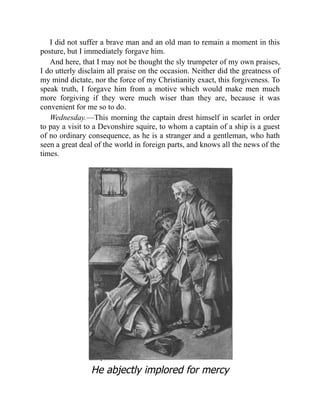
knees, and a little too abjectly implored for mercy.
I did not suffer a brave man and an old man to remain a moment in this
posture, but I immediately forgave him.
And here, that I may not be thought the sly trumpeter of my own praises,
I do utterly disclaim all praise on the occasion. Neither did the greatness of
my mind dictate, nor the force of my Christianity exact, this forgiveness. To
speak truth, I forgave him from a motive which would make men much
more forgiving if they were much wiser than they are, because it was
convenient for me so to do.
Wednesday.—This morning the captain drest himself in scarlet in order
to pay a visit to a Devonshire squire, to whom a captain of a ship is a guest
of no ordinary consequence, as he is a stranger and a gentleman, who hath
seen a great deal of the world in foreign parts, and knows all the news of the
times.
He abjectly implored for mercy
The squire, therefore, was to send his boat for the captain, but a most
unfortunate accident happened; for, as the wind was extremely rough and
against the hoy, while this was endeavouring to avail itself of great
seamanship in hawling up against the wind, a sudden squall carried off sail
and yard, or at least so disabled them that they were no longer of any use
and unable to reach the ship; but the captain, from the deck, saw his hopes
of venison disappointed, and was forced either to stay on board his ship, or
to hoist forth his own long-boat, which he could not prevail with himself to
think of, though the smell of the venison had had twenty times its attraction.
He did, indeed, love his ship as his wife, and his boats as children, and
never willingly trusted the latter, poor things! to the dangers of the seas.
To say truth, notwithstanding the strict rigour with which he preserved
the dignity of his station, and the hasty impatience with which he resented
any affront to his person or orders, disobedience to which he could in no
instance brook in any person on board, he was one of the best natured
fellows alive. He acted the part of a father to his sailors; he expressed great
tenderness for any of them when ill, and never suffered any the least work
of supererogation to go unrewarded by a glass of gin. He even extended his
humanity, if I may so call it, to animals, and even his cats and kittens had
large shares in his affections. An instance of which we saw this evening,
when the cat, which had shewn it could not be drowned, was found
suffocated under a feather-bed in the cabin. I will not endeavour to describe
his lamentations with more prolixity than barely by saying they were
grievous, and seemed to have some mixture of the Irish howl in them. Nay,
he carried his fondness even to inanimate objects, of which we have above
set down a pregnant example in his demonstration of love and tenderness
towards his boats and ship. He spoke of a ship which he had commanded
formerly, and which was long since no more, which he had called the
Princess of Brazil, as a widower of a deceased wife. This ship, after having
followed the honest business of carrying goods and passengers for hire
many years, did at last take to evil courses and turn privateer, in which
service, to use his own words, she received many dreadful wounds, which
he himself had felt as if they had been his own.
Thursday.—As the wind did not yesterday discover any purpose of
shifting, and the water in my belly grew troublesome and rendered me
short-breathed, I began a second time to have apprehensions of wanting the
assistance of a trochar when none was to be found; I therefore concluded to
be tapped again by way of precaution, and accordingly I this morning
summoned on board a surgeon from a neighbouring parish, one whom the
captain greatly recommended, and who did indeed perform his office with
much dexterity. He was, I believe, likewise a man of great judgment and
knowledge in the profession; but of this I cannot speak with perfect
certainty, for, when he was going to open on the dropsy at large and on the
particular degree of the distemper under which I laboured, I was obliged to
stop him short, for the wind was changed, and the captain in the utmost
hurry to depart; and to desire him, instead of his opinion, to assist me with
his execution.
I was now once more delivered from my burthen, which was not indeed
so great as I had apprehended, wanting two quarts of what was let out at the
last operation.
While the surgeon was drawing away my water the sailors were drawing
up the anchor; both were finished at the same time; we unfurled our sails
and soon passed the Berry-head, which forms the mouth of the bay.
We had not however sailed far when the wind, which had, though with a
slow pace, kept us company about six miles, suddenly turned about, and
offered to conduct us back again; a favour which, though sorely against the
grain, we were obliged to accept.
Nothing remarkable happened this day; for as to the firm persuasion of
the captain that he was under the spell of witchcraft, I would not repeat it
too often, though indeed he repeated it an hundred times every day; in truth,
he talked of nothing else, and seemed not only to be satisfied in general of
his being bewitched, but actually to have fixed with good certainty on the
person of the witch, whom, had he lived in the days of Sir Matthew Hale,
he would have infallibly indicted, and very possibly have hanged, for the
detestable sin of witchcraft; but that law, and the whole doctrine that
supported it, are now out of fashion; and witches, as a learned divine once
chose to express himself, are put down by act of parliament. This witch, in
the captain’s opinion, was no other than Mrs Francis of Ryde, who, as he
insinuated, out of anger to me for not spending more money in her house
than she could produce anything to exchange for, or any pretence to charge
for, had laid this spell on his ship.
Though we were again got near our harbour by three in the afternoon,
yet it seemed to require a full hour or more before we could come to our
former place of anchoring, or berth, as the captain called it. On this
occasion we exemplified one of the few advantages which the travellers by
water have over the travellers by land. What would the latter often give for
the sight of one of those hospitable mansions where he is assured that there
is good entertainment for man and horse; and where both may consequently
promise themselves to assuage that hunger which exercise is so sure to raise
in a healthy constitution.
At their arrival at this mansion, how much happier is the state of the
horse than that of the master! The former is immediately led to his repast,
such as it is, and, whatever it is, he falls to it with appetite. But the latter is
in a much worse situation. His hunger, however violent, is always in some
degree delicate, and his food must have some kind of ornament, or, as the
more usual phrase is, of dressing, to recommend it. Now all dressing
requires time, and therefore, though perhaps the sheep might be just killed
before you came to the inn, yet in cutting him up, fetching the joint, which
the landlord by mistake said he had in the house, from the butcher at two
miles’ distance, and afterwards warming it a little by the fire, two hours at
least must be consumed, while hunger, for want of better food, preys all the
time on the vitals of the man.
How different was the case with us! we carried our provision, our
kitchen, and our cook with us, and we were at one and the same time
travelling on our road, and sitting down to a repast of fish, with which the
greatest table in London can scarce at any rate be supplied.
Friday.—As we were disappointed of our wind, and obliged to return
back the preceding evening, we resolved to extract all the good we could
out of our misfortune, and to add considerably to our fresh stores of meat
and bread, with which we were very indifferently provided when we hurried
away yesterday. By the captain’s advice we likewise laid in some stores of
butter, which we salted and potted ourselves, for our use at Lisbon, and we
had great reason afterwards to thank him for his advice.
In the afternoon I persuaded my wife, whom it was no easy matter for
me to force from my side, to take a walk on shore, whither the gallant
captain declared he was ready to attend her. Accordingly the ladies set out,
and left me to enjoy a sweet and comfortable nap after the operation of the
preceding day.
Thus we enjoyed our separate pleasures full three hours, when we met
again, and my wife gave the foregoing account of the gentleman whom I
have before compared to Axylus, and of his habitation, to both which she
had been introduced by the captain, in the stile of an old friend and
acquaintance, though this foundation of intimacy seemed to her to be no
deeper laid than in an accidental dinner, eaten many years before, at this
temple of hospitality, when the captain lay wind-bound in the same bay.
Saturday.—Early this morning the wind seemed inclined to change in
our favour. Our alert captain snatched its very first motion, and got under
sail with so very gentle a breeze that, as the tide was against him, he
recommended to a fishing hoy to bring after him a vast salmon and some
other provisions which lay ready for him on shore.
Our anchor was up at six, and before nine in the morning we had
doubled the Berry-head, and were arrived off Dartmouth, having gone full
three miles in as many hours, in direct opposition to the tide, which only
befriended us out of our harbour; and though the wind was perhaps our
friend, it was so very silent, and exerted itself so little in our favour, that,
like some cool partisans, it was difficult to say whether it was with us or
against us. The captain, however, declared the former to be the case during
the whole three hours; but at last he perceived his error, or rather, perhaps,
this friend, which had hitherto wavered in chusing his side, became now
more determined. The captain then suddenly tacked about, and, asserting
that he was bewitched, submitted to return to the place from whence he
came. Now, though I am as free from superstition as any man breathing,
and never did believe in witches, notwithstanding all the excellent
arguments of my lord chief-justice Hale in their favour, and long before
they were put down by act of parliament, yet by what power a ship of
burthen should sail three miles against both wind and tide, I cannot
conceive, unless there was some supernatural interposition in the case; nay,
could we admit that the wind stood neuter, the difficulty would still remain.
So that we must of necessity conclude that the ship was either bewinded or
bewitched.
The captain, perhaps, had another meaning. He imagined himself, I
believe, bewitched, because the wind, instead of persevering in its change
in his favour, for change it certainly did that morning, should suddenly
return to its favourite station, and blow him back towards the bay. But, if
this was his opinion, he soon saw cause to alter; for he had not measured
half the way back when the wind again declared in his favour, and so
loudly, that there was no possibility of being mistaken.
The orders for the second tack were given, and obeyed with much more
alacrity than those had been for the first. We were all of us indeed in high
spirits on the occasion; though some of us a little regretted the good things
we were likely to leave behind us by the fisherman’s neglect; I might give it
a worse name, for he faithfully promised to execute the commission, which
he had had abundant opportunity to do; but nautica fides deserves as much
to be proverbial as ever Punica fides could formerly have done. Nay, when
we consider that the Carthaginians came from the Phenicians, who are
supposed to have produced the first mariners, we may probably see the true
reason of the adage, and it may open a field of very curious discoveries to
the antiquarian.
We were, however, too eager to pursue our voyage to suffer anything we
left behind us to interrupt our happiness, which, indeed, many agreeable
circumstances conspired to advance. The weather was inexpressibly
pleasant, and we were all seated on the deck, when our canvas began to
swell with the wind. We had likewise in our view above thirty other sail
around us, all in the same situation. Here an observation occurred to me,
which, perhaps, though extremely obvious, did not offer itself to every
individual in our little fleet: when I perceived with what different success
we proceeded under the influence of a superior power, which, while we lay
almost idle ourselves, pushed us forward on our intended voyage, and
compared this with the slow progress which we had made in the morning,
of ourselves, and without any such assistance, I could not help reflecting
how often the greatest abilities lie wind-bound as it were in life; or, if they
venture out and attempt to beat the seas, they struggle in vain against wind
and tide, and, if they have not sufficient prudence to put back, are most
probably cast away on the rocks and quicksands which are every day ready
to devour them.
It was now our fortune to set out melioribus avibus. The wind freshened
so briskly in our poop that the shore appeared to move from us as fast as we
did from the shore. The captain declared he was sure of a wind, meaning its
continuance; but he had disappointed us so often that he had lost all credit.
However, he kept his word a little better now, and we lost sight of our
native land as joyfully, at least, as it is usual to regain it.
Sunday.—The next morning the captain told me he thought himself
thirty miles to the westward of Plymouth, and before evening declared that
the Lizard Point, which is the extremity of Cornwall, bore several leagues
to leeward. Nothing remarkable passed this day, except the captain’s
devotion, who, in his own phrase, summoned all hands to prayers, which
were read by a common sailor upon deck, with more devout force and
address than they are commonly read by a country curate, and received with
more decency and attention by the sailors than are usually preserved in city
congregations. I am indeed assured, that if any such affected disregard of
the solemn office in which they were engaged, as I have seen practised by
fine gentlemen and ladies, expressing a kind of apprehension lest they
should be suspected of being really in earnest in their devotion, had been
shewn here, they would have contracted the contempt of the whole
audience. To say the truth, from what I observed in the behaviour of the
sailors in this voyage, and on comparing it with what I have formerly seen
of them at sea and on shore, I am convinced that on land there is nothing
more idle and dissolute; in their own element there are no persons near the
level of their degree who live in the constant practice of half so many good
qualities. They are, for much the greater part, perfect masters of their
business, and always extremely alert, and ready in executing it, without any
regard to fatigue or hazard. The soldiers themselves are not better
disciplined nor more obedient to orders than these whilst aboard; they
submit to every difficulty which attends their calling with chearfulness, and
no less virtues and patience and fortitude are exercised by them every day
of their lives.
All these good qualities, however, they always leave behind them on
shipboard; the sailor out of water is, indeed, as wretched an animal as the
fish out of water; for though the former hath, in common with amphibious
animals, the bare power of existing on the land, yet if he be kept there any
time he never fails to become a nuisance.
The ship having had a good deal of motion since she was last under sail,
our women returned to their sickness, and I to my solitude; having, for
twenty-four hours together, scarce opened my lips to a single person. This
circumstance of being shut up within the circumference of a few yards, with
a score of human creatures, with not one of whom it was possible to
converse, was perhaps so rare as scarce ever to have happened before, nor
could it ever happen to one who disliked it more than myself, or to myself
at a season when I wanted more food for my social disposition, or could
converse less wholesomely and happily with my own thoughts. To this
accident, which fortune opened to me in the Downs, was owing the first
serious thought which I ever entertained of enrolling myself among the
voyage-writers; some of the most amusing pages, if, indeed, there be any
which deserve that name, were possibly the production of the most
disagreeable hours which ever haunted the author.
Monday.—At noon the captain took an observation, by which it
appeared that Ushant bore some leagues northward of us, and that we were
just entering the bay of Biscay. We had advanced a very few miles in this
bay before we were entirely becalmed: we furled our sails, as being of no
use to us while we lay in this most disagreeable situation, more detested by
the sailors than the most violent tempest: we were alarmed with the loss of
a fine piece of salt beef, which had been hung in the sea to freshen it; this
being, it seems, the strange property of salt-water. The thief was
immediately suspected, and presently afterwards taken by the sailors. He
was, indeed, no other than a huge shark, who, not knowing when he was
well off, swallowed another piece of beef, together with a great iron crook
on which it was hung, and by which he was dragged into the ship.
I should scarce have mentioned the catching this shark, though so
exactly conformable to the rules and practice of voyage-writing, had it not
been for a strange circumstance that attended it. This was the recovery of
the stolen beef out of the shark’s maw, where it lay unchewed and
undigested, and whence, being conveyed into the pot, the flesh, and the
thief that had stolen it, joined together in furnishing variety to the ship’s
crew.
During this calm we likewise found the mast of a large vessel, which the
captain thought had lain at least three years in the sea. It was stuck all over
with a little shell-fish or reptile, called a barnacle, and which probably are
the prey of the rock-fish, as our captain calls it, asserting that it is the finest
fish in the world; for which we are obliged to confide entirely to his taste;
for, though he struck the fish with a kind of harping-iron, and wounded him,
I am convinced, to death, yet he could not possess himself of his body; but
the poor wretch escaped to linger out a few hours with probably great
torments.
In the evening our wind returned, and so briskly, that we ran upwards of
twenty leagues before the next day’s [Tuesday’s] observation, which
brought us to lat. 47° 42´. The captain promised us a very speedy passage
through the bay; but he deceived us, or the wind deceived him, for it so
slackened at sunset, that it scarce carried us a mile in an hour during the
whole succeeding night.
Wednesday.—A gale struck up a little after sun-rising, which carried us
between three and four knots or miles an hour. We were this day at noon
about the middle of the bay of Biscay, when the wind once more deserted
us, and we were so entirely becalmed, that we did not advance a mile in
many hours. My fresh-water reader will perhaps conceive no unpleasant
idea from this calm; but it affected us much more than a storm could have
done; for, as the irascible passions of men are apt to swell with indignation
long after the injury which first raised them is over, so fared it with the sea.
It rose mountains high, and lifted our poor ship up and down, backwards
and forwards, with so violent an emotion, that there was scarce a man in the
ship better able to stand than myself. Every utensil in our cabin rolled up
and down, as we should have rolled ourselves, had not our chairs been fast
lashed to the floor. In this situation, with our tables likewise fastened by
ropes, the captain and myself took our meal with some difficulty, and
swallowed a little of our broth, for we spilt much the greater part. The
remainder of our dinner being an old, lean, tame duck roasted, I regretted
but little the loss of, my teeth not being good enough to have chewed it.
Our women, who began to creep out of their holes in the morning,
retired again within the cabin to their beds, and were no more heard of this
day, in which my whole comfort was to find by the captain’s relation that
the swelling was sometimes much worse; he did, indeed, take this occasion
to be more communicative than ever, and informed me of such
misadventures that had befallen him within forty-six years at sea as might
frighten a very bold spirit from undertaking even the shortest voyage. Were
these, indeed, but universally known, our matrons of quality would possibly
be deterred from venturing their tender offspring at sea; by which means
our navy would lose the honour of many a young commodore, who at
twenty-two is better versed in maritime affairs than real seamen are made
by experience at sixty.
And this may, perhaps, appear the more extraordinary, as the education
of both seems to be pretty much the same; neither of them having had their
courage tried by Virgil’s description of a storm, in which, inspired as he
was, I doubt whether our captain doth not exceed him.
In the evening the wind, which continued in the N.W., again freshened,
and that so briskly that Cape Finisterre appeared by this day’s observation
to bear a few miles to the southward. We now indeed sailed, or rather flew,
near ten knots an hour; and the captain, in the redundancy of his good-
humour, declared he would go to church at Lisbon on Sunday next, for that
he was sure of a wind; and, indeed, we all firmly believed him. But the
event again contradicted him; for we were again visited by a calm in the
evening.
But here, though our voyage was retarded, we were entertained with a
scene, which as no one can behold without going to sea, so no one can form
an idea of anything equal to it on shore. We were seated on the deck,
women and all, in the serenest evening that can be imagined. Not a single
cloud presented itself to our view, and the sun himself was the only object
which engrossed our whole attention. He did indeed set with a majesty
which is incapable of description, with which, while the horizon was yet
blazing with glory, our eyes were called off to the opposite part to survey
the moon, which was then at full, and which in rising presented us with the
second object that this world hath offered to our vision. Compared to these
the pageantry of theatres, or splendour of courts, are sights almost below
the regard of children.
We did not return from the deck till late in the evening; the weather
being inexpressibly pleasant, and so warm that even my old distemper
perceived the alteration of the climate. There was indeed a swell, but
nothing comparable to what we had felt before, and it affected us on the
deck much less than in the cabin.
Friday.—The calm continued till sun-rising, when the wind likewise
arose, but unluckily for us it came from a wrong quarter; it was S.S.E.,
which is that very wind which Juno would have solicited of Æolus, had
Æneas been in our latitude bound for Lisbon.
The captain now put on his most melancholy aspect, and resumed his
former opinion that he was bewitched. He declared with great solemnity
that this was worse and worse, for that a wind directly in his teeth was
worse than no wind at all. Had we pursued the course which the wind
persuaded us to take we had gone directly for Newfoundland, if we had not
fallen in with Ireland in our way. Two ways remained to avoid this; one was
to put into a port of Galicia; the other, to beat to the westward with as little
sail as possible: and this was our captain’s election.
As for us, poor passengers, any port would have been welcome to us;
especially, as not only our fresh provisions, except a great number of old
ducks and fowls, but even our bread was come to an end, and nothing but
sea-biscuit remained, which I could not chew. So that now for the first time
in my life I saw what it was to want a bit of bread.
The wind however was not so unkind as we had apprehended; but,
having declined with the sun, it changed at the approach of the moon, and
became again favourable to us, though so gentle that the next day’s
observation carried us very little to the southward of Cape Finisterre. This
evening at six the wind, which had been very quiet all day, rose very high,
and continuing in our favour drove us seven knots an hour.
This day we saw a sail, the only one, as I heard of, we had seen in our
whole passage through the bay. I mention this on account of what appeared
to me somewhat extraordinary. Though she was at such a distance that I
could only perceive she was a ship, the sailors discovered that she was a
snow, bound to a port in Galicia.
Sunday.—After prayers, which our good captain read on the deck with
an audible voice, and with but one mistake, of a lion for Elias, in the second
lesson for this day, we found ourselves far advanced in 42°, and the captain
declared we should sup off Porte. We had not much wind this day; but, as
this was directly in our favour, we made it up with sail, of which we
crowded all we had. We went only at the rate of four miles an hour, but with
so uneasy a motion, continually rolling from side to side, that I suffered
more than I had done in our whole voyage; my bowels being almost twisted
out of my belly. However, the day was very serene and bright, and the
captain, who was in high spirits, affirmed he had never passed a pleasanter
at sea.
The wind continued so brisk that we ran upward of six knots an hour the
whole night.
Monday.—In the morning our captain concluded that he was got into lat.
40°, and was very little short of the Burlings, as they are called in the
charts. We came up with them at five in the afternoon, being the first land
we had distinctly seen since we left Devonshire. They consist of abundance
of little rocky islands, a little distant from the shore, three of them only
shewing themselves above the water.
Here the Portuguese maintain a kind of garrison, if we may allow it that
name. It consists of malefactors, who are banished hither for a term, for
divers small offences—a policy which they may have copied from the
Egyptians, as we may read in Diodorus Siculus. That wise people, to
prevent the corruption of good manners by evil communication, built a
town on the Red Sea, whither they transported a great number of their
criminals, having first set an indelible mark on them, to prevent their
returning and mixing with the sober part of their citizens.
These rocks lie about fifteen leagues north-west of Cape Roxent, or, as it
is commonly called, the Rock of Lisbon, which we past early the next
morning. The wind, indeed, would have carried us thither sooner; but the
captain was not in a hurry, as he was to lose nothing by his delay.
Tuesday.—This is a very high mountain, situated on the northern side of
the mouth of the river Tajo, which, rising about Madrid, in Spain, and soon
becoming navigable for small craft, empties itself, after a long course, into
the sea, about four leagues below Lisbon.
On the summit of the rock stands a hermitage, which is now in the
possession of an Englishman, who was formerly master of a vessel trading
to Lisbon; and, having changed his religion and his manners, the latter of
which, at least, were none of the best, betook himself to this place, in order
to do penance for his sins. He is now very old, and hath inhabited this
hermitage for a great number of years, during which he hath received some
countenance from the royal family, and particularly from the present queen
dowager, whose piety refuses no trouble or expence by which she may
make a proselyte, being used to say that the saving one soul would repay all
the endeavours of her life.
Here we waited for the tide, and had the pleasure of surveying the face
of the country, the soil of which, at this season, exactly resembles an old
brick-kill, or a field where the green sward is pared up and set a burning, or
rather a smoaking, in little heaps to manure the land. This sight will,
perhaps, of all others, make an Englishman proud of, and pleased with, his
own country, which in verdure excels, I believe, every other country.
Another deficiency here is the want of large trees, nothing above a shrub
being here to be discovered in the circumference of many miles.
At this place we took a pilot on board, who, being the first Portuguese
we spoke to, gave us an instance of that religious observance which is paid
by all nations to their laws; for, whereas it is here a capital offence to assist
any person in going on shore from a foreign vessel before it hath been
examined, and every person in it viewed by the magistrates of health, as
they are called, this worthy pilot, for a very small reward, rowed the
Portuguese priest to shore at this place, beyond which he did not dare to
advance, and in venturing whither he had given sufficient testimony of love
for his native country.
We did not enter the Tajo till noon, when, after passing several old
castles and other buildings which had greatly the aspect of ruins, we came
to the castle of Bellisle, where we had a full prospect of Lisbon, and were,
indeed, within three miles of it.
Here we were saluted with a gun, which was a signal to pass no farther
till we had complied with certain ceremonies which the laws of this country
require to be observed by all ships which arrive in this port. We were
obliged then to cast anchor, and expect the arrival of the officers of the
customs, without whose passport no ship must proceed farther than this
place.
Here likewise we received a visit from one of those magistrates of health
before mentioned. He refused to come on board the ship till every person in
her had been drawn up on deck and personally viewed by him. This
occasioned some delay on my part, as it was not the work of a minute to lift
me from the cabin to the deck. The captain thought my particular case
might have been excused from this ceremony, and that it would be
abundantly sufficient if the magistrate, who was obliged afterwards to visit
the cabin, surveyed me there. But this did not satisfy the magistrate’s strict
regard to his duty. When he was told of my lameness, he called out, with a
voice of authority, “Let him be brought up,” and his orders were presently
complied with. He was, indeed, a person of great dignity, as well as of the
most exact fidelity in the discharge of his trust. Both which are the more
admirable as his salary is less than thirty pounds English per annum.
Before a ship hath been visited by one of those magistrates no person
can lawfully go on board her, nor can any on board depart from her. This I
saw exemplified in a remarkable instance. The young lad whom I have
mentioned as one of our passengers was here met by his father, who, on the
first news of the captain’s arrival, came from Lisbon to Bellisle in a boat,
being eager to embrace a son whom he had not seen for many years. But
when he came alongside our ship neither did the father dare ascend nor the
son descend, as the magistrate of health had not yet been on board.
Some of our readers will, perhaps, admire the great caution of this
policy, so nicely calculated for the preservation of this country from all
pestilential distempers. Others will as probably regard it as too exact and
formal to be constantly persisted in, in seasons of the utmost safety, as well
as in times of danger. I will not decide either way, but will content myself
with observing that I never yet saw or heard of a place where a traveller had
so much trouble given him at his landing as here. The only use of which, as
all such matters begin and end in form only, is to put it into the power of
low and mean fellows to be either rudely officious or grossly corrupt, as
they shall see occasion to prefer the gratification of their pride or of their
avarice.
Of this kind, likewise, is that power which is lodged with other officers
here, of taking away every grain of snuff and every leaf of tobacco brought
hither from other countries, though only for the temporary use of the person
during his residence here. This is executed with great insolence, and, as it is
in the hands of the dregs of the people, very scandalously; for, under
pretence of searching for tobacco and snuff, they are sure to steal whatever
they can find, insomuch that when they came on board our sailors addressed
us in the Covent-garden language: “Pray, gentlemen and ladies, take care of
your swords and watches.” Indeed, I never yet saw anything equal to the
contempt and hatred which our honest tars every moment expressed for
these Portuguese officers.
At Bellisle lies buried Catharine of Arragon, widow of prince Arthur,
eldest son of our Henry VII., afterwards married to, and divorced from,
Henry VIII. Close by the church where her remains are deposited is a large
convent of Geronymites, one of the most beautiful piles of building in all
Portugal.
In the evening, at twelve, our ship, having received previous visits from
all the necessary parties, took the advantage of the tide, and having sailed
up to Lisbon cast anchor there, in a calm and moonshiny night, which made
the passage incredibly pleasant to the women, who remained three hours
enjoying it, whilst I was left to the cooler transports of enjoying their
pleasures at second-hand; and yet, cooler as they may be, whoever is totally
ignorant of such sensation is, at the same time, void of all ideas of
friendship.
Wednesday.—Lisbon, before which we now lay at anchor, is said to be
built on the same number of hills with old Rome; but these do not all appear
to the water; on the contrary, one sees from thence one vast high hill and
rock, with buildings arising above one another, and that in so steep and
almost perpendicular a manner, that they all seem to have but one
foundation.
As the houses, convents, churches, &c., are large, and all built with
white stone, they look very beautiful at a distance; but as you approach
nearer, and find them to want every kind of ornament, all idea of beauty
vanishes at once. While I was surveying the prospect of this city, which
bears so little resemblance to any other that I have ever seen, a reflexion
occurred to me that, if a man was suddenly to be removed from Palmyra
hither, and should take a view of no other city, in how glorious a light
would the antient architecture appear to him! and what desolation and
destruction of arts and sciences would he conclude had happened between
the several æras of these cities!
I had now waited full three hours upon deck for the return of my man,
whom I had sent to bespeak a good dinner (a thing which had been long
unknown to me) on shore, and then to bring a Lisbon chaise with him to the
sea-shore; but it seems the impertinence of the providore was not yet
brought to a conclusion. At three o’clock, when I was, from emptiness,
rather faint than hungry, my man returned, and told me there was a new law
lately made that no passenger should set his foot on shore without a special
order from the providore, and that he himself would have been sent to
prison for disobeying it, had he not been protected as the servant of the
captain. He informed me likewise that the captain had been very industrious
to get this order, but that it was then the providore’s hour of sleep, a time
when no man, except the king himself, durst disturb him.
To avoid prolixity, though in a part of my narrative which may be more
agreeable to my reader than it was to me, the providore, having at last
finished his nap, dispatched this absurd matter of form, and gave me leave
to come, or rather to be carried, on shore.
What it was that gave the first hint of this strange law is not easy to
guess. Possibly, in the infancy of their defection, and before their
government could be well established, they were willing to guard against
the bare possibility of surprise, of the success of which bare possibility the
Trojan horse will remain for ever on record, as a great and memorable
example. Now the Portuguese have no walls to secure them, and a vessel of
two or three hundred tons will contain a much larger body of troops than
could be concealed in that famous machine, though Virgil tells us
(somewhat hyperbolically, I believe) that it was as big as a mountain.
About seven in the evening I got into a chaise on shore, and was driven
through the nastiest city in the world, though at the same time one of the
most populous, to a kind of coffee-house, which is very pleasantly situated
on the brow of a hill, about a mile from the city, and hath a very fine
prospect of the river Tajo from Lisbon to the sea.
Here we regaled ourselves with a good supper, for which we were as
well charged as if the bill had been made on the Bath-road, between
Newbury and London.
And now we could joyfully say,
Egressi optata Troes potiuntur arena.
Therefore, in the words of Horace,
—hic Finis chartæque viæque.
END OF VOL. I.
BALLANTYNE PRESS: EDINBURGH AND LONDON
FOOTNOTES:
[A] Some doubt whether this should not be rather 1641, which is a date more
agreeable to the account given of it in the introduction: but then there are some
passages which seem to relate to transactions infinitely later, even within this year or
two. To say the truth there are difficulties attending either conjecture; so the reader
may take which he pleases
[B] Eyes are not perhaps so properly adapted to a spiritual substance; but we are
here, as in many other places, obliged to use corporeal terms to make ourselves the
better understood.
[C] This is the dress in which the god appears to mortals at the theatres. One of the
offices attributed to this god by the ancients, was to collect the ghosts as a shepherd
doth a flock of sheep, and drive them with his wand into the other world.
[D] Those who have read of the gods sleeping in Homer will not be surprized at
this happening to spirits.
[E] A particular lady of quality is meant here; but every lady of quality, or no
quality, are welcome to apply the character to themselves.
[F] We have before made an apology for this language, which we here repeat for
the last time; though the heart may, we hope, be metaphorically used here with more
propriety than when we apply those passions to the body which belong to the soul.
[G] That we may mention it once for all, in the panegyrical part of this work some
particular person is always meant: but, in the satirical, nobody.
[H] These ladies, I believe, by their names, presided over the leprosy, king’s-evil,
and scurvy.
[I] This silly story is told as a solemn truth (i.e., that St James really appeared in
the manner this fellow is described) by Mariana, I. 7, §78.
[J] Here part of the manuscript is lost, and that a very considerable one, as appears
by the number of the next book and chapter, which contains, I find, the history of
Anna Boleyn; but as to the manner in which it was introduced, or to whom the
narrative is told, we are totally left in the dark. I have only to remark, that this chapter
is, in the original, writ in a woman’s hand: and, though the observations in it are, I
think, as excellent as any in the whole volume, there seems to be a difference in style
between this and the preceding chapters; and, as it is the character of a woman which
is related, I am inclined to fancy it was really written by one of that sex.
[K] Here ends this curious manuscript; the rest being destroyed in rolling up pens,
tobacco, &c. It is to be hoped heedless people will henceforth be more cautious what
they burn, or use to other vile purposes; especially when they consider the fate which
had likely to have befallen the divine Milton, and that the works of Homer were
probably discovered in some chandler’s shop in Greece.
[L] At Lisbon.
[M] A predecessor of mine used to boast that he made one thousand pounds a-year
in his office; but how he did this (if indeed he did it) is to me a secret. His clerk, now
mine, told me I had more business than he had ever known there; I am sure I had as
much as any man could do. The truth is, the fees are so very low, when any are due,
and so much is done for nothing, that, if a single justice of peace had business enough
to employ twenty clerks, neither he nor they would get much by their labour. The
public will not, therefore, I hope, think I betray a secret when I inform them that I
received from the Government a yearly pension out of the public service-money;
which, I believe, indeed, would have been larger had my great patron been convinced
of an error, which I have heard him utter more than once, that he could not indeed say
that the acting as a principal justice of peace in Westminster was on all accounts very
desirable, but that all the world knew it was a very lucrative office. Now, to have
shewn him plainly that a man must be a rogue to make a very little this way, and that
he could not make much by being as great a rogue as he could be, would have
required more confidence than, I believe, he had in me, and more of his conversation
than he chose to allow me; I therefore resigned the office and the farther execution of
my plan to my brother, who had long been my assistant. And now, lest the case
between me and the reader should be the same in both instances as it was between me
and the great man, I will not add another word on the subject.
*** END OF THE PROJECT GUTENBERG EBOOK THE WORKS OF
HENRY FIELDING, VOL. 11 ***
Updated editions will replace the previous one—the old editions will
be renamed.
Creating the works from print editions not protected by U.S.
copyright law means that no one owns a United States copyright in
these works, so the Foundation (and you!) can copy and distribute it
in the United States without permission and without paying
copyright royalties. Special rules, set forth in the General Terms of
Use part of this license, apply to copying and distributing Project
Gutenberg™ electronic works to protect the PROJECT GUTENBERG™
concept and trademark. Project Gutenberg is a registered trademark,
and may not be used if you charge for an eBook, except by following
the terms of the trademark license, including paying royalties for use
of the Project Gutenberg trademark. If you do not charge anything
for copies of this eBook, complying with the trademark license is
very easy. You may use this eBook for nearly any purpose such as
creation of derivative works, reports, performances and research.
Project Gutenberg eBooks may be modified and printed and given
away—you may do practically ANYTHING in the United States with
eBooks not protected by U.S. copyright law. Redistribution is subject
to the trademark license, especially commercial redistribution.
START: FULL LICENSE
THE FULL PROJECT GUTENBERG LICENSE
Welcome to our website – the perfect destination for book lovers and
knowledge seekers. We believe that every book holds a new world,
offering opportunities for learning, discovery, and personal growth.
That’s why we are dedicated to bringing you a diverse collection of
books, ranging from classic literature and specialized publications to
self-development guides and children's books.
More than just a book-buying platform, we strive to be a bridge
connecting you with timeless cultural and intellectual values. With an
elegant, user-friendly interface and a smart search system, you can
quickly find the books that best suit your interests. Additionally,
our special promotions and home delivery services help you save time
and fully enjoy the joy of reading.
Join us on a journey of knowledge exploration, passion nurturing, and
personal growth every day!
testbankfan.com

Project Management Process Technology and Practice 1st Edition Vaidyanathan Solutions Manual

  • 1.
    Download the fullversion and explore a variety of test banks or solution manuals at https://testbankfan.com Project Management Process Technology and Practice 1st Edition Vaidyanathan Solutions Manual _____ Follow the link below to get your download now _____ https://testbankfan.com/product/project-management-process- technology-and-practice-1st-edition-vaidyanathan-solutions- manual/ Access testbankfan.com now to download high-quality test banks or solution manuals

  • 2.
    Here are somerecommended products for you. Click the link to download, or explore more at testbankfan.com Project Management Process Technology and Practice 1st Edition Vaidyanathan Test Bank https://testbankfan.com/product/project-management-process-technology- and-practice-1st-edition-vaidyanathan-test-bank/ Information Technology Project Management 9th Edition Schwalbe Solutions Manual https://testbankfan.com/product/information-technology-project- management-9th-edition-schwalbe-solutions-manual/ Information Technology Project Management 4th Edition Marchewka Solutions Manual https://testbankfan.com/product/information-technology-project- management-4th-edition-marchewka-solutions-manual/ Sonography Introduction to Normal Structure and Function 3rd Edition Curry Test Bank https://testbankfan.com/product/sonography-introduction-to-normal- structure-and-function-3rd-edition-curry-test-bank/

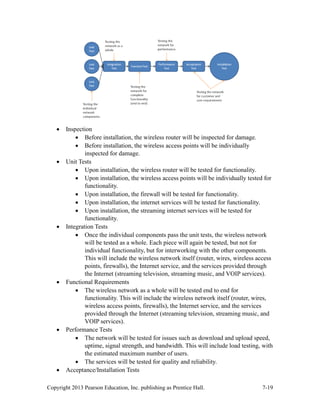
  • 3.
    Intermediate Accounting 15thEdition Kieso Solutions Manual https://testbankfan.com/product/intermediate-accounting-15th-edition- kieso-solutions-manual/ Digital Evidence and Computer Crime Forensic Science Computers and the Internet 3rd Edition Casey Test Bank https://testbankfan.com/product/digital-evidence-and-computer-crime- forensic-science-computers-and-the-internet-3rd-edition-casey-test- bank/ New Perspectives Microsoft Office 365 and Word 2016 Introductory 1st Edition Shaffer Solutions Manual https://testbankfan.com/product/new-perspectives-microsoft- office-365-and-word-2016-introductory-1st-edition-shaffer-solutions- manual/ Nutrition and Diet Therapy 9th Edition DeBruyne Solutions Manual https://testbankfan.com/product/nutrition-and-diet-therapy-9th- edition-debruyne-solutions-manual/ Better Business 4th Edition Solomon Test Bank https://testbankfan.com/product/better-business-4th-edition-solomon- test-bank/


  • 4.
    Management Information SystemsManaging the Digital Firm 15th Edition Laudon Test Bank https://testbankfan.com/product/management-information-systems- managing-the-digital-firm-15th-edition-laudon-test-bank/
  • 5.
    Copyright 2013 PearsonEducation, Inc. publishing as Prentice Hall. 7-1 Chapter 7 Quality and Performance NOTES for the Instructor: The study projects and the cases are posed as challenging assignments to students. This study guide elaborates all the material needed to teach those study guides and cases. The study projects can be assigned in two different ways: a. If you want to evaluate the ability of the students to form assumptions, research for materials, and understand the study projects, you can ask the students to work on the study project without any additional information. In this case, the students should be encouraged to obtain necessary information using the Internet. b. If you want to provide all the information, you can provide that information shown in the following pages to solve the study projects. Objectives • Manage project quality as seen by quality gurus • Determine how performance in projects are measured • Define cost of quality • Implement quality planning, assurance, and control in projects • Measure project value, project performance, and project scope Cases • Information technology Case: SAP Project at NIBCO, Inc. • Healthcare IT Case: Memorial Hospital of South Bend: Computerized Physician Order Entry Project • Financial Services IT Case: Syndicated Community Bank: Core Banking Systems Replacement Project • General Construction Case: Craig Constructions, Inc.: A Home Improvement Project Review Questions 1. Performance of a project can be defined as the execution or accomplishment of a project to fulfill customer requirements in accordance with the project scope.
  • 6.
    Copyright 2013 PearsonEducation, Inc. publishing as Prentice Hall. 7-2 2. Project value is a relative worth or importance that is monetary in nature. 3. Quality is defined as conformance to requirements. Deming defined quality as a predictable degree of uniformity and dependability at low cost suitable to the market. Juran defined quality as something that satisfies customer needs. Project quality is the degree to which a set of inherent characteristics of a project fulfill project scope. 4. Some of the main differences are in the areas of responsibility of senior management, SPC, and teamwork. 5. The major goal of quality management is to prevent defects. Quality management eliminates the source of defects so that defect detection and rework do not happen often during projects. Quality management complements project management, which means that components of quality management including customer satisfaction, defect prevention, continuous improvement, and management responsibility to provide essential resources are important in project management. Quality management is composed of quality planning, quality assurance, and quality control. Quality management is more about process and is based on problems related to processes. 6. The eight quality management principles include customer focus, leadership, involvement of projects, process approach, systems approach, continual improvement, decision making approach, and supplier relationships. 7. The quality model described in ISO/IEC 9126-1 addresses a framework for software evaluation using the general characteristics of software. These are further refined into sub-characteristics, which in turn are decomposed into attributes, yielding a multilevel hierarchy. The characteristics in a quality model are non- measurable quality factors and are used only to classify the sub-characteristics of the model, which may be subjectively measured. The ISO/IEC 9126 standard makes a distinction between internal quality and external quality and introduces the quality in use.
  • 7.
    Copyright 2013 PearsonEducation, Inc. publishing as Prentice Hall. 7-3 8. Quality management is composed of quality planning, quality assurance, and quality control. 9. Quality planning: The inputs for the quality planning are the scope document, the requirements from stakeholders, the risk register, and the project schedule. By using this input information, a project manager in cooperation with the quality team can develop a quality plan for a project as the output. Quality assurance: The inputs for quality assurance are quality planning, work performance information, quality control measurements, and quality metrics. The outputs of the process are asset updates, change requests, project management plan updates, and project document updates. Quality control: The inputs are quality metrics, approved change requests, and organizational process assets. The outputs are quality control measurements, validated changes, and updates to project management plans and other project documents. 10. Benchmarking is a process to measure the performance of an organization and compare that measure with other organizations in the same industry to understand industry best practices. 11. A quality audit is a review of the quality plan to determine whether the project activities comply with organizational and project policies, processes, and procedures. 12. There are many tools and techniques used in quality control including: • Cause-and-effect diagrams • Run charts • Scatter diagrams • Histograms • Pareto charts • Six Sigma • Process maps or flowcharts • Control charts • Statistical sampling • Reviews, and • Testing and inspection.
  • 8.
    Copyright 2013 PearsonEducation, Inc. publishing as Prentice Hall. 7-4 13. Testing is a procedure in which the system, product, or service is observed during operation in order to determine whether it functions properly. Inspection is the activity of examining the product, sub-components, or systems to determine if they meet the design standards. 14. Process capability is a critical aspect of quality control and evaluates the ability of a project process to meet or exceed the expectations or preset specifications. 15. Statistical sampling deals with the selection of a subset of a population in order to gain knowledge about the whole population and to predict quality outcomes of the population using statistics. 16. The three criteria are: 1. The level of precision 2. The level of confidence or risk, and 3. The level of variability in the attributes being measured. 17. There are a number of methods of quality reviews including: • Expert reviews • Peer reviews • Team reviews • Walk-through reviews • Formal reviews • Management reviews, and • Process reviews. 18. Metrics are required in order to answer the following questions: • Is the project is on track? • Is the project manager sure about the progress of the project? • Does the project manager understand the current status of the project, schedule wise or cost wise? • Can the project manager be sure of the performance of the project? Teaching Points - Discussion Questions
  • 9.
    Copyright 2013 PearsonEducation, Inc. publishing as Prentice Hall. 7-5 1. What else may be considered for performance other than quality? Performance measurement should consider many metrics that are listed in the chapter. It should also consider measuring time and cost constraints and make sure that the project is performing according to plan. 2. Do the three quality gurus preach the same message on quality? Even though they preach the same message, there are variations to their quality messages; See Table 7-1. 3. Quality audits have to be performed on each project. Quality audits typically should be deployed in all projects large and small. However, in reality it is not possible to do this because of added costs and time. Many industrial projects, especially small projects, are not usually audited. 4. Is there one tool that may be used in all projects for quality control? Analyzing using process maps is a very easy method that can be used in all projects for quality control. The “as-is” process and the “to-be” process bring out the essence of quality control in a very easy method especially in small projects. 5. Can we do without metrics when managing projects? No; every project has to be measured against the measurements of selected metrics. Proper metrics have to be identified and used. If metrics are not used in a project, there is no way to know how a project is progressing and may not ensure the success of the project. 6. There are differences between testing and inspection. Yes; Testing helps to execute the software in order to test the functionality and requirements while inspection analyzes the code based on a set of predefined rules. 7. Who decides which metrics are the best for a project: the project manager or management? Project manager should decide the metrics while management should help the project manager by removing any obstacles in order to measure those metrics. 8. Should management be involved in quality management? Yes; the management should provide leadership to encourage project managers to manage the project quality. Answers to Chapter Problems Problem 1: Observations
  • 10.
    Copyright 2013 PearsonEducation, Inc. publishing as Prentice Hall. 7-6 Sample number 1 2 3 4 5 Mean Range 1 0.786 0.799 0.793 0.511 0.781 0.734 0.288 2 0.799 0.506 0.516 0.797 0.529 0.629 0.293 3 0.796 0.500 0.515 0.788 0.521 0.624 0.296 4 0.795 0.506 0.783 0.787 0.789 0.732 0.289 5 0.772 0.502 0.526 0.769 0.781 0.670 0.279 6 0.773 0.795 0.507 0.793 0.506 0.675 0.289 7 0.795 0.512 0.790 0.771 0.507 0.675 0.288 8 0.525 0.501 0.798 0.777 0.785 0.677 0.297 9 0.797 0.501 0.517 0.506 0.516 0.567 0.296 10 0.795 0.505 0.516 0.511 0.797 0.625 0.292 11 0.795 0.782 0.768 0.792 0.792 0.786 0.027 12 0.783 0.759 0.526 0.506 0.522 0.619 0.277 13 0.521 0.512 0.793 0.525 0.510 0.572 0.283 14 0.787 0.521 0.507 0.501 0.500 0.563 0.287 15 0.793 0.516 0.799 0.511 0.513 0.626 0.288 Mean 0.652 0.271 X-bar UCL = 0.809 use Table 7-6 LCL= 0.494 R-bar UCL = 0.572 use Table 7-7 LCL= 0.000
  • 11.
    Copyright 2013 PearsonEducation, Inc. publishing as Prentice Hall. 7-7 Problem 2: 0.03 defective without inspection 0.02 defective with inspection Improvement=0.01 Cost of inspection = $0.40 Opportunity Cost of replacing the 1% improvement = $ 0.50 Therefore, inspection done be done now.
  • 12.
    Copyright 2013 PearsonEducation, Inc. publishing as Prentice Hall. 7-8 Cost of inspection = $0.80 Inspection should not be done now. Problem 3 Cost of quality is: CoQ = Cp + Ca + Cf This is described as the cost of prevention plus the cost of detection plus the cost of failures. This is not the cost of achieving quality in product and services, but rather not achieving quality and the cost associated with failures due to the lack of quality in the production process. The cost of quality for Superior Buy, who is the buyer in this scenario, would most likely be replacing or upgrading inferior computers that do not perform as expected. If the computers were to fail due to manufacturing defects, this would be covered under the manufacturer warranty. But if Superior Buy purchased computers with lower performance specifications to try and save money, then the cost of bringing them up to par if they are under performing would be the cost of quality. The cost includes installing additional RAM, changing the processor, installing different or new software, or may even be replacing the whole computer with one that will perform. Superior Buy must take into account these costs for possible upgrades or replacements when defining the specifications for their order. The cost of quality for Dell, who is the supplier in this scenario, would most likely be warranty repair or replacement costs. These costs would be incurred if defective computers were to leave the factory and end up in the hands of the customer. These costs would start the minute the customer calls the service number for help, and are not finished until the customer is completely satisfied with the end result. One customer may even call multiple times with multiple problems. Dell must integrate quality within the manufacturing process which will increase quality, decrease defects, and ultimately reduce the cost of quality. Problem 4: Process Mean Standard Deviation Lower Specification Upper Specification 1 7.0 0.1 6.9 7.9 2 4.0 0.1 4.2 4.9
  • 13.
    Copyright 2013 PearsonEducation, Inc. publishing as Prentice Hall. 7-9 3 6.6 0.1 5.4 6.5 For Process 1: cp= (upper spec - Lower Spec)/6σ= 1.667 Process is capable This m For Process 2: cp= (upper spec - Lower Spec)/6σ= 0.972 Process not capable For Process 3: cp= (upper spec - Lower Spec)/6σ= 1.410 Process is capable When the mean is centered or not situations, we can use Cp equation as follows: If the means of all processes are not exactly in the center: It is lesser of the formulae: (Upper spec-Mean)/3*σ or (Mean-Lower spec)/3σ Formula1 Formula2 Process 1 0.333 3.000 0.333 Process 2 -0.556 2.500 -0.556 Process 3 -0.256 -0.256 3.077 In this case, all processes are not capable.
  • 14.
    Copyright 2013 PearsonEducation, Inc. publishing as Prentice Hall. 7-10 The Cp should be at least equal to 1.33 Problem 5: a. The metrics to show control over a project are scope variance hours, scope cost increase, productivity, project cost deviation, and project progress deviation. The variance and deviation metrics for scope, cost and progress indicates that these factors are well defined and restrained within acceptable limitation. Meanwhile, productivity reflects how well the individual processes are executed. b. The metrics to show progress would be actual scope hours, productivity, and product progress deviation. Actual scope hours provide evidence for completed tasks which are related to the defined scope. Productivity and product progress deviation manifest the consistency of project progress. c. The metrics to charge a customer for changes are Scope Variance Hours, Scope Cost Increase, Number of baseline Changes, Project Effort and Project Cost Deviation. Number of baseline changes elicits additional requirements which have to be paid by the customers. The project effort, project cost deviation, and scope cost increases are used for calculating the amount of additional payment. Rescheduling of the project should take into account the scope variance hours metric. d. The metrics are Project Feature Enhancement Increase. This indicator measures the efficiency of effort scheduling which should be governed to complete important features. e. The metrics to use to manage customer expectations are Project Merit and Project Risk. The project merit communicates that expectations are consistently maintained and transparent during project duration. Meanwhile, project risk conveys the plans for securing and preserving expectations. f. The metrics to understand how fast a team is performing tasks are Project Efficiency and Project Effort. These metrics quantify the pace of task execution. g. The metrics for how well a team is performing are Project Effectiveness, Productivity and Project Effort. The three metrics are numerical presentations of quality of project execution. h. The metrics are removed are Removed Defects Efficiency. Removed Defects Efficiency numerically measures defect detecting and removing capability. i. The metrics are the Project Customer Commitment which completely evaluates factors of customer involvement, communication, and availability. Problem 6: Costs Cost of Conformance Cost of Non- Conformance Cost of Prevention Cost of Appraisal Cost of Failure Cost of Training X
  • 15.
    Copyright 2013 PearsonEducation, Inc. publishing as Prentice Hall. 7-11 Business Opportunity Cost X Cost of Testing Material X Cost of Quality Planning X Cost of Rework X Cost of handling Complaints X Cost of explaining Project Deviations X Cost of Testing Tools X Cost of Stationary and Printing for Quality X Problem 7: Year Revenues 0 ($22,500) 1 $51,000 2 $96,250 3 $96,250 4 $96,250 5 $96,250
  • 16.
    Copyright 2013 PearsonEducation, Inc. publishing as Prentice Hall. 7-12 Cpr+Ca $62,800 Cost of quality maint $37,000 Discount rate 10% a Cost of software quality $62,800 b See Appendix D SQNPV $201,426.86 c ROSQ 4.14 Problem 8: See Appendix D These are the non-conformance costs: Csc, Suncontractor related quality prevention and appraisal costs Ccp, Coordination and planning-related quality prevention and appraisal costs Ccw, Construction and workmanship-related quality prevention and appraisal costs Paid to sub-contracted electricians $210,000 not applied Paid for quality related planning costs $2,000,450 Ccp Paid for quality coordination $340,000 Ccp Paid for lack of good workmanship $540,000 Ccw Paid for accident-related work $380,000 not applied Paid for transportation of poor quality materials $6,000 Internal failure Paid for quality faults by sub-contracted electricians $80,040 Internal failure
  • 17.
    Copyright 2013 PearsonEducation, Inc. publishing as Prentice Hall. 7-13 Paid to repair leaky plumbing $6,000 Internal failure Paid to locate faulty roof shingles $80,700 Ccp Cost of construction quality = = Csc+Ccp+Ccw $2,961,150 Cost of internal failures $92,040 Total cost of Quality $3,053,190 Problem 9: Description Cost Quality training $4,000 Cpr Reliability training $20,000 Cpr Scrap $15,000 Cf Downtime $6,000 Cf Transportation losses $8,000 Cf Supplies inspection $6,000 Ca Contracted laboratory testing $300,000 Ca Pilot production runs $8,000 Cpr Reliability testing $9,560 Ca CoQ $376,560
  • 18.
    Copyright 2013 PearsonEducation, Inc. publishing as Prentice Hall. 7-14 The cost of quality is $4,000 + $20,000 + $15,000 + $6,000 + $8,000 + $6,000 + $300,000 + $8,000 + $9,560 = $376,560 Problem 10 Assume 8 hrs in a work day Expected Time to process 20 days No. of hrs in a day (assume) 8 hrs Total Time in hours 160 hrs Time for processing 4 days Total applications to be processed 1200 Defects > 20 days 150 Completed in a time period 1050 Applications with customer issues 20 out of 150 Apps with issues processed in 11 days Apps with issues processed in 88 hrs Applications without issues 1180 Rework time 5 days Rework time 40 hrs
  • 19.
    Copyright 2013 PearsonEducation, Inc. publishing as Prentice Hall. 7-15 Project Efficiency 88% Project Effectiveness 98% Productivity 4.84 in March Expected Productivity 7.5 in March Defective loans 13% Correct loans 88% See Appendix D Project Quality Time 0.55 Time spent on defects 40 hrs Defect by Time 0.16129 defect/project time Problem 11: Year Discount factor Cost Benefits Discounted Costs Discounted Benefits Accum. Discounted costs Accum. Discounted Benefits 0 1.00 ($22,500.00) $22,500.00 ($22,500.00) $22,500.00 ($22,500.00) $22,500.00 1 0.91 $6,250.00 $17,500.00 $5,681.82 $15,909.09 ($16,818.18) $38,409.09 2 0.83 $6,250.00 $14,000.00 $5,165.29 $11,570.25 ($11,652.89) $49,979.34 3 0.75 $6,250.00 $11,000.00 $4,695.72 $8,264.46 ($6,957.18) $58,243.80 4 0.68 $6,250.00 $5,000.00 $4,268.83 $3,415.07 ($2,688.34) $61,658.87 5 0.62 $6,250.00 $0.00 $3,880.76 $0.00 $1,192.42 $61,658.87 Total Cash flows $60,466.45 Initial Investment $22,500.00
  • 20.
    Copyright 2013 PearsonEducation, Inc. publishing as Prentice Hall. 7-16 Profitability Index 2.69 Hence, the project has positive value Project Value $61,250.00 Problem 12: Weighted score Criteria Weight A B C A B C Alignment to strategy 20 3 2 2 12 8 8 Cost benefits 10 1 2 4 2 4 8 Flexibility of products 10 1 2 3 2 4 6 Competitive advantage 15 5 4 3 15 12 9 Time to market 20 1 2 4 4 8 16 Employee benefits 10 2 2 3 4 4 6 Sales prospects 15 4 5 3 12 15 9 100 Total 51 55 62 a. Project C b. Project A Study Projects Information Systems: For the Wireless Project the following quality metrics will be captured, tracked, and analyzed on a continuous basis throughout the project: performance, conformance,
  • 21.
    Copyright 2013 PearsonEducation, Inc. publishing as Prentice Hall. 7-17 reliability, serviceability, and aesthetics. These metrics will be captured by the project team and presented to the project sponsor as outlined in the quality plan (in a separate word document). The following tools could be employed for the different processes used to establish quality within the Wireless Project: • Cause and Effect Diagrams – These types of diagrams are used to identify the root cause of a problem. These could easily be integrated into a quality process for testing and debugging performance issues within the Wireless Project. • Run Charts – This type of chart is used to graphically display observed data in a time sequence. The project team could employ this type of chart to observe the download and upload speeds of the Wireless Network over the course of a day to see the variance of said speeds. • Scatter Diagrams – This type of chart is used to observe the effect of two variables in a situation. For the design of the Wireless Project, one could plot the bandwidth against the download speed to determine how much bandwidth is needed for the download speed required. • Histograms – This type of chart is used to graphically represent the distribution of data. For the Wireless Project, a histogram could be used to analyze network performance metrics such as delay, packet loss, retransmission, and throughput. • Pareto Charts – This type of chart contains both bars and a line graph, where individual values are represented in descending order by bars, and the cumulative total is represented by the line. For the Wireless Project, a histogram could be used to analyze network performance metrics such as delay, packet loss, retransmission, and throughput. • Six Sigma – This statistical analysis is used to identify the number of defects in a process, and to help reduce the defects produced to increase quality. This type of statistical analysis may be a bit much for the Wireless Project, but it could be used to analyze the suppliers of the equipment. The suppliers with a higher Six Sigma level would be more likely to supply the project with quality equipment that is less likely to fail. • Process Maps or Flowcharts – These diagrams can be used to graphically display any process. An example of a process map or flowchart for the Wireless Project could be one that shows the construction, testing, and reworking (if needed) of the wireless network. There are many different activities that go into this process, and some must be completed before others can start. This type of chart could quickly and easily explain this to a non-technical reader. • Control Charts – A control chart is used to determine whether or not a process is within control limits. For the Wireless Project this type of chart could be used to identify bottlenecks and reduce waste if used in the scheduling of workers.
  • 22.
    Copyright 2013 PearsonEducation, Inc. publishing as Prentice Hall. 7-18 • Statistical Sampling – This type of analysis is used to gain a better knowledge of a population of data using a smaller subset of data called a sample. This type of sampling could be used in analyzing network performance metrics, and help to identify the possible problem areas. • Reviews – These are done to review a product, service, or system against quality criteria set forth by the project team or organization. In the Wireless Project nightly meetings with both the project team and project sponsor will be held to review the activities of the day and to identify sub-quality items that need to be addressed immediately. • Testing and Inspection – This is done to promote quality in products and services. In the Wireless Project a testing and inspection plan will be created for the construction and implementation of the wireless network. This will ensure that the various stages of the network are tested, and quality is established and maintained throughout the life of the project. Below is a table of the quality audit data for the Stafford Wireless Project. These data points provided valuable insight into issues that need to be addressed immediately for successful completion of the project. Quality Audit (with arbitrary numbers) Wireless Network Project Audit Audit Date Auditor U or P Non-Compliant Issues Elevated to Senior Mgmt. No of Hi- Priority Items Hrs to prepare and conduct the audit Major Minor Closed 3/19/12 JS/PR P 0 2 0 0 0 2 3/20/12 JS/PR P 0 0 2 0 0 3 3/22/12 JS/PR U 1 1 0 1 1 2 U- Unplanned; P-Planned Below is a testing and inspection plan for the Wireless Project. This plan will ensure that the wireless network is tested throughout the project, and any failures or defects are discovered and quickly addressed.
  • 23.
    Copyright 2013 PearsonEducation, Inc. publishing as Prentice Hall. 7-19 • Inspection • Before installation, the wireless router will be inspected for damage. • Before installation, the wireless access points will be individually inspected for damage. • Unit Tests • Upon installation, the wireless router will be tested for functionality. • Upon installation, the wireless access points will be individually tested for functionality. • Upon installation, the firewall will be tested for functionality. • Upon installation, the internet services will be tested for functionality. • Upon installation, the streaming internet services will be tested for functionality. • Integration Tests • Once the individual components pass the unit tests, the wireless network will be tested as a whole. Each piece will again be tested, but not for individual functionality, but for interworking with the other components. This will include the wireless network itself (router, wires, wireless access points, firewalls), the Internet service, and the services provided through the Internet (streaming television, streaming music, and VOIP services). • Functional Requirements • The wireless network as a whole will be tested end to end for functionality. This will include the wireless network itself (router, wires, wireless access points, firewalls), the Internet service, and the services provided through the Internet (streaming television, streaming music, and VOIP services). • Performance Tests • The network will be tested for issues such as download and upload speed, uptime, signal strength, and bandwidth. This will include load testing, with the estimated maximum number of users. • The services will be tested for quality and reliability. • Acceptance/Installation Tests
  • 24.
    Copyright 2013 PearsonEducation, Inc. publishing as Prentice Hall. 7-20 • The project sponsor and end users will test the network and services to determine if the performance, quality, and value of the wireless network and services are acceptable and meet the standards set forth in the project documentation. • The following metrics would be used to measure, track, and monitor the progress of the Stafford Wireless with reference to project scope, performance, and value. • Scope – To monitor the scope of the project, the schedule (hours) of the project participants can be used • Performance – The wireless signal strength and upload/download speeds are three metrics that can be used to adequately judge the performance of the network in the project • Value – To monitor the value that the project brings to the sponsor and end users, the cost savings can be measured and tracked. This is the savings which the sponsor will see by cancelling some of the now redundant services. Also to measure value, customer satisfaction can be measured and tracked on a daily basis. New Product Development a. • Customer-focused: Understanding customers’ needs, meeting customers’ requirements and exceeding customers’ expectations • Continual improvement: Continual improvement of the organization’s overall performance should be a permanent objective of the organization Quality assurance: • Checking whether the quality is built into the project process • Checking whether the project scope accurately reflects the needs of the customer • Checking whether the project plan is followed Quality control: • Determining the metrics that will be used in this project • Determining the audits and reviews b. The tools that will be employed for each of the three quality processes: • Control charts • Six sigma • Statistical sampling • Testing and inspection c. Quality Audit (with arbitrary numbers)
  • 25.
    Another Random ScribdDocument with Unrelated Content
  • 26.
    with great courageand conduct, and with as great success, discovered the utmost aversion to the sending his boat ashore whenever we lay wind- bound in any of our harbours. This aversion did not arise from any fear of wearing out his boat by using it, but was, in truth, the result of experience, that it was easier to send his men on shore than to recal them. They acknowledged him to be their master while they remained on shipboard, but did not allow his power to extend to the shores, where they had no sooner set their foot than every man became sui juris, and thought himself at full liberty to return when he pleased. Now it is not any delight that these fellows have in the fresh air or verdant fields on the land. Every one of them would prefer his ship and his hammock to all the sweets of Arabia the Happy; but, unluckily for them, there are in every seaport in England certain houses whose chief livelihood depends on providing entertainment for the gentlemen of the jacket. For this purpose they are always well furnished with those cordial liquors which do immediately inspire the heart with gladness, banishing all careful thoughts, and indeed all others, from the mind, and opening the mouth with songs of chearfulness and thanksgiving for the many wonderful blessings with which a sea-faring life overflows. For my own part, however whimsical it may appear, I confess I have thought the strange story of Circe in the Odyssey no other than an ingenious allegory, in which Homer intended to convey to his countrymen the same kind of instruction which we intend to communicate to our own in this digression. As teaching the art of war to the Greeks was the plain design of the Iliad, so was teaching them the art of navigation the no less manifest intention of the Odyssey. For the improvement of this, their situation was most excellently adapted; and accordingly we find Thucydides, in the beginning of his history, considers the Greeks as a sett of pirates or privateers, plundering each other by sea. This being probably the first institution of commerce before the Ars Cauponaria was invented, and merchants, instead of robbing, began to cheat and outwit each other, and by degrees changed the Metabletic, the only kind of traffic allowed by Aristotle in his Politics, into the Chrematistic. By this allegory then I suppose Ulysses to have been the captain of a merchant-ship, and Circe some good ale-wife, who made his crew drunk with the spirituous liquors of those days. With this the transformation into swine, as well as all other incidents of the fable, will notably agree; and
  • 27.
    thus a keywill be found out for unlocking the whole mystery, and forging at least some meaning to a story which, at present, appears very strange and absurd. Hence, moreover, will appear the very near resemblance between the sea-faring men of all ages and nations; and here perhaps may be established the truth and justice of that observation, which will occur oftener than once in this voyage, that all human flesh is not the same flesh, but that there is one kind of flesh of landmen, and another of seamen. Philosophers, divines, and others, who have treated the gratification of human appetites with contempt, have, among other instances, insisted very strongly on that satiety which is so apt to overtake them even in the very act of enjoyment. And here they more particularly deserve our attention, as most of them may be supposed to speak from their own experience, and very probably gave us their lessons with a full stomach. Thus hunger and thirst, whatever delight they may afford while we are eating and drinking, pass both away from us with the plate and the cup; and though we should imitate the Romans, if, indeed, they were such dull beasts, which I can scarce believe, to unload the belly like a dung-pot, in order to fill it again with another load, yet would the pleasure be so considerably lessened that it would scarce repay us the trouble of purchasing it with swallowing a bason of camomile tea. A second haunch of venison, or a second dose of turtle, would hardly allure a city glutton with its smell. Even the celebrated Jew himself, when well filled with calipash and calipee, goes contentedly home to tell his money, and expects no more pleasure from his throat during the next twenty-four hours. Hence I suppose Dr South took that elegant comparison of the joys of a speculative man to the solemn silence of an Archimedes over a problem, and those of a glutton to the stillness of a sow at her wash. A simile which, if it became the pulpit at all, could only become it in the afternoon. Whereas in those potations which the mind seems to enjoy, rather than the bodily appetite, there is happily no such satiety; but the more a man drinks, the more he desires; as if, like Mark Anthony in Dryden, his appetite encreased with feeding, and this to such an immoderate degree, ut nullus sit desiderio aut pudor aut modus. Hence, as with the gang of Captain Ulysses, ensues so total a transformation, that the man no more continues what he was. Perhaps he ceases for a time to be at all; or, though he may retain the same outward form and figure he had before, yet is his nobler part, as we
  • 28.
    are taught tocall it, so changed, that, instead of being the same man, he scarce remembers what he was a few hours before. And this transformation, being once obtained, is so easily preserved by the same potations, which induced no satiety, that the captain in vain sends or goes in quest of his crew. They know him no longer; or, if they do, they acknowledge not his power, having indeed as entirely forgotten themselves as if they had taken a large draught of the river of Lethe. Nor is the captain always sure of even finding out the place to which Circe hath conveyed them. There are many of those houses in every port- town. Nay, there are some where the sorceress doth not trust only to her drugs; but hath instruments of a different kind to execute her purposes, by whose means the tar is effectually secreted from the knowledge and pursuit of his captain. This would, indeed, be very fatal, was it not for one circumstance; that the sailor is seldom provided with the proper bait for these harpies. However, the contrary sometimes happens, as these harpies will bite at almost anything, and will snap at a pair of silver buttons, or buckles, as surely as at the specie itself. Nay, sometimes they are so voracious, that the very naked hook will go down, and the jolly young sailor is sacrificed for his own sake. In vain, at such a season as this, would the vows of a pious heathen have prevailed over Neptune, Æolus, or any other marine deity. In vain would the prayers of a Christian captain be attended with the like success. The wind may change how it pleases while all hands are on shore; the anchor would remain firm in the ground, and the ship would continue in durance, unless, like other forcible prison-breakers, it forcibly got loose for no good purpose. Now, as the favour of winds and courts, and such like, is always to be laid hold on at the very first motion, for within twenty-four hours all may be changed again; so, in the former case, the loss of a day may be the loss of a voyage: for, though it may appear to persons not well skilled in navigation, who see ships meet and sail by each other, that the wind sometimes east and west, north and south, backwards and forwards, at the same instant; yet, certain it is that the land is so contrived, that even the same wind will not, like the same horse, always bring a man to the end of his journey; but, that the gale which the mariner prayed heartily for yesterday, he may as heartily deprecate to-morrow; while all use and benefit which would have arisen to
  • 29.
    him from thewesterly wind of to-morrow may be totally lost and thrown away by neglecting the offer of the easterly blast which blows to-day. Hence ensues grief and disreputation to the innocent captain, loss and disappointment to the worthy merchant, and not seldom great prejudice to the trade of a nation whose manufactures are thus liable to lie unsold in a foreign warehouse, the market being forestalled by some rival whose sailors are under a better discipline. To guard against these inconveniences the prudent captain takes every precaution in his power; he makes the strongest contracts with his crew, and thereby binds them so firmly, that none but the greatest or least of men can break through them with impunity; but for one of these two reasons, which I will not determine, the sailor, like his brother fish the eel, is too slippery to be held, and plunges into his element with perfect impunity. To speak a plain truth, there is no trusting to any contract with one whom the wise citizens of London call a bad man; for, with such a one, though your bond be ever so strong, it will prove in the end good for nothing. What then is to be done in this case? What, indeed, but to call in the assistance of that tremendous magistrate, the justice of peace, who can, and often doth, lay good and bad men in equal durance; and, though he seldom cares to stretch his bonds to what is great, never finds anything too minute for their detention, but will hold the smallest reptile alive so fast in his noose, that he can never get out till he is let drop through it. Why, therefore, upon the breach of those contracts, should not an immediate application be made to the nearest magistrate of this order, who should be empowered to convey the delinquent either to ship or to prison, at the election of the captain, to be fettered by the leg in either place? But, as the case now stands, the condition of this poor captain without any commission, and of this absolute commander without any power, is much worse than we have hitherto shewn it to be; for, notwithstanding all the aforesaid contracts to sail in the good ship the Elizabeth, if the sailor should, for better wages, find it more his interest to go on board the better ship the Mary, either before their setting out or on their speedy meeting in some port, he may prefer the latter without any other danger than that of “doing what he ought not to have done,” contrary to a rule which he is seldom Christian enough to have much at heart, while the captain is generally too good a Christian to punish a man out of revenge only, when
  • 30.
    he is tobe at a considerable expense for so doing. There are many other deficiencies in our laws relating to maritime affairs, and which would probably have been long since corrected, had we any seamen in the House of Commons. Not that I would insinuate that the legislature wants a supply of many gentlemen in the sea-service; but, as these gentlemen are by their attendance in the house unfortunately prevented from ever going to sea, and there learning what they might communicate to their landed brethren, these latter remain as ignorant in that branch of knowledge as they would be if none but courtiers and fox-hunters had been elected into parliament, without a single fish among them. The following seems to me to be an effect of this kind, and it strikes me the stronger as I remember the case to have happened, and remember it to have been dispunishable. A captain of a trading vessel, of which he was part owner, took in a large freight of oats at Liverpool, consigned to the market at Bearkey: this he carried to a port in Hampshire, and there sold it as his own, and, freighting his vessel with wheat for the port of Cadiz, in Spain, dropt it at Oporto in his way; and there, selling it for his own use, took in a lading of wine, with which he sailed again, and, having converted it in the same manner, together with a large sum of money with which he was intrusted, for the benefit of certain merchants, sold the ship and cargo in another port, and then wisely sat down contented with the fortune he had made, and returned to London to enjoy the remainder of his days, with the fruits of his former labours and a good conscience. The sum he brought home with him consisted of near six thousand pounds, all in specie, and most of it in that coin which Portugal distributes so liberally over Europe. He was not yet old enough to be past all sense of pleasure, nor so puffed up with the pride of his good fortune as to overlook his old acquaintances the journeymen taylors, from among whom he had been formerly pressed into the sea-service, and, having there laid the foundation of his future success by his shares in prizes, had afterwards become captain of a trading vessel, in which he purchased an interest, and had soon begun to trade in the honourable manner above mentioned. The captain now took up his residence at an ale-house in Drury-lane, where, having all his money by him in a trunk, he spent about five pounds a day among his old friends the gentlemen and ladies of those parts.
  • 31.
    The merchant ofLiverpool, having luckily had notice from a friend during the blaze of his fortune, did, by the assistance of a justice of peace, without the assistance of the law, recover his whole loss. The captain, however, wisely chose to refund no more; but, perceiving with what hasty strides Envy was pursuing his fortune, he took speedy means to retire out of her reach, and to enjoy the rest of his wealth in an inglorious obscurity; nor could the same justice overtake him time enough to assist a second merchant as he had done the first. This was a very extraordinary case, and the more so as the ingenious gentleman had steered entirely clear of all crimes in our law. Now, how it comes about that a robbery so very easy to be committed, and to which there is such immediate temptation always before the eyes of these fellows, should receive the encouragement of impunity, is to be accounted for only from the oversight of the legislature, as that oversight can only be, I think, derived from the reasons I have assigned for it. But I will dwell no longer on this subject. If what I have here said should seem of sufficient consequence to engage the attention of any man in power, and should thus be the means of applying any remedy to the most inveterate evils, at least, I have obtained my whole desire, and shall have lain so long wind-bound in the ports of this kingdom to some purpose. I would, indeed, have this work—which, if I should live to finish it, a matter of no great certainty, if indeed of any great hope to me, will be probably the last I shall ever undertake—to produce some better end than the mere diversion of the reader. Monday.—This day our captain went ashore, to dine with a gentleman who lives in these parts, and who so exactly resembles the character given by Homer of Axylus, that the only difference I can trace between them is, the one, living by the highway, erected his hospitality chiefly in favour of land-travellers; and the other, living by the water-side, gratified his humanity by accommodating the wants of the mariner. In the evening our commander received a visit from a brother bashaw, who lay wind-bound in the same harbour. This latter captain was a Swiss. He was then master of a vessel bound to Guinea, and had formerly been a privateering, when our own hero was employed in the same laudable service. The honesty and freedom of the Switzer, his vivacity, in which he was in no respect inferior to his near neighbours the French, the aukward
  • 32.
    and affected politeness,which was likewise of French extraction, mixed with the brutal roughness of the English tar—for he had served under the colours of this nation and his crew had been of the same—made such an odd variety, such a hotchpotch of character, that I should have been much diverted with him, had not his voice, which was as loud as a speaking- trumpet, unfortunately made my head ach. The noise which he conveyed into the deaf ears of his brother captain, who sat on one side of him, the soft addresses with which, mixed with aukward bows, he saluted the ladies on the other, were so agreeably contrasted, that a man must not only have been void of all taste of humour, and insensible of mirth, but duller than Cibber is represented in the Dunciad, who could be unentertained with him a little while; for, I confess, such entertainments should always be very short, as they are very liable to pall. But he suffered not this to happen at present; for, having given us his company a quarter of an hour only, he retired, after many apologies for the shortness of his visit. Tuesday.—The wind being less boisterous than it had hitherto been since our arrival here, several fishing-boats, which the tempestuous weather yesterday had prevented from working, came on board us with fish. This was so fresh, so good in kind, and so very cheap, that we supplied ourselves in great numbers, among which were very large soles at fourpence a pair, and whitings of almost a preposterous size at ninepence a score. The only fish which bore any price was a john dorée, as it is called. I bought one of at least four pounds weight for as many shillings. It resembles a turbot in shape, but exceeds it in firmness and flavour. The price had the appearance of being considerable when opposed to the extraordinary cheapness of others of value, but was, in truth, so very reasonable when estimated by its goodness, that it left me under no other surprise than how the gentlemen of this country, not greatly eminent for the delicacy of their taste, had discovered the preference of the dorée to all other fish: but I was informed that Mr Quin, whose distinguishing tooth hath been so justly celebrated, had lately visited Plymouth, and had done those honours to the dorée which are so justly due to it from that sect of modern philosophers who, with Sir Epicure Mammon, or Sir Epicure Quin, their head, seem more to delight in a fish-pond than in a garden, as the old Epicureans are said to have done. Unfortunately for the fishmongers of London, the dorée resides only in those seas; for, could any of this company but convey one to the temple of
  • 33.
    luxury under thePiazza, where Macklin the high-priest daily serves up his rich offerings to that goddess, great would be the reward of that fishmonger, in blessings poured down upon him from the goddess, as great would his merit be towards the high-priest, who could never be thought to overrate such valuable incense. And here, having mentioned the extreme cheapness of fish in the Devonshire sea, and given some little hint of the extreme dearness with which this commodity is dispensed by those who deal in it in London, I cannot pass on without throwing forth an observation or two, with the same view with which I have scattered my several remarks through this voyage, sufficiently satisfied in having finished my life, as I have probably lost it, in the service of my country, from the best of motives, though it should be attended with the worst of success. Means are always in our power; ends are very seldom so. Of all the animal foods with which man is furnished, there are none so plenty as fish. A little rivulet, that glides almost unperceived through a vast tract of rich land, will support more hundreds with the flesh of its inhabitants than the meadow will nourish individuals. But if this be true of rivers, it is much truer of the seashores, which abound with such immense variety of fish that the curious fisherman, after he hath made his draught, often culls only the daintiest part and leaves the rest of his prey to perish on the shore. If this be true it would appear, I think, that there is nothing which might be had in such abundance, and consequently so cheap, as fish, of which Nature seems to have provided such inexhaustible stores with some peculiar design. In the production of terrestrial animals she proceeds with such slowness, that in the larger kind a single female seldom produces more than one a-year, and this again requires three, four, or five years more to bring it to perfection. And though the lesser quadrupeds, those of the wild kind particularly, with the birds, do multiply much faster, yet can none of these bear any proportion with the aquatic animals, of whom every female matrix is furnished with an annual offspring almost exceeding the power of numbers, and which, in many instances at least, a single year is capable of bringing to some degree of maturity. What then ought in general to be so plentiful, what so cheap, as fish? What then so properly the food of the poor? So in many places they are, and
  • 34.
    so might theyalways be in great cities, which are always situated near the sea, or on the conflux of large rivers. How comes it then, to look no farther abroad for instances, that in our city of London the case is so far otherwise that, except that of sprats, there is not one poor palate in a hundred that knows the taste of fish? It is true indeed that this taste is generally of such excellent flavour that it exceeds the power of French cookery to treat the palates of the rich with anything more exquisitely delicate; so that was fish the common food of the poor it might put them too much upon an equality with their betters in the great article of eating, in which, at present, in the opinion of some, the great difference in happiness between man and man consists. But this argument I shall treat with the utmost disdain: for if ortolans were as big as bustards, and at the same time as plenty as sparrows, I should hold it yet reasonable to indulge the poor with the dainty, and that for this cause especially, that the rich would soon find a sparrow, if as scarce as an ortolan, to be much the greater, as it would certainly be the rarer, dainty of the two. Vanity or scarcity will be always the favourite of luxury; but honest hunger will be satisfied with plenty. Not to search deeper into the cause of the evil, I should think it abundantly sufficient to propose the remedies of it. And, first, I humbly submit the absolute necessity of immediately hanging all the fishmongers within the bills of mortality; and, however it might have been some time ago the opinion of mild and temporizing men that the evil complained of might be removed by gentler methods, I suppose at this day there are none who do not see the impossibility of using such with any effect. Cuncta prius tentanda might have been formerly urged with some plausibility, but cuncta prius tentata may now be replied: for surely, if a few monopolizing fishmongers could defeat that excellent scheme of the Westminster market, to the erecting which so many justices of peace, as well as other wise and learned men, did so vehemently apply themselves, that they might be truly said not only to have laid the whole strength of their heads, but of their shoulders too, to the business, it would be a vain endeavour for any other body of men to attempt to remove so stubborn a nusance. If it should be doubted whether we can bring this case within the letter of any capital law now subsisting, I am ashamed to own it cannot; for surely no crime better deserves such punishment; but the remedy may, nevertheless, be immediate; and if a law was made at the beginning of next
  • 35.
    session, to takeplace immediately, by which the starving thousands of poor was declared to be felony, without benefit of clergy, the fishmongers would be hanged before the end of the session. A second method of filling the mouths of the poor, if not with loaves at least with fishes, is to desire the magistrates to carry into execution one at least out of near a hundred acts of parliament, for preserving the small fry of the river of Thames, by which means as few fish would satisfy thousands as may now be devoured by a small number of individuals. But while a fisherman can break through the strongest meshes of an act of parliament, we may be assured he will learn so to contrive his own meshes that the smallest fry will not be able to swim through them. Other methods may, we doubt not, be suggested by those who shall attentively consider the evil here hinted at; but we have dwelt too long on it already, and shall conclude with observing that it is difficult to affirm whether the atrocity of the evil itself, the facility of curing it, or the shameful neglect of the cure, be the more scandalous or more astonishing. After having, however, gloriously regaled myself with this food, I was washing it down with some good claret with my wife and her friend, in the cabin, when the captain’s valet-de-chambre, head cook, house and ship steward, footman in livery and out on’t, secretary and fore-mast man, all burst into the cabin at once, being, indeed, all but one person, and, without saying by your leave, began to pack half a hogshead of small beer in bottles, the necessary consequence of which must have been either a total stop to conversation at that chearful season when it is most agreeable, or the admitting that polyonymous officer aforesaid to the participation of it. I desired him therefore to delay his purpose a little longer, but he refused to grant my request; nor was he prevailed on to quit the room till he was threatened with having one bottle to pack more than his number, which then happened to stand empty within my reach. With these menaces he retired at last, but not without muttering some menaces on his side, and which, to our great terror, he failed not to put into immediate execution. Our captain was gone to dinner this day with his Swiss brother; and, though he was a very sober man, was a little elevated with some champagne, which, as it cost the Swiss little or nothing, he dispensed at his table more liberally than our hospitable English noblemen put about those
  • 36.
    bottles, which theingenious Peter Taylor teaches a led captain to avoid by distinguishing by the name of that generous liquor, which all humble companions are taught to postpone to the flavour of methuen, or honest port. While our two captains were thus regaling themselves, and celebrating their own heroic exploits with all the inspiration which the liquor, at least, of wit could afford them, the polyonymous officer arrived, and, being saluted by the name of Honest Tom, was ordered to sit down and take his glass before he delivered his message; for every sailor is by turns his captain’s mate over a cann, except only that captain bashaw who presides in a man-of-war, and who upon earth has no other mate, unless it be another of the same bashaws. Tom had no sooner swallowed his draught than he hastily began his narrative, and faithfully related what had happened on board our ship; we say faithfully, though from what happened it may be suspected that Tom chose to add perhaps only five or six immaterial circumstances, as is always I believe the case, and may possibly have been done by me in relating this very story, though it happened not many hours ago. No sooner was the captain informed of the interruption which had been given to his officer, and indeed to his orders, for he thought no time so convenient as that of his absence for causing any confusion in the cabin, than he leapt with such haste from his chair that he had like to have broke his sword, with which he always begirt himself when he walked out of his ship, and sometimes when he walked about in it; at the same time, grasping eagerly that other implement called a cockade, which modern soldiers wear on their helmets with the same view as the antients did their crests—to terrify the enemy, he muttered something, but so inarticulately that the word damn was only intelligible; he then hastily took leave of the Swiss captain, who was too well bred to press his stay on such an occasion, and leapt first from the ship to his boat, and then from his boat to his own ship, with as much fierceness in his looks as he had ever expressed on boarding his defenceless prey in the honourable calling of a privateer. Having regained the middle deck, he paused a moment while Tom and others loaded themselves with bottles, and then descending into the cabin exclaimed with a thundering voice, “D—n me, why arn’t the bottles stoed in, according to my orders?”
  • 37.
    I answered himvery mildly that I had prevented his man from doing it, as it was at an inconvenient time to me, and as in his absence, at least, I esteemed the cabin to be my own. “Your cabin!” repeated he many times; “no, d——n me! ’tis my cabin. Your cabin! d——n me! I have brought my hogs to a fair market. I suppose indeed you think it your cabin, and your ship, by your commanding in it; but I will command in it, d——n me! I will shew the world I am the commander, and nobody but I! Did you think I sold you the command of my ship for that pitiful thirty pounds? I wish I had not seen you nor your thirty pounds aboard of her.” He then repeated the words thirty pounds often, with great disdain, and with a contempt which I own the sum did not seem to deserve in my eye, either in itself or on the present occasion; being, indeed, paid for the freight of —— weight of human flesh, which is above fifty per cent. dearer than the freight of any other luggage, whilst in reality it takes up less room; in fact, no room at all. In truth, the sum was paid for nothing more than for a liberty to six persons (two of them servants) to stay on board a ship while she sails from one port to another, every shilling of which comes clear into the captain’s pocket. Ignorant people may perhaps imagine, especially when they are told that the captain is obliged to sustain them, that their diet at least is worth something, which may probably be now and then so far the case as to deduct a tenth part from the neat profits on this account; but it was otherwise at present; for when I had contracted with the captain at a price which I by no means thought moderate, I had some content in thinking I should have no more to pay for my voyage; but I was whispered that it was expected the passengers should find themselves in several things; such as tea, wine, and such like; and particularly that gentlemen should stowe of the latter a much larger quantity than they could use, in order to leave the remainder as a present to the captain at the end of the voyage; and it was expected likewise that gentlemen should put aboard some fresh stores, and the more of such things were put aboard the welcomer they would be to the captain. I was prevailed with by these hints to follow the advice proposed; and accordingly, besides tea and a large hamper of wine, with several hams and tongues, I caused a number of live chickens and sheep to be conveyed aboard; in truth, treble the quantity of provisions which would have supported the persons I took with me, had the voyage continued three weeks, as it was supposed, with a bare possibility, it might.
  • 38.
    Indeed it continuedmuch longer; but as this was occasioned by our being wind-bound in our own ports, it was by no means of any ill consequence to the captain, as the additional stores of fish, fresh meat, butter, bread, &c., which I constantly laid in, greatly exceeded the consumption, and went some way in maintaining the ship’s crew. It is true I was not obliged to do this; but it seemed to be expected; for the captain did not think himself obliged to do it, and I can truly say I soon ceased to expect it of him. He had, I confess, on board a number of fowls and ducks sufficient for a West India voyage; all of them, as he often said, “Very fine birds, and of the largest breed.” This I believe was really the fact, and I can add that they were all arrived at the full perfection of their size. Nor was there, I am convinced, any want of provisions of a more substantial kind; such as dried beef, pork, and fish; so that the captain seemed ready to perform his contract, and amply to provide for his passengers. What I did then was not from necessity, but, perhaps, from a less excusable motive, and was by no means chargeable to the account of the captain. But, let the motive have been what it would, the consequence was still the same; and this was such that I am firmly persuaded the whole pitiful thirty pounds came pure and neat into the captain’s pocket, and not only so, but attended with the value of ten pound more in sundries into the bargain. I must confess myself therefore at a loss how the epithet pitiful came to be annexed to the above sum; for, not being a pitiful price for what it was given, I cannot conceive it to be pitiful in itself; nor do I believe it is thought by the greatest men in the kingdom; none of whom would scruple to search for it in the dirtiest kennel, where they had only a reasonable hope of success. How, therefore, such a sum should acquire the idea of pitiful in the eyes of the master of a ship seems not easy to be accounted for; since it appears more likely to produce in him ideas of a different kind. Some men, perhaps, are no more sincere in the contempt for it which they express than others in their contempt of money in general; and I am the rather inclined to this persuasion, as I have seldom heard of either who have refused or refunded this their despised object. Besides, it is sometimes impossible to believe these professions, as every action of the man’s life is a contradiction to it. Who can believe a tradesman who says he would not tell his name for the profit he gets by he selling such a parcel of goods, when he hath told a thousand lies in order to get it?
  • 39.
    Pitiful, indeed, isoften applied to an object not absolutely, but comparatively with our expectations, or with a greater object: in which sense it is not easy to set any bounds to the use of the word. Thus, a handful of halfpence daily appear pitiful to a porter, and a handful of silver to a drawer. The latter, I am convinced, at a polite tavern, will not tell his name (for he will not give you any answer) under the price of gold. And in this sense thirty pound may be accounted pitiful by the lowest mechanic. One difficulty only seems to occur, and that is this, how comes it that, if the profits of the meanest arts are so considerable, the professors of them are not richer than we generally see them? One answer to this shall suffice. Men do not become rich by what they get, but by what they keep. He who is worth no more than his annual wages or salary, spends the whole; he will be always a beggar let his income be what it will, and so will be his family when he dies. This we see daily to be the case of ecclesiastics, who, during their lives, are extremely well provided for, only because they desire to maintain the honour of the cloth by living like gentlemen, which would, perhaps, be better maintained by living unlike them. But, to return from so long a digression, to which the use of so improper an epithet gave occasion, and to which the novelty of the subject allured, I will make the reader amends by concisely telling him that the captain poured forth such a torrent of abuse that I very hastily and very foolishly resolved to quit the ship. I gave immediate orders to summon a hoy to carry me that evening to Dartmouth, without considering any consequence. Those orders I gave in no very low voice, so that those above stairs might possibly conceive there was more than one master in the cabin. In the same tone I likewise threatened the captain with that which, he afterwards said, he feared more than any rock or quicksand. Nor can we wonder at this when we are told he had been twice obliged to bring to and cast anchor there before, and had neither time escaped without the loss of almost his whole cargo. The most distant sound of law thus frightened a man who had often, I am convinced, heard numbers of cannon roar round him with intrepidity. Nor did he sooner see the hoy approaching the vessel than he ran down again into the cabin, and, his rage being perfectly subsided, he tumbled on his knees, and a little too abjectly implored for mercy.
  • 40.
    I did notsuffer a brave man and an old man to remain a moment in this posture, but I immediately forgave him. And here, that I may not be thought the sly trumpeter of my own praises, I do utterly disclaim all praise on the occasion. Neither did the greatness of my mind dictate, nor the force of my Christianity exact, this forgiveness. To speak truth, I forgave him from a motive which would make men much more forgiving if they were much wiser than they are, because it was convenient for me so to do. Wednesday.—This morning the captain drest himself in scarlet in order to pay a visit to a Devonshire squire, to whom a captain of a ship is a guest of no ordinary consequence, as he is a stranger and a gentleman, who hath seen a great deal of the world in foreign parts, and knows all the news of the times. He abjectly implored for mercy
  • 41.
    The squire, therefore,was to send his boat for the captain, but a most unfortunate accident happened; for, as the wind was extremely rough and against the hoy, while this was endeavouring to avail itself of great seamanship in hawling up against the wind, a sudden squall carried off sail and yard, or at least so disabled them that they were no longer of any use and unable to reach the ship; but the captain, from the deck, saw his hopes of venison disappointed, and was forced either to stay on board his ship, or to hoist forth his own long-boat, which he could not prevail with himself to think of, though the smell of the venison had had twenty times its attraction. He did, indeed, love his ship as his wife, and his boats as children, and never willingly trusted the latter, poor things! to the dangers of the seas. To say truth, notwithstanding the strict rigour with which he preserved the dignity of his station, and the hasty impatience with which he resented any affront to his person or orders, disobedience to which he could in no instance brook in any person on board, he was one of the best natured fellows alive. He acted the part of a father to his sailors; he expressed great tenderness for any of them when ill, and never suffered any the least work of supererogation to go unrewarded by a glass of gin. He even extended his humanity, if I may so call it, to animals, and even his cats and kittens had large shares in his affections. An instance of which we saw this evening, when the cat, which had shewn it could not be drowned, was found suffocated under a feather-bed in the cabin. I will not endeavour to describe his lamentations with more prolixity than barely by saying they were grievous, and seemed to have some mixture of the Irish howl in them. Nay, he carried his fondness even to inanimate objects, of which we have above set down a pregnant example in his demonstration of love and tenderness towards his boats and ship. He spoke of a ship which he had commanded formerly, and which was long since no more, which he had called the Princess of Brazil, as a widower of a deceased wife. This ship, after having followed the honest business of carrying goods and passengers for hire many years, did at last take to evil courses and turn privateer, in which service, to use his own words, she received many dreadful wounds, which he himself had felt as if they had been his own. Thursday.—As the wind did not yesterday discover any purpose of shifting, and the water in my belly grew troublesome and rendered me short-breathed, I began a second time to have apprehensions of wanting the assistance of a trochar when none was to be found; I therefore concluded to
  • 42.
    be tapped againby way of precaution, and accordingly I this morning summoned on board a surgeon from a neighbouring parish, one whom the captain greatly recommended, and who did indeed perform his office with much dexterity. He was, I believe, likewise a man of great judgment and knowledge in the profession; but of this I cannot speak with perfect certainty, for, when he was going to open on the dropsy at large and on the particular degree of the distemper under which I laboured, I was obliged to stop him short, for the wind was changed, and the captain in the utmost hurry to depart; and to desire him, instead of his opinion, to assist me with his execution. I was now once more delivered from my burthen, which was not indeed so great as I had apprehended, wanting two quarts of what was let out at the last operation. While the surgeon was drawing away my water the sailors were drawing up the anchor; both were finished at the same time; we unfurled our sails and soon passed the Berry-head, which forms the mouth of the bay. We had not however sailed far when the wind, which had, though with a slow pace, kept us company about six miles, suddenly turned about, and offered to conduct us back again; a favour which, though sorely against the grain, we were obliged to accept. Nothing remarkable happened this day; for as to the firm persuasion of the captain that he was under the spell of witchcraft, I would not repeat it too often, though indeed he repeated it an hundred times every day; in truth, he talked of nothing else, and seemed not only to be satisfied in general of his being bewitched, but actually to have fixed with good certainty on the person of the witch, whom, had he lived in the days of Sir Matthew Hale, he would have infallibly indicted, and very possibly have hanged, for the detestable sin of witchcraft; but that law, and the whole doctrine that supported it, are now out of fashion; and witches, as a learned divine once chose to express himself, are put down by act of parliament. This witch, in the captain’s opinion, was no other than Mrs Francis of Ryde, who, as he insinuated, out of anger to me for not spending more money in her house than she could produce anything to exchange for, or any pretence to charge for, had laid this spell on his ship. Though we were again got near our harbour by three in the afternoon, yet it seemed to require a full hour or more before we could come to our
  • 43.
    former place ofanchoring, or berth, as the captain called it. On this occasion we exemplified one of the few advantages which the travellers by water have over the travellers by land. What would the latter often give for the sight of one of those hospitable mansions where he is assured that there is good entertainment for man and horse; and where both may consequently promise themselves to assuage that hunger which exercise is so sure to raise in a healthy constitution. At their arrival at this mansion, how much happier is the state of the horse than that of the master! The former is immediately led to his repast, such as it is, and, whatever it is, he falls to it with appetite. But the latter is in a much worse situation. His hunger, however violent, is always in some degree delicate, and his food must have some kind of ornament, or, as the more usual phrase is, of dressing, to recommend it. Now all dressing requires time, and therefore, though perhaps the sheep might be just killed before you came to the inn, yet in cutting him up, fetching the joint, which the landlord by mistake said he had in the house, from the butcher at two miles’ distance, and afterwards warming it a little by the fire, two hours at least must be consumed, while hunger, for want of better food, preys all the time on the vitals of the man. How different was the case with us! we carried our provision, our kitchen, and our cook with us, and we were at one and the same time travelling on our road, and sitting down to a repast of fish, with which the greatest table in London can scarce at any rate be supplied. Friday.—As we were disappointed of our wind, and obliged to return back the preceding evening, we resolved to extract all the good we could out of our misfortune, and to add considerably to our fresh stores of meat and bread, with which we were very indifferently provided when we hurried away yesterday. By the captain’s advice we likewise laid in some stores of butter, which we salted and potted ourselves, for our use at Lisbon, and we had great reason afterwards to thank him for his advice. In the afternoon I persuaded my wife, whom it was no easy matter for me to force from my side, to take a walk on shore, whither the gallant captain declared he was ready to attend her. Accordingly the ladies set out, and left me to enjoy a sweet and comfortable nap after the operation of the preceding day.
  • 44.
    Thus we enjoyedour separate pleasures full three hours, when we met again, and my wife gave the foregoing account of the gentleman whom I have before compared to Axylus, and of his habitation, to both which she had been introduced by the captain, in the stile of an old friend and acquaintance, though this foundation of intimacy seemed to her to be no deeper laid than in an accidental dinner, eaten many years before, at this temple of hospitality, when the captain lay wind-bound in the same bay. Saturday.—Early this morning the wind seemed inclined to change in our favour. Our alert captain snatched its very first motion, and got under sail with so very gentle a breeze that, as the tide was against him, he recommended to a fishing hoy to bring after him a vast salmon and some other provisions which lay ready for him on shore. Our anchor was up at six, and before nine in the morning we had doubled the Berry-head, and were arrived off Dartmouth, having gone full three miles in as many hours, in direct opposition to the tide, which only befriended us out of our harbour; and though the wind was perhaps our friend, it was so very silent, and exerted itself so little in our favour, that, like some cool partisans, it was difficult to say whether it was with us or against us. The captain, however, declared the former to be the case during the whole three hours; but at last he perceived his error, or rather, perhaps, this friend, which had hitherto wavered in chusing his side, became now more determined. The captain then suddenly tacked about, and, asserting that he was bewitched, submitted to return to the place from whence he came. Now, though I am as free from superstition as any man breathing, and never did believe in witches, notwithstanding all the excellent arguments of my lord chief-justice Hale in their favour, and long before they were put down by act of parliament, yet by what power a ship of burthen should sail three miles against both wind and tide, I cannot conceive, unless there was some supernatural interposition in the case; nay, could we admit that the wind stood neuter, the difficulty would still remain. So that we must of necessity conclude that the ship was either bewinded or bewitched. The captain, perhaps, had another meaning. He imagined himself, I believe, bewitched, because the wind, instead of persevering in its change in his favour, for change it certainly did that morning, should suddenly return to its favourite station, and blow him back towards the bay. But, if this was his opinion, he soon saw cause to alter; for he had not measured
  • 45.
    half the wayback when the wind again declared in his favour, and so loudly, that there was no possibility of being mistaken. The orders for the second tack were given, and obeyed with much more alacrity than those had been for the first. We were all of us indeed in high spirits on the occasion; though some of us a little regretted the good things we were likely to leave behind us by the fisherman’s neglect; I might give it a worse name, for he faithfully promised to execute the commission, which he had had abundant opportunity to do; but nautica fides deserves as much to be proverbial as ever Punica fides could formerly have done. Nay, when we consider that the Carthaginians came from the Phenicians, who are supposed to have produced the first mariners, we may probably see the true reason of the adage, and it may open a field of very curious discoveries to the antiquarian. We were, however, too eager to pursue our voyage to suffer anything we left behind us to interrupt our happiness, which, indeed, many agreeable circumstances conspired to advance. The weather was inexpressibly pleasant, and we were all seated on the deck, when our canvas began to swell with the wind. We had likewise in our view above thirty other sail around us, all in the same situation. Here an observation occurred to me, which, perhaps, though extremely obvious, did not offer itself to every individual in our little fleet: when I perceived with what different success we proceeded under the influence of a superior power, which, while we lay almost idle ourselves, pushed us forward on our intended voyage, and compared this with the slow progress which we had made in the morning, of ourselves, and without any such assistance, I could not help reflecting how often the greatest abilities lie wind-bound as it were in life; or, if they venture out and attempt to beat the seas, they struggle in vain against wind and tide, and, if they have not sufficient prudence to put back, are most probably cast away on the rocks and quicksands which are every day ready to devour them. It was now our fortune to set out melioribus avibus. The wind freshened so briskly in our poop that the shore appeared to move from us as fast as we did from the shore. The captain declared he was sure of a wind, meaning its continuance; but he had disappointed us so often that he had lost all credit. However, he kept his word a little better now, and we lost sight of our native land as joyfully, at least, as it is usual to regain it.
  • 46.
    Sunday.—The next morningthe captain told me he thought himself thirty miles to the westward of Plymouth, and before evening declared that the Lizard Point, which is the extremity of Cornwall, bore several leagues to leeward. Nothing remarkable passed this day, except the captain’s devotion, who, in his own phrase, summoned all hands to prayers, which were read by a common sailor upon deck, with more devout force and address than they are commonly read by a country curate, and received with more decency and attention by the sailors than are usually preserved in city congregations. I am indeed assured, that if any such affected disregard of the solemn office in which they were engaged, as I have seen practised by fine gentlemen and ladies, expressing a kind of apprehension lest they should be suspected of being really in earnest in their devotion, had been shewn here, they would have contracted the contempt of the whole audience. To say the truth, from what I observed in the behaviour of the sailors in this voyage, and on comparing it with what I have formerly seen of them at sea and on shore, I am convinced that on land there is nothing more idle and dissolute; in their own element there are no persons near the level of their degree who live in the constant practice of half so many good qualities. They are, for much the greater part, perfect masters of their business, and always extremely alert, and ready in executing it, without any regard to fatigue or hazard. The soldiers themselves are not better disciplined nor more obedient to orders than these whilst aboard; they submit to every difficulty which attends their calling with chearfulness, and no less virtues and patience and fortitude are exercised by them every day of their lives. All these good qualities, however, they always leave behind them on shipboard; the sailor out of water is, indeed, as wretched an animal as the fish out of water; for though the former hath, in common with amphibious animals, the bare power of existing on the land, yet if he be kept there any time he never fails to become a nuisance. The ship having had a good deal of motion since she was last under sail, our women returned to their sickness, and I to my solitude; having, for twenty-four hours together, scarce opened my lips to a single person. This circumstance of being shut up within the circumference of a few yards, with a score of human creatures, with not one of whom it was possible to converse, was perhaps so rare as scarce ever to have happened before, nor could it ever happen to one who disliked it more than myself, or to myself
  • 47.
    at a seasonwhen I wanted more food for my social disposition, or could converse less wholesomely and happily with my own thoughts. To this accident, which fortune opened to me in the Downs, was owing the first serious thought which I ever entertained of enrolling myself among the voyage-writers; some of the most amusing pages, if, indeed, there be any which deserve that name, were possibly the production of the most disagreeable hours which ever haunted the author. Monday.—At noon the captain took an observation, by which it appeared that Ushant bore some leagues northward of us, and that we were just entering the bay of Biscay. We had advanced a very few miles in this bay before we were entirely becalmed: we furled our sails, as being of no use to us while we lay in this most disagreeable situation, more detested by the sailors than the most violent tempest: we were alarmed with the loss of a fine piece of salt beef, which had been hung in the sea to freshen it; this being, it seems, the strange property of salt-water. The thief was immediately suspected, and presently afterwards taken by the sailors. He was, indeed, no other than a huge shark, who, not knowing when he was well off, swallowed another piece of beef, together with a great iron crook on which it was hung, and by which he was dragged into the ship. I should scarce have mentioned the catching this shark, though so exactly conformable to the rules and practice of voyage-writing, had it not been for a strange circumstance that attended it. This was the recovery of the stolen beef out of the shark’s maw, where it lay unchewed and undigested, and whence, being conveyed into the pot, the flesh, and the thief that had stolen it, joined together in furnishing variety to the ship’s crew. During this calm we likewise found the mast of a large vessel, which the captain thought had lain at least three years in the sea. It was stuck all over with a little shell-fish or reptile, called a barnacle, and which probably are the prey of the rock-fish, as our captain calls it, asserting that it is the finest fish in the world; for which we are obliged to confide entirely to his taste; for, though he struck the fish with a kind of harping-iron, and wounded him, I am convinced, to death, yet he could not possess himself of his body; but the poor wretch escaped to linger out a few hours with probably great torments.
  • 48.
    In the eveningour wind returned, and so briskly, that we ran upwards of twenty leagues before the next day’s [Tuesday’s] observation, which brought us to lat. 47° 42´. The captain promised us a very speedy passage through the bay; but he deceived us, or the wind deceived him, for it so slackened at sunset, that it scarce carried us a mile in an hour during the whole succeeding night. Wednesday.—A gale struck up a little after sun-rising, which carried us between three and four knots or miles an hour. We were this day at noon about the middle of the bay of Biscay, when the wind once more deserted us, and we were so entirely becalmed, that we did not advance a mile in many hours. My fresh-water reader will perhaps conceive no unpleasant idea from this calm; but it affected us much more than a storm could have done; for, as the irascible passions of men are apt to swell with indignation long after the injury which first raised them is over, so fared it with the sea. It rose mountains high, and lifted our poor ship up and down, backwards and forwards, with so violent an emotion, that there was scarce a man in the ship better able to stand than myself. Every utensil in our cabin rolled up and down, as we should have rolled ourselves, had not our chairs been fast lashed to the floor. In this situation, with our tables likewise fastened by ropes, the captain and myself took our meal with some difficulty, and swallowed a little of our broth, for we spilt much the greater part. The remainder of our dinner being an old, lean, tame duck roasted, I regretted but little the loss of, my teeth not being good enough to have chewed it. Our women, who began to creep out of their holes in the morning, retired again within the cabin to their beds, and were no more heard of this day, in which my whole comfort was to find by the captain’s relation that the swelling was sometimes much worse; he did, indeed, take this occasion to be more communicative than ever, and informed me of such misadventures that had befallen him within forty-six years at sea as might frighten a very bold spirit from undertaking even the shortest voyage. Were these, indeed, but universally known, our matrons of quality would possibly be deterred from venturing their tender offspring at sea; by which means our navy would lose the honour of many a young commodore, who at twenty-two is better versed in maritime affairs than real seamen are made by experience at sixty. And this may, perhaps, appear the more extraordinary, as the education of both seems to be pretty much the same; neither of them having had their
  • 49.
    courage tried byVirgil’s description of a storm, in which, inspired as he was, I doubt whether our captain doth not exceed him. In the evening the wind, which continued in the N.W., again freshened, and that so briskly that Cape Finisterre appeared by this day’s observation to bear a few miles to the southward. We now indeed sailed, or rather flew, near ten knots an hour; and the captain, in the redundancy of his good- humour, declared he would go to church at Lisbon on Sunday next, for that he was sure of a wind; and, indeed, we all firmly believed him. But the event again contradicted him; for we were again visited by a calm in the evening. But here, though our voyage was retarded, we were entertained with a scene, which as no one can behold without going to sea, so no one can form an idea of anything equal to it on shore. We were seated on the deck, women and all, in the serenest evening that can be imagined. Not a single cloud presented itself to our view, and the sun himself was the only object which engrossed our whole attention. He did indeed set with a majesty which is incapable of description, with which, while the horizon was yet blazing with glory, our eyes were called off to the opposite part to survey the moon, which was then at full, and which in rising presented us with the second object that this world hath offered to our vision. Compared to these the pageantry of theatres, or splendour of courts, are sights almost below the regard of children. We did not return from the deck till late in the evening; the weather being inexpressibly pleasant, and so warm that even my old distemper perceived the alteration of the climate. There was indeed a swell, but nothing comparable to what we had felt before, and it affected us on the deck much less than in the cabin. Friday.—The calm continued till sun-rising, when the wind likewise arose, but unluckily for us it came from a wrong quarter; it was S.S.E., which is that very wind which Juno would have solicited of Æolus, had Æneas been in our latitude bound for Lisbon. The captain now put on his most melancholy aspect, and resumed his former opinion that he was bewitched. He declared with great solemnity that this was worse and worse, for that a wind directly in his teeth was worse than no wind at all. Had we pursued the course which the wind persuaded us to take we had gone directly for Newfoundland, if we had not
  • 50.
    fallen in withIreland in our way. Two ways remained to avoid this; one was to put into a port of Galicia; the other, to beat to the westward with as little sail as possible: and this was our captain’s election. As for us, poor passengers, any port would have been welcome to us; especially, as not only our fresh provisions, except a great number of old ducks and fowls, but even our bread was come to an end, and nothing but sea-biscuit remained, which I could not chew. So that now for the first time in my life I saw what it was to want a bit of bread. The wind however was not so unkind as we had apprehended; but, having declined with the sun, it changed at the approach of the moon, and became again favourable to us, though so gentle that the next day’s observation carried us very little to the southward of Cape Finisterre. This evening at six the wind, which had been very quiet all day, rose very high, and continuing in our favour drove us seven knots an hour. This day we saw a sail, the only one, as I heard of, we had seen in our whole passage through the bay. I mention this on account of what appeared to me somewhat extraordinary. Though she was at such a distance that I could only perceive she was a ship, the sailors discovered that she was a snow, bound to a port in Galicia. Sunday.—After prayers, which our good captain read on the deck with an audible voice, and with but one mistake, of a lion for Elias, in the second lesson for this day, we found ourselves far advanced in 42°, and the captain declared we should sup off Porte. We had not much wind this day; but, as this was directly in our favour, we made it up with sail, of which we crowded all we had. We went only at the rate of four miles an hour, but with so uneasy a motion, continually rolling from side to side, that I suffered more than I had done in our whole voyage; my bowels being almost twisted out of my belly. However, the day was very serene and bright, and the captain, who was in high spirits, affirmed he had never passed a pleasanter at sea. The wind continued so brisk that we ran upward of six knots an hour the whole night. Monday.—In the morning our captain concluded that he was got into lat. 40°, and was very little short of the Burlings, as they are called in the charts. We came up with them at five in the afternoon, being the first land we had distinctly seen since we left Devonshire. They consist of abundance
  • 51.
    of little rockyislands, a little distant from the shore, three of them only shewing themselves above the water. Here the Portuguese maintain a kind of garrison, if we may allow it that name. It consists of malefactors, who are banished hither for a term, for divers small offences—a policy which they may have copied from the Egyptians, as we may read in Diodorus Siculus. That wise people, to prevent the corruption of good manners by evil communication, built a town on the Red Sea, whither they transported a great number of their criminals, having first set an indelible mark on them, to prevent their returning and mixing with the sober part of their citizens. These rocks lie about fifteen leagues north-west of Cape Roxent, or, as it is commonly called, the Rock of Lisbon, which we past early the next morning. The wind, indeed, would have carried us thither sooner; but the captain was not in a hurry, as he was to lose nothing by his delay. Tuesday.—This is a very high mountain, situated on the northern side of the mouth of the river Tajo, which, rising about Madrid, in Spain, and soon becoming navigable for small craft, empties itself, after a long course, into the sea, about four leagues below Lisbon. On the summit of the rock stands a hermitage, which is now in the possession of an Englishman, who was formerly master of a vessel trading to Lisbon; and, having changed his religion and his manners, the latter of which, at least, were none of the best, betook himself to this place, in order to do penance for his sins. He is now very old, and hath inhabited this hermitage for a great number of years, during which he hath received some countenance from the royal family, and particularly from the present queen dowager, whose piety refuses no trouble or expence by which she may make a proselyte, being used to say that the saving one soul would repay all the endeavours of her life. Here we waited for the tide, and had the pleasure of surveying the face of the country, the soil of which, at this season, exactly resembles an old brick-kill, or a field where the green sward is pared up and set a burning, or rather a smoaking, in little heaps to manure the land. This sight will, perhaps, of all others, make an Englishman proud of, and pleased with, his own country, which in verdure excels, I believe, every other country. Another deficiency here is the want of large trees, nothing above a shrub being here to be discovered in the circumference of many miles.
  • 52.
    At this placewe took a pilot on board, who, being the first Portuguese we spoke to, gave us an instance of that religious observance which is paid by all nations to their laws; for, whereas it is here a capital offence to assist any person in going on shore from a foreign vessel before it hath been examined, and every person in it viewed by the magistrates of health, as they are called, this worthy pilot, for a very small reward, rowed the Portuguese priest to shore at this place, beyond which he did not dare to advance, and in venturing whither he had given sufficient testimony of love for his native country. We did not enter the Tajo till noon, when, after passing several old castles and other buildings which had greatly the aspect of ruins, we came to the castle of Bellisle, where we had a full prospect of Lisbon, and were, indeed, within three miles of it. Here we were saluted with a gun, which was a signal to pass no farther till we had complied with certain ceremonies which the laws of this country require to be observed by all ships which arrive in this port. We were obliged then to cast anchor, and expect the arrival of the officers of the customs, without whose passport no ship must proceed farther than this place. Here likewise we received a visit from one of those magistrates of health before mentioned. He refused to come on board the ship till every person in her had been drawn up on deck and personally viewed by him. This occasioned some delay on my part, as it was not the work of a minute to lift me from the cabin to the deck. The captain thought my particular case might have been excused from this ceremony, and that it would be abundantly sufficient if the magistrate, who was obliged afterwards to visit the cabin, surveyed me there. But this did not satisfy the magistrate’s strict regard to his duty. When he was told of my lameness, he called out, with a voice of authority, “Let him be brought up,” and his orders were presently complied with. He was, indeed, a person of great dignity, as well as of the most exact fidelity in the discharge of his trust. Both which are the more admirable as his salary is less than thirty pounds English per annum. Before a ship hath been visited by one of those magistrates no person can lawfully go on board her, nor can any on board depart from her. This I saw exemplified in a remarkable instance. The young lad whom I have mentioned as one of our passengers was here met by his father, who, on the
  • 53.
    first news ofthe captain’s arrival, came from Lisbon to Bellisle in a boat, being eager to embrace a son whom he had not seen for many years. But when he came alongside our ship neither did the father dare ascend nor the son descend, as the magistrate of health had not yet been on board. Some of our readers will, perhaps, admire the great caution of this policy, so nicely calculated for the preservation of this country from all pestilential distempers. Others will as probably regard it as too exact and formal to be constantly persisted in, in seasons of the utmost safety, as well as in times of danger. I will not decide either way, but will content myself with observing that I never yet saw or heard of a place where a traveller had so much trouble given him at his landing as here. The only use of which, as all such matters begin and end in form only, is to put it into the power of low and mean fellows to be either rudely officious or grossly corrupt, as they shall see occasion to prefer the gratification of their pride or of their avarice. Of this kind, likewise, is that power which is lodged with other officers here, of taking away every grain of snuff and every leaf of tobacco brought hither from other countries, though only for the temporary use of the person during his residence here. This is executed with great insolence, and, as it is in the hands of the dregs of the people, very scandalously; for, under pretence of searching for tobacco and snuff, they are sure to steal whatever they can find, insomuch that when they came on board our sailors addressed us in the Covent-garden language: “Pray, gentlemen and ladies, take care of your swords and watches.” Indeed, I never yet saw anything equal to the contempt and hatred which our honest tars every moment expressed for these Portuguese officers. At Bellisle lies buried Catharine of Arragon, widow of prince Arthur, eldest son of our Henry VII., afterwards married to, and divorced from, Henry VIII. Close by the church where her remains are deposited is a large convent of Geronymites, one of the most beautiful piles of building in all Portugal. In the evening, at twelve, our ship, having received previous visits from all the necessary parties, took the advantage of the tide, and having sailed up to Lisbon cast anchor there, in a calm and moonshiny night, which made the passage incredibly pleasant to the women, who remained three hours enjoying it, whilst I was left to the cooler transports of enjoying their
  • 54.
    pleasures at second-hand;and yet, cooler as they may be, whoever is totally ignorant of such sensation is, at the same time, void of all ideas of friendship. Wednesday.—Lisbon, before which we now lay at anchor, is said to be built on the same number of hills with old Rome; but these do not all appear to the water; on the contrary, one sees from thence one vast high hill and rock, with buildings arising above one another, and that in so steep and almost perpendicular a manner, that they all seem to have but one foundation. As the houses, convents, churches, &c., are large, and all built with white stone, they look very beautiful at a distance; but as you approach nearer, and find them to want every kind of ornament, all idea of beauty vanishes at once. While I was surveying the prospect of this city, which bears so little resemblance to any other that I have ever seen, a reflexion occurred to me that, if a man was suddenly to be removed from Palmyra hither, and should take a view of no other city, in how glorious a light would the antient architecture appear to him! and what desolation and destruction of arts and sciences would he conclude had happened between the several æras of these cities! I had now waited full three hours upon deck for the return of my man, whom I had sent to bespeak a good dinner (a thing which had been long unknown to me) on shore, and then to bring a Lisbon chaise with him to the sea-shore; but it seems the impertinence of the providore was not yet brought to a conclusion. At three o’clock, when I was, from emptiness, rather faint than hungry, my man returned, and told me there was a new law lately made that no passenger should set his foot on shore without a special order from the providore, and that he himself would have been sent to prison for disobeying it, had he not been protected as the servant of the captain. He informed me likewise that the captain had been very industrious to get this order, but that it was then the providore’s hour of sleep, a time when no man, except the king himself, durst disturb him. To avoid prolixity, though in a part of my narrative which may be more agreeable to my reader than it was to me, the providore, having at last finished his nap, dispatched this absurd matter of form, and gave me leave to come, or rather to be carried, on shore.
  • 55.
    What it wasthat gave the first hint of this strange law is not easy to guess. Possibly, in the infancy of their defection, and before their government could be well established, they were willing to guard against the bare possibility of surprise, of the success of which bare possibility the Trojan horse will remain for ever on record, as a great and memorable example. Now the Portuguese have no walls to secure them, and a vessel of two or three hundred tons will contain a much larger body of troops than could be concealed in that famous machine, though Virgil tells us (somewhat hyperbolically, I believe) that it was as big as a mountain. About seven in the evening I got into a chaise on shore, and was driven through the nastiest city in the world, though at the same time one of the most populous, to a kind of coffee-house, which is very pleasantly situated on the brow of a hill, about a mile from the city, and hath a very fine prospect of the river Tajo from Lisbon to the sea. Here we regaled ourselves with a good supper, for which we were as well charged as if the bill had been made on the Bath-road, between Newbury and London. And now we could joyfully say, Egressi optata Troes potiuntur arena. Therefore, in the words of Horace, —hic Finis chartæque viæque. END OF VOL. I. BALLANTYNE PRESS: EDINBURGH AND LONDON FOOTNOTES: [A] Some doubt whether this should not be rather 1641, which is a date more agreeable to the account given of it in the introduction: but then there are some passages which seem to relate to transactions infinitely later, even within this year or two. To say the truth there are difficulties attending either conjecture; so the reader may take which he pleases [B] Eyes are not perhaps so properly adapted to a spiritual substance; but we are here, as in many other places, obliged to use corporeal terms to make ourselves the better understood.
  • 56.
    [C] This isthe dress in which the god appears to mortals at the theatres. One of the offices attributed to this god by the ancients, was to collect the ghosts as a shepherd doth a flock of sheep, and drive them with his wand into the other world. [D] Those who have read of the gods sleeping in Homer will not be surprized at this happening to spirits. [E] A particular lady of quality is meant here; but every lady of quality, or no quality, are welcome to apply the character to themselves. [F] We have before made an apology for this language, which we here repeat for the last time; though the heart may, we hope, be metaphorically used here with more propriety than when we apply those passions to the body which belong to the soul. [G] That we may mention it once for all, in the panegyrical part of this work some particular person is always meant: but, in the satirical, nobody. [H] These ladies, I believe, by their names, presided over the leprosy, king’s-evil, and scurvy. [I] This silly story is told as a solemn truth (i.e., that St James really appeared in the manner this fellow is described) by Mariana, I. 7, §78. [J] Here part of the manuscript is lost, and that a very considerable one, as appears by the number of the next book and chapter, which contains, I find, the history of Anna Boleyn; but as to the manner in which it was introduced, or to whom the narrative is told, we are totally left in the dark. I have only to remark, that this chapter is, in the original, writ in a woman’s hand: and, though the observations in it are, I think, as excellent as any in the whole volume, there seems to be a difference in style between this and the preceding chapters; and, as it is the character of a woman which is related, I am inclined to fancy it was really written by one of that sex. [K] Here ends this curious manuscript; the rest being destroyed in rolling up pens, tobacco, &c. It is to be hoped heedless people will henceforth be more cautious what they burn, or use to other vile purposes; especially when they consider the fate which had likely to have befallen the divine Milton, and that the works of Homer were probably discovered in some chandler’s shop in Greece. [L] At Lisbon. [M] A predecessor of mine used to boast that he made one thousand pounds a-year in his office; but how he did this (if indeed he did it) is to me a secret. His clerk, now mine, told me I had more business than he had ever known there; I am sure I had as much as any man could do. The truth is, the fees are so very low, when any are due, and so much is done for nothing, that, if a single justice of peace had business enough to employ twenty clerks, neither he nor they would get much by their labour. The public will not, therefore, I hope, think I betray a secret when I inform them that I received from the Government a yearly pension out of the public service-money; which, I believe, indeed, would have been larger had my great patron been convinced of an error, which I have heard him utter more than once, that he could not indeed say
  • 57.
    that the actingas a principal justice of peace in Westminster was on all accounts very desirable, but that all the world knew it was a very lucrative office. Now, to have shewn him plainly that a man must be a rogue to make a very little this way, and that he could not make much by being as great a rogue as he could be, would have required more confidence than, I believe, he had in me, and more of his conversation than he chose to allow me; I therefore resigned the office and the farther execution of my plan to my brother, who had long been my assistant. And now, lest the case between me and the reader should be the same in both instances as it was between me and the great man, I will not add another word on the subject.
  • 58.
    *** END OFTHE PROJECT GUTENBERG EBOOK THE WORKS OF HENRY FIELDING, VOL. 11 *** Updated editions will replace the previous one—the old editions will be renamed. Creating the works from print editions not protected by U.S. copyright law means that no one owns a United States copyright in these works, so the Foundation (and you!) can copy and distribute it in the United States without permission and without paying copyright royalties. Special rules, set forth in the General Terms of Use part of this license, apply to copying and distributing Project Gutenberg™ electronic works to protect the PROJECT GUTENBERG™ concept and trademark. Project Gutenberg is a registered trademark, and may not be used if you charge for an eBook, except by following the terms of the trademark license, including paying royalties for use of the Project Gutenberg trademark. If you do not charge anything for copies of this eBook, complying with the trademark license is very easy. You may use this eBook for nearly any purpose such as creation of derivative works, reports, performances and research. Project Gutenberg eBooks may be modified and printed and given away—you may do practically ANYTHING in the United States with eBooks not protected by U.S. copyright law. Redistribution is subject to the trademark license, especially commercial redistribution. START: FULL LICENSE
  • 59.
    THE FULL PROJECTGUTENBERG LICENSE
  • 60.
    Welcome to ourwebsite – the perfect destination for book lovers and knowledge seekers. We believe that every book holds a new world, offering opportunities for learning, discovery, and personal growth. That’s why we are dedicated to bringing you a diverse collection of books, ranging from classic literature and specialized publications to self-development guides and children's books. More than just a book-buying platform, we strive to be a bridge connecting you with timeless cultural and intellectual values. With an elegant, user-friendly interface and a smart search system, you can quickly find the books that best suit your interests. Additionally, our special promotions and home delivery services help you save time and fully enjoy the joy of reading. Join us on a journey of knowledge exploration, passion nurturing, and personal growth every day! testbankfan.com