Visit https://testbankdeal.com to download the full version and
explore more testbank or solutions manual
Project Management Process Technology and Practice
1st Edition Vaidyanathan Solutions Manual

_____ Click the link below to download _____
https://testbankdeal.com/product/project-management-process-
technology-and-practice-1st-edition-vaidyanathan-solutions-
manual/
Explore and download more testbank or solutions manual at testbankdeal.com
Here are some recommended products that we believe you will be
interested in. You can click the link to download.
Project Management Process Technology and Practice 1st
Edition Vaidyanathan Test Bank
https://testbankdeal.com/product/project-management-process-
technology-and-practice-1st-edition-vaidyanathan-test-bank/
Information Technology Project Management 9th Edition
Schwalbe Solutions Manual
https://testbankdeal.com/product/information-technology-project-
management-9th-edition-schwalbe-solutions-manual/
Information Technology Project Management 4th Edition
Marchewka Solutions Manual
https://testbankdeal.com/product/information-technology-project-
management-4th-edition-marchewka-solutions-manual/
American Government Brief 14th Edition Ansolabehere Test
Bank
https://testbankdeal.com/product/american-government-brief-14th-
edition-ansolabehere-test-bank/
Economics Canada in the Global Environment Canadian 8th
Edition Parkin Test Bank
https://testbankdeal.com/product/economics-canada-in-the-global-
environment-canadian-8th-edition-parkin-test-bank/
Oracle 11G PL SQL Programming 2nd Edition Casteel
Solutions Manual
https://testbankdeal.com/product/oracle-11g-pl-sql-programming-2nd-
edition-casteel-solutions-manual/
Payroll Accounting 2017 27th Edition Bieg Test Bank
https://testbankdeal.com/product/payroll-accounting-2017-27th-edition-
bieg-test-bank/
Organizational Communication Approaches and Processes 7th
Edition Miller Test Bank
https://testbankdeal.com/product/organizational-communication-
approaches-and-processes-7th-edition-miller-test-bank/
Essentials of Psychiatric Mental Health Nursing 1st
Edition Varcarolis Test Bank
https://testbankdeal.com/product/essentials-of-psychiatric-mental-
health-nursing-1st-edition-varcarolis-test-bank/
Essentials of Entrepreneurship and Small Business
Management 7th Edition Scarborough Solutions Manual
https://testbankdeal.com/product/essentials-of-entrepreneurship-and-
small-business-management-7th-edition-scarborough-solutions-manual/
Copyright 2013 Pearson Education, Inc. publishing as Prentice Hall. 7-1
Chapter 7
Quality and Performance
NOTES for the Instructor:
The study projects and the cases are posed as challenging assignments to students.
This study guide elaborates all the material needed to teach those study guides
and cases. The study projects can be assigned in two different ways:
a. If you want to evaluate the ability of the students to form assumptions,
research for materials, and understand the study projects, you can ask the
students to work on the study project without any additional information.
In this case, the students should be encouraged to obtain necessary
information using the Internet.
b. If you want to provide all the information, you can provide that
information shown in the following pages to solve the study projects.
Objectives
‱ Manage project quality as seen by quality gurus
‱ Determine how performance in projects are measured
‱ Define cost of quality
‱ Implement quality planning, assurance, and control in projects
‱ Measure project value, project performance, and project scope
Cases
‱ Information technology Case: SAP Project at NIBCO, Inc.
‱ Healthcare IT Case: Memorial Hospital of South Bend: Computerized Physician
Order Entry Project
‱ Financial Services IT Case: Syndicated Community Bank: Core Banking Systems
Replacement Project
‱ General Construction Case: Craig Constructions, Inc.: A Home Improvement
Project
Review Questions
1. Performance of a project can be defined as the execution or accomplishment of a
project to fulfill customer requirements in accordance with the project scope.
Copyright 2013 Pearson Education, Inc. publishing as Prentice Hall. 7-2
2. Project value is a relative worth or importance that is monetary in nature.
3. Quality is defined as conformance to requirements. Deming defined quality as a
predictable degree of uniformity and dependability at low cost suitable to the
market. Juran defined quality as something that satisfies customer needs. Project
quality is the degree to which a set of inherent characteristics of a project fulfill
project scope.
4. Some of the main differences are in the areas of responsibility of senior
management, SPC, and teamwork.
5. The major goal of quality management is to prevent defects. Quality management
eliminates the source of defects so that defect detection and rework do not happen
often during projects. Quality management complements project management,
which means that components of quality management including customer
satisfaction, defect prevention, continuous improvement, and management
responsibility to provide essential resources are important in project management.
Quality management is composed of quality planning, quality assurance, and
quality control. Quality management is more about process and is based on
problems related to processes.
6. The eight quality management principles include customer focus, leadership,
involvement of projects, process approach, systems approach, continual
improvement, decision making approach, and supplier relationships.
7. The quality model described in ISO/IEC 9126-1 addresses a framework for
software evaluation using the general characteristics of software. These are further
refined into sub-characteristics, which in turn are decomposed into attributes,
yielding a multilevel hierarchy. The characteristics in a quality model are non-
measurable quality factors and are used only to classify the sub-characteristics of
the model, which may be subjectively measured. The ISO/IEC 9126 standard
makes a distinction between internal quality and external quality and introduces
the quality in use.
Copyright 2013 Pearson Education, Inc. publishing as Prentice Hall. 7-3
8. Quality management is composed of quality planning, quality assurance, and
quality control.
9. Quality planning: The inputs for the quality planning are the scope document, the
requirements from stakeholders, the risk register, and the project schedule. By
using this input information, a project manager in cooperation with the quality
team can develop a quality plan for a project as the output.
Quality assurance: The inputs for quality assurance are quality planning, work
performance information, quality control measurements, and quality metrics. The
outputs of the process are asset updates, change requests, project management
plan updates, and project document updates.
Quality control: The inputs are quality metrics, approved change requests, and
organizational process assets. The outputs are quality control measurements,
validated changes, and updates to project management plans and other project
documents.
10. Benchmarking is a process to measure the performance of an organization and
compare that measure with other organizations in the same industry to understand
industry best practices.
11. A quality audit is a review of the quality plan to determine whether the project
activities comply with organizational and project policies, processes, and
procedures.
12. There are many tools and techniques used in quality control including:
‱ Cause-and-effect diagrams
‱ Run charts
‱ Scatter diagrams
‱ Histograms
‱ Pareto charts
‱ Six Sigma
‱ Process maps or flowcharts
‱ Control charts
‱ Statistical sampling
‱ Reviews, and
‱ Testing and inspection.
Copyright 2013 Pearson Education, Inc. publishing as Prentice Hall. 7-4
13. Testing is a procedure in which the system, product, or service is observed during
operation in order to determine whether it functions properly. Inspection is the
activity of examining the product, sub-components, or systems to determine if
they meet the design standards.
14. Process capability is a critical aspect of quality control and evaluates the ability of
a project process to meet or exceed the expectations or preset specifications.
15. Statistical sampling deals with the selection of a subset of a population in order to
gain knowledge about the whole population and to predict quality outcomes of the
population using statistics.
16. The three criteria are:
1. The level of precision
2. The level of confidence or risk, and
3. The level of variability in the attributes being measured.
17. There are a number of methods of quality reviews including:
‱ Expert reviews
‱ Peer reviews
‱ Team reviews
‱ Walk-through reviews
‱ Formal reviews
‱ Management reviews, and
‱ Process reviews.
18. Metrics are required in order to answer the following questions:
‱ Is the project is on track?
‱ Is the project manager sure about the progress of the project?
‱ Does the project manager understand the current status of the project,
schedule wise or cost wise?
‱ Can the project manager be sure of the performance of the project?
Teaching Points - Discussion Questions
Copyright 2013 Pearson Education, Inc. publishing as Prentice Hall. 7-5
1. What else may be considered for performance other than quality?
Performance measurement should consider many metrics that are listed in the chapter.
It should also consider measuring time and cost constraints and make sure that the
project is performing according to plan.
2. Do the three quality gurus preach the same message on quality?
Even though they preach the same message, there are variations to their quality
messages; See Table 7-1.
3. Quality audits have to be performed on each project.
Quality audits typically should be deployed in all projects large and small. However,
in reality it is not possible to do this because of added costs and time. Many industrial
projects, especially small projects, are not usually audited.
4. Is there one tool that may be used in all projects for quality control?
Analyzing using process maps is a very easy method that can be used in all projects
for quality control. The “as-is” process and the “to-be” process bring out the essence
of quality control in a very easy method especially in small projects.
5. Can we do without metrics when managing projects?
No; every project has to be measured against the measurements of selected metrics.
Proper metrics have to be identified and used. If metrics are not used in a project,
there is no way to know how a project is progressing and may not ensure the success
of the project.
6. There are differences between testing and inspection.
Yes; Testing helps to execute the software in order to test the functionality and
requirements while inspection analyzes the code based on a set of predefined rules.
7. Who decides which metrics are the best for a project: the project manager or
management?
Project manager should decide the metrics while management should help the project
manager by removing any obstacles in order to measure those metrics.
8. Should management be involved in quality management?
Yes; the management should provide leadership to encourage project managers to
manage the project quality.
Answers to Chapter Problems
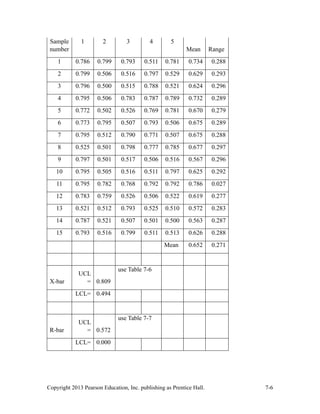
Problem 1:
Observations
Copyright 2013 Pearson Education, Inc. publishing as Prentice Hall. 7-6
Sample
number
1 2 3 4 5
Mean Range
1 0.786 0.799 0.793 0.511 0.781 0.734 0.288
2 0.799 0.506 0.516 0.797 0.529 0.629 0.293
3 0.796 0.500 0.515 0.788 0.521 0.624 0.296
4 0.795 0.506 0.783 0.787 0.789 0.732 0.289
5 0.772 0.502 0.526 0.769 0.781 0.670 0.279
6 0.773 0.795 0.507 0.793 0.506 0.675 0.289
7 0.795 0.512 0.790 0.771 0.507 0.675 0.288
8 0.525 0.501 0.798 0.777 0.785 0.677 0.297
9 0.797 0.501 0.517 0.506 0.516 0.567 0.296
10 0.795 0.505 0.516 0.511 0.797 0.625 0.292
11 0.795 0.782 0.768 0.792 0.792 0.786 0.027
12 0.783 0.759 0.526 0.506 0.522 0.619 0.277
13 0.521 0.512 0.793 0.525 0.510 0.572 0.283
14 0.787 0.521 0.507 0.501 0.500 0.563 0.287
15 0.793 0.516 0.799 0.511 0.513 0.626 0.288
Mean 0.652 0.271
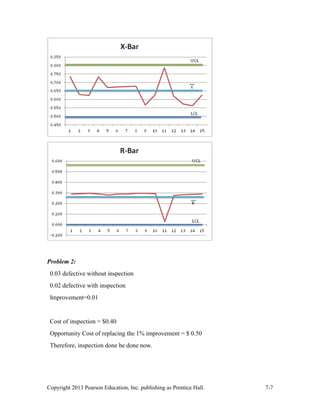
X-bar
UCL
= 0.809
use Table 7-6
LCL= 0.494
R-bar
UCL
= 0.572
use Table 7-7
LCL= 0.000
Copyright 2013 Pearson Education, Inc. publishing as Prentice Hall. 7-7
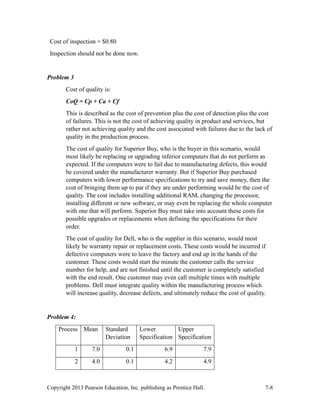
Problem 2:
0.03 defective without inspection
0.02 defective with inspection
Improvement=0.01
Cost of inspection = $0.40
Opportunity Cost of replacing the 1% improvement = $ 0.50
Therefore, inspection done be done now.
Copyright 2013 Pearson Education, Inc. publishing as Prentice Hall. 7-8
Cost of inspection = $0.80
Inspection should not be done now.
Problem 3
Cost of quality is:
CoQ = Cp + Ca + Cf
This is described as the cost of prevention plus the cost of detection plus the cost
of failures. This is not the cost of achieving quality in product and services, but
rather not achieving quality and the cost associated with failures due to the lack of
quality in the production process.
The cost of quality for Superior Buy, who is the buyer in this scenario, would
most likely be replacing or upgrading inferior computers that do not perform as
expected. If the computers were to fail due to manufacturing defects, this would
be covered under the manufacturer warranty. But if Superior Buy purchased
computers with lower performance specifications to try and save money, then the
cost of bringing them up to par if they are under performing would be the cost of
quality. The cost includes installing additional RAM, changing the processor,
installing different or new software, or may even be replacing the whole computer
with one that will perform. Superior Buy must take into account these costs for
possible upgrades or replacements when defining the specifications for their
order.
The cost of quality for Dell, who is the supplier in this scenario, would most
likely be warranty repair or replacement costs. These costs would be incurred if
defective computers were to leave the factory and end up in the hands of the
customer. These costs would start the minute the customer calls the service
number for help, and are not finished until the customer is completely satisfied
with the end result. One customer may even call multiple times with multiple
problems. Dell must integrate quality within the manufacturing process which
will increase quality, decrease defects, and ultimately reduce the cost of quality.
Problem 4:
Process Mean Standard
Deviation
Lower
Specification
Upper
Specification
1 7.0 0.1 6.9 7.9
2 4.0 0.1 4.2 4.9
Copyright 2013 Pearson Education, Inc. publishing as Prentice Hall. 7-9
3 6.6 0.1 5.4 6.5
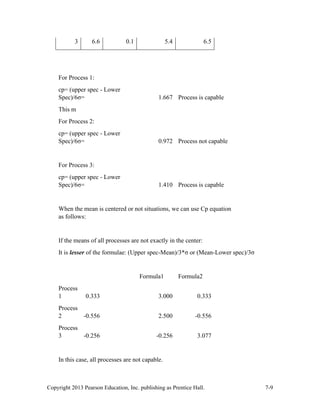
For Process 1:
cp= (upper spec - Lower
Spec)/6σ= 1.667 Process is capable
This m
For Process 2:
cp= (upper spec - Lower
Spec)/6σ= 0.972 Process not capable
For Process 3:
cp= (upper spec - Lower
Spec)/6σ= 1.410 Process is capable
When the mean is centered or not situations, we can use Cp equation
as follows:
If the means of all processes are not exactly in the center:
It is lesser of the formulae: (Upper spec-Mean)/3*σ or (Mean-Lower spec)/3σ
Formula1 Formula2
Process
1 0.333 3.000 0.333
Process
2 -0.556 2.500 -0.556
Process
3 -0.256 -0.256 3.077
In this case, all processes are not capable.
Copyright 2013 Pearson Education, Inc. publishing as Prentice Hall. 7-10
The Cp should be at least equal to 1.33
Problem 5:
a. The metrics to show control over a project are scope variance hours, scope cost
increase, productivity, project cost deviation, and project progress deviation. The
variance and deviation metrics for scope, cost and progress indicates that these factors
are well defined and restrained within acceptable limitation. Meanwhile, productivity
reflects how well the individual processes are executed.
b. The metrics to show progress would be actual scope hours, productivity, and product
progress deviation. Actual scope hours provide evidence for completed tasks which
are related to the defined scope. Productivity and product progress deviation manifest
the consistency of project progress.
c. The metrics to charge a customer for changes are Scope Variance Hours, Scope Cost
Increase, Number of baseline Changes, Project Effort and Project Cost Deviation.
Number of baseline changes elicits additional requirements which have to be paid by
the customers. The project effort, project cost deviation, and scope cost increases are
used for calculating the amount of additional payment. Rescheduling of the project
should take into account the scope variance hours metric.
d. The metrics are Project Feature Enhancement Increase. This indicator measures the
efficiency of effort scheduling which should be governed to complete important
features.
e. The metrics to use to manage customer expectations are Project Merit and Project
Risk. The project merit communicates that expectations are consistently maintained
and transparent during project duration. Meanwhile, project risk conveys the plans for
securing and preserving expectations.
f. The metrics to understand how fast a team is performing tasks are Project Efficiency
and Project Effort. These metrics quantify the pace of task execution.
g. The metrics for how well a team is performing are Project Effectiveness, Productivity
and Project Effort. The three metrics are numerical presentations of quality of project
execution.
h. The metrics are removed are Removed Defects Efficiency. Removed Defects
Efficiency numerically measures defect detecting and removing capability.
i. The metrics are the Project Customer Commitment which completely evaluates
factors of customer involvement, communication, and availability.
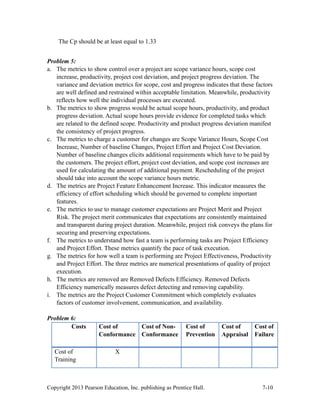
Problem 6:
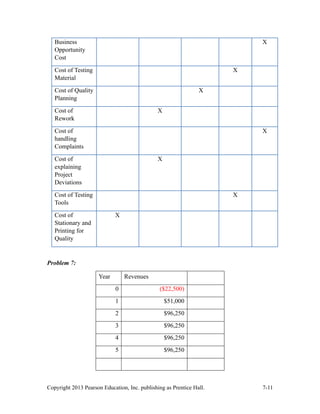
Costs Cost of
Conformance
Cost of Non-
Conformance
Cost of
Prevention
Cost of
Appraisal
Cost of
Failure
Cost of
Training
X
Copyright 2013 Pearson Education, Inc. publishing as Prentice Hall. 7-11
Business
Opportunity
Cost
X
Cost of Testing
Material
X
Cost of Quality
Planning
X
Cost of
Rework
X
Cost of
handling
Complaints
X
Cost of
explaining
Project
Deviations
X
Cost of Testing
Tools
X
Cost of
Stationary and
Printing for
Quality
X
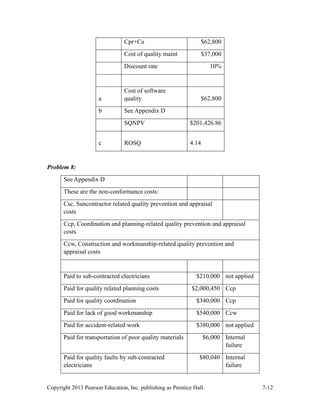
Problem 7:
Year Revenues
0 ($22,500)
1 $51,000
2 $96,250
3 $96,250
4 $96,250
5 $96,250
Copyright 2013 Pearson Education, Inc. publishing as Prentice Hall. 7-12
Cpr+Ca $62,800
Cost of quality maint $37,000
Discount rate 10%
a
Cost of software
quality $62,800
b See Appendix D
SQNPV $201,426.86
c ROSQ 4.14
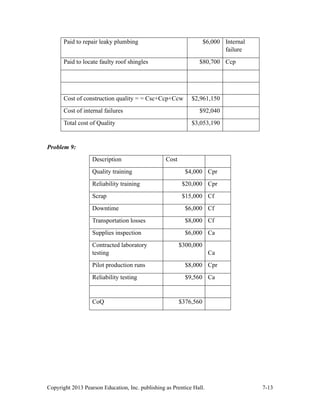
Problem 8:
See Appendix D
These are the non-conformance costs:
Csc, Suncontractor related quality prevention and appraisal
costs
Ccp, Coordination and planning-related quality prevention and appraisal
costs
Ccw, Construction and workmanship-related quality prevention and
appraisal costs
Paid to sub-contracted electricians $210,000 not applied
Paid for quality related planning costs $2,000,450 Ccp
Paid for quality coordination $340,000 Ccp
Paid for lack of good workmanship $540,000 Ccw
Paid for accident-related work $380,000 not applied
Paid for transportation of poor quality materials $6,000 Internal
failure
Paid for quality faults by sub-contracted
electricians
$80,040 Internal
failure
Copyright 2013 Pearson Education, Inc. publishing as Prentice Hall. 7-13
Paid to repair leaky plumbing $6,000 Internal
failure
Paid to locate faulty roof shingles $80,700 Ccp
Cost of construction quality = = Csc+Ccp+Ccw $2,961,150
Cost of internal failures $92,040
Total cost of Quality $3,053,190
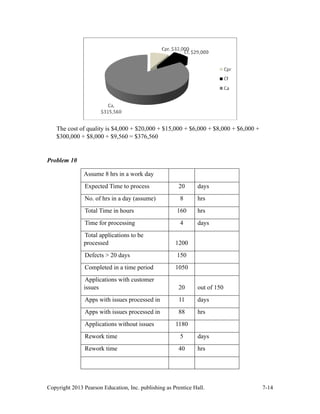
Problem 9:
Description Cost
Quality training $4,000 Cpr
Reliability training $20,000 Cpr
Scrap $15,000 Cf
Downtime $6,000 Cf
Transportation losses $8,000 Cf
Supplies inspection $6,000 Ca
Contracted laboratory
testing
$300,000
Ca
Pilot production runs $8,000 Cpr
Reliability testing $9,560 Ca
CoQ $376,560
Copyright 2013 Pearson Education, Inc. publishing as Prentice Hall. 7-14
The cost of quality is $4,000 + $20,000 + $15,000 + $6,000 + $8,000 + $6,000 +
$300,000 + $8,000 + $9,560 = $376,560
Problem 10
Assume 8 hrs in a work day
Expected Time to process 20 days
No. of hrs in a day (assume) 8 hrs
Total Time in hours 160 hrs
Time for processing 4 days
Total applications to be
processed 1200
Defects > 20 days 150
Completed in a time period 1050
Applications with customer
issues 20 out of 150
Apps with issues processed in 11 days
Apps with issues processed in 88 hrs
Applications without issues 1180
Rework time 5 days
Rework time 40 hrs
Copyright 2013 Pearson Education, Inc. publishing as Prentice Hall. 7-15
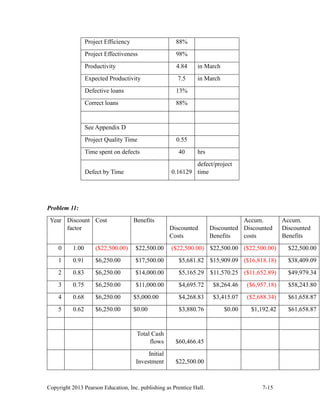
Project Efficiency 88%
Project Effectiveness 98%
Productivity 4.84 in March
Expected Productivity 7.5 in March
Defective loans 13%
Correct loans 88%
See Appendix D
Project Quality Time 0.55
Time spent on defects 40 hrs
Defect by Time 0.16129
defect/project
time
Problem 11:
Year Discount
factor
Cost Benefits
Discounted
Costs
Discounted
Benefits
Accum.
Discounted
costs
Accum.
Discounted
Benefits
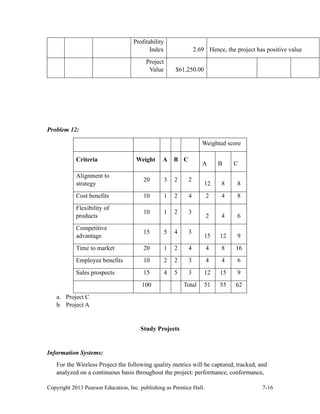
0 1.00 ($22,500.00) $22,500.00 ($22,500.00) $22,500.00 ($22,500.00) $22,500.00
1 0.91 $6,250.00 $17,500.00 $5,681.82 $15,909.09 ($16,818.18) $38,409.09
2 0.83 $6,250.00 $14,000.00 $5,165.29 $11,570.25 ($11,652.89) $49,979.34
3 0.75 $6,250.00 $11,000.00 $4,695.72 $8,264.46 ($6,957.18) $58,243.80
4 0.68 $6,250.00 $5,000.00 $4,268.83 $3,415.07 ($2,688.34) $61,658.87
5 0.62 $6,250.00 $0.00 $3,880.76 $0.00 $1,192.42 $61,658.87
Total Cash
flows $60,466.45
Initial
Investment $22,500.00
Copyright 2013 Pearson Education, Inc. publishing as Prentice Hall. 7-16
Profitability
Index 2.69 Hence, the project has positive value
Project
Value $61,250.00
Problem 12:
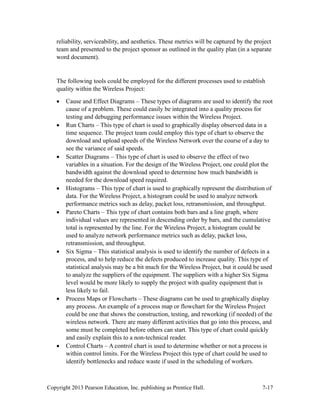
Weighted score
Criteria Weight A B C
A B C
Alignment to
strategy
20 3 2 2
12 8 8
Cost benefits 10 1 2 4 2 4 8
Flexibility of
products
10 1 2 3
2 4 6
Competitive
advantage
15 5 4 3
15 12 9
Time to market 20 1 2 4 4 8 16
Employee benefits 10 2 2 3 4 4 6
Sales prospects 15 4 5 3 12 15 9
100 Total 51 55 62
a. Project C
b. Project A
Study Projects
Information Systems:
For the Wireless Project the following quality metrics will be captured, tracked, and
analyzed on a continuous basis throughout the project: performance, conformance,
Copyright 2013 Pearson Education, Inc. publishing as Prentice Hall. 7-17
reliability, serviceability, and aesthetics. These metrics will be captured by the project
team and presented to the project sponsor as outlined in the quality plan (in a separate
word document).
The following tools could be employed for the different processes used to establish
quality within the Wireless Project:
‱ Cause and Effect Diagrams – These types of diagrams are used to identify the root
cause of a problem. These could easily be integrated into a quality process for
testing and debugging performance issues within the Wireless Project.
‱ Run Charts – This type of chart is used to graphically display observed data in a
time sequence. The project team could employ this type of chart to observe the
download and upload speeds of the Wireless Network over the course of a day to
see the variance of said speeds.
‱ Scatter Diagrams – This type of chart is used to observe the effect of two
variables in a situation. For the design of the Wireless Project, one could plot the
bandwidth against the download speed to determine how much bandwidth is
needed for the download speed required.
‱ Histograms – This type of chart is used to graphically represent the distribution of
data. For the Wireless Project, a histogram could be used to analyze network
performance metrics such as delay, packet loss, retransmission, and throughput.
‱ Pareto Charts – This type of chart contains both bars and a line graph, where
individual values are represented in descending order by bars, and the cumulative
total is represented by the line. For the Wireless Project, a histogram could be
used to analyze network performance metrics such as delay, packet loss,
retransmission, and throughput.
‱ Six Sigma – This statistical analysis is used to identify the number of defects in a
process, and to help reduce the defects produced to increase quality. This type of
statistical analysis may be a bit much for the Wireless Project, but it could be used
to analyze the suppliers of the equipment. The suppliers with a higher Six Sigma
level would be more likely to supply the project with quality equipment that is
less likely to fail.
‱ Process Maps or Flowcharts – These diagrams can be used to graphically display
any process. An example of a process map or flowchart for the Wireless Project
could be one that shows the construction, testing, and reworking (if needed) of the
wireless network. There are many different activities that go into this process, and
some must be completed before others can start. This type of chart could quickly
and easily explain this to a non-technical reader.
‱ Control Charts – A control chart is used to determine whether or not a process is
within control limits. For the Wireless Project this type of chart could be used to
identify bottlenecks and reduce waste if used in the scheduling of workers.
Copyright 2013 Pearson Education, Inc. publishing as Prentice Hall. 7-18
‱ Statistical Sampling – This type of analysis is used to gain a better knowledge of a
population of data using a smaller subset of data called a sample. This type of
sampling could be used in analyzing network performance metrics, and help to
identify the possible problem areas.
‱ Reviews – These are done to review a product, service, or system against quality
criteria set forth by the project team or organization. In the Wireless Project
nightly meetings with both the project team and project sponsor will be held to
review the activities of the day and to identify sub-quality items that need to be
addressed immediately.
‱ Testing and Inspection – This is done to promote quality in products and services.
In the Wireless Project a testing and inspection plan will be created for the
construction and implementation of the wireless network. This will ensure that the
various stages of the network are tested, and quality is established and maintained
throughout the life of the project.
Below is a table of the quality audit data for the Stafford Wireless Project. These data
points provided valuable insight into issues that need to be addressed immediately for
successful completion of the project.
Quality Audit (with arbitrary numbers)
Wireless Network Project Audit
Audit
Date
Auditor U
or
P
Non-Compliant Issues Elevated
to
Senior
Mgmt.
No of Hi-
Priority
Items
Hrs to
prepare
and
conduct
the
audit
Major Minor Closed
3/19/12 JS/PR P 0 2 0 0 0 2
3/20/12 JS/PR P 0 0 2 0 0 3
3/22/12 JS/PR U 1 1 0 1 1 2
U- Unplanned; P-Planned
Below is a testing and inspection plan for the Wireless Project. This plan will ensure
that the wireless network is tested throughout the project, and any failures or defects
are discovered and quickly addressed.
Copyright 2013 Pearson Education, Inc. publishing as Prentice Hall. 7-19
‱ Inspection
‱ Before installation, the wireless router will be inspected for damage.
‱ Before installation, the wireless access points will be individually
inspected for damage.
‱ Unit Tests
‱ Upon installation, the wireless router will be tested for functionality.
‱ Upon installation, the wireless access points will be individually tested for
functionality.
‱ Upon installation, the firewall will be tested for functionality.
‱ Upon installation, the internet services will be tested for functionality.
‱ Upon installation, the streaming internet services will be tested for
functionality.
‱ Integration Tests
‱ Once the individual components pass the unit tests, the wireless network
will be tested as a whole. Each piece will again be tested, but not for
individual functionality, but for interworking with the other components.
This will include the wireless network itself (router, wires, wireless access
points, firewalls), the Internet service, and the services provided through
the Internet (streaming television, streaming music, and VOIP services).
‱ Functional Requirements
‱ The wireless network as a whole will be tested end to end for
functionality. This will include the wireless network itself (router, wires,
wireless access points, firewalls), the Internet service, and the services
provided through the Internet (streaming television, streaming music, and
VOIP services).
‱ Performance Tests
‱ The network will be tested for issues such as download and upload speed,
uptime, signal strength, and bandwidth. This will include load testing, with
the estimated maximum number of users.
‱ The services will be tested for quality and reliability.
‱ Acceptance/Installation Tests
Copyright 2013 Pearson Education, Inc. publishing as Prentice Hall. 7-20
‱ The project sponsor and end users will test the network and services to
determine if the performance, quality, and value of the wireless network
and services are acceptable and meet the standards set forth in the project
documentation.
‱ The following metrics would be used to measure, track, and monitor the
progress of the Stafford Wireless with reference to project scope,
performance, and value.
‱ Scope – To monitor the scope of the project, the schedule (hours) of the
project participants can be used
‱ Performance – The wireless signal strength and upload/download speeds
are three metrics that can be used to adequately judge the performance of
the network in the project
‱ Value – To monitor the value that the project brings to the sponsor and end
users, the cost savings can be measured and tracked. This is the savings
which the sponsor will see by cancelling some of the now redundant
services. Also to measure value, customer satisfaction can be measured
and tracked on a daily basis.
New Product Development
a.
‱ Customer-focused: Understanding customers’ needs, meeting customers’
requirements and exceeding customers’ expectations
‱ Continual improvement: Continual improvement of the organization’s overall
performance should be a permanent objective of the organization
Quality assurance:
‱ Checking whether the quality is built into the project process
‱ Checking whether the project scope accurately reflects the needs of the customer
‱ Checking whether the project plan is followed
Quality control:
‱ Determining the metrics that will be used in this project
‱ Determining the audits and reviews
b.
The tools that will be employed for each of the three quality processes:
‱ Control charts
‱ Six sigma
‱ Statistical sampling
‱ Testing and inspection
c. Quality Audit (with arbitrary numbers)
Another Random Scribd Document
with Unrelated Content
term. They are hours at the gallop, and it is supposed that a swift
horse, going at his utmost speed, could cover the distance in seven
hours.
The immense concessions given by the Government are not
cultivated, for the Boer has a rooted dislike to work; his black
servants grow the necessary mealies, and keep his numerous flocks.
As his wants are very primitive, this suffices him. To procure sugar,
coffee, and other necessaries, he goes to town and sells two or
three oxen.
The rifle and cartridges furnished by the State in time of war
become the Burgher's property.
* * * * *
On the march in war-time this system of halting the oxen because
they are hot, and the men because they want to drink coffee at
every farm, is neither very rapid nor very practical. We do not arrive
at Boshof till the fifth day. This is the spot fated to be the grave of
our venerated leader.
Boshof, in contrast to its surroundings, is a gay little oasis,
traversed by a cool stream. It boasts green trees and pretty villas.
Two ambulances are installed here, but they shelter only two or
three wounded as yet.
At the end of the village is a pool, which delights us vastly. We
spend the afternoon in it, after lunching with the field-cornet.
The town is en fĂȘte, as at Brandfort, to receive us, or rather--
away with illusion!--to receive Long Tom.
We start again in the night, and reach Riverton Road. We are
now on English territory, in Cape Colony.
Towards noon, M. Léon comes to meet the cannon, the arrival
of which has been anxiously expected for the last two days.
We are only an hour from the camp, which we reach at a gallop.
There, at Waterworks--the reservoir that supplies Kimberley--we find
Colonel de Villebois-Mareuil.
Need I describe that frank and energetic face, with its searching
blue eyes, and its benevolent smile, sometimes a little ironical,
always subtle; the clear voice; the concise manner of speech, brief
without being brusque? Even at that stage a look of sadness had
stamped itself upon his face; he saw that the men for whom he was
to lay down his life would not follow the counsels dictated by his
profound knowledge and unquenchable devotion.
* * * * *
We had been expected for two days, and twice the Colonel had had
good luncheons prepared. Then, giving us up, he had ordered
nothing, and we took his kitchen by surprise.
We find with him Baron de Sternberg, that charming Viennese,
whose inexhaustible good spirits are famous throughout London and
Paris. In the evening he works in his tent at a history of the war, and
composes the most delicious verses in German. The Colonel also
works hard.
Long Tom arrives some time after us.
Our laager at Waterworks is a large square, measuring some
200 metres on every side, planted with trees, and containing the
machinery for distributing the water. It looks like an oasis in the
midst of the vast yellow plain. In the distance are a few kopjes. We
are about 700 metres from Kimberley. The camp is commanded by
General du Toit.
Kampferdam, where the cannon has been taken, is 3 kilometres
to the south, and 5,500 metres from Kimberley. It is a kind of
whitish peak, about 50 metres high, formed of the refuse from the
diamond mine below.
The night of Tuesday to Wednesday is spent in the construction
of the wooden platform on which Long Tom and his carriage are to
be mounted.
The English searchlights fix their great round eyes upon us from
time to time, but there is nothing to show that the enemy has
noticed anything abnormal in our proceedings.
All night long the work goes on with feverish activity, for Léon,
who is superintending the operations, wants to fire his first shell at
daybreak. But it is no easy task to hoist up that mass of 5,000 kilos,
especially with inexperienced, undisciplined, and obstinate men, and
the cannon is not ready till ten o'clock.
One of our party, Michel, an old artilleryman, the holder of some
twenty gunnery prizes, gives the workers the benefit of his
experience, and as he cannot find any sights, Erasmus artlessly
proposes to make one of wood!
At last the first shot is fired! I am certain that at this moment
not a single Boer is left in the trenches. Everyone has rushed out to
see the effect produced. It is of two kinds. Firstly, our shell, badly
calculated, bursts far off in the plain; then, no sooner has it been
fired, than an English shell from the Autoskopje battery, 3,500
metres to our right, falls and explodes among the machinery of the
Kampferdam mine. This exchange of compliments goes on till near
twelve o'clock. This is the sacred hour of lunch. The fire ceases.
As coffee is a liquid which has to be imbibed slowly, firing does
not begin again till nearly four o'clock. It is very hot, for it is the
height of summer.
During this interval, the Colonel has been several times to
General du Toit, to ask for fifty volunteers.
The Colonel's plan is to batter the town with a storm of shells
(we have 450) for two hours, from four to six, and thus demoralize
it; then, with fifty men, whom the French contingent would lead, to
seize the Autoskopje battery, which is but poorly defended, at
nightfall, and thence to gradually creep up to the town through a
little wood, which would mask the advance. The plan was very
simple, requiring but few men, and had every chance of success,
because of the surprise it would have been to the English, who had
never been attacked hitherto.
'Wait a bit,' said Du Toit; 'I will lay your plan before the council
of war to-morrow.'
In vain the Colonel tells him that the success of the plan
depends on its immediate execution. He can get no answer. The
evening is wasted.
General du Toit is a big, bronzed man, with a black pointed
beard and a straight and penetrating gaze. Though very brave
personally, he has never dared to engage his men.
The latter are very well pleased with their role of besiegers.
They will appreciate it less when the Long Cecil comes upon the
scene. Hitherto, the long far niente, comparatively free from peril--
the town, under the command of Colonel Kekewich, was defended
by such a small garrison that sorties were impossible--has only been
broken by the singing of hymns, the brewing of coffee and cocoa,
and the occasional pursuit of a springbock.
Every evening a guard, composed, I fancy, of anyone who chose
to go, went off, provided with a comfortable stock of bedding, to do
duty round the camp.
Others, the valiant spirits, remained at the three batteries where
were installed Long Tom, the three Armstrongs, and the Maxim.
Long Tom's battery was by far the most popular, for several
reasons. In the first place, its processes were much more interesting
than those of the small guns; then, its defenders were much more
sheltered, owing to the proximity of the mining works; and finally, a
good many former miners were always on the look-out for a stray
diamond or two.
Among the besiegers of Kimberley, indeed, we met with a good
many adventurers who took no other part in the campaign.
Men of all nationalities, many of them familiar with the town,
having worked in the mines here, they came in the hope of finding
some diamond overlooked in the sudden cessation of mining
operations.... Then, too, they knew that Cecil Rhodes was in the
town, having had no time to fly or to carry off his treasure.
Then, again, there are bankers and jewellers in Kimberley, and
if the Boers had taken the town....
It appears that Cecil Rhodes was quite aware of this danger,
and I have heard that he attempted to manufacture a balloon which
was to have carried 'Cecil and his fortunes' to a safer city.
In any case, his gratitude to his defenders was very lively. And,
in addition to other liberalities, he presented a commemorative
medal to them all.
IV
Failing an assault, we resume the bombardment. The firing is slow
and inaccurate. The English reply in much the same fashion, when
suddenly their new cannon appears on the scene, not altogether to
our surprise, for some intercepted letters had warned us of its
manufacture. It was the famous Long Cecil.
The Long Cecil was a gun of about 12 centimetres, made in
Kimberley itself during the siege with a piece of steel taken from the
machinery of the De Beers mine.
The piece was drilled and rifled with the means at the disposal
of the besieged.
The closing of the breech, a somewhat fantastic arrangement,
was based on the Canet system. In default of a trial field, the range
was arrived at from observations of actual firing against us.
Long Cecil accordingly began to speak, and to speak very much
to the point. Several times we were covered with earth, and I am
certain that out of twenty shells, the extreme error was not more
than 200 metres. One fortunately fell diagonally on Long Tom's very
platform, rebounded, and burst a little way off. Seven men were
killed.
The next day, Thursday, passed in almost precisely the same
fashion. Towards five o'clock the interchange of amenities between
Long Tom and Long Cecil began, and lasted till 8.30; at 8.30,
breakfast. After breakfast, the guns went to work again till 11. At 11,
lunch, rest. From 4 to 6, another cannonade. At 6, dinner.
This respect for meal-times is charming, and greatly facilitates
life in the field.
It is a pity the attention of the Powers is not called to this
subject by an international convention! Many affections of the
stomach would be hereby avoided.
Encouraged by the example of their big brothers, the little 12
and 15-pounder Krupps and Armstrongs join in the concert.
The English have five, and we have four. It is delightful, and one
can't complain of a single second of boredom.
On Friday, the Colonel's request is still unanswered.
'Wait a little while!'
Sternberg has had enough of it. Recognising the impossibility of
persuading Du Toit to take decisive action, he starts off to Jacobsdal,
where the English make him a prisoner. He was a great loss, for he
had an extraordinary repertory of adventures, which he told in a
very amusing manner, and, besides, he was a capital cook.
The 'boys' in these regions, greatly inferior to those of the
Soudan in this respect, claim to be cooks as soon as they know how
to light a fire. Accordingly, we prepare our meals ourselves. Tinned
meat, a bit of roast mutton, or a stew, are the usual dishes.
The Colonel eats very little, and only takes grilled meat; he
drinks tea or milk, and never touches wine or spirits. He does not
smoke. He is a striking contrast to the rest of us, who eat like ogres,
drink like sponges, and smoke like engines!
Our contingent, consisting of Breda, Léon, Michel, Coste, my
friend De C---- and I, remain with Villebois.
Michel has calculated the ranges, and we fire all Friday night.
The points aimed at are: the searchlights, Cecil Rhodes' house, the
Grand Hotel, the last high chimney on the left, and that on the right.
Erasmus was unable to suppress a gentle amusement at the
sight of our preparations for night-firing. But when he grasped the
idea that we were in earnest, and that his Long Tom was being
loaded, the benevolent smile with which one would watch a spoilt
child engaged in some innocent folly changed to a look of real
anxiety. He thought poor Michel had gone mad. He finally got used
to the novel proceeding.
Firing ceased on both sides about 12.30 a.m. Early on Saturday
morning it began again. One of our shells fell on the De Beers
magazine, transformed into an ammunition factory, and caused an
explosion and a fire.
The English, despairing of silencing our Long Tom with their
Long Cecil, replied to every shot at the town by a shell into our
laager. The accuracy of their fire with this gun at a range of about
7,000 metres was remarkable. We were indeed a capital target: a
green rectangle of 200 metres in the midst of a yellow, arid plain.
The shell arrived in thirty-four seconds, but did no great
damage, for a watchman gave the alarm, 'Skit!' each time when he
saw the smoke, and we retreated into shelter.
The telegraphists of the staff, who were working in a little
house, were placed in communication with the watchman by means
of a bell, and, warned half a minute before the arrival, they had time
to take refuge in a neighbouring trench.
We learnt later that a similar system had been adopted in
Kimberley as a protection against Long Tom, and hence the small
number of killed during the siege. One of the first victims of Long
Tom, however, was the engineer of the Long Cecil, who had just
finished his work. A shell burst on his house and killed him in his
bedroom. Another cause of the slight mortality on both sides was
the bad quality of the fuses for the projectiles, which often burst
imperfectly, or not at all. Thus, one of the English shells fell in the
machinery of the waterworks, only a few inches from our reserve of
a hundred shells, and happily failed to explode. Another went
through a cast-iron pipe, over a centimetre thick, and buried itself in
the earth without exploding; its fuse was completely flattened on the
projectile by contact with the pipe.
Nevertheless, a good many, too many indeed, did burst with
satisfactory results--to those who fired them.
A good many of the Boers accordingly took the precaution of
digging a sort of tomb several feet deep, in which they piled
mattresses and blankets. They spent all night and part of the day
lying in this shelter.
On Saturday morning, on arriving at the battery, we were
surprised by a whistling sound. The English, harassed by the fire of
Long Tom, had dug trenches during the night to a distance of about
1,200 yards, and had manned them with riflemen. Their fire was not
yet very galling, because of the distance between us.
Colonel de Villebois, seeing clearly what would happen, renewed
his request for a party of men. He now only asked for twenty-five to
make an assault that very night, for he pointed out that the shanjes
(trenches) would be pushed forward during the night, and that our
battery would become untenable. But he was repulsed by the
eternal 'Wait a little while!'
Long convoys of Kaffirs that the English could no longer feed
came out of the town every day, preceded by huge white flags.
Some were allowed to pass after a parley, others were sent back
again.
The Colonel feared that an attempt would be made against
Long Tom by night, as a sequel to the offensive movement on the
part of the garrison indicated by the making of the trenches.
Everyone goes to spend the night at the battery, and we take
the opportunity of firing at the town. It proves to be merely a
pastime. The English reply, but do not attack us.
On Sunday, February 11, we rest all along the line. The
Burghers sing hymns in chorus, and do not cease till late in the
evening. A sort of patriarchal simplicity obtains among them.
Yesterday the Colonel was shaving. A Boer entered without saying a
word, sat down on his little camp-bed, and remained there
motionless. The Colonel, used to their ways, took no notice, but
waited for the visitor to explain his visit. As this was prolonged
considerably, the Colonel continued his toilet by a tub taken puris
naturalibus. The Boer remained, staring silently at him. At last, his
toilet ended, the Colonel explained to the visitor that he must go, as
he wanted to close his tent. The Boer departed without a word.
About ten minutes afterwards he came back with a friend, who
explained that he wanted the Colonel's razor. He would bring it back
afterwards. It was very hard to make him understand that the
Colonel wished to reserve the implement for his private use.
On this Sunday, the day of rest, we accordingly went off to
bathe at a spring four kilometres from our laager. We enjoy this
peaceful pastime in the company of a young clergyman who was at
one time in the camp. When Long Cecil began to bombard us, he
judged its war-like thunders to be incompatible with his sacred
function, and set up his tent beyond its range.
On Monday morning the firing began again early. Léon and the
Colonel went off to the battery. Our horses had been turned out to
graze by mistake, so we did not start till an hour after them. On
arriving, we found the balls whistling more smartly than on Saturday.
We could plainly distinguish the buzz of the dum-dum bullets amidst
the whir of the ordinary charge.
During the two nights, the English had pushed forward their
trenches to a distance of from 700 to 800 yards from us. We went
up on the platform, where the Colonel, his glass in his eye, was
talking imperturbably to General du Toit. At the same moment we
saw Léon, who was standing behind them, spin round and fall across
the gun-carriage. The poor fellow had been shot right through the
forehead just above the eyes.
The Colonel at once raised him in his arms, others started off in
haste for an ambulance; but the bullets were now falling round us
like hail. Two horses were wounded in an instant, and a Burgher fell,
a bullet clean through his body.
Poor Léon was still conscious. He bid us all good-bye calmly,
taking a particularly affectionate leave of the Colonel, to whom he
was greatly attached. The Colonel took a little water to wash the
blood from his face, and placed the empty pannikin on the parapet
of sacks filled with earth behind which we were sheltered. So heavy
was the English fire that the pannikin instantly fell to the ground
pierced by a bullet.
At last a cart appeared with an attendant and a stretcher. The
wounded, who numbered about a dozen by this time, received first
aid; then Léon was carried off on a stretcher.
What a journey was that march of three kilometres, the first
part of which was performed under a rain of bullets! The head of the
wounded man was swathed in cloths, which we kept wetting
continually, holding an umbrella over his head, for the heat was
intense--it was eleven o'clock in the morning. Blood poured from his
mouth and nose. Poor fellow! we made up our minds that it was all
over with him.
We reached Waterworks in two hours. But the little house that
had been turned into a hospital was no longer safe since the
bombardment of our camp had begun. A telegram had therefore
been sent to Riverton Road, where there was an ambulance-station
with a good doctor. Towards one o'clock an ambulance-carriage
arrived and carried off our comrade.
On Tuesday, the 13th, we missed the salute Long Tom had been
in the habit of giving the enemy at daybreak. What had happened?
We sent off for news. General du Toit replied that Erasmus declared
the gun was broken, and could not be fired. He himself had not
been to inquire into the damage, and seemed to be no more
concerned than if he had been told it was raining at Chicago. We set
off to Kampferdam in great distress, expecting to find the gun a
wreck.
As we approached, however, we saw that it was still in place,
apparently wondering at its own silence. We examined it carefully all
over, but could find nothing to account for the catastrophe, and, in
despair, we sent for Erasmus.
Standing back a couple of paces, he showed us that one of the
beams of the platform, which had received the full force of the
recoil, had sunk some few centimetres. It was a matter of no
importance, and did not interfere with the firing in any way. But
Erasmus, I suppose, did not feel inclined to work the gun that day.
He had told Du Toit that it was broken, and the General had at once
accepted the statement. After a severe reprimand to the recalcitrant
gunner, the firing recommenced as usual.
Our provisions began to run out in camp, in spite of a stock of
potatoes we had discovered at the waterworks. It was accordingly
arranged that we should start off with two others of the party to get
fresh stores, and a cart and mules, at Pretoria.
The Colonel, believing that the lack of offensive action among
the Boers would prolong the siege indefinitely, determined to set out
himself on the 15th for Colesberg, where we were to rejoin him in a
few days. We started on the 14th, bound for Brandfort and Pretoria.
On setting out, my mare, an excellent mount, but very fiery,
brought me suddenly to the ground, to the great amusement of the
Colonel. The same accident having happened to Breda a day or two
before, it began to be looked upon as a special privilege of the ex-
cavalry officers!
At nightfall we arrived at Riverton Road, where Léon was lying.
During the evening the Colonel himself came over to inquire for him.
He had had a good day, and the operation that was judged
necessary had been fixed for eleven o'clock that night, to avoid the
heat of daylight. We waited about the door of the baggage-shed,
which had been converted into an ambulance.
The operation, which proved perfectly successful, lasted an hour
and a half. The doctor, a Scotchman called Dunlop, assured us that
our poor friend was out of danger.
At daybreak on the 15th we started, the Colonel for the camp,
we for Brandfort. It was terribly hot, and we were in a hurry, for a
rumour of Lord Roberts' arrival had got about. It seemed likely that
there would be some more lively work on hand very soon, and we
were anxious to get through the drudgery of revictualling as quickly
as possible.
In the evening we reached Boshof, where a good many
wounded had been brought since our last visit. We rode all day on
the 16th, slept in the bush, and started again at daybreak on the
17th. Towards noon we took a rest of an hour and a half, and
consumed a tin of corned beef.
It was nearly two when we mounted again under a sky of fire,
not to draw rein till we reached Brandfort at ten o'clock on Sunday
morning, save for a compulsory halt of two hours from three to five
in the morning, when the darkness made it impossible for us to
continue our journey in the trackless sand and tangled bush.
We had been in the saddle twenty-six hours out of thirty to
accomplish our journey of 120 miles, and had taken three and a half
days, riding over sixty kilometres a day, in average heat of from 38°
to 40° (centigrade), without fodder and almost without water, in a
wild, unknown country.
Our horses were dead-beat, and we entered the village on foot,
dragging the poor brutes by their bridles. What was our stupefaction
to hear that the siege of Kimberley had been raised without any
engagement the very day after our departure!
The surprise, it seems, had been complete. There was a cry of
'The English!' and then a panic, which barely left time to carry off
the guns and waggons. Part of the ammunition was left behind,
some provisions, Long Tom's break and its platform. The Colonel had
escaped with Breda. But in the confusion one of our comrades,
Coste, was lost, and eventually joined Cronje.
A story which amused us all at the time may be told here. A
volunteer, no longer in his first youth--well over fifty, in fact--had
come to join the Colonel just at the time of the English attack. A
very eccentric character, and slightly bemused by drink, he found
himself in the thick of the stampede, without any clear idea of what
it was all about.
Suddenly the Burghers, who had never seen him in the camp
before, struck by his odd behaviour, demanded his passports. Not
understanding a word of Dutch, he had some difficulty in making out
what they wanted.
At last he produced the necessary paper. The pandours of the
moment scrutinized them carefully, then, shaking their heads in the
fashion which among all races implies negation, they said:
'No good! Obsal!' (mount).
Two men ranged themselves on either side of the unlucky
wight, a complete novice in horsemanship, and galloped off with him
to a farm several miles off.
'Dismount! Your passports!'
About fifteen persons, men, women and children, were grouped
round a table. The passport, handed round once more, is discussed
by the assembly, each person present giving an opinion. The general
verdict is unfavourable, for heads are again shaken.
'No good! Obsal!'
The poor volunteer, aching from his furious gallop, begins to
think things rather beyond a joke; but, anxious to conciliate, he
remounts, and gallops off again under escort. On arriving at another
farm another inspection, also unfavourable, takes place.
'No good! Obsal!'
This time the worm turns. Pale, exhausted and racked with pain,
he opposes the force of inertia to the rigour of his tormentors, who,
convinced that he is a spy, set him against a wall and load their
rifles. This argument is so convincing that he remounts, and finally
makes them understand that he will be able to find someone to
answer for him at Brandfort.
Two days later he arrived there, fasting, exhausted, and still
guarded by his escort. Fortunately he was recognised and released.
He never returned to the front.
* * * * *
We leave for Pretoria by the first train, and arrive on the evening of
the 20th. We at once set to work on our re-victualling mission.
Two days later, I got a telegram from Colonel de Villebois-
Mareuil. Having heard of the arrival of a good many French
volunteers at Pretoria, he agrees to take the command of them, and
orders me to get them together. A letter to M. Reitz, sent off at the
same time, explains the project.
Among the new arrivals are ex-petty officers, ex-sailors, ex-
legionaries ... a motley crew. Their equipment will take several days,
and it is arranged that they are to join us at Colesberg, for which we
start by that evening's train.
During this short sojourn at Pretoria I was presented by Colonel
Gourko to Captain D----, the French military attaché, one of the most
charming men I have ever met.
We noticed numerous placards on the town walls, giving notice
of thanksgiving services for February 26 and 27. It is the anniversary
of Majuba Hill, which is celebrated every year with great pomp. This
year, in spite of the national pre-occupation in current events, the
traditional custom is to be kept up. The usual review of the troops
by the President and the Commander-in-Chief cannot, of course,
take place; but the shops and offices will be closed for forty-eight
hours, and the whole population will flock to the churches.
Shortly after our departure, at a station the name of which I
forget--perhaps intentionally, for I feel a qualm of remorse at the
recollection of it--a little fox-terrier playing about the train jumped
into our carriage. We were just starting.... It would have been cruel
to throw the poor little beast on to the platform at the risk of
maiming it or causing it to be run over.... In short, we kept her, and
christened her Nelly. She was very pretty, pure white, with a black
patch on her head and another on her back. I felt remorseful--until
the next station; then I overcame my scruples. I am so fond of dogs.
At Brandfort, a counter-order awaits us, directing us to go to
Bloemfontein, where the Colonel awaits us, in consequence of Lord
Roberts' latest operations. We land our cart, our mules, and our
provisions. But our worn-out horses have to be replaced. The
Colonel, impatient to be gone, will not wait for us, and starts for
Petrusburg, where we are to join him as quickly as possible.
On the 28th, the news of Cronje's capitulation reaches us. We
know nothing of the details, but the moral effect is terrible.
We had got together hastily at Pretoria a cart, harness, mules,
and three black boys. Individually, each of these acquisitions is
highly satisfactory. The cart is a superb omnibus, freshly painted
gray; the harness is almost new, the mules very handsome--a little
black one in particular. The boys were chosen to suit all tastes: one
tall, one short, and one of medium height. But it proves very difficult
to establish any sort of cohesion between these various elements.
At the first attempt the harness breaks, the mules bite and kick.
It needs the cunning of an Apache even to approach the little black
one. The boys are stupid, and speak neither Dutch nor English,
nothing but Kaffir. The omnibus alone remains stationary, but it
creaks and groans in a pitiable fashion when touched.
A second experiment is no more successful than the first. The
third gives a better result: the vehicle moves, and even goes very
near to losing a wheel.
This remarkable result is achieved, firstly, because all the rotten
leathers of the harness are in pieces, after a double series of joltings
and strainings; only the solid ones are left. Secondly, the pretty little
black mule has run away, after breaking some dozen halters, so that
we are saved the trouble of harnessing her. Lastly, we have
stationed the three boys at a safe distance, begging them on no
account to help us, and Michel, who as an old artilleryman is an
adept in harness, does wonders. Finally we get off, escorting our
omnibus, which groans aloud at every step.
We look like 'The Attack on the Stage Coach' in Buffalo Bill!
V
On the morning of the 7th, the road to Petrusburg was blocked, and
the guns were roaring in front of us. Marais, Botha's adjutant, joined
us. At the first sound of the guns we left the waggons, and galloped
off in the direction he pointed out. The battle of Poplar Grove was
about to be fought under our eyes, though we were unable to take a
very active part in it.
The engagement went on mainly oh our right; we were on the
left of the Boer lines. In front of us was a kopje occupied by a
hundred rifles.
About 11 o'clock the English cavalry charged at the guns, about
two miles away. The firing slackened. Then about 2 o'clock the
English began to shell us furiously with shrapnel, also the kopje
forming the Boer centre. An outflanking movement completed the
demoralisation of the Boers, and at 3.30 the retreat became general.
President Kruger came by this morning to announce that he had
made the following peace proposals:
'BLOEMFONTEIN,
'March 5, 1900.
'The blood and tears of the thousands who have suffered by this
war, and the prospect of all the moral and economic ruin with which
South Africa is now threatened, make it necessary for both
belligerents to ask themselves dispassionately, and as in the sight of
the Triune God, for what they are fighting, and whether the aim of
each justifies all this appalling misery and devastation.
'With this object, and in view of the assertions of various British
statesmen to the effect that this war was begun, and is being carried
on, with the set purpose of undermining Her Majesty's authority in
South Africa, and of setting up an administration over all South
Africa, independent of Her Majesty's Government, we consider it our
duty solemnly to declare that this war was undertaken solely as a
defensive measure to safeguard the threatened independence of the
South African Republic, and is only continued in order to secure and
safeguard the incontestable independence of both Republics as
sovereign international States, and to obtain the assurance that
those of Her Majesty's subjects who have taken part with us in this
war shall suffer no harm whatsoever in person or property.
'On these two conditions, but on these alone, are we now, as in
the past, desirous of seeing peace re-established in South Africa,
and of putting an end to the evils now reigning over South Africa;
while, if Her Majesty's Government is determined to destroy the
independence of the Republics, there is nothing left to us and to our
people but to persevere to the end in the course already begun, in
spite of the overwhelming pre-eminence of the British Empire,
confident that that God who lighted the inextinguishable fire of the
love of freedom in the hearts of ourselves and of our fathers will not
forsake us, but will accomplish His work in us and in our
descendants.
'We hesitated to make this declaration earlier to your Excellency,
as we feared that, as long as the advantage was always on our side,
and as long as our forces held defensive positions far in Her
Majesty's colonies, such a declaration might hurt the feelings of
honour of the British people; but now that the prestige of the British
Empire may be considered to be assured by the capture of one of
our forces by Her Majesty's troops, and that we are thereby forced
to evacuate other positions which our forces had occupied, that
difficulty is over, and we can no longer hesitate clearly to inform your
Government and people in the sight of the whole civilized world why
we are fighting, and on what conditions we are ready to restore
peace.'
Lord Salisbury replied as follows:
'FOREIGN OFFICE,
'March 11, 1900.
'I have the honour to acknowledge your Honours' telegram,
dated the 5th of March, from Bloemfontein, of which the purport is
principally to demand that Her Majesty's Government shall recognise
the "incontestable independence" of the South African Republic and
Orange Free State "as sovereign international States," and to offer
on those terms to bring the war to a conclusion.
'In the beginning of October peace existed between Her Majesty
and the two Republics under the Conventions which were then in
existence. A discussion had been proceeding for some months
between Her Majesty's Government and the South African Republic,
of which the object was to obtain redress for certain very serious
grievances under which British residents in the South African
Republic were suffering. In the course of these negotiations the
South African Republic had, to the knowledge of Her Majesty's
Government, made considerable armaments, and the latter had,
consequently, taken steps to provide corresponding reinforcements
to the British garrisons of Cape Town and Natal. No infringement of
the rights guaranteed by the Conventions had, up to that point,
taken place on the British side. Suddenly, at two days' notice, the
South African Republic, after issuing an insulting ultimatum, declared
war upon Her Majesty; and the Orange Free State, with whom there
had not even been any discussion, took a similar step. Her Majesty's
dominions were immediately invaded by the two Republics, siege
was laid to three towns within the British frontier, a large portion of
the two colonies was overrun, with great destruction to property and
life, and the Republics claimed to treat the inhabitants of extensive
portions of Her Majesty's dominions as if those dominions had been
annexed to one or other of them. In anticipation of these operations,
the South African Republic had been accumulating for many years
past military stores on an enormous scale, which, by their character,
could only have been intended for use against Great Britain.
'Your Honours make some observations of a negative character
upon the object with which these preparations were made. I do not
think it necessary to discuss the questions you have raised. But the
result of these preparations, carried on with great secrecy, has been
that the British Empire has been compelled to confront an invasion
which has entailed upon the Empire a costly war and the loss of
thousands of precious lives. This great calamity has been the penalty
which Great Britain has suffered for having in recent years
acquiesced in the existence of the two Republics.
'In view of the use to which the two Republics have put the
position which was given to them, and the calamities which their
unprovoked attack has inflicted upon Her Majesty's dominions, Her
Majesty's Government can only answer your Honours' telegram by
saying that they are not prepared to assent to the independence
either of the South African Republic or of the Orange Free State.'
It was to be war, then, to the bitter end.
* * * * *
At the beginning of the retreat, a field-cornet came to ask my
advice, as often happened. He disregarded it, as always happened. I
wanted them to destroy the reservoirs, burn the forage, and poison
the wells all along the line of retreat.[#] He would never consent.
[#] The writer apparently made this monstrous suggestion quite seriously.--
TRANSLATOR.
Later on, when I was a prisoner, an English officer of rank, who had
taken part in the march across the Orange Free State, told me he
had suffered terribly from thirst, and he assured me that if the
measures I had advised had been taken, Roberts' 40,000 men, for
the most part mounted, would never have achieved their task.
But at the moment time failed me to prove to the brave field-
cornet, by the teaching of history in general, and of the wars in
Spain in particular, what excellent results might be obtained by such
a method of defence. Minutes were becoming precious, and we
made off as fast as we could, while in the distance we saw half our
convoy blazing, fired by bursting shells.
Towards half-past nine we lay down on the veldt, without
pitching any tents, and keeping a sharp look-out. By eleven the last
of the Boer stragglers had passed. Colonel Gourko and Lieutenant
Thomson had been made prisoners.
On the 8th we were astir at daybreak. Our three boys went off
to find our beasts, which had strayed far in search of pasture, on
account of the scanty herbage, in spite of their hobbles. They were
all recovered, however, with the exception of one mule, which
remained deaf to every summons, a most inconsiderate proceeding
on his part, seeing that the English were at our heels.
Time being precious, we started off as well as we could with our
reduced convoy. Suddenly one of our boys, big John, stood tiptoe on
his long feet, gave a sweeping glance around, and went quietly on
his way. Half an hour later, he began again to increase in height and
to study the horizon.... We could see absolutely nothing. As my
acquaintance with John was slight, I imagined that he probably
suffered from some nervous affection. But this time he sniffed the
air loudly, and, without a word, darted off obliquely from our track.
An hour passed, and he did not return. Grave doubts of his
fidelity began to afflict us. At last, two hours later, we noticed a
speck on the horizon, then two. It was John with the missing mule.
John is an angel--a black angel!
All the farms we passed on the road had hoisted the white flag.
At noon we reached the point where the road to Bloemfontein
bifurcates. A few Burghers were gathered there. We pitched our
tents.
During the evening the French military attaché, Captain D----,
passed, and told us that Colonel de Villebois was only about an hour
distant from us.
On March 9 we set out to join him. We found him with about
fifty men, coming from Pretoria. These men were divided into two
companies, the first under Breda, the second under me. Directly we
arrived it was agreed to start at ten o'clock. We stopped long
enough to add our cart to the Colonel's convoy, which we were to
pick up near the farm of Abraham's Kraal. The 'French Corps' was
formed!
About four o'clock we arrived on the height of Abraham's Kraal.
The farm so-called lies along the Modder River, which flows from
east to west. Its steep, bush-entangled banks are bathed with
yellow, turbid water, whence its name--Modder (Mud) River. A line of
kopjes, starting from the edge of the river, stretches several miles
south of it. In front of them, to the west, lies a barren yellow plain.
Far off on the horizon lie the kopjes of Poplar Grove, where we were
forty-eight hours before.
The Colonel, who has gone off on a scouting expedition with his
troop, is not to be found. We wait for him vainly all the evening with
General Delarey's staff, in company with Baron von Wrangel, an ex-
lieutenant of the German Guards. In this expedition a young
volunteer named Franck, a quartermaster of the Chasseurs d'Afrique,
whose term had just expired, distinguished himself by his coolness
and his boldness under fire. He was a brave fellow, as he was to
prove later on.
Night came on fast, our chief was still absent, and we went off
to sleep at a little deserted farm, with the officers of the
Johannesburg Politie. We lay down beside them and slept like men
who have been in the saddle for twelve hours.
On March 10, at 5 a.m., we started for General Delarey's
bivouac. It might have been 6.30, when Vecht-General Sellier passed
us at a gallop, crying: 'Obsal! The English!'
Our positions, chosen the night before, were as follows: Our
right, with the Modder River beyond, consisted of about 400 men of
the Johannesburg Politie, with a Krupp gun, an Armstrong, and two
Maxims. Then a space in the plain, where a commando of 200 men,
with three cannon and a Maxim gun, constituting our centre, had
taken up a position early in the morning. Finally, to the south, on our
left, 300 men on a round kopje, fairly high.
At Poplar Grove two days before we had numbered several
thousands; but the Boers, discouraged by the check they had
undergone, had returned to their farms, refusing to fight. This was a
proceeding very characteristic of these men, slow physically and
morally, profoundly obstinate, astute rather than intelligent,
distrustful, sometimes magnanimous. Easily depressed and as easily
elated, without any apparent cause, they are a curious jumble of
virtues and failings, often of the most contradictory kinds. The sort
of panics frequent among them are due, I think, rather to their total
lack of organization than to their temperament; for, not to speak of
individual instances of valour, by no means rare among them, the
Johannesburg Politie, with their very primitive discipline, have shown
what might have been done by the Boers with some slight
instruction and some slight discipline.[#]
[#] Ten years ago the Duc de Broglie, in his 'Marie-ThérÚse Impératrice,' wrote as
follows of the campaign of 1744 against Frederick the Great:
'Prince Charles had not even all his force at his disposal.... All that had been
left him were the Hungarian levies, who had indeed been the main strength of the
Austrian army; but these irregular troops, passing from ardour to discouragement
with that mobility proper to men with whom enthusiasm does duty for experience
and discipline, now thought of nothing but of a speedy return to their homesteads,
and entered reluctantly upon every enterprise that retarded this return. Whole
companies deserted the flag and took the road for Hungary.'
These words, written of the Hungarians of the seventeenth century, are
literally applicable to the Boers of to-day, and it is curious to note--though I do not
for a moment compare Lord Roberts to Frederick the Great--that the Hungarians
often inflicted a check on the King of Prussia, just as the Boers have occasionally
stopped the English Marshal.
They alone had remained, with a handful of foreigners and some
stray men from various commandos.
The Heilbron Commando, consisting of over 200 men, was
represented by the corporal and three men. All the rest, the
commandant at their head, had gone home; hence their reduced
fighting strength. At last all the remnant of the force was in its place,
behind little rocky entrenchments hastily thrown up.
In the distance a long column of 'khakis' defiles, marching from
north to south, presenting its left flank to us from a distance of
seven or eight miles, and preceded by a body of mounted scouts.
We go to inspect the mounting of our guns, which are arriving
on our left and in the centre of our line. Then we return to the kopje
where we were before with the Johannesburg Politie. Captain D----,
the French military attaché, is there following all the movements.
About eight o'clock an English detachment essays a movement
against us, and we open fire with our Krupp gun. English regiments
defile against the horizon till eleven o'clock. Some Maxims and a
battery of field-guns have been mounted against us.
Between the English and Boer lines a herd of springbock are
running about in terror under the shells. The poor beasts finally
make off to more tranquil regions and disappear.
The Maxims fire short, but after a few seconds the field-guns
find the range, and fire with a certain precision. Two shrapnel-shells
fired one after the other burst over our heads. My right-hand
neighbour gets a bullet just below his right eye, and falls against
me; I am covered with his blood. He died soon after.
As I bathe his face, I see Captain D---- hobbling back. I go to
him. He has been struck on the hip by a ball, which, having
fortunately spent most of its force, has not penetrated the flesh. The
wound was not dangerous, but it swelled a good deal at once, and
caused a numbness in the leg. I hastily applied the necessary
dressing, which the Captain had with him, and then went to fetch his
horse.
After his departure, we return to the kopje. The Mounted Rifles
advance in force. We wait till they are about 500 metres off, and
then open a heavy fire upon them, supported by the two Maxims.
They retreat rapidly, leaving some dozen of their number on the
field. We make four prisoners. They are sailors who have been
mounted, lads of barely twenty. There is a lull after this attempt.
About four o'clock the artillery fire begins again with redoubled
fury, heralding a violent charge by the infantry, who have been
concentrated under the shelter of the field-guns. A simultaneous
charge is made on our left wing. All along the line and on both
flanks we sustain a heavy fusillade from the enemy. Although
protected to some extent by our rocks, our losses are pretty heavy.
The English come up to be killed with admirable courage. Three
times they return to the charge in the open, losing a great many
men. At nightfall they are close upon us.
I go in search of Colonel Villebois, who means to rest his men in
a little wood behind a kopje on the banks of the Modder. We have
eaten nothing since the night before.
At eight o'clock comes an order for a general retreat. We learn
that an outflanking movement is to be attempted against us. In the
evening General Delarey telegraphed as follows:
'The English are advancing upon our positions in two different
directions. They have begun to bombard General Sellier, and are
keeping up a sharp rifle-fire. We have been heavily engaged from
nine o'clock this morning till sunset. The federated troops fought like
heroes. Three times they repulsed a strong force of the English, who
brought up fresh troops against us every time. Each attack was
repulsed, and at sunset the English troops were only about forty
metres from us. Their losses were very heavy. Our own have not yet
been ascertained. A report on this point will follow.'
We found afterwards that Roberts' entire army was present, some
40,000 men, and that he had engaged over 12,000. Our losses were
380 men out of about 950.
At 8.30 we set out hastily for Bloemfontein, carrying off our
prisoners and wounded on trolleys drawn by mules. About eleven
o'clock we pass some English outposts, which are pointed out to us
on our right at a distance of only a few hundred metres.
At three in the morning we arrive at the store where we had
bivouacked two nights before. We leave our horses to graze in a
field of maize, and take a short rest. About five we are greeted by
distant volleys.
'Obsal!'
But my horse is dead lame in the right hind-leg. I try to bind it
up with the remains of an old waistcoat. Impossible. He cannot drag
himself along. I am forced to 'find' another which is grazing near by.
I seem to be forming predatory habits. Here I am now with a
dog I 'found,' which follows me faithfully, on a horse I also 'found'!
But it is in the cause of liberty.
Besides, these habits are so much in vogue among the Boers. I
could tell a tale of one of my comrades, to whose detriment some
half-dozen horses had been 'found' by the Burghers (the process is
called by them obtail). And, to conclude, my find was no great
acquisition.
We finally arrive at Bloemfontein about three o'clock in the
afternoon. Here we meet numbers of English men and women,
smartly dressed in summer costumes, smiling and cheerful, starting
out in carriages to meet the victors. They are not aggressive,
however; our sullen bearing perhaps warns them that a misplaced
exuberance might have unpleasant consequences.
We find our convoy at the entrance of the town, and we pass
through to our camp on the east.
Poor capital! What terror, what disorder shows itself on every
side! The shops have been hurriedly shut; men, carriages, riders
pass each other in every direction, and the two main streets are
encumbered with an interminable string of bullock-waggons. In the
market-place and in the market itself an improvised ambulance has
been set up, and the wounded are being tended. On every threshold
Welcome to our website – the ideal destination for book lovers and
knowledge seekers. With a mission to inspire endlessly, we offer a
vast collection of books, ranging from classic literary works to
specialized publications, self-development books, and children's
literature. Each book is a new journey of discovery, expanding
knowledge and enriching the soul of the reade
Our website is not just a platform for buying books, but a bridge
connecting readers to the timeless values of culture and wisdom. With
an elegant, user-friendly interface and an intelligent search system,
we are committed to providing a quick and convenient shopping
experience. Additionally, our special promotions and home delivery
services ensure that you save time and fully enjoy the joy of reading.
Let us accompany you on the journey of exploring knowledge and
personal growth!
testbankdeal.com

Project Management Process Technology and Practice 1st Edition Vaidyanathan Solutions Manual

  • 1.
    Visit https://testbankdeal.com todownload the full version and explore more testbank or solutions manual Project Management Process Technology and Practice 1st Edition Vaidyanathan Solutions Manual _____ Click the link below to download _____ https://testbankdeal.com/product/project-management-process- technology-and-practice-1st-edition-vaidyanathan-solutions- manual/ Explore and download more testbank or solutions manual at testbankdeal.com

  • 2.
    Here are somerecommended products that we believe you will be interested in. You can click the link to download. Project Management Process Technology and Practice 1st Edition Vaidyanathan Test Bank https://testbankdeal.com/product/project-management-process- technology-and-practice-1st-edition-vaidyanathan-test-bank/ Information Technology Project Management 9th Edition Schwalbe Solutions Manual https://testbankdeal.com/product/information-technology-project- management-9th-edition-schwalbe-solutions-manual/ Information Technology Project Management 4th Edition Marchewka Solutions Manual https://testbankdeal.com/product/information-technology-project- management-4th-edition-marchewka-solutions-manual/ American Government Brief 14th Edition Ansolabehere Test Bank https://testbankdeal.com/product/american-government-brief-14th- edition-ansolabehere-test-bank/

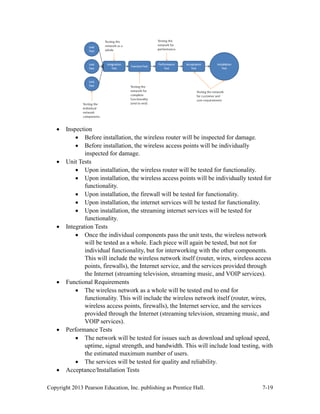
  • 3.
    Economics Canada inthe Global Environment Canadian 8th Edition Parkin Test Bank https://testbankdeal.com/product/economics-canada-in-the-global- environment-canadian-8th-edition-parkin-test-bank/ Oracle 11G PL SQL Programming 2nd Edition Casteel Solutions Manual https://testbankdeal.com/product/oracle-11g-pl-sql-programming-2nd- edition-casteel-solutions-manual/ Payroll Accounting 2017 27th Edition Bieg Test Bank https://testbankdeal.com/product/payroll-accounting-2017-27th-edition- bieg-test-bank/ Organizational Communication Approaches and Processes 7th Edition Miller Test Bank https://testbankdeal.com/product/organizational-communication- approaches-and-processes-7th-edition-miller-test-bank/ Essentials of Psychiatric Mental Health Nursing 1st Edition Varcarolis Test Bank https://testbankdeal.com/product/essentials-of-psychiatric-mental- health-nursing-1st-edition-varcarolis-test-bank/
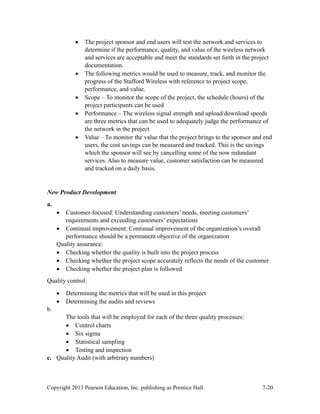
  • 4.
    Essentials of Entrepreneurshipand Small Business Management 7th Edition Scarborough Solutions Manual https://testbankdeal.com/product/essentials-of-entrepreneurship-and- small-business-management-7th-edition-scarborough-solutions-manual/

  • 5.
    Copyright 2013 PearsonEducation, Inc. publishing as Prentice Hall. 7-1 Chapter 7 Quality and Performance NOTES for the Instructor: The study projects and the cases are posed as challenging assignments to students. This study guide elaborates all the material needed to teach those study guides and cases. The study projects can be assigned in two different ways: a. If you want to evaluate the ability of the students to form assumptions, research for materials, and understand the study projects, you can ask the students to work on the study project without any additional information. In this case, the students should be encouraged to obtain necessary information using the Internet. b. If you want to provide all the information, you can provide that information shown in the following pages to solve the study projects. Objectives ‱ Manage project quality as seen by quality gurus ‱ Determine how performance in projects are measured ‱ Define cost of quality ‱ Implement quality planning, assurance, and control in projects ‱ Measure project value, project performance, and project scope Cases ‱ Information technology Case: SAP Project at NIBCO, Inc. ‱ Healthcare IT Case: Memorial Hospital of South Bend: Computerized Physician Order Entry Project ‱ Financial Services IT Case: Syndicated Community Bank: Core Banking Systems Replacement Project ‱ General Construction Case: Craig Constructions, Inc.: A Home Improvement Project Review Questions 1. Performance of a project can be defined as the execution or accomplishment of a project to fulfill customer requirements in accordance with the project scope.
  • 6.
    Copyright 2013 PearsonEducation, Inc. publishing as Prentice Hall. 7-2 2. Project value is a relative worth or importance that is monetary in nature. 3. Quality is defined as conformance to requirements. Deming defined quality as a predictable degree of uniformity and dependability at low cost suitable to the market. Juran defined quality as something that satisfies customer needs. Project quality is the degree to which a set of inherent characteristics of a project fulfill project scope. 4. Some of the main differences are in the areas of responsibility of senior management, SPC, and teamwork. 5. The major goal of quality management is to prevent defects. Quality management eliminates the source of defects so that defect detection and rework do not happen often during projects. Quality management complements project management, which means that components of quality management including customer satisfaction, defect prevention, continuous improvement, and management responsibility to provide essential resources are important in project management. Quality management is composed of quality planning, quality assurance, and quality control. Quality management is more about process and is based on problems related to processes. 6. The eight quality management principles include customer focus, leadership, involvement of projects, process approach, systems approach, continual improvement, decision making approach, and supplier relationships. 7. The quality model described in ISO/IEC 9126-1 addresses a framework for software evaluation using the general characteristics of software. These are further refined into sub-characteristics, which in turn are decomposed into attributes, yielding a multilevel hierarchy. The characteristics in a quality model are non- measurable quality factors and are used only to classify the sub-characteristics of the model, which may be subjectively measured. The ISO/IEC 9126 standard makes a distinction between internal quality and external quality and introduces the quality in use.
  • 7.
    Copyright 2013 PearsonEducation, Inc. publishing as Prentice Hall. 7-3 8. Quality management is composed of quality planning, quality assurance, and quality control. 9. Quality planning: The inputs for the quality planning are the scope document, the requirements from stakeholders, the risk register, and the project schedule. By using this input information, a project manager in cooperation with the quality team can develop a quality plan for a project as the output. Quality assurance: The inputs for quality assurance are quality planning, work performance information, quality control measurements, and quality metrics. The outputs of the process are asset updates, change requests, project management plan updates, and project document updates. Quality control: The inputs are quality metrics, approved change requests, and organizational process assets. The outputs are quality control measurements, validated changes, and updates to project management plans and other project documents. 10. Benchmarking is a process to measure the performance of an organization and compare that measure with other organizations in the same industry to understand industry best practices. 11. A quality audit is a review of the quality plan to determine whether the project activities comply with organizational and project policies, processes, and procedures. 12. There are many tools and techniques used in quality control including: ‱ Cause-and-effect diagrams ‱ Run charts ‱ Scatter diagrams ‱ Histograms ‱ Pareto charts ‱ Six Sigma ‱ Process maps or flowcharts ‱ Control charts ‱ Statistical sampling ‱ Reviews, and ‱ Testing and inspection.
  • 8.
    Copyright 2013 PearsonEducation, Inc. publishing as Prentice Hall. 7-4 13. Testing is a procedure in which the system, product, or service is observed during operation in order to determine whether it functions properly. Inspection is the activity of examining the product, sub-components, or systems to determine if they meet the design standards. 14. Process capability is a critical aspect of quality control and evaluates the ability of a project process to meet or exceed the expectations or preset specifications. 15. Statistical sampling deals with the selection of a subset of a population in order to gain knowledge about the whole population and to predict quality outcomes of the population using statistics. 16. The three criteria are: 1. The level of precision 2. The level of confidence or risk, and 3. The level of variability in the attributes being measured. 17. There are a number of methods of quality reviews including: ‱ Expert reviews ‱ Peer reviews ‱ Team reviews ‱ Walk-through reviews ‱ Formal reviews ‱ Management reviews, and ‱ Process reviews. 18. Metrics are required in order to answer the following questions: ‱ Is the project is on track? ‱ Is the project manager sure about the progress of the project? ‱ Does the project manager understand the current status of the project, schedule wise or cost wise? ‱ Can the project manager be sure of the performance of the project? Teaching Points - Discussion Questions
  • 9.
    Copyright 2013 PearsonEducation, Inc. publishing as Prentice Hall. 7-5 1. What else may be considered for performance other than quality? Performance measurement should consider many metrics that are listed in the chapter. It should also consider measuring time and cost constraints and make sure that the project is performing according to plan. 2. Do the three quality gurus preach the same message on quality? Even though they preach the same message, there are variations to their quality messages; See Table 7-1. 3. Quality audits have to be performed on each project. Quality audits typically should be deployed in all projects large and small. However, in reality it is not possible to do this because of added costs and time. Many industrial projects, especially small projects, are not usually audited. 4. Is there one tool that may be used in all projects for quality control? Analyzing using process maps is a very easy method that can be used in all projects for quality control. The “as-is” process and the “to-be” process bring out the essence of quality control in a very easy method especially in small projects. 5. Can we do without metrics when managing projects? No; every project has to be measured against the measurements of selected metrics. Proper metrics have to be identified and used. If metrics are not used in a project, there is no way to know how a project is progressing and may not ensure the success of the project. 6. There are differences between testing and inspection. Yes; Testing helps to execute the software in order to test the functionality and requirements while inspection analyzes the code based on a set of predefined rules. 7. Who decides which metrics are the best for a project: the project manager or management? Project manager should decide the metrics while management should help the project manager by removing any obstacles in order to measure those metrics. 8. Should management be involved in quality management? Yes; the management should provide leadership to encourage project managers to manage the project quality. Answers to Chapter Problems Problem 1: Observations
  • 10.
    Copyright 2013 PearsonEducation, Inc. publishing as Prentice Hall. 7-6 Sample number 1 2 3 4 5 Mean Range 1 0.786 0.799 0.793 0.511 0.781 0.734 0.288 2 0.799 0.506 0.516 0.797 0.529 0.629 0.293 3 0.796 0.500 0.515 0.788 0.521 0.624 0.296 4 0.795 0.506 0.783 0.787 0.789 0.732 0.289 5 0.772 0.502 0.526 0.769 0.781 0.670 0.279 6 0.773 0.795 0.507 0.793 0.506 0.675 0.289 7 0.795 0.512 0.790 0.771 0.507 0.675 0.288 8 0.525 0.501 0.798 0.777 0.785 0.677 0.297 9 0.797 0.501 0.517 0.506 0.516 0.567 0.296 10 0.795 0.505 0.516 0.511 0.797 0.625 0.292 11 0.795 0.782 0.768 0.792 0.792 0.786 0.027 12 0.783 0.759 0.526 0.506 0.522 0.619 0.277 13 0.521 0.512 0.793 0.525 0.510 0.572 0.283 14 0.787 0.521 0.507 0.501 0.500 0.563 0.287 15 0.793 0.516 0.799 0.511 0.513 0.626 0.288 Mean 0.652 0.271 X-bar UCL = 0.809 use Table 7-6 LCL= 0.494 R-bar UCL = 0.572 use Table 7-7 LCL= 0.000
  • 11.
    Copyright 2013 PearsonEducation, Inc. publishing as Prentice Hall. 7-7 Problem 2: 0.03 defective without inspection 0.02 defective with inspection Improvement=0.01 Cost of inspection = $0.40 Opportunity Cost of replacing the 1% improvement = $ 0.50 Therefore, inspection done be done now.
  • 12.
    Copyright 2013 PearsonEducation, Inc. publishing as Prentice Hall. 7-8 Cost of inspection = $0.80 Inspection should not be done now. Problem 3 Cost of quality is: CoQ = Cp + Ca + Cf This is described as the cost of prevention plus the cost of detection plus the cost of failures. This is not the cost of achieving quality in product and services, but rather not achieving quality and the cost associated with failures due to the lack of quality in the production process. The cost of quality for Superior Buy, who is the buyer in this scenario, would most likely be replacing or upgrading inferior computers that do not perform as expected. If the computers were to fail due to manufacturing defects, this would be covered under the manufacturer warranty. But if Superior Buy purchased computers with lower performance specifications to try and save money, then the cost of bringing them up to par if they are under performing would be the cost of quality. The cost includes installing additional RAM, changing the processor, installing different or new software, or may even be replacing the whole computer with one that will perform. Superior Buy must take into account these costs for possible upgrades or replacements when defining the specifications for their order. The cost of quality for Dell, who is the supplier in this scenario, would most likely be warranty repair or replacement costs. These costs would be incurred if defective computers were to leave the factory and end up in the hands of the customer. These costs would start the minute the customer calls the service number for help, and are not finished until the customer is completely satisfied with the end result. One customer may even call multiple times with multiple problems. Dell must integrate quality within the manufacturing process which will increase quality, decrease defects, and ultimately reduce the cost of quality. Problem 4: Process Mean Standard Deviation Lower Specification Upper Specification 1 7.0 0.1 6.9 7.9 2 4.0 0.1 4.2 4.9
  • 13.
    Copyright 2013 PearsonEducation, Inc. publishing as Prentice Hall. 7-9 3 6.6 0.1 5.4 6.5 For Process 1: cp= (upper spec - Lower Spec)/6σ= 1.667 Process is capable This m For Process 2: cp= (upper spec - Lower Spec)/6σ= 0.972 Process not capable For Process 3: cp= (upper spec - Lower Spec)/6σ= 1.410 Process is capable When the mean is centered or not situations, we can use Cp equation as follows: If the means of all processes are not exactly in the center: It is lesser of the formulae: (Upper spec-Mean)/3*σ or (Mean-Lower spec)/3σ Formula1 Formula2 Process 1 0.333 3.000 0.333 Process 2 -0.556 2.500 -0.556 Process 3 -0.256 -0.256 3.077 In this case, all processes are not capable.
  • 14.
    Copyright 2013 PearsonEducation, Inc. publishing as Prentice Hall. 7-10 The Cp should be at least equal to 1.33 Problem 5: a. The metrics to show control over a project are scope variance hours, scope cost increase, productivity, project cost deviation, and project progress deviation. The variance and deviation metrics for scope, cost and progress indicates that these factors are well defined and restrained within acceptable limitation. Meanwhile, productivity reflects how well the individual processes are executed. b. The metrics to show progress would be actual scope hours, productivity, and product progress deviation. Actual scope hours provide evidence for completed tasks which are related to the defined scope. Productivity and product progress deviation manifest the consistency of project progress. c. The metrics to charge a customer for changes are Scope Variance Hours, Scope Cost Increase, Number of baseline Changes, Project Effort and Project Cost Deviation. Number of baseline changes elicits additional requirements which have to be paid by the customers. The project effort, project cost deviation, and scope cost increases are used for calculating the amount of additional payment. Rescheduling of the project should take into account the scope variance hours metric. d. The metrics are Project Feature Enhancement Increase. This indicator measures the efficiency of effort scheduling which should be governed to complete important features. e. The metrics to use to manage customer expectations are Project Merit and Project Risk. The project merit communicates that expectations are consistently maintained and transparent during project duration. Meanwhile, project risk conveys the plans for securing and preserving expectations. f. The metrics to understand how fast a team is performing tasks are Project Efficiency and Project Effort. These metrics quantify the pace of task execution. g. The metrics for how well a team is performing are Project Effectiveness, Productivity and Project Effort. The three metrics are numerical presentations of quality of project execution. h. The metrics are removed are Removed Defects Efficiency. Removed Defects Efficiency numerically measures defect detecting and removing capability. i. The metrics are the Project Customer Commitment which completely evaluates factors of customer involvement, communication, and availability. Problem 6: Costs Cost of Conformance Cost of Non- Conformance Cost of Prevention Cost of Appraisal Cost of Failure Cost of Training X
  • 15.
    Copyright 2013 PearsonEducation, Inc. publishing as Prentice Hall. 7-11 Business Opportunity Cost X Cost of Testing Material X Cost of Quality Planning X Cost of Rework X Cost of handling Complaints X Cost of explaining Project Deviations X Cost of Testing Tools X Cost of Stationary and Printing for Quality X Problem 7: Year Revenues 0 ($22,500) 1 $51,000 2 $96,250 3 $96,250 4 $96,250 5 $96,250
  • 16.
    Copyright 2013 PearsonEducation, Inc. publishing as Prentice Hall. 7-12 Cpr+Ca $62,800 Cost of quality maint $37,000 Discount rate 10% a Cost of software quality $62,800 b See Appendix D SQNPV $201,426.86 c ROSQ 4.14 Problem 8: See Appendix D These are the non-conformance costs: Csc, Suncontractor related quality prevention and appraisal costs Ccp, Coordination and planning-related quality prevention and appraisal costs Ccw, Construction and workmanship-related quality prevention and appraisal costs Paid to sub-contracted electricians $210,000 not applied Paid for quality related planning costs $2,000,450 Ccp Paid for quality coordination $340,000 Ccp Paid for lack of good workmanship $540,000 Ccw Paid for accident-related work $380,000 not applied Paid for transportation of poor quality materials $6,000 Internal failure Paid for quality faults by sub-contracted electricians $80,040 Internal failure
  • 17.
    Copyright 2013 PearsonEducation, Inc. publishing as Prentice Hall. 7-13 Paid to repair leaky plumbing $6,000 Internal failure Paid to locate faulty roof shingles $80,700 Ccp Cost of construction quality = = Csc+Ccp+Ccw $2,961,150 Cost of internal failures $92,040 Total cost of Quality $3,053,190 Problem 9: Description Cost Quality training $4,000 Cpr Reliability training $20,000 Cpr Scrap $15,000 Cf Downtime $6,000 Cf Transportation losses $8,000 Cf Supplies inspection $6,000 Ca Contracted laboratory testing $300,000 Ca Pilot production runs $8,000 Cpr Reliability testing $9,560 Ca CoQ $376,560
  • 18.
    Copyright 2013 PearsonEducation, Inc. publishing as Prentice Hall. 7-14 The cost of quality is $4,000 + $20,000 + $15,000 + $6,000 + $8,000 + $6,000 + $300,000 + $8,000 + $9,560 = $376,560 Problem 10 Assume 8 hrs in a work day Expected Time to process 20 days No. of hrs in a day (assume) 8 hrs Total Time in hours 160 hrs Time for processing 4 days Total applications to be processed 1200 Defects > 20 days 150 Completed in a time period 1050 Applications with customer issues 20 out of 150 Apps with issues processed in 11 days Apps with issues processed in 88 hrs Applications without issues 1180 Rework time 5 days Rework time 40 hrs
  • 19.
    Copyright 2013 PearsonEducation, Inc. publishing as Prentice Hall. 7-15 Project Efficiency 88% Project Effectiveness 98% Productivity 4.84 in March Expected Productivity 7.5 in March Defective loans 13% Correct loans 88% See Appendix D Project Quality Time 0.55 Time spent on defects 40 hrs Defect by Time 0.16129 defect/project time Problem 11: Year Discount factor Cost Benefits Discounted Costs Discounted Benefits Accum. Discounted costs Accum. Discounted Benefits 0 1.00 ($22,500.00) $22,500.00 ($22,500.00) $22,500.00 ($22,500.00) $22,500.00 1 0.91 $6,250.00 $17,500.00 $5,681.82 $15,909.09 ($16,818.18) $38,409.09 2 0.83 $6,250.00 $14,000.00 $5,165.29 $11,570.25 ($11,652.89) $49,979.34 3 0.75 $6,250.00 $11,000.00 $4,695.72 $8,264.46 ($6,957.18) $58,243.80 4 0.68 $6,250.00 $5,000.00 $4,268.83 $3,415.07 ($2,688.34) $61,658.87 5 0.62 $6,250.00 $0.00 $3,880.76 $0.00 $1,192.42 $61,658.87 Total Cash flows $60,466.45 Initial Investment $22,500.00
  • 20.
    Copyright 2013 PearsonEducation, Inc. publishing as Prentice Hall. 7-16 Profitability Index 2.69 Hence, the project has positive value Project Value $61,250.00 Problem 12: Weighted score Criteria Weight A B C A B C Alignment to strategy 20 3 2 2 12 8 8 Cost benefits 10 1 2 4 2 4 8 Flexibility of products 10 1 2 3 2 4 6 Competitive advantage 15 5 4 3 15 12 9 Time to market 20 1 2 4 4 8 16 Employee benefits 10 2 2 3 4 4 6 Sales prospects 15 4 5 3 12 15 9 100 Total 51 55 62 a. Project C b. Project A Study Projects Information Systems: For the Wireless Project the following quality metrics will be captured, tracked, and analyzed on a continuous basis throughout the project: performance, conformance,
  • 21.
    Copyright 2013 PearsonEducation, Inc. publishing as Prentice Hall. 7-17 reliability, serviceability, and aesthetics. These metrics will be captured by the project team and presented to the project sponsor as outlined in the quality plan (in a separate word document). The following tools could be employed for the different processes used to establish quality within the Wireless Project: ‱ Cause and Effect Diagrams – These types of diagrams are used to identify the root cause of a problem. These could easily be integrated into a quality process for testing and debugging performance issues within the Wireless Project. ‱ Run Charts – This type of chart is used to graphically display observed data in a time sequence. The project team could employ this type of chart to observe the download and upload speeds of the Wireless Network over the course of a day to see the variance of said speeds. ‱ Scatter Diagrams – This type of chart is used to observe the effect of two variables in a situation. For the design of the Wireless Project, one could plot the bandwidth against the download speed to determine how much bandwidth is needed for the download speed required. ‱ Histograms – This type of chart is used to graphically represent the distribution of data. For the Wireless Project, a histogram could be used to analyze network performance metrics such as delay, packet loss, retransmission, and throughput. ‱ Pareto Charts – This type of chart contains both bars and a line graph, where individual values are represented in descending order by bars, and the cumulative total is represented by the line. For the Wireless Project, a histogram could be used to analyze network performance metrics such as delay, packet loss, retransmission, and throughput. ‱ Six Sigma – This statistical analysis is used to identify the number of defects in a process, and to help reduce the defects produced to increase quality. This type of statistical analysis may be a bit much for the Wireless Project, but it could be used to analyze the suppliers of the equipment. The suppliers with a higher Six Sigma level would be more likely to supply the project with quality equipment that is less likely to fail. ‱ Process Maps or Flowcharts – These diagrams can be used to graphically display any process. An example of a process map or flowchart for the Wireless Project could be one that shows the construction, testing, and reworking (if needed) of the wireless network. There are many different activities that go into this process, and some must be completed before others can start. This type of chart could quickly and easily explain this to a non-technical reader. ‱ Control Charts – A control chart is used to determine whether or not a process is within control limits. For the Wireless Project this type of chart could be used to identify bottlenecks and reduce waste if used in the scheduling of workers.
  • 22.
    Copyright 2013 PearsonEducation, Inc. publishing as Prentice Hall. 7-18 ‱ Statistical Sampling – This type of analysis is used to gain a better knowledge of a population of data using a smaller subset of data called a sample. This type of sampling could be used in analyzing network performance metrics, and help to identify the possible problem areas. ‱ Reviews – These are done to review a product, service, or system against quality criteria set forth by the project team or organization. In the Wireless Project nightly meetings with both the project team and project sponsor will be held to review the activities of the day and to identify sub-quality items that need to be addressed immediately. ‱ Testing and Inspection – This is done to promote quality in products and services. In the Wireless Project a testing and inspection plan will be created for the construction and implementation of the wireless network. This will ensure that the various stages of the network are tested, and quality is established and maintained throughout the life of the project. Below is a table of the quality audit data for the Stafford Wireless Project. These data points provided valuable insight into issues that need to be addressed immediately for successful completion of the project. Quality Audit (with arbitrary numbers) Wireless Network Project Audit Audit Date Auditor U or P Non-Compliant Issues Elevated to Senior Mgmt. No of Hi- Priority Items Hrs to prepare and conduct the audit Major Minor Closed 3/19/12 JS/PR P 0 2 0 0 0 2 3/20/12 JS/PR P 0 0 2 0 0 3 3/22/12 JS/PR U 1 1 0 1 1 2 U- Unplanned; P-Planned Below is a testing and inspection plan for the Wireless Project. This plan will ensure that the wireless network is tested throughout the project, and any failures or defects are discovered and quickly addressed.
  • 23.
    Copyright 2013 PearsonEducation, Inc. publishing as Prentice Hall. 7-19 ‱ Inspection ‱ Before installation, the wireless router will be inspected for damage. ‱ Before installation, the wireless access points will be individually inspected for damage. ‱ Unit Tests ‱ Upon installation, the wireless router will be tested for functionality. ‱ Upon installation, the wireless access points will be individually tested for functionality. ‱ Upon installation, the firewall will be tested for functionality. ‱ Upon installation, the internet services will be tested for functionality. ‱ Upon installation, the streaming internet services will be tested for functionality. ‱ Integration Tests ‱ Once the individual components pass the unit tests, the wireless network will be tested as a whole. Each piece will again be tested, but not for individual functionality, but for interworking with the other components. This will include the wireless network itself (router, wires, wireless access points, firewalls), the Internet service, and the services provided through the Internet (streaming television, streaming music, and VOIP services). ‱ Functional Requirements ‱ The wireless network as a whole will be tested end to end for functionality. This will include the wireless network itself (router, wires, wireless access points, firewalls), the Internet service, and the services provided through the Internet (streaming television, streaming music, and VOIP services). ‱ Performance Tests ‱ The network will be tested for issues such as download and upload speed, uptime, signal strength, and bandwidth. This will include load testing, with the estimated maximum number of users. ‱ The services will be tested for quality and reliability. ‱ Acceptance/Installation Tests
  • 24.
    Copyright 2013 PearsonEducation, Inc. publishing as Prentice Hall. 7-20 ‱ The project sponsor and end users will test the network and services to determine if the performance, quality, and value of the wireless network and services are acceptable and meet the standards set forth in the project documentation. ‱ The following metrics would be used to measure, track, and monitor the progress of the Stafford Wireless with reference to project scope, performance, and value. ‱ Scope – To monitor the scope of the project, the schedule (hours) of the project participants can be used ‱ Performance – The wireless signal strength and upload/download speeds are three metrics that can be used to adequately judge the performance of the network in the project ‱ Value – To monitor the value that the project brings to the sponsor and end users, the cost savings can be measured and tracked. This is the savings which the sponsor will see by cancelling some of the now redundant services. Also to measure value, customer satisfaction can be measured and tracked on a daily basis. New Product Development a. ‱ Customer-focused: Understanding customers’ needs, meeting customers’ requirements and exceeding customers’ expectations ‱ Continual improvement: Continual improvement of the organization’s overall performance should be a permanent objective of the organization Quality assurance: ‱ Checking whether the quality is built into the project process ‱ Checking whether the project scope accurately reflects the needs of the customer ‱ Checking whether the project plan is followed Quality control: ‱ Determining the metrics that will be used in this project ‱ Determining the audits and reviews b. The tools that will be employed for each of the three quality processes: ‱ Control charts ‱ Six sigma ‱ Statistical sampling ‱ Testing and inspection c. Quality Audit (with arbitrary numbers)
  • 25.
    Another Random ScribdDocument with Unrelated Content
  • 26.
    term. They arehours at the gallop, and it is supposed that a swift horse, going at his utmost speed, could cover the distance in seven hours. The immense concessions given by the Government are not cultivated, for the Boer has a rooted dislike to work; his black servants grow the necessary mealies, and keep his numerous flocks. As his wants are very primitive, this suffices him. To procure sugar, coffee, and other necessaries, he goes to town and sells two or three oxen. The rifle and cartridges furnished by the State in time of war become the Burgher's property. * * * * * On the march in war-time this system of halting the oxen because they are hot, and the men because they want to drink coffee at every farm, is neither very rapid nor very practical. We do not arrive at Boshof till the fifth day. This is the spot fated to be the grave of our venerated leader. Boshof, in contrast to its surroundings, is a gay little oasis, traversed by a cool stream. It boasts green trees and pretty villas. Two ambulances are installed here, but they shelter only two or three wounded as yet. At the end of the village is a pool, which delights us vastly. We spend the afternoon in it, after lunching with the field-cornet. The town is en fĂȘte, as at Brandfort, to receive us, or rather-- away with illusion!--to receive Long Tom. We start again in the night, and reach Riverton Road. We are now on English territory, in Cape Colony.
  • 27.
    Towards noon, M.Léon comes to meet the cannon, the arrival of which has been anxiously expected for the last two days. We are only an hour from the camp, which we reach at a gallop. There, at Waterworks--the reservoir that supplies Kimberley--we find Colonel de Villebois-Mareuil. Need I describe that frank and energetic face, with its searching blue eyes, and its benevolent smile, sometimes a little ironical, always subtle; the clear voice; the concise manner of speech, brief without being brusque? Even at that stage a look of sadness had stamped itself upon his face; he saw that the men for whom he was to lay down his life would not follow the counsels dictated by his profound knowledge and unquenchable devotion. * * * * * We had been expected for two days, and twice the Colonel had had good luncheons prepared. Then, giving us up, he had ordered nothing, and we took his kitchen by surprise. We find with him Baron de Sternberg, that charming Viennese, whose inexhaustible good spirits are famous throughout London and Paris. In the evening he works in his tent at a history of the war, and composes the most delicious verses in German. The Colonel also works hard. Long Tom arrives some time after us. Our laager at Waterworks is a large square, measuring some 200 metres on every side, planted with trees, and containing the machinery for distributing the water. It looks like an oasis in the midst of the vast yellow plain. In the distance are a few kopjes. We
  • 28.
    are about 700metres from Kimberley. The camp is commanded by General du Toit. Kampferdam, where the cannon has been taken, is 3 kilometres to the south, and 5,500 metres from Kimberley. It is a kind of whitish peak, about 50 metres high, formed of the refuse from the diamond mine below. The night of Tuesday to Wednesday is spent in the construction of the wooden platform on which Long Tom and his carriage are to be mounted. The English searchlights fix their great round eyes upon us from time to time, but there is nothing to show that the enemy has noticed anything abnormal in our proceedings. All night long the work goes on with feverish activity, for Léon, who is superintending the operations, wants to fire his first shell at daybreak. But it is no easy task to hoist up that mass of 5,000 kilos, especially with inexperienced, undisciplined, and obstinate men, and the cannon is not ready till ten o'clock. One of our party, Michel, an old artilleryman, the holder of some twenty gunnery prizes, gives the workers the benefit of his experience, and as he cannot find any sights, Erasmus artlessly proposes to make one of wood! At last the first shot is fired! I am certain that at this moment not a single Boer is left in the trenches. Everyone has rushed out to see the effect produced. It is of two kinds. Firstly, our shell, badly calculated, bursts far off in the plain; then, no sooner has it been fired, than an English shell from the Autoskopje battery, 3,500 metres to our right, falls and explodes among the machinery of the
  • 29.
    Kampferdam mine. Thisexchange of compliments goes on till near twelve o'clock. This is the sacred hour of lunch. The fire ceases. As coffee is a liquid which has to be imbibed slowly, firing does not begin again till nearly four o'clock. It is very hot, for it is the height of summer. During this interval, the Colonel has been several times to General du Toit, to ask for fifty volunteers. The Colonel's plan is to batter the town with a storm of shells (we have 450) for two hours, from four to six, and thus demoralize it; then, with fifty men, whom the French contingent would lead, to seize the Autoskopje battery, which is but poorly defended, at nightfall, and thence to gradually creep up to the town through a little wood, which would mask the advance. The plan was very simple, requiring but few men, and had every chance of success, because of the surprise it would have been to the English, who had never been attacked hitherto. 'Wait a bit,' said Du Toit; 'I will lay your plan before the council of war to-morrow.' In vain the Colonel tells him that the success of the plan depends on its immediate execution. He can get no answer. The evening is wasted. General du Toit is a big, bronzed man, with a black pointed beard and a straight and penetrating gaze. Though very brave personally, he has never dared to engage his men. The latter are very well pleased with their role of besiegers. They will appreciate it less when the Long Cecil comes upon the scene. Hitherto, the long far niente, comparatively free from peril-- the town, under the command of Colonel Kekewich, was defended
  • 30.
    by such asmall garrison that sorties were impossible--has only been broken by the singing of hymns, the brewing of coffee and cocoa, and the occasional pursuit of a springbock. Every evening a guard, composed, I fancy, of anyone who chose to go, went off, provided with a comfortable stock of bedding, to do duty round the camp. Others, the valiant spirits, remained at the three batteries where were installed Long Tom, the three Armstrongs, and the Maxim. Long Tom's battery was by far the most popular, for several reasons. In the first place, its processes were much more interesting than those of the small guns; then, its defenders were much more sheltered, owing to the proximity of the mining works; and finally, a good many former miners were always on the look-out for a stray diamond or two. Among the besiegers of Kimberley, indeed, we met with a good many adventurers who took no other part in the campaign. Men of all nationalities, many of them familiar with the town, having worked in the mines here, they came in the hope of finding some diamond overlooked in the sudden cessation of mining operations.... Then, too, they knew that Cecil Rhodes was in the town, having had no time to fly or to carry off his treasure. Then, again, there are bankers and jewellers in Kimberley, and if the Boers had taken the town.... It appears that Cecil Rhodes was quite aware of this danger, and I have heard that he attempted to manufacture a balloon which was to have carried 'Cecil and his fortunes' to a safer city. In any case, his gratitude to his defenders was very lively. And, in addition to other liberalities, he presented a commemorative
  • 31.
    medal to themall. IV Failing an assault, we resume the bombardment. The firing is slow and inaccurate. The English reply in much the same fashion, when suddenly their new cannon appears on the scene, not altogether to our surprise, for some intercepted letters had warned us of its manufacture. It was the famous Long Cecil. The Long Cecil was a gun of about 12 centimetres, made in Kimberley itself during the siege with a piece of steel taken from the machinery of the De Beers mine. The piece was drilled and rifled with the means at the disposal of the besieged. The closing of the breech, a somewhat fantastic arrangement, was based on the Canet system. In default of a trial field, the range was arrived at from observations of actual firing against us. Long Cecil accordingly began to speak, and to speak very much to the point. Several times we were covered with earth, and I am certain that out of twenty shells, the extreme error was not more than 200 metres. One fortunately fell diagonally on Long Tom's very platform, rebounded, and burst a little way off. Seven men were killed. The next day, Thursday, passed in almost precisely the same fashion. Towards five o'clock the interchange of amenities between Long Tom and Long Cecil began, and lasted till 8.30; at 8.30,
  • 32.
    breakfast. After breakfast,the guns went to work again till 11. At 11, lunch, rest. From 4 to 6, another cannonade. At 6, dinner. This respect for meal-times is charming, and greatly facilitates life in the field. It is a pity the attention of the Powers is not called to this subject by an international convention! Many affections of the stomach would be hereby avoided. Encouraged by the example of their big brothers, the little 12 and 15-pounder Krupps and Armstrongs join in the concert. The English have five, and we have four. It is delightful, and one can't complain of a single second of boredom. On Friday, the Colonel's request is still unanswered. 'Wait a little while!' Sternberg has had enough of it. Recognising the impossibility of persuading Du Toit to take decisive action, he starts off to Jacobsdal, where the English make him a prisoner. He was a great loss, for he had an extraordinary repertory of adventures, which he told in a very amusing manner, and, besides, he was a capital cook. The 'boys' in these regions, greatly inferior to those of the Soudan in this respect, claim to be cooks as soon as they know how to light a fire. Accordingly, we prepare our meals ourselves. Tinned meat, a bit of roast mutton, or a stew, are the usual dishes. The Colonel eats very little, and only takes grilled meat; he drinks tea or milk, and never touches wine or spirits. He does not smoke. He is a striking contrast to the rest of us, who eat like ogres, drink like sponges, and smoke like engines! Our contingent, consisting of Breda, Léon, Michel, Coste, my friend De C---- and I, remain with Villebois.
  • 33.
    Michel has calculatedthe ranges, and we fire all Friday night. The points aimed at are: the searchlights, Cecil Rhodes' house, the Grand Hotel, the last high chimney on the left, and that on the right. Erasmus was unable to suppress a gentle amusement at the sight of our preparations for night-firing. But when he grasped the idea that we were in earnest, and that his Long Tom was being loaded, the benevolent smile with which one would watch a spoilt child engaged in some innocent folly changed to a look of real anxiety. He thought poor Michel had gone mad. He finally got used to the novel proceeding. Firing ceased on both sides about 12.30 a.m. Early on Saturday morning it began again. One of our shells fell on the De Beers magazine, transformed into an ammunition factory, and caused an explosion and a fire. The English, despairing of silencing our Long Tom with their Long Cecil, replied to every shot at the town by a shell into our laager. The accuracy of their fire with this gun at a range of about 7,000 metres was remarkable. We were indeed a capital target: a green rectangle of 200 metres in the midst of a yellow, arid plain. The shell arrived in thirty-four seconds, but did no great damage, for a watchman gave the alarm, 'Skit!' each time when he saw the smoke, and we retreated into shelter. The telegraphists of the staff, who were working in a little house, were placed in communication with the watchman by means of a bell, and, warned half a minute before the arrival, they had time to take refuge in a neighbouring trench. We learnt later that a similar system had been adopted in Kimberley as a protection against Long Tom, and hence the small
  • 34.
    number of killedduring the siege. One of the first victims of Long Tom, however, was the engineer of the Long Cecil, who had just finished his work. A shell burst on his house and killed him in his bedroom. Another cause of the slight mortality on both sides was the bad quality of the fuses for the projectiles, which often burst imperfectly, or not at all. Thus, one of the English shells fell in the machinery of the waterworks, only a few inches from our reserve of a hundred shells, and happily failed to explode. Another went through a cast-iron pipe, over a centimetre thick, and buried itself in the earth without exploding; its fuse was completely flattened on the projectile by contact with the pipe. Nevertheless, a good many, too many indeed, did burst with satisfactory results--to those who fired them. A good many of the Boers accordingly took the precaution of digging a sort of tomb several feet deep, in which they piled mattresses and blankets. They spent all night and part of the day lying in this shelter. On Saturday morning, on arriving at the battery, we were surprised by a whistling sound. The English, harassed by the fire of Long Tom, had dug trenches during the night to a distance of about 1,200 yards, and had manned them with riflemen. Their fire was not yet very galling, because of the distance between us. Colonel de Villebois, seeing clearly what would happen, renewed his request for a party of men. He now only asked for twenty-five to make an assault that very night, for he pointed out that the shanjes (trenches) would be pushed forward during the night, and that our battery would become untenable. But he was repulsed by the eternal 'Wait a little while!'
  • 35.
    Long convoys ofKaffirs that the English could no longer feed came out of the town every day, preceded by huge white flags. Some were allowed to pass after a parley, others were sent back again. The Colonel feared that an attempt would be made against Long Tom by night, as a sequel to the offensive movement on the part of the garrison indicated by the making of the trenches. Everyone goes to spend the night at the battery, and we take the opportunity of firing at the town. It proves to be merely a pastime. The English reply, but do not attack us. On Sunday, February 11, we rest all along the line. The Burghers sing hymns in chorus, and do not cease till late in the evening. A sort of patriarchal simplicity obtains among them. Yesterday the Colonel was shaving. A Boer entered without saying a word, sat down on his little camp-bed, and remained there motionless. The Colonel, used to their ways, took no notice, but waited for the visitor to explain his visit. As this was prolonged considerably, the Colonel continued his toilet by a tub taken puris naturalibus. The Boer remained, staring silently at him. At last, his toilet ended, the Colonel explained to the visitor that he must go, as he wanted to close his tent. The Boer departed without a word. About ten minutes afterwards he came back with a friend, who explained that he wanted the Colonel's razor. He would bring it back afterwards. It was very hard to make him understand that the Colonel wished to reserve the implement for his private use. On this Sunday, the day of rest, we accordingly went off to bathe at a spring four kilometres from our laager. We enjoy this peaceful pastime in the company of a young clergyman who was at
  • 36.
    one time inthe camp. When Long Cecil began to bombard us, he judged its war-like thunders to be incompatible with his sacred function, and set up his tent beyond its range. On Monday morning the firing began again early. Léon and the Colonel went off to the battery. Our horses had been turned out to graze by mistake, so we did not start till an hour after them. On arriving, we found the balls whistling more smartly than on Saturday. We could plainly distinguish the buzz of the dum-dum bullets amidst the whir of the ordinary charge. During the two nights, the English had pushed forward their trenches to a distance of from 700 to 800 yards from us. We went up on the platform, where the Colonel, his glass in his eye, was talking imperturbably to General du Toit. At the same moment we saw Léon, who was standing behind them, spin round and fall across the gun-carriage. The poor fellow had been shot right through the forehead just above the eyes. The Colonel at once raised him in his arms, others started off in haste for an ambulance; but the bullets were now falling round us like hail. Two horses were wounded in an instant, and a Burgher fell, a bullet clean through his body. Poor Léon was still conscious. He bid us all good-bye calmly, taking a particularly affectionate leave of the Colonel, to whom he was greatly attached. The Colonel took a little water to wash the blood from his face, and placed the empty pannikin on the parapet of sacks filled with earth behind which we were sheltered. So heavy was the English fire that the pannikin instantly fell to the ground pierced by a bullet.
  • 37.
    At last acart appeared with an attendant and a stretcher. The wounded, who numbered about a dozen by this time, received first aid; then Léon was carried off on a stretcher. What a journey was that march of three kilometres, the first part of which was performed under a rain of bullets! The head of the wounded man was swathed in cloths, which we kept wetting continually, holding an umbrella over his head, for the heat was intense--it was eleven o'clock in the morning. Blood poured from his mouth and nose. Poor fellow! we made up our minds that it was all over with him. We reached Waterworks in two hours. But the little house that had been turned into a hospital was no longer safe since the bombardment of our camp had begun. A telegram had therefore been sent to Riverton Road, where there was an ambulance-station with a good doctor. Towards one o'clock an ambulance-carriage arrived and carried off our comrade. On Tuesday, the 13th, we missed the salute Long Tom had been in the habit of giving the enemy at daybreak. What had happened? We sent off for news. General du Toit replied that Erasmus declared the gun was broken, and could not be fired. He himself had not been to inquire into the damage, and seemed to be no more concerned than if he had been told it was raining at Chicago. We set off to Kampferdam in great distress, expecting to find the gun a wreck. As we approached, however, we saw that it was still in place, apparently wondering at its own silence. We examined it carefully all over, but could find nothing to account for the catastrophe, and, in despair, we sent for Erasmus.
  • 38.
    Standing back acouple of paces, he showed us that one of the beams of the platform, which had received the full force of the recoil, had sunk some few centimetres. It was a matter of no importance, and did not interfere with the firing in any way. But Erasmus, I suppose, did not feel inclined to work the gun that day. He had told Du Toit that it was broken, and the General had at once accepted the statement. After a severe reprimand to the recalcitrant gunner, the firing recommenced as usual. Our provisions began to run out in camp, in spite of a stock of potatoes we had discovered at the waterworks. It was accordingly arranged that we should start off with two others of the party to get fresh stores, and a cart and mules, at Pretoria. The Colonel, believing that the lack of offensive action among the Boers would prolong the siege indefinitely, determined to set out himself on the 15th for Colesberg, where we were to rejoin him in a few days. We started on the 14th, bound for Brandfort and Pretoria. On setting out, my mare, an excellent mount, but very fiery, brought me suddenly to the ground, to the great amusement of the Colonel. The same accident having happened to Breda a day or two before, it began to be looked upon as a special privilege of the ex- cavalry officers! At nightfall we arrived at Riverton Road, where Léon was lying. During the evening the Colonel himself came over to inquire for him. He had had a good day, and the operation that was judged necessary had been fixed for eleven o'clock that night, to avoid the heat of daylight. We waited about the door of the baggage-shed, which had been converted into an ambulance.
  • 39.
    The operation, whichproved perfectly successful, lasted an hour and a half. The doctor, a Scotchman called Dunlop, assured us that our poor friend was out of danger. At daybreak on the 15th we started, the Colonel for the camp, we for Brandfort. It was terribly hot, and we were in a hurry, for a rumour of Lord Roberts' arrival had got about. It seemed likely that there would be some more lively work on hand very soon, and we were anxious to get through the drudgery of revictualling as quickly as possible. In the evening we reached Boshof, where a good many wounded had been brought since our last visit. We rode all day on the 16th, slept in the bush, and started again at daybreak on the 17th. Towards noon we took a rest of an hour and a half, and consumed a tin of corned beef. It was nearly two when we mounted again under a sky of fire, not to draw rein till we reached Brandfort at ten o'clock on Sunday morning, save for a compulsory halt of two hours from three to five in the morning, when the darkness made it impossible for us to continue our journey in the trackless sand and tangled bush. We had been in the saddle twenty-six hours out of thirty to accomplish our journey of 120 miles, and had taken three and a half days, riding over sixty kilometres a day, in average heat of from 38° to 40° (centigrade), without fodder and almost without water, in a wild, unknown country. Our horses were dead-beat, and we entered the village on foot, dragging the poor brutes by their bridles. What was our stupefaction to hear that the siege of Kimberley had been raised without any engagement the very day after our departure!
  • 40.
    The surprise, itseems, had been complete. There was a cry of 'The English!' and then a panic, which barely left time to carry off the guns and waggons. Part of the ammunition was left behind, some provisions, Long Tom's break and its platform. The Colonel had escaped with Breda. But in the confusion one of our comrades, Coste, was lost, and eventually joined Cronje. A story which amused us all at the time may be told here. A volunteer, no longer in his first youth--well over fifty, in fact--had come to join the Colonel just at the time of the English attack. A very eccentric character, and slightly bemused by drink, he found himself in the thick of the stampede, without any clear idea of what it was all about. Suddenly the Burghers, who had never seen him in the camp before, struck by his odd behaviour, demanded his passports. Not understanding a word of Dutch, he had some difficulty in making out what they wanted. At last he produced the necessary paper. The pandours of the moment scrutinized them carefully, then, shaking their heads in the fashion which among all races implies negation, they said: 'No good! Obsal!' (mount). Two men ranged themselves on either side of the unlucky wight, a complete novice in horsemanship, and galloped off with him to a farm several miles off. 'Dismount! Your passports!' About fifteen persons, men, women and children, were grouped round a table. The passport, handed round once more, is discussed by the assembly, each person present giving an opinion. The general verdict is unfavourable, for heads are again shaken.
  • 41.
    'No good! Obsal!' Thepoor volunteer, aching from his furious gallop, begins to think things rather beyond a joke; but, anxious to conciliate, he remounts, and gallops off again under escort. On arriving at another farm another inspection, also unfavourable, takes place. 'No good! Obsal!' This time the worm turns. Pale, exhausted and racked with pain, he opposes the force of inertia to the rigour of his tormentors, who, convinced that he is a spy, set him against a wall and load their rifles. This argument is so convincing that he remounts, and finally makes them understand that he will be able to find someone to answer for him at Brandfort. Two days later he arrived there, fasting, exhausted, and still guarded by his escort. Fortunately he was recognised and released. He never returned to the front. * * * * * We leave for Pretoria by the first train, and arrive on the evening of the 20th. We at once set to work on our re-victualling mission. Two days later, I got a telegram from Colonel de Villebois- Mareuil. Having heard of the arrival of a good many French volunteers at Pretoria, he agrees to take the command of them, and orders me to get them together. A letter to M. Reitz, sent off at the same time, explains the project. Among the new arrivals are ex-petty officers, ex-sailors, ex- legionaries ... a motley crew. Their equipment will take several days, and it is arranged that they are to join us at Colesberg, for which we start by that evening's train.
  • 42.
    During this shortsojourn at Pretoria I was presented by Colonel Gourko to Captain D----, the French military attaché, one of the most charming men I have ever met. We noticed numerous placards on the town walls, giving notice of thanksgiving services for February 26 and 27. It is the anniversary of Majuba Hill, which is celebrated every year with great pomp. This year, in spite of the national pre-occupation in current events, the traditional custom is to be kept up. The usual review of the troops by the President and the Commander-in-Chief cannot, of course, take place; but the shops and offices will be closed for forty-eight hours, and the whole population will flock to the churches. Shortly after our departure, at a station the name of which I forget--perhaps intentionally, for I feel a qualm of remorse at the recollection of it--a little fox-terrier playing about the train jumped into our carriage. We were just starting.... It would have been cruel to throw the poor little beast on to the platform at the risk of maiming it or causing it to be run over.... In short, we kept her, and christened her Nelly. She was very pretty, pure white, with a black patch on her head and another on her back. I felt remorseful--until the next station; then I overcame my scruples. I am so fond of dogs. At Brandfort, a counter-order awaits us, directing us to go to Bloemfontein, where the Colonel awaits us, in consequence of Lord Roberts' latest operations. We land our cart, our mules, and our provisions. But our worn-out horses have to be replaced. The Colonel, impatient to be gone, will not wait for us, and starts for Petrusburg, where we are to join him as quickly as possible. On the 28th, the news of Cronje's capitulation reaches us. We know nothing of the details, but the moral effect is terrible.
  • 43.
    We had gottogether hastily at Pretoria a cart, harness, mules, and three black boys. Individually, each of these acquisitions is highly satisfactory. The cart is a superb omnibus, freshly painted gray; the harness is almost new, the mules very handsome--a little black one in particular. The boys were chosen to suit all tastes: one tall, one short, and one of medium height. But it proves very difficult to establish any sort of cohesion between these various elements. At the first attempt the harness breaks, the mules bite and kick. It needs the cunning of an Apache even to approach the little black one. The boys are stupid, and speak neither Dutch nor English, nothing but Kaffir. The omnibus alone remains stationary, but it creaks and groans in a pitiable fashion when touched. A second experiment is no more successful than the first. The third gives a better result: the vehicle moves, and even goes very near to losing a wheel. This remarkable result is achieved, firstly, because all the rotten leathers of the harness are in pieces, after a double series of joltings and strainings; only the solid ones are left. Secondly, the pretty little black mule has run away, after breaking some dozen halters, so that we are saved the trouble of harnessing her. Lastly, we have stationed the three boys at a safe distance, begging them on no account to help us, and Michel, who as an old artilleryman is an adept in harness, does wonders. Finally we get off, escorting our omnibus, which groans aloud at every step. We look like 'The Attack on the Stage Coach' in Buffalo Bill! V
  • 44.
    On the morningof the 7th, the road to Petrusburg was blocked, and the guns were roaring in front of us. Marais, Botha's adjutant, joined us. At the first sound of the guns we left the waggons, and galloped off in the direction he pointed out. The battle of Poplar Grove was about to be fought under our eyes, though we were unable to take a very active part in it. The engagement went on mainly oh our right; we were on the left of the Boer lines. In front of us was a kopje occupied by a hundred rifles. About 11 o'clock the English cavalry charged at the guns, about two miles away. The firing slackened. Then about 2 o'clock the English began to shell us furiously with shrapnel, also the kopje forming the Boer centre. An outflanking movement completed the demoralisation of the Boers, and at 3.30 the retreat became general. President Kruger came by this morning to announce that he had made the following peace proposals: 'BLOEMFONTEIN, 'March 5, 1900. 'The blood and tears of the thousands who have suffered by this war, and the prospect of all the moral and economic ruin with which South Africa is now threatened, make it necessary for both belligerents to ask themselves dispassionately, and as in the sight of the Triune God, for what they are fighting, and whether the aim of each justifies all this appalling misery and devastation. 'With this object, and in view of the assertions of various British statesmen to the effect that this war was begun, and is being carried
  • 45.
    on, with theset purpose of undermining Her Majesty's authority in South Africa, and of setting up an administration over all South Africa, independent of Her Majesty's Government, we consider it our duty solemnly to declare that this war was undertaken solely as a defensive measure to safeguard the threatened independence of the South African Republic, and is only continued in order to secure and safeguard the incontestable independence of both Republics as sovereign international States, and to obtain the assurance that those of Her Majesty's subjects who have taken part with us in this war shall suffer no harm whatsoever in person or property. 'On these two conditions, but on these alone, are we now, as in the past, desirous of seeing peace re-established in South Africa, and of putting an end to the evils now reigning over South Africa; while, if Her Majesty's Government is determined to destroy the independence of the Republics, there is nothing left to us and to our people but to persevere to the end in the course already begun, in spite of the overwhelming pre-eminence of the British Empire, confident that that God who lighted the inextinguishable fire of the love of freedom in the hearts of ourselves and of our fathers will not forsake us, but will accomplish His work in us and in our descendants. 'We hesitated to make this declaration earlier to your Excellency, as we feared that, as long as the advantage was always on our side, and as long as our forces held defensive positions far in Her Majesty's colonies, such a declaration might hurt the feelings of honour of the British people; but now that the prestige of the British Empire may be considered to be assured by the capture of one of our forces by Her Majesty's troops, and that we are thereby forced
  • 46.
    to evacuate otherpositions which our forces had occupied, that difficulty is over, and we can no longer hesitate clearly to inform your Government and people in the sight of the whole civilized world why we are fighting, and on what conditions we are ready to restore peace.' Lord Salisbury replied as follows: 'FOREIGN OFFICE, 'March 11, 1900. 'I have the honour to acknowledge your Honours' telegram, dated the 5th of March, from Bloemfontein, of which the purport is principally to demand that Her Majesty's Government shall recognise the "incontestable independence" of the South African Republic and Orange Free State "as sovereign international States," and to offer on those terms to bring the war to a conclusion. 'In the beginning of October peace existed between Her Majesty and the two Republics under the Conventions which were then in existence. A discussion had been proceeding for some months between Her Majesty's Government and the South African Republic, of which the object was to obtain redress for certain very serious grievances under which British residents in the South African Republic were suffering. In the course of these negotiations the South African Republic had, to the knowledge of Her Majesty's Government, made considerable armaments, and the latter had, consequently, taken steps to provide corresponding reinforcements to the British garrisons of Cape Town and Natal. No infringement of the rights guaranteed by the Conventions had, up to that point,
  • 47.
    taken place onthe British side. Suddenly, at two days' notice, the South African Republic, after issuing an insulting ultimatum, declared war upon Her Majesty; and the Orange Free State, with whom there had not even been any discussion, took a similar step. Her Majesty's dominions were immediately invaded by the two Republics, siege was laid to three towns within the British frontier, a large portion of the two colonies was overrun, with great destruction to property and life, and the Republics claimed to treat the inhabitants of extensive portions of Her Majesty's dominions as if those dominions had been annexed to one or other of them. In anticipation of these operations, the South African Republic had been accumulating for many years past military stores on an enormous scale, which, by their character, could only have been intended for use against Great Britain. 'Your Honours make some observations of a negative character upon the object with which these preparations were made. I do not think it necessary to discuss the questions you have raised. But the result of these preparations, carried on with great secrecy, has been that the British Empire has been compelled to confront an invasion which has entailed upon the Empire a costly war and the loss of thousands of precious lives. This great calamity has been the penalty which Great Britain has suffered for having in recent years acquiesced in the existence of the two Republics. 'In view of the use to which the two Republics have put the position which was given to them, and the calamities which their unprovoked attack has inflicted upon Her Majesty's dominions, Her Majesty's Government can only answer your Honours' telegram by saying that they are not prepared to assent to the independence either of the South African Republic or of the Orange Free State.'
  • 48.
    It was tobe war, then, to the bitter end. * * * * * At the beginning of the retreat, a field-cornet came to ask my advice, as often happened. He disregarded it, as always happened. I wanted them to destroy the reservoirs, burn the forage, and poison the wells all along the line of retreat.[#] He would never consent. [#] The writer apparently made this monstrous suggestion quite seriously.-- TRANSLATOR. Later on, when I was a prisoner, an English officer of rank, who had taken part in the march across the Orange Free State, told me he had suffered terribly from thirst, and he assured me that if the measures I had advised had been taken, Roberts' 40,000 men, for the most part mounted, would never have achieved their task. But at the moment time failed me to prove to the brave field- cornet, by the teaching of history in general, and of the wars in Spain in particular, what excellent results might be obtained by such a method of defence. Minutes were becoming precious, and we made off as fast as we could, while in the distance we saw half our convoy blazing, fired by bursting shells. Towards half-past nine we lay down on the veldt, without pitching any tents, and keeping a sharp look-out. By eleven the last of the Boer stragglers had passed. Colonel Gourko and Lieutenant Thomson had been made prisoners.
  • 49.
    On the 8thwe were astir at daybreak. Our three boys went off to find our beasts, which had strayed far in search of pasture, on account of the scanty herbage, in spite of their hobbles. They were all recovered, however, with the exception of one mule, which remained deaf to every summons, a most inconsiderate proceeding on his part, seeing that the English were at our heels. Time being precious, we started off as well as we could with our reduced convoy. Suddenly one of our boys, big John, stood tiptoe on his long feet, gave a sweeping glance around, and went quietly on his way. Half an hour later, he began again to increase in height and to study the horizon.... We could see absolutely nothing. As my acquaintance with John was slight, I imagined that he probably suffered from some nervous affection. But this time he sniffed the air loudly, and, without a word, darted off obliquely from our track. An hour passed, and he did not return. Grave doubts of his fidelity began to afflict us. At last, two hours later, we noticed a speck on the horizon, then two. It was John with the missing mule. John is an angel--a black angel! All the farms we passed on the road had hoisted the white flag. At noon we reached the point where the road to Bloemfontein bifurcates. A few Burghers were gathered there. We pitched our tents. During the evening the French military attaché, Captain D----, passed, and told us that Colonel de Villebois was only about an hour distant from us. On March 9 we set out to join him. We found him with about fifty men, coming from Pretoria. These men were divided into two companies, the first under Breda, the second under me. Directly we
  • 50.
    arrived it wasagreed to start at ten o'clock. We stopped long enough to add our cart to the Colonel's convoy, which we were to pick up near the farm of Abraham's Kraal. The 'French Corps' was formed! About four o'clock we arrived on the height of Abraham's Kraal. The farm so-called lies along the Modder River, which flows from east to west. Its steep, bush-entangled banks are bathed with yellow, turbid water, whence its name--Modder (Mud) River. A line of kopjes, starting from the edge of the river, stretches several miles south of it. In front of them, to the west, lies a barren yellow plain. Far off on the horizon lie the kopjes of Poplar Grove, where we were forty-eight hours before. The Colonel, who has gone off on a scouting expedition with his troop, is not to be found. We wait for him vainly all the evening with General Delarey's staff, in company with Baron von Wrangel, an ex- lieutenant of the German Guards. In this expedition a young volunteer named Franck, a quartermaster of the Chasseurs d'Afrique, whose term had just expired, distinguished himself by his coolness and his boldness under fire. He was a brave fellow, as he was to prove later on. Night came on fast, our chief was still absent, and we went off to sleep at a little deserted farm, with the officers of the Johannesburg Politie. We lay down beside them and slept like men who have been in the saddle for twelve hours. On March 10, at 5 a.m., we started for General Delarey's bivouac. It might have been 6.30, when Vecht-General Sellier passed us at a gallop, crying: 'Obsal! The English!'
  • 51.
    Our positions, chosenthe night before, were as follows: Our right, with the Modder River beyond, consisted of about 400 men of the Johannesburg Politie, with a Krupp gun, an Armstrong, and two Maxims. Then a space in the plain, where a commando of 200 men, with three cannon and a Maxim gun, constituting our centre, had taken up a position early in the morning. Finally, to the south, on our left, 300 men on a round kopje, fairly high. At Poplar Grove two days before we had numbered several thousands; but the Boers, discouraged by the check they had undergone, had returned to their farms, refusing to fight. This was a proceeding very characteristic of these men, slow physically and morally, profoundly obstinate, astute rather than intelligent, distrustful, sometimes magnanimous. Easily depressed and as easily elated, without any apparent cause, they are a curious jumble of virtues and failings, often of the most contradictory kinds. The sort of panics frequent among them are due, I think, rather to their total lack of organization than to their temperament; for, not to speak of individual instances of valour, by no means rare among them, the Johannesburg Politie, with their very primitive discipline, have shown what might have been done by the Boers with some slight instruction and some slight discipline.[#] [#] Ten years ago the Duc de Broglie, in his 'Marie-ThérÚse Impératrice,' wrote as follows of the campaign of 1744 against Frederick the Great: 'Prince Charles had not even all his force at his disposal.... All that had been left him were the Hungarian levies, who had indeed been the main strength of the Austrian army; but these irregular troops, passing from ardour to discouragement with that mobility proper to men with whom enthusiasm does duty for experience
  • 52.
    and discipline, nowthought of nothing but of a speedy return to their homesteads, and entered reluctantly upon every enterprise that retarded this return. Whole companies deserted the flag and took the road for Hungary.' These words, written of the Hungarians of the seventeenth century, are literally applicable to the Boers of to-day, and it is curious to note--though I do not for a moment compare Lord Roberts to Frederick the Great--that the Hungarians often inflicted a check on the King of Prussia, just as the Boers have occasionally stopped the English Marshal. They alone had remained, with a handful of foreigners and some stray men from various commandos. The Heilbron Commando, consisting of over 200 men, was represented by the corporal and three men. All the rest, the commandant at their head, had gone home; hence their reduced fighting strength. At last all the remnant of the force was in its place, behind little rocky entrenchments hastily thrown up. In the distance a long column of 'khakis' defiles, marching from north to south, presenting its left flank to us from a distance of seven or eight miles, and preceded by a body of mounted scouts. We go to inspect the mounting of our guns, which are arriving on our left and in the centre of our line. Then we return to the kopje where we were before with the Johannesburg Politie. Captain D----, the French military attaché, is there following all the movements. About eight o'clock an English detachment essays a movement against us, and we open fire with our Krupp gun. English regiments defile against the horizon till eleven o'clock. Some Maxims and a battery of field-guns have been mounted against us.
  • 53.
    Between the Englishand Boer lines a herd of springbock are running about in terror under the shells. The poor beasts finally make off to more tranquil regions and disappear. The Maxims fire short, but after a few seconds the field-guns find the range, and fire with a certain precision. Two shrapnel-shells fired one after the other burst over our heads. My right-hand neighbour gets a bullet just below his right eye, and falls against me; I am covered with his blood. He died soon after. As I bathe his face, I see Captain D---- hobbling back. I go to him. He has been struck on the hip by a ball, which, having fortunately spent most of its force, has not penetrated the flesh. The wound was not dangerous, but it swelled a good deal at once, and caused a numbness in the leg. I hastily applied the necessary dressing, which the Captain had with him, and then went to fetch his horse. After his departure, we return to the kopje. The Mounted Rifles advance in force. We wait till they are about 500 metres off, and then open a heavy fire upon them, supported by the two Maxims. They retreat rapidly, leaving some dozen of their number on the field. We make four prisoners. They are sailors who have been mounted, lads of barely twenty. There is a lull after this attempt. About four o'clock the artillery fire begins again with redoubled fury, heralding a violent charge by the infantry, who have been concentrated under the shelter of the field-guns. A simultaneous charge is made on our left wing. All along the line and on both flanks we sustain a heavy fusillade from the enemy. Although protected to some extent by our rocks, our losses are pretty heavy.
  • 54.
    The English comeup to be killed with admirable courage. Three times they return to the charge in the open, losing a great many men. At nightfall they are close upon us. I go in search of Colonel Villebois, who means to rest his men in a little wood behind a kopje on the banks of the Modder. We have eaten nothing since the night before. At eight o'clock comes an order for a general retreat. We learn that an outflanking movement is to be attempted against us. In the evening General Delarey telegraphed as follows: 'The English are advancing upon our positions in two different directions. They have begun to bombard General Sellier, and are keeping up a sharp rifle-fire. We have been heavily engaged from nine o'clock this morning till sunset. The federated troops fought like heroes. Three times they repulsed a strong force of the English, who brought up fresh troops against us every time. Each attack was repulsed, and at sunset the English troops were only about forty metres from us. Their losses were very heavy. Our own have not yet been ascertained. A report on this point will follow.' We found afterwards that Roberts' entire army was present, some 40,000 men, and that he had engaged over 12,000. Our losses were 380 men out of about 950. At 8.30 we set out hastily for Bloemfontein, carrying off our prisoners and wounded on trolleys drawn by mules. About eleven o'clock we pass some English outposts, which are pointed out to us on our right at a distance of only a few hundred metres. At three in the morning we arrive at the store where we had bivouacked two nights before. We leave our horses to graze in a
  • 55.
    field of maize,and take a short rest. About five we are greeted by distant volleys. 'Obsal!' But my horse is dead lame in the right hind-leg. I try to bind it up with the remains of an old waistcoat. Impossible. He cannot drag himself along. I am forced to 'find' another which is grazing near by. I seem to be forming predatory habits. Here I am now with a dog I 'found,' which follows me faithfully, on a horse I also 'found'! But it is in the cause of liberty. Besides, these habits are so much in vogue among the Boers. I could tell a tale of one of my comrades, to whose detriment some half-dozen horses had been 'found' by the Burghers (the process is called by them obtail). And, to conclude, my find was no great acquisition. We finally arrive at Bloemfontein about three o'clock in the afternoon. Here we meet numbers of English men and women, smartly dressed in summer costumes, smiling and cheerful, starting out in carriages to meet the victors. They are not aggressive, however; our sullen bearing perhaps warns them that a misplaced exuberance might have unpleasant consequences. We find our convoy at the entrance of the town, and we pass through to our camp on the east. Poor capital! What terror, what disorder shows itself on every side! The shops have been hurriedly shut; men, carriages, riders pass each other in every direction, and the two main streets are encumbered with an interminable string of bullock-waggons. In the market-place and in the market itself an improvised ambulance has been set up, and the wounded are being tended. On every threshold
  • 56.
    Welcome to ourwebsite – the ideal destination for book lovers and knowledge seekers. With a mission to inspire endlessly, we offer a vast collection of books, ranging from classic literary works to specialized publications, self-development books, and children's literature. Each book is a new journey of discovery, expanding knowledge and enriching the soul of the reade Our website is not just a platform for buying books, but a bridge connecting readers to the timeless values of culture and wisdom. With an elegant, user-friendly interface and an intelligent search system, we are committed to providing a quick and convenient shopping experience. Additionally, our special promotions and home delivery services ensure that you save time and fully enjoy the joy of reading. Let us accompany you on the journey of exploring knowledge and personal growth! testbankdeal.com