1

MATCHING CONCEPTUAL MODELS
(PART OF THE ‘IBIOSEARCH’ PROJECT)

JUNE 9 2008
Quantitative Methods

Ritu Khare
Order of the Presentation
2







Problem and
Background
Research Questions
Initial Dataset
Overall Methodology
Representation of
Dataset A
 Criteria to compare two
entities
 Generation of dataset B
 Multivariate Analysis of
dataset B




Results
Case I
 Case II
 Case III
 Case IV






Inferences
Future Work
References
1. Problem and Background
3



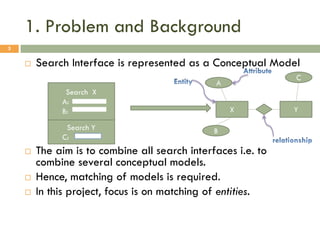
Search Interface is represented as a Conceptual Model
C

A
Search X
A:
B:
Search Y
C:






X

B

The aim is to combine all search interfaces i.e. to
combine several conceptual models.
Hence, matching of models is required.
In this project, focus is on matching of entities.

Y
2. Research Questions
4







Find an Entity Matching Technique(s) to match
entities of two models.
Does this technique (or combination of techniques )
provide a good way to compare two entities?
What other basis of comparison can be used?
3. Initial Dataset A
5




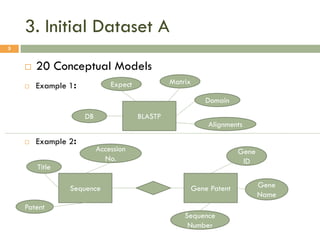
20 Conceptual Models
Expect
Example 1:

Matrix
Domain

DB


Example 2:

BLASTP

Alignments

Accession
No.

Gene
ID

Title

Sequence

Gene Patent

Patent
Sequence
Number

Gene
Name
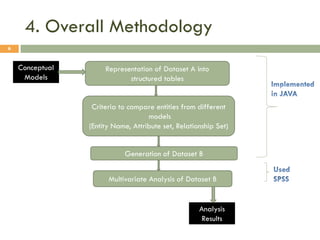
4. Overall Methodology
6

Conceptual
Models

Representation of Dataset A into
structured tables
Criteria to compare entities from different
models
(Entity Name, Attribute set, Relationship Set)
Generation of Dataset B
Multivariate Analysis of Dataset B

Analysis
Results
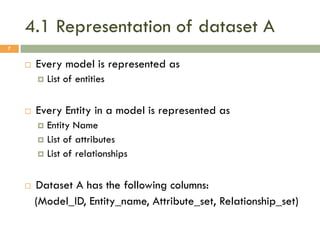
4.1 Representation of dataset A
7



Every model is represented as




List of entities

Every Entity in a model is represented as
Entity Name
 List of attributes
 List of relationships




Dataset A has the following columns:
(Model_ID, Entity_name, Attribute_set, Relationship_set)
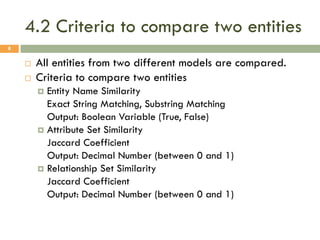
4.2 Criteria to compare two entities
8




All entities from two different models are compared.
Criteria to compare two entities
Entity Name Similarity
Exact String Matching, Substring Matching
Output: Boolean Variable (True, False)
 Attribute Set Similarity
Jaccard Coefficient
Output: Decimal Number (between 0 and 1)
 Relationship Set Similarity
Jaccard Coefficient
Output: Decimal Number (between 0 and 1)

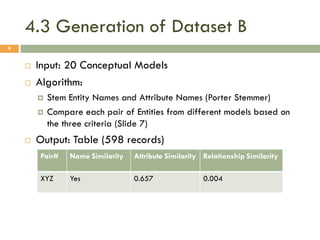
4.3 Generation of Dataset B
9





Input: 20 Conceptual Models
Algorithm:





Stem Entity Names and Attribute Names (Porter Stemmer)
Compare each pair of Entities from different models based on
the three criteria (Slide 7)

Output: Table (598 records)
Pair#

Name Similarity

Attribute Similarity Relationship Similarity

XYZ

Yes

0.657

0.004
4.4 Multivariate Analysis of dataset B
10




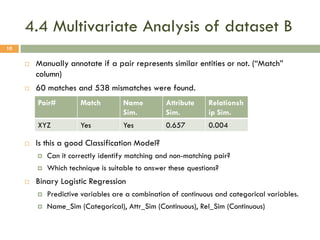
Manually annotate if a pair represents similar entities or not. (“Match”
column)
60 matches and 538 mismatches were found.
Pair#

Name
Sim.

Attribute
Sim.

Relationsh
ip Sim.

XYZ


Match
Yes

Yes

0.657

0.004

Is this a good Classification Model?





Can it correctly identify matching and non-matching pair?
Which technique is suitable to answer these questions?

Binary Logistic Regression


Predictive variables are a combination of continuous and categorical variables.



Name_Sim (Categorical), Attr_Sim (Continuous), Rel_Sim (Continuous)
5. Results
11



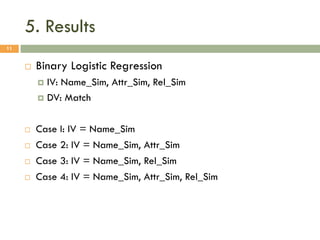
Binary Logistic Regression
IV: Name_Sim, Attr_Sim, Rel_Sim
 DV: Match







Case I: IV = Name_Sim
Case 2: IV = Name_Sim, Attr_Sim
Case 3: IV = Name_Sim, Rel_Sim
Case 4: IV = Name_Sim, Attr_Sim, Rel_Sim
5.1 Results: Case 1and Case 2
12

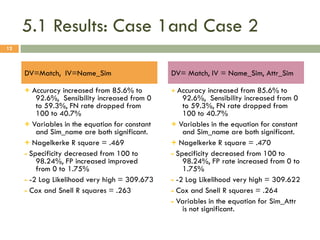
DV=Match, IV=Name_Sim

DV= Match, IV = Name_Sim, Attr_Sim

+ Accuracy increased from 85.6% to
92.6%, Sensibility increased from 0
to 59.3%, FN rate dropped from
100 to 40.7%
+ Variables in the equation for constant
and Sim_name are both significant.
+ Nagelkerke R square = .469
- Specificity decreased from 100 to
98.24%, FP increased improved
from 0 to 1.75%
- -2 Log Likelihood very high = 309.673
- Cox and Snell R squares = .263

+ Accuracy

increased from 85.6% to
92.6%, Sensibility increased from 0
to 59.3%, FN rate dropped from
100 to 40.7%
+ Variables in the equation for constant
and Sim_name are both significant.
+ Nagelkerke R square = .470
- Specificity decreased from 100 to
98.24%, FP rate increased from 0 to
1.75%
- -2 Log Likelihood very high = 309.622
- Cox and Snell R squares = .264
- Variables in the equation for Sim_Attr
is not significant.
5.2 Results: Case 3 and 4
13

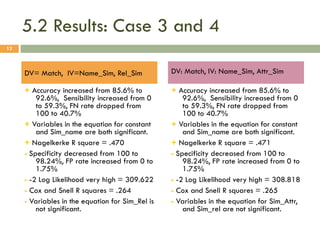
DV= Match, IV=Name_Sim, Rel_Sim

DV: Match, IV: Name_Sim, Attr_Sim

+ Accuracy increased from 85.6% to
92.6%, Sensibility increased from 0
to 59.3%, FN rate dropped from
100 to 40.7%
+ Variables in the equation for constant
and Sim_name are both significant.
+ Nagelkerke R square = .470
- Specificity decreased from 100 to
98.24%, FP rate increased from 0 to
1.75%
- -2 Log Likelihood very high = 309.622
- Cox and Snell R squares = .264
- Variables in the equation for Sim_Rel is
not significant.

+ Accuracy increased from 85.6% to
92.6%, Sensibility increased from 0
to 59.3%, FN rate dropped from
100 to 40.7%
+ Variables in the equation for constant
and Sim_name are both significant.
+ Nagelkerke R square = .471
- Specificity decreased from 100 to
98.24%, FP rate increased from 0 to
1.75%
- -2 Log Likelihood very high = 308.818
- Cox and Snell R squares = .265
- Variables in the equation for Sim_Attr,
and Sim_rel are not significant.
6. Inferences
14





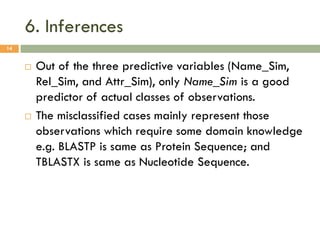
Out of the three predictive variables (Name_Sim,
Rel_Sim, and Attr_Sim), only Name_Sim is a good
predictor of actual classes of observations.
The misclassified cases mainly represent those
observations which require some domain knowledge
e.g. BLASTP is same as Protein Sequence; and
TBLASTX is same as Nucleotide Sequence.
7. Future Work
15









Improve Similarity Function
Use of domain dictionaries
Include more number of models
Generate a new classification function
Clustering entities that are found similar
References
16









NAR Journal dataset
Porter’s Stemming Algorithm:
http://tartarus.org/~martin/PorterStemmer/
Sharma, S. (1995), Applied Multivariate Techniques,
John Wiley & Sons, Inc. New York, NY, USA.
INFO 692 Lecture Handouts
17

Thank You
Questions, Comments, Ideas…?

Matching Conceptual Models Using Multivariate Analysis

  • 1.
    1 MATCHING CONCEPTUAL MODELS (PARTOF THE ‘IBIOSEARCH’ PROJECT) JUNE 9 2008 Quantitative Methods Ritu Khare
  • 2.
    Order of thePresentation 2     Problem and Background Research Questions Initial Dataset Overall Methodology Representation of Dataset A  Criteria to compare two entities  Generation of dataset B  Multivariate Analysis of dataset B   Results Case I  Case II  Case III  Case IV     Inferences Future Work References
  • 3.
    1. Problem andBackground 3  Search Interface is represented as a Conceptual Model C A Search X A: B: Search Y C:    X B The aim is to combine all search interfaces i.e. to combine several conceptual models. Hence, matching of models is required. In this project, focus is on matching of entities. Y
  • 4.
    2. Research Questions 4    Findan Entity Matching Technique(s) to match entities of two models. Does this technique (or combination of techniques ) provide a good way to compare two entities? What other basis of comparison can be used?
  • 5.
    3. Initial DatasetA 5   20 Conceptual Models Expect Example 1: Matrix Domain DB  Example 2: BLASTP Alignments Accession No. Gene ID Title Sequence Gene Patent Patent Sequence Number Gene Name
  • 6.
    4. Overall Methodology 6 Conceptual Models Representationof Dataset A into structured tables Criteria to compare entities from different models (Entity Name, Attribute set, Relationship Set) Generation of Dataset B Multivariate Analysis of Dataset B Analysis Results
  • 7.
    4.1 Representation ofdataset A 7  Every model is represented as   List of entities Every Entity in a model is represented as Entity Name  List of attributes  List of relationships   Dataset A has the following columns: (Model_ID, Entity_name, Attribute_set, Relationship_set)
  • 8.
    4.2 Criteria tocompare two entities 8   All entities from two different models are compared. Criteria to compare two entities Entity Name Similarity Exact String Matching, Substring Matching Output: Boolean Variable (True, False)  Attribute Set Similarity Jaccard Coefficient Output: Decimal Number (between 0 and 1)  Relationship Set Similarity Jaccard Coefficient Output: Decimal Number (between 0 and 1) 
  • 9.
    4.3 Generation ofDataset B 9   Input: 20 Conceptual Models Algorithm:    Stem Entity Names and Attribute Names (Porter Stemmer) Compare each pair of Entities from different models based on the three criteria (Slide 7) Output: Table (598 records) Pair# Name Similarity Attribute Similarity Relationship Similarity XYZ Yes 0.657 0.004
  • 10.
    4.4 Multivariate Analysisof dataset B 10   Manually annotate if a pair represents similar entities or not. (“Match” column) 60 matches and 538 mismatches were found. Pair# Name Sim. Attribute Sim. Relationsh ip Sim. XYZ  Match Yes Yes 0.657 0.004 Is this a good Classification Model?    Can it correctly identify matching and non-matching pair? Which technique is suitable to answer these questions? Binary Logistic Regression  Predictive variables are a combination of continuous and categorical variables.  Name_Sim (Categorical), Attr_Sim (Continuous), Rel_Sim (Continuous)
  • 11.
    5. Results 11  Binary LogisticRegression IV: Name_Sim, Attr_Sim, Rel_Sim  DV: Match      Case I: IV = Name_Sim Case 2: IV = Name_Sim, Attr_Sim Case 3: IV = Name_Sim, Rel_Sim Case 4: IV = Name_Sim, Attr_Sim, Rel_Sim
  • 12.
    5.1 Results: Case1and Case 2 12 DV=Match, IV=Name_Sim DV= Match, IV = Name_Sim, Attr_Sim + Accuracy increased from 85.6% to 92.6%, Sensibility increased from 0 to 59.3%, FN rate dropped from 100 to 40.7% + Variables in the equation for constant and Sim_name are both significant. + Nagelkerke R square = .469 - Specificity decreased from 100 to 98.24%, FP increased improved from 0 to 1.75% - -2 Log Likelihood very high = 309.673 - Cox and Snell R squares = .263 + Accuracy increased from 85.6% to 92.6%, Sensibility increased from 0 to 59.3%, FN rate dropped from 100 to 40.7% + Variables in the equation for constant and Sim_name are both significant. + Nagelkerke R square = .470 - Specificity decreased from 100 to 98.24%, FP rate increased from 0 to 1.75% - -2 Log Likelihood very high = 309.622 - Cox and Snell R squares = .264 - Variables in the equation for Sim_Attr is not significant.
  • 13.
    5.2 Results: Case3 and 4 13 DV= Match, IV=Name_Sim, Rel_Sim DV: Match, IV: Name_Sim, Attr_Sim + Accuracy increased from 85.6% to 92.6%, Sensibility increased from 0 to 59.3%, FN rate dropped from 100 to 40.7% + Variables in the equation for constant and Sim_name are both significant. + Nagelkerke R square = .470 - Specificity decreased from 100 to 98.24%, FP rate increased from 0 to 1.75% - -2 Log Likelihood very high = 309.622 - Cox and Snell R squares = .264 - Variables in the equation for Sim_Rel is not significant. + Accuracy increased from 85.6% to 92.6%, Sensibility increased from 0 to 59.3%, FN rate dropped from 100 to 40.7% + Variables in the equation for constant and Sim_name are both significant. + Nagelkerke R square = .471 - Specificity decreased from 100 to 98.24%, FP rate increased from 0 to 1.75% - -2 Log Likelihood very high = 308.818 - Cox and Snell R squares = .265 - Variables in the equation for Sim_Attr, and Sim_rel are not significant.
  • 14.
    6. Inferences 14   Out ofthe three predictive variables (Name_Sim, Rel_Sim, and Attr_Sim), only Name_Sim is a good predictor of actual classes of observations. The misclassified cases mainly represent those observations which require some domain knowledge e.g. BLASTP is same as Protein Sequence; and TBLASTX is same as Nucleotide Sequence.
  • 15.
    7. Future Work 15      ImproveSimilarity Function Use of domain dictionaries Include more number of models Generate a new classification function Clustering entities that are found similar
  • 16.
    References 16     NAR Journal dataset Porter’sStemming Algorithm: http://tartarus.org/~martin/PorterStemmer/ Sharma, S. (1995), Applied Multivariate Techniques, John Wiley & Sons, Inc. New York, NY, USA. INFO 692 Lecture Handouts
  • 17.