17-1 Project Management
Project Management Triangle
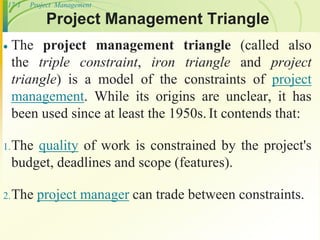
 The project management triangle (called also
the triple constraint, iron triangle and project
triangle) is a model of the constraints of project
management. While its origins are unclear, it has
been used since at least the 1950s. It contends that:
1.The quality of work is constrained by the project's
budget, deadlines and scope (features).
2.The project manager can trade between constraints.
17-2 Project Management
Project Management Triangle
17-3 Project Management
Project Management Triangle
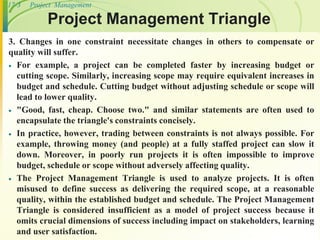
3. Changes in one constraint necessitate changes in others to compensate or
quality will suffer.
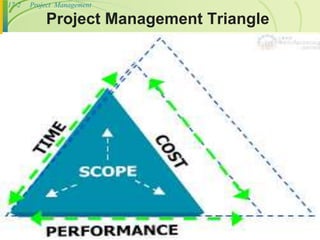
 For example, a project can be completed faster by increasing budget or
cutting scope. Similarly, increasing scope may require equivalent increases in
budget and schedule. Cutting budget without adjusting schedule or scope will
lead to lower quality.
 "Good, fast, cheap. Choose two." and similar statements are often used to
encapsulate the triangle's constraints concisely.
 In practice, however, trading between constraints is not always possible. For
example, throwing money (and people) at a fully staffed project can slow it
down. Moreover, in poorly run projects it is often impossible to improve
budget, schedule or scope without adversely affecting quality.
 The Project Management Triangle is used to analyze projects. It is often
misused to define success as delivering the required scope, at a reasonable
quality, within the established budget and schedule. The Project Management
Triangle is considered insufficient as a model of project success because it
omits crucial dimensions of success including impact on stakeholders, learning
and user satisfaction.

Project Management Triangle.ppt

  • 1.
    17-1 Project Management ProjectManagement Triangle  The project management triangle (called also the triple constraint, iron triangle and project triangle) is a model of the constraints of project management. While its origins are unclear, it has been used since at least the 1950s. It contends that: 1.The quality of work is constrained by the project's budget, deadlines and scope (features). 2.The project manager can trade between constraints.
  • 2.
  • 3.
    17-3 Project Management ProjectManagement Triangle 3. Changes in one constraint necessitate changes in others to compensate or quality will suffer.  For example, a project can be completed faster by increasing budget or cutting scope. Similarly, increasing scope may require equivalent increases in budget and schedule. Cutting budget without adjusting schedule or scope will lead to lower quality.  "Good, fast, cheap. Choose two." and similar statements are often used to encapsulate the triangle's constraints concisely.  In practice, however, trading between constraints is not always possible. For example, throwing money (and people) at a fully staffed project can slow it down. Moreover, in poorly run projects it is often impossible to improve budget, schedule or scope without adversely affecting quality.  The Project Management Triangle is used to analyze projects. It is often misused to define success as delivering the required scope, at a reasonable quality, within the established budget and schedule. The Project Management Triangle is considered insufficient as a model of project success because it omits crucial dimensions of success including impact on stakeholders, learning and user satisfaction.