Organizational Project Management
(OPM)
Lecture 4-8
Rehmat Karim, Project Management, Evaluation, Monitoring and Reporting Specialist
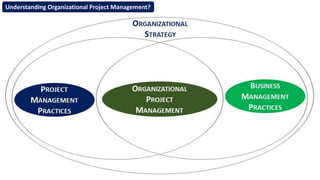
Understanding Organizational Project Management?
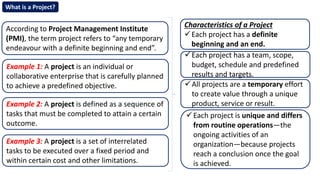
What is a Project?
According to Project Management Institute
(PMI), the term project refers to “any temporary
endeavour with a definite beginning and end”.
Example 1: A project is an individual or
collaborative enterprise that is carefully planned
to achieve a predefined objective.
Example 2: A project is defined as a sequence of
tasks that must be completed to attain a certain
outcome.
Example 3: A project is a set of interrelated
tasks to be executed over a fixed period and
within certain cost and other limitations.
Each project is unique and differs
from routine operations—the
ongoing activities of an
organization—because projects
reach a conclusion once the goal
is achieved.
Characteristics of a Project
Each project has a definite
beginning and an end.
Each project has a team, scope,
budget, schedule and predefined
results and targets.
All projects are a temporary effort
to create value through a unique
product, service or result.
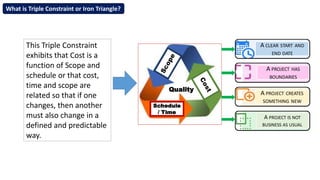
Schedule
/ Time
Quality
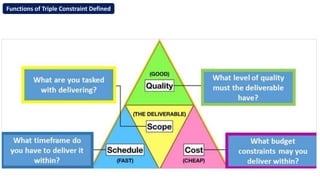
This Triple Constraint
exhibits that Cost is a
function of Scope and
schedule or that cost,
time and scope are
related so that if one
changes, then another
must also change in a
defined and predictable
way.
A CLEAR START AND
END DATE
A PROJECT HAS
BOUNDARIES
A PROJECT CREATES
SOMETHING NEW
A PROJECT IS NOT
BUSINESS USUAL
A PROJECT IS
BUSINESS AS USUAL
A PROJECT IS NOT
BUSINESS AS USUAL
A PROJECT IS NOT
BUSINESS AS USUAL
What is Triple Constraint or Iron Triangle?
Functions of Triple Constraint Defined
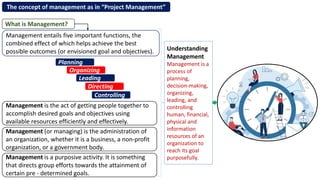
The concept of management as in “Project Management”
Management entails five important functions, the
combined effect of which helps achieve the best
possible outcomes (or envisioned goal and objectives).
Management is the act of getting people together to
accomplish desired goals and objectives using
available resources efficiently and effectively.
What is Management?
Management (or managing) is the administration of
an organization, whether it is a business, a non-profit
organization, or a government body.
Management is a purposive activity. It is something
that directs group efforts towards the attainment of
certain pre - determined goals.
Planning
Organizing
Leading
Directing
Controlling
Understanding
Management
Management is a
process of
planning,
decision-making,
organizing,
leading, and
controlling
human, financial,
physical and
information
resources of an
organization to
reach its goal
purposefully.
According to PMI, “Project management is the use
of specific knowledge, skills, tools and techniques
to deliver something of value to people.”
Project management is the practice of applying
knowledge, skills, tools, and techniques to
complete a project according to specific
requirements.
What is Project Management?
The construction of a building, the relief effort
after a natural disaster, the expansion of sales into
a new geographic market, the development of
software for an improved business process - these
are all examples of projects.
[https://www.pmi.org/about/learn-about-pmi/what-is-project-management]
Project management is defined as a collection of
proven techniques for proposing, planning,
implementing, managing, and evaluating projects,
combined with the art of managing people.
People at Work!
World View of Projects
World Bank: [https://projects.worldbank.org/en/projects-operations/products-and-services/brief/projectcycle]
Project cycle is the framework used to design, prepare, implement, and supervise projects
PMI: [https://www.pmi.org/about/learn-about-pmi/what-is-project-management]
1) Project Management Drives Change
PMI: [https://www.pmi.org/learning/library/global-project-management-framework-6863]
1) Global projects involve team members from various cultures and organizations, spread in locations across
countries and time zones, and speaking different native languages
4) Through projects change is realized and value is
delivered
2) We live in the project economy
3) Projects are the driving force behind how work is done
5) Project management is a strategic
organizational competence and career path
2) Each of these dimensions can contribute to the success of the team and the quality of project deliverables,
while adding challenges to project and program managers, PMOs, and the team members
3) Global Project Managers must be ready to face the challenges of cross-cultural communication, different
organizations, skewed time zones, multiple languages, and collaboration across locations
World Bank projects consist of six stages: (1) Identification, (2) Preparation, (3) Appraisal, (4) Negotiation /
Approval, (5) Implementation/Support, and (6) Completion / Evaluation
Projects of today both shape
and are shaped by the
society (Packendorff and
Lindgren, 2014)
[https://www.emerald.com/insight/content/doi/
10.1108/IJMPB-06-2019-285/full/html]
1) Cost or budget
2) Scope
3) Quality
4) Risk
5) Time or schedule
6) Resource
7) [https://opentextbc.ca/projectmanagement/chapter/c
hapter-2-what-is-a-project-project-management/]
 Projects have distinctive attributes that distinguish them from ongoing work or business operations.
 Projects are temporary in nature.
 They are not an everyday business process and have definitive start dates and end dates.
 Project efforts are dedicated to ensuring that they are completed at the appointed time.
 Schedules are created showing when tasks should begin and end.
 Projects can last minutes, hours, days, weeks, months, or years.
 Project Management Constraints:
World View of Projects…
Five Project Management Approaches
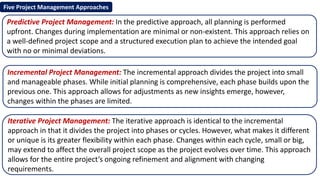
Predictive Project Management: In the predictive approach, all planning is performed
upfront. Changes during implementation are minimal or non-existent. This approach relies on
a well-defined project scope and a structured execution plan to achieve the intended goal
with no or minimal deviations.
Iterative Project Management: The iterative approach is identical to the incremental
approach in that it divides the project into phases or cycles. However, what makes it different
or unique is its greater flexibility within each phase. Changes within each cycle, small or big,
may extend to affect the overall project scope as the project evolves over time. This approach
allows for the entire project’s ongoing refinement and alignment with changing
requirements.
Incremental Project Management: The incremental approach divides the project into small
and manageable phases. While initial planning is comprehensive, each phase builds upon the
previous one. This approach allows for adjustments as new insights emerge, however,
changes within the phases are limited.
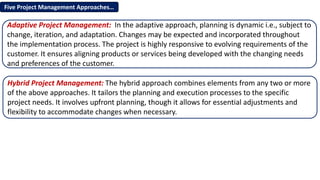
Adaptive Project Management: In the adaptive approach, planning is dynamic i.e., subject to
change, iteration, and adaptation. Changes may be expected and incorporated throughout
the implementation process. The project is highly responsive to evolving requirements of the
customer. It ensures aligning products or services being developed with the changing needs
and preferences of the customer.
Hybrid Project Management: The hybrid approach combines elements from any two or more
of the above approaches. It tailors the planning and execution processes to the specific
project needs. It involves upfront planning, though it allows for essential adjustments and
flexibility to accommodate changes when necessary.
Five Project Management Approaches…
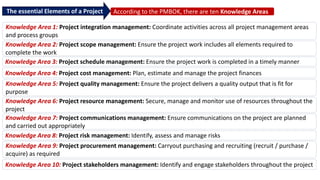
Knowledge Area 1: Project integration management: Coordinate activities across all project management areas
and process groups
Knowledge Area 2: Project scope management: Ensure the project work includes all elements required to
complete the work
According to the PMBOK, there are ten Knowledge Areas
Knowledge Area 3: Project schedule management: Ensure the project work is completed in a timely manner
Knowledge Area 4: Project cost management: Plan, estimate and manage the project finances
Knowledge Area 5: Project quality management: Ensure the project delivers a quality output that is fit for
purpose
Knowledge Area 6: Project resource management: Secure, manage and monitor use of resources throughout the
project
Knowledge Area 7: Project communications management: Ensure communications on the project are planned
and carried out appropriately
Knowledge Area 8: Project risk management: Identify, assess and manage risks
Knowledge Area 9: Project procurement management: Carryout purchasing and recruiting (recruit / purchase /
acquire) as required
Knowledge Area 10: Project stakeholders management: Identify and engage stakeholders throughout the project
The essential Elements of a Project
Understanding Organizations, Projects, and Products – The Conceptual Frameworks or Models?
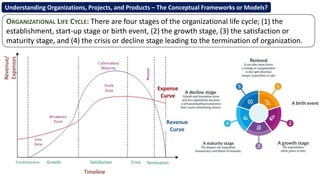
ORGANIZATIONAL LIFE CYCLE: There are four stages of the organizational life cycle; (1) the
establishment, start-up stage or birth event, (2) the growth stage, (3) the satisfaction or
maturity stage, and (4) the crisis or decline stage leading to the termination of organization.
The essential Elements of Project Management
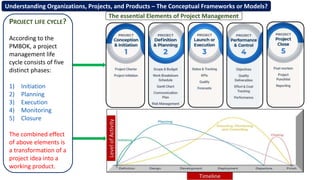
PROJECT LIFE CYCLE?
According to the
PMBOK, a project
management life
cycle consists of five
distinct phases:
1) Initiation
2) Planning
3) Execution
4) Monitoring
5) Closure
The combined effect
of above elements is
a transformation of a
project idea into a
working product.
Understanding Organizations, Projects, and Products – The Conceptual Frameworks or Models?
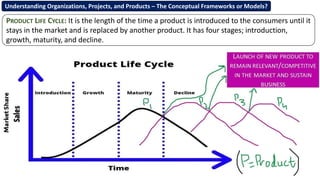
PRODUCT LIFE CYCLE: It is the length of the time a product is introduced to the consumers until it
stays in the market and is replaced by another product. It has four stages; introduction,
growth, maturity, and decline.
Understanding Organizations, Projects, and Products – The Conceptual Frameworks or Models?
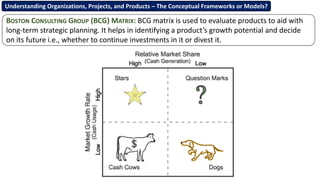
BOSTON CONSULTING GROUP (BCG) MATRIX: BCG matrix is used to evaluate products to aid with
long-term strategic planning. It helps in identifying a product’s growth potential and decide
on its future i.e., whether to continue investments in it or divest it.
Understanding Organizations, Projects, and Products – The Conceptual Frameworks or Models?
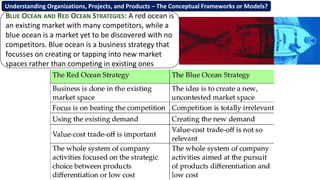
BLUE OCEAN AND RED OCEAN STRATEGIES: A red ocean is
an existing market with many competitors, while a
blue ocean is a market yet to be discovered with no
competitors. Blue ocean is a business strategy that
focusses on creating or tapping into new market
spaces rather than competing in existing ones
Understanding Organizations, Projects, and Products – The Conceptual Frameworks or Models?
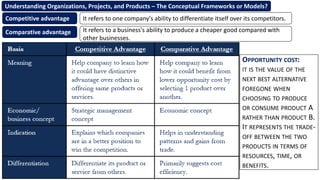
OPPORTUNITY COST:
IT IS THE VALUE OF THE
NEXT BEST ALTERNATIVE
FOREGONE WHEN
CHOOSING TO PRODUCE
OR CONSUME PRODUCT A
RATHER THAN PRODUCT B.
IT REPRESENTS THE TRADE-
OFF BETWEEN THE TWO
PRODUCTS IN TERMS OF
RESOURCES, TIME, OR
BENEFITS.
Competitive advantage It refers to one company's ability to differentiate itself over its competitors.
It refers to a business's ability to produce a cheaper good compared with
other businesses.
Comparative advantage
Understanding Organizations, Projects, and Products – The Conceptual Frameworks or Models?
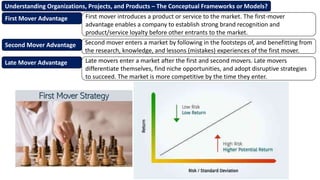
First Mover Advantage First mover introduces a product or service to the market. The first-mover
advantage enables a company to establish strong brand recognition and
product/service loyalty before other entrants to the market.
Second mover enters a market by following in the footsteps of, and benefitting from
the research, knowledge, and lessons (mistakes) experiences of the first mover.
Second Mover Advantage
Late movers enter a market after the first and second movers. Late movers
differentiate themselves, find niche opportunities, and adopt disruptive strategies
to succeed. The market is more competitive by the time they enter.
Late Mover Advantage
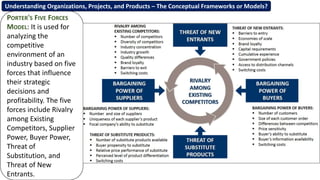
PORTER'S FIVE FORCES
MODEL: It is used for
analyzing the
competitive
environment of an
industry based on five
forces that influence
their strategic
decisions and
profitability. The five
forces include Rivalry
among Existing
Competitors, Supplier
Power, Buyer Power,
Threat of
Substitution, and
Threat of New
Entrants.
Understanding Organizations, Projects, and Products – The Conceptual Frameworks or Models?
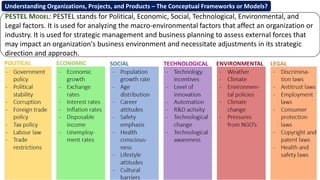
PESTEL MODEL: PESTEL stands for Political, Economic, Social, Technological, Environmental, and
Legal factors. It is used for analyzing the macro-environmental factors that affect an organization or
industry. It is used for strategic management and business planning to assess external forces that
may impact an organization's business environment and necessitate adjustments in its strategic
direction and approach.
Understanding Organizations, Projects, and Products – The Conceptual Frameworks or Models?
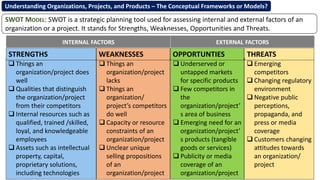
SWOT MODEL: SWOT is a strategic planning tool used for assessing internal and external factors of an
organization or a project. It stands for Strengths, Weaknesses, Opportunities and Threats.
Understanding Organizations, Projects, and Products – The Conceptual Frameworks or Models?
 Things an
organization/project does
well
 Qualities that distinguish
the organization/project
from their competitors
 Internal resources such as
qualified, trained /skilled,
loyal, and knowledgeable
employees
 Assets such as intellectual
property, capital,
proprietary solutions,
including technologies
 Things an
organization/project
lacks
 Things an
organization/
project’s competitors
do well
 Capacity or resource
constraints of an
organization/project
 Unclear unique
selling propositions
of an
organization/project
 Underserved or
untapped markets
for specific products
 Few competitors in
the
organization/project’
s area of business
 Emerging need for an
organization/project’
s products (tangible
goods or services)
 Publicity or media
coverage of an
organization/project
 Emerging
competitors
 Changing regulatory
environment
 Negative public
perceptions,
propaganda, and
press or media
coverage
 Customers changing
attitudes towards
an organization/
project
STRENGTHS WEAKNESSES OPPORTUNTIES THREATS
INTERNAL FACTORS EXTERNAL FACTORS
Monitoring and Evaluation Versus Quality Assurance (QA) and Quality Control (QC)
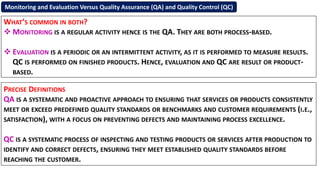
WHAT’S COMMON IN BOTH?
 MONITORING IS A REGULAR ACTIVITY HENCE IS THE QA. THEY ARE BOTH PROCESS-BASED.
 EVALUATION IS A PERIODIC OR AN INTERMITTENT ACTIVITY, AS IT IS PERFORMED TO MEASURE RESULTS.
QC IS PERFORMED ON FINISHED PRODUCTS. HENCE, EVALUATION AND QC ARE RESULT OR PRODUCT-
BASED.
PRECISE DEFINITIONS
QA IS A SYSTEMATIC AND PROACTIVE APPROACH TO ENSURING THAT SERVICES OR PRODUCTS CONSISTENTLY
MEET OR EXCEED PREDEFINED QUALITY STANDARDS OR BENCHMARKS AND CUSTOMER REQUIREMENTS (I.E.,
SATISFACTION), WITH A FOCUS ON PREVENTING DEFECTS AND MAINTAINING PROCESS EXCELLENCE.
QC IS A SYSTEMATIC PROCESS OF INSPECTING AND TESTING PRODUCTS OR SERVICES AFTER PRODUCTION TO
IDENTIFY AND CORRECT DEFECTS, ENSURING THEY MEET ESTABLISHED QUALITY STANDARDS BEFORE
REACHING THE CUSTOMER.
Project Quality Management
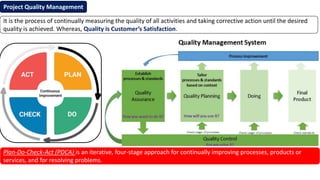
Plan-Do-Check-Act (PDCA) is an iterative, four-stage approach for continually improving processes, products or
services, and for resolving problems.
It is the process of continually measuring the quality of all activities and taking corrective action until the desired
quality is achieved. Whereas, Quality is Customer’s Satisfaction.
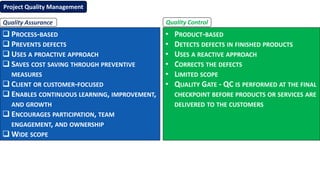
 PROCESS-BASED
 PREVENTS DEFECTS
 USES A PROACTIVE APPROACH
 SAVES COST SAVING THROUGH PREVENTIVE
MEASURES
 CLIENT OR CUSTOMER-FOCUSED
 ENABLES CONTINUOUS LEARNING, IMPROVEMENT,
AND GROWTH
 ENCOURAGES PARTICIPATION, TEAM
ENGAGEMENT, AND OWNERSHIP
 WIDE SCOPE
• PRODUCT-BASED
• DETECTS DEFECTS IN FINISHED PRODUCTS
• USES A REACTIVE APPROACH
• CORRECTS THE DEFECTS
• LIMITED SCOPE
• QUALITY GATE - QC IS PERFORMED AT THE FINAL
CHECKPOINT BEFORE PRODUCTS OR SERVICES ARE
DELIVERED TO THE CUSTOMERS
Quality Assurance Quality Control
Project Quality Management
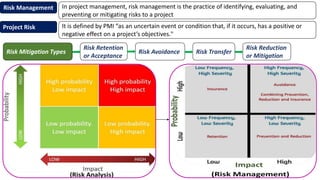
Risk Mitigation Types
Risk Retention
or Acceptance
Risk Avoidance Risk Transfer
Risk Reduction
or Mitigation
Risk Management In project management, risk management is the practice of identifying, evaluating, and
preventing or mitigating risks to a project
It is defined by PMI “as an uncertain event or condition that, if it occurs, has a positive or
negative effect on a project’s objectives."
Project Risk
Stakeholder Analysis
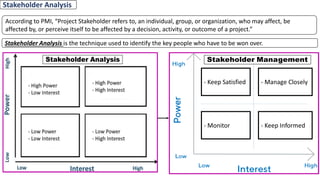
According to PMI, “Project Stakeholder refers to, an individual, group, or organization, who may affect, be
affected by, or perceive itself to be affected by a decision, activity, or outcome of a project.”
Stakeholder Analysis is the technique used to identify the key people who have to be won over.
Stakeholder Analysis Stakeholder Management
- Keep Satisfied - Manage Closely
- Monitor - Keep Informed

5 Forces Model - SWOT, PESTEL presentation.pptx

  • 1.
    Organizational Project Management (OPM) Lecture4-8 Rehmat Karim, Project Management, Evaluation, Monitoring and Reporting Specialist
  • 2.
  • 3.
    What is aProject? According to Project Management Institute (PMI), the term project refers to “any temporary endeavour with a definite beginning and end”. Example 1: A project is an individual or collaborative enterprise that is carefully planned to achieve a predefined objective. Example 2: A project is defined as a sequence of tasks that must be completed to attain a certain outcome. Example 3: A project is a set of interrelated tasks to be executed over a fixed period and within certain cost and other limitations. Each project is unique and differs from routine operations—the ongoing activities of an organization—because projects reach a conclusion once the goal is achieved. Characteristics of a Project Each project has a definite beginning and an end. Each project has a team, scope, budget, schedule and predefined results and targets. All projects are a temporary effort to create value through a unique product, service or result.
  • 4.
    Schedule / Time Quality This TripleConstraint exhibits that Cost is a function of Scope and schedule or that cost, time and scope are related so that if one changes, then another must also change in a defined and predictable way. A CLEAR START AND END DATE A PROJECT HAS BOUNDARIES A PROJECT CREATES SOMETHING NEW A PROJECT IS NOT BUSINESS USUAL A PROJECT IS BUSINESS AS USUAL A PROJECT IS NOT BUSINESS AS USUAL A PROJECT IS NOT BUSINESS AS USUAL What is Triple Constraint or Iron Triangle?
  • 5.
    Functions of TripleConstraint Defined
  • 6.
    The concept ofmanagement as in “Project Management” Management entails five important functions, the combined effect of which helps achieve the best possible outcomes (or envisioned goal and objectives). Management is the act of getting people together to accomplish desired goals and objectives using available resources efficiently and effectively. What is Management? Management (or managing) is the administration of an organization, whether it is a business, a non-profit organization, or a government body. Management is a purposive activity. It is something that directs group efforts towards the attainment of certain pre - determined goals. Planning Organizing Leading Directing Controlling Understanding Management Management is a process of planning, decision-making, organizing, leading, and controlling human, financial, physical and information resources of an organization to reach its goal purposefully.
  • 7.
    According to PMI,“Project management is the use of specific knowledge, skills, tools and techniques to deliver something of value to people.” Project management is the practice of applying knowledge, skills, tools, and techniques to complete a project according to specific requirements. What is Project Management? The construction of a building, the relief effort after a natural disaster, the expansion of sales into a new geographic market, the development of software for an improved business process - these are all examples of projects. [https://www.pmi.org/about/learn-about-pmi/what-is-project-management] Project management is defined as a collection of proven techniques for proposing, planning, implementing, managing, and evaluating projects, combined with the art of managing people. People at Work!
  • 8.
    World View ofProjects World Bank: [https://projects.worldbank.org/en/projects-operations/products-and-services/brief/projectcycle] Project cycle is the framework used to design, prepare, implement, and supervise projects PMI: [https://www.pmi.org/about/learn-about-pmi/what-is-project-management] 1) Project Management Drives Change PMI: [https://www.pmi.org/learning/library/global-project-management-framework-6863] 1) Global projects involve team members from various cultures and organizations, spread in locations across countries and time zones, and speaking different native languages 4) Through projects change is realized and value is delivered 2) We live in the project economy 3) Projects are the driving force behind how work is done 5) Project management is a strategic organizational competence and career path 2) Each of these dimensions can contribute to the success of the team and the quality of project deliverables, while adding challenges to project and program managers, PMOs, and the team members 3) Global Project Managers must be ready to face the challenges of cross-cultural communication, different organizations, skewed time zones, multiple languages, and collaboration across locations World Bank projects consist of six stages: (1) Identification, (2) Preparation, (3) Appraisal, (4) Negotiation / Approval, (5) Implementation/Support, and (6) Completion / Evaluation
  • 9.
    Projects of todayboth shape and are shaped by the society (Packendorff and Lindgren, 2014) [https://www.emerald.com/insight/content/doi/ 10.1108/IJMPB-06-2019-285/full/html] 1) Cost or budget 2) Scope 3) Quality 4) Risk 5) Time or schedule 6) Resource 7) [https://opentextbc.ca/projectmanagement/chapter/c hapter-2-what-is-a-project-project-management/]  Projects have distinctive attributes that distinguish them from ongoing work or business operations.  Projects are temporary in nature.  They are not an everyday business process and have definitive start dates and end dates.  Project efforts are dedicated to ensuring that they are completed at the appointed time.  Schedules are created showing when tasks should begin and end.  Projects can last minutes, hours, days, weeks, months, or years.  Project Management Constraints: World View of Projects…
  • 10.
    Five Project ManagementApproaches Predictive Project Management: In the predictive approach, all planning is performed upfront. Changes during implementation are minimal or non-existent. This approach relies on a well-defined project scope and a structured execution plan to achieve the intended goal with no or minimal deviations. Iterative Project Management: The iterative approach is identical to the incremental approach in that it divides the project into phases or cycles. However, what makes it different or unique is its greater flexibility within each phase. Changes within each cycle, small or big, may extend to affect the overall project scope as the project evolves over time. This approach allows for the entire project’s ongoing refinement and alignment with changing requirements. Incremental Project Management: The incremental approach divides the project into small and manageable phases. While initial planning is comprehensive, each phase builds upon the previous one. This approach allows for adjustments as new insights emerge, however, changes within the phases are limited.
  • 11.
    Adaptive Project Management:In the adaptive approach, planning is dynamic i.e., subject to change, iteration, and adaptation. Changes may be expected and incorporated throughout the implementation process. The project is highly responsive to evolving requirements of the customer. It ensures aligning products or services being developed with the changing needs and preferences of the customer. Hybrid Project Management: The hybrid approach combines elements from any two or more of the above approaches. It tailors the planning and execution processes to the specific project needs. It involves upfront planning, though it allows for essential adjustments and flexibility to accommodate changes when necessary. Five Project Management Approaches…
  • 12.
    Knowledge Area 1:Project integration management: Coordinate activities across all project management areas and process groups Knowledge Area 2: Project scope management: Ensure the project work includes all elements required to complete the work According to the PMBOK, there are ten Knowledge Areas Knowledge Area 3: Project schedule management: Ensure the project work is completed in a timely manner Knowledge Area 4: Project cost management: Plan, estimate and manage the project finances Knowledge Area 5: Project quality management: Ensure the project delivers a quality output that is fit for purpose Knowledge Area 6: Project resource management: Secure, manage and monitor use of resources throughout the project Knowledge Area 7: Project communications management: Ensure communications on the project are planned and carried out appropriately Knowledge Area 8: Project risk management: Identify, assess and manage risks Knowledge Area 9: Project procurement management: Carryout purchasing and recruiting (recruit / purchase / acquire) as required Knowledge Area 10: Project stakeholders management: Identify and engage stakeholders throughout the project The essential Elements of a Project
  • 13.
    Understanding Organizations, Projects,and Products – The Conceptual Frameworks or Models? ORGANIZATIONAL LIFE CYCLE: There are four stages of the organizational life cycle; (1) the establishment, start-up stage or birth event, (2) the growth stage, (3) the satisfaction or maturity stage, and (4) the crisis or decline stage leading to the termination of organization.
  • 14.
    The essential Elementsof Project Management PROJECT LIFE CYCLE? According to the PMBOK, a project management life cycle consists of five distinct phases: 1) Initiation 2) Planning 3) Execution 4) Monitoring 5) Closure The combined effect of above elements is a transformation of a project idea into a working product. Understanding Organizations, Projects, and Products – The Conceptual Frameworks or Models?
  • 15.
    PRODUCT LIFE CYCLE:It is the length of the time a product is introduced to the consumers until it stays in the market and is replaced by another product. It has four stages; introduction, growth, maturity, and decline. Understanding Organizations, Projects, and Products – The Conceptual Frameworks or Models?
  • 16.
    BOSTON CONSULTING GROUP(BCG) MATRIX: BCG matrix is used to evaluate products to aid with long-term strategic planning. It helps in identifying a product’s growth potential and decide on its future i.e., whether to continue investments in it or divest it. Understanding Organizations, Projects, and Products – The Conceptual Frameworks or Models?
  • 17.
    BLUE OCEAN ANDRED OCEAN STRATEGIES: A red ocean is an existing market with many competitors, while a blue ocean is a market yet to be discovered with no competitors. Blue ocean is a business strategy that focusses on creating or tapping into new market spaces rather than competing in existing ones Understanding Organizations, Projects, and Products – The Conceptual Frameworks or Models?
  • 18.
    Understanding Organizations, Projects,and Products – The Conceptual Frameworks or Models? OPPORTUNITY COST: IT IS THE VALUE OF THE NEXT BEST ALTERNATIVE FOREGONE WHEN CHOOSING TO PRODUCE OR CONSUME PRODUCT A RATHER THAN PRODUCT B. IT REPRESENTS THE TRADE- OFF BETWEEN THE TWO PRODUCTS IN TERMS OF RESOURCES, TIME, OR BENEFITS. Competitive advantage It refers to one company's ability to differentiate itself over its competitors. It refers to a business's ability to produce a cheaper good compared with other businesses. Comparative advantage
  • 19.
    Understanding Organizations, Projects,and Products – The Conceptual Frameworks or Models? First Mover Advantage First mover introduces a product or service to the market. The first-mover advantage enables a company to establish strong brand recognition and product/service loyalty before other entrants to the market. Second mover enters a market by following in the footsteps of, and benefitting from the research, knowledge, and lessons (mistakes) experiences of the first mover. Second Mover Advantage Late movers enter a market after the first and second movers. Late movers differentiate themselves, find niche opportunities, and adopt disruptive strategies to succeed. The market is more competitive by the time they enter. Late Mover Advantage
  • 20.
    PORTER'S FIVE FORCES MODEL:It is used for analyzing the competitive environment of an industry based on five forces that influence their strategic decisions and profitability. The five forces include Rivalry among Existing Competitors, Supplier Power, Buyer Power, Threat of Substitution, and Threat of New Entrants. Understanding Organizations, Projects, and Products – The Conceptual Frameworks or Models?
  • 21.
    PESTEL MODEL: PESTELstands for Political, Economic, Social, Technological, Environmental, and Legal factors. It is used for analyzing the macro-environmental factors that affect an organization or industry. It is used for strategic management and business planning to assess external forces that may impact an organization's business environment and necessitate adjustments in its strategic direction and approach. Understanding Organizations, Projects, and Products – The Conceptual Frameworks or Models?
  • 22.
    SWOT MODEL: SWOTis a strategic planning tool used for assessing internal and external factors of an organization or a project. It stands for Strengths, Weaknesses, Opportunities and Threats. Understanding Organizations, Projects, and Products – The Conceptual Frameworks or Models?  Things an organization/project does well  Qualities that distinguish the organization/project from their competitors  Internal resources such as qualified, trained /skilled, loyal, and knowledgeable employees  Assets such as intellectual property, capital, proprietary solutions, including technologies  Things an organization/project lacks  Things an organization/ project’s competitors do well  Capacity or resource constraints of an organization/project  Unclear unique selling propositions of an organization/project  Underserved or untapped markets for specific products  Few competitors in the organization/project’ s area of business  Emerging need for an organization/project’ s products (tangible goods or services)  Publicity or media coverage of an organization/project  Emerging competitors  Changing regulatory environment  Negative public perceptions, propaganda, and press or media coverage  Customers changing attitudes towards an organization/ project STRENGTHS WEAKNESSES OPPORTUNTIES THREATS INTERNAL FACTORS EXTERNAL FACTORS
  • 23.
    Monitoring and EvaluationVersus Quality Assurance (QA) and Quality Control (QC) WHAT’S COMMON IN BOTH?  MONITORING IS A REGULAR ACTIVITY HENCE IS THE QA. THEY ARE BOTH PROCESS-BASED.  EVALUATION IS A PERIODIC OR AN INTERMITTENT ACTIVITY, AS IT IS PERFORMED TO MEASURE RESULTS. QC IS PERFORMED ON FINISHED PRODUCTS. HENCE, EVALUATION AND QC ARE RESULT OR PRODUCT- BASED. PRECISE DEFINITIONS QA IS A SYSTEMATIC AND PROACTIVE APPROACH TO ENSURING THAT SERVICES OR PRODUCTS CONSISTENTLY MEET OR EXCEED PREDEFINED QUALITY STANDARDS OR BENCHMARKS AND CUSTOMER REQUIREMENTS (I.E., SATISFACTION), WITH A FOCUS ON PREVENTING DEFECTS AND MAINTAINING PROCESS EXCELLENCE. QC IS A SYSTEMATIC PROCESS OF INSPECTING AND TESTING PRODUCTS OR SERVICES AFTER PRODUCTION TO IDENTIFY AND CORRECT DEFECTS, ENSURING THEY MEET ESTABLISHED QUALITY STANDARDS BEFORE REACHING THE CUSTOMER.
  • 24.
    Project Quality Management Plan-Do-Check-Act(PDCA) is an iterative, four-stage approach for continually improving processes, products or services, and for resolving problems. It is the process of continually measuring the quality of all activities and taking corrective action until the desired quality is achieved. Whereas, Quality is Customer’s Satisfaction.
  • 25.
     PROCESS-BASED  PREVENTSDEFECTS  USES A PROACTIVE APPROACH  SAVES COST SAVING THROUGH PREVENTIVE MEASURES  CLIENT OR CUSTOMER-FOCUSED  ENABLES CONTINUOUS LEARNING, IMPROVEMENT, AND GROWTH  ENCOURAGES PARTICIPATION, TEAM ENGAGEMENT, AND OWNERSHIP  WIDE SCOPE • PRODUCT-BASED • DETECTS DEFECTS IN FINISHED PRODUCTS • USES A REACTIVE APPROACH • CORRECTS THE DEFECTS • LIMITED SCOPE • QUALITY GATE - QC IS PERFORMED AT THE FINAL CHECKPOINT BEFORE PRODUCTS OR SERVICES ARE DELIVERED TO THE CUSTOMERS Quality Assurance Quality Control Project Quality Management
  • 26.
    Risk Mitigation Types RiskRetention or Acceptance Risk Avoidance Risk Transfer Risk Reduction or Mitigation Risk Management In project management, risk management is the practice of identifying, evaluating, and preventing or mitigating risks to a project It is defined by PMI “as an uncertain event or condition that, if it occurs, has a positive or negative effect on a project’s objectives." Project Risk
  • 27.
    Stakeholder Analysis According toPMI, “Project Stakeholder refers to, an individual, group, or organization, who may affect, be affected by, or perceive itself to be affected by a decision, activity, or outcome of a project.” Stakeholder Analysis is the technique used to identify the key people who have to be won over. Stakeholder Analysis Stakeholder Management - Keep Satisfied - Manage Closely - Monitor - Keep Informed