@Copyright: Msc. PMP. Nguyễn Thanh Phước
Project Management
Framework
PMP 7th
MSc. PMP. Nguyen Thanh Phuoc
phuocnt@gmail.com
@Copyright: Msc. PMP. Nguyễn Thanh Phước 2
Objectives
• Enterprise Environment Factor
– PMIS
• Organizational Process Asset
• Definition of a project and
Constraints
• Organizational Structure
– Matrix (Strong, Weak, Balanced)
– Functional
– Projectized
– Project-based organization
– Organizational Hierarchy
– Tight matrix
• Project Life Cycle
– Predictive, Incremental, Iterative,
Adaptive
• Work Performance Data and
Information
• Stakeholder Management
• Operational work
• PMO (Supportive, Controlling,
Directive)
• Program, Portfolio Management
@Copyright: Msc. PMP. Nguyễn Thanh Phước 3
Content
1. Project
2. Program & Portfolio
3. Project Management
Office
4. Operation
5. Project Manager
6. Organizational influence
on Project Management
7. Project Life Cycle
8. Project Element
@Copyright: Msc. PMP. Nguyễn Thanh Phước
1. Project
@Copyright: Msc. PMP. Nguyễn Thanh Phước
> Overview
5
• A project is a temporary endeavor undertaken to create
a unique product, service or result
Temporary
endeavor
Progressively
elaborated
Unique (product,
service, result)
@Copyright: Msc. PMP. Nguyễn Thanh Phước 6
> Overview
Has unique
purpose
It is temporary
Progressive
elaboration
Requires
Resources from
various areas
Initiate by
customer or
Sponsor
Uncertainty
@Copyright: Msc. PMP. Nguyễn Thanh Phước 7
> Overview
• When project will end?
– Terminated – due to change in strategy or many not be feasible
– Stopped – When need for project no longer exist
• Project’s are authorized because of
– Marketing Demand Strategic & business need
– Social need Customer request
– Legal Requirement Environment Consideration
@Copyright: Msc. PMP. Nguyễn Thanh Phước 8
> Project Management
• The application of knowledge, skills, tools & techniques
to project activities to meet project requirements.
@Copyright: Msc. PMP. Nguyễn Thanh Phước 9
> Project Management
Advantages
• Better control of financial, physical and human resource
• Improved customer relations
• Shorter development times
• Lower cost & Higher profit margins
• Improved productivity
• Better internal coordination
• Higher quality and increased reliability
@Copyright: Msc. PMP. Nguyễn Thanh Phước 10
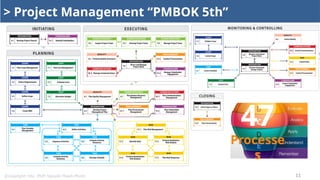
> Project Management “PMBOK 5th
” => PMBOK 6: 49.
@Copyright: Msc. PMP. Nguyễn Thanh Phước 11
> Project Management “PMBOK 5th”
47
Processe
s
@Copyright: Msc. PMP. Nguyễn Thanh Phước 12
> Project Management “PMBOK 6th”
@Copyright: Msc. PMP. Nguyễn Thanh Phước 13
> Project Management “PMBOK 6th”
@Copyright: Msc. PMP. Nguyễn Thanh Phước 14
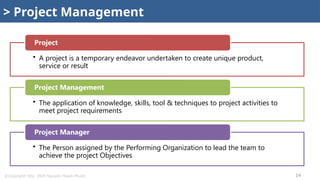
> Project Management
• A project is a temporary endeavor undertaken to create unique product,
service or result
Project
• The application of knowledge, skills, tool & techniques to project activities to
meet project requirements
Project Management
• The Person assigned by the Performing Organization to lead the team to
achieve the project Objectives
Project Manager
@Copyright: Msc. PMP. Nguyễn Thanh Phước
2. Program & Portfolio
@Copyright: Msc. PMP. Nguyễn Thanh Phước 16
> Program Overview
• Is a group of related projects that has
related output
• Attributes
– Decreased risk
– Economics of scale
– Align projects direction & improve co-
ordination
– Focus on inter-dependencies between
projects
• Need program manager’s coordination
and management activities
Project
3
Project4
Project2 Project6
Project
1
Project7
Program
Sub
Program
Project 1
Project 2
Project 3
@Copyright: Msc. PMP. Nguyễn Thanh Phước 17
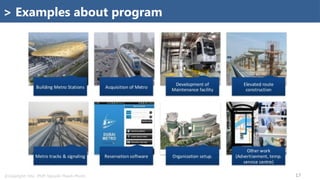
> Examples about program
@Copyright: Msc. PMP. Nguyễn Thanh Phước 18
> Program Management vs Program Manager
• The application of knowledge, skills, tool & techniques to program
activities to meet program requirements
• Obtain benefits and control not available by Managing Projects
individually
Program Management
• Provides leaderships and direction for the project managers heading
the project in the program
• Focus on Benefits
• Decreased risk
Program Manager
@Copyright: Msc. PMP. Nguyễn Thanh Phước 19
> Portfolio Overview
• Is a group of related program,
individual project and other related
operation work
• Attributes
– Helps achieve specific strategic business
goals, Enhance benefits to Organization
– Reduce risks
– Optimize use of resources
– Include Operations
– Not necessarily directly related between
projects
Portfolio
Sub Portfolio
Project
Program
Project
Program
Project
Project
Operations
@Copyright: Msc. PMP. Nguyễn Thanh Phước 20
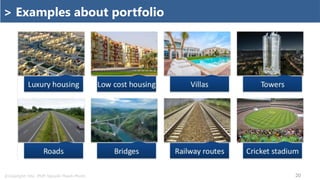
> Examples about portfolio
@Copyright: Msc. PMP. Nguyễn Thanh Phước
3. Project Management Office (PMO)
21
@Copyright: Msc. PMP. Nguyễn Thanh Phước 22
> Overview
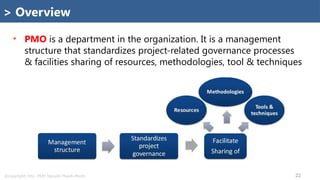
• PMO is a department in the organization. It is a management
structure that standardizes project-related governance processes
& facilities sharing of resources, methodologies, tool & techniques
@Copyright: Msc. PMP. Nguyễn Thanh Phước 23
> Overview
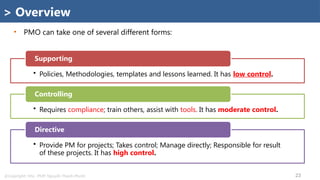
• Policies, Methodologies, templates and lessons learned. It has low control.
Supporting
• Requires compliance; train others, assist with tools. It has moderate control.
Controlling
• Provide PM for projects; Takes control; Manage directly; Responsible for result
of these projects. It has high control.
Directive
• PMO can take one of several different forms:
@Copyright: Msc. PMP. Nguyễn Thanh Phước 24
> vs Project Manager
PM
• Focuses on project
objectives
• Controls assigned project
resources
• Manages constraints of
individual projects
PMO
• Manages major program
scope changes to better
achieve business objectives
• Optimizes use of shared
resource across projects
• Manages methodologies,
standards, risk/opportunities,
metrics & interdependencies
@Copyright: Msc. PMP. Nguyễn Thanh Phước 25
Henry Ford
“Obstacle are those
frightful things you
see when you take
your eyes off your
goal.”
@Copyright: Msc. PMP. Nguyễn Thanh Phước
4. Operation
@Copyright: Msc. PMP. Nguyễn Thanh Phước 27
> Overview
• Is on-going endeavors
that product repetitive
output, with resources
assigned to perform
same set of tasks
according to standards
institutionalized in a
product life cycle
Introdu
Decline
PLC
Product
Life Cycle
@Copyright: Msc. PMP. Nguyễn Thanh Phước 28
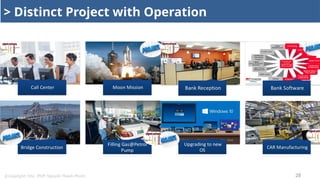
> Distinct Project with Operation
@Copyright: Msc. PMP. Nguyễn Thanh Phước 29
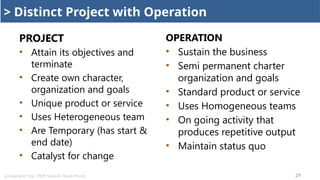
> Distinct Project with Operation
PROJECT
• Attain its objectives and
terminate
• Create own character,
organization and goals
• Unique product or service
• Uses Heterogeneous team
• Are Temporary (has start &
end date)
• Catalyst for change
OPERATION
• Sustain the business
• Semi permanent charter
organization and goals
• Standard product or service
• Uses Homogeneous teams
• On going activity that
produces repetitive output
• Maintain status quo
@Copyright: Msc. PMP. Nguyễn Thanh Phước
5. Project Manager
@Copyright: Msc. PMP. Nguyễn Thanh Phước 31
> Overview
Management Skills
• Planning
• Meeting Management
• Time Management
• Organizing
• Controlling
Interpersonal Skills
• Leadership
• Communication
• Influence
• Motivation
• Negotiation
• Team Building
• The person assigned by Performing Organization to lead
team that is responsible for achieving project objective.
@Copyright: Msc. PMP. Nguyễn Thanh Phước 32
> Overview
Reports to
• Functional Manager
• Program Manager
• Portfolio Manager
• PMO Manager
• Operation Manager
Works with
• Business, System Analyst
• Quality Assurance Manager
• Subject Master Expert
• Vendor, Project Staff
• PMO
• PM often has lot of responsibility and lacks of real
authority. He often negotiate with management/function
manager for resources.
@Copyright: Msc. PMP. Nguyễn Thanh Phước 33
> Overview
• PM need to involve project team members in the
planning process.
• Identifies and document conflicts of project objectives
with organization strategy as soon as possible.
• Show consider every processes to determine if they are
needed for individual projects
• Must balance the constraints and tradeoff, effectively
communicate the info (including bad news) to sponsor
for informed decisions
@Copyright: Msc. PMP. Nguyễn Thanh Phước 34
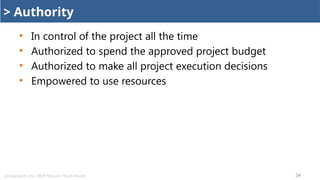
> Authority
• In control of the project all the time
• Authorized to spend the approved project budget
• Authorized to make all project execution decisions
• Empowered to use resources
@Copyright: Msc. PMP. Nguyễn Thanh Phước
6. Organizational influence
on Project Management
35
@Copyright: Msc. PMP. Nguyễn Thanh Phước 36
> Overview
Organization Culture & Style
Organization Communication
Organizational Structures
Organizational Process Assets (OPA)
Enterprise Environment Factors (EEF)
@Copyright: Msc. PMP. Nguyễn Thanh Phước 37
> Overview
• Organization Communication
– Project management success is highly dependent on an effective
organizational communication style.
– Existing communication culture will impacts projects
– Electronic Communication
– E-mail
– Texting (text chatting); Instant messaging (SMS)
– Telephone / Fax
– Social media
• Video and web conferencing
@Copyright: Msc. PMP. Nguyễn Thanh Phước 38
> Overview
• Organization Culture & Style
– It is a system of shared assumptions, values, and beliefs, which governs
how people behave (dress, act, & perform job) in organizations
– Examples
– Shared visions, mission, values, beliefs, & expectations
– Regulations, policies, methods, & procedures
– Motivation & reward systems
– Risk tolerance
– View of leadership, hierarchy, & authority relationships
– Code of conduct, work ethic, & work hours
• Operating environments
@Copyright: Msc. PMP. Nguyễn Thanh Phước 39
> Overview
• Organizational structures
• It define a hierarchy within an organization.
• It identifies each job, its function & where it reports to.
– It determines how information flows in the company.
• Organization Types
– Functional
– Projectized
– Matrix (Week, Strong, Balanced)
– Composite
@Copyright: Msc. PMP. Nguyễn Thanh Phước 40
• Functional Organization
> Organization Type
@Copyright: Msc. PMP. Nguyễn Thanh Phước 41
• In functional Organization
– Project Expeditor
• Staff assistant
• Communication Coordinator
• Can not make or enforce decisions
– Project Coordinator
• Similar to Project Expeditor.
• Some power & authority to make decisions
• Reports to higher level managers
> Organization Type
@Copyright: Msc. PMP. Nguyễn Thanh Phước 42
Advantages
 Highly specialized expertise.
Easier management of
specialists
 Resource grouping by
specialties
 Clear reporting relationships.
Team member reports to one
supervisor.
 Well defined career path.
Disadvantages
More emphasis of functional
specialty, result in harming
project.
Difficulty in balancing project
versus real work.
Slow in delivering outcome.
PM has little of no authority.
 No career path in project
management.
> Organization Type
• Functional Organization
@Copyright: Msc. PMP. Nguyễn Thanh Phước 43
• Projectized Organization
> Organization Type
@Copyright: Msc. PMP. Nguyễn Thanh Phước 44
Advantages
 New work /enhancement is
organized by Projects
 PM gets resources from different
functions & can hire its own
 Team works only on project work
 PM has its own full time support
staff
 PM has full control on budget &
Resources, Fully responsible for
outcome.
 Communication is vertical.
Disadvantages
 No home
 Duplication of work &
facilitates
 In-efficient resource utilization.
 Project isolation
 Projectitis
> Organization Type
• Projectized Organization
@Copyright: Msc. PMP. Nguyễn Thanh Phước 45
• Matrix Organization: Strong, Weak, Balanced
> Organization Type
• * Tight Matrix:
has nothing to do
with a matrix
organization
@Copyright: Msc. PMP. Nguyễn Thanh Phước 46
• Matrix Organization: Strong, Weak, Balanced
> Organization Type
@Copyright: Msc. PMP. Nguyễn Thanh Phước 47
• Matrix Organization: Strong, Weak, Balanced
> Organization Type
@Copyright: Msc. PMP. Nguyễn Thanh Phước 48
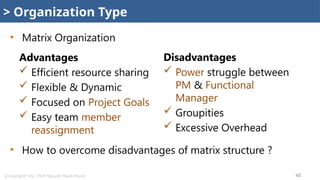
Advantages
 Efficient resource sharing
 Flexible & Dynamic
 Focused on Project Goals
 Easy team member
reassignment
Disadvantages
 Power struggle between
PM & Functional
Manager
 Groupities
 Excessive Overhead
> Organization Type
• Matrix Organization
• How to overcome disadvantages of matrix structure ?
@Copyright: Msc. PMP. Nguyễn Thanh Phước 49
• Composite Organization
> Organization Type
 Very effective
resource utilization
 High flexibility in
meeting
requirements
@Copyright: Msc. PMP. Nguyễn Thanh Phước 50
• Authority Matrix
> Organization Type
@Copyright: Msc. PMP. Nguyễn Thanh Phước 51
> Organizational Process Asset (OPA)
 Processes and Procedures
 Policies
 Procedures / Process
 Standard template
 Guideline
 Corporate knowledge base
 Historical information of
projects
 Lessons Learnt
 Stakeholder Register
 Risk Register
 Best Practice
=> Quản lý tri thức của doanh nghiệp
@Copyright: Msc. PMP. Nguyễn Thanh Phước 52
> Enterprise Environment Factor
External Enterprise
 Government regulation
 Market conditions
 Infrastructure
 External political conditions
• It refer to conditions, not under the control of the project
team, that influence, constrain, or direct the project
Internal Enterprise
 Organizational culture
 Type of organizational
structure
 Internal political conditions
 Available resources
 PMIS: Project Management
Information System
@Copyright: Msc. PMP. Nguyễn Thanh Phước 53
Edgar Schein
“The only thing of real
importance that leaders do is
to create and manage culture”
@Copyright: Msc. PMP. Nguyễn Thanh Phước
7. Project Life Cycle
@Copyright: Msc. PMP. Nguyễn Thanh Phước 55
> Overview
• A project life cycle is a collection of project phases. It is
a performing organizations or departments project
methodology.
• Project phase is a collection of logically related project
activities that results in one or more deliverables. These
are industry specific.
• Project Management Process – what you need to do to
mange the work
@Copyright: Msc. PMP. Nguyễn Thanh Phước 56
> Overview
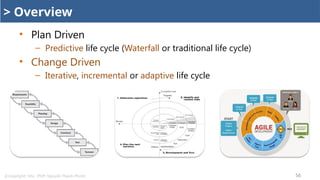
• Plan Driven
– Predictive life cycle (Waterfall or traditional life cycle)
• Change Driven
– Iterative, incremental or adaptive life cycle
@Copyright: Msc. PMP. Nguyễn Thanh Phước 57
> Overview
• Characteristic
@Copyright: Msc. PMP. Nguyễn Thanh Phước 58
> Overview
• Phase to phase relationship
Sequential
Overlapping
@Copyright: Msc. PMP. Nguyễn Thanh Phước 59
> Project Management Process
• A management process group (process group) is what
you need to do to manage the work
• In PMBOK 6th
– Initiating
– Planning
– Executing
– Monitoring and Controlling
– Closing
• Compare with Project Life Cycle?
@Copyright: Msc. PMP. Nguyễn Thanh Phước
8. Project Elements
@Copyright: Msc. PMP. Nguyễn Thanh Phước 61
> Project Constraints
• The 6 project constraints are similar to this 6 legged robot.
Each leg represents a constraint, and an issue with any of
the constraints may impact the entire project
@Copyright: Msc. PMP. Nguyễn Thanh Phước 62
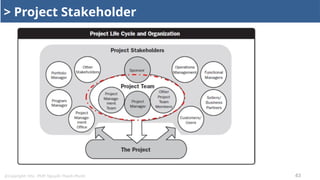
> Project Stakeholder
• Stakeholder is an individual, group, or organization who
may affect, be affected by outcome of a project.
– May be actively involved in the project
– May have interests that may be positively or negatively affected by
outcome of the project.
– Different stakeholders may have competing expectations that
might create conflicts within the project
• Stakeholders identification is a continuous process.
• Stakeholder has varying level of responsibility
@Copyright: Msc. PMP. Nguyễn Thanh Phước 63
> Project Stakeholder
@Copyright: Msc. PMP. Nguyễn Thanh Phước 64
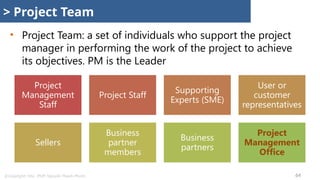
> Project Team
Project
Management
Staff
Project Staff
Supporting
Experts (SME)
User or
customer
representatives
Sellers
Business
partner
members
Business
partners
Project
Management
Office
• Project Team: a set of individuals who support the project
manager in performing the work of the project to achieve
its objectives. PM is the Leader
@Copyright: Msc. PMP. Nguyễn Thanh Phước 65
> Project Team
• Project Team composition is based on factors such as
– Organizational culture, Scope & Location
– The relationship between PM & the team varies depending on
the authority of PM
Fulltime
Part-
time
@Copyright: Msc. PMP. Nguyễn Thanh Phước 66
> Project Governance
• The alignment of project objectives with the strategy of
the larger organization by the project sponsor and project
team.
• A project’s governance is defined by and is required to fit
within the larger context of the program or organization
sponsoring it, but is separate from organizational
governance
@Copyright: Msc. PMP. Nguyễn Thanh Phước 67
> Project Information
Work Performance
Data
• The raw
observations and
measurements
identified during
activities
performed to carry
out the project
work
Work Performance
Information
• The performance
data collected from
various controlling
processes, analyzed
in context and
integrated based on
relationships across
areas;
Work Performance
Reports
• A compilation of
work performance
information for
consumption
purpose such as
status or decision
making
@Copyright: Msc. PMP. Nguyễn Thanh Phước 68
> Other concept
• Project Success
– Measured in terms of completing project within constraints of
scope, quality, schedule, budget, resources and risks.
• Responsibility of PM
– The PM is responsible and accountable for setting realistic and
achievable boundaries for the project .
– To accomplish project within the approved baselines
• Cost baseline
• Schedule baseline
• Scope baseline
@Copyright: Msc. PMP. Nguyễn Thanh Phước 69
Nikos Kazantzukis
“In order to succeed,
we must first believe
that we can.”
@Copyright: Msc. PMP. Nguyễn Thanh Phước 70
Summary
• Enterprise Environment Factor
– PMIS
• Organizational Process Asset
• Definition of a project and
Constraints
• Organizational Structure
– Matrix (Strong, Weak, Balanced)
– Functional
– Projectized
– Project-based organization
– Organizational Hierarchy
– Tight matrix
• Project Life Cycle
– Predictive, Incremental, Iterative,
Adaptive
• Work Performance Data and
Information
• Stakeholder Management
• Operational work
• PMO (Supportive, Controlling,
Directive)
• Program, Portfolio Management
@Copyright: Msc. PMP. Nguyễn Thanh Phước 71
Next Objectives
• What is done during each of
the project management
process groups
– Initiating
– Planning
– Executing
– Monitoring and Controlling
– Closing
• What you do not do but
should do in your real
world during each of the
project management
process groups.
@Copyright: Msc. PMP. Nguyễn Thanh Phước 72
References
• Many other resources from
Internet
• A Guide to the Project
Management Body of Knowledge
(PMBOK® Guide)—Sixth Edition
of Project Management Institute
@Copyright: Msc. PMP. Nguyễn Thanh Phước 73
Thank You

Project Management Framework for PMP Cert

  • 1.
    @Copyright: Msc. PMP.Nguyễn Thanh Phước Project Management Framework PMP 7th MSc. PMP. Nguyen Thanh Phuoc phuocnt@gmail.com
  • 2.
    @Copyright: Msc. PMP.Nguyễn Thanh Phước 2 Objectives • Enterprise Environment Factor – PMIS • Organizational Process Asset • Definition of a project and Constraints • Organizational Structure – Matrix (Strong, Weak, Balanced) – Functional – Projectized – Project-based organization – Organizational Hierarchy – Tight matrix • Project Life Cycle – Predictive, Incremental, Iterative, Adaptive • Work Performance Data and Information • Stakeholder Management • Operational work • PMO (Supportive, Controlling, Directive) • Program, Portfolio Management
  • 3.
    @Copyright: Msc. PMP.Nguyễn Thanh Phước 3 Content 1. Project 2. Program & Portfolio 3. Project Management Office 4. Operation 5. Project Manager 6. Organizational influence on Project Management 7. Project Life Cycle 8. Project Element
  • 4.
    @Copyright: Msc. PMP.Nguyễn Thanh Phước 1. Project
  • 5.
    @Copyright: Msc. PMP.Nguyễn Thanh Phước > Overview 5 • A project is a temporary endeavor undertaken to create a unique product, service or result Temporary endeavor Progressively elaborated Unique (product, service, result)
  • 6.
    @Copyright: Msc. PMP.Nguyễn Thanh Phước 6 > Overview Has unique purpose It is temporary Progressive elaboration Requires Resources from various areas Initiate by customer or Sponsor Uncertainty
  • 7.
    @Copyright: Msc. PMP.Nguyễn Thanh Phước 7 > Overview • When project will end? – Terminated – due to change in strategy or many not be feasible – Stopped – When need for project no longer exist • Project’s are authorized because of – Marketing Demand Strategic & business need – Social need Customer request – Legal Requirement Environment Consideration
  • 8.
    @Copyright: Msc. PMP.Nguyễn Thanh Phước 8 > Project Management • The application of knowledge, skills, tools & techniques to project activities to meet project requirements.
  • 9.
    @Copyright: Msc. PMP.Nguyễn Thanh Phước 9 > Project Management Advantages • Better control of financial, physical and human resource • Improved customer relations • Shorter development times • Lower cost & Higher profit margins • Improved productivity • Better internal coordination • Higher quality and increased reliability
  • 10.
    @Copyright: Msc. PMP.Nguyễn Thanh Phước 10 > Project Management “PMBOK 5th ” => PMBOK 6: 49.
  • 11.
    @Copyright: Msc. PMP.Nguyễn Thanh Phước 11 > Project Management “PMBOK 5th” 47 Processe s
  • 12.
    @Copyright: Msc. PMP.Nguyễn Thanh Phước 12 > Project Management “PMBOK 6th”
  • 13.
    @Copyright: Msc. PMP.Nguyễn Thanh Phước 13 > Project Management “PMBOK 6th”
  • 14.
    @Copyright: Msc. PMP.Nguyễn Thanh Phước 14 > Project Management • A project is a temporary endeavor undertaken to create unique product, service or result Project • The application of knowledge, skills, tool & techniques to project activities to meet project requirements Project Management • The Person assigned by the Performing Organization to lead the team to achieve the project Objectives Project Manager
  • 15.
    @Copyright: Msc. PMP.Nguyễn Thanh Phước 2. Program & Portfolio
  • 16.
    @Copyright: Msc. PMP.Nguyễn Thanh Phước 16 > Program Overview • Is a group of related projects that has related output • Attributes – Decreased risk – Economics of scale – Align projects direction & improve co- ordination – Focus on inter-dependencies between projects • Need program manager’s coordination and management activities Project 3 Project4 Project2 Project6 Project 1 Project7 Program Sub Program Project 1 Project 2 Project 3
  • 17.
    @Copyright: Msc. PMP.Nguyễn Thanh Phước 17 > Examples about program
  • 18.
    @Copyright: Msc. PMP.Nguyễn Thanh Phước 18 > Program Management vs Program Manager • The application of knowledge, skills, tool & techniques to program activities to meet program requirements • Obtain benefits and control not available by Managing Projects individually Program Management • Provides leaderships and direction for the project managers heading the project in the program • Focus on Benefits • Decreased risk Program Manager
  • 19.
    @Copyright: Msc. PMP.Nguyễn Thanh Phước 19 > Portfolio Overview • Is a group of related program, individual project and other related operation work • Attributes – Helps achieve specific strategic business goals, Enhance benefits to Organization – Reduce risks – Optimize use of resources – Include Operations – Not necessarily directly related between projects Portfolio Sub Portfolio Project Program Project Program Project Project Operations
  • 20.
    @Copyright: Msc. PMP.Nguyễn Thanh Phước 20 > Examples about portfolio
  • 21.
    @Copyright: Msc. PMP.Nguyễn Thanh Phước 3. Project Management Office (PMO) 21
  • 22.
    @Copyright: Msc. PMP.Nguyễn Thanh Phước 22 > Overview • PMO is a department in the organization. It is a management structure that standardizes project-related governance processes & facilities sharing of resources, methodologies, tool & techniques
  • 23.
    @Copyright: Msc. PMP.Nguyễn Thanh Phước 23 > Overview • Policies, Methodologies, templates and lessons learned. It has low control. Supporting • Requires compliance; train others, assist with tools. It has moderate control. Controlling • Provide PM for projects; Takes control; Manage directly; Responsible for result of these projects. It has high control. Directive • PMO can take one of several different forms:
  • 24.
    @Copyright: Msc. PMP.Nguyễn Thanh Phước 24 > vs Project Manager PM • Focuses on project objectives • Controls assigned project resources • Manages constraints of individual projects PMO • Manages major program scope changes to better achieve business objectives • Optimizes use of shared resource across projects • Manages methodologies, standards, risk/opportunities, metrics & interdependencies
  • 25.
    @Copyright: Msc. PMP.Nguyễn Thanh Phước 25 Henry Ford “Obstacle are those frightful things you see when you take your eyes off your goal.”
  • 26.
    @Copyright: Msc. PMP.Nguyễn Thanh Phước 4. Operation
  • 27.
    @Copyright: Msc. PMP.Nguyễn Thanh Phước 27 > Overview • Is on-going endeavors that product repetitive output, with resources assigned to perform same set of tasks according to standards institutionalized in a product life cycle Introdu Decline PLC Product Life Cycle
  • 28.
    @Copyright: Msc. PMP.Nguyễn Thanh Phước 28 > Distinct Project with Operation
  • 29.
    @Copyright: Msc. PMP.Nguyễn Thanh Phước 29 > Distinct Project with Operation PROJECT • Attain its objectives and terminate • Create own character, organization and goals • Unique product or service • Uses Heterogeneous team • Are Temporary (has start & end date) • Catalyst for change OPERATION • Sustain the business • Semi permanent charter organization and goals • Standard product or service • Uses Homogeneous teams • On going activity that produces repetitive output • Maintain status quo
  • 30.
    @Copyright: Msc. PMP.Nguyễn Thanh Phước 5. Project Manager
  • 31.
    @Copyright: Msc. PMP.Nguyễn Thanh Phước 31 > Overview Management Skills • Planning • Meeting Management • Time Management • Organizing • Controlling Interpersonal Skills • Leadership • Communication • Influence • Motivation • Negotiation • Team Building • The person assigned by Performing Organization to lead team that is responsible for achieving project objective.
  • 32.
    @Copyright: Msc. PMP.Nguyễn Thanh Phước 32 > Overview Reports to • Functional Manager • Program Manager • Portfolio Manager • PMO Manager • Operation Manager Works with • Business, System Analyst • Quality Assurance Manager • Subject Master Expert • Vendor, Project Staff • PMO • PM often has lot of responsibility and lacks of real authority. He often negotiate with management/function manager for resources.
  • 33.
    @Copyright: Msc. PMP.Nguyễn Thanh Phước 33 > Overview • PM need to involve project team members in the planning process. • Identifies and document conflicts of project objectives with organization strategy as soon as possible. • Show consider every processes to determine if they are needed for individual projects • Must balance the constraints and tradeoff, effectively communicate the info (including bad news) to sponsor for informed decisions
  • 34.
    @Copyright: Msc. PMP.Nguyễn Thanh Phước 34 > Authority • In control of the project all the time • Authorized to spend the approved project budget • Authorized to make all project execution decisions • Empowered to use resources
  • 35.
    @Copyright: Msc. PMP.Nguyễn Thanh Phước 6. Organizational influence on Project Management 35
  • 36.
    @Copyright: Msc. PMP.Nguyễn Thanh Phước 36 > Overview Organization Culture & Style Organization Communication Organizational Structures Organizational Process Assets (OPA) Enterprise Environment Factors (EEF)
  • 37.
    @Copyright: Msc. PMP.Nguyễn Thanh Phước 37 > Overview • Organization Communication – Project management success is highly dependent on an effective organizational communication style. – Existing communication culture will impacts projects – Electronic Communication – E-mail – Texting (text chatting); Instant messaging (SMS) – Telephone / Fax – Social media • Video and web conferencing
  • 38.
    @Copyright: Msc. PMP.Nguyễn Thanh Phước 38 > Overview • Organization Culture & Style – It is a system of shared assumptions, values, and beliefs, which governs how people behave (dress, act, & perform job) in organizations – Examples – Shared visions, mission, values, beliefs, & expectations – Regulations, policies, methods, & procedures – Motivation & reward systems – Risk tolerance – View of leadership, hierarchy, & authority relationships – Code of conduct, work ethic, & work hours • Operating environments
  • 39.
    @Copyright: Msc. PMP.Nguyễn Thanh Phước 39 > Overview • Organizational structures • It define a hierarchy within an organization. • It identifies each job, its function & where it reports to. – It determines how information flows in the company. • Organization Types – Functional – Projectized – Matrix (Week, Strong, Balanced) – Composite
  • 40.
    @Copyright: Msc. PMP.Nguyễn Thanh Phước 40 • Functional Organization > Organization Type
  • 41.
    @Copyright: Msc. PMP.Nguyễn Thanh Phước 41 • In functional Organization – Project Expeditor • Staff assistant • Communication Coordinator • Can not make or enforce decisions – Project Coordinator • Similar to Project Expeditor. • Some power & authority to make decisions • Reports to higher level managers > Organization Type
  • 42.
    @Copyright: Msc. PMP.Nguyễn Thanh Phước 42 Advantages  Highly specialized expertise. Easier management of specialists  Resource grouping by specialties  Clear reporting relationships. Team member reports to one supervisor.  Well defined career path. Disadvantages More emphasis of functional specialty, result in harming project. Difficulty in balancing project versus real work. Slow in delivering outcome. PM has little of no authority.  No career path in project management. > Organization Type • Functional Organization
  • 43.
    @Copyright: Msc. PMP.Nguyễn Thanh Phước 43 • Projectized Organization > Organization Type
  • 44.
    @Copyright: Msc. PMP.Nguyễn Thanh Phước 44 Advantages  New work /enhancement is organized by Projects  PM gets resources from different functions & can hire its own  Team works only on project work  PM has its own full time support staff  PM has full control on budget & Resources, Fully responsible for outcome.  Communication is vertical. Disadvantages  No home  Duplication of work & facilitates  In-efficient resource utilization.  Project isolation  Projectitis > Organization Type • Projectized Organization
  • 45.
    @Copyright: Msc. PMP.Nguyễn Thanh Phước 45 • Matrix Organization: Strong, Weak, Balanced > Organization Type • * Tight Matrix: has nothing to do with a matrix organization
  • 46.
    @Copyright: Msc. PMP.Nguyễn Thanh Phước 46 • Matrix Organization: Strong, Weak, Balanced > Organization Type
  • 47.
    @Copyright: Msc. PMP.Nguyễn Thanh Phước 47 • Matrix Organization: Strong, Weak, Balanced > Organization Type
  • 48.
    @Copyright: Msc. PMP.Nguyễn Thanh Phước 48 Advantages  Efficient resource sharing  Flexible & Dynamic  Focused on Project Goals  Easy team member reassignment Disadvantages  Power struggle between PM & Functional Manager  Groupities  Excessive Overhead > Organization Type • Matrix Organization • How to overcome disadvantages of matrix structure ?
  • 49.
    @Copyright: Msc. PMP.Nguyễn Thanh Phước 49 • Composite Organization > Organization Type  Very effective resource utilization  High flexibility in meeting requirements
  • 50.
    @Copyright: Msc. PMP.Nguyễn Thanh Phước 50 • Authority Matrix > Organization Type
  • 51.
    @Copyright: Msc. PMP.Nguyễn Thanh Phước 51 > Organizational Process Asset (OPA)  Processes and Procedures  Policies  Procedures / Process  Standard template  Guideline  Corporate knowledge base  Historical information of projects  Lessons Learnt  Stakeholder Register  Risk Register  Best Practice => Quản lý tri thức của doanh nghiệp
  • 52.
    @Copyright: Msc. PMP.Nguyễn Thanh Phước 52 > Enterprise Environment Factor External Enterprise  Government regulation  Market conditions  Infrastructure  External political conditions • It refer to conditions, not under the control of the project team, that influence, constrain, or direct the project Internal Enterprise  Organizational culture  Type of organizational structure  Internal political conditions  Available resources  PMIS: Project Management Information System
  • 53.
    @Copyright: Msc. PMP.Nguyễn Thanh Phước 53 Edgar Schein “The only thing of real importance that leaders do is to create and manage culture”
  • 54.
    @Copyright: Msc. PMP.Nguyễn Thanh Phước 7. Project Life Cycle
  • 55.
    @Copyright: Msc. PMP.Nguyễn Thanh Phước 55 > Overview • A project life cycle is a collection of project phases. It is a performing organizations or departments project methodology. • Project phase is a collection of logically related project activities that results in one or more deliverables. These are industry specific. • Project Management Process – what you need to do to mange the work
  • 56.
    @Copyright: Msc. PMP.Nguyễn Thanh Phước 56 > Overview • Plan Driven – Predictive life cycle (Waterfall or traditional life cycle) • Change Driven – Iterative, incremental or adaptive life cycle
  • 57.
    @Copyright: Msc. PMP.Nguyễn Thanh Phước 57 > Overview • Characteristic
  • 58.
    @Copyright: Msc. PMP.Nguyễn Thanh Phước 58 > Overview • Phase to phase relationship Sequential Overlapping
  • 59.
    @Copyright: Msc. PMP.Nguyễn Thanh Phước 59 > Project Management Process • A management process group (process group) is what you need to do to manage the work • In PMBOK 6th – Initiating – Planning – Executing – Monitoring and Controlling – Closing • Compare with Project Life Cycle?
  • 60.
    @Copyright: Msc. PMP.Nguyễn Thanh Phước 8. Project Elements
  • 61.
    @Copyright: Msc. PMP.Nguyễn Thanh Phước 61 > Project Constraints • The 6 project constraints are similar to this 6 legged robot. Each leg represents a constraint, and an issue with any of the constraints may impact the entire project
  • 62.
    @Copyright: Msc. PMP.Nguyễn Thanh Phước 62 > Project Stakeholder • Stakeholder is an individual, group, or organization who may affect, be affected by outcome of a project. – May be actively involved in the project – May have interests that may be positively or negatively affected by outcome of the project. – Different stakeholders may have competing expectations that might create conflicts within the project • Stakeholders identification is a continuous process. • Stakeholder has varying level of responsibility
  • 63.
    @Copyright: Msc. PMP.Nguyễn Thanh Phước 63 > Project Stakeholder
  • 64.
    @Copyright: Msc. PMP.Nguyễn Thanh Phước 64 > Project Team Project Management Staff Project Staff Supporting Experts (SME) User or customer representatives Sellers Business partner members Business partners Project Management Office • Project Team: a set of individuals who support the project manager in performing the work of the project to achieve its objectives. PM is the Leader
  • 65.
    @Copyright: Msc. PMP.Nguyễn Thanh Phước 65 > Project Team • Project Team composition is based on factors such as – Organizational culture, Scope & Location – The relationship between PM & the team varies depending on the authority of PM Fulltime Part- time
  • 66.
    @Copyright: Msc. PMP.Nguyễn Thanh Phước 66 > Project Governance • The alignment of project objectives with the strategy of the larger organization by the project sponsor and project team. • A project’s governance is defined by and is required to fit within the larger context of the program or organization sponsoring it, but is separate from organizational governance
  • 67.
    @Copyright: Msc. PMP.Nguyễn Thanh Phước 67 > Project Information Work Performance Data • The raw observations and measurements identified during activities performed to carry out the project work Work Performance Information • The performance data collected from various controlling processes, analyzed in context and integrated based on relationships across areas; Work Performance Reports • A compilation of work performance information for consumption purpose such as status or decision making
  • 68.
    @Copyright: Msc. PMP.Nguyễn Thanh Phước 68 > Other concept • Project Success – Measured in terms of completing project within constraints of scope, quality, schedule, budget, resources and risks. • Responsibility of PM – The PM is responsible and accountable for setting realistic and achievable boundaries for the project . – To accomplish project within the approved baselines • Cost baseline • Schedule baseline • Scope baseline
  • 69.
    @Copyright: Msc. PMP.Nguyễn Thanh Phước 69 Nikos Kazantzukis “In order to succeed, we must first believe that we can.”
  • 70.
    @Copyright: Msc. PMP.Nguyễn Thanh Phước 70 Summary • Enterprise Environment Factor – PMIS • Organizational Process Asset • Definition of a project and Constraints • Organizational Structure – Matrix (Strong, Weak, Balanced) – Functional – Projectized – Project-based organization – Organizational Hierarchy – Tight matrix • Project Life Cycle – Predictive, Incremental, Iterative, Adaptive • Work Performance Data and Information • Stakeholder Management • Operational work • PMO (Supportive, Controlling, Directive) • Program, Portfolio Management
  • 71.
    @Copyright: Msc. PMP.Nguyễn Thanh Phước 71 Next Objectives • What is done during each of the project management process groups – Initiating – Planning – Executing – Monitoring and Controlling – Closing • What you do not do but should do in your real world during each of the project management process groups.
  • 72.
    @Copyright: Msc. PMP.Nguyễn Thanh Phước 72 References • Many other resources from Internet • A Guide to the Project Management Body of Knowledge (PMBOK® Guide)—Sixth Edition of Project Management Institute
  • 73.
    @Copyright: Msc. PMP.Nguyễn Thanh Phước 73 Thank You

Editor's Notes

  • #5 - A product: that can be component of another item) - A service: a capability to perform a service - A result: Research results or research documents An improvement in an existing product or service Process improvement – such as an improved business process - You should have a large project in mind when you answer questions on the exam. Think of a project that is new to the organization (it has not been done before), utilizes resources from many countries, has more than 200 people on the team, lasts longer than one year, and has a budget of over US $10 million. - Another thing to keep in mind for the exam is that you should assume project proposals are formally reviewed and approved by management in your organization after a comparison of all proposed projects. Projects are not selected arbitrarily or informally. (See the Business Case and Project Selection discussions in the Integration Management chapter.)
  • #6 Attributes of a project
  • #10 Follow systematic process Process groups Knowledge Area Project Management Framework
  • #11 47 processes must to remember for pass exam the first exam
  • #12 47 processes must to remember for pass exam the first exam
  • #13 47 processes must to remember for pass exam the first exam
  • #23 When answering exam questions, assume there is a PMO in the organization, unless the question states otherwise. Read situational questions carefully to determine if the PMO is supportive, controlling, or directive.
  • #36 Organization Culture & Style Shared visions, mission, values, beliefs and expectation Regulations, policies, methods, procedures Motivation & reward system Risk tolerance Code of Conduct, work ethic Operation environments View of leadership
  • #40 - The organization is grouped into various departments (Sales, Marketing etc). People with similar skills are kept together. Departments executes its own projects. Communication happens horizontally via functional manager/ heads. Functional head controls the Project Budget. Part time PM Role & no admin staff. (act as Co-ordinator or Experditor) PM has little or none Power and authority
  • #41 Assume Matrix organization when nothing is specified. Tight Matrix simply refer to co-located team.
  • #43 PM has full authority to assign priorities, apply resources, and direct the work of persons assigned to the project.
  • #44 Advantages New work /enhancement is organized by Projects PM gets resources from different functions & can hire its own Team works only on project work PM has its own full time support staff PM has full control on budget & Resources, Fully responsible for outcome. Communication is vertical. Disadvantages No home Duplication of work & facilitates In-efficient resource utilization. Project isolation Projectitis
  • #45 Power and authority with the project manager Full time PM Role & full time admin staff. Many characteristics of the Projectized Organization A tight matrix has nothing to do with a matrix organization. It simply refers to “colocation,” or locating the work spaces for the project team in the same room. Because it sounds similar to the other forms of organization, it has often been used as a fourth choice for these questions on the exam. The exam typically does not identify the form of organization being discussed. When it does not specify a form, assume matrix. If you remember this, you should get a few more questions right.
  • #46 PM has low Power And authority Part time PM Role & no admin staff. Communication happens horizontally Functional manager / head controls the Project Budget.
  • #47 Power and authority Shared between PM & FM. Full time PM Role & part time admin staff. Communication happens horizontally PM & FM both controls the Project Budget.
  • #48 Advantages Efficient resource sharing. Flexible & Dynamic Focused on Project Goals. Easy team member reassignment Disadvantages Power struggle between PM & Functional Manager Groupities. Excessive Overhead How to overcome disadvantages of matrix structure - Close cooperation between the PM and FM. - Well defined Roles & responsibilities. - Well defined and strong multi directional communication. - Balanced distribution of authority and power between PM & FM. - Early resolution of conflicts between PM & FM.
  • #49 It is a mixture of functional, matrix, and Projectized type of organization. Involves all these structures at the various levels.
  • #50 It is a mixture of functional, matrix, and Projectized type of organization. Involves all these structures at the various levels.
  • #51 Historical information (or Data) : is a record of past projects. - Activities - Lessons Learned - WBS Reports - Risk & Response plans - Estimates Resources used PMP OPA - Help organizations to continuously improve their process. - Help project management teams to learn & share the best practices. - OPA can be customized according to the suitability. - They make PM life’s easier
  • #52 It refer to conditions, not under the control of the project team, that influence, constrain, or direct the project. - EEF may or may not help your organizations. - These are conditions in which your organization has to work. - These do not fall under control of the project or Project management team. - It is not easy to change the EEF.
  • #54 1. Scope 2. Schedule 3. Cost => Effort (MM); 4. Quality 5. Resources 6. Risk 7.Communication 8.Stakeholder 9.Procurement 10.Integration
  • #55 Project life cycle What you need to do to do the work What work will be performed in each phase What deliverables will be produced & when Who is involved in each phase How management will control and approve work of each phase Project Management Processes - what you need to do to mange the work
  • #56 Predictive life cycle - Used when product to be deliver is well understood - Sequential or overlapping phases - Scope, Time & Cost is calculated in the early in the project lifecycle Iterative & Incremental - Used when organization need to manage changing objective & scope; partial delivery is beneficial - High level vision is developed for the product; scope is elaborated one iteration at a time - Increment successively, to add to the functionality of the product - Product is developed both incrementally & iteratively Adaptive - Used in rapidly changing environment, when requirement & scope is difficult to define - It involve fixed time & cost,; Scope is broadly defined & will be refined as progresses. - Scope decomposed into the set of requirements call product backlog - Iteration are rapid(2 to 4 weeks) are fixed in time and Cost (resources). - Customer can change or re-prioritize requirements in each iteration More The processes, tools and techniques, and concepts identified in the PMBOIQ Guide and discussed in this book can be tailored based on the project, the organization, and various other factors, including the project life cycle. As you read through this book and seek to understand the concepts presented here, however, it’s often useful to think in terms of a plan-driven life cycle. Just remember that these processes, tools, and techniques can be used on change-driven projects as well,
  • #57 In early phases - Greater opportunity to influence the project. - Resource needs are usually lowest. - Risk is highest. - Cost of changes are lowest. In middle phases - Certainty of completing a project improves. - More resources are needed. In final phase - Cost of changes is highest. - Risk are lowest.
  • #58 Sequential - Next Phase starts only when previous phase is completed - Reduces uncertainty - Eliminate options to reduce schedule Overlapping - Phases starts before completion of previous phase - Fast tracking - Additional Resources - Increase Risk - Result in Rework
  • #59 + Compare with project life cycle Small: all phase in 1 project life cycle Large: each phase in 1 project life cycle, 5 phase = 5 project life cycle
  • #62 Project stakeholders includes - Sponsor Customer & users - Seller; Business - Partners; Organizational group - Functional Managers
  • #64 Project management staff. The members of the team who perform project management activities such as scheduling, budgeting, reporting and control, communications, risk management and administrative support. This role may be performed or supported by a project management office (PMO). The members of the project team who are directly involved in project management activities. May be performed or supported by a PMO. Project Manager always leads the PM staff Staff members performs project management tasks & administrative functions Each staff may have specific roles (Tracking Risk & issues, communications, Schedule management) Mostly needed to manage large & complex projects. Project staff. The members of the team who carry out the work of creating the project deliverables The members of the team who carry out the work of creating the project deliverables They are execution team. Perform majority of actual work. Create deliverables. Various sub-teams based on skills may be involved to perform daily task (Design, Coding, testing etc) Participation of Project staff in planning process, strengthen project commitment Supporting experts. Supporting experts perform activities required to develop or execute the project management plan. These can include such roles as contracting, financial management, logistics, legal, safety, engineering, test, or quality control. Depending on the size of the project and level of support required, supporting experts may be assigned to work full time or may just participate on the team when their particular skills are required. Subject Matter Expert (SME) A subject-matter expert (SME) or domain expert is a person who is an authority in a particular area or topic. Provide expert advise & help perform project activities. Roles/expertise depends on the project. SME can be part time or full time. SME can be insourced/outsourced. User or customer representatives. Members of the organization who will accept the deliverables or products of the project may be assigned to act as representatives or liaisons to ensure proper coordination, advise on requirements, or validate the acceptability of the project’s results - Member of organization who will accept deliverable or product of the project Sellers. Sellers, also called vendors, suppliers, or contractors, are external companies that enter into a contractual agreement to provide components or services necessary for the project. The project team is often assigned the responsibility to oversee the performance and acceptance of sellers’ deliverables or services. If the sellers bear a large share of the risk for delivering the project’s results, they may play a significant role on the project team. - Sellers, also called vendors, suppliers, or contractors - If the sellers bear a large share of the risk for delivering the projects results, they may play a significant role on the project team. Business partner members. Members of business partners’ organizations may be assigned as members of the project team to ensure proper coordination - Members of business partners’ organizations may be assigned as members of the project team to ensure proper coordination Business partners. Business partners are also external companies, but they have a special relationship with the enterprise, sometimes attained through a certification process. Business partners provide specialized expertise or fall a specified role such as installation, customization, training, or support - Provide specialized expertise or fill a specified role required by the organizations. - Members of business partners’ organizations may be assigned as members of the project team to ensure proper coordination Project Management Officer An organizational structure that standardizes project-related governance processes & facilitates sharing of resources, methodologies, tools, & techniques. - Facilitates resource sharing, provide training - PMO may provide as PM staff. - Using PMO staff will bring in consistent standards for projects.
  • #65 Dedicated - Fulltime - Team members are assigned full time. - Team may be collocated or virtual - Reports directly to PM - Mostly seen in Projectized Organization Part-time: - Team members are assigned part time. - Partial assignment means resource work on his regular activities along with project. - Controlled by Functional managers.
  • #67 Project Information: Significant amount of data & information is collected, analyzed, transformed and distributed. Work Performance Data: The raw observations and measurements identified during activities performed to carry out the project work; e.g. actual cost, actual duration, and percent of work physically completed Work performance information: The performance data collected from various controlling processes, analyzed in context and integrated based on relationships across areas; e.g. status of deliverables, and forecasted estimates to complete, etc. Work performance Reports: A compilation of work performance information for consumption purpose such as status or decision making.
  • #68 Refer to Page 99 in pmbok