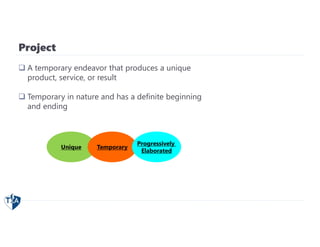
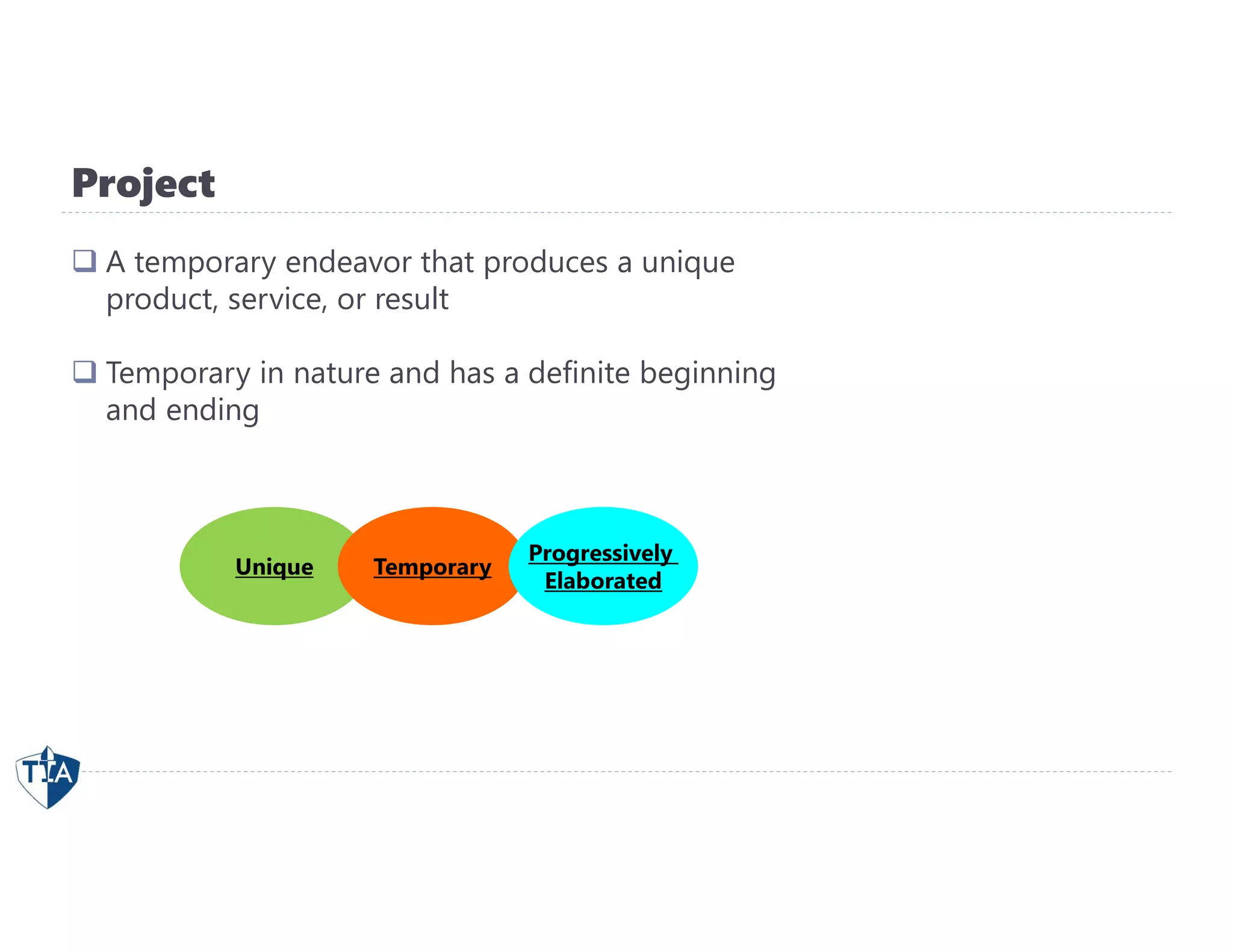
Project
 A temporary endeavor that produces a unique
product, service, or result
 Temporary in nature and has a definite beginning
and ending
Unique Temporary
Progressively
Elaborated
Project Management
 Project management is the application of knowledge, skills,
tools, and techniques to satisfy project requirements
 Preparing a business case to justify the investment
 Estimating resources and times
 Developing and implementing a management plan for the
project
 Leading and motivating the project delivery team
 Managing the risks, issues, and changes on the project
 Monitoring progress against plan
 Closing the project in a controlled fashion when appropriate
Value of Projects
 What value will this project bring to the
company upon completion?
 Why should we undertake this project?
 Money, Brand Reputation, Customer Service,
New or Change product or Service
Operations Management
 Deals with the ongoing production of goods
and/or Services
 Considers the acquisition, development, and
utilization of resources that firms need to deliver
the goods and services
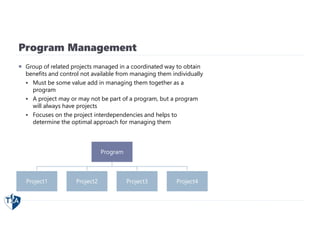
Program Management
 Group of related projects managed in a coordinated way to obtain
benefits and control not available from managing them individually
 Must be some value add in managing them together as a
program
 A project may or may not be part of a program, but a program
will always have projects
 Focuses on the project interdependencies and helps to
determine the optimal approach for managing them
Program
Project1 Project2 Project3 Project4
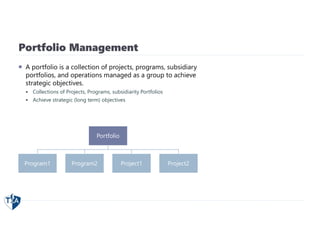
Portfolio Management
 A portfolio is a collection of projects, programs, subsidiary
portfolios, and operations managed as a group to achieve
strategic objectives.
 Collections of Projects, Programs, subsidiarity Portfolios
 Achieve strategic (long term) objectives
Portfolio
Program1 Program2 Project1 Project2
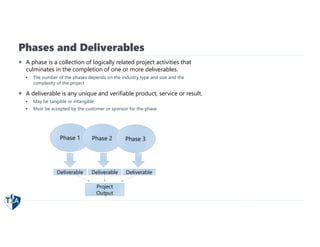
Phases and Deliverables
 A phase is a collection of logically related project activities that
culminates in the completion of one or more deliverables.
 The number of the phases depends on the industry type and size and the
complexity of the project
 A deliverable is any unique and verifiable product, service or result.
 May be tangible or intangible
 Must be accepted by the customer or sponsor for the phase
Phase 1 Phase 2 Phase 3
Deliverable
Deliverable Deliverable
Deliverable
Project
Output
Project
Output
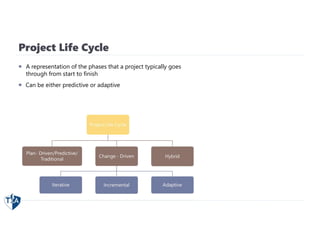
Project Life Cycle
 A representation of the phases that a project typically goes
through from start to finish
 Can be either predictive or adaptive
Project Governance
 Project Governance
 Framework within which project decisions are made
 Three pillars:
 Structure
 People
 Information
Stakeholders
 Individuals, group, or organization that may affect, be affected,
or perceive to be affected by the project.
Key Stakeholders
 Project Manager - manages the project
 Customer - uses the project deliverable
 Project team - the collection of individuals completing the
project work
 Project Sponsor – Provides resources and support
 Functional Manager - Departmental Manager, i.e Manager
of Engineering, Vice President of Marketing, Director of IT.
Generally controls resources
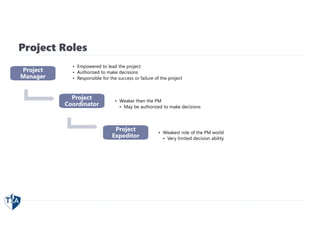
Project Roles
Project
Manager
• Empowered to lead the project
• Authorized to make decisions
• Responsible for the success or failure of the project
Project
Coordinator
• Weaker then the PM
• May be authorized to make decisions
Project
Expeditor
• Weakest role of the PM world
• Very limited decision ability
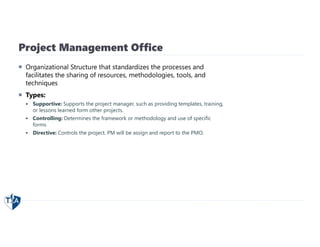
Project Management Office
 Organizational Structure that standardizes the processes and
facilitates the sharing of resources, methodologies, tools, and
techniques
 Types:
 Supportive: Supports the project manager, such as providing templates, training,
or lessons learned form other projects.
 Controlling: Determines the framework or methodology and use of specific
forms
 Directive: Controls the project. PM will be assign and report to the PMO.
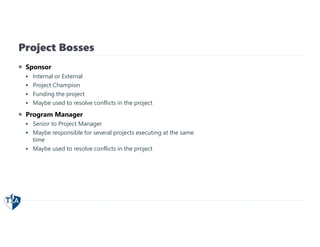
Project Bosses
 Sponsor
 Internal or External
 Project Champion
 Funding the project
 Maybe used to resolve conflicts in the project
 Program Manager
 Senior to Project Manager
 Maybe responsible for several projects executing at the same
time
 Maybe used to resolve conflicts in the project
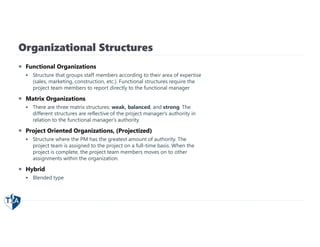
Organizational Structures
 Functional Organizations
 Structure that groups staff members according to their area of expertise
(sales, marketing, construction, etc.). Functional structures require the
project team members to report directly to the functional manager
 Matrix Organizations
 There are three matrix structures: weak, balanced, and strong. The
different structures are reflective of the project manager's authority in
relation to the functional manager's authority.
 Project Oriented Organizations, (Projectized)
 Structure where the PM has the greatest amount of authority. The
project team is assigned to the project on a full-time basis. When the
project is complete, the project team members moves on to other
assignments within the organization.
 Hybrid
 Blended type
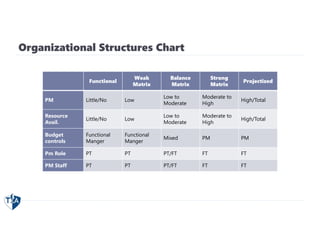
Organizational Structures Chart
Functional
Weak
Matrix
Balance
Matrix
Strong
Matrix
Projectized
PM Little/No Low
Low to
Moderate
Moderate to
High
High/Total
Resource
Avail.
Little/No Low
Low to
Moderate
Moderate to
High
High/Total
Budget
controls
Functional
Manger
Functional
Manger
Mixed PM PM
Pm Role PT PT PT/FT FT FT
PM Staff PT PT PT/FT FT FT
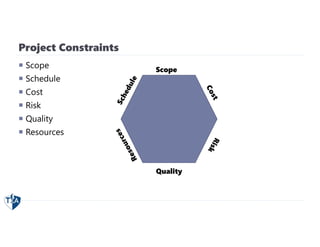
Project Constraints
 Scope
 Schedule
 Cost
 Risk
 Quality
 Resources
Scope
Quality
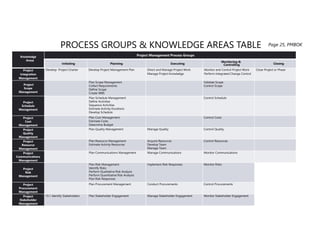
Knowledge
Areas
Project Management Process Groups
Initiating Planning Executing
Monitoring &
Controlling Closing
Project
Integration
Management
Develop Project Charter Develop Project Management Plan Direct and Manage Project Work
Manage Project Knowledge
Monitor and Control Project Work
Perform Integrated Change Control
Close Project or Phase
Project
Scope
Management
Plan Scope Management
Collect Requirements
Define Scope
Create WBS
Validate Scope
Control Scope
Project
Schedule
Management
Plan Schedule Management
Define Activities
Sequence Activities
Estimate Activity Durations
Develop Schedule
Control Schedule
Project
Cost
Management
Plan Cost Management
Estimate Costs
Determine Budget
Control Costs
Project
Quality
Management
Plan Quality Management Manage Quality Control Quality
Project
Resource
Management
Plan Resource Management
Estimate Activity Resources
Acquire Resources
Develop Team
Manage Team
Control Resources
Project
Communications
Management
Plan Communications Management Manage Communications Monitor Communications
Project
Risk
Management
Plan Risk Management
Identify Risks
Perform Qualitative Risk Analysis
Perform Quantitative Risk Analysis
Plan Risk Responses
Implement Risk Responses Monitor Risks
Project
Procurement
Management
Plan Procurement Management Conduct Procurements Control Procurements
Project
Stakeholder
Management
13.1 Identify Stakeholders Plan Stakeholder Engagement Manage Stakeholder Engagement Monitor Stakeholder Engagement
PROCESS GROUPS & KNOWLEDGE AREAS TABLE Page 25, PMBOK
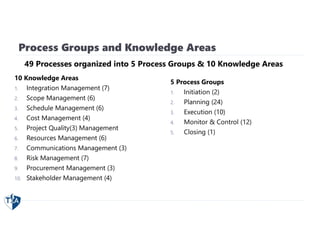
Process Groups and Knowledge Areas
5 Process Groups
1. Initiation (2)
2. Planning (24)
3. Execution (10)
4. Monitor & Control (12)
5. Closing (1)
10 Knowledge Areas
1. Integration Management (7)
2. Scope Management (6)
3. Schedule Management (6)
4. Cost Management (4)
5. Project Quality(3) Management
6. Resources Management (6)
7. Communications Management (3)
8. Risk Management (7)
9. Procurement Management (3)
10. Stakeholder Management (4)
49 Processes organized into 5 Process Groups & 10 Knowledge Areas
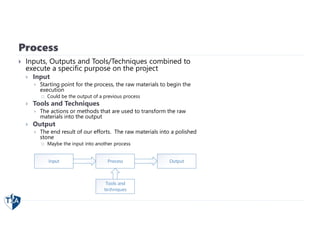
Process
 Inputs, Outputs and Tools/Techniques combined to
execute a specific purpose on the project
 Input
 Starting point for the process, the raw materials to begin the
execution
 Could be the output of a previous process
 Tools and Techniques
 The actions or methods that are used to transform the raw
materials into the output
 Output
 The end result of our efforts. The raw materials into a polished
stone
 Maybe the input into another process
Input Process Output
Tools and
techniques

PMP.pdf

  • 1.
    Project  A temporaryendeavor that produces a unique product, service, or result  Temporary in nature and has a definite beginning and ending Unique Temporary Progressively Elaborated
  • 2.
    Project Management  Projectmanagement is the application of knowledge, skills, tools, and techniques to satisfy project requirements  Preparing a business case to justify the investment  Estimating resources and times  Developing and implementing a management plan for the project  Leading and motivating the project delivery team  Managing the risks, issues, and changes on the project  Monitoring progress against plan  Closing the project in a controlled fashion when appropriate
  • 3.
    Value of Projects What value will this project bring to the company upon completion?  Why should we undertake this project?  Money, Brand Reputation, Customer Service, New or Change product or Service
  • 4.
    Operations Management  Dealswith the ongoing production of goods and/or Services  Considers the acquisition, development, and utilization of resources that firms need to deliver the goods and services
  • 5.
    Program Management  Groupof related projects managed in a coordinated way to obtain benefits and control not available from managing them individually  Must be some value add in managing them together as a program  A project may or may not be part of a program, but a program will always have projects  Focuses on the project interdependencies and helps to determine the optimal approach for managing them Program Project1 Project2 Project3 Project4
  • 6.
    Portfolio Management  Aportfolio is a collection of projects, programs, subsidiary portfolios, and operations managed as a group to achieve strategic objectives.  Collections of Projects, Programs, subsidiarity Portfolios  Achieve strategic (long term) objectives Portfolio Program1 Program2 Project1 Project2
  • 7.
    Phases and Deliverables A phase is a collection of logically related project activities that culminates in the completion of one or more deliverables.  The number of the phases depends on the industry type and size and the complexity of the project  A deliverable is any unique and verifiable product, service or result.  May be tangible or intangible  Must be accepted by the customer or sponsor for the phase Phase 1 Phase 2 Phase 3 Deliverable Deliverable Deliverable Deliverable Deliverable Deliverable Project Output Project Output
  • 8.
    Project Life Cycle A representation of the phases that a project typically goes through from start to finish  Can be either predictive or adaptive
  • 9.
    Project Governance  ProjectGovernance  Framework within which project decisions are made  Three pillars:  Structure  People  Information
  • 10.
    Stakeholders  Individuals, group,or organization that may affect, be affected, or perceive to be affected by the project. Key Stakeholders  Project Manager - manages the project  Customer - uses the project deliverable  Project team - the collection of individuals completing the project work  Project Sponsor – Provides resources and support  Functional Manager - Departmental Manager, i.e Manager of Engineering, Vice President of Marketing, Director of IT. Generally controls resources
  • 11.
    Project Roles Project Manager • Empoweredto lead the project • Authorized to make decisions • Responsible for the success or failure of the project Project Coordinator • Weaker then the PM • May be authorized to make decisions Project Expeditor • Weakest role of the PM world • Very limited decision ability
  • 12.
    Project Management Office Organizational Structure that standardizes the processes and facilitates the sharing of resources, methodologies, tools, and techniques  Types:  Supportive: Supports the project manager, such as providing templates, training, or lessons learned form other projects.  Controlling: Determines the framework or methodology and use of specific forms  Directive: Controls the project. PM will be assign and report to the PMO.
  • 13.
    Project Bosses  Sponsor Internal or External  Project Champion  Funding the project  Maybe used to resolve conflicts in the project  Program Manager  Senior to Project Manager  Maybe responsible for several projects executing at the same time  Maybe used to resolve conflicts in the project
  • 14.
    Organizational Structures  FunctionalOrganizations  Structure that groups staff members according to their area of expertise (sales, marketing, construction, etc.). Functional structures require the project team members to report directly to the functional manager  Matrix Organizations  There are three matrix structures: weak, balanced, and strong. The different structures are reflective of the project manager's authority in relation to the functional manager's authority.  Project Oriented Organizations, (Projectized)  Structure where the PM has the greatest amount of authority. The project team is assigned to the project on a full-time basis. When the project is complete, the project team members moves on to other assignments within the organization.  Hybrid  Blended type
  • 15.
    Organizational Structures Chart Functional Weak Matrix Balance Matrix Strong Matrix Projectized PMLittle/No Low Low to Moderate Moderate to High High/Total Resource Avail. Little/No Low Low to Moderate Moderate to High High/Total Budget controls Functional Manger Functional Manger Mixed PM PM Pm Role PT PT PT/FT FT FT PM Staff PT PT PT/FT FT FT
  • 16.
    Project Constraints  Scope Schedule  Cost  Risk  Quality  Resources Scope Quality
  • 17.
    Knowledge Areas Project Management ProcessGroups Initiating Planning Executing Monitoring & Controlling Closing Project Integration Management Develop Project Charter Develop Project Management Plan Direct and Manage Project Work Manage Project Knowledge Monitor and Control Project Work Perform Integrated Change Control Close Project or Phase Project Scope Management Plan Scope Management Collect Requirements Define Scope Create WBS Validate Scope Control Scope Project Schedule Management Plan Schedule Management Define Activities Sequence Activities Estimate Activity Durations Develop Schedule Control Schedule Project Cost Management Plan Cost Management Estimate Costs Determine Budget Control Costs Project Quality Management Plan Quality Management Manage Quality Control Quality Project Resource Management Plan Resource Management Estimate Activity Resources Acquire Resources Develop Team Manage Team Control Resources Project Communications Management Plan Communications Management Manage Communications Monitor Communications Project Risk Management Plan Risk Management Identify Risks Perform Qualitative Risk Analysis Perform Quantitative Risk Analysis Plan Risk Responses Implement Risk Responses Monitor Risks Project Procurement Management Plan Procurement Management Conduct Procurements Control Procurements Project Stakeholder Management 13.1 Identify Stakeholders Plan Stakeholder Engagement Manage Stakeholder Engagement Monitor Stakeholder Engagement PROCESS GROUPS & KNOWLEDGE AREAS TABLE Page 25, PMBOK
  • 18.
    Process Groups andKnowledge Areas 5 Process Groups 1. Initiation (2) 2. Planning (24) 3. Execution (10) 4. Monitor & Control (12) 5. Closing (1) 10 Knowledge Areas 1. Integration Management (7) 2. Scope Management (6) 3. Schedule Management (6) 4. Cost Management (4) 5. Project Quality(3) Management 6. Resources Management (6) 7. Communications Management (3) 8. Risk Management (7) 9. Procurement Management (3) 10. Stakeholder Management (4) 49 Processes organized into 5 Process Groups & 10 Knowledge Areas
  • 19.
    Process  Inputs, Outputsand Tools/Techniques combined to execute a specific purpose on the project  Input  Starting point for the process, the raw materials to begin the execution  Could be the output of a previous process  Tools and Techniques  The actions or methods that are used to transform the raw materials into the output  Output  The end result of our efforts. The raw materials into a polished stone  Maybe the input into another process Input Process Output Tools and techniques