PRESENTATION
ON
PROJECT MANAGEMENT
SUBMITTED TO:
MRS. MANU GAHLAWAT
What is a project?
 Converting a vision , a dream or a need to reality.
 Projects are a group of activities that have to be performed with limited resources
to yield objectives , in a specific time, and in a specific locality. Thus , a project is
a temporary endeavor employed to create a unique product, service or results
 It is a unique process , consisting of a set of coordinated and controlled activities
with start and finish dates, undertaken to achieve an objective conforming to
specific requirements, including the constraints of time, cost and resources.
 In a simple terms, project is a collection of activities that are interrelated with a
specific over all purpose.
Project characteristics
 Project can have a number of starting points but one
end.
 Complexity
 Investment decision
 Focus –Fixed set of objectives/ mission / goal.
 Unique
 Unity in diversity
Project management
 It is a application of knowledge, skills , tools and
techniques to project objectives to meet stakeholders
needs and expectations.
 It is planning, monitoring and controlling of all aspects of
a project and motivation of all involved to achieve project
objective of safety and within a defined time, cost and
performance.
 Project management is both people and technical
oriented. It involve understanding the cause effect
relationship and interactions among socio technical
dimensions of projects.
How does Project management benefit
you?
 To have goal clarity and measurement
 Resources will be coordinated.
 Risks will be identified and managed.
 Increase the possibilities of time savings.
 Increase the possibilities of cost savings.
 Increase the possibilities to deliver projects successfully.
Need for Project management
 To manage large investment opportunities in different
emerging sectors.
 Projects of increasingly complex sizes
 Aggressive competition
 Greater focus for operational effectiveness and efficiency
 downsizing
Common pitfalls in project management
 Lack of top management or sponsor support.
 Political disagreement
 Poor or inadequate estimating.
 Working backwards from a given date.
 Inexperienced project management personnel
 Poor communication or lack of communication.
 Ignoring project warning signs
 Poor governance
Why do companies use PM?
 To handle projects effectively in an organization.
 To define the project and agree with the customer.
 To plan and assess resource needs for the project.
 To estimate project cost and make proposals
 To plan and schedule activities in a project.
 To access risk and failure points and make backup plans.
 To lead a project team effectively and communicate well.
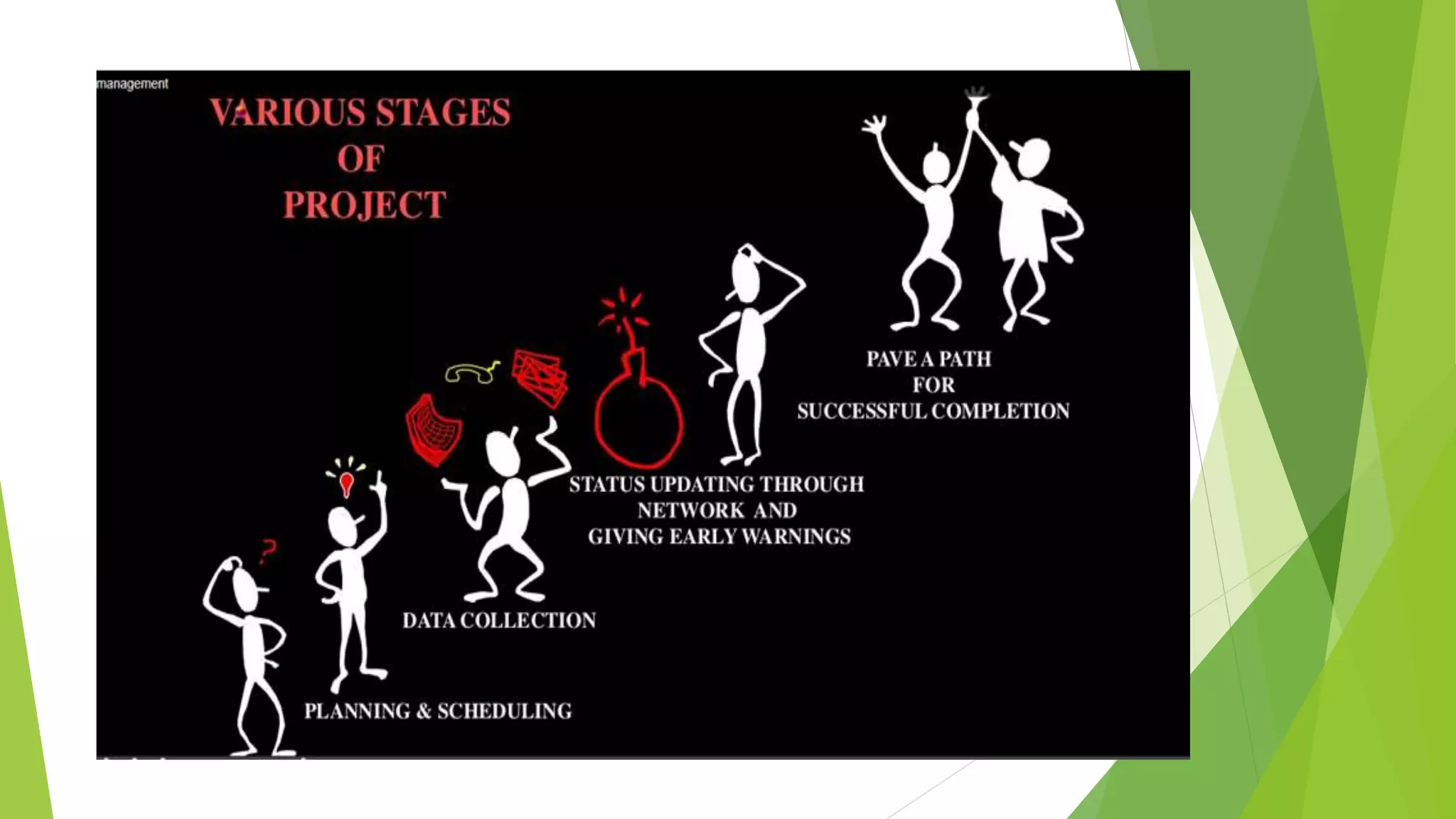
Phases of project management
 planning phase
 Scheduling phase
 Controlling phase
 Closing phase
Planning of Project management
 Most important phase of the project management
 Planning is a art and science of converting a set of
objectives to realization through a series of steps
executed in a organized and predicted way so
that there will be less requirements of changes in
the plan later on
 The old saying “plan the work , “work the plan”.
Scheduling the project
 Scheduling phase is the process of formatting the
planned activities, assigning the durations ,
resources and sequence of occurrence in
consultation with the team members.
 Planning and scheduling phases are under taken
before the actual project starts.
Controlling
 Controlling phase is undertaken during the actual
project implementation.
 Project controlling is a mechanism established to
determine deviations from the project base
schedule during implementation to compensate
the deviations on the basis of commissioning
minima , flow of resources like finance ,
manpower , equipment & application techniques.
Closing
 Closing phase is the last phase of the project
which brings close out of the complete project.
Whatever the project requirements are pre-
defined, during this phase the total delivery is
made and it is accepted by the customer.
 Maximum conflicts can arise in the project during
this phase between those who have worked to
deliver the outcome and those who are accepting
the results of the work.
.

Project management

  • 1.
  • 2.
    What is aproject?  Converting a vision , a dream or a need to reality.  Projects are a group of activities that have to be performed with limited resources to yield objectives , in a specific time, and in a specific locality. Thus , a project is a temporary endeavor employed to create a unique product, service or results  It is a unique process , consisting of a set of coordinated and controlled activities with start and finish dates, undertaken to achieve an objective conforming to specific requirements, including the constraints of time, cost and resources.  In a simple terms, project is a collection of activities that are interrelated with a specific over all purpose.
  • 3.
    Project characteristics  Projectcan have a number of starting points but one end.  Complexity  Investment decision  Focus –Fixed set of objectives/ mission / goal.  Unique  Unity in diversity
  • 4.
    Project management  Itis a application of knowledge, skills , tools and techniques to project objectives to meet stakeholders needs and expectations.  It is planning, monitoring and controlling of all aspects of a project and motivation of all involved to achieve project objective of safety and within a defined time, cost and performance.  Project management is both people and technical oriented. It involve understanding the cause effect relationship and interactions among socio technical dimensions of projects.
  • 5.
    How does Projectmanagement benefit you?  To have goal clarity and measurement  Resources will be coordinated.  Risks will be identified and managed.  Increase the possibilities of time savings.  Increase the possibilities of cost savings.  Increase the possibilities to deliver projects successfully.
  • 7.
    Need for Projectmanagement  To manage large investment opportunities in different emerging sectors.  Projects of increasingly complex sizes  Aggressive competition  Greater focus for operational effectiveness and efficiency  downsizing
  • 8.
    Common pitfalls inproject management  Lack of top management or sponsor support.  Political disagreement  Poor or inadequate estimating.  Working backwards from a given date.  Inexperienced project management personnel  Poor communication or lack of communication.  Ignoring project warning signs  Poor governance
  • 9.
    Why do companiesuse PM?  To handle projects effectively in an organization.  To define the project and agree with the customer.  To plan and assess resource needs for the project.  To estimate project cost and make proposals  To plan and schedule activities in a project.  To access risk and failure points and make backup plans.  To lead a project team effectively and communicate well.
  • 10.
    Phases of projectmanagement  planning phase  Scheduling phase  Controlling phase  Closing phase
  • 11.
    Planning of Projectmanagement  Most important phase of the project management  Planning is a art and science of converting a set of objectives to realization through a series of steps executed in a organized and predicted way so that there will be less requirements of changes in the plan later on  The old saying “plan the work , “work the plan”.
  • 12.
    Scheduling the project Scheduling phase is the process of formatting the planned activities, assigning the durations , resources and sequence of occurrence in consultation with the team members.  Planning and scheduling phases are under taken before the actual project starts.
  • 13.
    Controlling  Controlling phaseis undertaken during the actual project implementation.  Project controlling is a mechanism established to determine deviations from the project base schedule during implementation to compensate the deviations on the basis of commissioning minima , flow of resources like finance , manpower , equipment & application techniques.
  • 14.
    Closing  Closing phaseis the last phase of the project which brings close out of the complete project. Whatever the project requirements are pre- defined, during this phase the total delivery is made and it is accepted by the customer.  Maximum conflicts can arise in the project during this phase between those who have worked to deliver the outcome and those who are accepting the results of the work.
  • 15.