1
• A project organization is a structure that facilitates
the coordination and implementation of project
activities. Each project has unique characteristics and
the design of an organization structure should
consider the organization environment, the project
characteristics in which it will operate, and the level
of authority the the project manager is given. The
structure defines the relationships among members
of the project management and relationships with
the external environment.One of the main objectives
of the structure is to reduce uncertainty and
confusion that typically occurs at the project
initiation phase.
Project organization structure
2
• Project organization helps to determine what must
be done, what kind of authority one should have to
perform efficiently,what he is expected to perform
and how efforts of various team members can be
coordinated and directed towards a common goal.
• Creating an organizational structure that supports
projects has been a complex process. After all, if
project happens only one time, has a unique
reporting structure,how can any firm create an
organization chart that will last beyond the end of
the last project?
Project organization structure
3
• The common understanding of project managers
now days is that, there is not a single best option for
setting up a project organization. Project
Management has to identify prior to a project
start,the internal and external requirements in order
to give the best possible recommendation for a
successful project.
Project organization structure
4
• TYPES OF PROJECT ORGANIZATION
• Project organizations can be:
• Functional or Pure Line Organization
• Pure Project Organization
• Matrix Organization - is a hybrid of the first two
organizations.
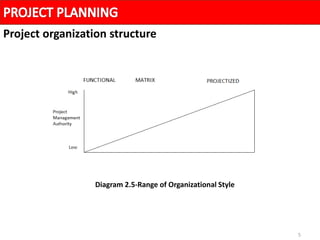
• The project manager’s authority for each of the
project organization is shown in the Diagram 2.5
below.
Project organization structure
5
Project organization structure
Diagram 2.5-Range of Organizational Style
6
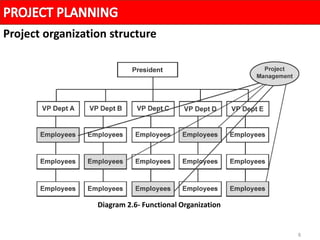
• Functional or Pure Line Organization
• A functional organization structure is a hierarchical
organization structure wherein people are grouped
as per their area of specialization. As shown in the
Diagram 2.6,the functional driven firms have a
organizational structure based on functional areas
such as sales and marketing,finance,information
systems,manufacturing,and human resources. Team
members complete the project work over and above
their responsibilities to normal departmental work.
Communication primarily occurs within the same
function.s
Project organization structure
Diagram 2.5-Range of Organizational Style
7
• Here,all authority(i.e. resource allocation,budget
allocation,etc.) are with the functional manager.The
project manager does not have a specific
position,and his role is to ensure smooth execution
of processses. Project Manager is a specialist or line
manager who is aligned to the project for a specific
time. The team members continue to report to their
respective line general manager. Projects that span
functional groups are difficult to manage because
project managers have no functional authority and
must work through the functional vice-president /
managers to assign, monitor and coordinate work.
Project organization structure
Diagram 2.5-Range of Organizational Style
8
Project organization structure
Diagram 2.6- Functional Organization
9
• Advantages:
• Employees are grouped by their knowledge and skills
• Reduced overhead, as no additional team members
have to be hired
• Flexibility for changes in project scope and
manpower
Project organization structure
10
• Many projects can share functional expertise
• Provides opportunity for career growth
• Roles and responsibilities are fixed,which makes
accountability much easier
• Cooperation and communication are excellent within
each department
Project organization structure
11
• Disadvantages:
• Suitable for small projects only
• Slow reaction time due to long communication lines
within the project
• No direct link with the customer
• Accountability for the project is difficult to be fixed
• More priority to function than for the project
• Focus towards departmental goals rater than
organizational goals
Project organization structure
12
• Pure Project Organization
• Dedicated teams are put together to work on
projects in this type of project organizational
structure. The project manager is very high in the
hirarchy having direct control over business
functions,personnel and project
resources.members.They have total control over the
project they oversee.
Project organization structure
13
• The project-based model of managing projects is
widespread in traditional manufacturing
industry,consultancy firms,construction firms.The
project manager has ultimate authority, reporting to
the project director. The individuals on the team
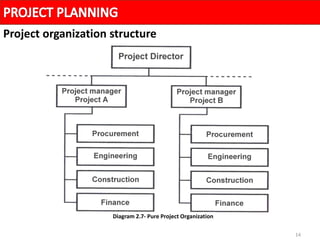
work directly for the project manager. Diagram 2.7
shows a pure organization structure
Project organization structure
14
Project organization structure
Diagram 2.7- Pure Project Organization
15
• Advantages:
• The line of communication is short
• Appropriate for firms that work on large long term
projects
• Project manager has full line of authority
• Decisions are swift because of centralized authority
• Specialist functional dependent skills help in speedy
completion of the project
• High level of commitment from its memberss
Project organization structure
16
• Disadvantages:
• Each project has to be fully staffed which can lead to
duplication of staff members
• Tendency of project manager to stock pile resources
and materials to ensure their availability
• Not suitable for small projects
• Project takes on a direction of its own without rules
and procedures
• Concern among team members for career growth
Project organization structure
17
• Matrix Organization
• The third option is a matrix structure. Resources are
shared across both business-as-usual work and
project work. It might mean having two managers or
"dotted-line" responsibility to a project manager as
well as to the team manager. The functional
management line structure is normally in place first,
and the project manager takes the dotted line.
Project organization structure
18
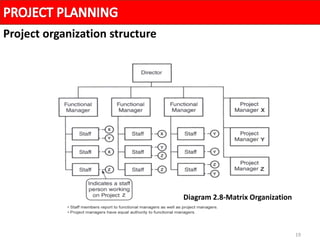
• This structure splits power and authority between
the functional head and the project manager. You
will need to possess excellent negotiating skills as a
project manager to get things done as per your
requirement. Diagram 2.8 shows a typical matrix
organization
Project organization structure
19
Project organization structure
Diagram 2.8-Matrix Organization
20
• Advantages:
• The advantages of functional organization and
project team structure are retained
• Team members can maintain contact with project
teams as well as their functional department
colleagues and functional boss
• Project Manager is directly responsible for
completion of the project by a specific deadline &
budget
• The project manager has control over all the
resources
Project organization structure
21
• Optimization of resources utilization as any spare
resource can be shifted from one project to another
• Conflicts can be resolved speedily
• On completion of the project, team members can
return to their respective functional departments
• Sharing helps in reducing project cost
• Suitable for small, medium and large projects
Project organization structure
22
• Disadvantages:
• Potential for conflict between functional head and
project manager especially when their Key Result
Areas (KRA) are different
• There is dual reporting as team members have to
report to the project manager and their functional
heads/ manager
Project organization structure
23
• Decisions are likely to get delayed on account of
discussions/ meetings between the project manager
and functional heads/ manager
• A conflict of loyalty between functional heads/
managers and project manager over the allocation of
resources especially during multiple projects
Project organization structure

Project initiation topic 2.5_project organization structure

  • 1.
    1 • A projectorganization is a structure that facilitates the coordination and implementation of project activities. Each project has unique characteristics and the design of an organization structure should consider the organization environment, the project characteristics in which it will operate, and the level of authority the the project manager is given. The structure defines the relationships among members of the project management and relationships with the external environment.One of the main objectives of the structure is to reduce uncertainty and confusion that typically occurs at the project initiation phase. Project organization structure
  • 2.
    2 • Project organizationhelps to determine what must be done, what kind of authority one should have to perform efficiently,what he is expected to perform and how efforts of various team members can be coordinated and directed towards a common goal. • Creating an organizational structure that supports projects has been a complex process. After all, if project happens only one time, has a unique reporting structure,how can any firm create an organization chart that will last beyond the end of the last project? Project organization structure
  • 3.
    3 • The commonunderstanding of project managers now days is that, there is not a single best option for setting up a project organization. Project Management has to identify prior to a project start,the internal and external requirements in order to give the best possible recommendation for a successful project. Project organization structure
  • 4.
    4 • TYPES OFPROJECT ORGANIZATION • Project organizations can be: • Functional or Pure Line Organization • Pure Project Organization • Matrix Organization - is a hybrid of the first two organizations. • The project manager’s authority for each of the project organization is shown in the Diagram 2.5 below. Project organization structure
  • 5.
    5 Project organization structure Diagram2.5-Range of Organizational Style
  • 6.
    6 • Functional orPure Line Organization • A functional organization structure is a hierarchical organization structure wherein people are grouped as per their area of specialization. As shown in the Diagram 2.6,the functional driven firms have a organizational structure based on functional areas such as sales and marketing,finance,information systems,manufacturing,and human resources. Team members complete the project work over and above their responsibilities to normal departmental work. Communication primarily occurs within the same function.s Project organization structure Diagram 2.5-Range of Organizational Style
  • 7.
    7 • Here,all authority(i.e.resource allocation,budget allocation,etc.) are with the functional manager.The project manager does not have a specific position,and his role is to ensure smooth execution of processses. Project Manager is a specialist or line manager who is aligned to the project for a specific time. The team members continue to report to their respective line general manager. Projects that span functional groups are difficult to manage because project managers have no functional authority and must work through the functional vice-president / managers to assign, monitor and coordinate work. Project organization structure Diagram 2.5-Range of Organizational Style
  • 8.
    8 Project organization structure Diagram2.6- Functional Organization
  • 9.
    9 • Advantages: • Employeesare grouped by their knowledge and skills • Reduced overhead, as no additional team members have to be hired • Flexibility for changes in project scope and manpower Project organization structure
  • 10.
    10 • Many projectscan share functional expertise • Provides opportunity for career growth • Roles and responsibilities are fixed,which makes accountability much easier • Cooperation and communication are excellent within each department Project organization structure
  • 11.
    11 • Disadvantages: • Suitablefor small projects only • Slow reaction time due to long communication lines within the project • No direct link with the customer • Accountability for the project is difficult to be fixed • More priority to function than for the project • Focus towards departmental goals rater than organizational goals Project organization structure
  • 12.
    12 • Pure ProjectOrganization • Dedicated teams are put together to work on projects in this type of project organizational structure. The project manager is very high in the hirarchy having direct control over business functions,personnel and project resources.members.They have total control over the project they oversee. Project organization structure
  • 13.
    13 • The project-basedmodel of managing projects is widespread in traditional manufacturing industry,consultancy firms,construction firms.The project manager has ultimate authority, reporting to the project director. The individuals on the team work directly for the project manager. Diagram 2.7 shows a pure organization structure Project organization structure
  • 14.
    14 Project organization structure Diagram2.7- Pure Project Organization
  • 15.
    15 • Advantages: • Theline of communication is short • Appropriate for firms that work on large long term projects • Project manager has full line of authority • Decisions are swift because of centralized authority • Specialist functional dependent skills help in speedy completion of the project • High level of commitment from its memberss Project organization structure
  • 16.
    16 • Disadvantages: • Eachproject has to be fully staffed which can lead to duplication of staff members • Tendency of project manager to stock pile resources and materials to ensure their availability • Not suitable for small projects • Project takes on a direction of its own without rules and procedures • Concern among team members for career growth Project organization structure
  • 17.
    17 • Matrix Organization •The third option is a matrix structure. Resources are shared across both business-as-usual work and project work. It might mean having two managers or "dotted-line" responsibility to a project manager as well as to the team manager. The functional management line structure is normally in place first, and the project manager takes the dotted line. Project organization structure
  • 18.
    18 • This structuresplits power and authority between the functional head and the project manager. You will need to possess excellent negotiating skills as a project manager to get things done as per your requirement. Diagram 2.8 shows a typical matrix organization Project organization structure
  • 19.
  • 20.
    20 • Advantages: • Theadvantages of functional organization and project team structure are retained • Team members can maintain contact with project teams as well as their functional department colleagues and functional boss • Project Manager is directly responsible for completion of the project by a specific deadline & budget • The project manager has control over all the resources Project organization structure
  • 21.
    21 • Optimization ofresources utilization as any spare resource can be shifted from one project to another • Conflicts can be resolved speedily • On completion of the project, team members can return to their respective functional departments • Sharing helps in reducing project cost • Suitable for small, medium and large projects Project organization structure
  • 22.
    22 • Disadvantages: • Potentialfor conflict between functional head and project manager especially when their Key Result Areas (KRA) are different • There is dual reporting as team members have to report to the project manager and their functional heads/ manager Project organization structure
  • 23.
    23 • Decisions arelikely to get delayed on account of discussions/ meetings between the project manager and functional heads/ manager • A conflict of loyalty between functional heads/ managers and project manager over the allocation of resources especially during multiple projects Project organization structure