Project Management
OBJECTIVES
At the end of this chapter, the learner will be able to:
▪ Differentiate a program manager from a project manager;
▪ Identify a project organizational structure;
▪ Compare and contrast the different forms of organizational
structures used in organizing projects;
▪ Design an optimal organizational structure for a project.
OBJECTIVES
▪ Select the best organizational structure in organizing projects
based from their advantages and disadvantages;
▪ Categorize the different forms of matrix organizational
structure based on the authority of the functional and project
manager;
▪ Design an optimal organizational structure for a project
Structure involves an organization. People
who work in an organization are clustered in
order that their efforts can be guided for utmost
efficiency.
There are numerous new organizational
structures that materialized in the last couple of
decades. Project managers continue to search
for organizational techniques that make
possible teamwork, can take full advantage on
the use of restricted resources, efficiency and
high quality in the manner a project is
accomplished and how the goals and
objectives are realized.
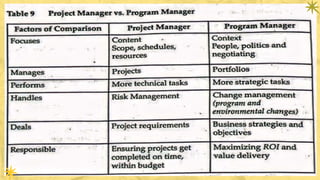
Program Manager vs. Project Manager
▪For several projects managers,
the next steps in their careers is
the move up to program manager.
▪The roles of project and project
manager vary from company to
company, there are some unique
characteristics that characterize
the two.
▪A program manager
synchronizes groups of related
projects instead of just manage
individual projects.
▪They supervises horizontally
across the functional projects
involved with the program.
▪From a business point of view this
manager makes certain that cross-
project work endeavor stays viable
and recognizes gains.
PROGRAM MANAGER PROJECT MANAGER
Program Manager vs. Project Manager
▪A lot of project managers look up
to program managers and aspire
to be in their shoes one day.
▪In order to be able to get to that
level of program managers,
project managers, as well as their
organizations, must clearly
undestand the general
responsibilities that are expected
from each role.
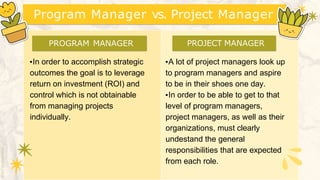
▪In order to accomplish strategic
outcomes the goal is to leverage
return on investment (ROI) and
control which is not obtainable
from managing projects
individually.
PROGRAM MANAGER PROJECT MANAGER
The Project Organizational Structure
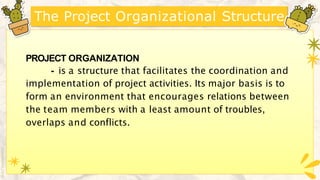
PROJECT ORGANIZATION
- is a structure that facilitates the coordination and
implementation of project activities. Its major basis is to
form an environment that encourages relations between
the team members with a least amount of troubles,
overlaps and conflicts.
The Project Organizational Structure
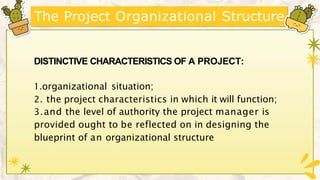
DISTINCTIVE CHARACTERISTICS OF A PROJECT:
1.organizational situation;
2. the project characteristics in which it will function;
3.and the level of authority the project manager is
provided ought to be reflected on in designing the
blueprint of an organizational structure
The Project Organizational Structure
The structure delineates the interactions amongst members of the
project management and the dealings with the external environment.
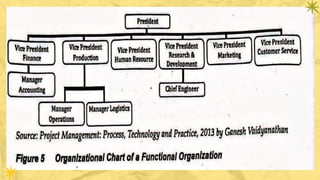
The structure also identifies the authority by way of graphical diagram
named an organization chart.
It is the responsibility of the project manager to create a project
structure that will match the various project requirements at different
phases of the project. The structure cannot be devised to be too regid
or too lose. This is the for the reason that the project organization’s
purpose is to make easy the interactions of people to reach the the
project vital goals despite restrictions in scope, schedule, budget and
quality.
The Project Organizational Structure
The intention in drawing a project structure is to afford a
proper environment that the project manager can utilize to
persuade team members to do their best in carrying out their
assignments and duties. The structure needs to be planned
to increase cooperation between individual team members,
all in a cost effective manner with a least of repetition to
effort and overlaps.
Forms of Project Organizational
Structure
A project structure can be in different forms. Every form
has its own advantages and disadvantages. There are often
varied project organizational structures that are used in
organization. These structures are at times informal and
often overlap and sometimes even oppose each other.
Forms of Project Organizational
Structure
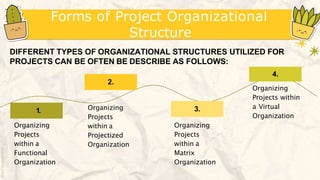
Organizing
Projects
within a
Projectized
Organization
2.
Organizing
Projects
within a
Matrix
Organization
3.
Organizing
Projects within
a Virtual
Organization
4.
Organizing
Projects
within a
Functional
Organization
1.
DIFFERENT TYPES OF ORGANIZATIONAL STRUCTURES UTILIZED FOR
PROJECTS CAN BE OFTEN BE DESCRIBE AS FOLLOWS:
Forms of Project Organizational
Structure
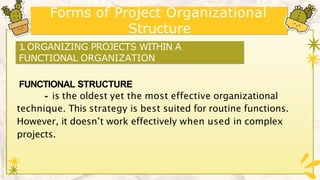
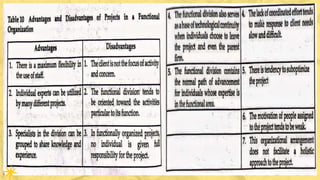
FUNCTIONAL STRUCTURE
- is the oldest yet the most effective organizational
technique. This strategy is best suited for routine functions.
However, it doesn’t work effectively when used in complex
projects.
1
.ORGANIZING PROJECTS WITHIN A
FUNCTIONAL ORGANIZATION
Forms of Project Organizational
Structure
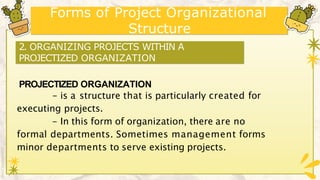
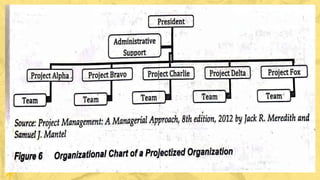
PROJECTIZED ORGANIZATION
- is a structure that is particularly created for
executing projects.
- In this form of organization, there are no
formal departments. Sometimes management forms
minor departments to serve existing projects.
2. ORGANIZING PROJECTS WITHIN A
PROJECTIZED ORGANIZATION
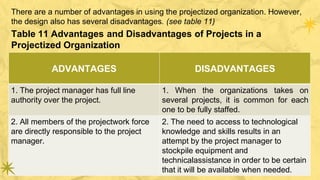
ADVANTAGES DISADVANTAGES
1. The project manager has full line
authority over the project.
1. When the organizations takes on
several projects, it is common for each
one to be fully staffed.
2. All members of the projectwork force
are directly responsible to the project
manager.
2. The need to access to technological
knowledge and skills results in an
attempt by the project manager to
stockpile equipment and
technicalassistance in order to be certain
that it will be available when needed.
There are a number of advantages in using the projectized organization. However,
the design also has several disadvantages. (see table 11)
Table 11 Advantages and Disadvantages of Projects in a
Projectized Organization
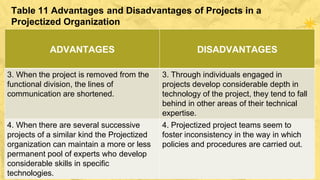
Table 11 Advantages and Disadvantages of Projects in a
Projectized Organization
ADVANTAGES DISADVANTAGES
3. When the project is removed from the
functional division, the lines of
communication are shortened.
3. Through individuals engaged in
projects develop considerable depth in
technology of the project, they tend to fall
behind in other areas of their technical
expertise.
4. When there are several successive
projects of a similar kind the Projectized
organization can maintain a more or less
permanent pool of experts who develop
considerable skills in specific
technologies.
4. Projectized project teams seem to
foster inconsistency in the way in which
policies and procedures are carried out.
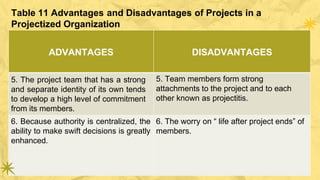
Table 11 Advantages and Disadvantages of Projects in a
Projectized Organization
ADVANTAGES DISADVANTAGES
5. The project team that has a strong
and separate identity of its own tends
to develop a high level of commitment
from its members.
5. Team members form strong
attachments to the project and to each
other known as projectitis.
6. Because authority is centralized, the
ability to make swift decisions is greatly
enhanced.
6. The worry on “ life after project ends” of
members.
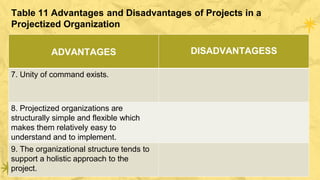
Table 11 Advantages and Disadvantages of Projects in a
Projectized Organization
ADVANTAGES DISADVANTAGESS
7. Unity of command exists.
8. Projectized organizations are
structurally simple and flexible which
makes them relatively easy to
understand and to implement.
9. The organizational structure tends to
support a holistic approach to the
project.
Forms of Project Organizational
Structure
MATRIX ORGANIZATION
- is actually a project management structure that
combines the very best components of functional
organization and project organization structures besides the
recognition of intrinsic defects inside these two structures.
3. ORGANIZING PROJECTS WITHIN A MATRIX
ORGANIZATION
Forms of Project Organizational
Structure
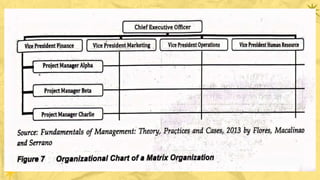
There are two distinctive levels of responsibility that are
present of organizing (see figure 7). Departments such as
manufacturing and finance exist under the vertical functional
hierarchy. While, alongside are the horizontal structures
created by the projects that have some access to functional
departments’ resources.
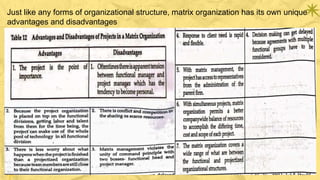
Just like any forms of organizational structure, matrix organization has its own unique
advantages and disadvantages
Forms of Project Organizational
Structure
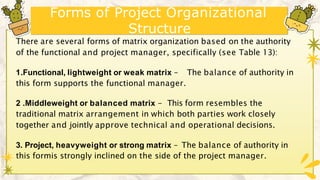
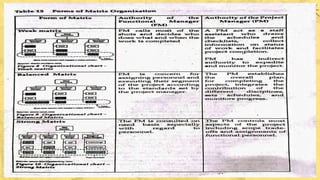
There are several forms of matrix organization based on the authority
of the functional and project manager, specifically (see Table 13):
1.Functional, lightweight or weak matrix – The balance of authority in
this form supports the functional manager.
2 .Middleweight or balanced matrix - This form resembles the
traditional matrix arrangement in which both parties work closely
together and jointly approve technical and operational decisions.
3. Project, heavyweight or strong matrix – The balance of authority in
this formis strongly inclined on the side of the project manager.
Forms of Project Organizational
Structure
The use of the Internet and other modern communication
technologies paved the way to the rise of virtual projects. A
virtual project has project team that may work in different
time zones, in geographically dispersed places, in different
organizations, and in different cultures. In this form of
organization, the project team is often formed in a matrix
type of structure
4. ORGANIZING PROJECTS WITHIN A VIRTUAL
ORGANIZATION
Forms of Project Organizational
Structure
Here are some of the guidelines for the success of an
organization in using virtual form of organization:
1. Challenging and interesting projects are appropriate for
virtual teams, but make sure that the project has meaning for
both the company and the team.
2. If possible request volunteers to be part of the team because
they are more enthusiastic and dedicated to the success of the
project.
Forms of Project Organizational
Structure
3. Each team must be composed of six to seven members
only with outside contacts. Make sure a few members of the
team are familiar with each other.
4. Form an online resource for team members to learn about
each other on how they choose to work collaborate,
brainstorm and draw inspiration.
Forms of Project Organizational
Structure
5.Promote regular communication among team members.
6. If possible divide the project work into geographically
independent components to avoid hindering one location for
delays of other places.
Forms of Project Organizational
Structure
There are four types of electronic communication being used help in
beating the lack of formal and informal personal contact between
members of the project team. These manners of electronic
communication have been extensively even before by managers of
virtual projects:
1.The Internet - It provides a faster and cheap mode of communication
worldwide. This is a necessary ways of contacting all participants in
virtual project especially with virtual project manager who depends on
emails to exchange project data with his dispersed team.
Forms of Project Organizational
Structure
2. The pager – Each member has a paging system with individual pager
number. A particular team member can be “paged” whenever an issue
surface that requires the person’s attention. This mode of
communication is good for quick response to problems and issues.
3. Teleconferencing - This mode of electronic communication allows all
essential persons to share conversation and resent their view in real time.
The absence of visual though needs the one speaking to make proper
identification when participating in the discussion via this telephony
technology.
Forms of Project Organizational
Structure
4. Videoconferencing – This manner of communication saves
time and money for the geographically dispersed team for
periodic face-to-face meeting. When important issues could
be discussed and resolved with email, teleconferencing and
voice contact, the use of teleconferencing must be
appropriately utilized.
Selecting the Optimal
Organizational Structure
The best project organizational structure balances the needs of the
project with the needs of the organization. Selecting the correct project
structure type is a key success factor that can create better business
results and achieve the competitive advantage and value that the
organization visualized. The choice of the organizational form in
managing a project rarely lies on the project manager. It is the senior
management who is responsible for this job. The preference is
determined by the situation and to some extent instinctive.
Selecting the Optimal
Organizational Structure
Here are some basic considerations that may influence the selection of
the organizational structure for project management:
1.Project size – a project could be small, medium and large.
2. Project length – number of calendar periods it takes from the time the
execution of element starts to the moment it is completed.
3. Experience with project management organization – familiarity with
other organizations’ way of handling projects
Selecting the Optimal
Organizational Structure
4. Philosophy and visibility of upper level management – the
beliefs and the presence of support of top management.
5. Project location – the geographic location using the street
address, nearest major city, or the latitude and longitude.
Selecting the Optimal
Organizational Structure
6. Available resources – the accessibility of needed resources.
7. Unique aspects of the project – the best control of human
resources classified as labor-intensive and capital intensive;
labor intensive projects need a formal structure while capital
intensive may use informal organizational form.
MEMBERS:
Nicole Meca
Mariel Galos
Melisa Cortez
Panie Joy Bernardo
Ginevi Gregorio

Project Management vdhsjsjskskaannzbdnsj

  • 1.
  • 2.
    OBJECTIVES At the endof this chapter, the learner will be able to: ▪ Differentiate a program manager from a project manager; ▪ Identify a project organizational structure; ▪ Compare and contrast the different forms of organizational structures used in organizing projects; ▪ Design an optimal organizational structure for a project.
  • 3.
    OBJECTIVES ▪ Select thebest organizational structure in organizing projects based from their advantages and disadvantages; ▪ Categorize the different forms of matrix organizational structure based on the authority of the functional and project manager; ▪ Design an optimal organizational structure for a project
  • 4.
    Structure involves anorganization. People who work in an organization are clustered in order that their efforts can be guided for utmost efficiency. There are numerous new organizational structures that materialized in the last couple of decades. Project managers continue to search for organizational techniques that make possible teamwork, can take full advantage on the use of restricted resources, efficiency and high quality in the manner a project is accomplished and how the goals and objectives are realized.
  • 5.
    Program Manager vs.Project Manager ▪For several projects managers, the next steps in their careers is the move up to program manager. ▪The roles of project and project manager vary from company to company, there are some unique characteristics that characterize the two. ▪A program manager synchronizes groups of related projects instead of just manage individual projects. ▪They supervises horizontally across the functional projects involved with the program. ▪From a business point of view this manager makes certain that cross- project work endeavor stays viable and recognizes gains. PROGRAM MANAGER PROJECT MANAGER
  • 6.
    Program Manager vs.Project Manager ▪A lot of project managers look up to program managers and aspire to be in their shoes one day. ▪In order to be able to get to that level of program managers, project managers, as well as their organizations, must clearly undestand the general responsibilities that are expected from each role. ▪In order to accomplish strategic outcomes the goal is to leverage return on investment (ROI) and control which is not obtainable from managing projects individually. PROGRAM MANAGER PROJECT MANAGER
  • 8.
    The Project OrganizationalStructure PROJECT ORGANIZATION - is a structure that facilitates the coordination and implementation of project activities. Its major basis is to form an environment that encourages relations between the team members with a least amount of troubles, overlaps and conflicts.
  • 9.
    The Project OrganizationalStructure DISTINCTIVE CHARACTERISTICS OF A PROJECT: 1.organizational situation; 2. the project characteristics in which it will function; 3.and the level of authority the project manager is provided ought to be reflected on in designing the blueprint of an organizational structure
  • 10.
    The Project OrganizationalStructure The structure delineates the interactions amongst members of the project management and the dealings with the external environment. The structure also identifies the authority by way of graphical diagram named an organization chart. It is the responsibility of the project manager to create a project structure that will match the various project requirements at different phases of the project. The structure cannot be devised to be too regid or too lose. This is the for the reason that the project organization’s purpose is to make easy the interactions of people to reach the the project vital goals despite restrictions in scope, schedule, budget and quality.
  • 11.
    The Project OrganizationalStructure The intention in drawing a project structure is to afford a proper environment that the project manager can utilize to persuade team members to do their best in carrying out their assignments and duties. The structure needs to be planned to increase cooperation between individual team members, all in a cost effective manner with a least of repetition to effort and overlaps.
  • 12.
    Forms of ProjectOrganizational Structure A project structure can be in different forms. Every form has its own advantages and disadvantages. There are often varied project organizational structures that are used in organization. These structures are at times informal and often overlap and sometimes even oppose each other.
  • 13.
    Forms of ProjectOrganizational Structure Organizing Projects within a Projectized Organization 2. Organizing Projects within a Matrix Organization 3. Organizing Projects within a Virtual Organization 4. Organizing Projects within a Functional Organization 1. DIFFERENT TYPES OF ORGANIZATIONAL STRUCTURES UTILIZED FOR PROJECTS CAN BE OFTEN BE DESCRIBE AS FOLLOWS:
  • 14.
    Forms of ProjectOrganizational Structure FUNCTIONAL STRUCTURE - is the oldest yet the most effective organizational technique. This strategy is best suited for routine functions. However, it doesn’t work effectively when used in complex projects. 1 .ORGANIZING PROJECTS WITHIN A FUNCTIONAL ORGANIZATION
  • 17.
    Forms of ProjectOrganizational Structure PROJECTIZED ORGANIZATION - is a structure that is particularly created for executing projects. - In this form of organization, there are no formal departments. Sometimes management forms minor departments to serve existing projects. 2. ORGANIZING PROJECTS WITHIN A PROJECTIZED ORGANIZATION
  • 19.
    ADVANTAGES DISADVANTAGES 1. Theproject manager has full line authority over the project. 1. When the organizations takes on several projects, it is common for each one to be fully staffed. 2. All members of the projectwork force are directly responsible to the project manager. 2. The need to access to technological knowledge and skills results in an attempt by the project manager to stockpile equipment and technicalassistance in order to be certain that it will be available when needed. There are a number of advantages in using the projectized organization. However, the design also has several disadvantages. (see table 11) Table 11 Advantages and Disadvantages of Projects in a Projectized Organization
  • 20.
    Table 11 Advantagesand Disadvantages of Projects in a Projectized Organization ADVANTAGES DISADVANTAGES 3. When the project is removed from the functional division, the lines of communication are shortened. 3. Through individuals engaged in projects develop considerable depth in technology of the project, they tend to fall behind in other areas of their technical expertise. 4. When there are several successive projects of a similar kind the Projectized organization can maintain a more or less permanent pool of experts who develop considerable skills in specific technologies. 4. Projectized project teams seem to foster inconsistency in the way in which policies and procedures are carried out.
  • 21.
    Table 11 Advantagesand Disadvantages of Projects in a Projectized Organization ADVANTAGES DISADVANTAGES 5. The project team that has a strong and separate identity of its own tends to develop a high level of commitment from its members. 5. Team members form strong attachments to the project and to each other known as projectitis. 6. Because authority is centralized, the ability to make swift decisions is greatly enhanced. 6. The worry on “ life after project ends” of members.
  • 22.
    Table 11 Advantagesand Disadvantages of Projects in a Projectized Organization ADVANTAGES DISADVANTAGESS 7. Unity of command exists. 8. Projectized organizations are structurally simple and flexible which makes them relatively easy to understand and to implement. 9. The organizational structure tends to support a holistic approach to the project.
  • 23.
    Forms of ProjectOrganizational Structure MATRIX ORGANIZATION - is actually a project management structure that combines the very best components of functional organization and project organization structures besides the recognition of intrinsic defects inside these two structures. 3. ORGANIZING PROJECTS WITHIN A MATRIX ORGANIZATION
  • 24.
    Forms of ProjectOrganizational Structure There are two distinctive levels of responsibility that are present of organizing (see figure 7). Departments such as manufacturing and finance exist under the vertical functional hierarchy. While, alongside are the horizontal structures created by the projects that have some access to functional departments’ resources.
  • 26.
    Just like anyforms of organizational structure, matrix organization has its own unique advantages and disadvantages
  • 27.
    Forms of ProjectOrganizational Structure There are several forms of matrix organization based on the authority of the functional and project manager, specifically (see Table 13): 1.Functional, lightweight or weak matrix – The balance of authority in this form supports the functional manager. 2 .Middleweight or balanced matrix - This form resembles the traditional matrix arrangement in which both parties work closely together and jointly approve technical and operational decisions. 3. Project, heavyweight or strong matrix – The balance of authority in this formis strongly inclined on the side of the project manager.
  • 29.
    Forms of ProjectOrganizational Structure The use of the Internet and other modern communication technologies paved the way to the rise of virtual projects. A virtual project has project team that may work in different time zones, in geographically dispersed places, in different organizations, and in different cultures. In this form of organization, the project team is often formed in a matrix type of structure 4. ORGANIZING PROJECTS WITHIN A VIRTUAL ORGANIZATION
  • 30.
    Forms of ProjectOrganizational Structure Here are some of the guidelines for the success of an organization in using virtual form of organization: 1. Challenging and interesting projects are appropriate for virtual teams, but make sure that the project has meaning for both the company and the team. 2. If possible request volunteers to be part of the team because they are more enthusiastic and dedicated to the success of the project.
  • 31.
    Forms of ProjectOrganizational Structure 3. Each team must be composed of six to seven members only with outside contacts. Make sure a few members of the team are familiar with each other. 4. Form an online resource for team members to learn about each other on how they choose to work collaborate, brainstorm and draw inspiration.
  • 32.
    Forms of ProjectOrganizational Structure 5.Promote regular communication among team members. 6. If possible divide the project work into geographically independent components to avoid hindering one location for delays of other places.
  • 33.
    Forms of ProjectOrganizational Structure There are four types of electronic communication being used help in beating the lack of formal and informal personal contact between members of the project team. These manners of electronic communication have been extensively even before by managers of virtual projects: 1.The Internet - It provides a faster and cheap mode of communication worldwide. This is a necessary ways of contacting all participants in virtual project especially with virtual project manager who depends on emails to exchange project data with his dispersed team.
  • 34.
    Forms of ProjectOrganizational Structure 2. The pager – Each member has a paging system with individual pager number. A particular team member can be “paged” whenever an issue surface that requires the person’s attention. This mode of communication is good for quick response to problems and issues. 3. Teleconferencing - This mode of electronic communication allows all essential persons to share conversation and resent their view in real time. The absence of visual though needs the one speaking to make proper identification when participating in the discussion via this telephony technology.
  • 35.
    Forms of ProjectOrganizational Structure 4. Videoconferencing – This manner of communication saves time and money for the geographically dispersed team for periodic face-to-face meeting. When important issues could be discussed and resolved with email, teleconferencing and voice contact, the use of teleconferencing must be appropriately utilized.
  • 36.
    Selecting the Optimal OrganizationalStructure The best project organizational structure balances the needs of the project with the needs of the organization. Selecting the correct project structure type is a key success factor that can create better business results and achieve the competitive advantage and value that the organization visualized. The choice of the organizational form in managing a project rarely lies on the project manager. It is the senior management who is responsible for this job. The preference is determined by the situation and to some extent instinctive.
  • 37.
    Selecting the Optimal OrganizationalStructure Here are some basic considerations that may influence the selection of the organizational structure for project management: 1.Project size – a project could be small, medium and large. 2. Project length – number of calendar periods it takes from the time the execution of element starts to the moment it is completed. 3. Experience with project management organization – familiarity with other organizations’ way of handling projects
  • 38.
    Selecting the Optimal OrganizationalStructure 4. Philosophy and visibility of upper level management – the beliefs and the presence of support of top management. 5. Project location – the geographic location using the street address, nearest major city, or the latitude and longitude.
  • 39.
    Selecting the Optimal OrganizationalStructure 6. Available resources – the accessibility of needed resources. 7. Unique aspects of the project – the best control of human resources classified as labor-intensive and capital intensive; labor intensive projects need a formal structure while capital intensive may use informal organizational form.
  • 40.
    MEMBERS: Nicole Meca Mariel Galos MelisaCortez Panie Joy Bernardo Ginevi Gregorio