CHAPTER 1
AN OVERVIEW
Outline
▪ Concept of FairValue
▪ Context ofValuation
▪ Approaches toValuation
▪ Features of theValuation Process
▪ CorporateValuation in Practice
▪ Importance of Knowing IntrinsicValue
OVERVIEW OF CORPORATE VALUATION
• Context of valuation
• Approaches to valuation
• Features of the valuation process
• Corporate valuation in practice
• Information needed for valuation
• Refinements in valuation
• Judicial and regulatory overview of valuation
• Intrinsic value and stock market
• Importance of knowing the intrinsic value
GOAL OFVALUATION
The goal of such an appraisal is essentially to estimate a fair
market value of a company. So, at the outset, we must clarify
what is meant by “fair market value” and what is meant by “a
company”. The most widely accepted definition of fair market
value was laid down by the Internal Revenue Service of the US.
It defined fair market value as "the price at which the property
would change hands between a willing buyer and a willing seller
when the former is not under any compulsion to buy and the
latter is not under any compulsion to sell, both parties having
reasonable knowledge of relevant facts.” When the asset being
appraised is “a company”, the property the buyer and the seller
are trading consists of the claims of all the investors of the
company. This includes outstanding equity shares, preference
shares, debentures, and loans.
© Centre for Financial Management , Bangalore
Context ofValuation
▪ Raising capital for a nascent venture
▪ Initial public offering
▪ Acquisitions
▪ Divestitures
▪ PSU disinvestment
▪ ESOPs
Approaches to
Valuation
BookValue
Approach
Stock and
Debt
Approach
DCF
Approach
Relative
Valuation
Approach
Option
Valuation
Approach
DCF VALUATION MODELS
• Equity DCG Model
• Equity DCF model
∙ Dividend discount model
∙ FCFE model
• Adjusted present value model
• Economic profit model
INFORMATION NEEDED FOR VALUATION
A. Industry and Competition
B. Operations
C. Marketing and Sales
D. Human Resources
E. Historical Financial Information
F. Financial Projections
Features of theValuation Process
▪ Bias inValuation
. Choice of Company
. MarketValue
. Institutional Pressures
▪ Manifestation of Bias
. Optimistic or Pessimistic Definition of
Inputs.
. Post-valuationTinkering.
contd..
▪ Mitigation of Bias
. Avoid Precommitments.
. DelinkValuation from
Reward/Punishment.
. Diminish Institutional Pressures.
. Increase Self-Awareness.
▪ Uncertainty inValuation
. Estimation Uncertainty
. Firm specific Uncertainty
. Macroeconomic Uncertainty
▪ Response to Uncertainties
. BetterValuation Models
.Valuation Ranges
. Probabilistic Estimates
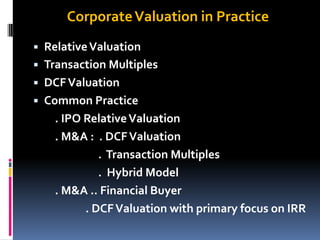
CorporateValuation in Practice
▪ RelativeValuation
▪ Transaction Multiples
▪ DCFValuation
▪ Common Practice
. IPO RelativeValuation
. M&A : . DCFValuation
. Transaction Multiples
. Hybrid Model
. M&A .. Financial Buyer
. DCFValuation with primary focus on IRR
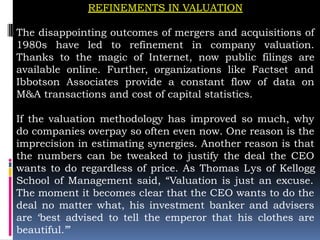
REFINEMENTS IN VALUATION
The disappointing outcomes of mergers and acquisitions of
1980s have led to refinement in company valuation.
Thanks to the magic of Internet, now public filings are
available online. Further, organizations like Factset and
Ibbotson Associates provide a constant flow of data on
M&A transactions and cost of capital statistics.
If the valuation methodology has improved so much, why
do companies overpay so often even now. One reason is the
imprecision in estimating synergies. Another reason is that
the numbers can be tweaked to justify the deal the CEO
wants to do regardless of price. As Thomas Lys of Kellogg
School of Management said, “Valuation is just an excuse.
The moment it becomes clear that the CEO wants to do the
deal no matter what, his investment banker and advisers
are ‘best advised to tell the emperor that his clothes are
beautiful.’”
JUDICIAL REVIEW AND REGULATORY
OVERSIGHT ON VALUATION
Valuation is understandably the most contentious issue
in various corporate transactions such as mergers,
takeovers, preferential allotments by listed companies,
and so on. Hence it is subject to regulation and judicial
review in various ways. Here is a synoptic view of such
regulation and review.
• The pricing of preferential allotments by listed
companies is subject to regulations of SEBI.
• To determine the fair value of shares to be transferred
by a resident in India to a non-resident, the RBI has
prescribed that the DCF method must be used and the
valuation must be done by a chartered accountant or a
SEBI-registered category 1 merchant banker.
• The pricing of open offers under the SEBI Takeover Code
is subject to regulation.
• The valuation in a merger petition submitted to the
court is a matter of judicial review.
• Minority shareholders, creditors, the central
government, SEBI, or revenue authorities can challenge
the proposed valuation in a court of competent
jurisdiction for judicial review.
In general, the courts have maintained that valuation is
a technical exercise to be done by experts and that
courts will interfere only when it is seriously flawed or
unfair.
INTRINSIC VALUE AND THE STOCK
MARKET
• For short periods, market values may diverge from
fundamental values, but in the long run there is a
remarkable convergence between the two
• Return on invested capital (ROIC) and growth are the
major drivers of value
• Markets reflects substance, not form
• Emotions and mispricing
A MODEL OF THE MARKET
• A simple and yet insightful model assumes that two
types of investors trade in the market viz., informed
investors and noise traders
• Informed investors estimate intrinsic value based on
fundamental analysis. Noise traders trade on the
basis of some new that may not really be material.
• As a result of the interaction among these players,
market prices tend to gyrate around intrinsic value
Importance of Knowing IntrinsicValue
▪ Although valuations have been wrong from time to time,
eventually they have returned to the level justified by
economic fundamentals.
▪ Such market deviations suggest that it is even more
important for the managers of a company to understand
and focus on the intrinsic value of its shares.
▪ Managers can exploit such deviations by:
. Issuing additional share capital when the share
price is too high relative to its intrinsic value.
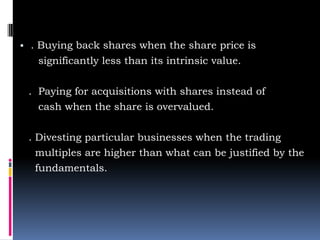
▪ . Buying back shares when the share price is
significantly less than its intrinsic value.
. Paying for acquisitions with shares instead of
cash when the share is overvalued.
. Divesting particular businesses when the trading
multiples are higher than what can be justified by the
fundamentals.
CONSEQUENCES OF IGNORING VALUE
Ignoring intrinsic value can have serious adverse
consequences, as the following conspicuous examples
suggest:
• The rise and fall of business conglomerates in the
1970s.
• Hostile takeovers in the US in the 1980s.
• The collapse of Japan’s bubble economy in the 1990s.
• The Southeast Asian crisis in 1998.
• Internet bubble
• The economic crisis starting in 2007.
• The ambitious global leveraged acquisitions by Indian
firms.
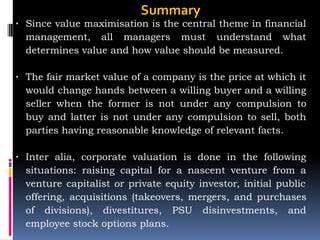
Summary
∙ Since value maximisation is the central theme in financial
management, all managers must understand what
determines value and how value should be measured.
∙ The fair market value of a company is the price at which it
would change hands between a willing buyer and a willing
seller when the former is not under any compulsion to
buy and latter is not under any compulsion to sell, both
parties having reasonable knowledge of relevant facts.
∙ Inter alia, corporate valuation is done in the following
situations: raising capital for a nascent venture from a
venture capitalist or private equity investor, initial public
offering, acquisitions (takeovers, mergers, and purchases
of divisions), divestitures, PSU disinvestments, and
employee stock options plans.
∙ Valuation is often characterised by bias stemming from
factors like perception about the company being valued,
the current market value of the company, and
institutional pressures.
∙ To mitigate the bias in valuation avoid precommitments,
delink valuation from reward or punishment, diminish
institutional pressures, and increase self-awareness.
∙ In general, there is always an uncertainty associated with
valuation on account of estimation uncertainty,
firm-specific uncertainty, and macroeconomic
uncertainty.
∙ Very broadly, the investment banking industry employs
three basic methodologies for enterprise valuation: relative
valuation, transaction multiples, and discounted cash
THANKYOU

Corporate valuation overview

  • 1.
  • 2.
    Outline ▪ Concept ofFairValue ▪ Context ofValuation ▪ Approaches toValuation ▪ Features of theValuation Process ▪ CorporateValuation in Practice ▪ Importance of Knowing IntrinsicValue
  • 3.
    OVERVIEW OF CORPORATEVALUATION • Context of valuation • Approaches to valuation • Features of the valuation process • Corporate valuation in practice • Information needed for valuation • Refinements in valuation • Judicial and regulatory overview of valuation • Intrinsic value and stock market • Importance of knowing the intrinsic value
  • 4.
    GOAL OFVALUATION The goalof such an appraisal is essentially to estimate a fair market value of a company. So, at the outset, we must clarify what is meant by “fair market value” and what is meant by “a company”. The most widely accepted definition of fair market value was laid down by the Internal Revenue Service of the US. It defined fair market value as "the price at which the property would change hands between a willing buyer and a willing seller when the former is not under any compulsion to buy and the latter is not under any compulsion to sell, both parties having reasonable knowledge of relevant facts.” When the asset being appraised is “a company”, the property the buyer and the seller are trading consists of the claims of all the investors of the company. This includes outstanding equity shares, preference shares, debentures, and loans. © Centre for Financial Management , Bangalore
  • 5.
    Context ofValuation ▪ Raisingcapital for a nascent venture ▪ Initial public offering ▪ Acquisitions ▪ Divestitures ▪ PSU disinvestment ▪ ESOPs
  • 6.
  • 7.
    DCF VALUATION MODELS •Equity DCG Model • Equity DCF model ∙ Dividend discount model ∙ FCFE model • Adjusted present value model • Economic profit model
  • 8.
    INFORMATION NEEDED FORVALUATION A. Industry and Competition B. Operations C. Marketing and Sales D. Human Resources E. Historical Financial Information F. Financial Projections
  • 9.
    Features of theValuationProcess ▪ Bias inValuation . Choice of Company . MarketValue . Institutional Pressures ▪ Manifestation of Bias . Optimistic or Pessimistic Definition of Inputs. . Post-valuationTinkering. contd..
  • 10.
    ▪ Mitigation ofBias . Avoid Precommitments. . DelinkValuation from Reward/Punishment. . Diminish Institutional Pressures. . Increase Self-Awareness.
  • 11.
    ▪ Uncertainty inValuation .Estimation Uncertainty . Firm specific Uncertainty . Macroeconomic Uncertainty ▪ Response to Uncertainties . BetterValuation Models .Valuation Ranges . Probabilistic Estimates
  • 12.
    CorporateValuation in Practice ▪RelativeValuation ▪ Transaction Multiples ▪ DCFValuation ▪ Common Practice . IPO RelativeValuation . M&A : . DCFValuation . Transaction Multiples . Hybrid Model . M&A .. Financial Buyer . DCFValuation with primary focus on IRR
  • 13.
    REFINEMENTS IN VALUATION Thedisappointing outcomes of mergers and acquisitions of 1980s have led to refinement in company valuation. Thanks to the magic of Internet, now public filings are available online. Further, organizations like Factset and Ibbotson Associates provide a constant flow of data on M&A transactions and cost of capital statistics. If the valuation methodology has improved so much, why do companies overpay so often even now. One reason is the imprecision in estimating synergies. Another reason is that the numbers can be tweaked to justify the deal the CEO wants to do regardless of price. As Thomas Lys of Kellogg School of Management said, “Valuation is just an excuse. The moment it becomes clear that the CEO wants to do the deal no matter what, his investment banker and advisers are ‘best advised to tell the emperor that his clothes are beautiful.’”
  • 14.
    JUDICIAL REVIEW ANDREGULATORY OVERSIGHT ON VALUATION Valuation is understandably the most contentious issue in various corporate transactions such as mergers, takeovers, preferential allotments by listed companies, and so on. Hence it is subject to regulation and judicial review in various ways. Here is a synoptic view of such regulation and review. • The pricing of preferential allotments by listed companies is subject to regulations of SEBI. • To determine the fair value of shares to be transferred by a resident in India to a non-resident, the RBI has prescribed that the DCF method must be used and the valuation must be done by a chartered accountant or a SEBI-registered category 1 merchant banker.
  • 15.
    • The pricingof open offers under the SEBI Takeover Code is subject to regulation. • The valuation in a merger petition submitted to the court is a matter of judicial review. • Minority shareholders, creditors, the central government, SEBI, or revenue authorities can challenge the proposed valuation in a court of competent jurisdiction for judicial review. In general, the courts have maintained that valuation is a technical exercise to be done by experts and that courts will interfere only when it is seriously flawed or unfair.
  • 16.
    INTRINSIC VALUE ANDTHE STOCK MARKET • For short periods, market values may diverge from fundamental values, but in the long run there is a remarkable convergence between the two • Return on invested capital (ROIC) and growth are the major drivers of value • Markets reflects substance, not form • Emotions and mispricing
  • 17.
    A MODEL OFTHE MARKET • A simple and yet insightful model assumes that two types of investors trade in the market viz., informed investors and noise traders • Informed investors estimate intrinsic value based on fundamental analysis. Noise traders trade on the basis of some new that may not really be material. • As a result of the interaction among these players, market prices tend to gyrate around intrinsic value
  • 18.
    Importance of KnowingIntrinsicValue ▪ Although valuations have been wrong from time to time, eventually they have returned to the level justified by economic fundamentals. ▪ Such market deviations suggest that it is even more important for the managers of a company to understand and focus on the intrinsic value of its shares. ▪ Managers can exploit such deviations by: . Issuing additional share capital when the share price is too high relative to its intrinsic value.
  • 19.
    ▪ . Buyingback shares when the share price is significantly less than its intrinsic value. . Paying for acquisitions with shares instead of cash when the share is overvalued. . Divesting particular businesses when the trading multiples are higher than what can be justified by the fundamentals.
  • 20.
    CONSEQUENCES OF IGNORINGVALUE Ignoring intrinsic value can have serious adverse consequences, as the following conspicuous examples suggest: • The rise and fall of business conglomerates in the 1970s. • Hostile takeovers in the US in the 1980s. • The collapse of Japan’s bubble economy in the 1990s. • The Southeast Asian crisis in 1998. • Internet bubble • The economic crisis starting in 2007. • The ambitious global leveraged acquisitions by Indian firms.
  • 21.
    Summary ∙ Since valuemaximisation is the central theme in financial management, all managers must understand what determines value and how value should be measured. ∙ The fair market value of a company is the price at which it would change hands between a willing buyer and a willing seller when the former is not under any compulsion to buy and latter is not under any compulsion to sell, both parties having reasonable knowledge of relevant facts. ∙ Inter alia, corporate valuation is done in the following situations: raising capital for a nascent venture from a venture capitalist or private equity investor, initial public offering, acquisitions (takeovers, mergers, and purchases of divisions), divestitures, PSU disinvestments, and employee stock options plans.
  • 22.
    ∙ Valuation isoften characterised by bias stemming from factors like perception about the company being valued, the current market value of the company, and institutional pressures. ∙ To mitigate the bias in valuation avoid precommitments, delink valuation from reward or punishment, diminish institutional pressures, and increase self-awareness. ∙ In general, there is always an uncertainty associated with valuation on account of estimation uncertainty, firm-specific uncertainty, and macroeconomic uncertainty. ∙ Very broadly, the investment banking industry employs three basic methodologies for enterprise valuation: relative valuation, transaction multiples, and discounted cash
  • 23.