Project Management
Definitions
• A Project is a series of related jobs usually directed
toward some major output and requiring a
significant period of time to perform
• Project Management are the management activities
of planning, directing, and controlling resources
(people, equipment, material) to meet the technical,
cost, and time constraints of a project
• Organization: Pure project, Functional Project, Matrix
Project
Pure Project
• Self-contained team works full time on the project
• Advantages:
– PM has full authority over the project
– Team members report to one boss
– Lines of communication are short
– Fast decision making
– Team pride, motivation and commitment are high
• Disadvantages:
– Duplication of resources
– Organizational goals and policies are ignored
– Organization falls behind in its knowledge of new technologies due to
weakened functional divisions
Functional Project
• The project is housed within a functional division
• Advantages:
– Team members can work on several projects
– Technical expertise is maintained within the functional area
– Functional area is a home after the project is completed
– Critical mass of specialized functional area experts creates synergistic
solutions to a project’s technical problems
• Disadvantages:
– Aspects of project that are not directly related to the functional area
get short changed
– Motivation of team members is often weak
– Needs of the client are secondary and are responded to slowly
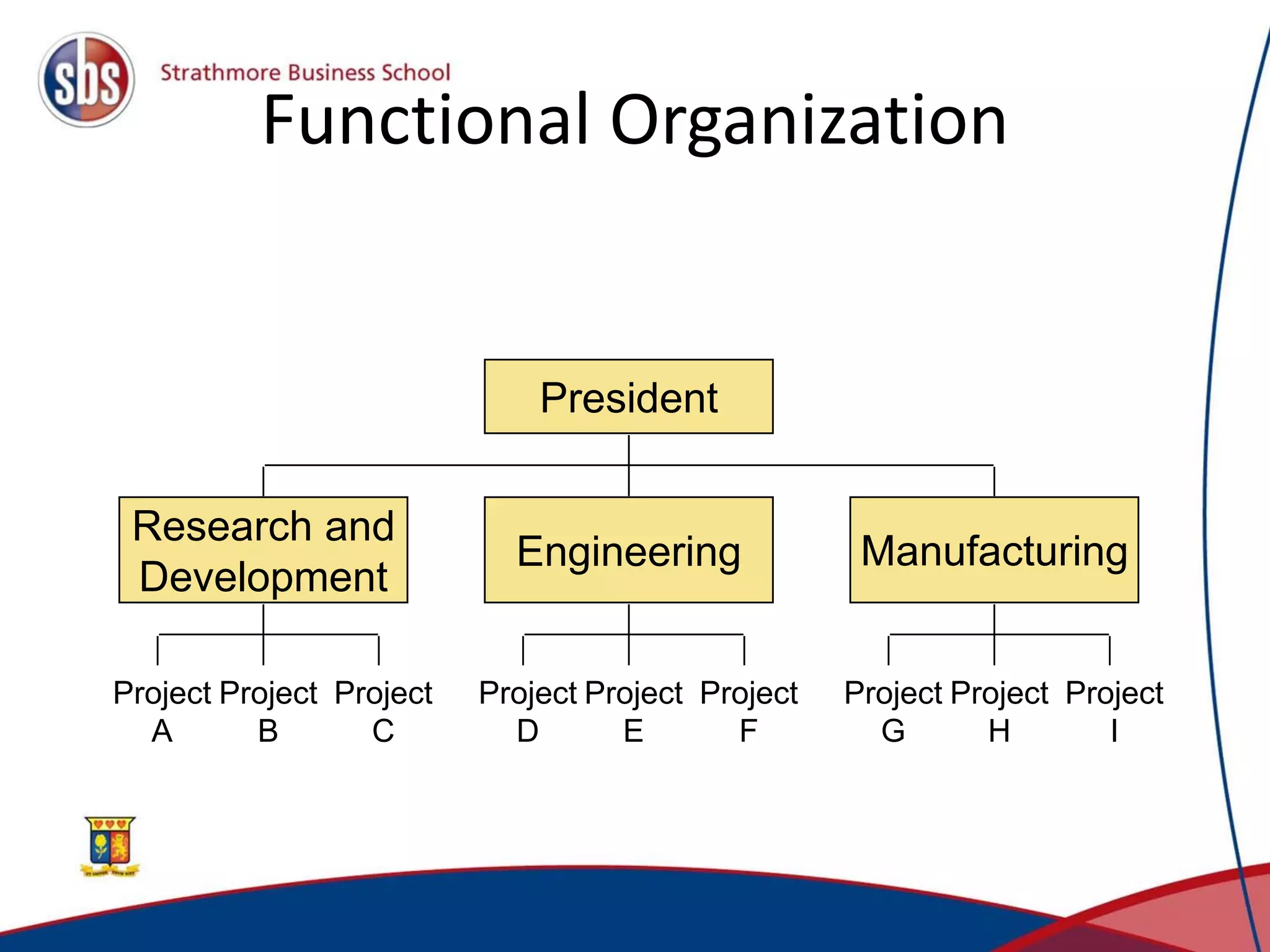
Functional Organization
President
Research and
Development
Engineering Manufacturing
Project
A
Project
B
Project
C
Project
D
Project
E
Project
F
Project
G
Project
H
Project
I
Matrix Project
• Blends properties of pure and functional project
structures
• Each project utilizes people from different functional
areas
• PM decides what tasks and when they will be
performed
• Functional managers control which people and
technologies are used
• Can be weak, balanced or strong
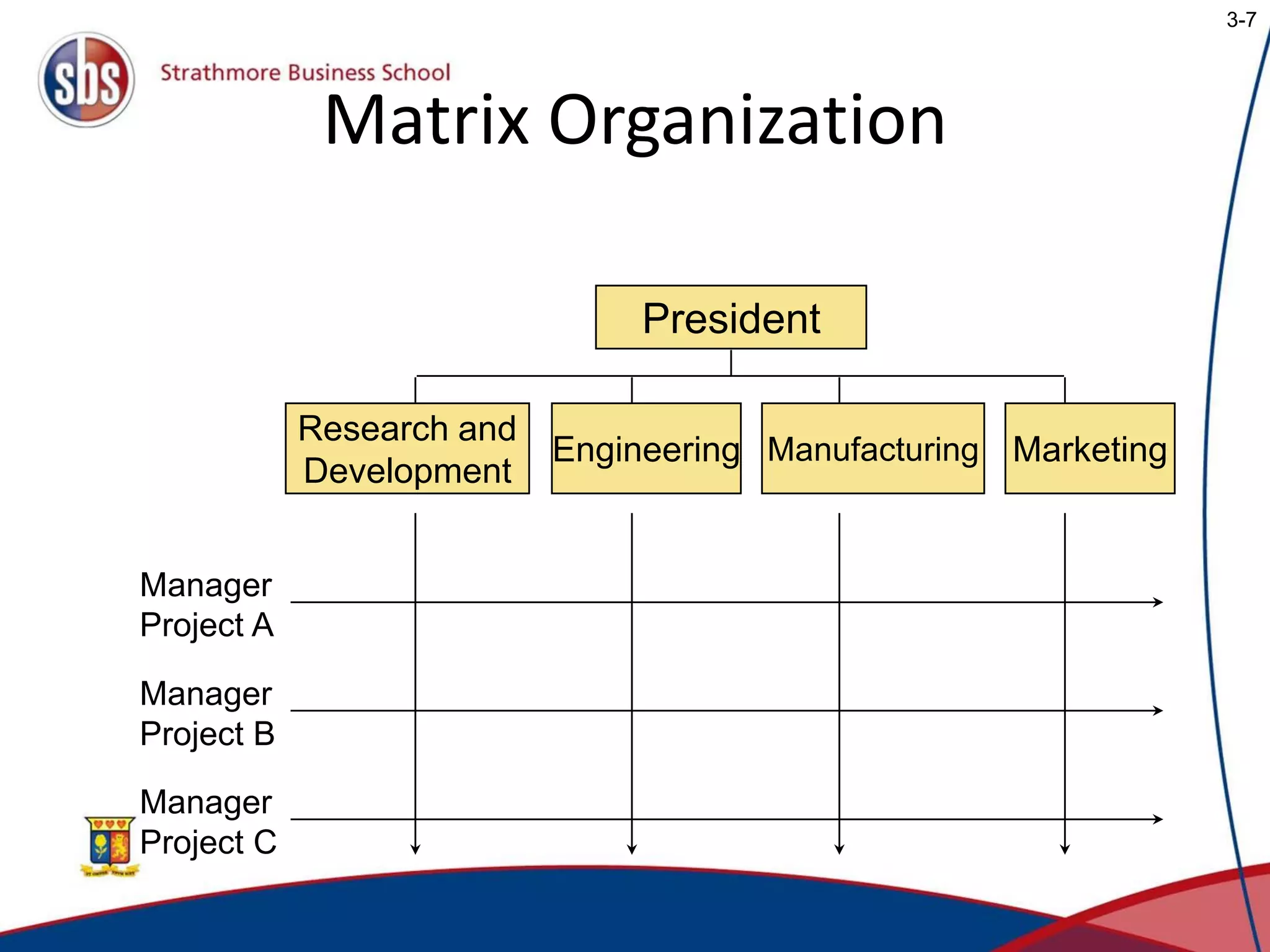
Matrix Organization
President
Research and
Development
Engineering Manufacturing Marketing
Manager
Project A
Manager
Project B
Manager
Project C
3-7
Matrix Project Pros/Cons
• Advantages:
– Communication between functional divisions is enhanced
– PM is held responsible for successful completion of project
– Duplication of resources is minimized
– Team members have a functional home to return to after project
completion
– Policies of parent organization are followed
• Disadvantages:
– There are two bosses for team members
– Doomed to failure unless PM has strong negotiation skills
– Sub-optimization may occur due to hoarding of resources for project
Project Selection – No Numeric
• Sacred cow – project suggested by a senior and powerful
official
• Operating necessity – project is required for the organization
to continue operating
• Competitive necessity – project is required to enable the
company to maintain its competitive position
• Product line extension – project to develop and distribute
new products
• Comparative benefits model – portfolio of projects that best
fits the organization’s aims is constructed
Profit/Profitability Models
• Payback period – Initial fixed investment in the project divided
by the estimated annual net cash inflows from the project
• Average Rate of Return – Ratio of average annual profit to the
initial or average investment in the project
• Discounted cash Flow (Net present value) – determines the
net present of all cash flows by discounting them.
• Profitability index – also known as benefit-cost ratio is the
NPV of all future expected cash flows divided by the initial
cash investment
Scoring Models
• Unweighted scoring models – a set of relevant
factors are selected by management and
scored for each project.
• Weighted scoring models – Numeric weights
reflecting the relative importance of each
individual factor are added
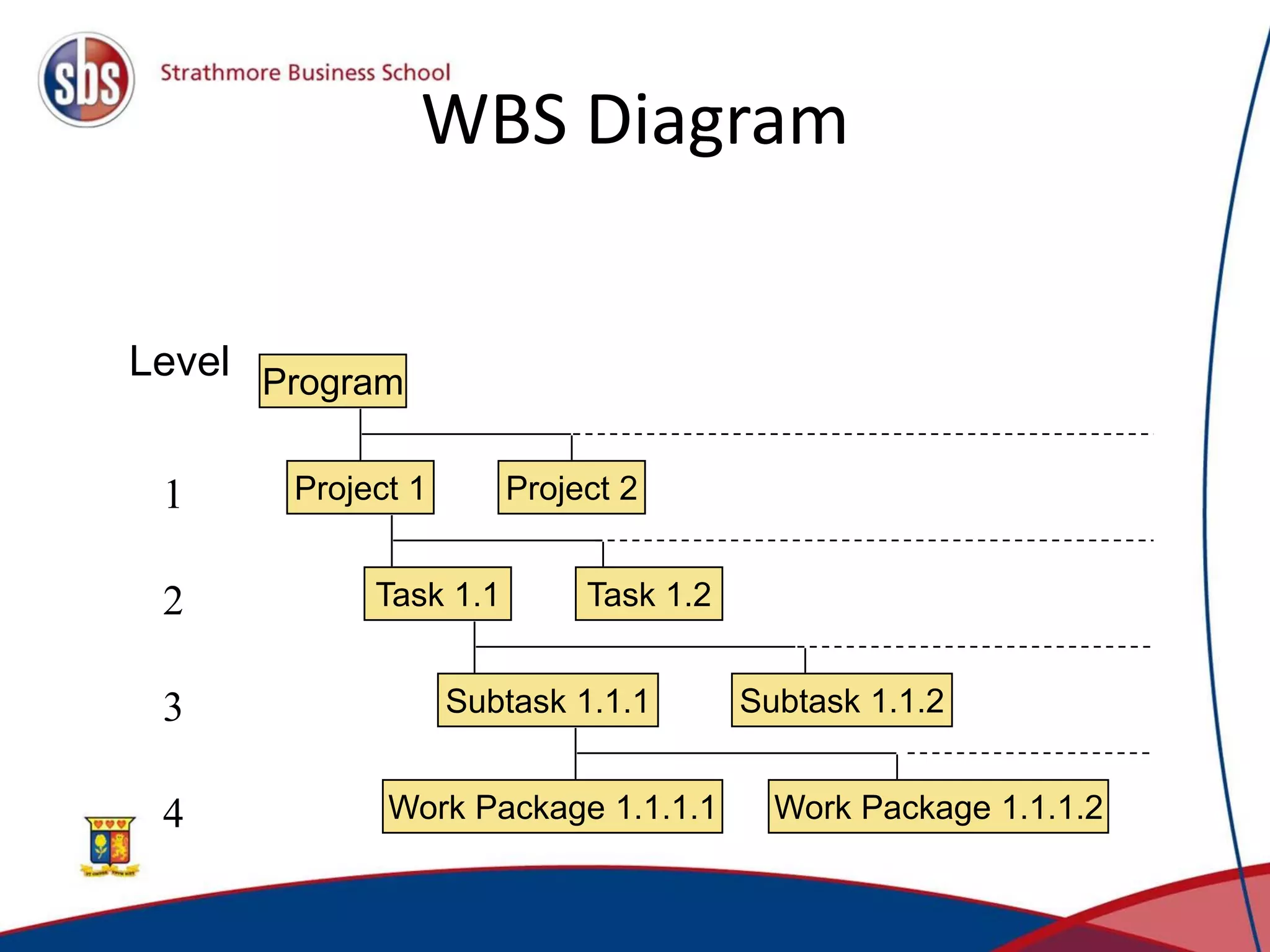
Work Breakdown Structure
• Project starts out as a statement of work
• The project is then broken down to tasks
• Tasks may be further subdivided into more
meaningful pieces known as sub-tasks
• The sub-tasks are further subdivided into work
packages
• WBS defines the hierarchy of project tasks, sub-tasks
and work packages
WBS Diagram
Program
Project 1 Project 2
Task 1.1
Subtask 1.1.1
Work Package 1.1.1.1
Level
1
2
3
4
Task 1.2
Subtask 1.1.2
Work Package 1.1.1.2
Network-Planning Models
• A project is made up of a sequence of activities that
form a network representing a project
• The path taking longest time through this network of
activities is called the “critical path”
• The critical path provides a wide range of scheduling
information useful in managing a project
• Critical Path Method (CPM) helps to identify the
critical path(s) in the project networks
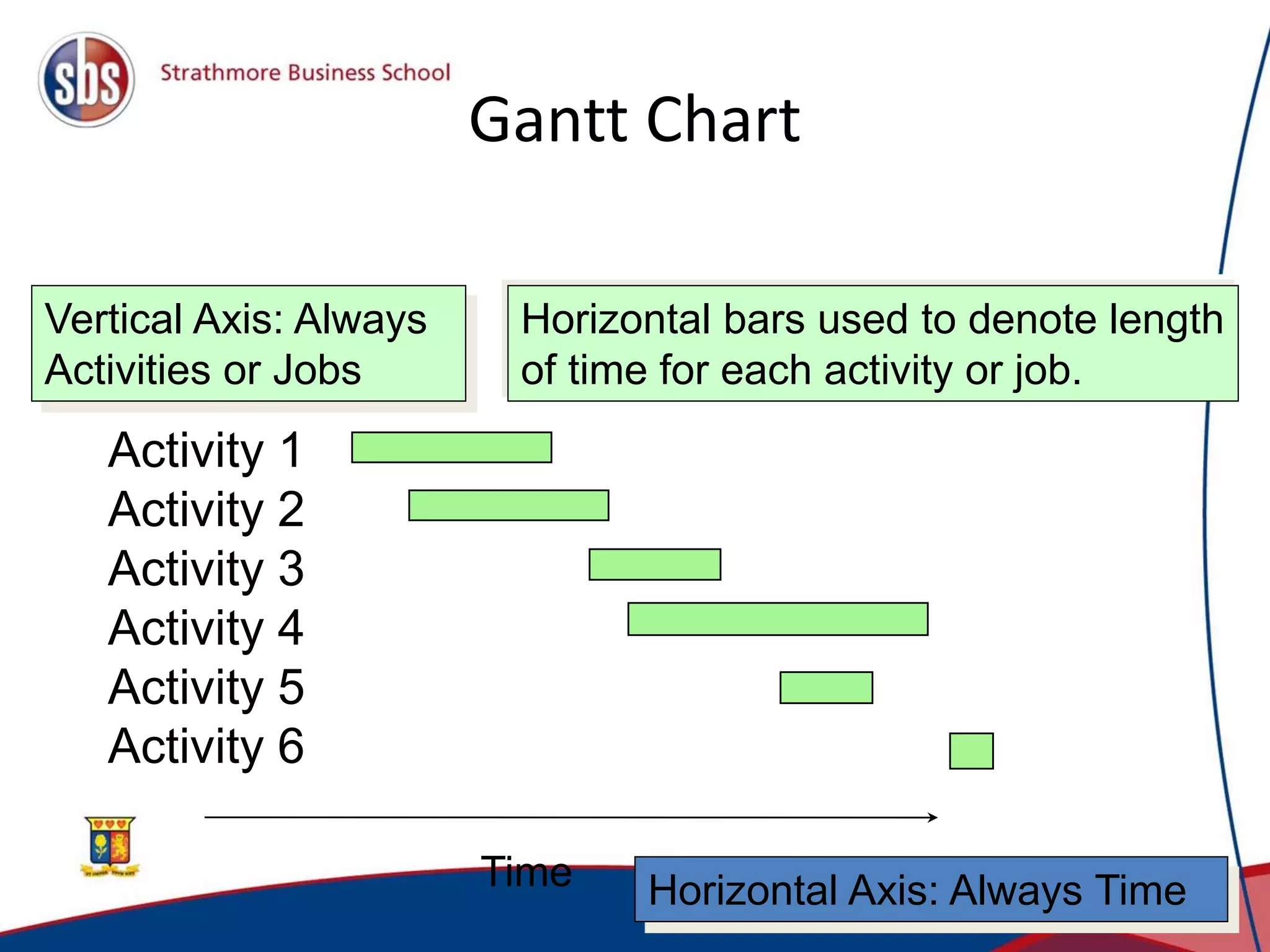
Gantt Chart
Activity 1
Activity 2
Activity 3
Activity 4
Activity 5
Activity 6
Time
Vertical Axis: Always
Activities or Jobs
Horizontal Axis: Always Time
Horizontal bars used to denote length
of time for each activity or job.

Project management

  • 1.
  • 2.
    Definitions • A Projectis a series of related jobs usually directed toward some major output and requiring a significant period of time to perform • Project Management are the management activities of planning, directing, and controlling resources (people, equipment, material) to meet the technical, cost, and time constraints of a project • Organization: Pure project, Functional Project, Matrix Project
  • 3.
    Pure Project • Self-containedteam works full time on the project • Advantages: – PM has full authority over the project – Team members report to one boss – Lines of communication are short – Fast decision making – Team pride, motivation and commitment are high • Disadvantages: – Duplication of resources – Organizational goals and policies are ignored – Organization falls behind in its knowledge of new technologies due to weakened functional divisions
  • 4.
    Functional Project • Theproject is housed within a functional division • Advantages: – Team members can work on several projects – Technical expertise is maintained within the functional area – Functional area is a home after the project is completed – Critical mass of specialized functional area experts creates synergistic solutions to a project’s technical problems • Disadvantages: – Aspects of project that are not directly related to the functional area get short changed – Motivation of team members is often weak – Needs of the client are secondary and are responded to slowly
  • 5.
    Functional Organization President Research and Development EngineeringManufacturing Project A Project B Project C Project D Project E Project F Project G Project H Project I
  • 6.
    Matrix Project • Blendsproperties of pure and functional project structures • Each project utilizes people from different functional areas • PM decides what tasks and when they will be performed • Functional managers control which people and technologies are used • Can be weak, balanced or strong
  • 7.
    Matrix Organization President Research and Development EngineeringManufacturing Marketing Manager Project A Manager Project B Manager Project C 3-7
  • 8.
    Matrix Project Pros/Cons •Advantages: – Communication between functional divisions is enhanced – PM is held responsible for successful completion of project – Duplication of resources is minimized – Team members have a functional home to return to after project completion – Policies of parent organization are followed • Disadvantages: – There are two bosses for team members – Doomed to failure unless PM has strong negotiation skills – Sub-optimization may occur due to hoarding of resources for project
  • 9.
    Project Selection –No Numeric • Sacred cow – project suggested by a senior and powerful official • Operating necessity – project is required for the organization to continue operating • Competitive necessity – project is required to enable the company to maintain its competitive position • Product line extension – project to develop and distribute new products • Comparative benefits model – portfolio of projects that best fits the organization’s aims is constructed
  • 10.
    Profit/Profitability Models • Paybackperiod – Initial fixed investment in the project divided by the estimated annual net cash inflows from the project • Average Rate of Return – Ratio of average annual profit to the initial or average investment in the project • Discounted cash Flow (Net present value) – determines the net present of all cash flows by discounting them. • Profitability index – also known as benefit-cost ratio is the NPV of all future expected cash flows divided by the initial cash investment
  • 11.
    Scoring Models • Unweightedscoring models – a set of relevant factors are selected by management and scored for each project. • Weighted scoring models – Numeric weights reflecting the relative importance of each individual factor are added
  • 12.
    Work Breakdown Structure •Project starts out as a statement of work • The project is then broken down to tasks • Tasks may be further subdivided into more meaningful pieces known as sub-tasks • The sub-tasks are further subdivided into work packages • WBS defines the hierarchy of project tasks, sub-tasks and work packages
  • 13.
    WBS Diagram Program Project 1Project 2 Task 1.1 Subtask 1.1.1 Work Package 1.1.1.1 Level 1 2 3 4 Task 1.2 Subtask 1.1.2 Work Package 1.1.1.2
  • 14.
    Network-Planning Models • Aproject is made up of a sequence of activities that form a network representing a project • The path taking longest time through this network of activities is called the “critical path” • The critical path provides a wide range of scheduling information useful in managing a project • Critical Path Method (CPM) helps to identify the critical path(s) in the project networks
  • 15.
    Gantt Chart Activity 1 Activity2 Activity 3 Activity 4 Activity 5 Activity 6 Time Vertical Axis: Always Activities or Jobs Horizontal Axis: Always Time Horizontal bars used to denote length of time for each activity or job.