Good morning
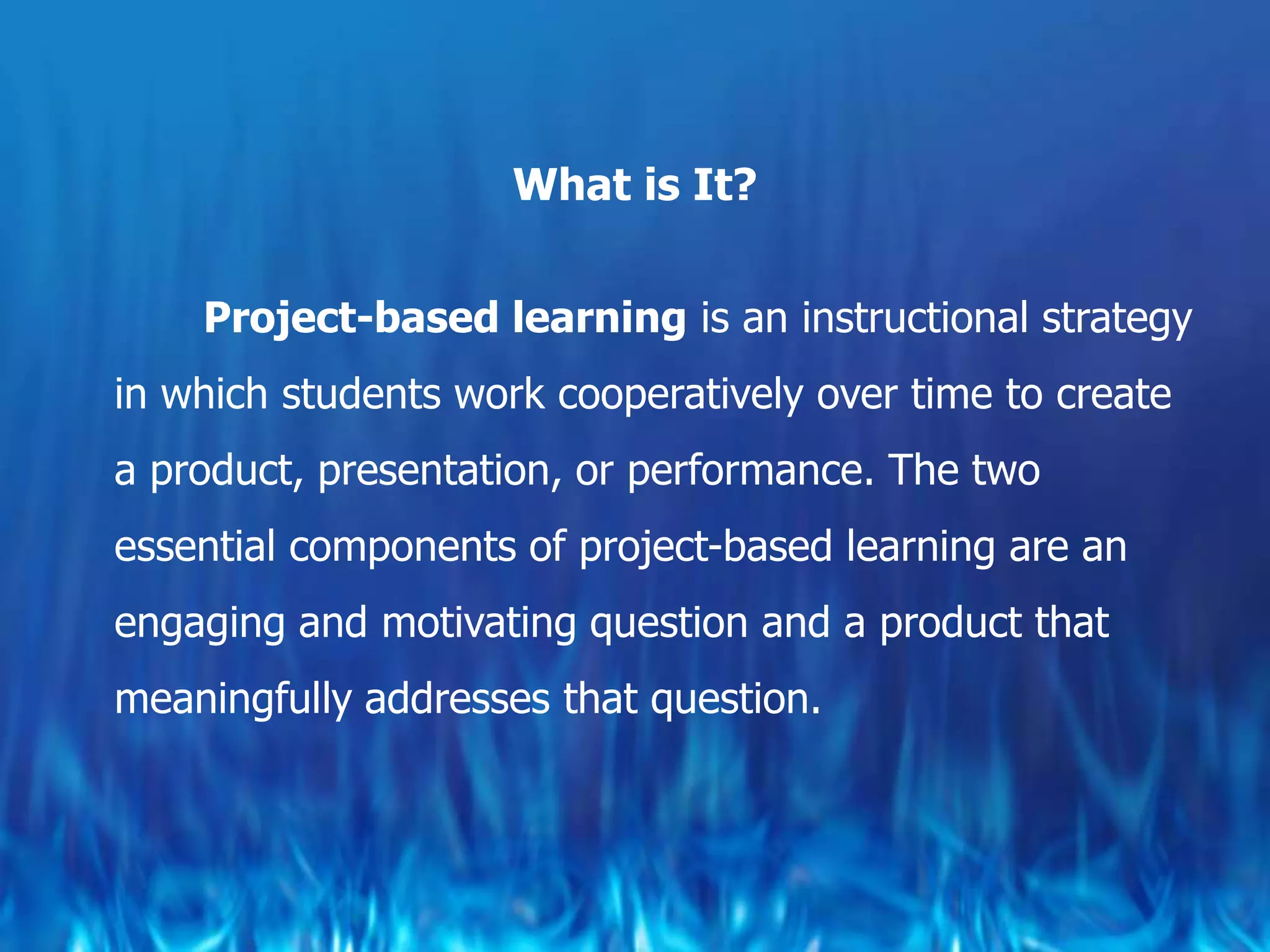
What is It?


    Project-based learning is an instructional strategy
in which students work cooperatively over time to create
a product, presentation, or performance. The two
essential components of project-based learning are an
engaging and motivating question and a product that
meaningfully addresses that question.
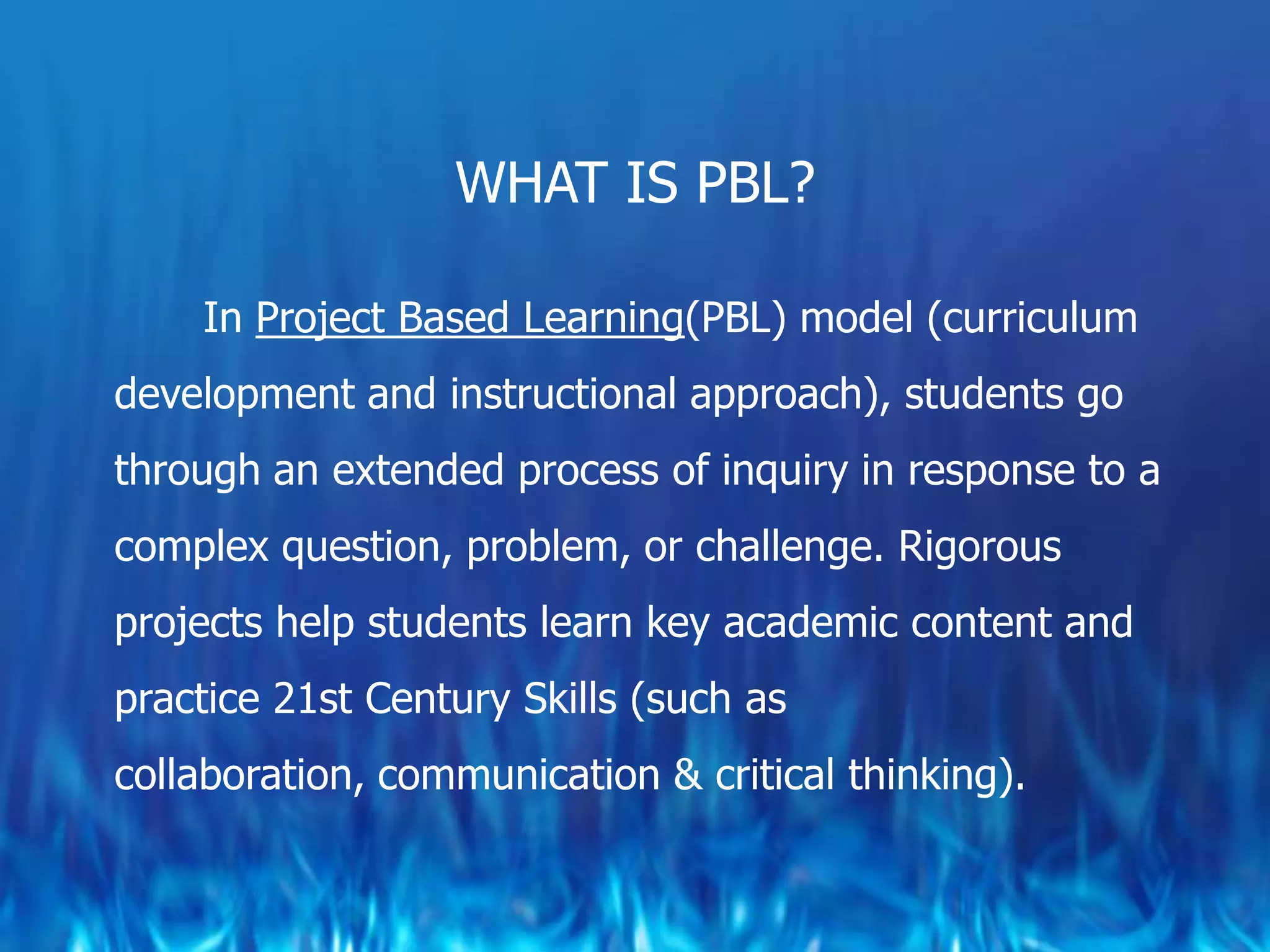
WHAT IS PBL?

    In Project Based Learning(PBL) model (curriculum
development and instructional approach), students go
through an extended process of inquiry in response to a
complex question, problem, or challenge. Rigorous
projects help students learn key academic content and
practice 21st Century Skills (such as
collaboration, communication & critical thinking).
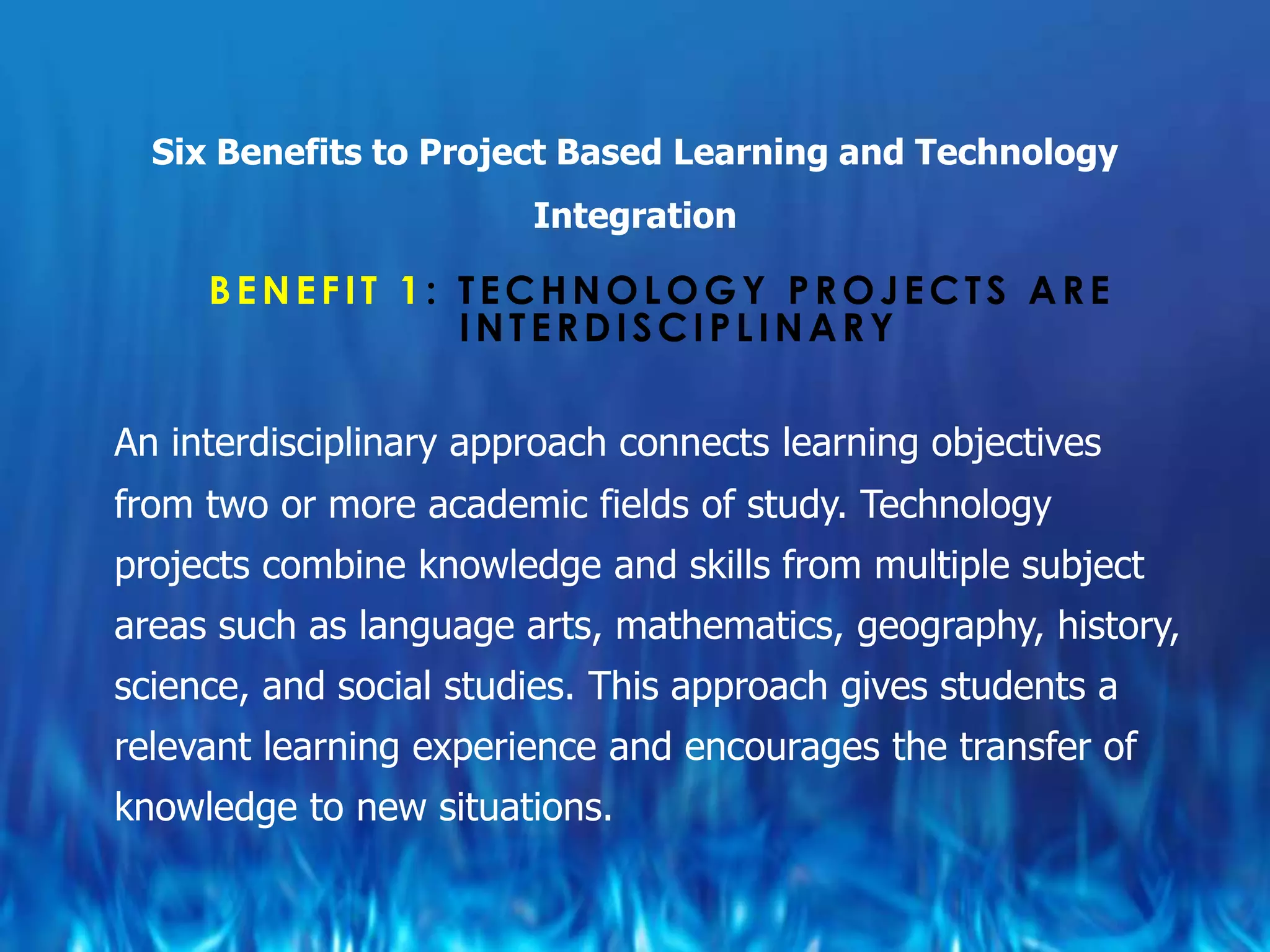
Six Benefits to Project Based Learning and Technology
                        Integration

     BENEFIT 1: TECHNOLOGY PROJECTS ARE
                INTERDISCIPLINARY

An interdisciplinary approach connects learning objectives
from two or more academic fields of study. Technology
projects combine knowledge and skills from multiple subject
areas such as language arts, mathematics, geography, history,
science, and social studies. This approach gives students a
relevant learning experience and encourages the transfer of
knowledge to new situations.
BENEFIT 2: TECHNOLOGY PROJECTS ENCOURAGE
               COLLABORATION

      Collaboration is a process where two or more people
 work together to reach a common goal. Technology projects
 allow students to cooperate in partners or small groups to
 acquire information, share resources, and create original
 works using the computer as a tool. This benefits students as
 they can build on team members range of abilities and
 interests. As well, collaboration promotes participation, fosters
 responsibility, and improves social skills.
Benefit 3: Technology Projects Promote Inquiry

     Inquiry is the search for knowledge or truth by asking
questions, examining facts, and synthesizing the information.
Technology projects often include an investigation into a problem to
discover viable solutions with the search guided by a series of
questions. For example, students may use Excel to record survey
results and then graph the data to learn about food preferences to
make decisions when planning a bake sale or use Publisher to design
a pamphlet that summarizes researched questions to raise
environmental awareness.
BENEFIT 4: TECHNOLOGY PROJECTS SUPPORT SELF

                     DIRECTED LEARNING

     Self directed learning is when students are able to

independently undertake a task and make judgments without the

direction of a teacher. Working independently can often be

challenging, even for the brightest students. However, technology

projects motivate students to take control of their learning. The

computer provides students with software to plan and organize

ideas, monitor progress, and carry out the assignment with the

teacher assuming the role of a facilitator. Students becoming self

directed learners is one of the many benefits to project based

learning and technology integration.
Benefit 5: Technology Projects are Motivating


    Motivation is the incentive to act. Technology
projects motivate students to learn because they are
personally meaningful. During a project, students
become engaged in the learning process. They select a
topic of personal interest and pick the type of product
they will make using the computer. This active
involvement promotes learning.
Benefit 6: Technology Projects Target a Range of
                      Learning Styles


     A learning style is how a person comprehends,
expresses, and remembers information to gain
knowledge or develop skills. A benefit to project based
learning and technology integration is that the activities
target various styles of learning. This combination helps
all students learn.
Difficulties

       Although PBL is considered to be a profitable
  learning strategy, its implementation faces several
  challenges.
                STUDENTS HAVE DIFFICULTY TO:

 Initiate inquiry; have coherent research questions,

 Define a research project; good research design and
  appropriate methodology,
 Direct investigations; find resources,
 Manage complexity and time; keep deadlines, estimate
  time needed to do a task,

 Collaborate and give feedback; articulating the work of
  others and give regular feedback. Known problems
  concern planning, operationalisation and monitoring.

 Follow-up the project; revise products, thing that requires
  critical thinking skills and cognitive self-awareness.
Project based learning  jerome

Project based learning jerome

  • 1.
  • 3.
    What is It? Project-based learning is an instructional strategy in which students work cooperatively over time to create a product, presentation, or performance. The two essential components of project-based learning are an engaging and motivating question and a product that meaningfully addresses that question.
  • 4.
    WHAT IS PBL? In Project Based Learning(PBL) model (curriculum development and instructional approach), students go through an extended process of inquiry in response to a complex question, problem, or challenge. Rigorous projects help students learn key academic content and practice 21st Century Skills (such as collaboration, communication & critical thinking).
  • 5.
    Six Benefits toProject Based Learning and Technology Integration BENEFIT 1: TECHNOLOGY PROJECTS ARE INTERDISCIPLINARY An interdisciplinary approach connects learning objectives from two or more academic fields of study. Technology projects combine knowledge and skills from multiple subject areas such as language arts, mathematics, geography, history, science, and social studies. This approach gives students a relevant learning experience and encourages the transfer of knowledge to new situations.
  • 6.
    BENEFIT 2: TECHNOLOGYPROJECTS ENCOURAGE COLLABORATION Collaboration is a process where two or more people work together to reach a common goal. Technology projects allow students to cooperate in partners or small groups to acquire information, share resources, and create original works using the computer as a tool. This benefits students as they can build on team members range of abilities and interests. As well, collaboration promotes participation, fosters responsibility, and improves social skills.
  • 7.
    Benefit 3: TechnologyProjects Promote Inquiry Inquiry is the search for knowledge or truth by asking questions, examining facts, and synthesizing the information. Technology projects often include an investigation into a problem to discover viable solutions with the search guided by a series of questions. For example, students may use Excel to record survey results and then graph the data to learn about food preferences to make decisions when planning a bake sale or use Publisher to design a pamphlet that summarizes researched questions to raise environmental awareness.
  • 8.
    BENEFIT 4: TECHNOLOGYPROJECTS SUPPORT SELF DIRECTED LEARNING Self directed learning is when students are able to independently undertake a task and make judgments without the direction of a teacher. Working independently can often be challenging, even for the brightest students. However, technology projects motivate students to take control of their learning. The computer provides students with software to plan and organize ideas, monitor progress, and carry out the assignment with the teacher assuming the role of a facilitator. Students becoming self directed learners is one of the many benefits to project based learning and technology integration.
  • 9.
    Benefit 5: TechnologyProjects are Motivating Motivation is the incentive to act. Technology projects motivate students to learn because they are personally meaningful. During a project, students become engaged in the learning process. They select a topic of personal interest and pick the type of product they will make using the computer. This active involvement promotes learning.
  • 10.
    Benefit 6: TechnologyProjects Target a Range of Learning Styles A learning style is how a person comprehends, expresses, and remembers information to gain knowledge or develop skills. A benefit to project based learning and technology integration is that the activities target various styles of learning. This combination helps all students learn.
  • 11.
    Difficulties Although PBL is considered to be a profitable learning strategy, its implementation faces several challenges. STUDENTS HAVE DIFFICULTY TO:  Initiate inquiry; have coherent research questions,  Define a research project; good research design and appropriate methodology,  Direct investigations; find resources,
  • 12.
     Manage complexityand time; keep deadlines, estimate time needed to do a task,  Collaborate and give feedback; articulating the work of others and give regular feedback. Known problems concern planning, operationalisation and monitoring.  Follow-up the project; revise products, thing that requires critical thinking skills and cognitive self-awareness.