
3/27/2016García Ramos
English Literacy through
Project Based Learning
Reyna García Ramos, Ph. D.
Pepperdine University
Graduate School of Education & Psychology
6100 Center Drive
Los Angeles, CA 90045
310-568-2306
rgramos@pepperdine.edu
3/27/2016García Ramos
CABE 2016
March 25, 2016
Room: Tower 3-Sutter
San Francisco, California
3/27/2016García Ramos
Variables
3/27/2016
English Literacy
PBL
ELD
Standards
CCSS
García Ramos
Academic English
 Academic English is much more than
conversational English.
 Beyond Basic Interpersonal Communication
Skills (BICS).
 Often, cognitively demanding and context
reduced (Cummins, 1983).
3/27/2016García Ramos
Academic English Use
 Needed to be successful in classes that are
conducted completely in English.
 Students need to be able to read large amounts of
academic material in English, understand lectures
in English, think critically about the ideas they have
read and heard, and express their understandings
and critiques of ideas through English.
 Listening, speaking, reading and writing (literacy
domains).
3/27/2016García Ramos
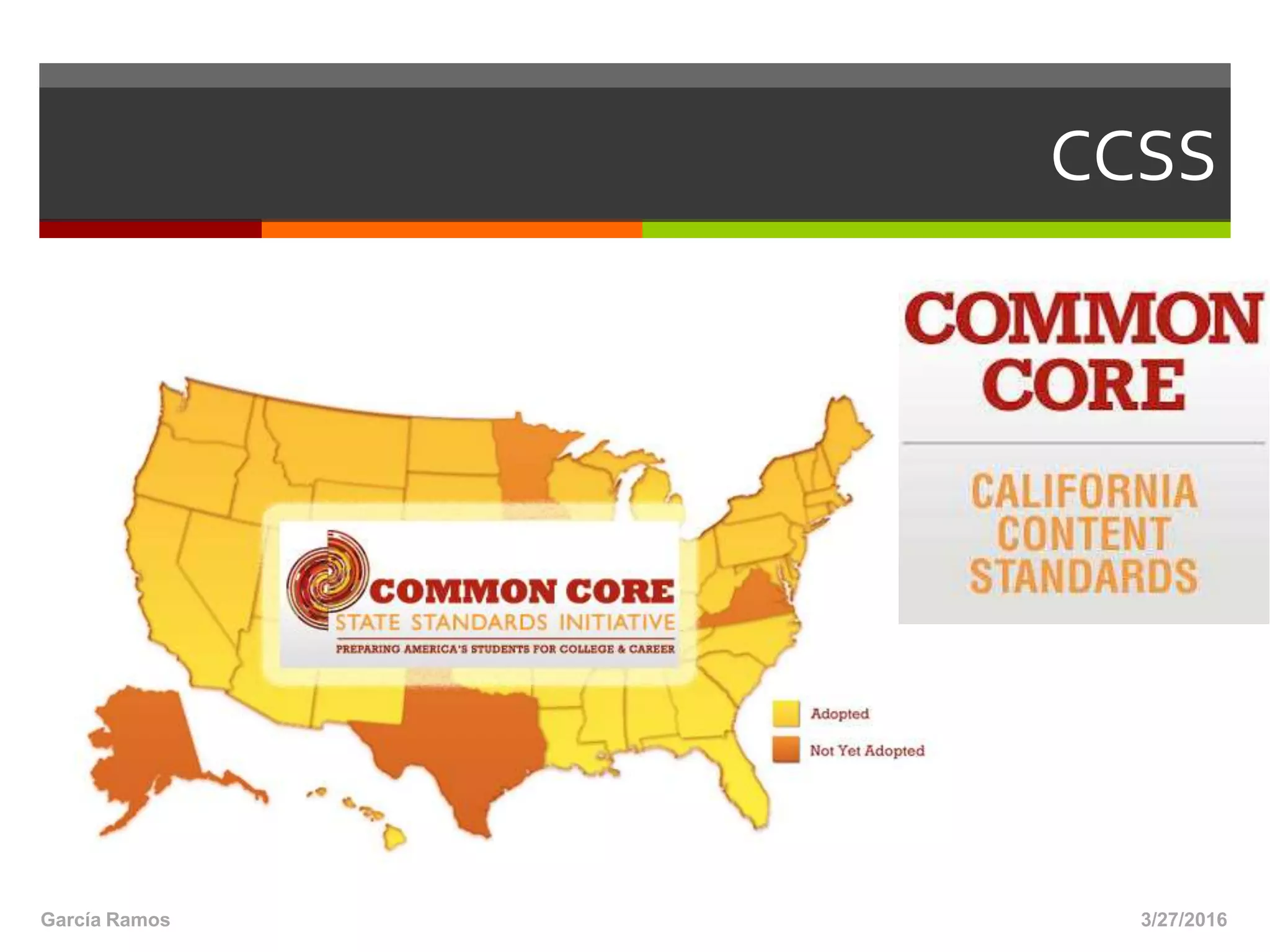
CCSS
3/27/2016García Ramos
CCSS
Although the historical paradigm of teaching
content and language to ELLs focused mainly on
vocabulary and grammar, the CCSS requires
teachers to teach content and language by focusing
on such language constructs as discourse, complex
text, explanation, argumentation, purpose, typical
structure of text, sentence structures, and
vocabulary practices.
3/27/2016García Ramos
CCSS
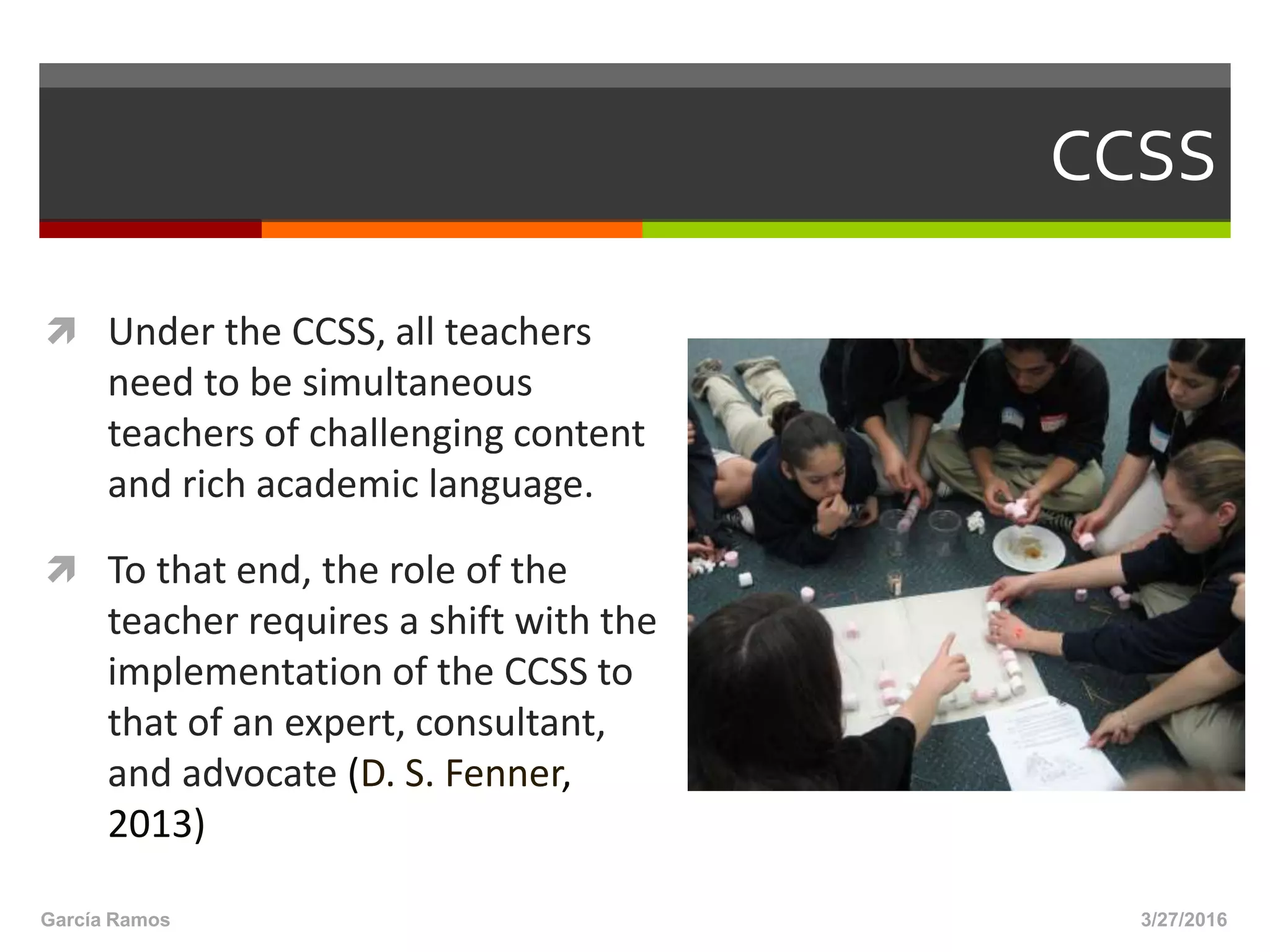
 Under the CCSS, all teachers
need to be simultaneous
teachers of challenging content
and rich academic language.
 To that end, the role of the
teacher requires a shift with the
implementation of the CCSS to
that of an expert, consultant,
and advocate (D. S. Fenner,
2013)
3/27/2016García Ramos
ELD Standards
3/27/2016García Ramos
CA ELD Standards
The CA ELD Standards describe the key knowledge, skills, and abilities
that students who are learning English as a new language need in
order to access, engage with, and achieve in grade-level academic
content. The CA ELD Standards, in particular, align with the key
knowledge, skills, and abilities for achieving college and career
readiness described in the California Common Core State Standards
for English Language Arts and Literacy in History/Social Studies,
Science, and Technical Subjects (CA CCSS for ELA/Literacy). However,
the CA ELD Standards do not repeat the CA CCSS for ELA/Literacy,
nor do they represent ELA content at lower levels of achievement
or rigor. Instead, the CA ELD Standards are designed to provide
challenging content in English language development for ELs to gain
proficiency in a range of rigorous academic English language skills.
The CA ELD Standards are not intended to replace the CA CCSS for
ELA/Literacy. Instead, they amplify the language knowledge, skills,
and abilities of these standards, which are essential for ELs to
succeed in school while they are developing their English.
3/27/2016García Ramos
Project Based Learning
 What is it?
 What does it look like?
 What does it sound like?
 Does it meet Common Core State Standards?
 Can I use it in my classroom?
3/27/2016García Ramos
Definition
“Project-based learning emphasizes depth of
understanding over content coverage: comprehension of
concepts and principles rather than knowledge of facts:
development of complex problem-solving skills rather
than learning building blocks skills in isolation. PBL
emphasizes student interest rather than following a fixed
curriculum; emphasizes a broad, interdisciplinary focus
rather than a narrow, discipline-based focus; uses direct,
primary, or original sources rather than texts, lectures, and
secondary sources; emphasizes data and materials
developed by students rather than the teacher.” Ronald J. Newell (2003)
3/27/2016García Ramos
Definition for Classroom Use
 Project based learning
is a dynamic way to
wake up your
students and still
work on the standard
curriculum in ways
that few students and
teachers alike know
how to manage.
3/27/2016García Ramos
Definition for Classroom Use
 Project-based learning is a
teaching approach that
engages students in
sustained, collaborative real-
world investigations. Projects
are organized around a
driving question, and
students participate in a
variety of tasks that seek to
meaningfully address this
question. (Heather Coffey, LEARN NC)
3/27/2016García Ramos
Why Use it?
 Leads to higher levels of
cognitive development
(Piaget, 1970; Vygotsky, 1977)
 Increase motivation
(Bandura, 1997; Maslow, 1954)
 Rigorous and authentic
(García Ramos, 1994)
 Taps students’ strengths
(Gardner, 2000, Jennings and Caulfield, 2005)
3/27/2016García Ramos
Looks Like…
 Cooperative (Johnson
and Johnson, 1997)
 Small Group
 Group Roles
 Unstructured
 Engagement
 Excitement
 Student Centered
3/27/2016García Ramos
Sound Like…..
 Loud!
 Student Centered
Discussion.
 L1 Negotiation.
 L2 Vocabulary
Development.
 Oral language.
(Peregoy & Boyle, 2005)
3/27/2016García Ramos
Does it Meet Standards?
 California ELD Standards
 CCSS
 ELA/Literacy
 History/Social Studies
 Science
 Technical Subjects
 Mathematics
 Visual and Performing Arts
 Physical Education
3/27/2016García Ramos
Can I use PBL in my classroom?
 Of Course!
 Increase Motivation
 Student Centered
Approach
 Critical Thinking
 Time on task
 Connect to Standards
3/27/2016García Ramos
Where do I begin?
3/27/2016García Ramos
Planning
1. Long Term Units vs.
Lessons
2. Inquiry – Research, complex
text, generate questions, analysis &
presentation of findings.
3. Critical Thinking –
Understanding of topic of
investigation and how to support
arguments with evidence, bring
back to text/primary sources.
4. Perseverance– Analyzing,
Solving, Reflecting
5. Integration – Content, Relevance,
Meaningful
6. Communication – Teachers as
facilitators, Critical discussions,
Academic English (seminar).
7. Time/Space – Time to provide
feedback & time for students to work
critically through complex task.
8. Public display – Display/Present
work of students.
3/27/2016García Ramos
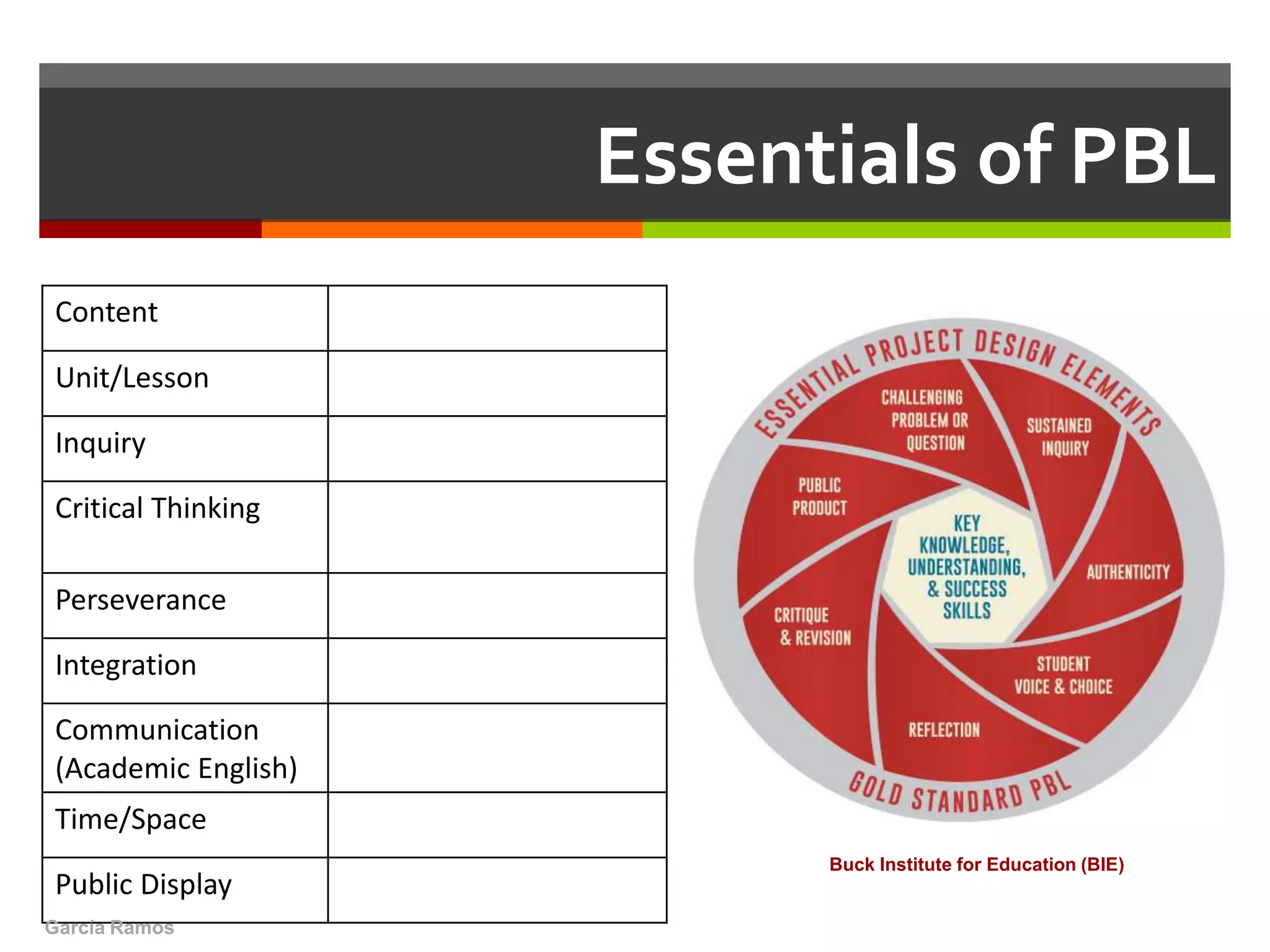
Essentials of PBL
Content
Unit/Lesson
Inquiry
Critical Thinking
Perseverance
Integration
Communication
(Academic English)
Time/Space
Public Display
García Ramos
Buck Institute for Education (BIE)
Design
1. Establish Content & Skill Goals
 Outcomes
2. Models or Formats for Final Products
 Presentations, teams
3. Scope and Time
 Unit to be spread out over a month or several weeks?
4. Design Instructional Activities
 Initial activity to engage students in thought provoking experience
 Content and skills taught through explicit Instruction; what will be scaffolded?
5. Assessment
 Does project meet standards and encourage higher-level thinking?
 Does project integrate content, reinforces literacy, inquiry, technology, basic skills?
 Have you communicated clarity over assessments and rubrics?
 What ways will EL’s demonstrate knowledge?
3/27/2016García Ramos
Getting Started
 Create Options for students
 Teacher generated
 Each Team picks an Option
 no repeats
 Share Outline for
engagement in PBL
 Minimize affective filter (see
checklist and benchmarks)
 Discussion with class about
ideas and goal/s
 Projects are group oriented
 Each student has her own
checklist to follow for
project.
3/27/2016García Ramos
Elementary Ideas
ELA/Literacy & History/Social Science
 First graders investigate the contents of
suitcases filled with diaries, family
photographs, artifacts, maps, and
architectural drawings. They generate
questions to investigate about family life in
their local community long ago so they can
create a video on the topic.
 Time: 1 month
 Groups: In pairs
 Project Idea: Video
3/27/2016García Ramos
Management of PBL
Keep it manageable:
1. Students have their checklist that teacher will sign off regularly.
2. Keep reminders about due date
3. Stop and explore collaborative group work
 Students present progress at identified point throughout project.
4. Students check in with teacher.
 Teachers collect related assignments throughout project.
 Teacher can assess what the are learning to keep focus.
5. Teacher teaches to where group are or where they are going.
6. Remind students of Family Literacy Night, Display Boards.
3/27/2016García Ramos
Addressing Challenges
• Curriculum is standards driven
• Solution = align curriculum after you figure
out the project ideas
• Pacing Guide
• Solution = Outline topics, ideas, time frame
needed (group material)
• Textbook driven
• Solution = Use the textbook for some
material - not all since they are not fully
required due to size and scope.
• Limited resources
• Solution = See resources list (Online
sources for materials and ideas)
• Time for Planning
• Solution = take your time and plan for next
unit.
3/27/2016García Ramos

3/27/2016García Ramos
Project Based Learning University
PBL University
Get Started Now!
3/27/2016García Ramos

English literacypbl cabe2016_gr_pepperdine

  • 1.
     3/27/2016García Ramos English Literacythrough Project Based Learning
  • 2.
    Reyna García Ramos,Ph. D. Pepperdine University Graduate School of Education & Psychology 6100 Center Drive Los Angeles, CA 90045 310-568-2306 rgramos@pepperdine.edu 3/27/2016García Ramos
  • 3.
    CABE 2016 March 25,2016 Room: Tower 3-Sutter San Francisco, California 3/27/2016García Ramos
  • 4.
  • 5.
    Academic English  AcademicEnglish is much more than conversational English.  Beyond Basic Interpersonal Communication Skills (BICS).  Often, cognitively demanding and context reduced (Cummins, 1983). 3/27/2016García Ramos
  • 6.
    Academic English Use Needed to be successful in classes that are conducted completely in English.  Students need to be able to read large amounts of academic material in English, understand lectures in English, think critically about the ideas they have read and heard, and express their understandings and critiques of ideas through English.  Listening, speaking, reading and writing (literacy domains). 3/27/2016García Ramos
  • 7.
  • 8.
    CCSS Although the historicalparadigm of teaching content and language to ELLs focused mainly on vocabulary and grammar, the CCSS requires teachers to teach content and language by focusing on such language constructs as discourse, complex text, explanation, argumentation, purpose, typical structure of text, sentence structures, and vocabulary practices. 3/27/2016García Ramos
  • 9.
    CCSS  Under theCCSS, all teachers need to be simultaneous teachers of challenging content and rich academic language.  To that end, the role of the teacher requires a shift with the implementation of the CCSS to that of an expert, consultant, and advocate (D. S. Fenner, 2013) 3/27/2016García Ramos
  • 10.
  • 11.
    CA ELD Standards TheCA ELD Standards describe the key knowledge, skills, and abilities that students who are learning English as a new language need in order to access, engage with, and achieve in grade-level academic content. The CA ELD Standards, in particular, align with the key knowledge, skills, and abilities for achieving college and career readiness described in the California Common Core State Standards for English Language Arts and Literacy in History/Social Studies, Science, and Technical Subjects (CA CCSS for ELA/Literacy). However, the CA ELD Standards do not repeat the CA CCSS for ELA/Literacy, nor do they represent ELA content at lower levels of achievement or rigor. Instead, the CA ELD Standards are designed to provide challenging content in English language development for ELs to gain proficiency in a range of rigorous academic English language skills. The CA ELD Standards are not intended to replace the CA CCSS for ELA/Literacy. Instead, they amplify the language knowledge, skills, and abilities of these standards, which are essential for ELs to succeed in school while they are developing their English. 3/27/2016García Ramos
  • 12.
    Project Based Learning What is it?  What does it look like?  What does it sound like?  Does it meet Common Core State Standards?  Can I use it in my classroom? 3/27/2016García Ramos
  • 13.
    Definition “Project-based learning emphasizesdepth of understanding over content coverage: comprehension of concepts and principles rather than knowledge of facts: development of complex problem-solving skills rather than learning building blocks skills in isolation. PBL emphasizes student interest rather than following a fixed curriculum; emphasizes a broad, interdisciplinary focus rather than a narrow, discipline-based focus; uses direct, primary, or original sources rather than texts, lectures, and secondary sources; emphasizes data and materials developed by students rather than the teacher.” Ronald J. Newell (2003) 3/27/2016García Ramos
  • 14.
    Definition for ClassroomUse  Project based learning is a dynamic way to wake up your students and still work on the standard curriculum in ways that few students and teachers alike know how to manage. 3/27/2016García Ramos
  • 15.
    Definition for ClassroomUse  Project-based learning is a teaching approach that engages students in sustained, collaborative real- world investigations. Projects are organized around a driving question, and students participate in a variety of tasks that seek to meaningfully address this question. (Heather Coffey, LEARN NC) 3/27/2016García Ramos
  • 16.
    Why Use it? Leads to higher levels of cognitive development (Piaget, 1970; Vygotsky, 1977)  Increase motivation (Bandura, 1997; Maslow, 1954)  Rigorous and authentic (García Ramos, 1994)  Taps students’ strengths (Gardner, 2000, Jennings and Caulfield, 2005) 3/27/2016García Ramos
  • 17.
    Looks Like…  Cooperative(Johnson and Johnson, 1997)  Small Group  Group Roles  Unstructured  Engagement  Excitement  Student Centered 3/27/2016García Ramos
  • 18.
    Sound Like…..  Loud! Student Centered Discussion.  L1 Negotiation.  L2 Vocabulary Development.  Oral language. (Peregoy & Boyle, 2005) 3/27/2016García Ramos
  • 19.
    Does it MeetStandards?  California ELD Standards  CCSS  ELA/Literacy  History/Social Studies  Science  Technical Subjects  Mathematics  Visual and Performing Arts  Physical Education 3/27/2016García Ramos
  • 20.
    Can I usePBL in my classroom?  Of Course!  Increase Motivation  Student Centered Approach  Critical Thinking  Time on task  Connect to Standards 3/27/2016García Ramos
  • 21.
    Where do Ibegin? 3/27/2016García Ramos
  • 22.
    Planning 1. Long TermUnits vs. Lessons 2. Inquiry – Research, complex text, generate questions, analysis & presentation of findings. 3. Critical Thinking – Understanding of topic of investigation and how to support arguments with evidence, bring back to text/primary sources. 4. Perseverance– Analyzing, Solving, Reflecting 5. Integration – Content, Relevance, Meaningful 6. Communication – Teachers as facilitators, Critical discussions, Academic English (seminar). 7. Time/Space – Time to provide feedback & time for students to work critically through complex task. 8. Public display – Display/Present work of students. 3/27/2016García Ramos
  • 23.
    Essentials of PBL Content Unit/Lesson Inquiry CriticalThinking Perseverance Integration Communication (Academic English) Time/Space Public Display García Ramos Buck Institute for Education (BIE)
  • 24.
    Design 1. Establish Content& Skill Goals  Outcomes 2. Models or Formats for Final Products  Presentations, teams 3. Scope and Time  Unit to be spread out over a month or several weeks? 4. Design Instructional Activities  Initial activity to engage students in thought provoking experience  Content and skills taught through explicit Instruction; what will be scaffolded? 5. Assessment  Does project meet standards and encourage higher-level thinking?  Does project integrate content, reinforces literacy, inquiry, technology, basic skills?  Have you communicated clarity over assessments and rubrics?  What ways will EL’s demonstrate knowledge? 3/27/2016García Ramos
  • 25.
    Getting Started  CreateOptions for students  Teacher generated  Each Team picks an Option  no repeats  Share Outline for engagement in PBL  Minimize affective filter (see checklist and benchmarks)  Discussion with class about ideas and goal/s  Projects are group oriented  Each student has her own checklist to follow for project. 3/27/2016García Ramos
  • 26.
  • 27.
    Elementary Ideas ELA/Literacy &History/Social Science  First graders investigate the contents of suitcases filled with diaries, family photographs, artifacts, maps, and architectural drawings. They generate questions to investigate about family life in their local community long ago so they can create a video on the topic.  Time: 1 month  Groups: In pairs  Project Idea: Video 3/27/2016García Ramos
  • 28.
    Management of PBL Keepit manageable: 1. Students have their checklist that teacher will sign off regularly. 2. Keep reminders about due date 3. Stop and explore collaborative group work  Students present progress at identified point throughout project. 4. Students check in with teacher.  Teachers collect related assignments throughout project.  Teacher can assess what the are learning to keep focus. 5. Teacher teaches to where group are or where they are going. 6. Remind students of Family Literacy Night, Display Boards. 3/27/2016García Ramos
  • 29.
    Addressing Challenges • Curriculumis standards driven • Solution = align curriculum after you figure out the project ideas • Pacing Guide • Solution = Outline topics, ideas, time frame needed (group material) • Textbook driven • Solution = Use the textbook for some material - not all since they are not fully required due to size and scope. • Limited resources • Solution = See resources list (Online sources for materials and ideas) • Time for Planning • Solution = take your time and plan for next unit. 3/27/2016García Ramos
  • 30.
     3/27/2016García Ramos Project BasedLearning University PBL University
  • 31.