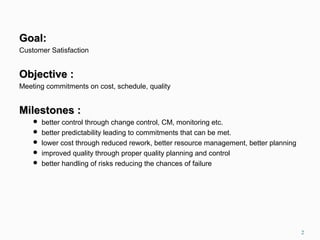
Goal:Goal:
Customer Satisfaction
Objective :Objective :
Meeting commitments on cost, schedule, quality
Milestones :Milestones :
 better control through change control, CM, monitoring etc.
 better predictability leading to commitments that can be met.
 lower cost through reduced rework, better resource management, better planning
 improved quality through proper quality planning and control
 better handling of risks reducing the chances of failure
2
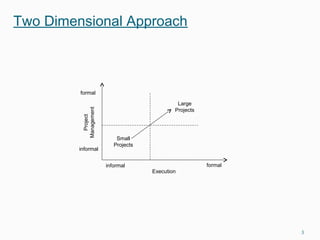
Two Dimensional Approach
3
Small
Projects
Large
Projects
formalinformal
informal
formal
Execution
Project
Management
4
Organization
Project plan
Change management
Resources
People management
Team management
Cost Management
Project Variables
Quality management
Scope management
Risk Management
Communication
Project kick off
Status reporting
communication
Management
Project Governance
Project Governance Model
Project Management Process
planning, monitoring and control, and closureplanning, monitoring and control, and closure
 before the main execution life cycle (LC) and closure after the LC
 monitoring phase is in parallel with LC
Project Planning :Project Planning :
 defining suitable processes for executing the project
 estimating effort
 defining project milestones and create a schedule
 defining quality objectives and a quality plan
 identifying risks and make plans to mitigate them
 defining measurement plan, project-tracking procedures, training plan, team organization, etc
Process Planning :Process Planning :
 process to be followed
 process will decide the tasks, their ordering, milestones
 plan for LC as supporting process
Life Cycle Process:Life Cycle Process:
 NRE ,OJT, First Article
o adding, deleting, modifying some process steps
o fine-tuning to suit the project needs
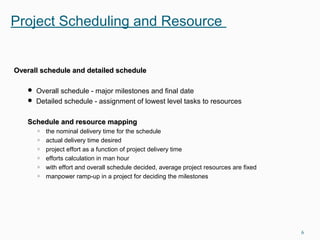
Project Scheduling and Resource
Overall schedule and detailed scheduleOverall schedule and detailed schedule
 Overall schedule - major milestones and final date
 Detailed schedule - assignment of lowest level tasks to resources
Schedule and resource mappingSchedule and resource mapping
o the nominal delivery time for the schedule
o actual delivery time desired
o project effort as a function of project delivery time
o efforts calculation in man hour
o with effort and overall schedule decided, average project resources are fixed
o manpower ramp-up in a project for deciding the milestones
6
 consistent with milestones
 identifying lowest level tasks those can be done in less than 2-3 days
 deciding the tasks, assigning them while preserving high-level schedule
 modifying if cannot “fit” all tasks, must revisit high level schedule
 Identifying each task by name, date, duration, resource assigned
7
Detailed Scheduling
Manpower distribution – PM approach
8
TestPlan Build
Quality Planning
Defect Injection and RemovalDefect Injection and Removal
harness assembly is a labor intensive job
defects are injected at any stage
as quality goal is low delivered defect density, these defects are removed
done primarily by quality control (QC) activities of reviews and testing
Procedural approachProcedural approach
quality plan defines what QC tasks will be undertaken
main QC tasks - reviews and testing
guidelines and procedures for reviews and testing
adherence to the plan and procedures ensured
Quality PlanQuality Plan
drives the quality activities in the project
level of plan based on job criticality
defined QC tasks that have to be performed
specify defect levels for each QC tasks
Measurement of defect injection and removal rates, defect removal efficiency (DRE)
Continuous Improvement
 Process Mapping and Redesign
 Work Standardization
 Mistake Proofing
 Visibility Management Tools
 Cross-training and Certification

10
Risk Management Tasks
11
Risk Identification
Risk Management
Risk Assessment
Risk Control
Risk Analysis
Risk Prioritization
Risk Management Planning
Risk Resolution
Risk Monitoring
Risk Identification, Analysis and Prioritization
 “what ifs”, checklists, past experience
 list of “top 10” risks similar projects have seen in past
o shortage of technically trained manpower
o too many requirement changes
o unclear requirements
o not meeting performance requirements
o unrealistic schedules
o insufficient business knowledge
o working on new technology
 Risk Exposure (RE) = probability of risk occurring * risk impact
o RE considered as expected value of loss for a risk
o Prioritization done based on risk exposure value
 Plans are made to handle high RE risks
 REs revisited periodically
12
Tracking
Activity level monitoringActivity level monitoring
 Each activity in detailed schedule is getting done
 daily review
Status reportsStatus reports
 weekly to take stock
 Summary of activities completed, pending
 Issues to be resolved
Milestone analysisMilestone analysis
 A bigger review at milestones
 Actual vs estimated for effort and sched is done
 Risks are revisited
 Changes to product and their impact may be analyzed
Cost-schedule milestone graph is another way of doing this
13
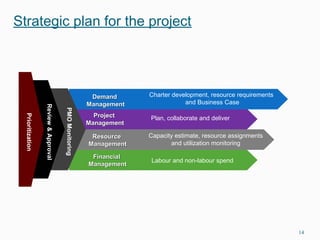
14
Prioritization
Review&Approval
PMOMonitoring
DemandDemand
ManagementManagement
Charter development, resource requirements
and Business Case
ProjectProject
ManagementManagement
Plan, collaborate and deliver
ResourceResource
ManagementManagement
Capacity estimate, resource assignments
and utilization monitoring
FinancialFinancial
ManagementManagement
Labour and non-labour spend
Strategic plan for the project
Team structure
Customer
Project Manager
Project Coordinator
Material
Planning Rep
Product
Engineering Rep
Production
Team Lead
QA Team Lead
Goal:Goal:
Global Optimization and managing uncertainty
Objective :Objective :
 supply in the right quantities at right time
 minimize total system cost
 satisfy customer service requirements
Milestones :Milestones :
 Purchasing - Supplier alliances, supplier management, strategic sourcing
 Operations - Demand management, TQM
 Distribution - Transportation management, customer relationship management,
logistics
 Integration - Coordination/Integration activities, global sourcing problems,
performance measurement
17
Supply Chain Organization in Sasmos
Supply Chain Manager
Procurement Logistics SCM admin
• KAP identification
• Volume driven
• Audit
• Spend areas-future
• Critical components
• Strategies
• Efficiencies
• Process review
• Demand &
forecasting
• Warehousing
• Inventory
• Transportation
• Release orders
• Spot orders
• Non-repetitive orders
• Non critical
components
Strategic Sourcing Tactical
Contract Management
Project Manger
Is viewed asIs viewed as effective, relevant, valued ,part of the Management Team
KAP = Key Alliance Partners
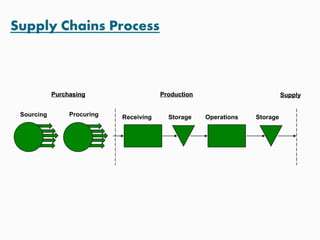
PurchasingPurchasing
Receiving Storage Operations Storage
ProductionProduction SupplySupply
Sourcing Procuring
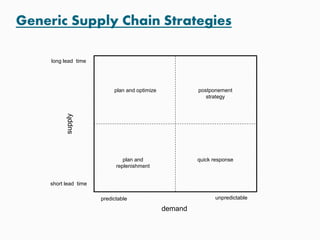
short lead time
long lead time
predictable unpredictable
plan and optimize
quick responseplan and
replenishment
postponement
strategy
supply
demand
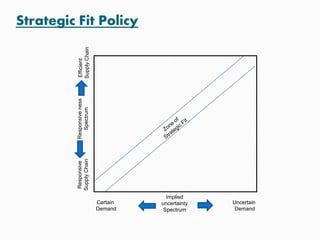
Responsive
SupplyChain
Certain
Demand
Responsiveness
Spectrum
Efficient
SupplyChain
Implied
uncertainty
Spectrum
Uncertain
Demand
Zone
of
Strategic
Fit
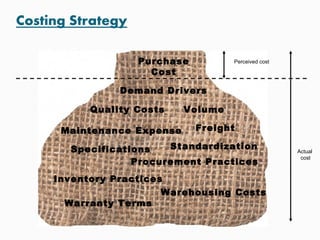
Purchase
Cost
Demand Drivers
Specifications Standardization
Inventory Practices
Warehousing Costs
Maintenance Expense
Quality Costs
Procurement Practices
Warranty Terms
Freight
Volume
Perceived cost
Actual
cost
Sasmos Trends:Sasmos Trends:
 long term relationships
 improve performance through
 determining supplier capabilities
 self or internal certification to assure product quality and service
requirements
 strategic partnerships- successful and trusting relationships with
top-performing suppliers
Quick wins as well as longer-term opportunities that could form the basis of a
structured plan of activities over the coming years to deliver the benefits.
considering the development of detailed category strategies
looking at the best geographic location for sourcing
looking across the full range of procurement levers all of which help manage
and reduce cost but also lead to reduced supply chain risk, such as
o strategic sourcing
o cost modelling
o inflation management
o Dollar fluctuation
o fixed rate contract with partners
Reducing Supply Chain CostsReducing Supply Chain Costs
 Reduced purchasing costs
 Reducing waste
 Reducing excess inventory, and
 Reducing non-value added activities
Continuous ImprovementContinuous Improvement
 Benchmarking- improve over competitors’ performance
 Trial & error
 Increased knowledge of supply chain processes
Cost Reduction –Current Practice
 Demand management - matching demand to available capacity
 Linking suppliers via MRP and ERP systems
 Use JIT to improve the pull of materials to reduce inventory levels
 Employ TQM to improve quality compliance among suppliers
 Use TCO as a tool
Cost Reduction –Plan
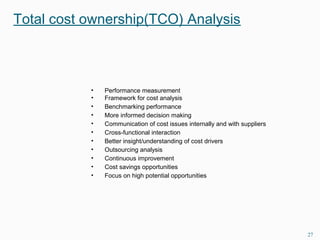
• Performance measurement
• Framework for cost analysis
• Benchmarking performance
• More informed decision making
• Communication of cost issues internally and with suppliers
• Cross-functional interaction
• Better insight/understanding of cost drivers
• Outsourcing analysis
• Continuous improvement
• Cost savings opportunities
• Focus on high potential opportunities
27
Total cost ownership(TCO) Analysis
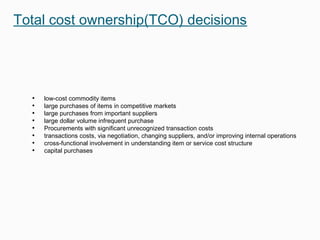
Total cost ownership(TCO) decisions
• low-cost commodity items
• large purchases of items in competitive markets
• large purchases from important suppliers
• large dollar volume infrequent purchase
• Procurements with significant unrecognized transaction costs
• transactions costs, via negotiation, changing suppliers, and/or improving internal operations
• cross-functional involvement in understanding item or service cost structure
• capital purchases

Proj mgmt and scm

  • 2.
    Goal:Goal: Customer Satisfaction Objective :Objective: Meeting commitments on cost, schedule, quality Milestones :Milestones :  better control through change control, CM, monitoring etc.  better predictability leading to commitments that can be met.  lower cost through reduced rework, better resource management, better planning  improved quality through proper quality planning and control  better handling of risks reducing the chances of failure 2
  • 3.
  • 4.
    4 Organization Project plan Change management Resources Peoplemanagement Team management Cost Management Project Variables Quality management Scope management Risk Management Communication Project kick off Status reporting communication Management Project Governance Project Governance Model
  • 5.
    Project Management Process planning,monitoring and control, and closureplanning, monitoring and control, and closure  before the main execution life cycle (LC) and closure after the LC  monitoring phase is in parallel with LC Project Planning :Project Planning :  defining suitable processes for executing the project  estimating effort  defining project milestones and create a schedule  defining quality objectives and a quality plan  identifying risks and make plans to mitigate them  defining measurement plan, project-tracking procedures, training plan, team organization, etc Process Planning :Process Planning :  process to be followed  process will decide the tasks, their ordering, milestones  plan for LC as supporting process Life Cycle Process:Life Cycle Process:  NRE ,OJT, First Article o adding, deleting, modifying some process steps o fine-tuning to suit the project needs
  • 6.
    Project Scheduling andResource Overall schedule and detailed scheduleOverall schedule and detailed schedule  Overall schedule - major milestones and final date  Detailed schedule - assignment of lowest level tasks to resources Schedule and resource mappingSchedule and resource mapping o the nominal delivery time for the schedule o actual delivery time desired o project effort as a function of project delivery time o efforts calculation in man hour o with effort and overall schedule decided, average project resources are fixed o manpower ramp-up in a project for deciding the milestones 6
  • 7.
     consistent withmilestones  identifying lowest level tasks those can be done in less than 2-3 days  deciding the tasks, assigning them while preserving high-level schedule  modifying if cannot “fit” all tasks, must revisit high level schedule  Identifying each task by name, date, duration, resource assigned 7 Detailed Scheduling
  • 8.
    Manpower distribution –PM approach 8 TestPlan Build
  • 9.
    Quality Planning Defect Injectionand RemovalDefect Injection and Removal harness assembly is a labor intensive job defects are injected at any stage as quality goal is low delivered defect density, these defects are removed done primarily by quality control (QC) activities of reviews and testing Procedural approachProcedural approach quality plan defines what QC tasks will be undertaken main QC tasks - reviews and testing guidelines and procedures for reviews and testing adherence to the plan and procedures ensured Quality PlanQuality Plan drives the quality activities in the project level of plan based on job criticality defined QC tasks that have to be performed specify defect levels for each QC tasks Measurement of defect injection and removal rates, defect removal efficiency (DRE)
  • 10.
    Continuous Improvement  ProcessMapping and Redesign  Work Standardization  Mistake Proofing  Visibility Management Tools  Cross-training and Certification  10
  • 11.
    Risk Management Tasks 11 RiskIdentification Risk Management Risk Assessment Risk Control Risk Analysis Risk Prioritization Risk Management Planning Risk Resolution Risk Monitoring
  • 12.
    Risk Identification, Analysisand Prioritization  “what ifs”, checklists, past experience  list of “top 10” risks similar projects have seen in past o shortage of technically trained manpower o too many requirement changes o unclear requirements o not meeting performance requirements o unrealistic schedules o insufficient business knowledge o working on new technology  Risk Exposure (RE) = probability of risk occurring * risk impact o RE considered as expected value of loss for a risk o Prioritization done based on risk exposure value  Plans are made to handle high RE risks  REs revisited periodically 12
  • 13.
    Tracking Activity level monitoringActivitylevel monitoring  Each activity in detailed schedule is getting done  daily review Status reportsStatus reports  weekly to take stock  Summary of activities completed, pending  Issues to be resolved Milestone analysisMilestone analysis  A bigger review at milestones  Actual vs estimated for effort and sched is done  Risks are revisited  Changes to product and their impact may be analyzed Cost-schedule milestone graph is another way of doing this 13
  • 14.
    14 Prioritization Review&Approval PMOMonitoring DemandDemand ManagementManagement Charter development, resourcerequirements and Business Case ProjectProject ManagementManagement Plan, collaborate and deliver ResourceResource ManagementManagement Capacity estimate, resource assignments and utilization monitoring FinancialFinancial ManagementManagement Labour and non-labour spend Strategic plan for the project
  • 15.
    Team structure Customer Project Manager ProjectCoordinator Material Planning Rep Product Engineering Rep Production Team Lead QA Team Lead
  • 17.
    Goal:Goal: Global Optimization andmanaging uncertainty Objective :Objective :  supply in the right quantities at right time  minimize total system cost  satisfy customer service requirements Milestones :Milestones :  Purchasing - Supplier alliances, supplier management, strategic sourcing  Operations - Demand management, TQM  Distribution - Transportation management, customer relationship management, logistics  Integration - Coordination/Integration activities, global sourcing problems, performance measurement 17
  • 18.
    Supply Chain Organizationin Sasmos Supply Chain Manager Procurement Logistics SCM admin • KAP identification • Volume driven • Audit • Spend areas-future • Critical components • Strategies • Efficiencies • Process review • Demand & forecasting • Warehousing • Inventory • Transportation • Release orders • Spot orders • Non-repetitive orders • Non critical components Strategic Sourcing Tactical Contract Management Project Manger Is viewed asIs viewed as effective, relevant, valued ,part of the Management Team KAP = Key Alliance Partners
  • 19.
    PurchasingPurchasing Receiving Storage OperationsStorage ProductionProduction SupplySupply Sourcing Procuring
  • 20.
    short lead time longlead time predictable unpredictable plan and optimize quick responseplan and replenishment postponement strategy supply demand
  • 21.
  • 22.
    Purchase Cost Demand Drivers Specifications Standardization InventoryPractices Warehousing Costs Maintenance Expense Quality Costs Procurement Practices Warranty Terms Freight Volume Perceived cost Actual cost
  • 23.
    Sasmos Trends:Sasmos Trends: long term relationships  improve performance through  determining supplier capabilities  self or internal certification to assure product quality and service requirements  strategic partnerships- successful and trusting relationships with top-performing suppliers
  • 24.
    Quick wins aswell as longer-term opportunities that could form the basis of a structured plan of activities over the coming years to deliver the benefits. considering the development of detailed category strategies looking at the best geographic location for sourcing looking across the full range of procurement levers all of which help manage and reduce cost but also lead to reduced supply chain risk, such as o strategic sourcing o cost modelling o inflation management o Dollar fluctuation o fixed rate contract with partners
  • 25.
    Reducing Supply ChainCostsReducing Supply Chain Costs  Reduced purchasing costs  Reducing waste  Reducing excess inventory, and  Reducing non-value added activities Continuous ImprovementContinuous Improvement  Benchmarking- improve over competitors’ performance  Trial & error  Increased knowledge of supply chain processes Cost Reduction –Current Practice
  • 26.
     Demand management- matching demand to available capacity  Linking suppliers via MRP and ERP systems  Use JIT to improve the pull of materials to reduce inventory levels  Employ TQM to improve quality compliance among suppliers  Use TCO as a tool Cost Reduction –Plan
  • 27.
    • Performance measurement •Framework for cost analysis • Benchmarking performance • More informed decision making • Communication of cost issues internally and with suppliers • Cross-functional interaction • Better insight/understanding of cost drivers • Outsourcing analysis • Continuous improvement • Cost savings opportunities • Focus on high potential opportunities 27 Total cost ownership(TCO) Analysis
  • 28.
    Total cost ownership(TCO)decisions • low-cost commodity items • large purchases of items in competitive markets • large purchases from important suppliers • large dollar volume infrequent purchase • Procurements with significant unrecognized transaction costs • transactions costs, via negotiation, changing suppliers, and/or improving internal operations • cross-functional involvement in understanding item or service cost structure • capital purchases