Progressive Corporation A Case Study Scott Campbell - Christina Connolly - Maureen Stafford MBAM 619 2/16/09
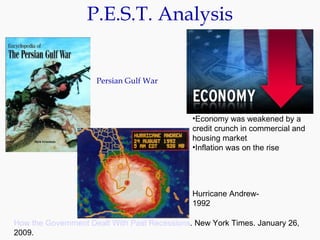
P.E.S.T. Analysis Persian Gulf War How the Government Dealt With Past Recessions . New York Times. January 26, 2009.  Economy was weakened by a credit crunch in commercial and housing market Inflation was on the rise Hurricane Andrew- 1992
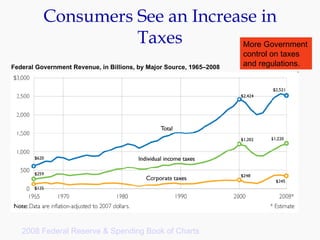
Consumers See an Increase in Taxes Federal Government Revenue, in Billions, by Major Source, 1965–2008 2008 Federal Reserve & Spending Book of Charts More Government control on taxes and regulations.
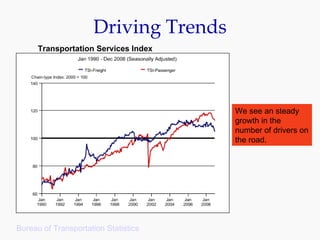
Driving Trends Transportation Services Index Bureau of Transportation Statistics  We see an steady growth in the number of drivers on the road.                                                                             
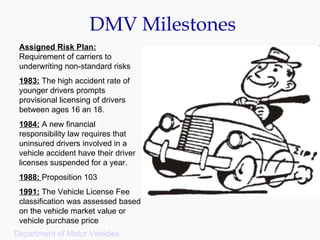
DMV Milestones Assigned Risk Plan:  Requirement of carriers to underwriting non-standard risks 1983:  The high accident rate of younger drivers prompts provisional licensing of drivers between ages 16 an 18.  1984:  A new financial responsibility law requires that uninsured drivers involved in a vehicle accident have their driver licenses suspended for a year.  1988:  Proposition 103 1991:  The Vehicle License Fee classification was assessed based on the vehicle market value or vehicle purchase price  Department of Motor Vehicles
Technology Nationwide voice/data system:  faster communication btwn agents & headquarters, increase process claims by 30% Express Quote Service:  list of competitors’ pricing available to consumers Immediate Response System:  “office on wheels”
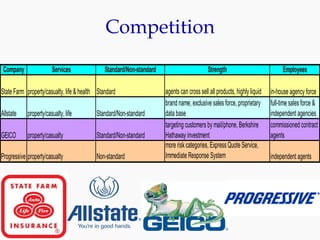
Competition
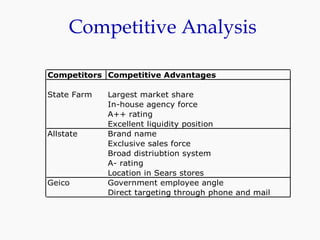
Competitive Analysis
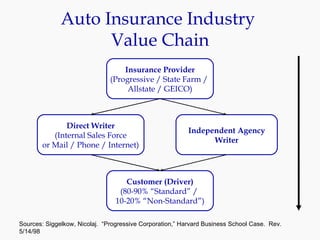
Auto Insurance Industry  Value Chain Insurance Provider (Progressive / State Farm /  Allstate / GEICO)‏ Independent Agency Writer Customer (Driver)‏ (80-90% “Standard” /  10-20% “Non-Standard”)‏ Direct Writer (Internal Sales Force or Mail / Phone / Internet)‏ Sources: Siggelkow, Nicolaj.  “Progressive Corporation,” Harvard Business School Case.  Rev. 5/14/98  http://www.iii.org/media/hottopics/insurance/distribution/  (Accessed 2/13/09)‏
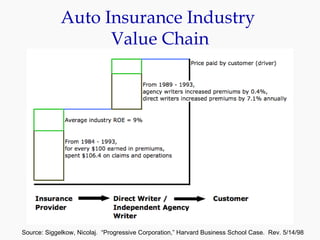
Auto Insurance Industry  Value Chain Source: Siggelkow, Nicolaj.  “Progressive Corporation,” Harvard Business School Case.  Rev. 5/14/98
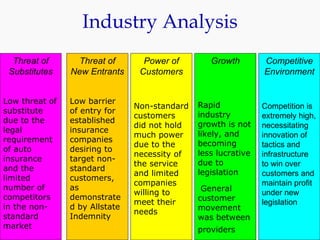
Industry Analysis Threat of Substitutes Low threat of substitute due to the legal requirement of auto insurance and the limited number of competitors in the non-standard market Threat of New Entrants Low barrier of entry for established insurance companies desiring to target non-standard customers, as demonstrated by Allstate Indemnity Power of Customers Non-standard customers did not hold much power due to the necessity of the service and limited companies willing to meet their needs Growth Rapid industry growth is not likely, and becoming less lucrative due to legislation General customer movement was between providers   Competitive Environment Competition is extremely high, necessitating innovation of tactics and infrastructure to win over customers and maintain profit under new legislation
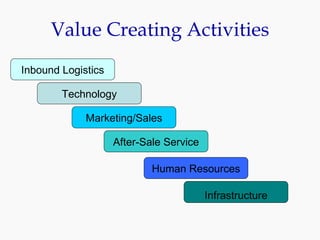
Value Creating Activities Inbound Logistics Marketing/Sales After-Sale Service Human Resources Infrastructure Technology Marketing/Sales After-Sale Service Human Resources Infrastructure
Inbound Logistics  “The Prince of Smart Pricing” Utilized database to price policies appropriately to risk Developed 14,000 premiums under which to classify
Technology “Agents’ mispricing policies was identified as a major cost driver.” Computer system to facilitate fast communication with headquarters Shorter processing time Decreased operating expenses Expedited claims process
Marketing/Sales  “It’s the difference between a tricycle and a Boeing 747.” Used independent agents to maximize coverage while minimizing fixed costs Express Quote Service Promoted Progressive’s awareness of consumers Channel Options Open an account with an independent agent or directly with Progressive via phone Walk-in customer service centers Drive-in service center Increased brand awareness
After-Sale Service  “Most people start out not trusting their insurance company. But if you are there right away… fewer people will go to lawyers.” Immediate Response system Progressive accident victims who used an attorney decreased 20% Rental car duration decreased Duration a car remained in storage decreased Word of mouth promotion Reduction in fraudulent activity (previously 10-15%of insurance losses)‏
After-Sales Service Cont’d Office on Wheels Reduced employee and administrative costs Decreased customers who turned to an attorney Decreased number of open claims 50% Innovative Cost Containment Offering special options to decrease premiums by 12-20% opened up to a greater number of users
Human Resources “The transition towards a service-oriented insurance company proved to be difficult.” Hired “blank slate” employees and trained to their standards Great responsibility level Brought in amenities for a comfortable working environment High pay
Infrastructure “We will go for profit, not simply for growth.” Profit prioritized over growth 4% underwriting target Nonstandard culture No regard for industry standard

Progressive Case Study.Scm

  • 1.
    Progressive Corporation ACase Study Scott Campbell - Christina Connolly - Maureen Stafford MBAM 619 2/16/09
  • 2.
    P.E.S.T. Analysis PersianGulf War How the Government Dealt With Past Recessions . New York Times. January 26, 2009. Economy was weakened by a credit crunch in commercial and housing market Inflation was on the rise Hurricane Andrew- 1992
  • 3.
    Consumers See anIncrease in Taxes Federal Government Revenue, in Billions, by Major Source, 1965–2008 2008 Federal Reserve & Spending Book of Charts More Government control on taxes and regulations.
  • 4.
    Driving Trends TransportationServices Index Bureau of Transportation Statistics We see an steady growth in the number of drivers on the road.                                                                             
  • 5.
    DMV Milestones AssignedRisk Plan: Requirement of carriers to underwriting non-standard risks 1983: The high accident rate of younger drivers prompts provisional licensing of drivers between ages 16 an 18. 1984: A new financial responsibility law requires that uninsured drivers involved in a vehicle accident have their driver licenses suspended for a year. 1988: Proposition 103 1991: The Vehicle License Fee classification was assessed based on the vehicle market value or vehicle purchase price Department of Motor Vehicles
  • 6.
    Technology Nationwide voice/datasystem: faster communication btwn agents & headquarters, increase process claims by 30% Express Quote Service: list of competitors’ pricing available to consumers Immediate Response System: “office on wheels”
  • 7.
  • 8.
  • 9.
    Auto Insurance Industry Value Chain Insurance Provider (Progressive / State Farm / Allstate / GEICO)‏ Independent Agency Writer Customer (Driver)‏ (80-90% “Standard” / 10-20% “Non-Standard”)‏ Direct Writer (Internal Sales Force or Mail / Phone / Internet)‏ Sources: Siggelkow, Nicolaj. “Progressive Corporation,” Harvard Business School Case. Rev. 5/14/98 http://www.iii.org/media/hottopics/insurance/distribution/ (Accessed 2/13/09)‏
  • 10.
    Auto Insurance Industry Value Chain Source: Siggelkow, Nicolaj. “Progressive Corporation,” Harvard Business School Case. Rev. 5/14/98
  • 11.
    Industry Analysis Threatof Substitutes Low threat of substitute due to the legal requirement of auto insurance and the limited number of competitors in the non-standard market Threat of New Entrants Low barrier of entry for established insurance companies desiring to target non-standard customers, as demonstrated by Allstate Indemnity Power of Customers Non-standard customers did not hold much power due to the necessity of the service and limited companies willing to meet their needs Growth Rapid industry growth is not likely, and becoming less lucrative due to legislation General customer movement was between providers Competitive Environment Competition is extremely high, necessitating innovation of tactics and infrastructure to win over customers and maintain profit under new legislation
  • 12.
    Value Creating ActivitiesInbound Logistics Marketing/Sales After-Sale Service Human Resources Infrastructure Technology Marketing/Sales After-Sale Service Human Resources Infrastructure
  • 13.
    Inbound Logistics “The Prince of Smart Pricing” Utilized database to price policies appropriately to risk Developed 14,000 premiums under which to classify
  • 14.
    Technology “Agents’ mispricingpolicies was identified as a major cost driver.” Computer system to facilitate fast communication with headquarters Shorter processing time Decreased operating expenses Expedited claims process
  • 15.
    Marketing/Sales “It’sthe difference between a tricycle and a Boeing 747.” Used independent agents to maximize coverage while minimizing fixed costs Express Quote Service Promoted Progressive’s awareness of consumers Channel Options Open an account with an independent agent or directly with Progressive via phone Walk-in customer service centers Drive-in service center Increased brand awareness
  • 16.
    After-Sale Service “Most people start out not trusting their insurance company. But if you are there right away… fewer people will go to lawyers.” Immediate Response system Progressive accident victims who used an attorney decreased 20% Rental car duration decreased Duration a car remained in storage decreased Word of mouth promotion Reduction in fraudulent activity (previously 10-15%of insurance losses)‏
  • 17.
    After-Sales Service Cont’dOffice on Wheels Reduced employee and administrative costs Decreased customers who turned to an attorney Decreased number of open claims 50% Innovative Cost Containment Offering special options to decrease premiums by 12-20% opened up to a greater number of users
  • 18.
    Human Resources “Thetransition towards a service-oriented insurance company proved to be difficult.” Hired “blank slate” employees and trained to their standards Great responsibility level Brought in amenities for a comfortable working environment High pay
  • 19.
    Infrastructure “We willgo for profit, not simply for growth.” Profit prioritized over growth 4% underwriting target Nonstandard culture No regard for industry standard