INDIVIDUAL ASSIGNMENT INFORMATION TECHNOLGY IN LOGISTICS  &  SUPPLY CHAIN MANAGEMENT     Faculty   :  Prof. Ashis K. Pani   Name  :  Gurjeet Bhatia    SMS ID  :  101903   Batch    :  PGCLSCM-3   Centre    :  Indore (M.P.)
e-Buisness Strategy in Progressive Insurance: Creating Value via Mobile Field Service
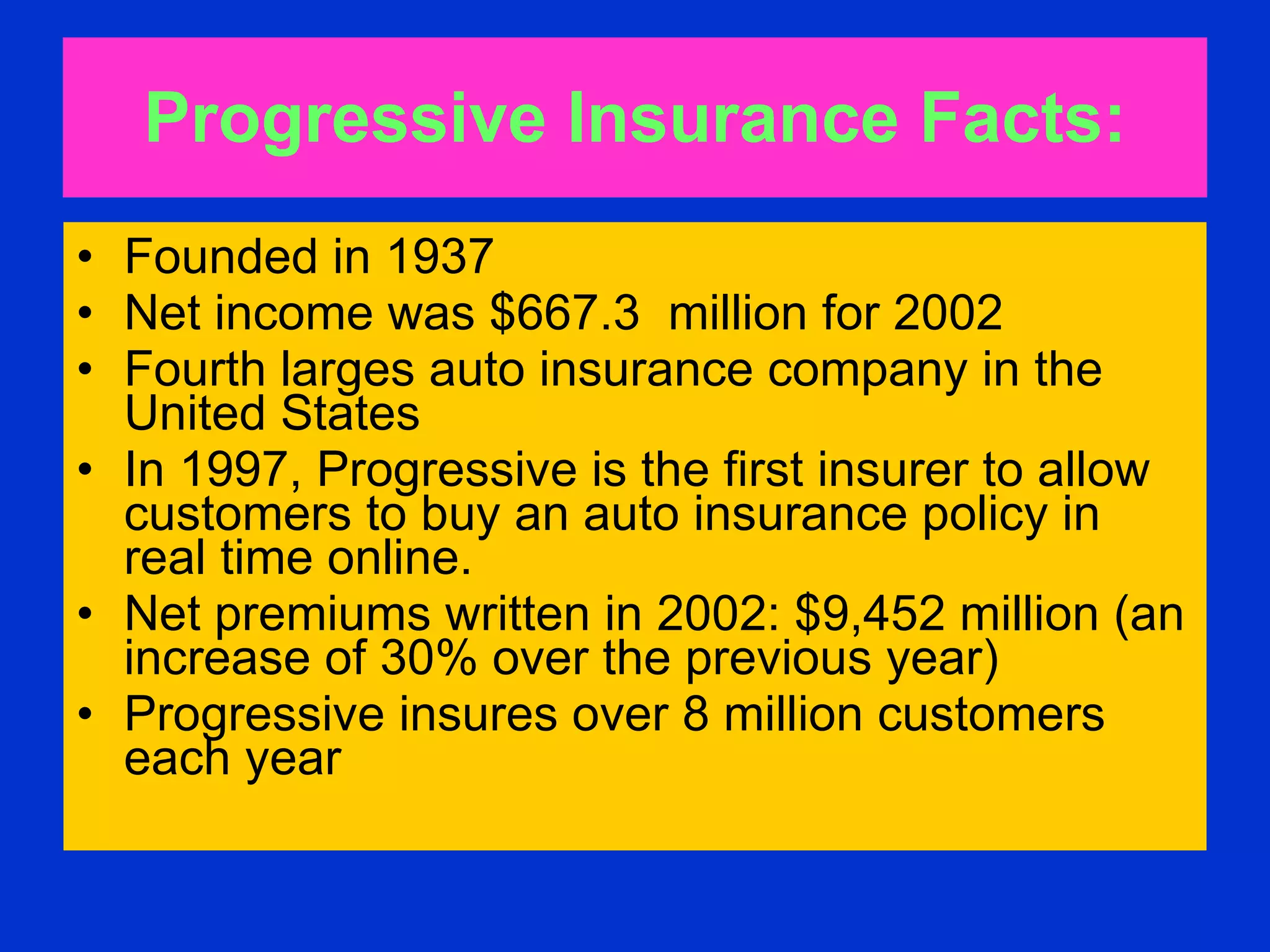
Progressive Insurance Facts: Founded in 1937  Net income was $667.3  million for 2002  Fourth larges auto insurance company in the United States  In 1997, Progressive is the first insurer to allow customers to buy an auto insurance policy in real time online.  Net premiums written in 2002: $9,452 million (an increase of 30% over the previous year) Progressive insures over 8 million customers each year
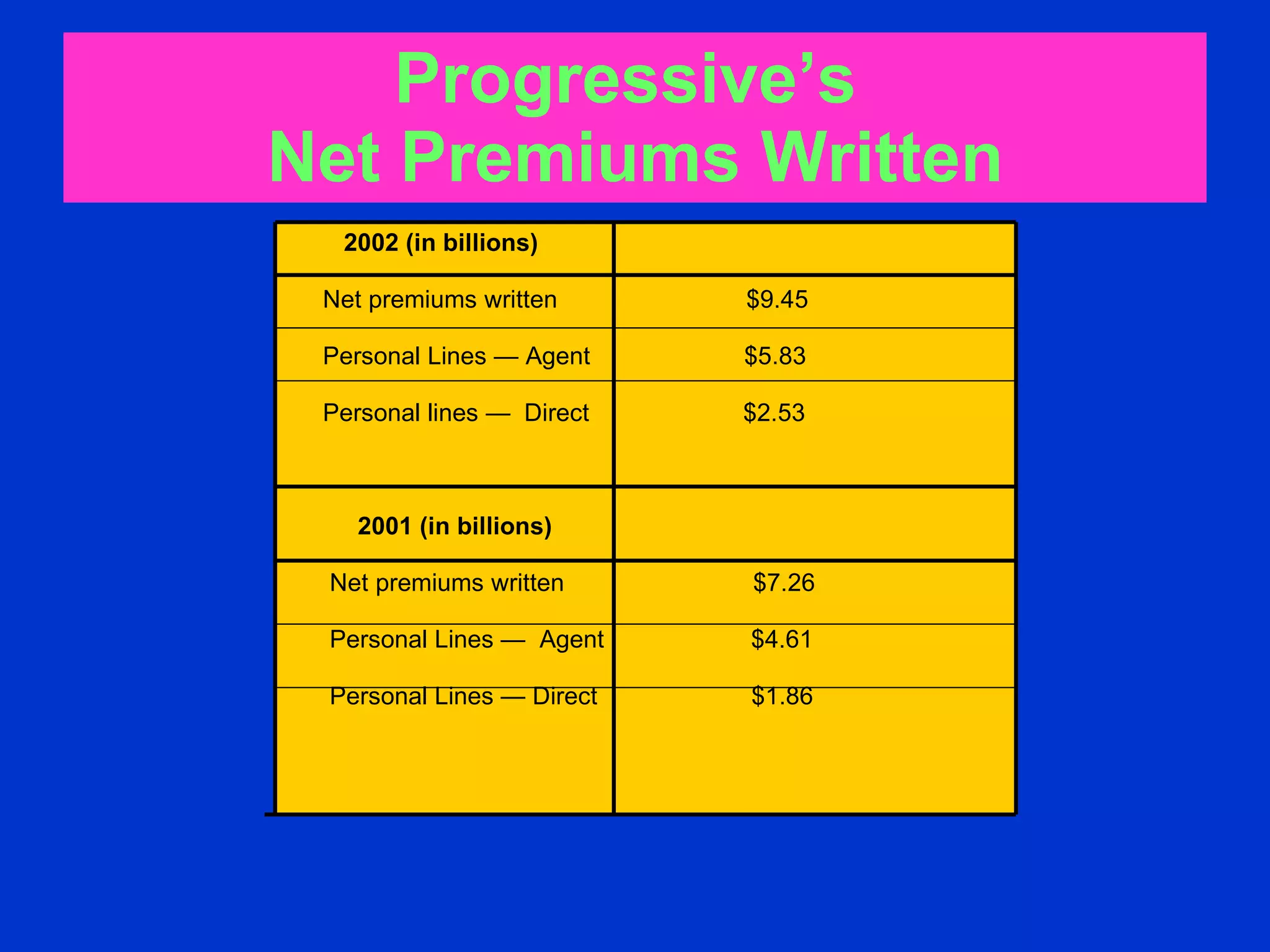
Progressive’s  Net Premiums Written 2002 (in billions)   Net premiums written  $9.45 Personal Lines — Agent  $5.83 Personal lines —  Direct  $2.53 2001 (in billions)  Net premiums written  $7.26 Personal Lines —  Agent  $4.61  Personal Lines — Direct  $1.86
DESCRIPTION OF BUISNESS Personal Lines  This segment writes insurance for private passenger automobiles, as well as recreational and other vehicles.  Other Businesses  The company's other lines of business include the commercial vehicle business unit, lenders' collateral protection group (LCPG), professional liability group (PLG), and motor carrier business unit.  Distribution Channels   Progressive either directly writes the personal lines insurance itself or indirectly sells policies by an agent or broker.  Progressive’s Focal Point —  Becoming “Easy To Do Business With”
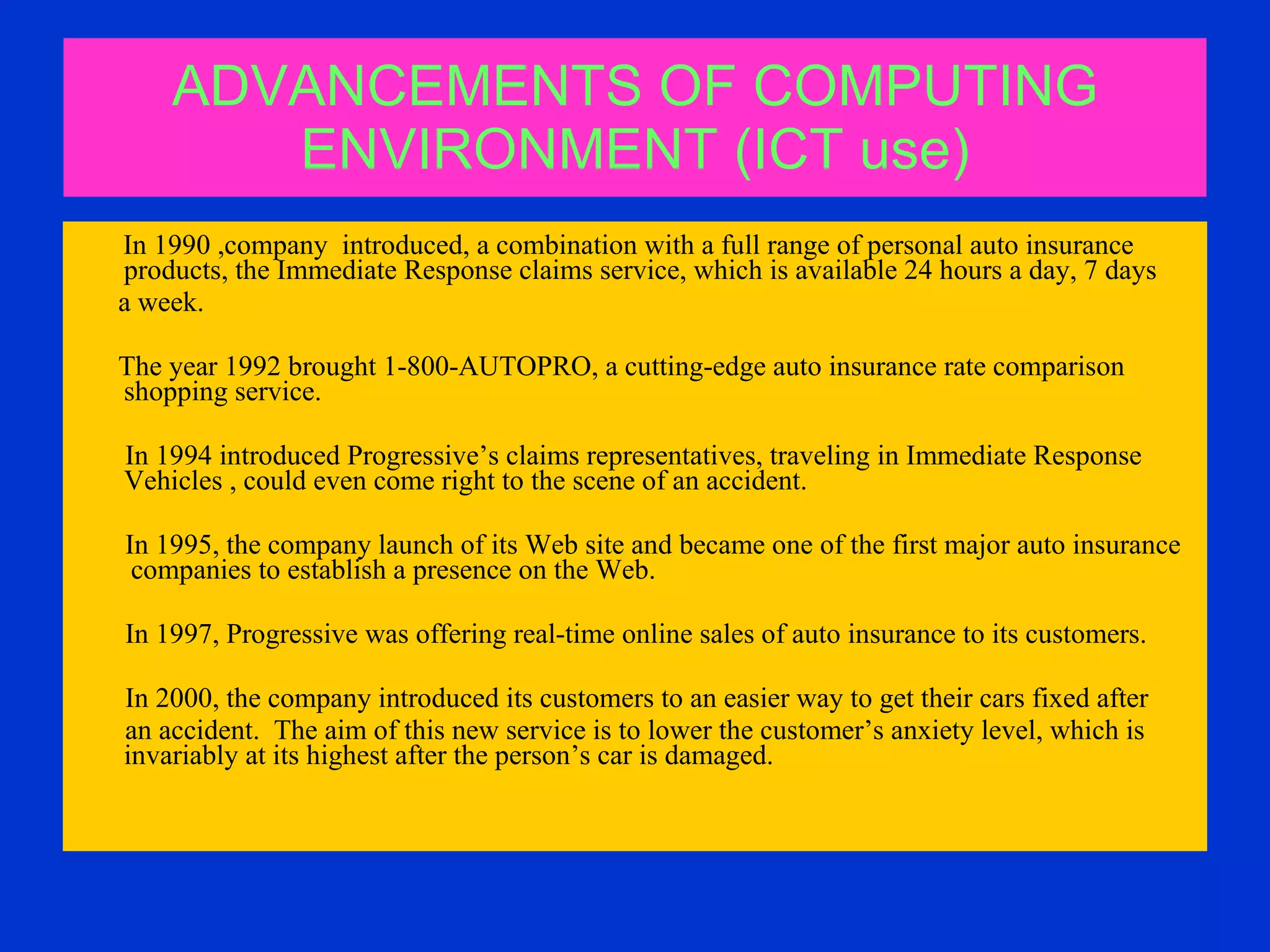
ADVANCEMENTS OF COMPUTING ENVIRONMENT (ICT use) In 1990 ,company  introduced, a combination with a full range of personal auto insurance products, the Immediate Response claims service, which is available 24 hours a day, 7 days a week. The year 1992 brought 1-800-AUTOPRO, a cutting-edge auto insurance rate comparison shopping service.  In 1994 introduced Progressive’s claims representatives, traveling in Immediate Response  Vehicles , could even come right to the scene of an accident. In 1995, the company launch of its Web site and became one of the first major auto insurance  companies to establish a presence on the Web.  In 1997, Progressive was offering real-time online sales of auto insurance to its customers.  In 2000, the company introduced its customers to an easier way to get their cars fixed after an accident.  The aim of this new service is to lower the customer’s anxiety level, which is invariably at its highest after the person’s car is damaged.
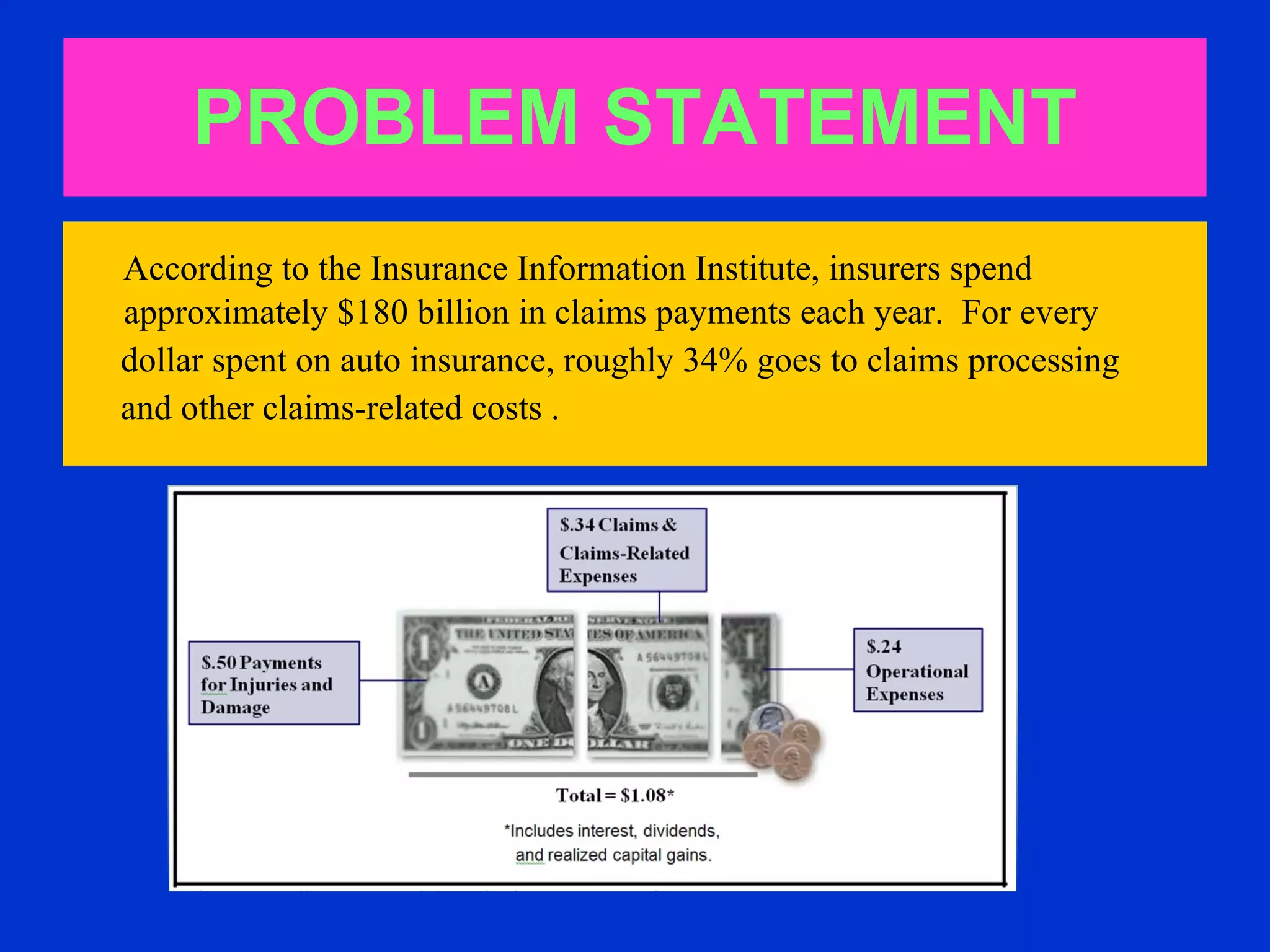
PROBLEM STATEMENT According to the Insurance Information Institute, insurers spend approximately $180 billion in claims payments each year.  For every dollar spent on auto insurance, roughly 34% goes to claims processing and other claims-related costs .
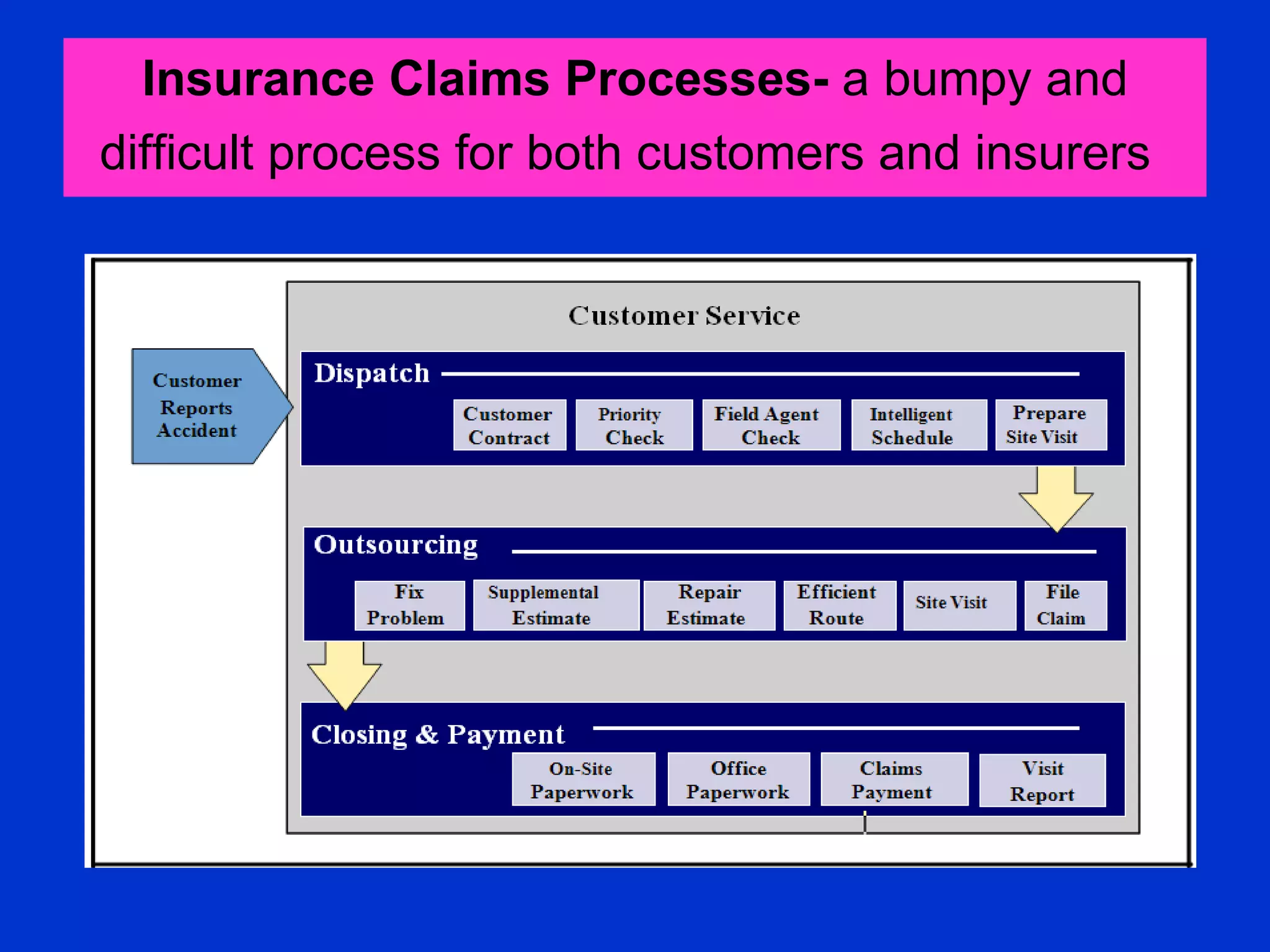
Insurance Claims Processes-  a bumpy and difficult process for both customers and insurers
e-BUSINESS ROADMAP   Mobile will help in the following ways:  Improving Adjuster Utilization  Reducing Call Volume  Enhancing Accuracy of Data
DESCRIPTION OF STUDY SOLUTION Mobile Claims Processing and Field Force Automation   An adjuster is Dispatched to the accident scene with a laptop, intelligent software, and the power to Make on-the-spot decisions.  The result is faster, less expensive and more profitable Service.  In fact, Progressive can perform several tasks at the scene of the accident that Would normally take other insurers weeks, or even months, to complete
Accident Claims Settled   in Hours, not Weeks   Imagine a scenario where a customer’s automobile accident results with the  insurance appraiser totaling the vehicle. Not only does the customer have to deal  with the accident itself, but now they must work with their insurance company for  weeks to get a check to purchase a new vehicle. Weeks turn into months and piles of  paper, missed phone calls, and headaches are all the customer has to show for their  wait.  The customer is disappointed and angry.  Now consider this same scenario with and appraiser armed with a laptop that can  upload the accident information directly to the insurance company.  In turn, the  insurance company can come back to the appraiser and customer with the fair  market value of the car and make a settlement offer on the spot. Once the necessary papers are signed, the case is completely settled in a matter of hours. The customer  is pleasantly surprised and happy .
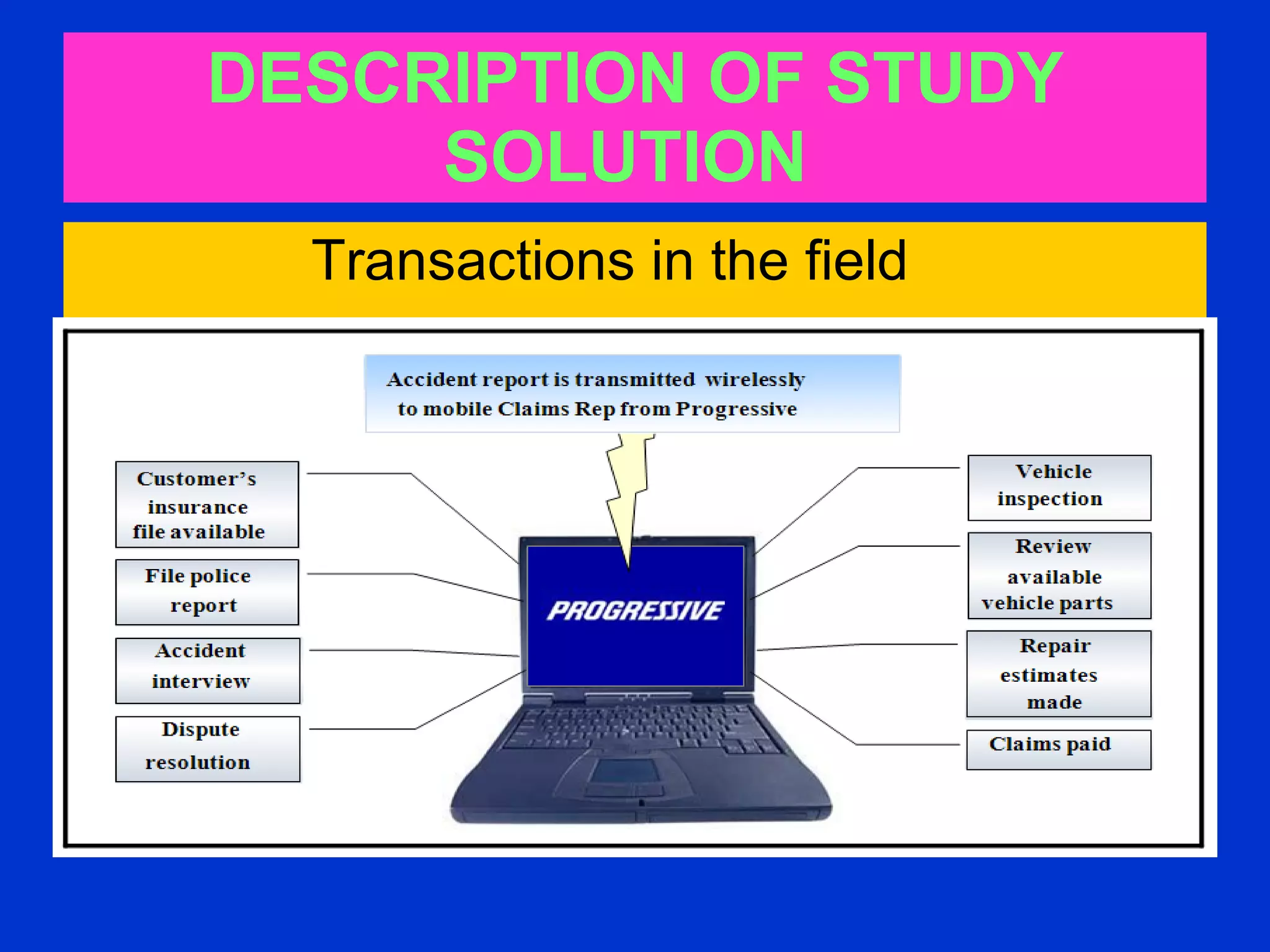
DESCRIPTION OF STUDY SOLUTION   Transactions in the field
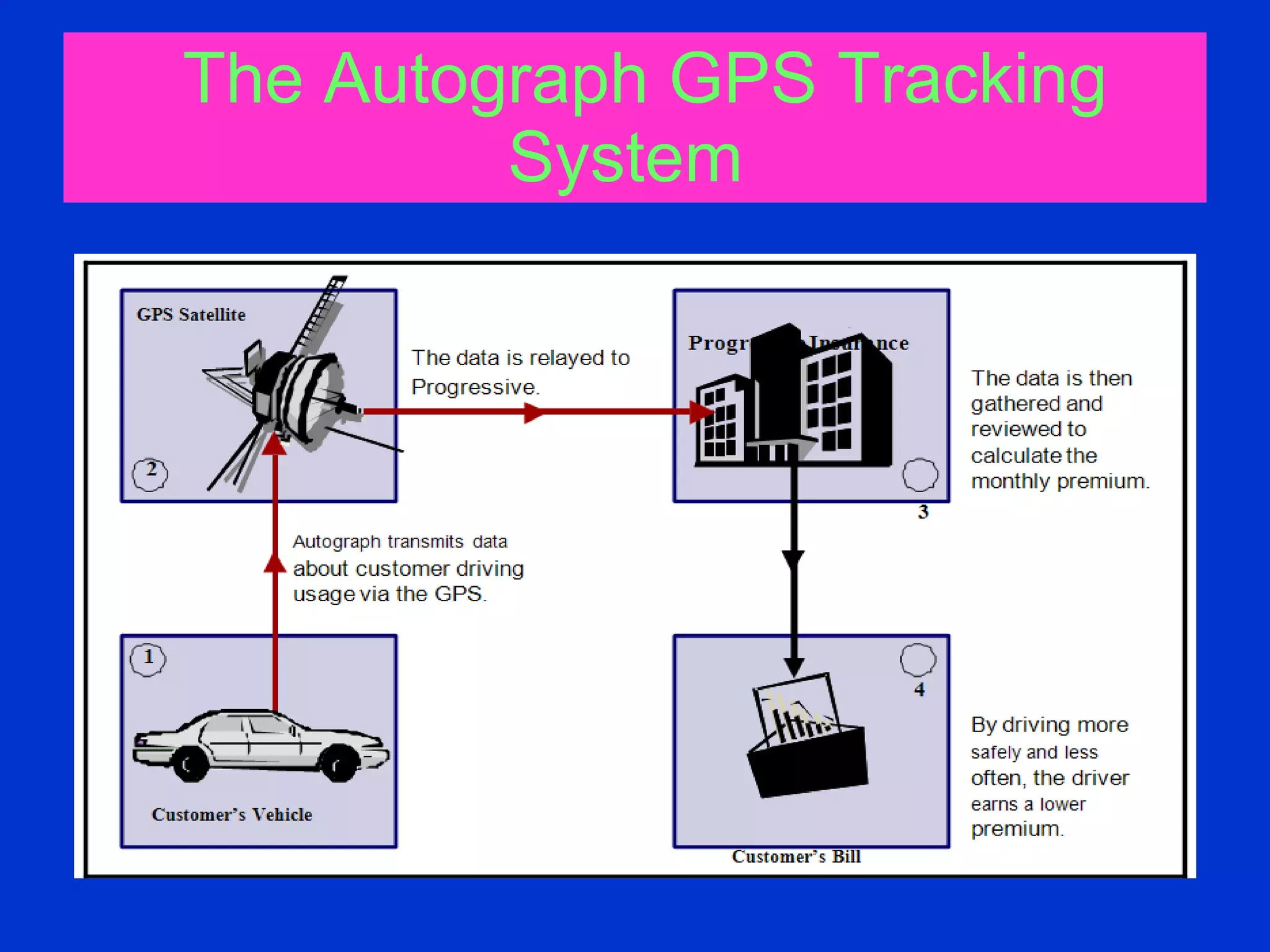
Mobile for “Adequate” Pricing.   Progressive considers its ability to underwrite risks accurately and to charge adequate rates to  policyholders for a full spectrum of risks as critical to success.  Rate adequacy is necessary to generate sufficient premiums to offset losses, loss  adjustment expenses, and underwriting expenses and, of course, to make a profit.  In order to accurately price policies, the company must collect and analyze  substantial data; develop, test, and implement appropriate rating formulas; monitor  for trend changes; and predict the severity and frequency of losses with some  accuracy.  Global positioning systems (GPSs) and other tracking technologies can  help collect extensive customer-driving behavior data and assess risks much more  accurately. Mobile technology makes pricing auto insurance more of an exact  science.
The Autograph GPS Tracking System
Other Insurance Cost  Drivers   Premium costs also rely on a number of other factors:  Dramatic increase in the costs of doing business,  Increased claims,  Escalating litigation,  Rising healthcare costs, and  A significant decline in investment returns.
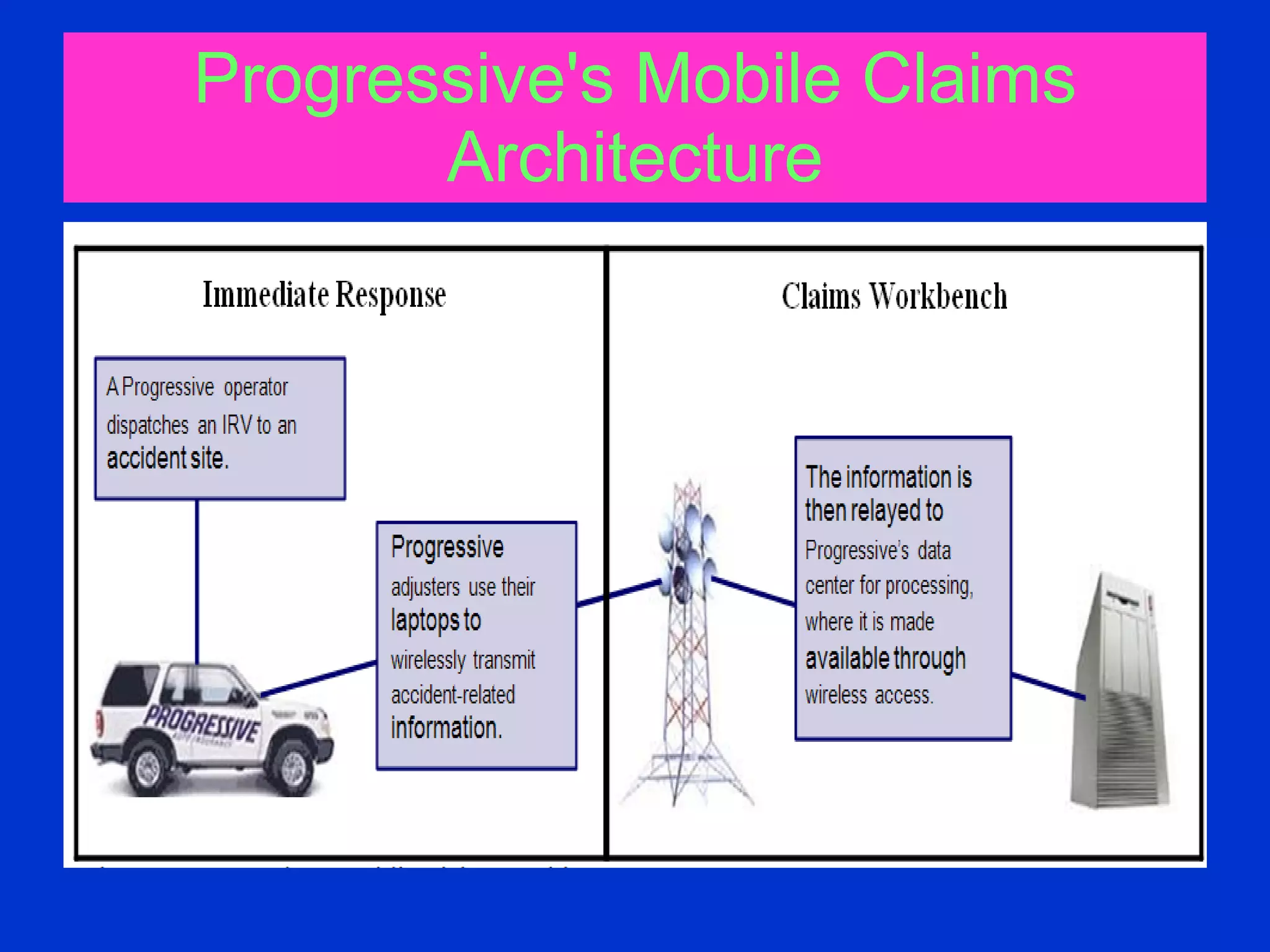
Progressive's Mobile Claims Architecture
Claims Workbench   Claims Workbench- an object-oriented mobile application that Progressive spent four years developing, eliminated the kinks in the Immediate Response program. Progressive developed a proprietary mainframe system that its employees can access through wireless laptops.  The laptops come equipped with  built-in, integrated wireless capability.  The primary application deployed on the laptops is to estimate claims and settle claims.
Mobile is Critical to   Success Mobile in Claims.   Progressive considers its ability to attract and retain talented employees as critical  to its success. Ineffectively training new employees in the claims area or losing a significant number experienced claims representatives and  managers could lead to Progressive being unable to handle an increasing workload. The company could also suffer from a decreased quality of claims work, which in turn could lower its operating margins.  Mobile field force applications alleviate job-related  frustrations and thus make training and retention easier.  For instance, mobile applications can eliminate unnecessary paperwork and help capture and provide  “To catch the reader 's attention, place an interesting sentence or quote from the story here.”  timely, accurate data.
Cell Phone Power   With a Cell Phone, Progressive’s Customers Can:  Make a payment  Look up vehicle recall information  Search crash test ratings Find an agent  Use financial calculators to figure potential monthly  payment, or find out the most coverage they can afford  Call to get a quote  Call policy services  Call claims
Driving Concerns over Privacy   With thoughts of “Big Brother” in their minds, some customers and  consumer groups have raised concerns over Progressive’s use of Autograph.  While the company maintains that the information gathered is used strictly for deciding insurance rates, some fear what could happen if the information got into the wrong hands.  Could the information be sold to third party groups who are interested in your shopping habits?  Does Progressive have a moral or  legal responsibility to divulge information if one of their customers is accused of committing a crime while driving?  And consumers need to consider the trade-off:  are potentially lower rates worth more than compromising personal privacy?
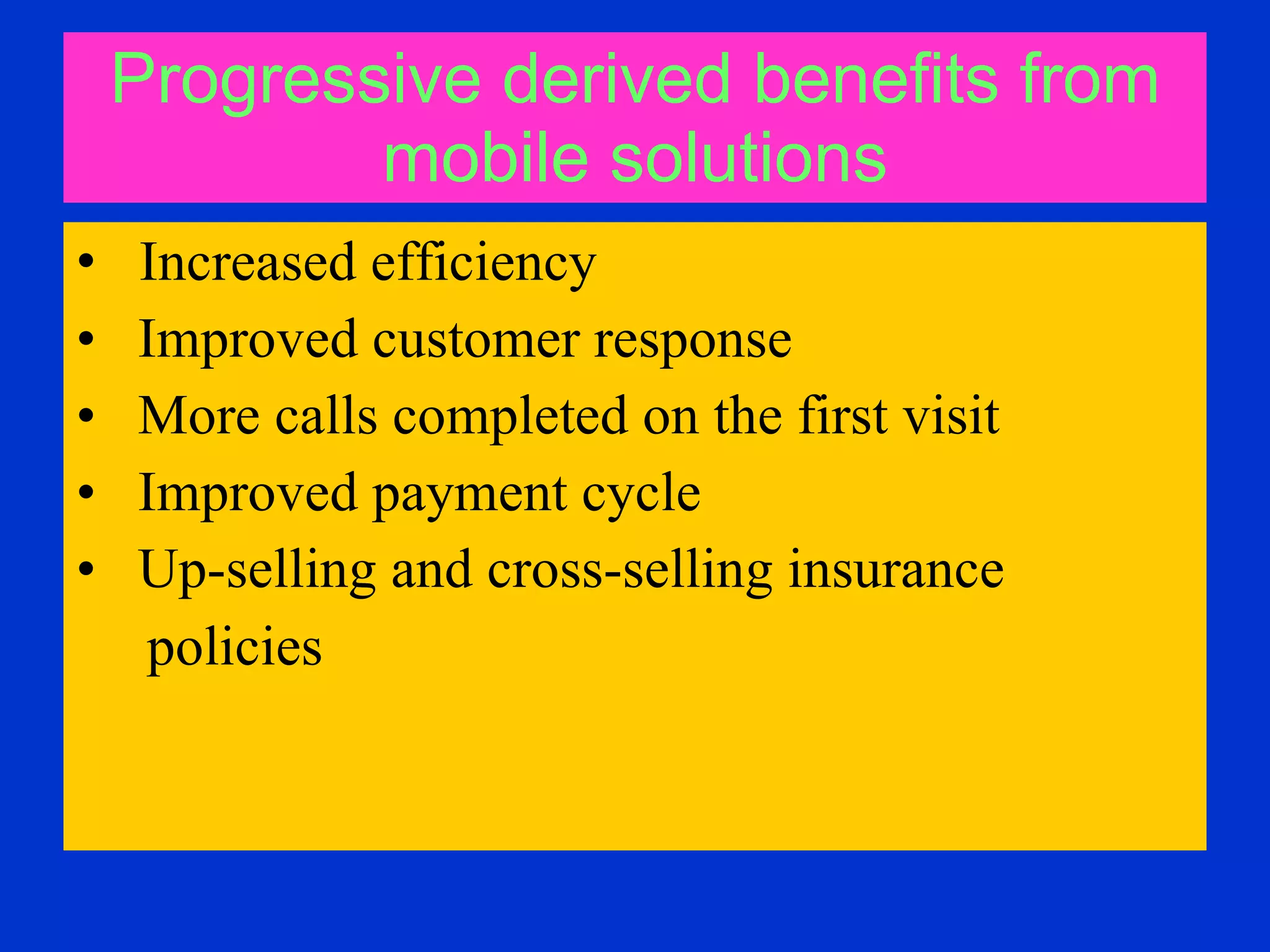
Progressive derived benefits from mobile solutions Increased efficiency Improved customer response  More calls completed on the first visit  Improved payment cycle  Up-selling and cross-selling insurance  policies
THANK YOU

Itlscm Gurjeet Bhatia

  • 1.
    INDIVIDUAL ASSIGNMENT INFORMATIONTECHNOLGY IN LOGISTICS & SUPPLY CHAIN MANAGEMENT Faculty : Prof. Ashis K. Pani Name : Gurjeet Bhatia SMS ID : 101903 Batch : PGCLSCM-3 Centre : Indore (M.P.)
  • 2.
    e-Buisness Strategy inProgressive Insurance: Creating Value via Mobile Field Service
  • 3.
    Progressive Insurance Facts:Founded in 1937 Net income was $667.3 million for 2002 Fourth larges auto insurance company in the United States In 1997, Progressive is the first insurer to allow customers to buy an auto insurance policy in real time online. Net premiums written in 2002: $9,452 million (an increase of 30% over the previous year) Progressive insures over 8 million customers each year
  • 4.
    Progressive’s NetPremiums Written 2002 (in billions) Net premiums written $9.45 Personal Lines — Agent $5.83 Personal lines — Direct $2.53 2001 (in billions) Net premiums written $7.26 Personal Lines — Agent $4.61 Personal Lines — Direct $1.86
  • 5.
    DESCRIPTION OF BUISNESSPersonal Lines This segment writes insurance for private passenger automobiles, as well as recreational and other vehicles. Other Businesses The company's other lines of business include the commercial vehicle business unit, lenders' collateral protection group (LCPG), professional liability group (PLG), and motor carrier business unit. Distribution Channels Progressive either directly writes the personal lines insurance itself or indirectly sells policies by an agent or broker. Progressive’s Focal Point — Becoming “Easy To Do Business With”
  • 6.
    ADVANCEMENTS OF COMPUTINGENVIRONMENT (ICT use) In 1990 ,company introduced, a combination with a full range of personal auto insurance products, the Immediate Response claims service, which is available 24 hours a day, 7 days a week. The year 1992 brought 1-800-AUTOPRO, a cutting-edge auto insurance rate comparison shopping service. In 1994 introduced Progressive’s claims representatives, traveling in Immediate Response Vehicles , could even come right to the scene of an accident. In 1995, the company launch of its Web site and became one of the first major auto insurance companies to establish a presence on the Web. In 1997, Progressive was offering real-time online sales of auto insurance to its customers. In 2000, the company introduced its customers to an easier way to get their cars fixed after an accident. The aim of this new service is to lower the customer’s anxiety level, which is invariably at its highest after the person’s car is damaged.
  • 7.
    PROBLEM STATEMENT Accordingto the Insurance Information Institute, insurers spend approximately $180 billion in claims payments each year. For every dollar spent on auto insurance, roughly 34% goes to claims processing and other claims-related costs .
  • 8.
    Insurance Claims Processes- a bumpy and difficult process for both customers and insurers
  • 9.
    e-BUSINESS ROADMAP Mobile will help in the following ways: Improving Adjuster Utilization Reducing Call Volume Enhancing Accuracy of Data
  • 10.
    DESCRIPTION OF STUDYSOLUTION Mobile Claims Processing and Field Force Automation An adjuster is Dispatched to the accident scene with a laptop, intelligent software, and the power to Make on-the-spot decisions. The result is faster, less expensive and more profitable Service. In fact, Progressive can perform several tasks at the scene of the accident that Would normally take other insurers weeks, or even months, to complete
  • 11.
    Accident Claims Settled in Hours, not Weeks Imagine a scenario where a customer’s automobile accident results with the insurance appraiser totaling the vehicle. Not only does the customer have to deal with the accident itself, but now they must work with their insurance company for weeks to get a check to purchase a new vehicle. Weeks turn into months and piles of paper, missed phone calls, and headaches are all the customer has to show for their wait. The customer is disappointed and angry. Now consider this same scenario with and appraiser armed with a laptop that can upload the accident information directly to the insurance company. In turn, the insurance company can come back to the appraiser and customer with the fair market value of the car and make a settlement offer on the spot. Once the necessary papers are signed, the case is completely settled in a matter of hours. The customer is pleasantly surprised and happy .
  • 12.
    DESCRIPTION OF STUDYSOLUTION Transactions in the field
  • 13.
    Mobile for “Adequate”Pricing. Progressive considers its ability to underwrite risks accurately and to charge adequate rates to policyholders for a full spectrum of risks as critical to success. Rate adequacy is necessary to generate sufficient premiums to offset losses, loss adjustment expenses, and underwriting expenses and, of course, to make a profit. In order to accurately price policies, the company must collect and analyze substantial data; develop, test, and implement appropriate rating formulas; monitor for trend changes; and predict the severity and frequency of losses with some accuracy. Global positioning systems (GPSs) and other tracking technologies can help collect extensive customer-driving behavior data and assess risks much more accurately. Mobile technology makes pricing auto insurance more of an exact science.
  • 14.
    The Autograph GPSTracking System
  • 15.
    Other Insurance Cost Drivers Premium costs also rely on a number of other factors: Dramatic increase in the costs of doing business, Increased claims, Escalating litigation, Rising healthcare costs, and A significant decline in investment returns.
  • 16.
  • 17.
    Claims Workbench Claims Workbench- an object-oriented mobile application that Progressive spent four years developing, eliminated the kinks in the Immediate Response program. Progressive developed a proprietary mainframe system that its employees can access through wireless laptops. The laptops come equipped with built-in, integrated wireless capability. The primary application deployed on the laptops is to estimate claims and settle claims.
  • 18.
    Mobile is Criticalto Success Mobile in Claims. Progressive considers its ability to attract and retain talented employees as critical to its success. Ineffectively training new employees in the claims area or losing a significant number experienced claims representatives and managers could lead to Progressive being unable to handle an increasing workload. The company could also suffer from a decreased quality of claims work, which in turn could lower its operating margins. Mobile field force applications alleviate job-related frustrations and thus make training and retention easier. For instance, mobile applications can eliminate unnecessary paperwork and help capture and provide “To catch the reader 's attention, place an interesting sentence or quote from the story here.” timely, accurate data.
  • 19.
    Cell Phone Power With a Cell Phone, Progressive’s Customers Can: Make a payment Look up vehicle recall information Search crash test ratings Find an agent Use financial calculators to figure potential monthly payment, or find out the most coverage they can afford Call to get a quote Call policy services Call claims
  • 20.
    Driving Concerns overPrivacy With thoughts of “Big Brother” in their minds, some customers and consumer groups have raised concerns over Progressive’s use of Autograph. While the company maintains that the information gathered is used strictly for deciding insurance rates, some fear what could happen if the information got into the wrong hands. Could the information be sold to third party groups who are interested in your shopping habits? Does Progressive have a moral or legal responsibility to divulge information if one of their customers is accused of committing a crime while driving? And consumers need to consider the trade-off: are potentially lower rates worth more than compromising personal privacy?
  • 21.
    Progressive derived benefitsfrom mobile solutions Increased efficiency Improved customer response More calls completed on the first visit Improved payment cycle Up-selling and cross-selling insurance policies
  • 22.