www.niit-tech.com
NIIT Technologies White Paper
Analytics in Insurance Value ChainAnalytics in Insurance Value Chain
Surekha Sugandhi
Insurance Practice - Solution Architect
CONTENTS
Insurance Industry Overview and Major Trends 3
Business Intelligence and Insurance Value Chain 3
Insurance and Analytics: Current state of the art 4
How can analytics help build insurance value chain? 4
Best Practices for leveraging business analytics in insurance sector 5
Conclusion 6
industry have exponentially increased the importance and
complexity of an effective business intelligence environment.
Growing Consolidation: Consolidation is a major force altering
the structure of the insurance industry, as insurers seek to create
economies of scale and broaden their product portfolios. The
aggregated value of mergers and acquisitions was $75.7 billion in
2010, up from $ 41.7 billion in 1999 and a mere $8.5 billion in 1993.
Convergence of Financial Services: Mergers and acquisitions
involving insurance companies and financial service providers,
such as banks have led to the emergence of integrated financial
services companies.
New Distribution Channels: New distribution channels are fast
catching up with traditional insurance agents. These channels,
though, not a major threat, are rapidly changing the way insurers
and clients interact with each other.
Focus on Customer Relationship Management: The only
viable strategy for insurers, today, is to focus on customer needs
and serve them better. Clients have extremely differentiated needs
with different profitability. Hence, an effective CRM strategy is the
most vital component of an insurer's overall business strategy.
Insurance Industry Overview and
Major Trends
Insurance industry is totally dependent on the ability to convert raw
data into intelligence - about clients, markets, competitors, and
business environment. Over the years, data processing technology
has progressed phenomenally and tools such as data
warehousing, OLAP and data mining that constitute the
cornerstone of an effective Business Intelligence (BI) environment
are today widely accepted across industries. However, insurance
companies have been relatively slow in adopting these tools,
primarily because of protective regulations. Now they can no
longer afford to be complacent as the Internet, deregulation,
consolidation, and convergence of insurance with other financial
services are fast changing the basics.
The insurance industry is quite diverse in terms of product portfolio
offered by different companies. These can be broadly classified
into two product lines: Property and Casualty (P&C) and Life
Insurance. Life insurance product line can be further sub-divided
into life insurance, health insurance and annuity products.
Growing consolidation and changes in regulatory framework have
forced insurers to add new products to their portfolio. These
changes have presented its own unique challenge of leveraging its
greatest asset - data. A number of other trends in the insurance
Business Intelligence and
Insurance Value Chain
In the last three decades, insurance companies have acquired
significant product development capabilities. However, they
failed to truly understand clients’ needs and demands. This led
most firms to rather develop products that they could manage
than, those their clients required. Moreover, during the last few
years, deregulation and growing competition have forced
insurance companies to move from traditional product-centric
operations to customer-centric operations.
3
Analytics is a two-sided coin. While on one side, it uses
descriptive and predictive models to gain valuable knowledge
from data, i.e. data analysis, on the other side, it provides
insight to recommend action or guide decision making, i.e.
communication. Thus, analytics is not much about individual
analyses or analysis steps as it is about the entire methodology.
Today, there is a pronounced tendency to use the term analytics
in business settings e.g. text analytics vs. generic text mining to
emphasize this broader perspective.
4
Insurance and Analytics:
Current state of the art
Introduction of business intelligence software resulted in the
evolution of computing in the insurance industry from a tactical
and transaction focus to a strategic and business planning focus.
This does not mean that transaction processing has faded from
the scene or diminished in importance. Rather, it means insurers
still process billions of transactions every day in sales, service,
and claims arena. They perform basic data processing and
appear competitive only when they efficiently handle large
transaction volumes.
However, for insurers, efficiency is only one aspect of the winning
equation. To compete successfully and profitably, insurers must
identify and act on emerging trends, new customer insights, and
improve understanding of natural and man-made hazards. In
addition, insurers need the ability to spot operational issues and
opportunities in real-time to respond proactively. Fortunately, this is
possible with two new classes of software known as business
intelligence and advanced analytics. Currently, insurers use any of
the two software’s with the ability to create dashboards and
scorecards, conduct what-if analyses, leverage scenario planning,
employ advanced statistical analyses, harness data/text mining, as
well as uncover new opportunities from predictive models.
These technologies, combined with human experience and insights,
are already giving leading insurers advantage in the marketplace.
How can analytics help build
insurance value chain?
Leading organizations use analytics to drive important decisions
and progressively build their analytics capability. Assessing the
maturity of skills, insurance companies design and technology
capability against current and future needs will guide your
priorities and planning process.
Choose your strategy carefully
• Grow client profitability by looking at your own information from
a client perspective. Use digital and social media to identify high
potential clients, their behaviors and preferences.
• Use this information to define client’s experience strategies and
implement initiatives that will delight your priority clients and
attract new high potential clients.
• Continuously monitor and re-evaluate clients’ potential, risk
attributes, situation and environment to test on-going validity of
segmentation. As circumstances change, this information will
help companies in retaining a realistic view of client profitability
and risk.
So, many additional opportunities exist for insurers to further
capitalize on today’s business intelligence and advanced
analytics solutions.
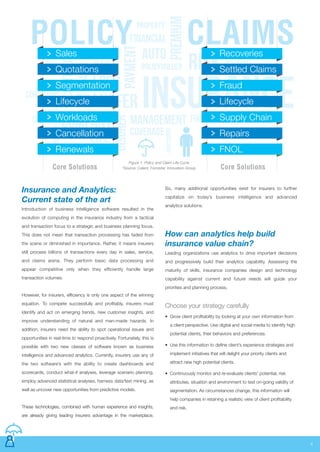
Figure 1: Policy and Claim Life Cycle
*Source: Celent, Forrester, Innovation Group
CLAIMSPOLICY
Core Solutions Core Solutions
Sales
Quotations
Segmentation
Lifecycle
Workloads
Cancellation
Renewals
Recoveries
Settled Claims
Fraud
Lifecycle
Supply Chain
Repairs
FNOL
• Mine data in a risky environment to understand how market and
credit events are related and use it for funding plan and for
reducing emergency funding at punitive rates.
Develop highly relevant and attractive products
and service offerings
• Use client insight to develop highly relevant and attractive
products and product bundles for specific customer segments
or individual customers. Along with these products,
organizations must develop an effective pricing strategy to
maximize delicate risk reward balance.
• Harness more sophisticated, risk-based pricing to introduce
products that otherwise would have been too risky to develop at
the right price.
Generate quality leads
• Embed intelligence about your clients in your distribution
strategy to generate quality leads. This should be performed for
clients that have a high propensity to buy and determine the
most effective distribution channel that cost effectively captures
their business.
• Improve your risk culture by profiling employees for mismatches
in risk profile required by the role.
• Identify and monitor leading risk and profitability indicators
across distribution network to detect poor selling practices. It will
help to refine your distribution strategy.
Track client behavior
• Build digital records about your clients, their behaviors and
preferences to develop effective loyalty programs and retention
strategies. These digital records will make it difficult for other
insurers to attract your highly valued clients
5
Best Practices for leveraging
business analytics in
insurance sector
Profitable growth is an elusive goal in today’s increasingly
competitive insurance industry. Rapid development and
deployment of new products and its features, balancing broader
distribution channel opportunities, managing risks across
organization, responding to regulatory and reporting agency
demands, and providing precise pricing levels require effective
decisions to be made with greater accuracy, efficiency and
transparency. Personal experience is often insufficient in making
consistent, accurate and effective decisions in line with rapidly
changing marketplace.
Leading organizations are increasingly turning to business
analytics for survival. Business analytics solutions are used by
insurers to reduce the time required to react to competitive
pressure, respond efficiently to market changes, increase
effectiveness of business managers in improving financial results
and driving value for organization, to more effectively managing
risks an enterprise face to improve precision and efficiency of
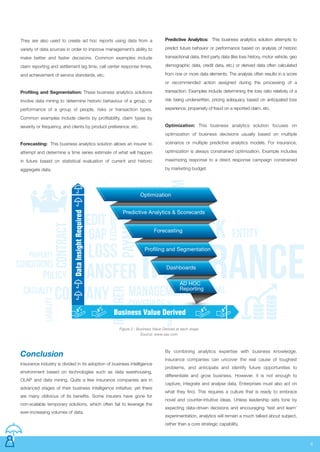
operational decisions. The primary forms of business analytics
used by the industry leaders include:
Ad Hoc Management Reporting and Dashboards: This
business analytics solution use analysis and reporting tools to provide
automatic feedback on achievement of key performance criteria.
• Analyze customer interactions and channel choices to improve
customer service and deliver new service to sale opportunities.
This data will also reveal opportunities to reduce cost by
eliminating services your clients do not value.
They are also used to create ad hoc reports using data from a
variety of data sources in order to improve management’s ability to
make better and faster decisions. Common examples include
claim reporting and settlement lag time, call center response times,
and achievement of service standards, etc.
Profiling and Segmentation: These business analytics solutions
involve data mining to determine historic behaviour of a group, or
performance of a group of people, risks or transaction types.
Common examples include clients by profitability, claim types by
severity or frequency, and clients by product preference, etc.
Forecasting: This business analytics solution allows an insurer to
attempt and determine a time series estimate of what will happen
in future based on statistical evaluation of current and historic
aggregate data.
6
Conclusion
Insurance industry is divided in its adoption of business intelligence
environment based on technologies such as data warehousing,
OLAP and data mining. Quite a few insurance companies are in
advanced stages of their business intelligence initiative; yet there
are many oblivious of its benefits. Some insurers have gone for
non-scalable temporary solutions, which often fail to leverage the
ever-increasing volumes of data.
Predictive Analytics: This business analytics solution attempts to
predict future behavior or performance based on analysis of historic
transactional data, third party data (like loss history, motor vehicle, geo
demographic data, credit data, etc.) or derived data often calculated
from one or more data elements. The analysis often results in a score
or recommended action assigned during the processing of a
transaction. Examples include determining the loss ratio relativity of a
risk being underwritten, pricing adequacy based on anticipated loss
experience, propensity of fraud on a reported claim, etc.
Optimization: This business analytics solution focuses on
optimization of business decisions usually based on multiple
scenarios or multiple predictive analytics models. For insurance,
optimization is always constrained optimization. Example includes
maximizing response to a direct response campaign constrained
by marketing budget.
DataInsightRequired
Business Value Derived
AD HOC
Reporting
Dashboards
Profiling and Segmentation
Forecasting
Predictive Analytics & Scorecards
Optimization
Figure 2 : Business Value Derived at each stage
Source: www.sas.com
By combining analytics expertise with business knowledge,
insurance companies can uncover the real cause of toughest
problems, and anticipate and identify future opportunities to
differentiate and grow business. However, it is not enough to
capture, integrate and analyse data. Enterprises must also act on
what they find. This requires a culture that is ready to embrace
novel and counter-intuitive ideas. Unless leadership sets tone by
expecting data-driven decisions and encouraging ‘test and learn’
experimentation, analytics will remain a much talked about subject,
rather than a core strategic capability.
D_54_200114
Write to us at marketing@niit-tech.com www.niit-tech.com
NIIT Technologies is a leading IT solutions organization, servicing customers in North America,
Europe, Asia and Australia. It offers services in Application Development and Maintenance,
Enterprise Solutions including Managed Services and Business Process Outsourcing to
organisations in the Financial Services, Travel & Transportation, Manufacturing/Distribution, and
Government sectors. With employees over 8,000 professionals, NIIT Technologies follows global
standards of software development processes.
Over the years the Company has forged extremely rewarding relationships with global majors, a
testimony to mutual commitment and its ability to retain marquee clients, drawing repeat
business from them. NIIT Technologies has been able to scale its interactions with marquee
clients in the BFSI sector, the Travel Transport & Logistics and Manufacturing & Distribution, into
extremely meaningful, multi-year "collaborations.
NIIT Technologies follows global standards of development, which include ISO 9001:2000
Certification, assessment at Level 5 for SEI-CMMi version 1.2 and ISO 27001 information
security management certification. Its data centre operations are assessed at the international
ISO 20000 IT management standards.
About NIIT Technologies
NIIT Technologies Limited
2nd
Floor, 47 Mark Lane
London - EC3R 7QQ, U.K.
Ph: +44 20 70020700
Fax: +44 20 70020701
Europe
NIIT Technologies Pte. Limited
31 Kaki Bukit Road 3
#05-13 Techlink
Singapore 417818
Ph: +65 68488300
Fax: +65 68488322
Singapore
India
NIIT Technologies Inc.,
1050 Crown Pointe Parkway
5th
Floor, Atlanta, GA 30338, USA
Ph: +1 770 551 9494
Toll Free: +1 888 454 NIIT
Fax: +1 770 551 9229
Americas
NIIT Technologies Ltd.
Corporate Heights (Tapasya)
Plot No. 5, EFGH, Sector 126
Noida-Greater Noida Expressway
Noida – 201301, U.P., India
Ph: + 91 120 7119100
Fax: + 91 120 7119150
A leading IT solutions organization | 21 locations and 16 countries | 8000 professionals | Level 5 of SEI-CMMi, ver1.2
ISO 27001 certified | Level 5 of People CMM Framework

Analytics in Insurance Value Chain

  • 1.
    www.niit-tech.com NIIT Technologies WhitePaper Analytics in Insurance Value ChainAnalytics in Insurance Value Chain Surekha Sugandhi Insurance Practice - Solution Architect
  • 2.
    CONTENTS Insurance Industry Overviewand Major Trends 3 Business Intelligence and Insurance Value Chain 3 Insurance and Analytics: Current state of the art 4 How can analytics help build insurance value chain? 4 Best Practices for leveraging business analytics in insurance sector 5 Conclusion 6
  • 3.
    industry have exponentiallyincreased the importance and complexity of an effective business intelligence environment. Growing Consolidation: Consolidation is a major force altering the structure of the insurance industry, as insurers seek to create economies of scale and broaden their product portfolios. The aggregated value of mergers and acquisitions was $75.7 billion in 2010, up from $ 41.7 billion in 1999 and a mere $8.5 billion in 1993. Convergence of Financial Services: Mergers and acquisitions involving insurance companies and financial service providers, such as banks have led to the emergence of integrated financial services companies. New Distribution Channels: New distribution channels are fast catching up with traditional insurance agents. These channels, though, not a major threat, are rapidly changing the way insurers and clients interact with each other. Focus on Customer Relationship Management: The only viable strategy for insurers, today, is to focus on customer needs and serve them better. Clients have extremely differentiated needs with different profitability. Hence, an effective CRM strategy is the most vital component of an insurer's overall business strategy. Insurance Industry Overview and Major Trends Insurance industry is totally dependent on the ability to convert raw data into intelligence - about clients, markets, competitors, and business environment. Over the years, data processing technology has progressed phenomenally and tools such as data warehousing, OLAP and data mining that constitute the cornerstone of an effective Business Intelligence (BI) environment are today widely accepted across industries. However, insurance companies have been relatively slow in adopting these tools, primarily because of protective regulations. Now they can no longer afford to be complacent as the Internet, deregulation, consolidation, and convergence of insurance with other financial services are fast changing the basics. The insurance industry is quite diverse in terms of product portfolio offered by different companies. These can be broadly classified into two product lines: Property and Casualty (P&C) and Life Insurance. Life insurance product line can be further sub-divided into life insurance, health insurance and annuity products. Growing consolidation and changes in regulatory framework have forced insurers to add new products to their portfolio. These changes have presented its own unique challenge of leveraging its greatest asset - data. A number of other trends in the insurance Business Intelligence and Insurance Value Chain In the last three decades, insurance companies have acquired significant product development capabilities. However, they failed to truly understand clients’ needs and demands. This led most firms to rather develop products that they could manage than, those their clients required. Moreover, during the last few years, deregulation and growing competition have forced insurance companies to move from traditional product-centric operations to customer-centric operations. 3 Analytics is a two-sided coin. While on one side, it uses descriptive and predictive models to gain valuable knowledge from data, i.e. data analysis, on the other side, it provides insight to recommend action or guide decision making, i.e. communication. Thus, analytics is not much about individual analyses or analysis steps as it is about the entire methodology. Today, there is a pronounced tendency to use the term analytics in business settings e.g. text analytics vs. generic text mining to emphasize this broader perspective.
  • 4.
    4 Insurance and Analytics: Currentstate of the art Introduction of business intelligence software resulted in the evolution of computing in the insurance industry from a tactical and transaction focus to a strategic and business planning focus. This does not mean that transaction processing has faded from the scene or diminished in importance. Rather, it means insurers still process billions of transactions every day in sales, service, and claims arena. They perform basic data processing and appear competitive only when they efficiently handle large transaction volumes. However, for insurers, efficiency is only one aspect of the winning equation. To compete successfully and profitably, insurers must identify and act on emerging trends, new customer insights, and improve understanding of natural and man-made hazards. In addition, insurers need the ability to spot operational issues and opportunities in real-time to respond proactively. Fortunately, this is possible with two new classes of software known as business intelligence and advanced analytics. Currently, insurers use any of the two software’s with the ability to create dashboards and scorecards, conduct what-if analyses, leverage scenario planning, employ advanced statistical analyses, harness data/text mining, as well as uncover new opportunities from predictive models. These technologies, combined with human experience and insights, are already giving leading insurers advantage in the marketplace. How can analytics help build insurance value chain? Leading organizations use analytics to drive important decisions and progressively build their analytics capability. Assessing the maturity of skills, insurance companies design and technology capability against current and future needs will guide your priorities and planning process. Choose your strategy carefully • Grow client profitability by looking at your own information from a client perspective. Use digital and social media to identify high potential clients, their behaviors and preferences. • Use this information to define client’s experience strategies and implement initiatives that will delight your priority clients and attract new high potential clients. • Continuously monitor and re-evaluate clients’ potential, risk attributes, situation and environment to test on-going validity of segmentation. As circumstances change, this information will help companies in retaining a realistic view of client profitability and risk. So, many additional opportunities exist for insurers to further capitalize on today’s business intelligence and advanced analytics solutions. Figure 1: Policy and Claim Life Cycle *Source: Celent, Forrester, Innovation Group CLAIMSPOLICY Core Solutions Core Solutions Sales Quotations Segmentation Lifecycle Workloads Cancellation Renewals Recoveries Settled Claims Fraud Lifecycle Supply Chain Repairs FNOL
  • 5.
    • Mine datain a risky environment to understand how market and credit events are related and use it for funding plan and for reducing emergency funding at punitive rates. Develop highly relevant and attractive products and service offerings • Use client insight to develop highly relevant and attractive products and product bundles for specific customer segments or individual customers. Along with these products, organizations must develop an effective pricing strategy to maximize delicate risk reward balance. • Harness more sophisticated, risk-based pricing to introduce products that otherwise would have been too risky to develop at the right price. Generate quality leads • Embed intelligence about your clients in your distribution strategy to generate quality leads. This should be performed for clients that have a high propensity to buy and determine the most effective distribution channel that cost effectively captures their business. • Improve your risk culture by profiling employees for mismatches in risk profile required by the role. • Identify and monitor leading risk and profitability indicators across distribution network to detect poor selling practices. It will help to refine your distribution strategy. Track client behavior • Build digital records about your clients, their behaviors and preferences to develop effective loyalty programs and retention strategies. These digital records will make it difficult for other insurers to attract your highly valued clients 5 Best Practices for leveraging business analytics in insurance sector Profitable growth is an elusive goal in today’s increasingly competitive insurance industry. Rapid development and deployment of new products and its features, balancing broader distribution channel opportunities, managing risks across organization, responding to regulatory and reporting agency demands, and providing precise pricing levels require effective decisions to be made with greater accuracy, efficiency and transparency. Personal experience is often insufficient in making consistent, accurate and effective decisions in line with rapidly changing marketplace. Leading organizations are increasingly turning to business analytics for survival. Business analytics solutions are used by insurers to reduce the time required to react to competitive pressure, respond efficiently to market changes, increase effectiveness of business managers in improving financial results and driving value for organization, to more effectively managing risks an enterprise face to improve precision and efficiency of operational decisions. The primary forms of business analytics used by the industry leaders include: Ad Hoc Management Reporting and Dashboards: This business analytics solution use analysis and reporting tools to provide automatic feedback on achievement of key performance criteria. • Analyze customer interactions and channel choices to improve customer service and deliver new service to sale opportunities. This data will also reveal opportunities to reduce cost by eliminating services your clients do not value.
  • 6.
    They are alsoused to create ad hoc reports using data from a variety of data sources in order to improve management’s ability to make better and faster decisions. Common examples include claim reporting and settlement lag time, call center response times, and achievement of service standards, etc. Profiling and Segmentation: These business analytics solutions involve data mining to determine historic behaviour of a group, or performance of a group of people, risks or transaction types. Common examples include clients by profitability, claim types by severity or frequency, and clients by product preference, etc. Forecasting: This business analytics solution allows an insurer to attempt and determine a time series estimate of what will happen in future based on statistical evaluation of current and historic aggregate data. 6 Conclusion Insurance industry is divided in its adoption of business intelligence environment based on technologies such as data warehousing, OLAP and data mining. Quite a few insurance companies are in advanced stages of their business intelligence initiative; yet there are many oblivious of its benefits. Some insurers have gone for non-scalable temporary solutions, which often fail to leverage the ever-increasing volumes of data. Predictive Analytics: This business analytics solution attempts to predict future behavior or performance based on analysis of historic transactional data, third party data (like loss history, motor vehicle, geo demographic data, credit data, etc.) or derived data often calculated from one or more data elements. The analysis often results in a score or recommended action assigned during the processing of a transaction. Examples include determining the loss ratio relativity of a risk being underwritten, pricing adequacy based on anticipated loss experience, propensity of fraud on a reported claim, etc. Optimization: This business analytics solution focuses on optimization of business decisions usually based on multiple scenarios or multiple predictive analytics models. For insurance, optimization is always constrained optimization. Example includes maximizing response to a direct response campaign constrained by marketing budget. DataInsightRequired Business Value Derived AD HOC Reporting Dashboards Profiling and Segmentation Forecasting Predictive Analytics & Scorecards Optimization Figure 2 : Business Value Derived at each stage Source: www.sas.com By combining analytics expertise with business knowledge, insurance companies can uncover the real cause of toughest problems, and anticipate and identify future opportunities to differentiate and grow business. However, it is not enough to capture, integrate and analyse data. Enterprises must also act on what they find. This requires a culture that is ready to embrace novel and counter-intuitive ideas. Unless leadership sets tone by expecting data-driven decisions and encouraging ‘test and learn’ experimentation, analytics will remain a much talked about subject, rather than a core strategic capability.
  • 7.
    D_54_200114 Write to usat marketing@niit-tech.com www.niit-tech.com NIIT Technologies is a leading IT solutions organization, servicing customers in North America, Europe, Asia and Australia. It offers services in Application Development and Maintenance, Enterprise Solutions including Managed Services and Business Process Outsourcing to organisations in the Financial Services, Travel & Transportation, Manufacturing/Distribution, and Government sectors. With employees over 8,000 professionals, NIIT Technologies follows global standards of software development processes. Over the years the Company has forged extremely rewarding relationships with global majors, a testimony to mutual commitment and its ability to retain marquee clients, drawing repeat business from them. NIIT Technologies has been able to scale its interactions with marquee clients in the BFSI sector, the Travel Transport & Logistics and Manufacturing & Distribution, into extremely meaningful, multi-year "collaborations. NIIT Technologies follows global standards of development, which include ISO 9001:2000 Certification, assessment at Level 5 for SEI-CMMi version 1.2 and ISO 27001 information security management certification. Its data centre operations are assessed at the international ISO 20000 IT management standards. About NIIT Technologies NIIT Technologies Limited 2nd Floor, 47 Mark Lane London - EC3R 7QQ, U.K. Ph: +44 20 70020700 Fax: +44 20 70020701 Europe NIIT Technologies Pte. Limited 31 Kaki Bukit Road 3 #05-13 Techlink Singapore 417818 Ph: +65 68488300 Fax: +65 68488322 Singapore India NIIT Technologies Inc., 1050 Crown Pointe Parkway 5th Floor, Atlanta, GA 30338, USA Ph: +1 770 551 9494 Toll Free: +1 888 454 NIIT Fax: +1 770 551 9229 Americas NIIT Technologies Ltd. Corporate Heights (Tapasya) Plot No. 5, EFGH, Sector 126 Noida-Greater Noida Expressway Noida – 201301, U.P., India Ph: + 91 120 7119100 Fax: + 91 120 7119150 A leading IT solutions organization | 21 locations and 16 countries | 8000 professionals | Level 5 of SEI-CMMi, ver1.2 ISO 27001 certified | Level 5 of People CMM Framework