Programming with OpenGL
Part 3: Three Dimensions
1
Objectives
• Develop a more sophisticated three-dimensional example
• Sierpinski gasket: a fractal
• Introduce hidden-surface removal
2
Three-dimensional Applications
• In OpenGL, two-dimensional applications are a special case of three-
dimensional graphics
• Going to 3D
• Not much changes
• Use glVertex3*( )
• Have to worry about the order in which polygons are drawn or use hidden-
surface removal
• Polygons should be simple, convex, flat
3
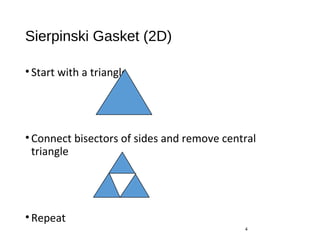
Sierpinski Gasket (2D)
•Start with a triangle
•Connect bisectors of sides and remove central
triangle
•Repeat
4
Example
• Five subdivisions
5
The gasket as a fractal
• Consider the filled area (black) and the perimeter (the length of all the
lines around the filled triangles)
• As we continue subdividing
• the area goes to zero
• but the perimeter goes to infinity
• This is not an ordinary geometric object
• It is neither two- nor three-dimensional
• It is a fractal (fractional dimension) object
6
Gasket Program
#include <GL/glut.h>
/* initial triangle */
GLfloat v[3][2]={{-1.0, -0.58},
{1.0, -0.58}, {0.0, 1.15}};
int n; /* number of recursive steps */
7
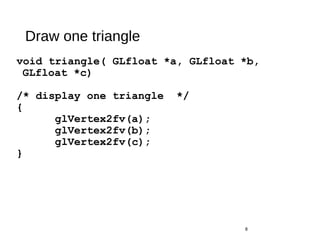
Draw one triangle
void triangle( GLfloat *a, GLfloat *b,
GLfloat *c)
/* display one triangle */
{
glVertex2fv(a);
glVertex2fv(b);
glVertex2fv(c);
}
8
Triangle Subdivision
void divide_triangle(GLfloat *a, GLfloat *b, GLfloat *c,
int m)
{
/* triangle subdivision using vertex numbers */
point2 v0, v1, v2;
int j;
if(m>0)
{
for(j=0; j<2; j++) v0[j]=(a[j]+b[j])/2;
for(j=0; j<2; j++) v1[j]=(a[j]+c[j])/2;
for(j=0; j<2; j++) v2[j]=(b[j]+c[j])/2;
divide_triangle(a, v0, v1, m-1);
divide_triangle(c, v1, v2, m-1);
divide_triangle(b, v2, v0, m-1);
}
else(triangle(a,b,c));
/* draw triangle at end of recursion */
}
9
display and init Functions
void display()
{
glClear(GL_COLOR_BUFFER_BIT);
glBegin(GL_TRIANGLES);
divide_triangle(v[0], v[1], v[2], n);
glEnd();
glFlush();
}
void myinit()
{
glMatrixMode(GL_PROJECTION);
glLoadIdentity();
gluOrtho2D(-2.0, 2.0, -2.0, 2.0);
glMatrixMode(GL_MODELVIEW);
glClearColor (1.0, 1.0, 1.0,1.0)
glColor3f(0.0,0.0,0.0);
}
10
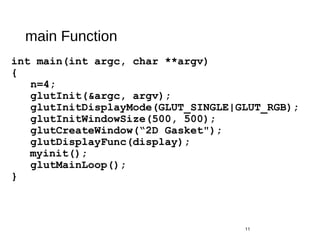
main Function
int main(int argc, char **argv)
{
n=4;
glutInit(&argc, argv);
glutInitDisplayMode(GLUT_SINGLE|GLUT_RGB);
glutInitWindowSize(500, 500);
glutCreateWindow(“2D Gasket");
glutDisplayFunc(display);
myinit();
glutMainLoop();
}
11
Efficiency Note
By having the glBegin and glEnd in the display callback rather than
in the function triangle and using GL_TRIANGLES rather than
GL_POLYGON in glBegin, we call glBegin and glEnd only
once for the entire gasket rather than once for each triangle
12
Moving to 3D
• We can easily make the program three-dimensional by using
GLfloat v[3][3]
glVertex3f
glOrtho
• But that would not be very interesting
• Instead, we can start with a tetrahedron
13
3D Gasket
• We can subdivide each of the four faces
• Appears as if we remove a solid tetrahedron from the center leaving
four smaller tetrahedra
14
Example
15
after 5 iterations
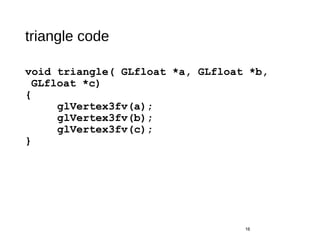
triangle code
void triangle( GLfloat *a, GLfloat *b,
GLfloat *c)
{
glVertex3fv(a);
glVertex3fv(b);
glVertex3fv(c);
}
16
subdivision code
void divide_triangle(GLfloat *a, GLfloat *b,
GLfloat *c, int m)
{
GLfloat v1[3], v2[3], v3[3];
int j;
if(m>0)
{
for(j=0; j<3; j++) v1[j]=(a[j]+b[j])/2;
for(j=0; j<3; j++) v2[j]=(a[j]+c[j])/2;
for(j=0; j<3; j++) v3[j]=(b[j]+c[j])/2;
divide_triangle(a, v1, v2, m-1);
divide_triangle(c, v2, v3, m-1);
divide_triangle(b, v3, v1, m-1);
}
else(triangle(a,b,c));
}
17
tetrahedron code
void tetrahedron( int m)
{
glColor3f(1.0,0.0,0.0);
divide_triangle(v[0], v[1], v[2], m);
glColor3f(0.0,1.0,0.0);
divide_triangle(v[3], v[2], v[1], m);
glColor3f(0.0,0.0,1.0);
divide_triangle(v[0], v[3], v[1], m);
glColor3f(0.0,0.0,0.0);
divide_triangle(v[0], v[2], v[3], m);
}
18
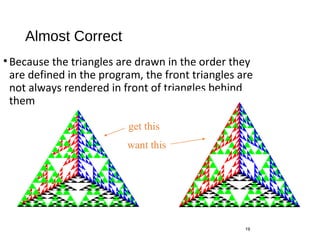
Almost Correct
19
•Because the triangles are drawn in the order they
are defined in the program, the front triangles are
not always rendered in front of triangles behind
them
get this
want this
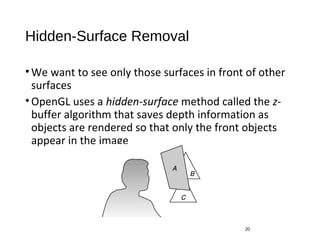
Hidden-Surface Removal
•We want to see only those surfaces in front of other
surfaces
•OpenGL uses a hidden-surface method called the z-
buffer algorithm that saves depth information as
objects are rendered so that only the front objects
appear in the image
20
Using the z-buffer algorithm
• The algorithm uses an extra buffer, the z-buffer, to store
depth information as geometry travels down the pipeline
• It must be
• Requested in main.c
• glutInitDisplayMode
(GLUT_SINGLE | GLUT_RGB | GLUT_DEPTH)
• Enabled in init.c
• glEnable(GL_DEPTH_TEST)
• Cleared in the display callback
• glClear(GL_COLOR_BUFFER_BIT |
GL_DEPTH_BUFFER_BIT)
21
Surface vs Volume Subdvision
• In our example, we divided the surface of each face
• We could also divide the volume using the same midpoints
• The midpoints define four smaller tetrahedrons, one for each vertex
• Keeping only these tetrahedrons removes a volume in the middle
• See text for code
22
Volume Subdivision
23

Programming with OpenGL

  • 1.
    Programming with OpenGL Part3: Three Dimensions 1
  • 2.
    Objectives • Develop amore sophisticated three-dimensional example • Sierpinski gasket: a fractal • Introduce hidden-surface removal 2
  • 3.
    Three-dimensional Applications • InOpenGL, two-dimensional applications are a special case of three- dimensional graphics • Going to 3D • Not much changes • Use glVertex3*( ) • Have to worry about the order in which polygons are drawn or use hidden- surface removal • Polygons should be simple, convex, flat 3
  • 4.
    Sierpinski Gasket (2D) •Startwith a triangle •Connect bisectors of sides and remove central triangle •Repeat 4
  • 5.
  • 6.
    The gasket asa fractal • Consider the filled area (black) and the perimeter (the length of all the lines around the filled triangles) • As we continue subdividing • the area goes to zero • but the perimeter goes to infinity • This is not an ordinary geometric object • It is neither two- nor three-dimensional • It is a fractal (fractional dimension) object 6
  • 7.
    Gasket Program #include <GL/glut.h> /*initial triangle */ GLfloat v[3][2]={{-1.0, -0.58}, {1.0, -0.58}, {0.0, 1.15}}; int n; /* number of recursive steps */ 7
  • 8.
    Draw one triangle voidtriangle( GLfloat *a, GLfloat *b, GLfloat *c) /* display one triangle */ { glVertex2fv(a); glVertex2fv(b); glVertex2fv(c); } 8
  • 9.
    Triangle Subdivision void divide_triangle(GLfloat*a, GLfloat *b, GLfloat *c, int m) { /* triangle subdivision using vertex numbers */ point2 v0, v1, v2; int j; if(m>0) { for(j=0; j<2; j++) v0[j]=(a[j]+b[j])/2; for(j=0; j<2; j++) v1[j]=(a[j]+c[j])/2; for(j=0; j<2; j++) v2[j]=(b[j]+c[j])/2; divide_triangle(a, v0, v1, m-1); divide_triangle(c, v1, v2, m-1); divide_triangle(b, v2, v0, m-1); } else(triangle(a,b,c)); /* draw triangle at end of recursion */ } 9
  • 10.
    display and initFunctions void display() { glClear(GL_COLOR_BUFFER_BIT); glBegin(GL_TRIANGLES); divide_triangle(v[0], v[1], v[2], n); glEnd(); glFlush(); } void myinit() { glMatrixMode(GL_PROJECTION); glLoadIdentity(); gluOrtho2D(-2.0, 2.0, -2.0, 2.0); glMatrixMode(GL_MODELVIEW); glClearColor (1.0, 1.0, 1.0,1.0) glColor3f(0.0,0.0,0.0); } 10
  • 11.
    main Function int main(intargc, char **argv) { n=4; glutInit(&argc, argv); glutInitDisplayMode(GLUT_SINGLE|GLUT_RGB); glutInitWindowSize(500, 500); glutCreateWindow(“2D Gasket"); glutDisplayFunc(display); myinit(); glutMainLoop(); } 11
  • 12.
    Efficiency Note By havingthe glBegin and glEnd in the display callback rather than in the function triangle and using GL_TRIANGLES rather than GL_POLYGON in glBegin, we call glBegin and glEnd only once for the entire gasket rather than once for each triangle 12
  • 13.
    Moving to 3D •We can easily make the program three-dimensional by using GLfloat v[3][3] glVertex3f glOrtho • But that would not be very interesting • Instead, we can start with a tetrahedron 13
  • 14.
    3D Gasket • Wecan subdivide each of the four faces • Appears as if we remove a solid tetrahedron from the center leaving four smaller tetrahedra 14
  • 15.
  • 16.
    triangle code void triangle(GLfloat *a, GLfloat *b, GLfloat *c) { glVertex3fv(a); glVertex3fv(b); glVertex3fv(c); } 16
  • 17.
    subdivision code void divide_triangle(GLfloat*a, GLfloat *b, GLfloat *c, int m) { GLfloat v1[3], v2[3], v3[3]; int j; if(m>0) { for(j=0; j<3; j++) v1[j]=(a[j]+b[j])/2; for(j=0; j<3; j++) v2[j]=(a[j]+c[j])/2; for(j=0; j<3; j++) v3[j]=(b[j]+c[j])/2; divide_triangle(a, v1, v2, m-1); divide_triangle(c, v2, v3, m-1); divide_triangle(b, v3, v1, m-1); } else(triangle(a,b,c)); } 17
  • 18.
    tetrahedron code void tetrahedron(int m) { glColor3f(1.0,0.0,0.0); divide_triangle(v[0], v[1], v[2], m); glColor3f(0.0,1.0,0.0); divide_triangle(v[3], v[2], v[1], m); glColor3f(0.0,0.0,1.0); divide_triangle(v[0], v[3], v[1], m); glColor3f(0.0,0.0,0.0); divide_triangle(v[0], v[2], v[3], m); } 18
  • 19.
    Almost Correct 19 •Because thetriangles are drawn in the order they are defined in the program, the front triangles are not always rendered in front of triangles behind them get this want this
  • 20.
    Hidden-Surface Removal •We wantto see only those surfaces in front of other surfaces •OpenGL uses a hidden-surface method called the z- buffer algorithm that saves depth information as objects are rendered so that only the front objects appear in the image 20
  • 21.
    Using the z-bufferalgorithm • The algorithm uses an extra buffer, the z-buffer, to store depth information as geometry travels down the pipeline • It must be • Requested in main.c • glutInitDisplayMode (GLUT_SINGLE | GLUT_RGB | GLUT_DEPTH) • Enabled in init.c • glEnable(GL_DEPTH_TEST) • Cleared in the display callback • glClear(GL_COLOR_BUFFER_BIT | GL_DEPTH_BUFFER_BIT) 21
  • 22.
    Surface vs VolumeSubdvision • In our example, we divided the surface of each face • We could also divide the volume using the same midpoints • The midpoints define four smaller tetrahedrons, one for each vertex • Keeping only these tetrahedrons removes a volume in the middle • See text for code 22
  • 23.