PROGRAM 1
Program to recursively subdivide a tetrahedron to
form 3D Sierpinski gasket. The number of recursive
steps is to be specified by the user.
3D Sierpinski gasket
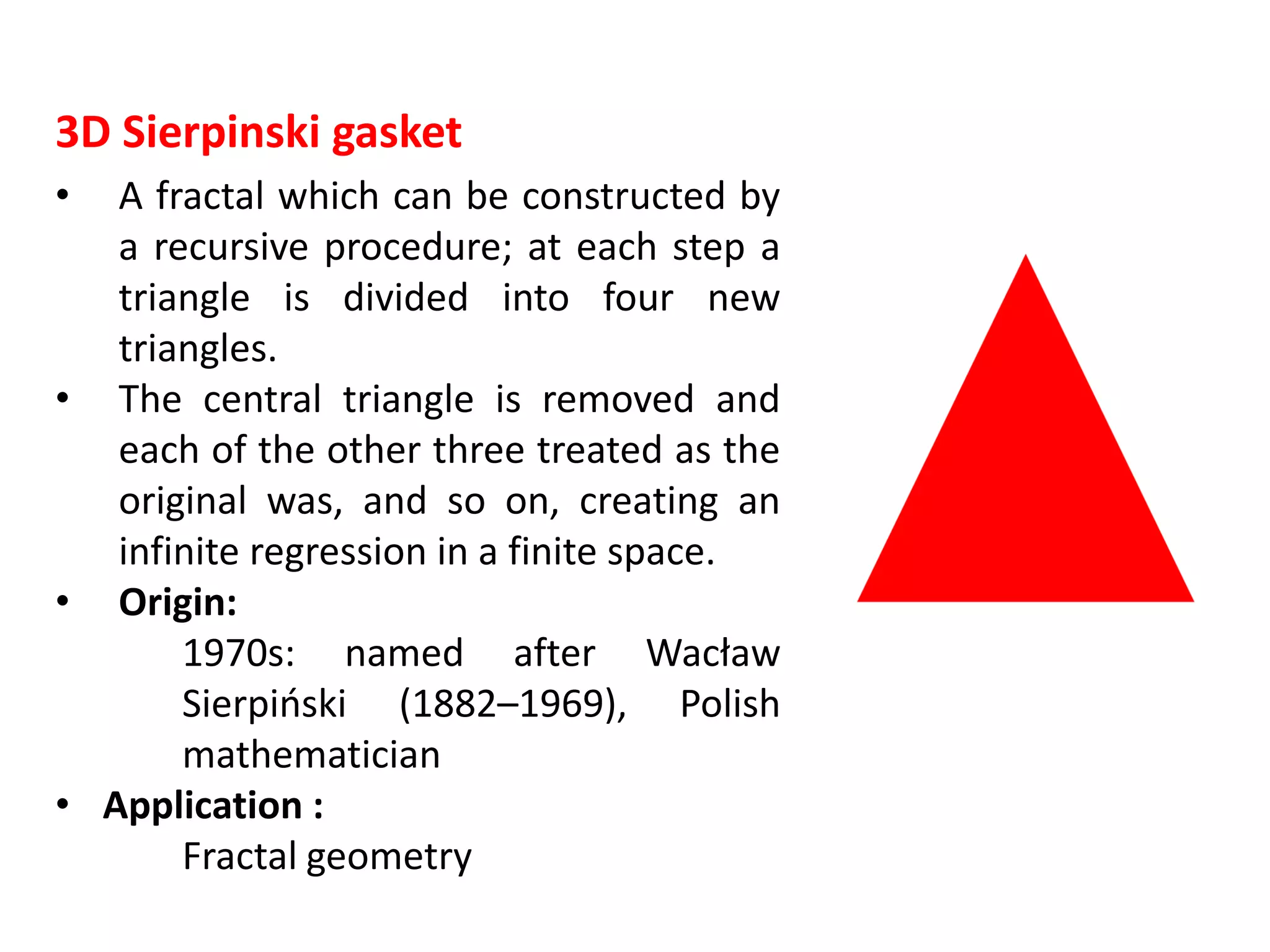
• A fractal which can be constructed by
a recursive procedure; at each step a
triangle is divided into four new
triangles.
• The central triangle is removed and
each of the other three treated as the
original was, and so on, creating an
infinite regression in a finite space.
• Origin:
1970s: named after Wacław
Sierpiński (1882–1969), Polish
mathematician
• Application :
Fractal geometry
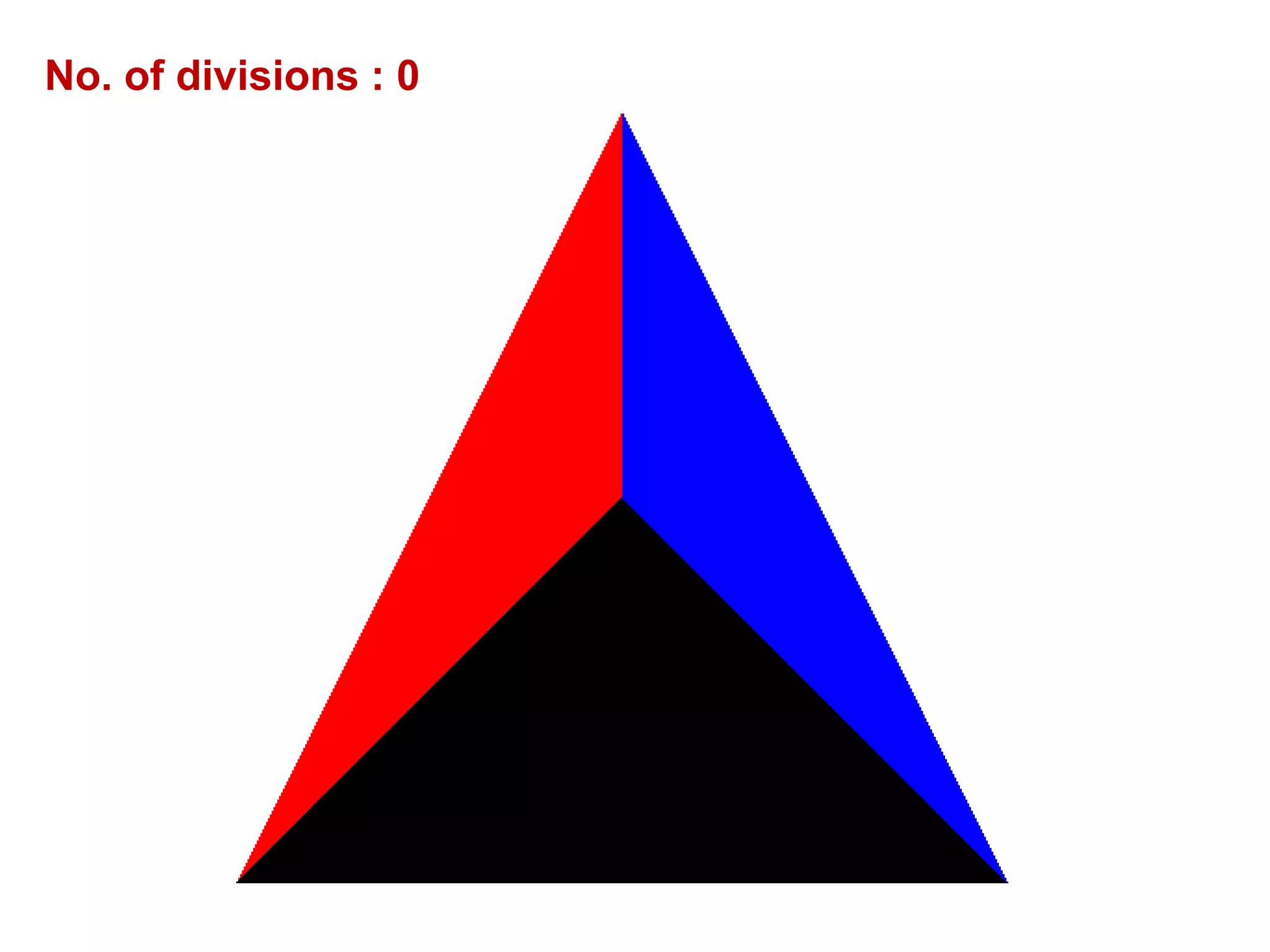
No. of divisions : 0
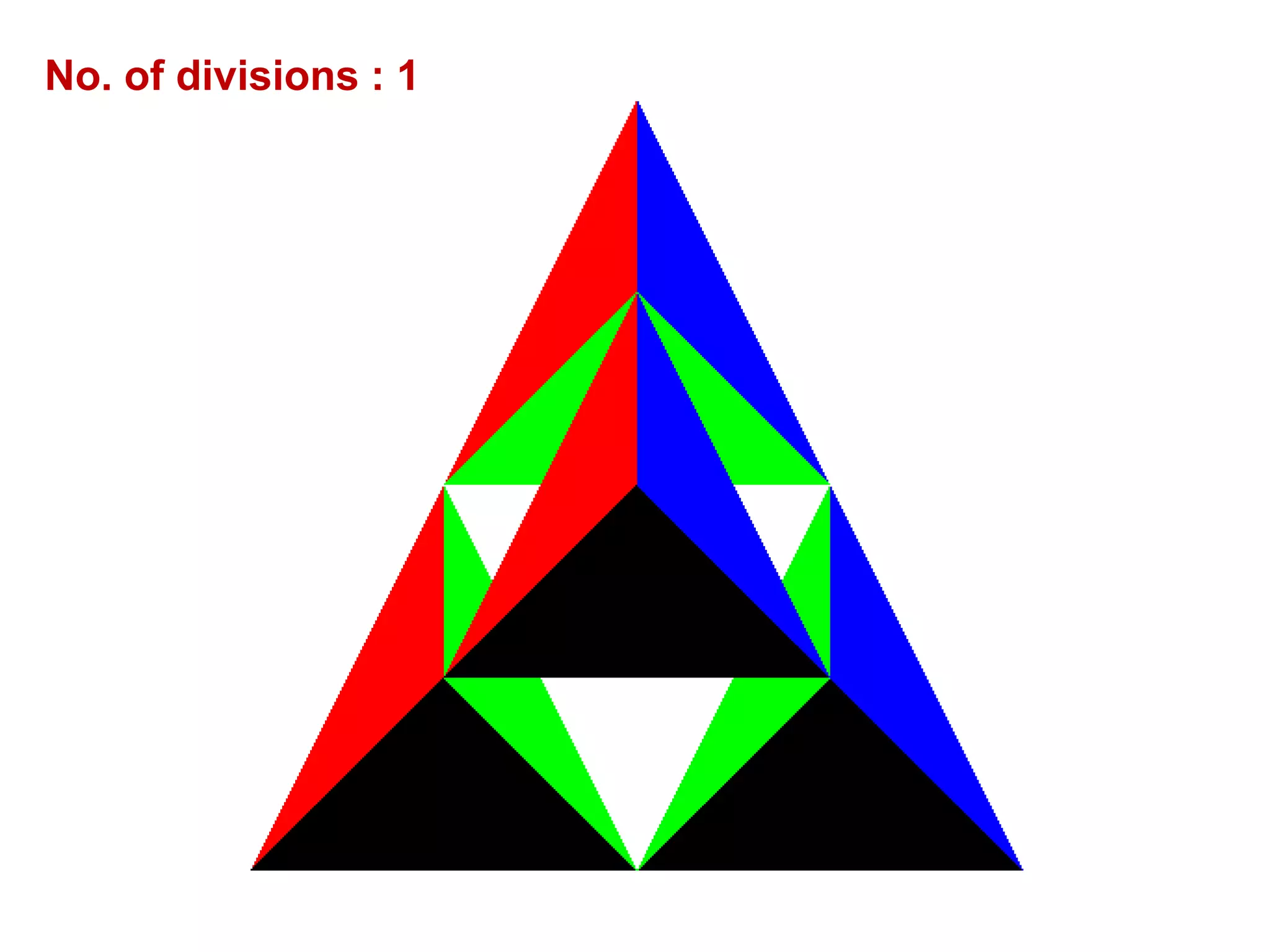
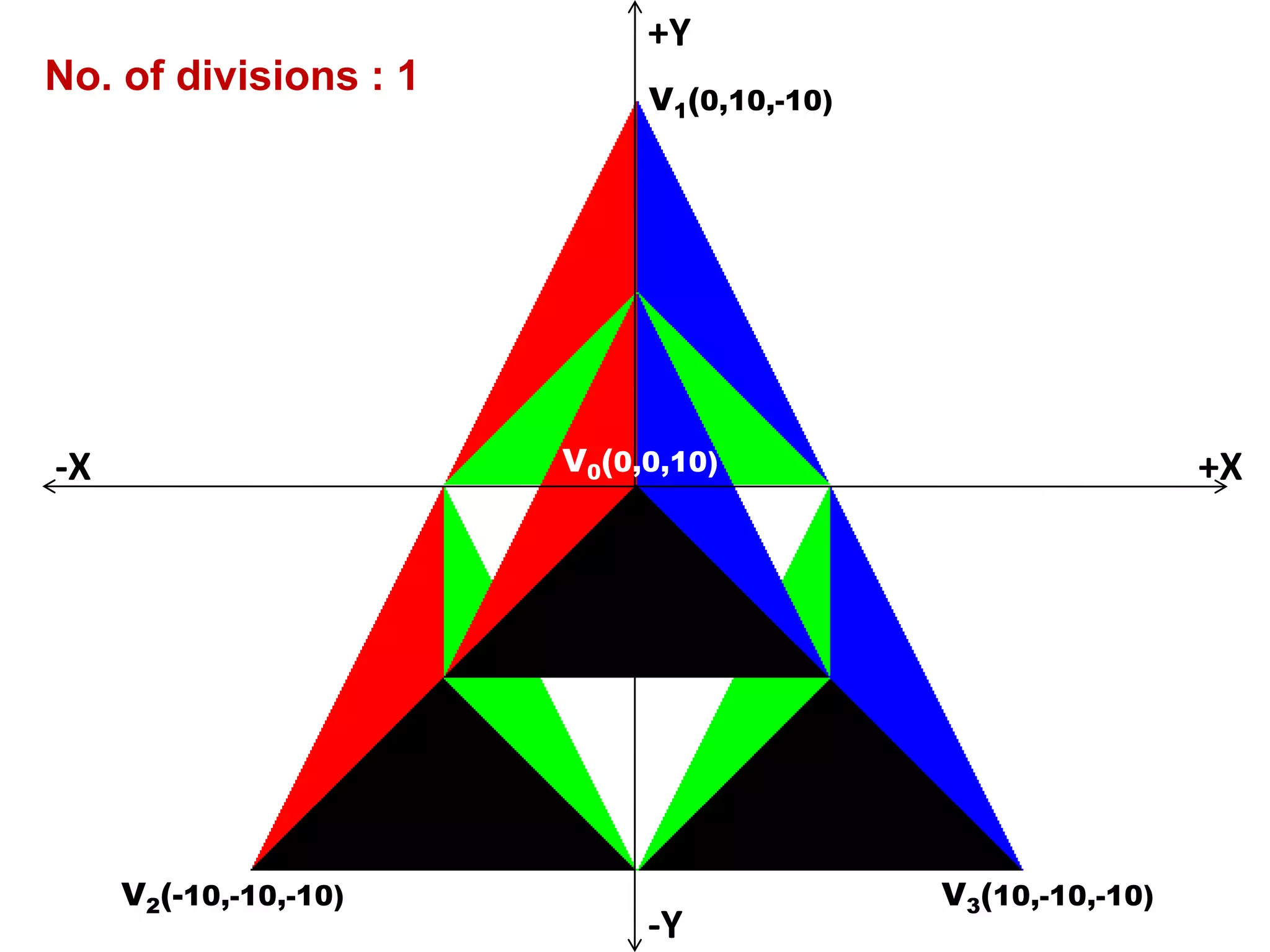
No. of divisions : 1
V0(0,0,10)
V1(0,10,-10)
V2(-10,-10,-10) V3(10,-10,-10)
-X +X
-Y
+Y
No. of divisions : 1
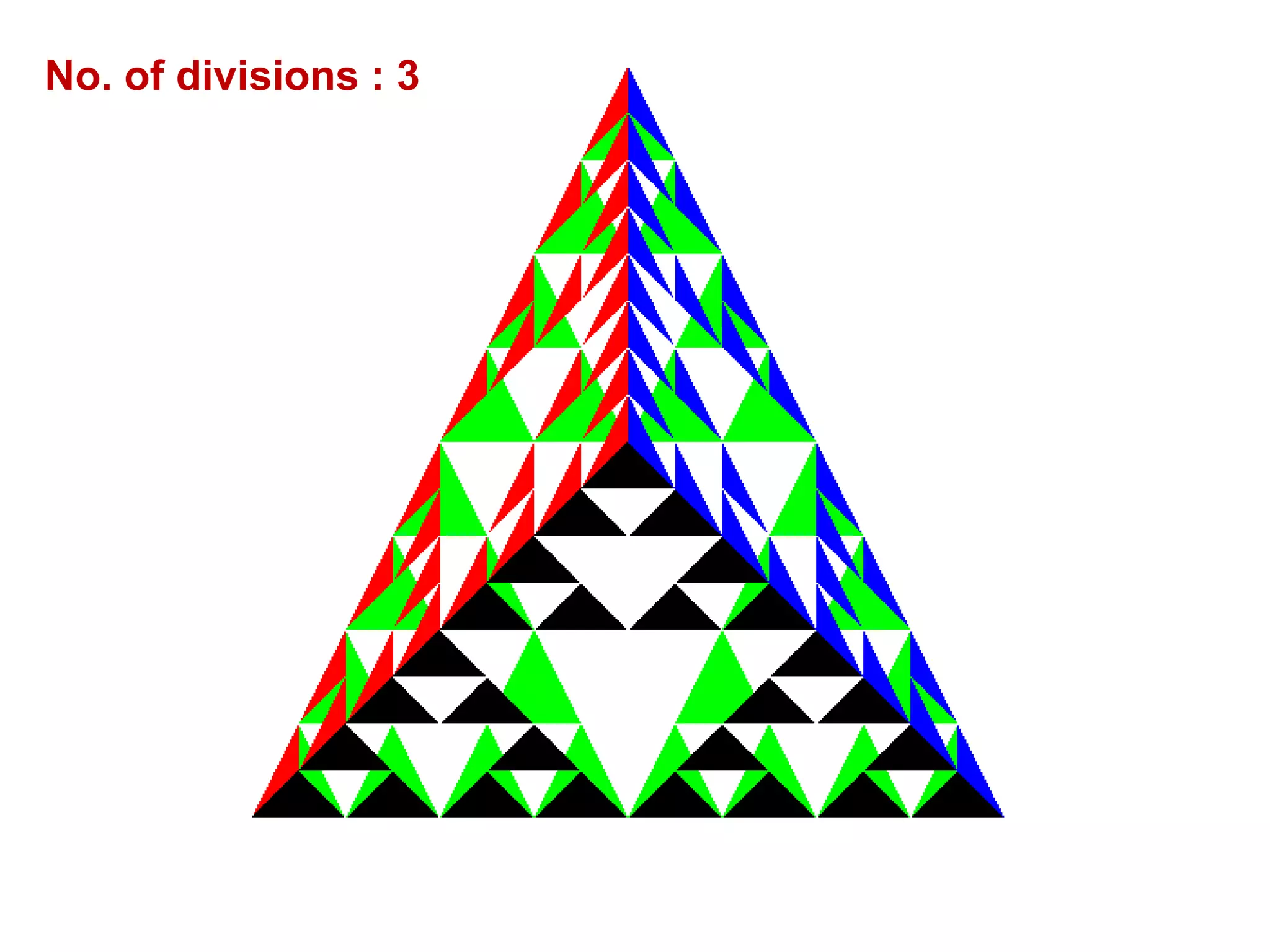
No. of divisions : 3
#include <stdio.h>
#include <GL/glut.h>
typedef float point[3];
/* initial tetrahedron */
point v[4] = { {0.0, 0.0, 10.0}, {0.0, 10.0, -10.0},
{-10.0, -10.0, -10.0}, {10.0, -10.0, -10.0}
};
int n;
/* display one triangle */
void triangle( point a, point b, point c)
{ glBegin(GL_POLYGON);
glVertex3fv(a);
glVertex3fv(b);
glVertex3fv(c);
glEnd();
}
/* triangle subdivision */
void divide_triangle(point a, point b, point c, int m)
{
point p1, p2, p3;
int i;
if(m>0)
{
for(i=0; i<3; i++) p1[i]=(a[i]+b[i])/2;
for(i=0; i<3; i++) p2[i]=(a[i]+c[i])/2;
for(i=0; i<3; i++) p3[i]=(b[i]+c[i])/2;
divide_triangle(a, p1, p2, m-1);
divide_triangle(c, p2, p3, m-1);
divide_triangle(b, p3, p1, m-1);
}
else
triangle(a,b,c); /* draw triangle at end of recursion */
}
/* Apply triangle subdivision to faces of tetrahedron */
void tetrahedron( int m)
{
glColor3f(1.0,0.0,0.0);
divide_triangle(v[0], v[1], v[2], m);
glColor3f(0.0,1.0,0.0);
divide_triangle(v[3], v[2], v[1], m);
glColor3f(0.0,0.0,1.0);
divide_triangle(v[0], v[3], v[1], m);
glColor3f(0.0,0.0,0.0);
divide_triangle(v[0], v[2], v[3], m);
}
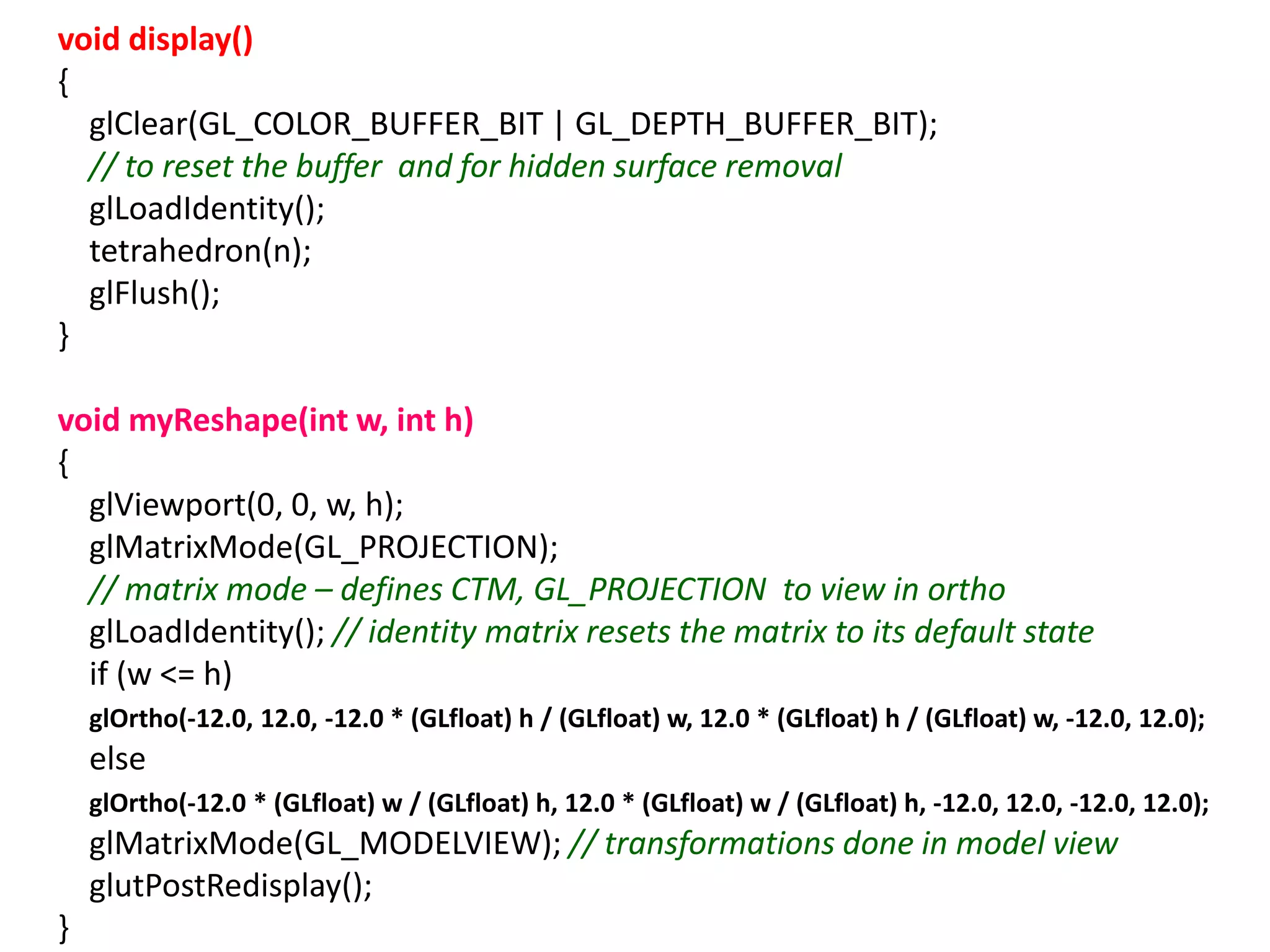
void display()
{
glClear(GL_COLOR_BUFFER_BIT | GL_DEPTH_BUFFER_BIT);
// to reset the buffer and for hidden surface removal
glLoadIdentity();
tetrahedron(n);
glFlush();
}
void myReshape(int w, int h)
{
glViewport(0, 0, w, h);
glMatrixMode(GL_PROJECTION);
// matrix mode – defines CTM, GL_PROJECTION to view in ortho
glLoadIdentity(); // identity matrix resets the matrix to its default state
if (w <= h)
glOrtho(-12.0, 12.0, -12.0 * (GLfloat) h / (GLfloat) w, 12.0 * (GLfloat) h / (GLfloat) w, -12.0, 12.0);
else
glOrtho(-12.0 * (GLfloat) w / (GLfloat) h, 12.0 * (GLfloat) w / (GLfloat) h, -12.0, 12.0, -12.0, 12.0);
glMatrixMode(GL_MODELVIEW); // transformations done in model view
glutPostRedisplay();
}
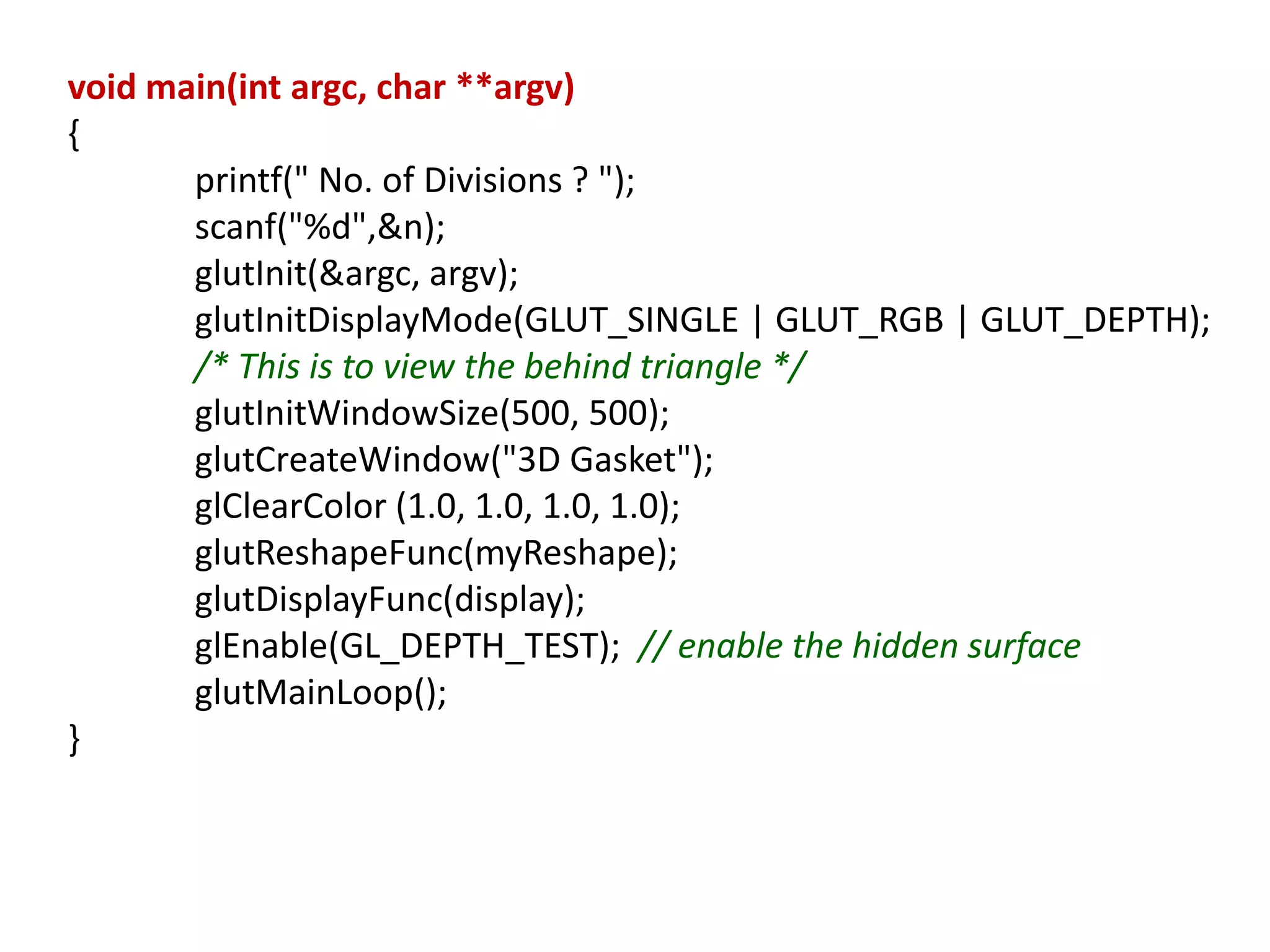
void main(int argc, char **argv)
{
printf(" No. of Divisions ? ");
scanf("%d",&n);
glutInit(&argc, argv);
glutInitDisplayMode(GLUT_SINGLE | GLUT_RGB | GLUT_DEPTH);
/* This is to view the behind triangle */
glutInitWindowSize(500, 500);
glutCreateWindow("3D Gasket");
glClearColor (1.0, 1.0, 1.0, 1.0);
glutReshapeFunc(myReshape);
glutDisplayFunc(display);
glEnable(GL_DEPTH_TEST); // enable the hidden surface
glutMainLoop();
}

10CSL67 CG LAB PROGRAM 1

  • 1.
    PROGRAM 1 Program torecursively subdivide a tetrahedron to form 3D Sierpinski gasket. The number of recursive steps is to be specified by the user.
  • 2.
    3D Sierpinski gasket •A fractal which can be constructed by a recursive procedure; at each step a triangle is divided into four new triangles. • The central triangle is removed and each of the other three treated as the original was, and so on, creating an infinite regression in a finite space. • Origin: 1970s: named after Wacław Sierpiński (1882–1969), Polish mathematician • Application : Fractal geometry
  • 3.
  • 4.
  • 5.
  • 6.
  • 7.
    #include <stdio.h> #include <GL/glut.h> typedeffloat point[3]; /* initial tetrahedron */ point v[4] = { {0.0, 0.0, 10.0}, {0.0, 10.0, -10.0}, {-10.0, -10.0, -10.0}, {10.0, -10.0, -10.0} }; int n; /* display one triangle */ void triangle( point a, point b, point c) { glBegin(GL_POLYGON); glVertex3fv(a); glVertex3fv(b); glVertex3fv(c); glEnd(); }
  • 8.
    /* triangle subdivision*/ void divide_triangle(point a, point b, point c, int m) { point p1, p2, p3; int i; if(m>0) { for(i=0; i<3; i++) p1[i]=(a[i]+b[i])/2; for(i=0; i<3; i++) p2[i]=(a[i]+c[i])/2; for(i=0; i<3; i++) p3[i]=(b[i]+c[i])/2; divide_triangle(a, p1, p2, m-1); divide_triangle(c, p2, p3, m-1); divide_triangle(b, p3, p1, m-1); } else triangle(a,b,c); /* draw triangle at end of recursion */ }
  • 9.
    /* Apply trianglesubdivision to faces of tetrahedron */ void tetrahedron( int m) { glColor3f(1.0,0.0,0.0); divide_triangle(v[0], v[1], v[2], m); glColor3f(0.0,1.0,0.0); divide_triangle(v[3], v[2], v[1], m); glColor3f(0.0,0.0,1.0); divide_triangle(v[0], v[3], v[1], m); glColor3f(0.0,0.0,0.0); divide_triangle(v[0], v[2], v[3], m); }
  • 10.
    void display() { glClear(GL_COLOR_BUFFER_BIT |GL_DEPTH_BUFFER_BIT); // to reset the buffer and for hidden surface removal glLoadIdentity(); tetrahedron(n); glFlush(); } void myReshape(int w, int h) { glViewport(0, 0, w, h); glMatrixMode(GL_PROJECTION); // matrix mode – defines CTM, GL_PROJECTION to view in ortho glLoadIdentity(); // identity matrix resets the matrix to its default state if (w <= h) glOrtho(-12.0, 12.0, -12.0 * (GLfloat) h / (GLfloat) w, 12.0 * (GLfloat) h / (GLfloat) w, -12.0, 12.0); else glOrtho(-12.0 * (GLfloat) w / (GLfloat) h, 12.0 * (GLfloat) w / (GLfloat) h, -12.0, 12.0, -12.0, 12.0); glMatrixMode(GL_MODELVIEW); // transformations done in model view glutPostRedisplay(); }
  • 11.
    void main(int argc,char **argv) { printf(" No. of Divisions ? "); scanf("%d",&n); glutInit(&argc, argv); glutInitDisplayMode(GLUT_SINGLE | GLUT_RGB | GLUT_DEPTH); /* This is to view the behind triangle */ glutInitWindowSize(500, 500); glutCreateWindow("3D Gasket"); glClearColor (1.0, 1.0, 1.0, 1.0); glutReshapeFunc(myReshape); glutDisplayFunc(display); glEnable(GL_DEPTH_TEST); // enable the hidden surface glutMainLoop(); }