PROGRAMMING PARADIGMS
LLOYD CHRISTOPHER M. ESTEBAN
FIRST GENERATION PROGRAMMING
•Machine language
•Binary code
•Not transferable
•Machine dependent
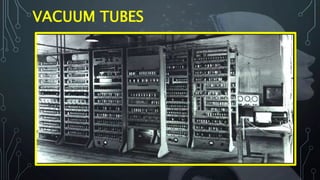
•Vacuum tubes
VACUUM TUBES
SECOND GENERATION
•Assembly language
•Symbolic
•Short word commands
•Machine dependent
THIRD GENERATION
•High level languages
•Closer to human language
•Machine independent
•Source code
FOURTH GENERATION
•English like command
•Does not follow input-process-output
•Non-procedural
•Focus on the result rather than the process.
•Visual basic
FIFTH GENERATION
•Artificial intelligence
•Rely on algorithms defined by the
programmer to solve problems.
•Computer program will solve the
problem for you.
IMPERATIVE PROGRAMMING
•Follows an essential order or command.
•Program consist of explicit commands or
instructions to be executed.
•Perform operations on data and modify values
of program variables.
•How (how the computation is to take place)
FUNCTIONAL PROGRAMMING
•Focus on the “What”
•Describe problem to be solved rather than the
actual step.
•Emphasis is on the evaluation of expressions
•Expressions are formed by using functions to
combine basic values.
LOGIC PROGRAMMING
•Written as logical statements that describes the
properties the solution must have
OBJECT ORIENTED PROGRAMMING
•Data structure is viewed as an object.
•Class – group of objects that have the same
properties, operations and behavior.
•Model a real world system
•Computation is the transformation of the
objects.
•JAVA and C++
PARALLEL PROGRAMMING
•Allow the execution of two or more operations
at the same time
•Concurrent = occurring at the same time
•Parallel = the process run side by side yet
independent to each other.
•Split a single task into smaller subtask

Programming Paradigms