Pioneers of Information Science in Europe:
         The Œuvre of Norbert Henrichs


              Katharina Hauk & Wolfgang G. Stock
Heinrich-Heine-University Düsseldorf, Germany, Department of Information Science

              ASIS&T AM 2012, Baltimore, MD
   History of ASIS&T and Information and Technology Worldwide. October 27, 2012
MOTIVATION

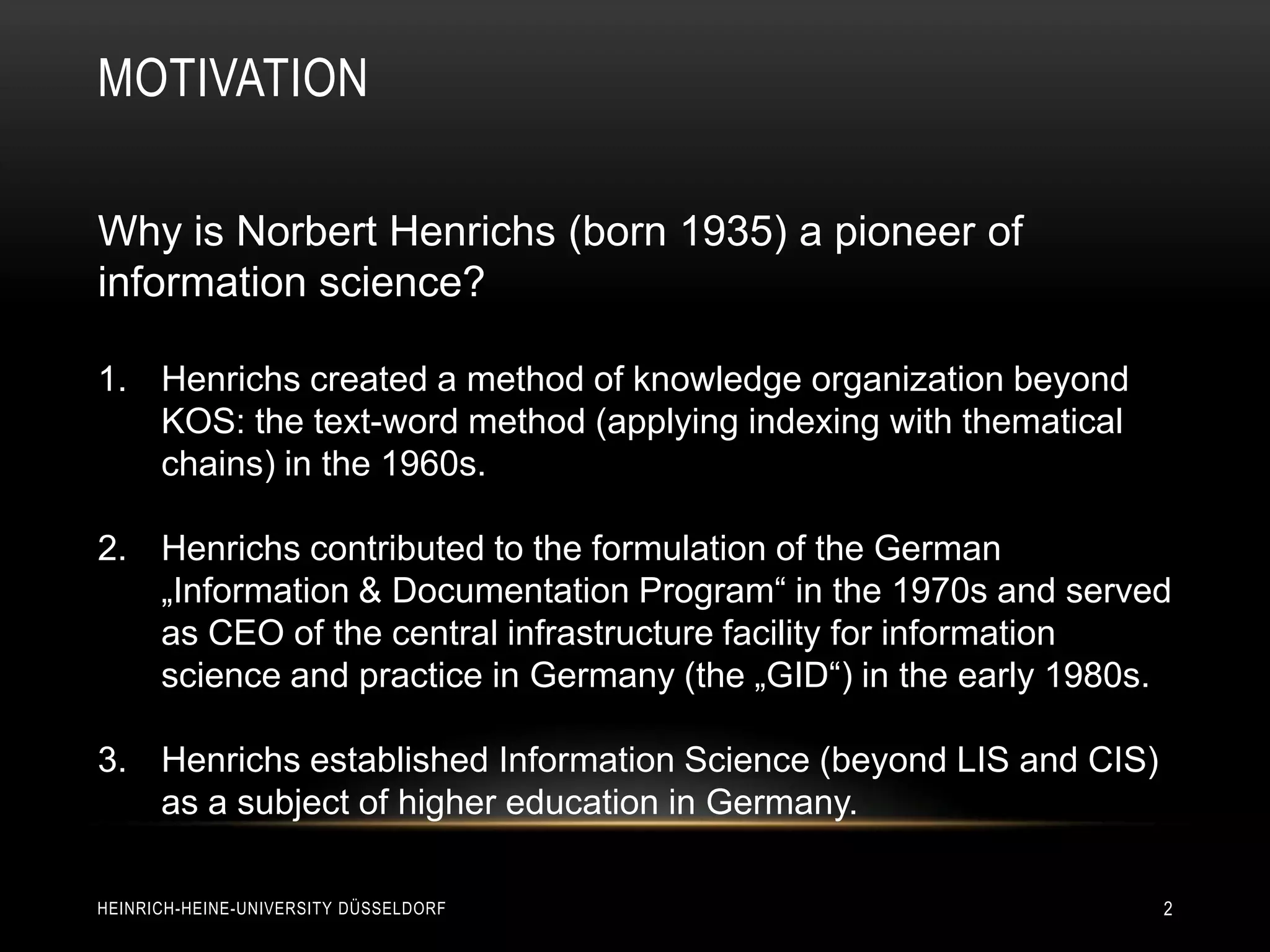
Why is Norbert Henrichs (born 1935) a pioneer of
information science?

1. Henrichs created a method of knowledge organization beyond
   KOS: the text-word method (applying indexing with thematical
   chains) in the 1960s.

2. Henrichs contributed to the formulation of the German
   „Information & Documentation Program“ in the 1970s and served
   as CEO of the central infrastructure facility for information
   science and practice in Germany (the „GID“) in the early 1980s.

3. Henrichs established Information Science (beyond LIS and CIS)
   as a subject of higher education in Germany.

HEINRICH-HEINE-UNIVERSITY DÜSSELDORF                               2
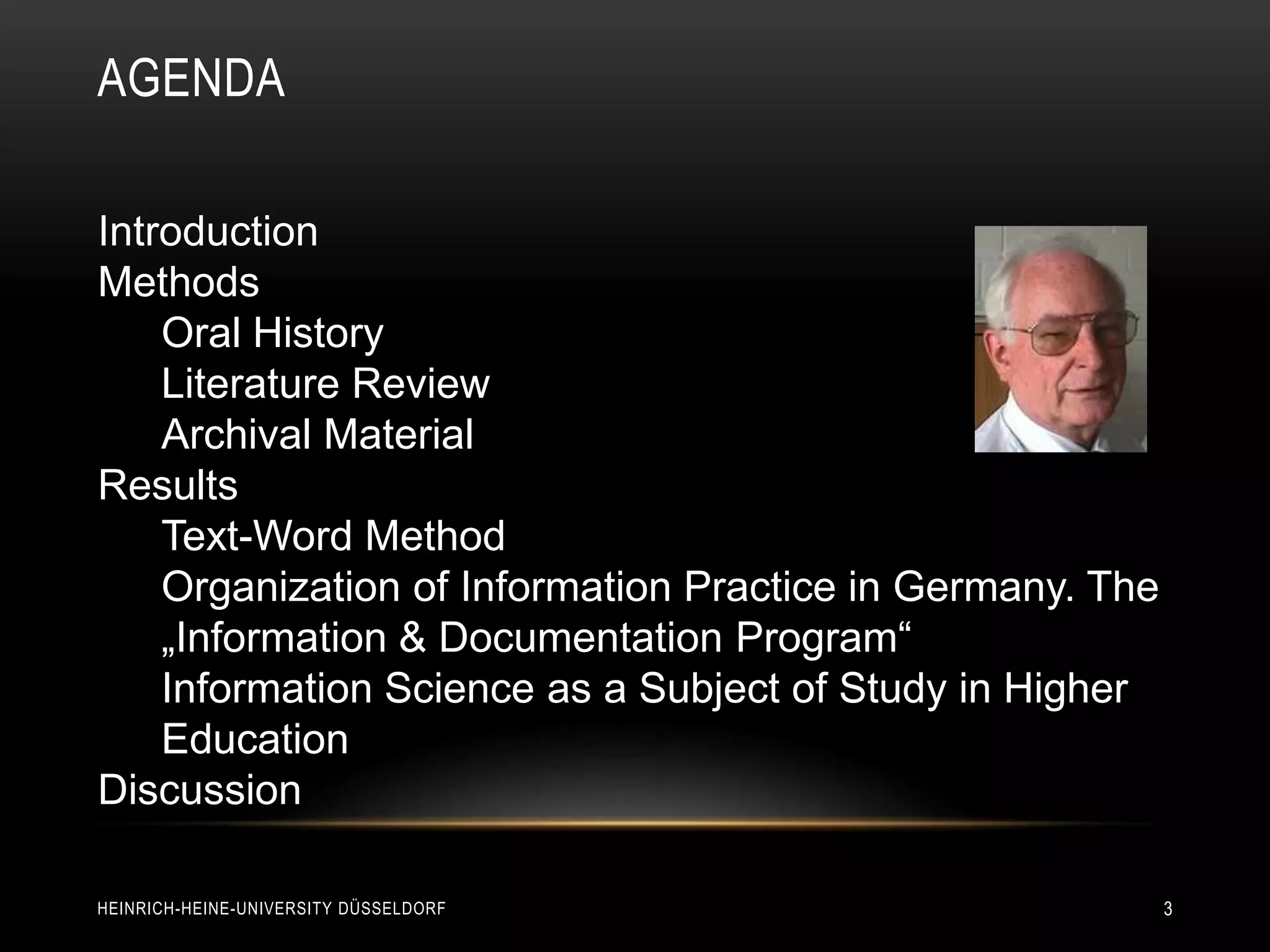
AGENDA

Introduction
Methods
    Oral History
    Literature Review
    Archival Material
Results
    Text-Word Method
    Organization of Information Practice in Germany. The
    „Information & Documentation Program“
    Information Science as a Subject of Study in Higher
    Education
Discussion

HEINRICH-HEINE-UNIVERSITY DÜSSELDORF                       3
NORBERT HENRICHS IN 1968


                                       Source: German Television Broadcast
HEINRICH-HEINE-UNIVERSITY DÜSSELDORF   WDR, 1968                             4
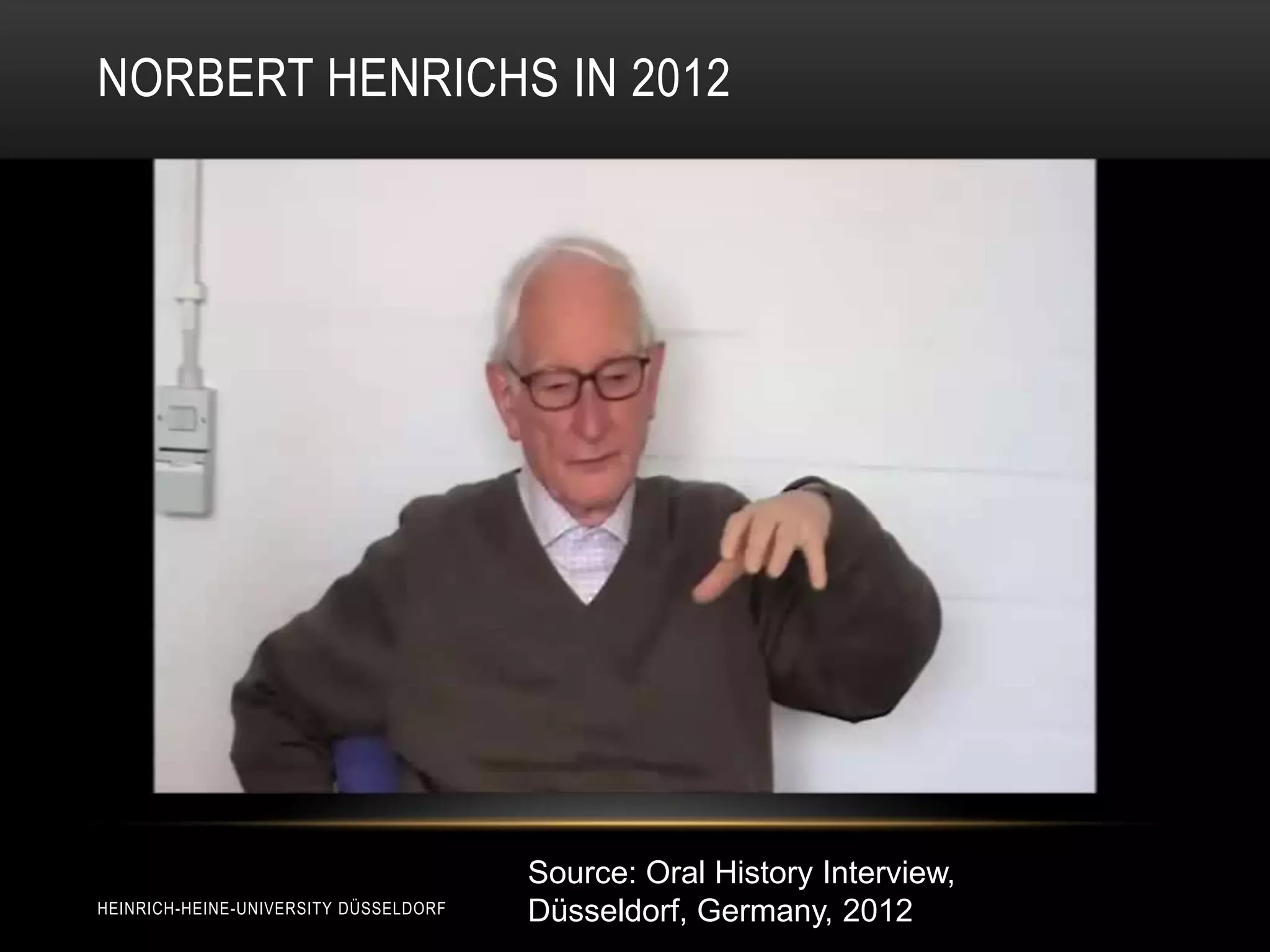
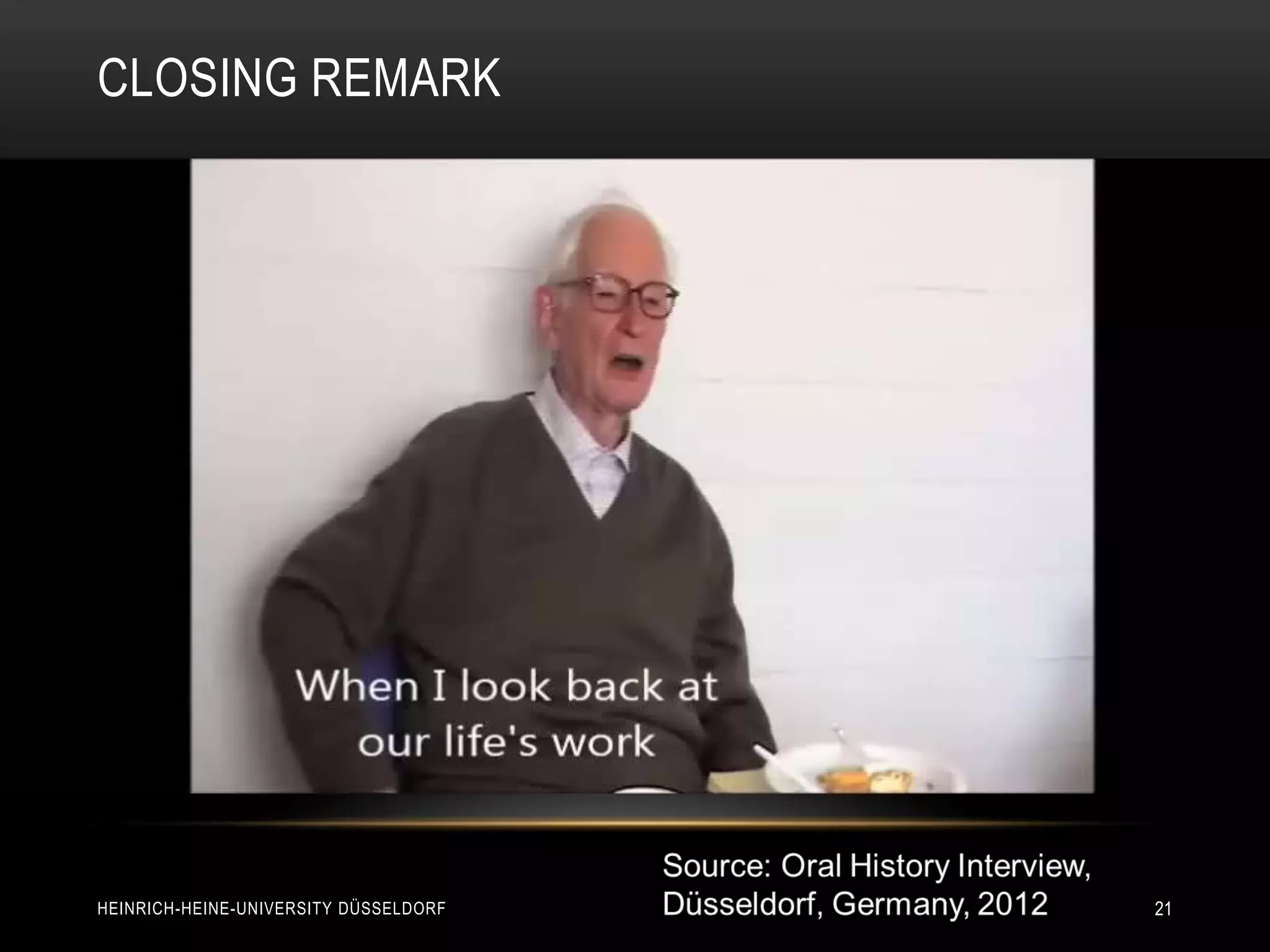
NORBERT HENRICHS IN 2012


                                       Source: Oral History Interview,
HEINRICH-HEINE-UNIVERSITY DÜSSELDORF   Düsseldorf, Germany, 2012
METHODS

1. Oral history: interview with Norbert Henrichs on April 12, 2012 in
   Düsseldorf, Germany – video (about 200 minutes) – transcript
   (stored in the archive of the Heinrich-Heine-University)

2. Literature review: analysis of the published articles of Henrichs
   (as a by-product of the edition of selected works of Henrichs)

3. Review of archival material: analysis of some unpublished
   materials by and on Henrichs in the archive the Dept. of
   Information Science at the Heinrich-Heine-University)


HEINRICH-HEINE-UNIVERSITY DÜSSELDORF                                   6
RESULTS, PART 1:
TEXT-WORD METHOD

• Philosophy documentation – cooperation with
   • University of Louvain, Belgium (Jucquois-Delpierre, Wenin)
   • Research and Documentation Center of Austrian Philosophy,
      Graz, Austria (Haller, Gombocz)
   • Philosophy Documentation Center, Bowling Green State
      University, Bowling Green, OH, U.S.A. (Lineback)
• How to index philosophical literature?
   • No classification system, no thesaurus
   • No full text storage
   • Introduction of the Text-Word Method


HEINRICH-HEINE-UNIVERSITY DÜSSELDORF                              7
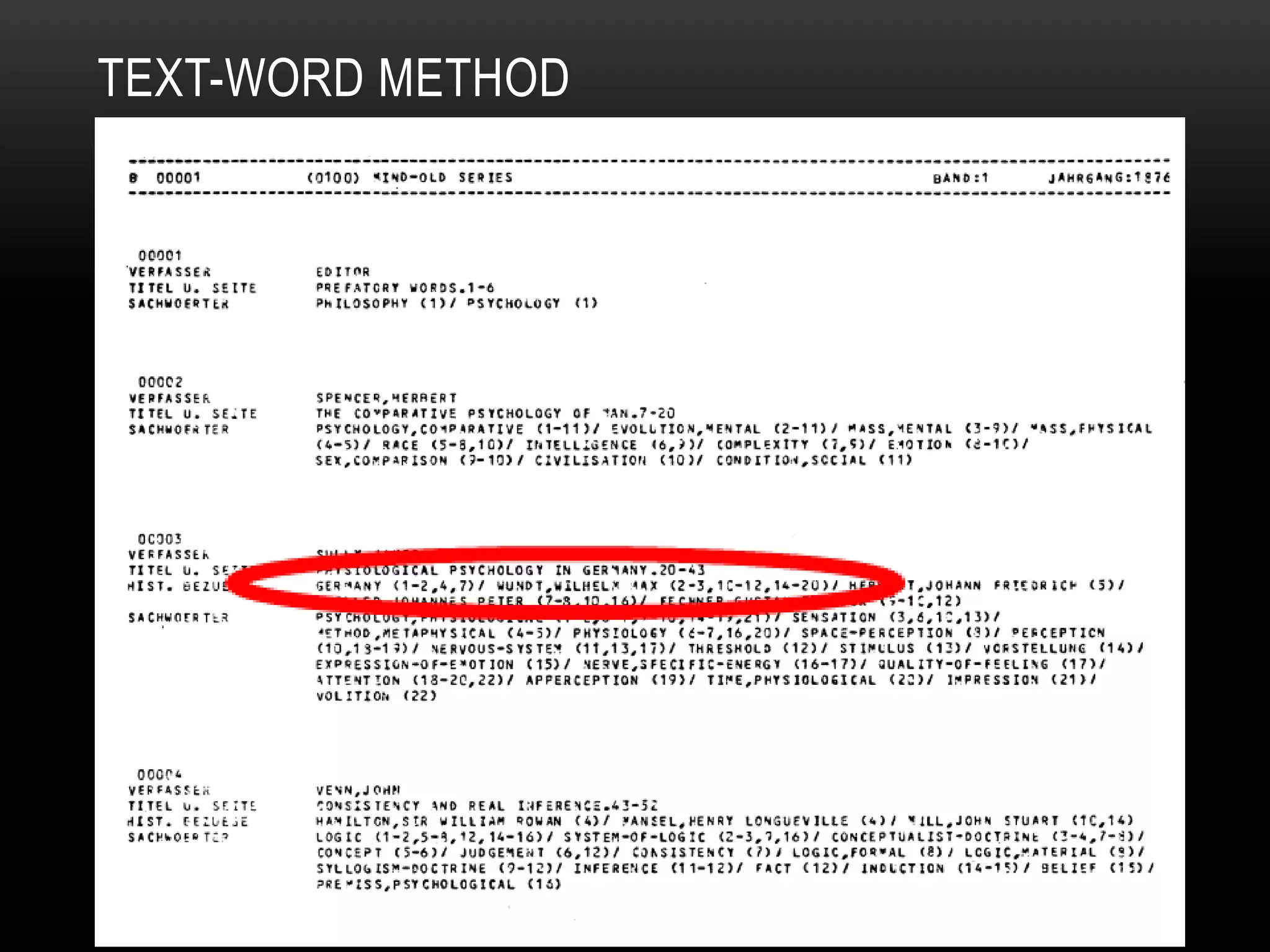
TEXT-WORD METHOD


• Text-Word Method
   • Only words (in original language) which occur in the text
   • Syntactical indexing: no single topics, but chains of topics
   • Very precise retrieval results
   • But: Problems for the users to anticipate the language use of
      the authors (in all languages) – Solutions:
       • Term networks (as an early form of informetrics)
       • Pentagram lists (as an early form of n-gram retrieval)
       • (Not by Henrichs, but by M.Stock) text-words in original
          language and in a unified language
   • Commercial partner: Siemens


HEINRICH-HEINE-UNIVERSITY DÜSSELDORF                                 8
TEXT-WORD METHOD


HEINRICH-HEINE-UNIVERSITY DÜSSELDORF   9
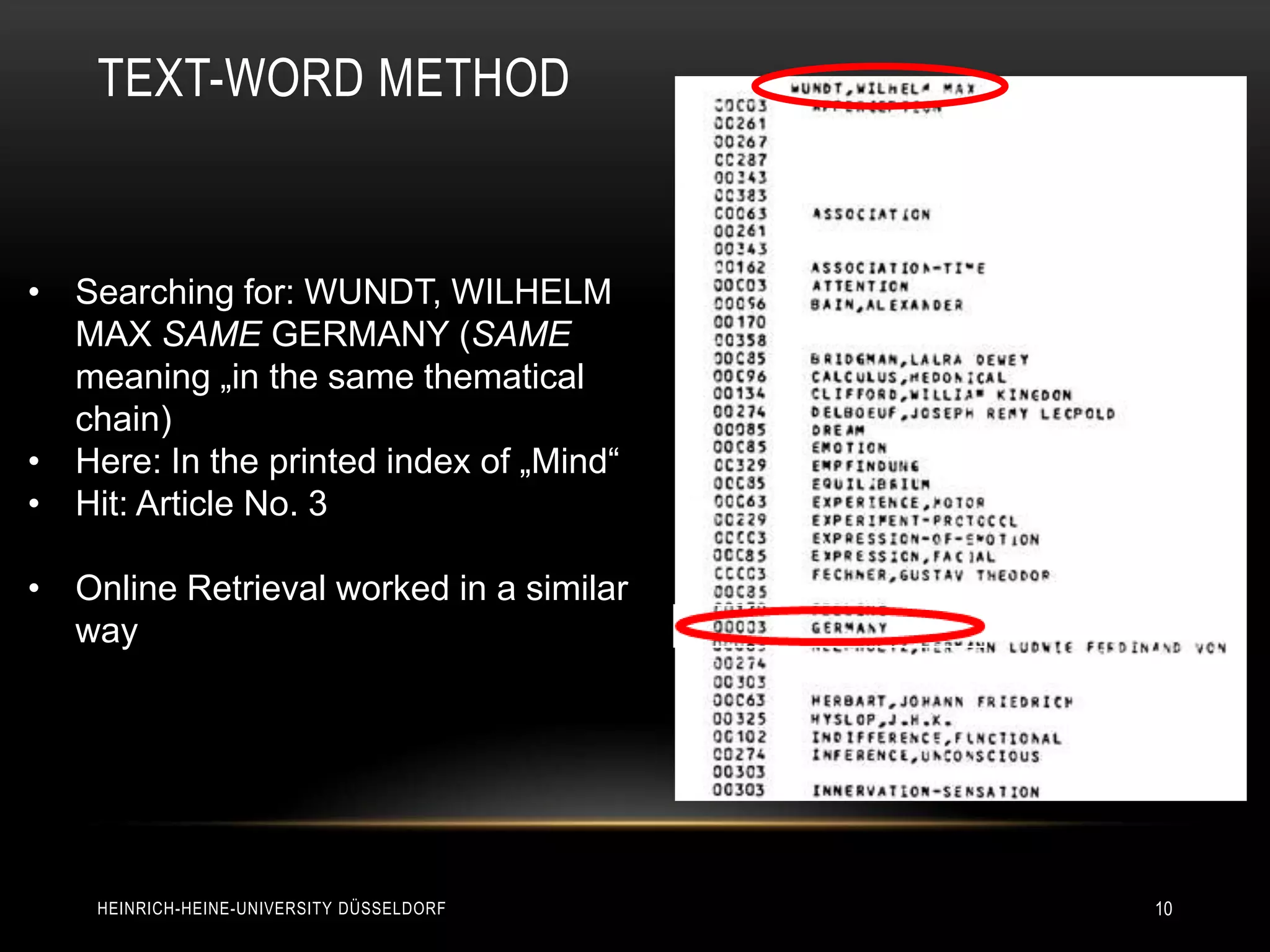
TEXT-WORD METHOD


• Searching for: WUNDT, WILHELM
  MAX SAME GERMANY (SAME
  meaning „in the same thematical
  chain)
• Here: In the printed index of „Mind“
• Hit: Article No. 3

• Online Retrieval worked in a similar
  way


    HEINRICH-HEINE-UNIVERSITY DÜSSELDORF   10
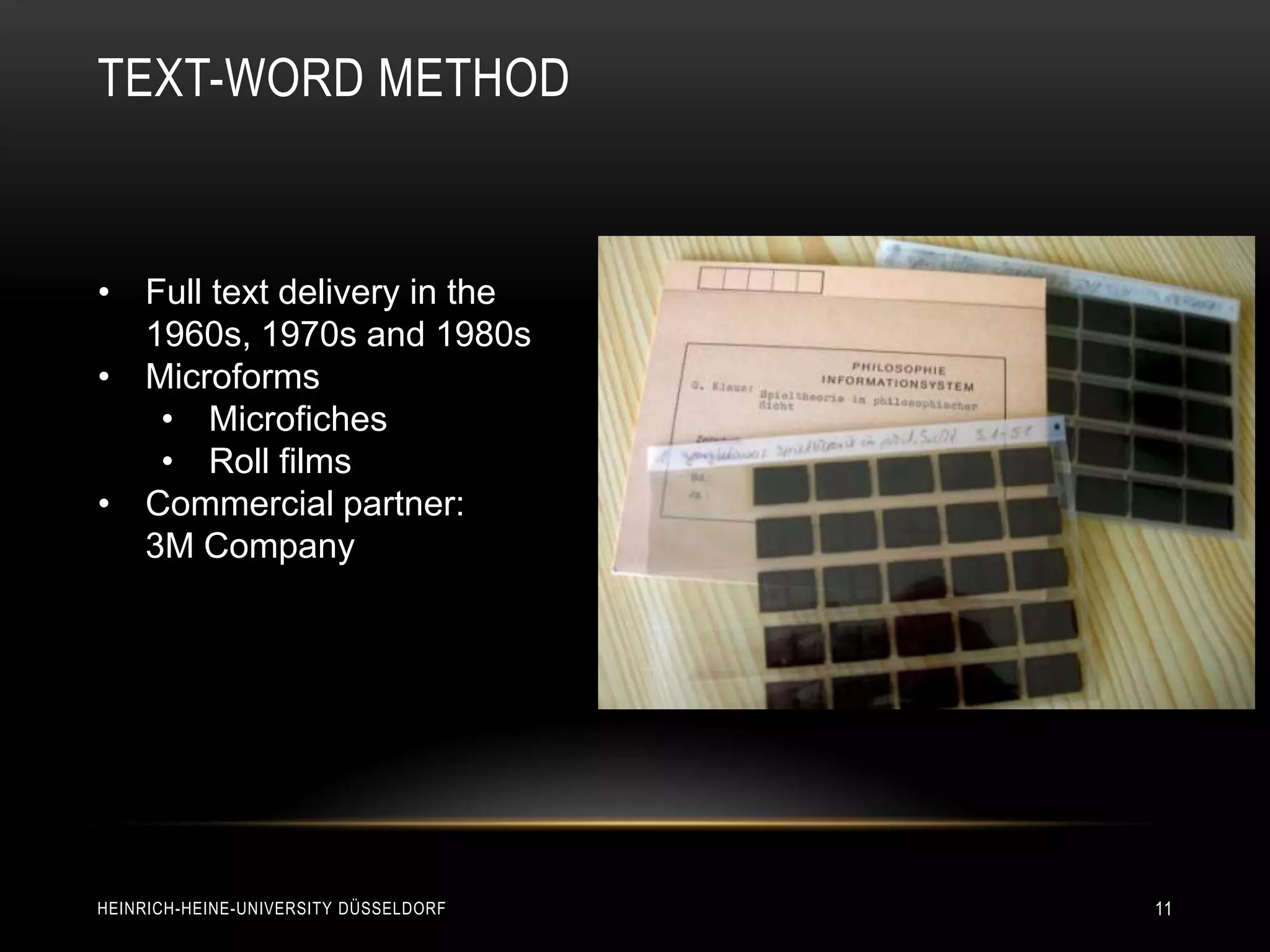
TEXT-WORD METHOD


• Full text delivery in the
  1960s, 1970s and 1980s
• Microforms
   • Microfiches
   • Roll films
• Commercial partner:
  3M Company


HEINRICH-HEINE-UNIVERSITY DÜSSELDORF   11
RESULTS, PART 2:
Organization of Information Practice in Germany


• In the 1960s the German government recognized the
  importance of Information and Documentation (I&D).

• In the I&D program (1974-1977) the government was
  responsible for planning, implementing and financing I&D.

• Henrichs played an essential role in planning this
  program.


HEINRICH-HEINE-UNIVERSITY DÜSSELDORF                          12
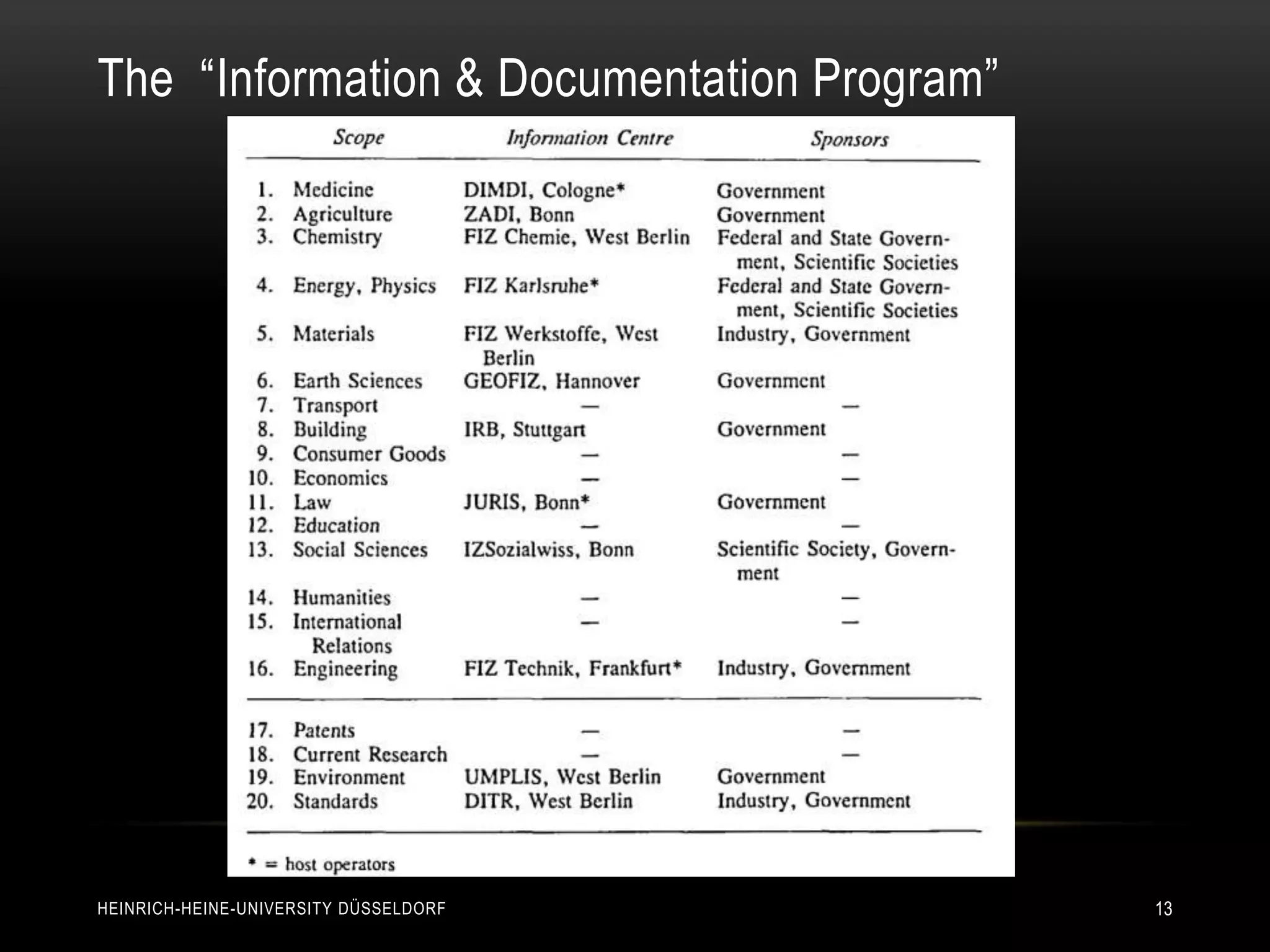
The “Information & Documentation Program”


HEINRICH-HEINE-UNIVERSITY DÜSSELDORF        13
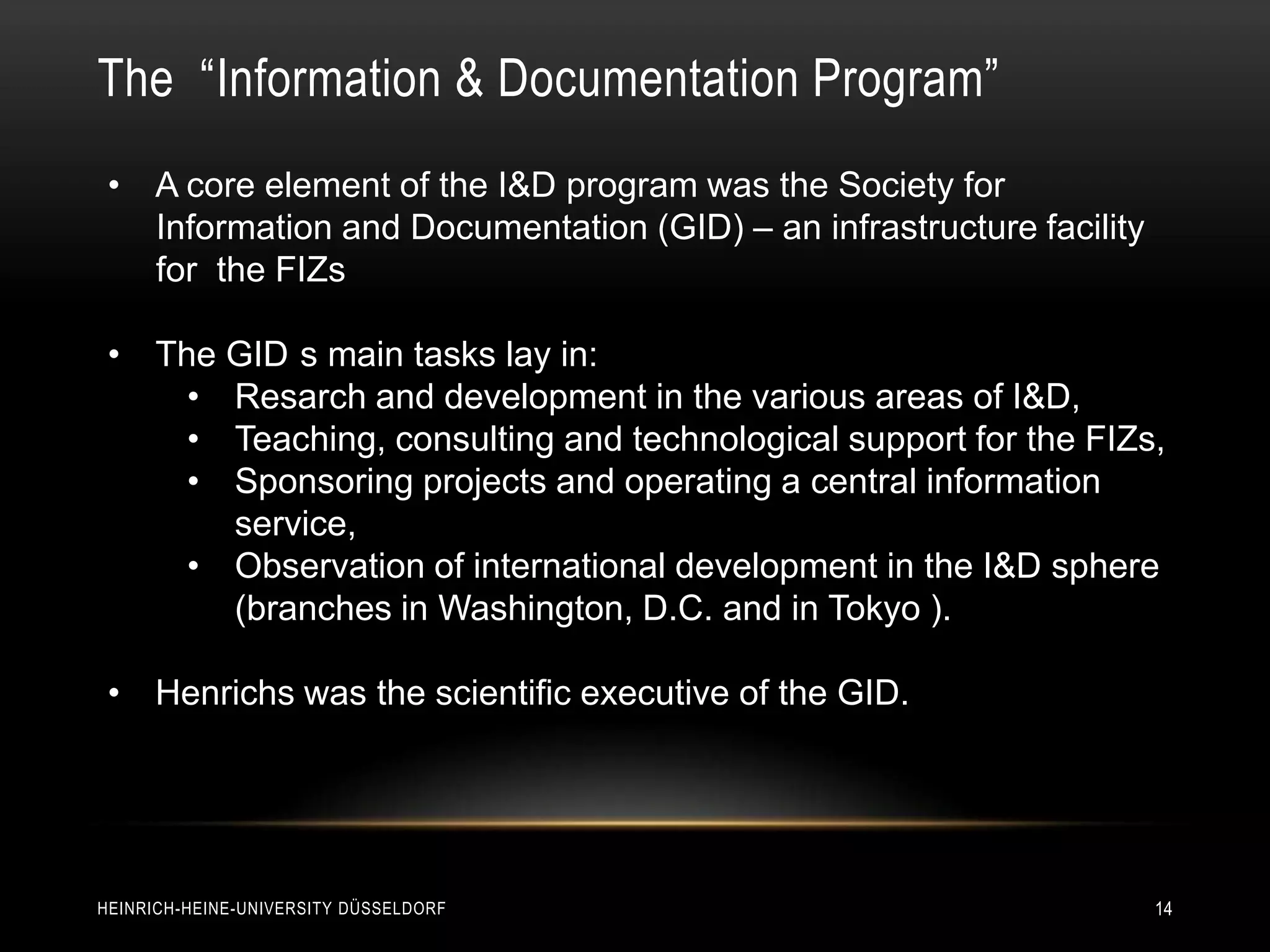
The “Information & Documentation Program”
 • A core element of the I&D program was the Society for
   Information and Documentation (GID) – an infrastructure facility
   for the FIZs

 • The GID s main tasks lay in:
     • Resarch and development in the various areas of I&D,
     • Teaching, consulting and technological support for the FIZs,
     • Sponsoring projects and operating a central information
       service,
     • Observation of international development in the I&D sphere
       (branches in Washington, D.C. and in Tokyo ).

 • Henrichs was the scientific executive of the GID.


HEINRICH-HEINE-UNIVERSITY DÜSSELDORF                                  14
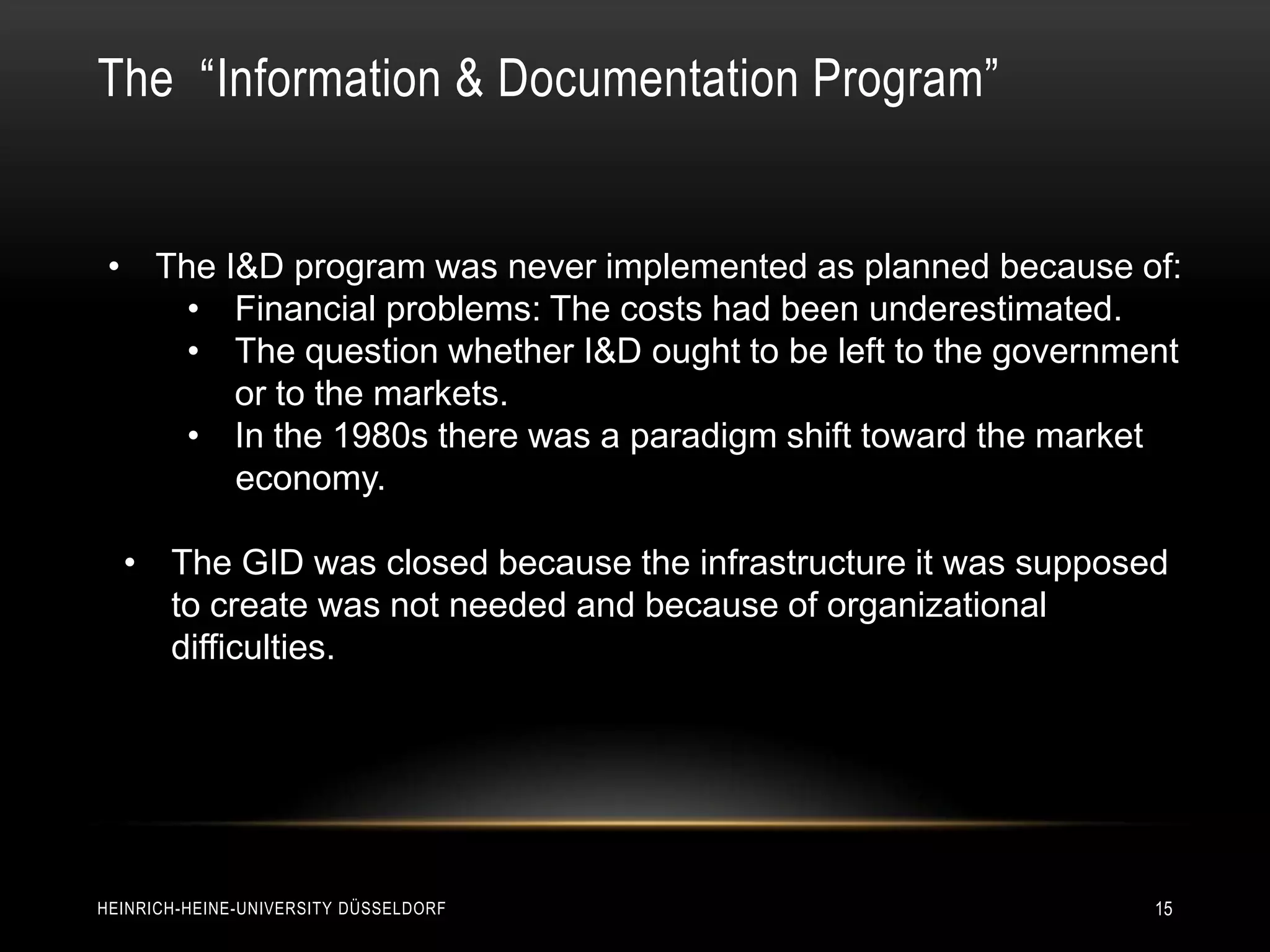
The “Information & Documentation Program”


 • The I&D program was never implemented as planned because of:
     • Financial problems: The costs had been underestimated.
     • The question whether I&D ought to be left to the government
        or to the markets.
     • In the 1980s there was a paradigm shift toward the market
        economy.

  • The GID was closed because the infrastructure it was supposed
    to create was not needed and because of organizational
    difficulties.


HEINRICH-HEINE-UNIVERSITY DÜSSELDORF                            15
RESULTS, PART 3:
Information Science as a subject of study

  • The origin of Information Science in Düsseldorf lay in philosophy
    documentation.

  • In 1970 there were the first courses that could be called
    Information Science.

  • By 1974 Henrichs worked out a curriculum for Information
    Science as a minor subject.

  • However Information Science was only accredited as a subject in
    its own right in 1989.


HEINRICH-HEINE-UNIVERSITY DÜSSELDORF                                16
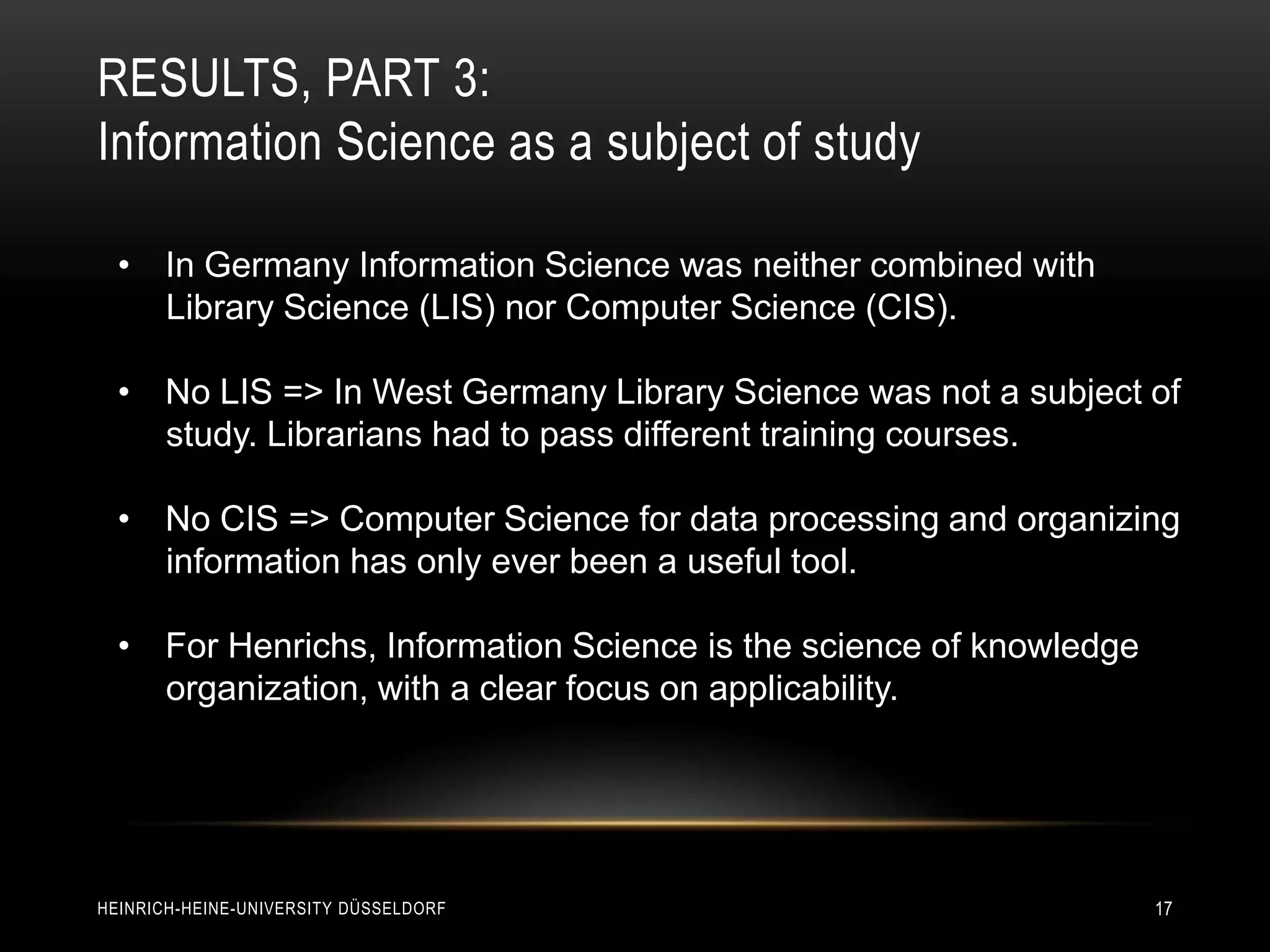
RESULTS, PART 3:
Information Science as a subject of study

  • In Germany Information Science was neither combined with
    Library Science (LIS) nor Computer Science (CIS).

  • No LIS => In West Germany Library Science was not a subject of
    study. Librarians had to pass different training courses.

  • No CIS => Computer Science for data processing and organizing
    information has only ever been a useful tool.

  • For Henrichs, Information Science is the science of knowledge
    organization, with a clear focus on applicability.


HEINRICH-HEINE-UNIVERSITY DÜSSELDORF                                17
DISCUSSION

Text-Word Method
Is knowledge organization beyond of Knowledge
Organization Systems (KOS, e.g. classification systems,
thesauri) useful?

Folksonomies do not make use of KOS as well. Can we
transfer the experiences of the text-word method to
social tagging?

Is syntactical indexing by thematic chains applicable in
other environments?


HEINRICH-HEINE-UNIVERSITY DÜSSELDORF                       18
DISCUSSION
Governmental Information Policy

Information supply: government-driven or market-
driven?
                                 Information science think tank?
                           Central organization of information services?
If market-driven: Who will finance unprofitable
information services (e.g., global philosophy)?
                       On a for scale:


Is there a need for a central think tank for information
science?

Is there a need for a central organization of information
services for ALL kinds of (STM) information?

HEINRICH-HEINE-UNIVERSITY DÜSSELDORF                                       19
DISCUSSION
Information Science as an Academic
Discipline

Is Information Science indeed beyond Library &
Information Science (LIS)?

Is it beyond Computer & Information Science (CIS) as
well?

Is Information Science a subject on its own right?


HEINRICH-HEINE-UNIVERSITY DÜSSELDORF                   20
CLOSING REMARK


HEINRICH-HEINE-UNIVERSITY DÜSSELDORF   21
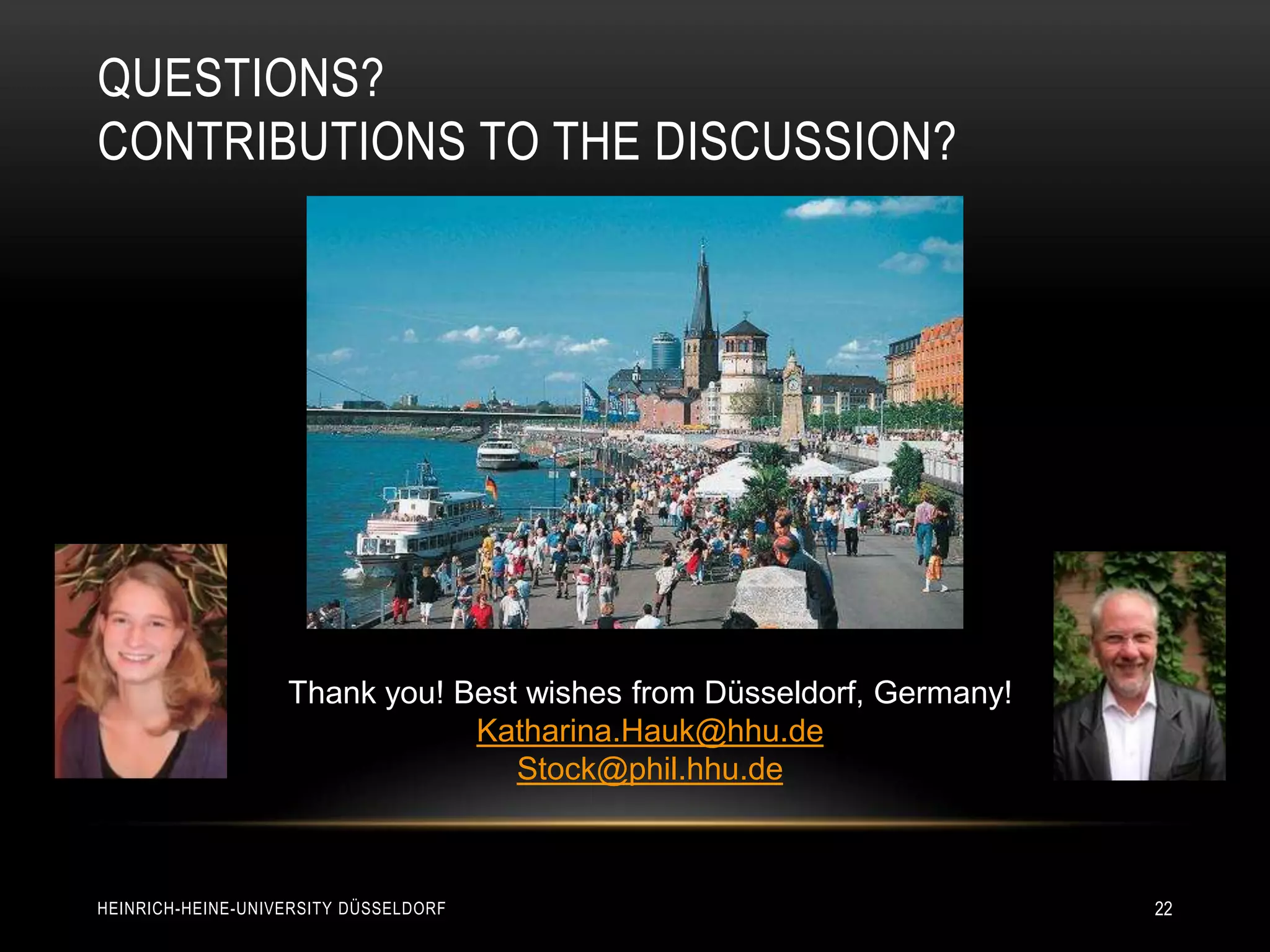
QUESTIONS?
CONTRIBUTIONS TO THE DISCUSSION?


                   Thank you! Best wishes from Düsseldorf, Germany!
                               Katharina.Hauk@hhu.de
                                  Stock@phil.hhu.de


HEINRICH-HEINE-UNIVERSITY DÜSSELDORF                                  22
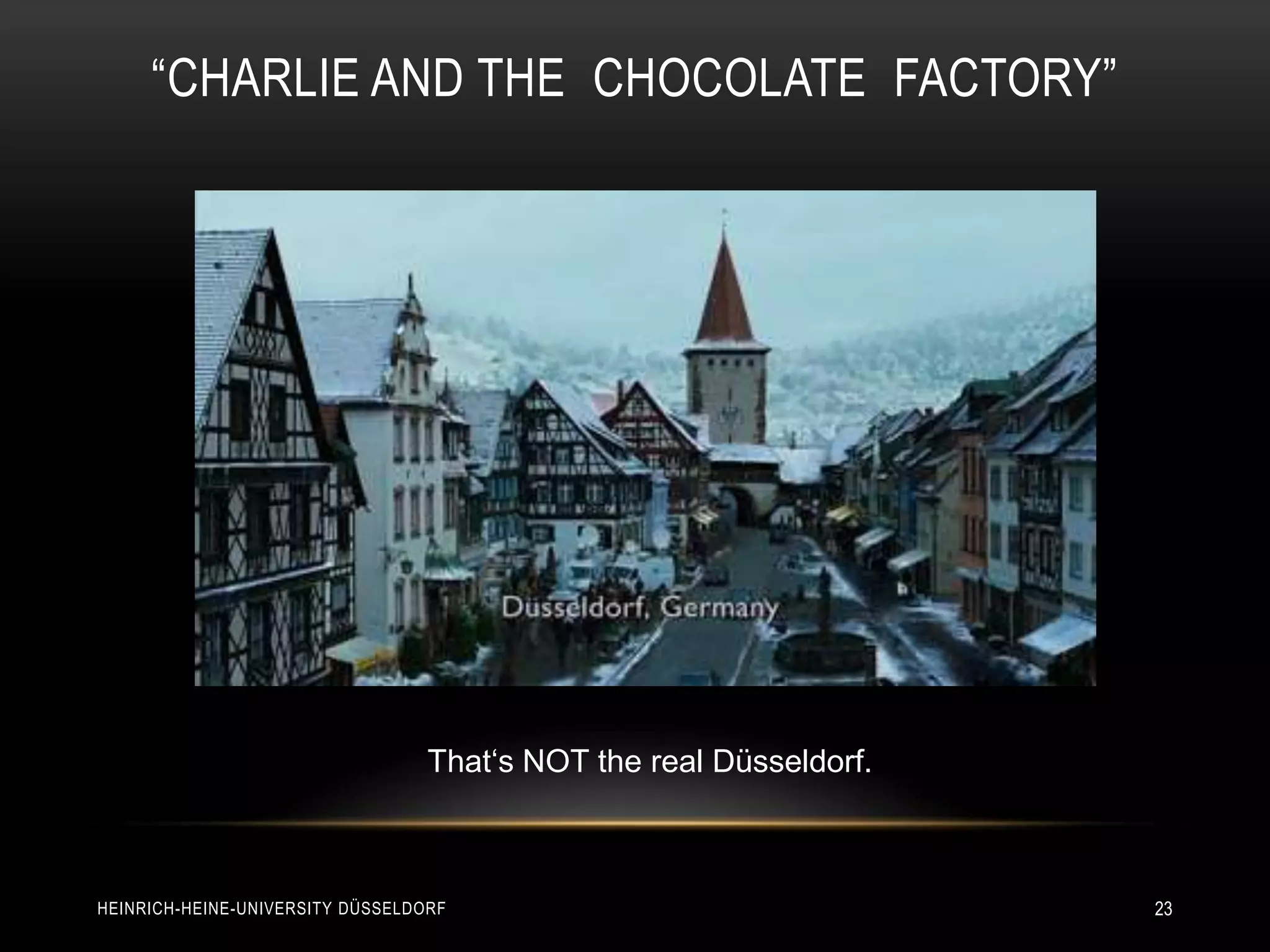
“CHARLIE AND THE CHOCOLATE FACTORY”


                                  That‘s NOT the real Düsseldorf.


HEINRICH-HEINE-UNIVERSITY DÜSSELDORF                                23

Pioneers of Information Science in Europe: The Oeuvre of Norbert Henrichs

  • 1.
    Pioneers of InformationScience in Europe: The Œuvre of Norbert Henrichs Katharina Hauk & Wolfgang G. Stock Heinrich-Heine-University Düsseldorf, Germany, Department of Information Science ASIS&T AM 2012, Baltimore, MD History of ASIS&T and Information and Technology Worldwide. October 27, 2012
  • 2.
    MOTIVATION Why is NorbertHenrichs (born 1935) a pioneer of information science? 1. Henrichs created a method of knowledge organization beyond KOS: the text-word method (applying indexing with thematical chains) in the 1960s. 2. Henrichs contributed to the formulation of the German „Information & Documentation Program“ in the 1970s and served as CEO of the central infrastructure facility for information science and practice in Germany (the „GID“) in the early 1980s. 3. Henrichs established Information Science (beyond LIS and CIS) as a subject of higher education in Germany. HEINRICH-HEINE-UNIVERSITY DÜSSELDORF 2
  • 3.
    AGENDA Introduction Methods Oral History Literature Review Archival Material Results Text-Word Method Organization of Information Practice in Germany. The „Information & Documentation Program“ Information Science as a Subject of Study in Higher Education Discussion HEINRICH-HEINE-UNIVERSITY DÜSSELDORF 3
  • 4.
    NORBERT HENRICHS IN1968 Source: German Television Broadcast HEINRICH-HEINE-UNIVERSITY DÜSSELDORF WDR, 1968 4
  • 5.
    NORBERT HENRICHS IN2012 Source: Oral History Interview, HEINRICH-HEINE-UNIVERSITY DÜSSELDORF Düsseldorf, Germany, 2012
  • 6.
    METHODS 1. Oral history:interview with Norbert Henrichs on April 12, 2012 in Düsseldorf, Germany – video (about 200 minutes) – transcript (stored in the archive of the Heinrich-Heine-University) 2. Literature review: analysis of the published articles of Henrichs (as a by-product of the edition of selected works of Henrichs) 3. Review of archival material: analysis of some unpublished materials by and on Henrichs in the archive the Dept. of Information Science at the Heinrich-Heine-University) HEINRICH-HEINE-UNIVERSITY DÜSSELDORF 6
  • 7.
    RESULTS, PART 1: TEXT-WORDMETHOD • Philosophy documentation – cooperation with • University of Louvain, Belgium (Jucquois-Delpierre, Wenin) • Research and Documentation Center of Austrian Philosophy, Graz, Austria (Haller, Gombocz) • Philosophy Documentation Center, Bowling Green State University, Bowling Green, OH, U.S.A. (Lineback) • How to index philosophical literature? • No classification system, no thesaurus • No full text storage • Introduction of the Text-Word Method HEINRICH-HEINE-UNIVERSITY DÜSSELDORF 7
  • 8.
    TEXT-WORD METHOD • Text-WordMethod • Only words (in original language) which occur in the text • Syntactical indexing: no single topics, but chains of topics • Very precise retrieval results • But: Problems for the users to anticipate the language use of the authors (in all languages) – Solutions: • Term networks (as an early form of informetrics) • Pentagram lists (as an early form of n-gram retrieval) • (Not by Henrichs, but by M.Stock) text-words in original language and in a unified language • Commercial partner: Siemens HEINRICH-HEINE-UNIVERSITY DÜSSELDORF 8
  • 9.
  • 10.
    TEXT-WORD METHOD • Searchingfor: WUNDT, WILHELM MAX SAME GERMANY (SAME meaning „in the same thematical chain) • Here: In the printed index of „Mind“ • Hit: Article No. 3 • Online Retrieval worked in a similar way HEINRICH-HEINE-UNIVERSITY DÜSSELDORF 10
  • 11.
    TEXT-WORD METHOD • Fulltext delivery in the 1960s, 1970s and 1980s • Microforms • Microfiches • Roll films • Commercial partner: 3M Company HEINRICH-HEINE-UNIVERSITY DÜSSELDORF 11
  • 12.
    RESULTS, PART 2: Organizationof Information Practice in Germany • In the 1960s the German government recognized the importance of Information and Documentation (I&D). • In the I&D program (1974-1977) the government was responsible for planning, implementing and financing I&D. • Henrichs played an essential role in planning this program. HEINRICH-HEINE-UNIVERSITY DÜSSELDORF 12
  • 13.
    The “Information &Documentation Program” HEINRICH-HEINE-UNIVERSITY DÜSSELDORF 13
  • 14.
    The “Information &Documentation Program” • A core element of the I&D program was the Society for Information and Documentation (GID) – an infrastructure facility for the FIZs • The GID s main tasks lay in: • Resarch and development in the various areas of I&D, • Teaching, consulting and technological support for the FIZs, • Sponsoring projects and operating a central information service, • Observation of international development in the I&D sphere (branches in Washington, D.C. and in Tokyo ). • Henrichs was the scientific executive of the GID. HEINRICH-HEINE-UNIVERSITY DÜSSELDORF 14
  • 15.
    The “Information &Documentation Program” • The I&D program was never implemented as planned because of: • Financial problems: The costs had been underestimated. • The question whether I&D ought to be left to the government or to the markets. • In the 1980s there was a paradigm shift toward the market economy. • The GID was closed because the infrastructure it was supposed to create was not needed and because of organizational difficulties. HEINRICH-HEINE-UNIVERSITY DÜSSELDORF 15
  • 16.
    RESULTS, PART 3: InformationScience as a subject of study • The origin of Information Science in Düsseldorf lay in philosophy documentation. • In 1970 there were the first courses that could be called Information Science. • By 1974 Henrichs worked out a curriculum for Information Science as a minor subject. • However Information Science was only accredited as a subject in its own right in 1989. HEINRICH-HEINE-UNIVERSITY DÜSSELDORF 16
  • 17.
    RESULTS, PART 3: InformationScience as a subject of study • In Germany Information Science was neither combined with Library Science (LIS) nor Computer Science (CIS). • No LIS => In West Germany Library Science was not a subject of study. Librarians had to pass different training courses. • No CIS => Computer Science for data processing and organizing information has only ever been a useful tool. • For Henrichs, Information Science is the science of knowledge organization, with a clear focus on applicability. HEINRICH-HEINE-UNIVERSITY DÜSSELDORF 17
  • 18.
    DISCUSSION Text-Word Method Is knowledgeorganization beyond of Knowledge Organization Systems (KOS, e.g. classification systems, thesauri) useful? Folksonomies do not make use of KOS as well. Can we transfer the experiences of the text-word method to social tagging? Is syntactical indexing by thematic chains applicable in other environments? HEINRICH-HEINE-UNIVERSITY DÜSSELDORF 18
  • 19.
    DISCUSSION Governmental Information Policy Informationsupply: government-driven or market- driven? Information science think tank? Central organization of information services? If market-driven: Who will finance unprofitable information services (e.g., global philosophy)? On a for scale: Is there a need for a central think tank for information science? Is there a need for a central organization of information services for ALL kinds of (STM) information? HEINRICH-HEINE-UNIVERSITY DÜSSELDORF 19
  • 20.
    DISCUSSION Information Science asan Academic Discipline Is Information Science indeed beyond Library & Information Science (LIS)? Is it beyond Computer & Information Science (CIS) as well? Is Information Science a subject on its own right? HEINRICH-HEINE-UNIVERSITY DÜSSELDORF 20
  • 21.
  • 22.
    QUESTIONS? CONTRIBUTIONS TO THEDISCUSSION? Thank you! Best wishes from Düsseldorf, Germany! Katharina.Hauk@hhu.de Stock@phil.hhu.de HEINRICH-HEINE-UNIVERSITY DÜSSELDORF 22
  • 23.
    “CHARLIE AND THECHOCOLATE FACTORY” That‘s NOT the real Düsseldorf. HEINRICH-HEINE-UNIVERSITY DÜSSELDORF 23