Topic:
Languages Of AI (lisp/prolog)

Group Members:
Shagufta Arif (027)
Sania Alyas (020)
Maryam Afza (006)
What is LISP??
LISP stands for (LIST
PROCESSING). It was invented
by John McCarthy in 1958. As its
name implies, LISP is a
programming language that
manipulates LISTS.
LISP Discription:
A list is either empty or non-empty.
[a, b, c, d]
Empty: []
Non-empty: head=[a] tail=[b, c, d]
Example:
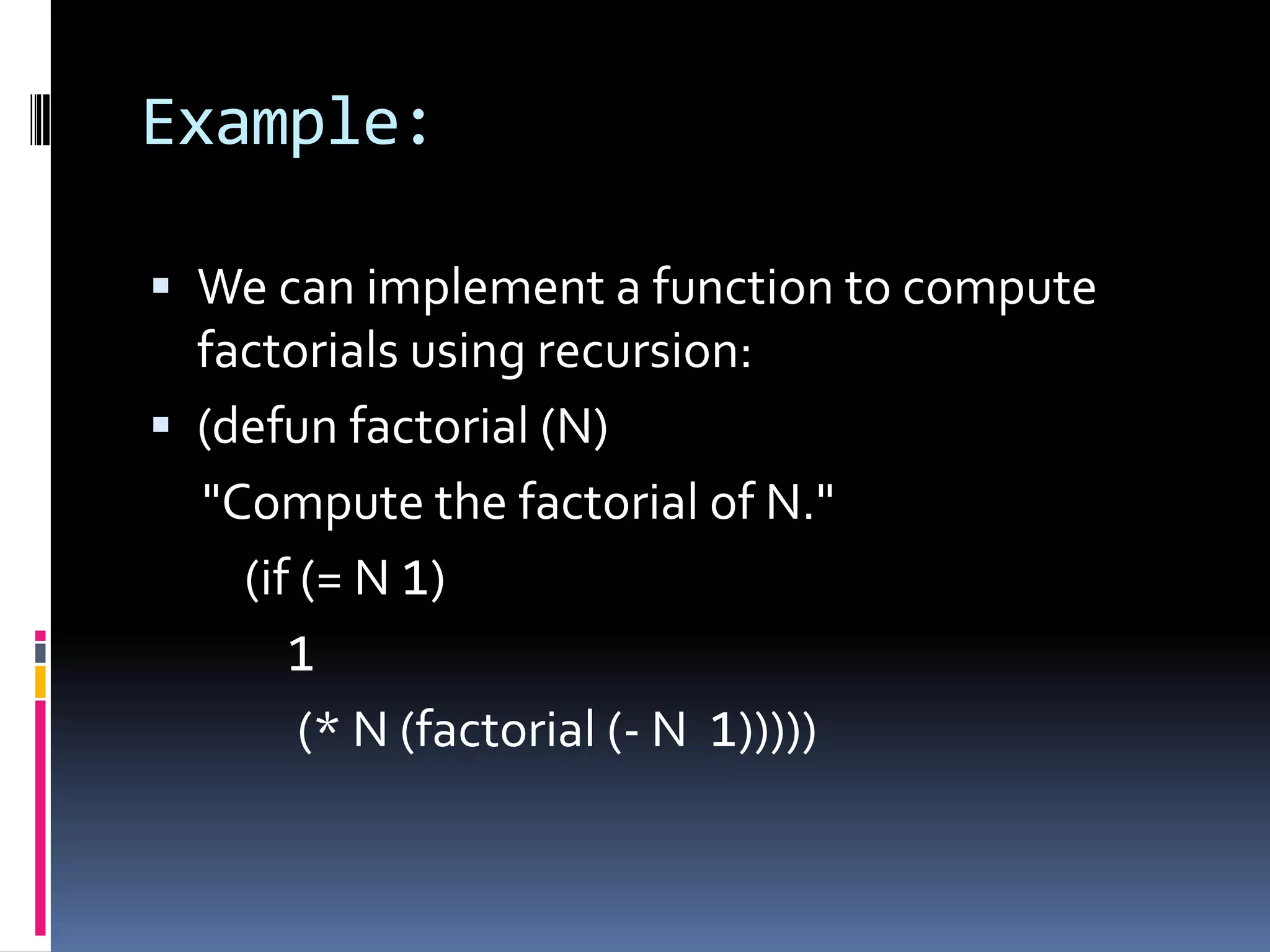
 We can implement a function to compute

factorials using recursion:
 (defun factorial (N)
"Compute the factorial of N."
(if (= N 1)
1
(* N (factorial (- N 1)))))
Example:
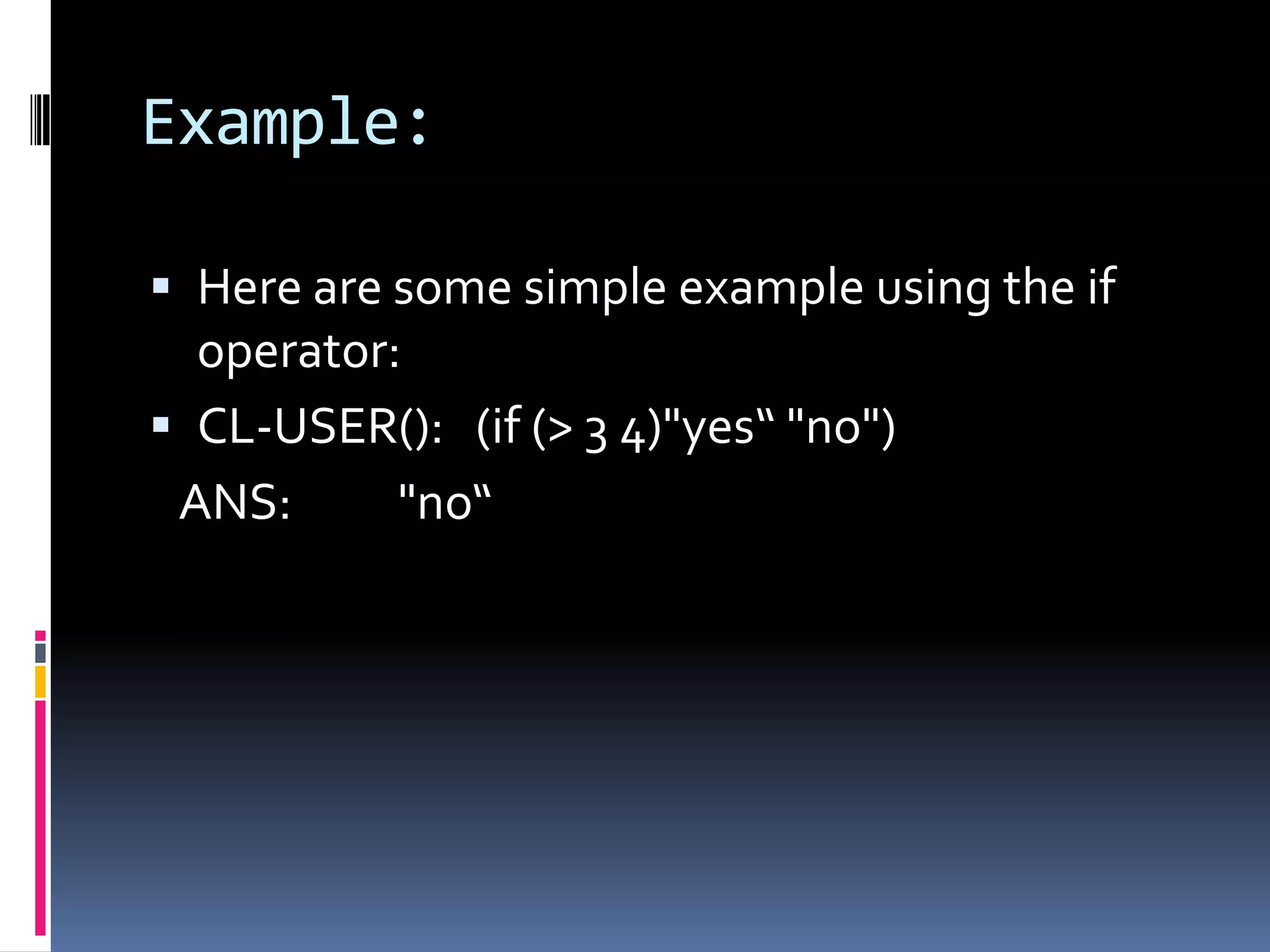
 Here are some simple example using the if

operator:
 CL-USER(): (if (> 3 4)"yes“ "no")
ANS:
"no“
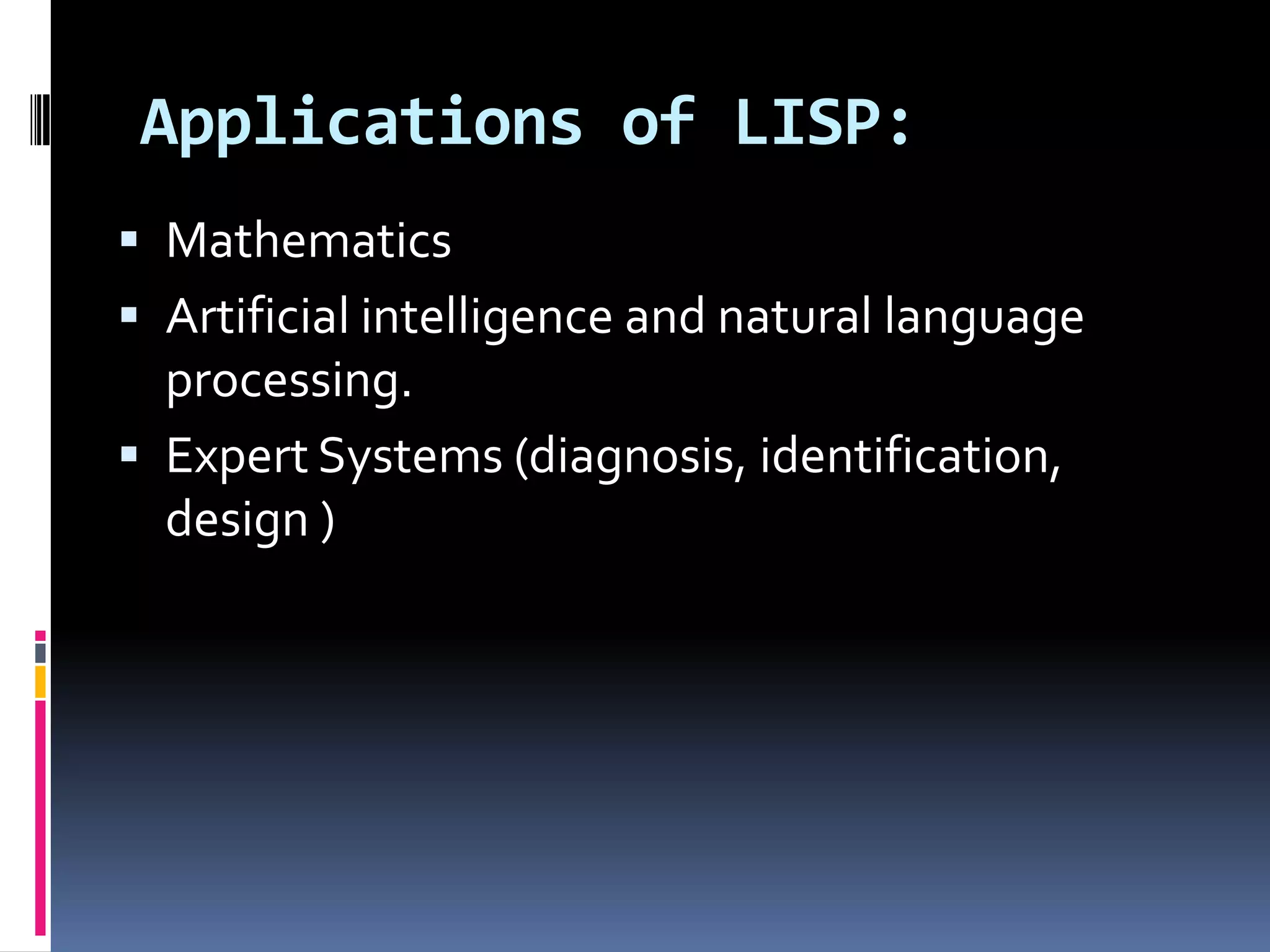
Applications of LISP:
 Mathematics
 Artificial intelligence and natural language

processing.
 Expert Systems (diagnosis, identification,
design )
Advantages of LISP:
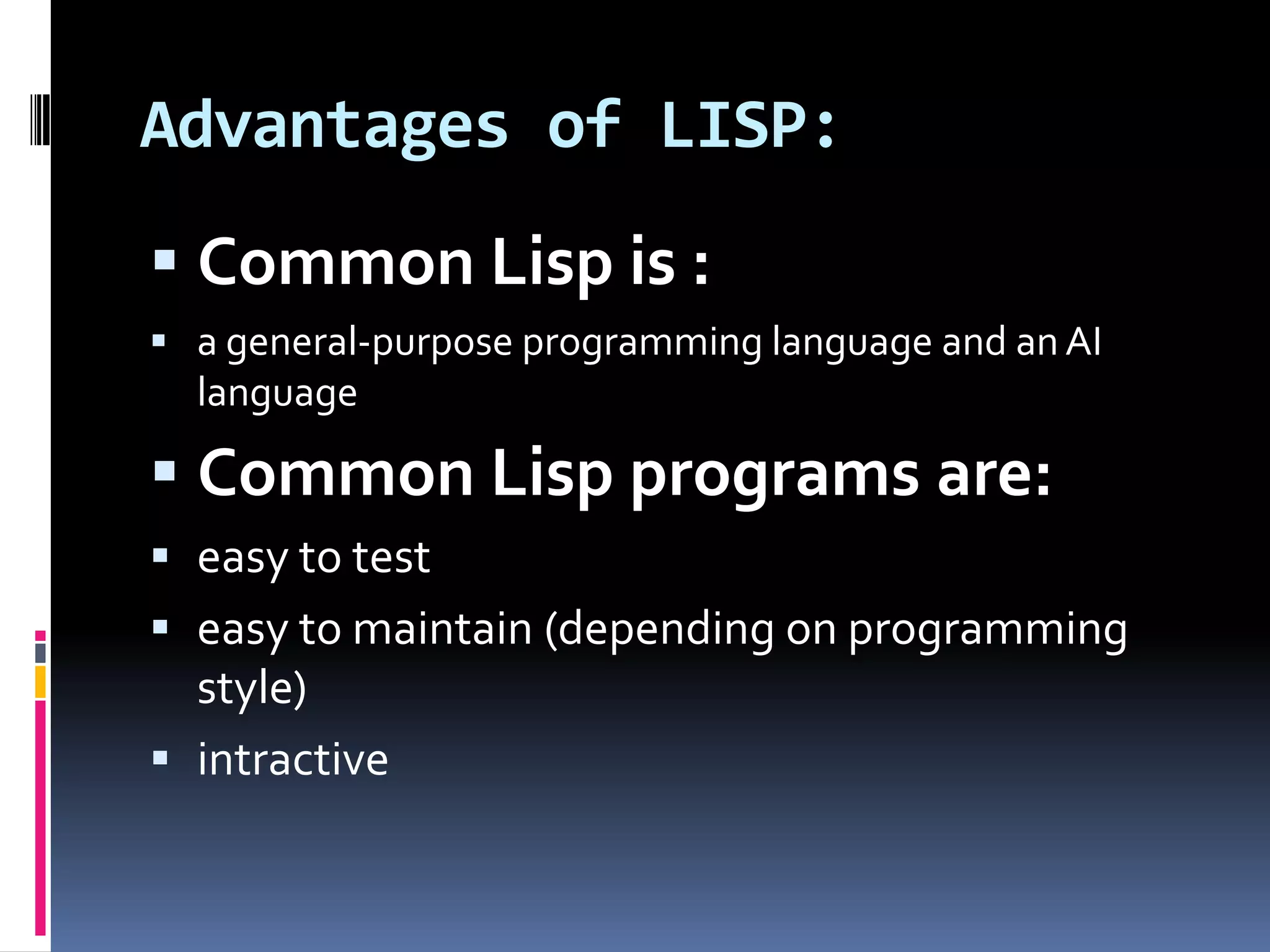
 Common Lisp is :
 a general-purpose programming language and an AI

language

 Common Lisp programs are:
 easy to test
 easy to maintain (depending on programming
style)

 intractive
Cont…
 Provides clear syntax
 LISP expressions are case-insensitive.
 runtime typing:
the programmer need not bother about type
declarations

 several data types:
numbers, strings, arrays, lists, char, symbols etc.
Disadvantages of LISP
 The major disadvantage is due to the

lack of popularity and lack of
widespread support and knowledge.
 It is relatively hard to find Lisp
programmers.
What is PROLOG?
 PROLOG is a declarative language

where programs are expressed in
terms of relations.
 A program in PROLOG can use logical
reasoning to answer questions that
can be inferred from the knowledge
base.
Cont …
A Prolog language designed in Europe to
support natural language processing.
It was created by Alain and Robert 1972 as an
alternative to the Lisp programming languages.
Conti…
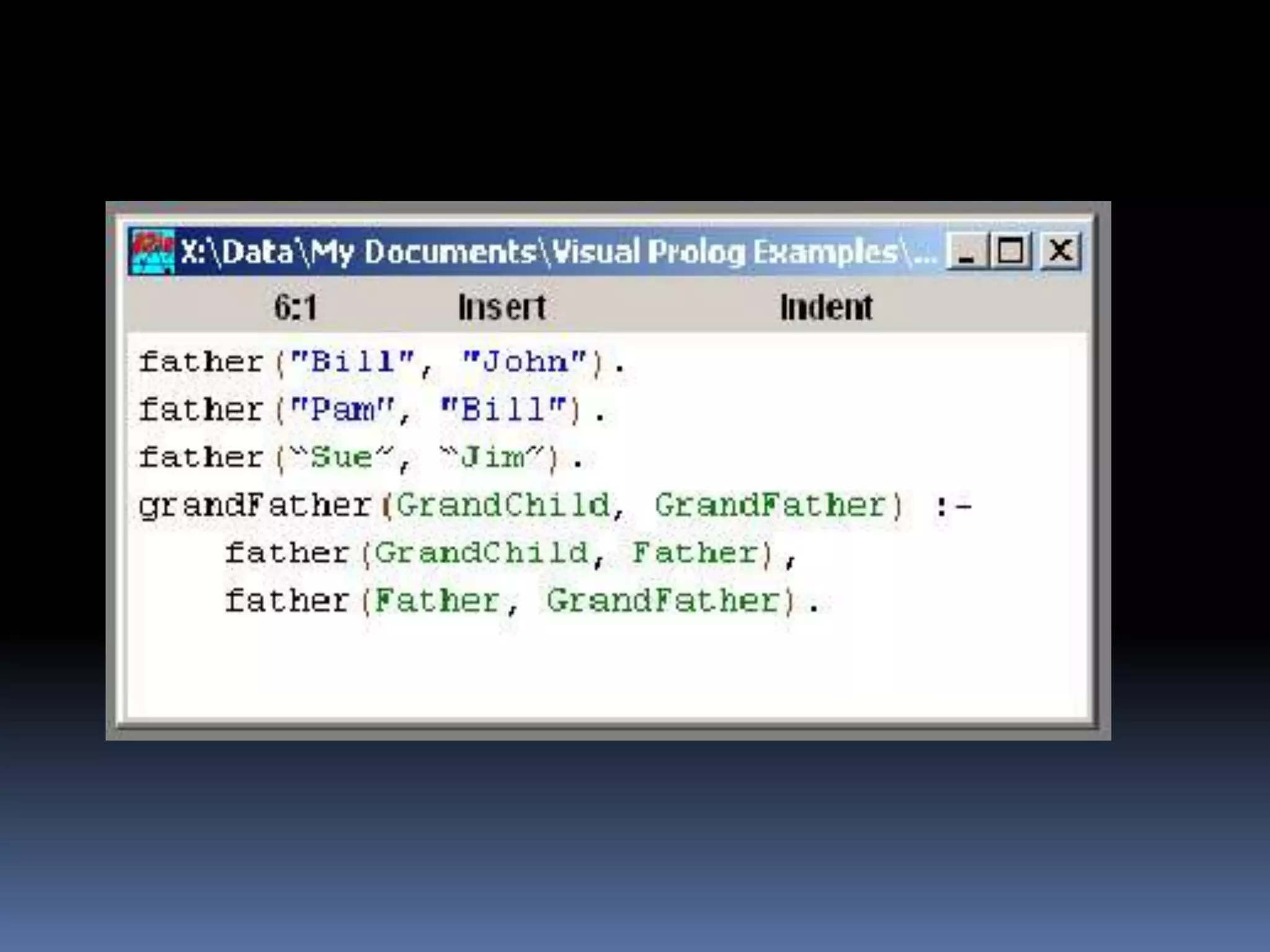
 There are three basic stratgies in Prolog:
facts, rules, and queries.
 A collection of facts and rules which
describe some collection of relationships is
called a knowledge base.
 That is, Prolog programs simply are
knowledge bases.
Conti…
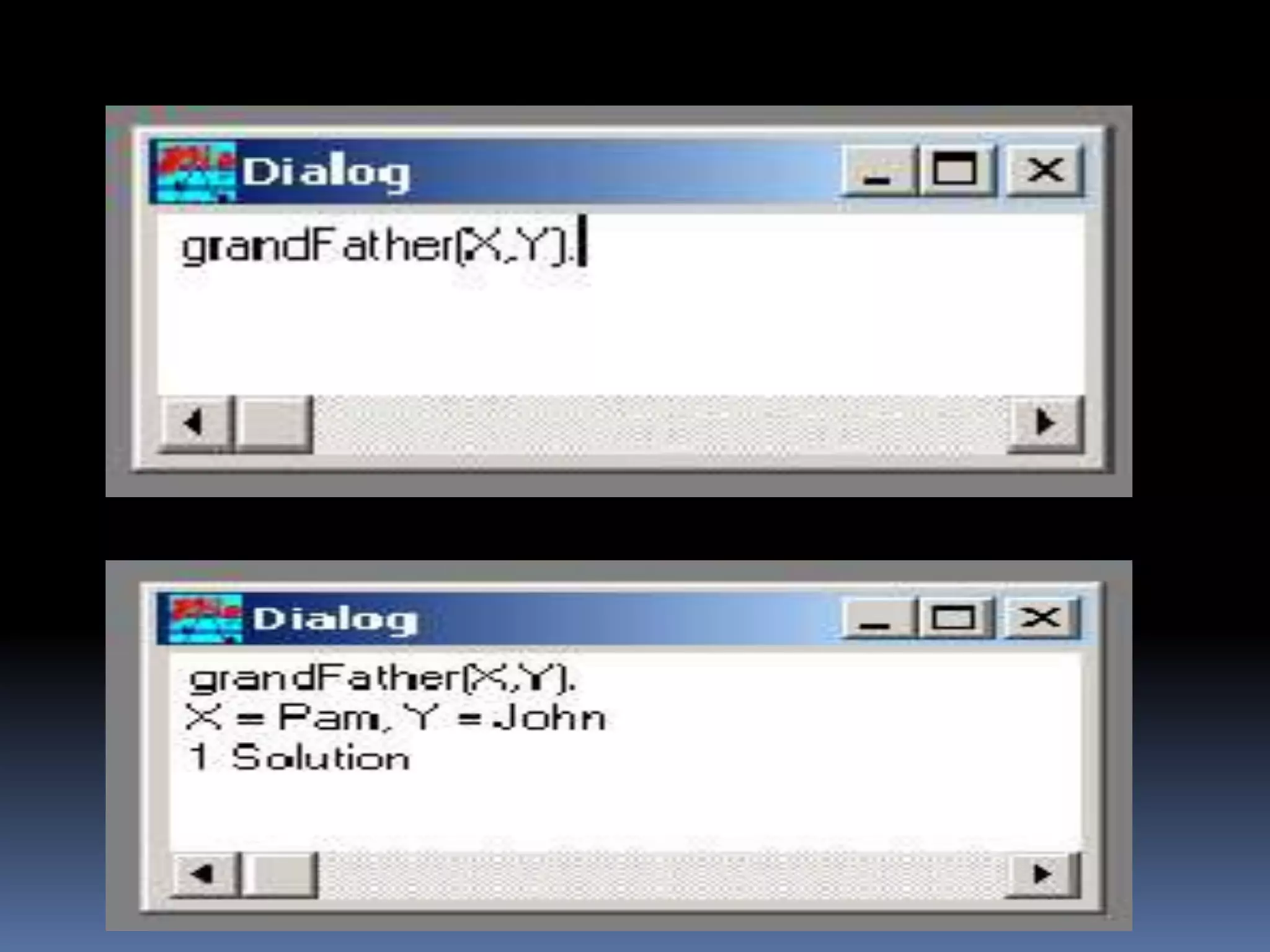
Prolog includes an inference engine, which is
a process for reasoning logically about
information. The inference engine includes a
pattern matcher, which retrieves stored
(known) information by matching answers to
questions.
One important feature of Prolog is find all
possible solutions rather than only one.
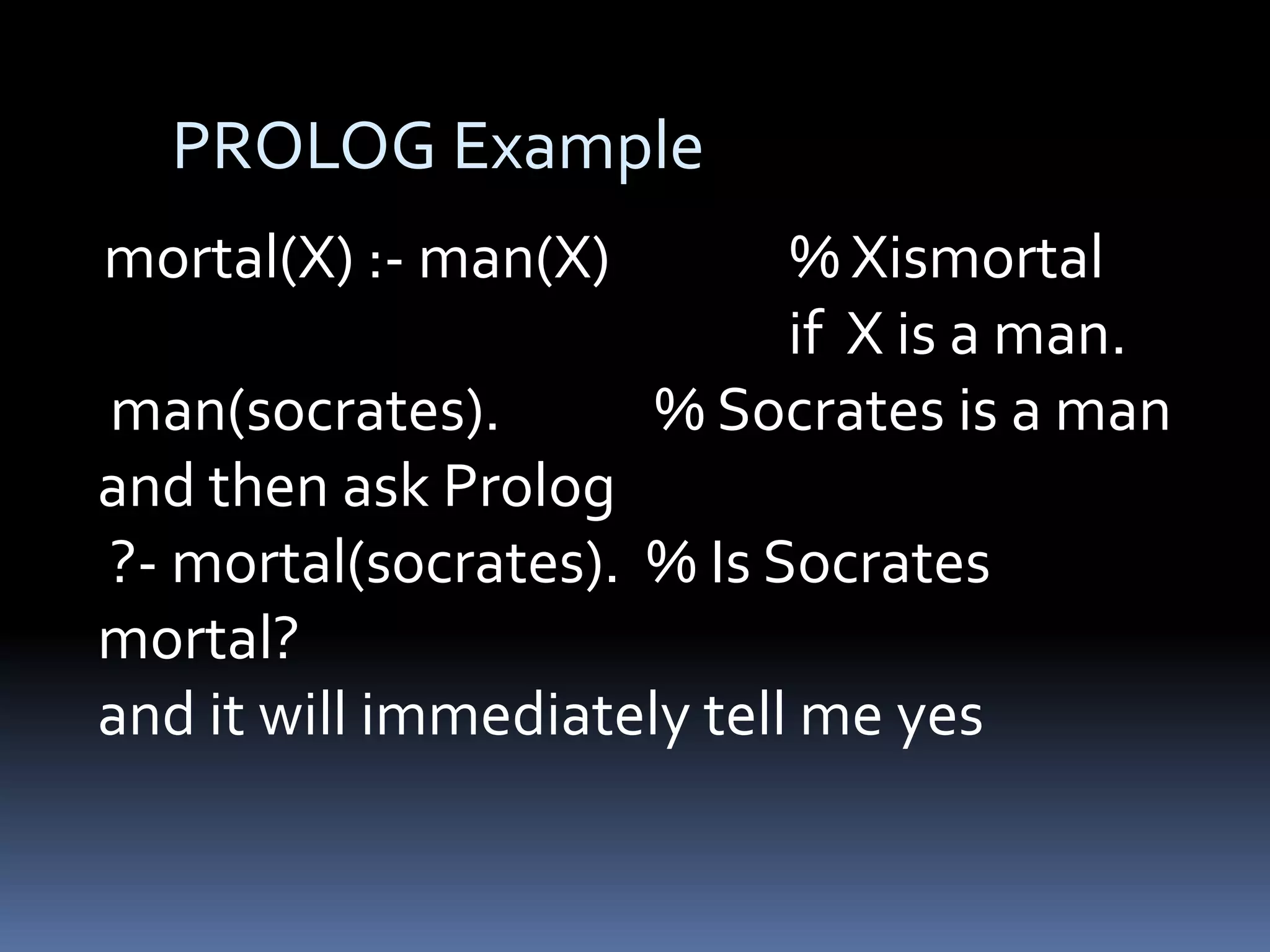
PROLOG Example
mortal(X) :- man(X)

% Xismortal
if X is a man.
% Socrates is a man

man(socrates).
and then ask Prolog
?- mortal(socrates). % Is Socrates
mortal?
and it will immediately tell me yes
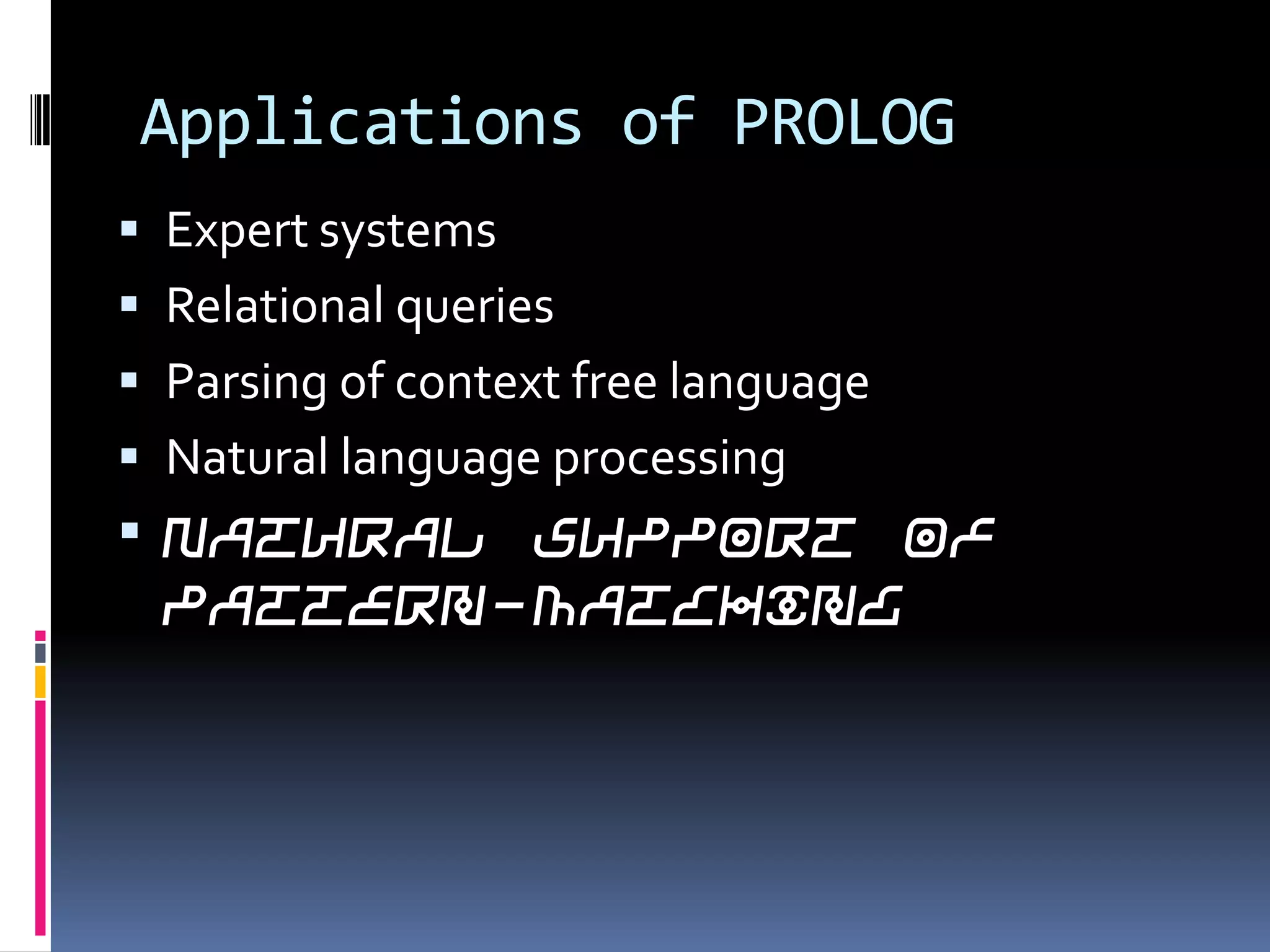
Applications of PROLOG
 Expert systems
 Relational queries
 Parsing of context free language
 Natural language processing

 Natural support of

pattern-matching
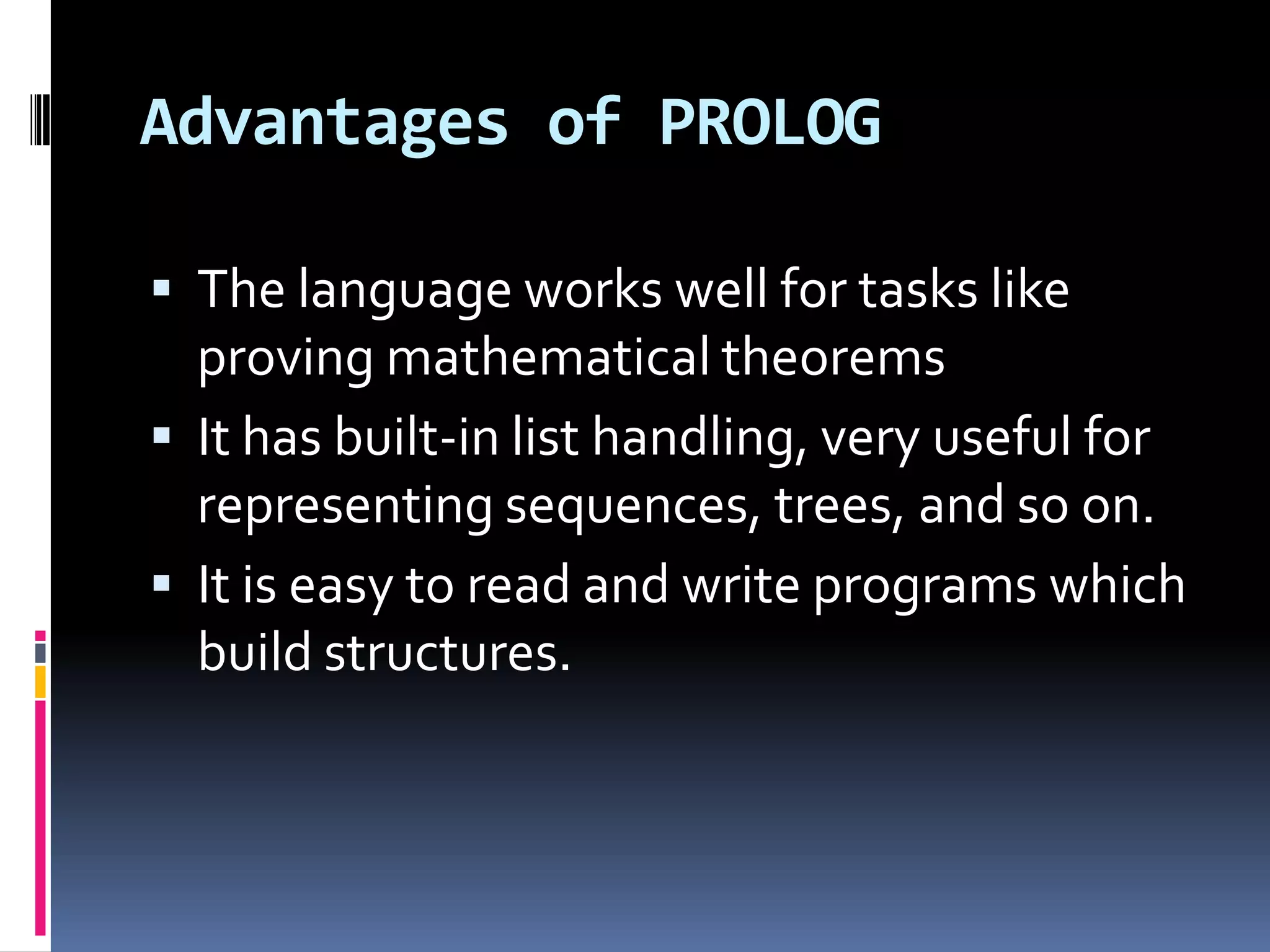
Advantages of PROLOG
 The language works well for tasks like

proving mathematical theorems
 It has built-in list handling, very useful for
representing sequences, trees, and so on.
 It is easy to read and write programs which
build structures.
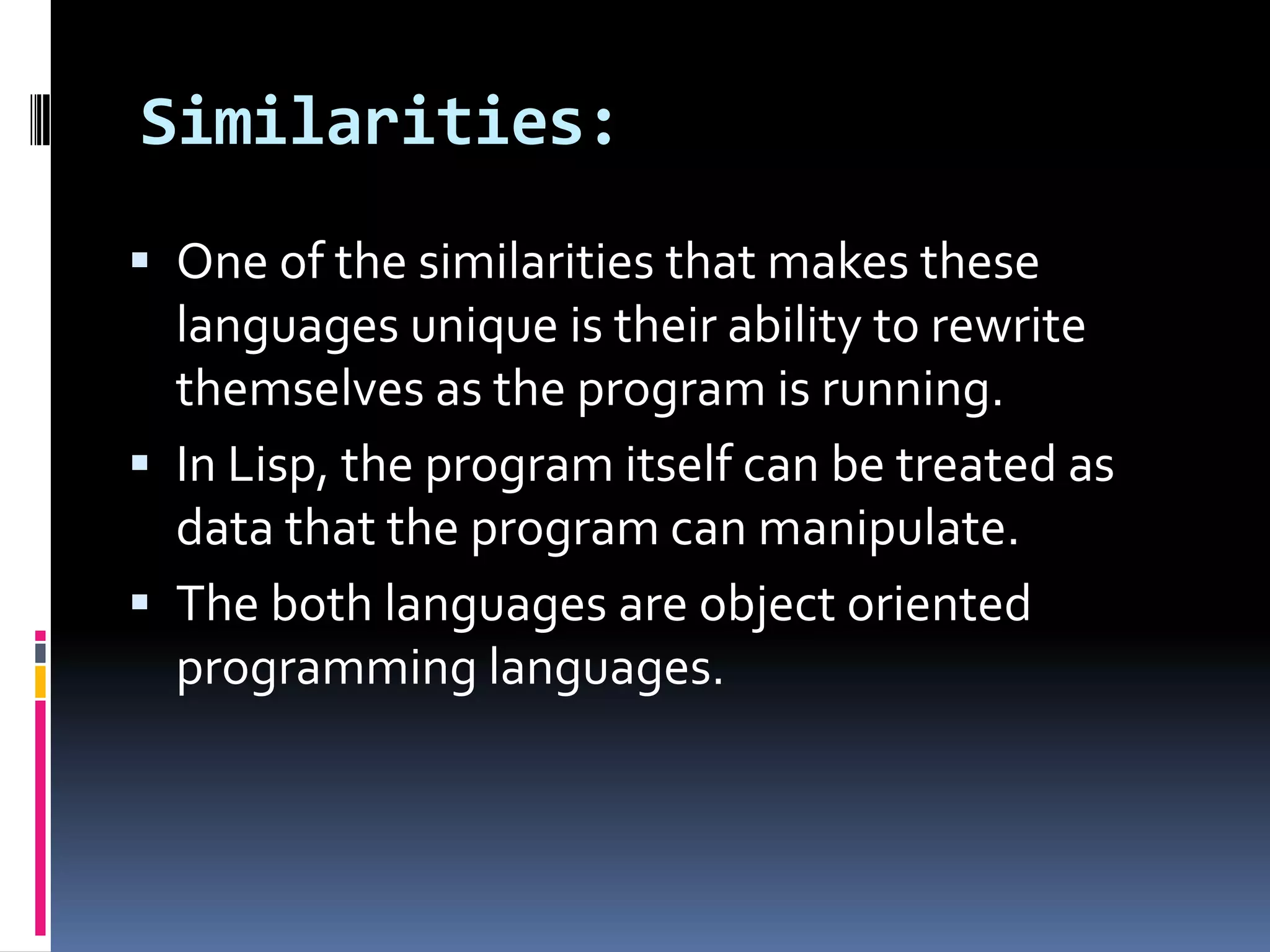
Similarities:
 One of the similarities that makes these

languages unique is their ability to rewrite
themselves as the program is running.
 In Lisp, the program itself can be treated as
data that the program can manipulate.
 The both languages are object oriented
programming languages.
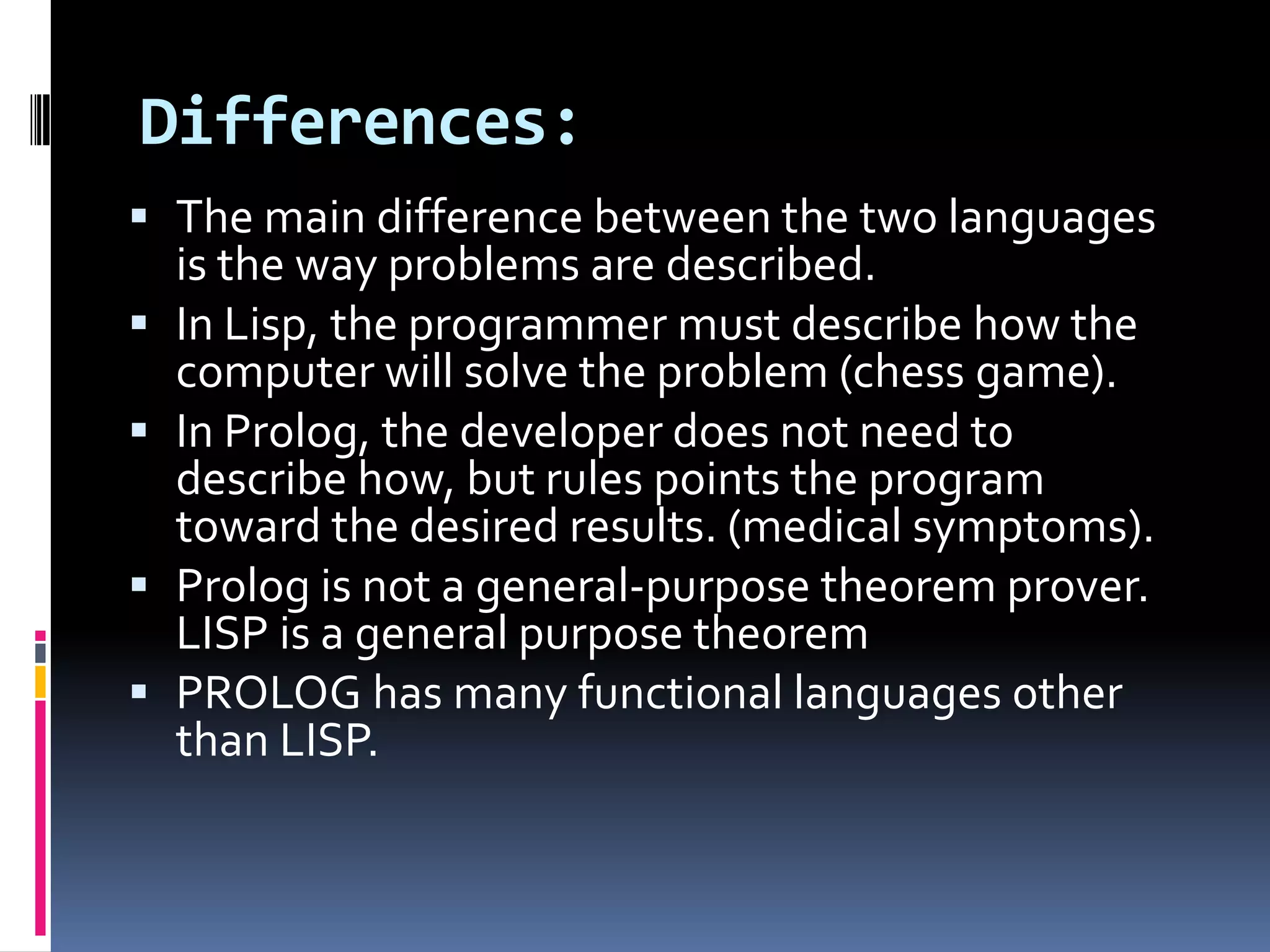
Differences:
 The main difference between the two languages
is the way problems are described.
 In Lisp, the programmer must describe how the
computer will solve the problem (chess game).
 In Prolog, the developer does not need to
describe how, but rules points the program

toward the desired results. (medical symptoms).
 Prolog is not a general-purpose theorem prover.
LISP is a general purpose theorem
 PROLOG has many functional languages other
than LISP.
LISP & PROLOG

PROGRAMMING LANGUAGE
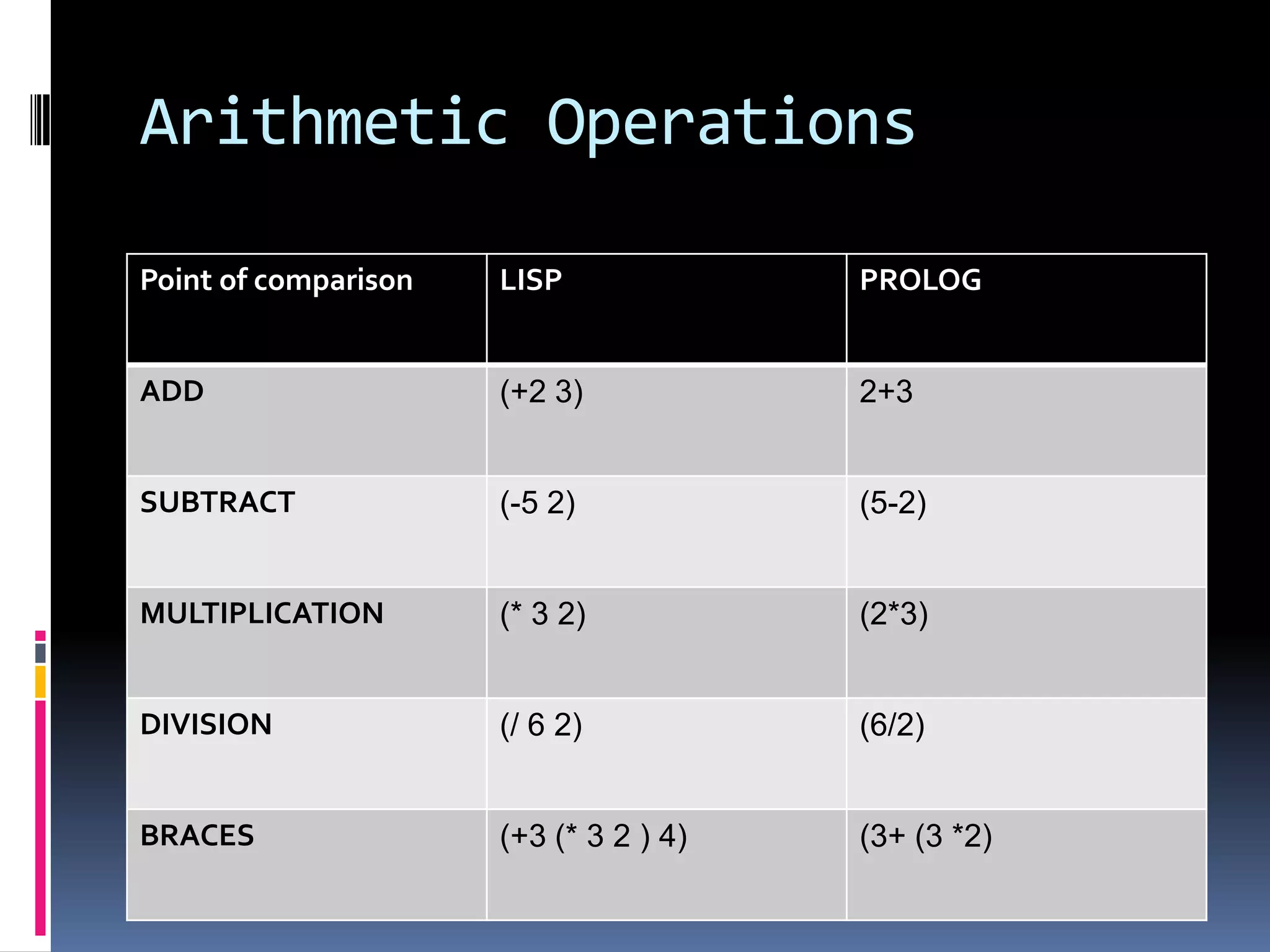
Arithmetic Operations
Point of comparison

LISP

PROLOG

ADD

(+2 3)

2+3

SUBTRACT

(-5 2)

(5-2)

MULTIPLICATION

(* 3 2)

(2*3)

DIVISION

(/ 6 2)

(6/2)

BRACES

(+3 (* 3 2 ) 4)

(3+ (3 *2)
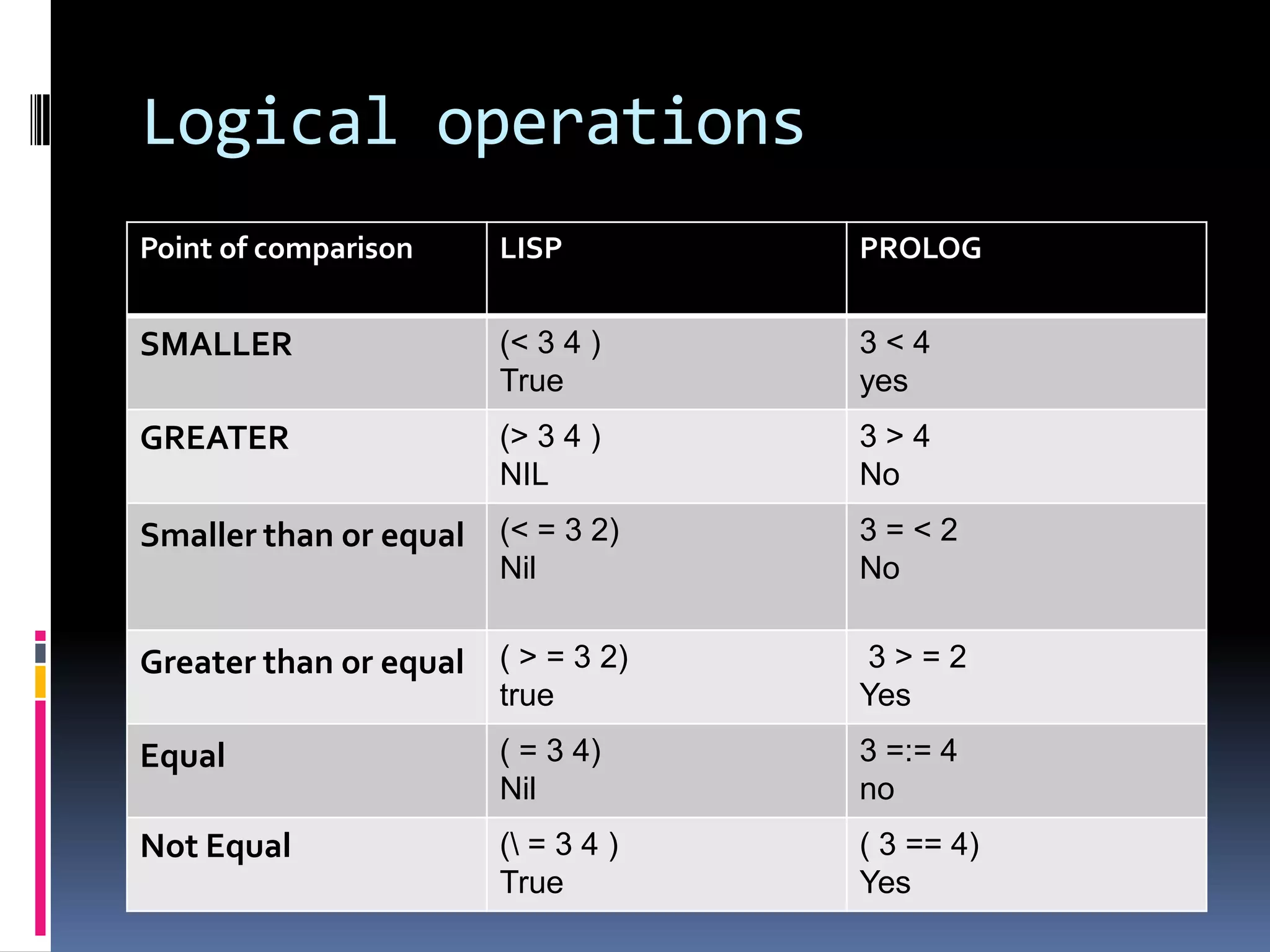
Logical operations
Point of comparison

LISP

PROLOG

SMALLER

(< 3 4 )
True

3<4
yes

GREATER

(> 3 4 )
NIL

3>4
No

Smaller than or equal (< = 3 2)
Nil

Greater than or equal ( > = 3 2)

3=<2
No

true

3>=2
Yes

Equal

( = 3 4)
Nil

3 =:= 4
no

Not Equal

( = 3 4 )
True

( 3 == 4)
Yes
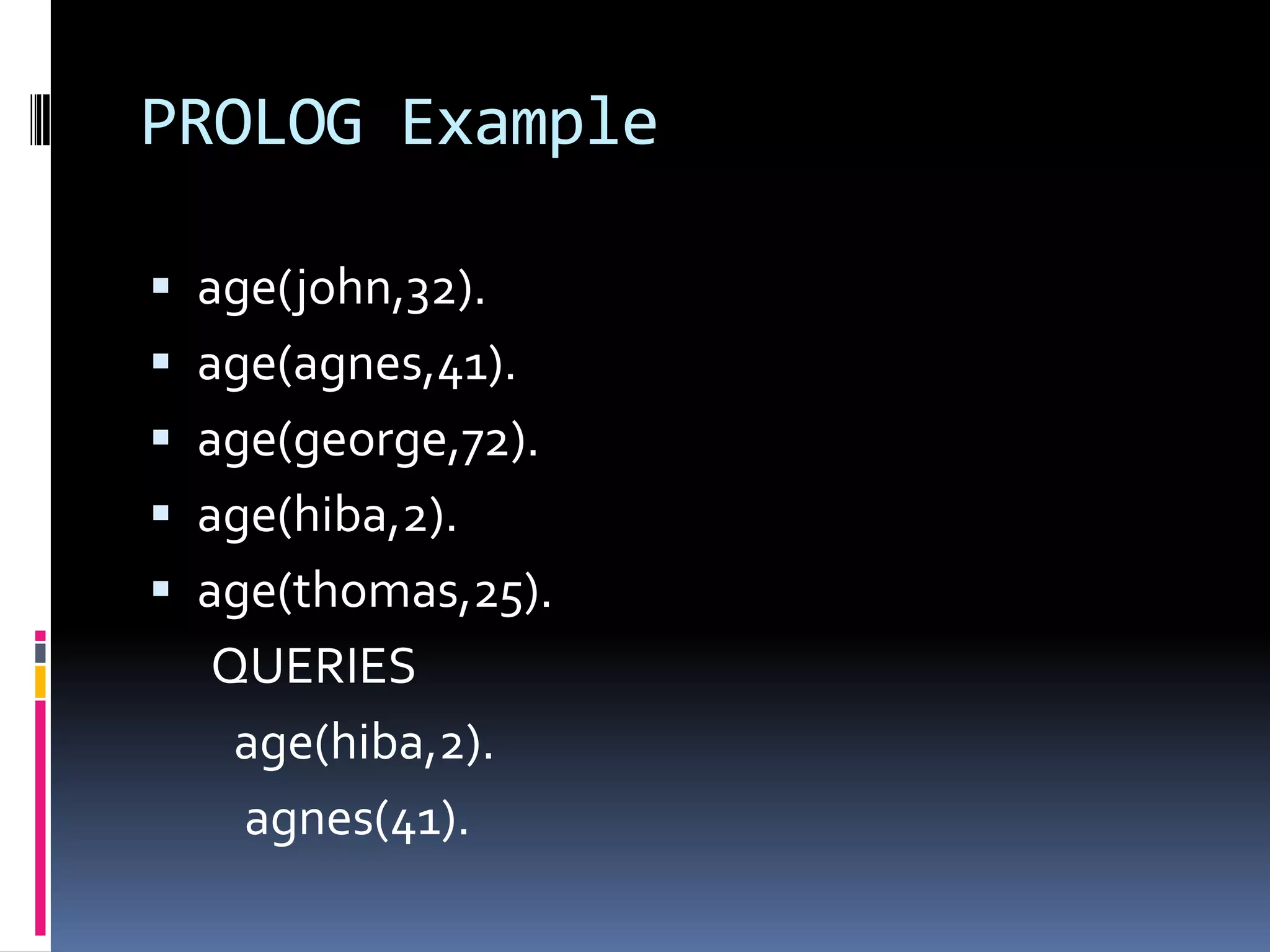
PROLOG Example
 age(john,32).
 age(agnes,41).

 age(george,72).
 age(hiba,2).
 age(thomas,25).

QUERIES
age(hiba,2).
agnes(41).
Thanks

Presentation1

  • 2.
    Topic: Languages Of AI(lisp/prolog) Group Members: Shagufta Arif (027) Sania Alyas (020) Maryam Afza (006)
  • 3.
    What is LISP?? LISPstands for (LIST PROCESSING). It was invented by John McCarthy in 1958. As its name implies, LISP is a programming language that manipulates LISTS.
  • 4.
    LISP Discription: A listis either empty or non-empty. [a, b, c, d] Empty: [] Non-empty: head=[a] tail=[b, c, d]
  • 5.
    Example:  We canimplement a function to compute factorials using recursion:  (defun factorial (N) "Compute the factorial of N." (if (= N 1) 1 (* N (factorial (- N 1)))))
  • 6.
    Example:  Here aresome simple example using the if operator:  CL-USER(): (if (> 3 4)"yes“ "no") ANS: "no“
  • 7.
    Applications of LISP: Mathematics  Artificial intelligence and natural language processing.  Expert Systems (diagnosis, identification, design )
  • 8.
    Advantages of LISP: Common Lisp is :  a general-purpose programming language and an AI language  Common Lisp programs are:  easy to test  easy to maintain (depending on programming style)  intractive
  • 9.
    Cont…  Provides clearsyntax  LISP expressions are case-insensitive.  runtime typing: the programmer need not bother about type declarations  several data types: numbers, strings, arrays, lists, char, symbols etc.
  • 10.
    Disadvantages of LISP The major disadvantage is due to the lack of popularity and lack of widespread support and knowledge.  It is relatively hard to find Lisp programmers.
  • 11.
    What is PROLOG? PROLOG is a declarative language where programs are expressed in terms of relations.  A program in PROLOG can use logical reasoning to answer questions that can be inferred from the knowledge base.
  • 12.
    Cont … A Prologlanguage designed in Europe to support natural language processing. It was created by Alain and Robert 1972 as an alternative to the Lisp programming languages.
  • 13.
    Conti…  There arethree basic stratgies in Prolog: facts, rules, and queries.  A collection of facts and rules which describe some collection of relationships is called a knowledge base.  That is, Prolog programs simply are knowledge bases.
  • 14.
    Conti… Prolog includes aninference engine, which is a process for reasoning logically about information. The inference engine includes a pattern matcher, which retrieves stored (known) information by matching answers to questions. One important feature of Prolog is find all possible solutions rather than only one.
  • 21.
    PROLOG Example mortal(X) :-man(X) % Xismortal if X is a man. % Socrates is a man man(socrates). and then ask Prolog ?- mortal(socrates). % Is Socrates mortal? and it will immediately tell me yes
  • 22.
    Applications of PROLOG Expert systems  Relational queries  Parsing of context free language  Natural language processing  Natural support of pattern-matching
  • 23.
    Advantages of PROLOG The language works well for tasks like proving mathematical theorems  It has built-in list handling, very useful for representing sequences, trees, and so on.  It is easy to read and write programs which build structures.
  • 24.
    Similarities:  One ofthe similarities that makes these languages unique is their ability to rewrite themselves as the program is running.  In Lisp, the program itself can be treated as data that the program can manipulate.  The both languages are object oriented programming languages.
  • 25.
    Differences:  The maindifference between the two languages is the way problems are described.  In Lisp, the programmer must describe how the computer will solve the problem (chess game).  In Prolog, the developer does not need to describe how, but rules points the program toward the desired results. (medical symptoms).  Prolog is not a general-purpose theorem prover. LISP is a general purpose theorem  PROLOG has many functional languages other than LISP.
  • 26.
  • 27.
    Arithmetic Operations Point ofcomparison LISP PROLOG ADD (+2 3) 2+3 SUBTRACT (-5 2) (5-2) MULTIPLICATION (* 3 2) (2*3) DIVISION (/ 6 2) (6/2) BRACES (+3 (* 3 2 ) 4) (3+ (3 *2)
  • 28.
    Logical operations Point ofcomparison LISP PROLOG SMALLER (< 3 4 ) True 3<4 yes GREATER (> 3 4 ) NIL 3>4 No Smaller than or equal (< = 3 2) Nil Greater than or equal ( > = 3 2) 3=<2 No true 3>=2 Yes Equal ( = 3 4) Nil 3 =:= 4 no Not Equal ( = 3 4 ) True ( 3 == 4) Yes
  • 29.
    PROLOG Example  age(john,32). age(agnes,41).  age(george,72).  age(hiba,2).  age(thomas,25). QUERIES age(hiba,2). agnes(41).
  • 30.