Dr.Hafiz Kosar
PROGRAMMES OF ENVIRONMENTAL
EDUCATION
PROGRAMMES OF
ENVIRONMENTAL EDUCATION
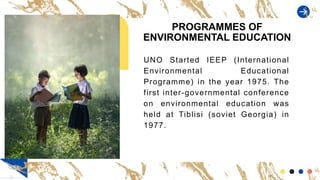
UNO Started IEEP (International
Environmental Educational
Programme) in the year 1975. The
first inter-governmental conference
on environmental education was
held at Tiblisi (soviet Georgia) in
1977.
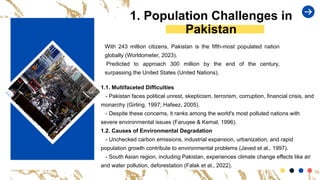
With 243 million citizens, Pakistan is the fifth-most populated nation
globally (Worldometer, 2023).
Predicted to approach 300 million by the end of the century,
surpassing the United States (United Nations).
1. Population Challenges in
Pakistan
1.1. Multifaceted Difficulties
- Pakistan faces political unrest, skepticism, terrorism, corruption, financial crisis, and
monarchy (Girling, 1997; Hafeez, 2005).
- Despite these concerns, it ranks among the world's most polluted nations with
severe environmental issues (Faruqee & Kemal, 1996).
1.2. Causes of Environmental Degradation
- Unchecked carbon emissions, industrial expansion, urbanization, and rapid
population growth contribute to environmental problems (Javed et al., 1997).
- South Asian region, including Pakistan, experiences climate change effects like air
and water pollution, deforestation (Falak et al., 2022).
1. Population Challenges in
Pakistan...
1.3. Lack of Awareness and Hazards
- Environmental problems persist due to a lack of awareness, with serious and
dangerous repercussions (Leiserowitz, 2005).
- Pakistan ranks sixth most vulnerable to climate change, emphasizing its susceptibility
(Eckstein et al., 2018).
1.4 Inadequate Waste Management
- Sectors like textiles, chemicals, pharmaceuticals lack proper waste management
systems (Eckstein et al., 2018).
- Solid waste management (SWM) is a major concern in every Pakistani city, negatively
impacting public health (Iqbal et al., 2022).
1.5 Urgent Need for Action
- Despite environmental challenges, regulators and the government do not prioritize
waste management (Iqbal et al., 2022).
- International forums, including the World Economic Forum, discuss the need for urgent
action to address environmental concerns globally.
2. Environmental Regulatory Boards and the
Conceptual Model
The establishment of the Pakistan Ministry of Environment in 1975 was a pivotal response
to the Stockholm Declaration of 1972. This move signified a commitment to addressing
environmental concerns within the nation. Subsequently, in 1983, the Pakistan
Environmental Protection Ordinance (PEPO) was drafted, marking the inception of the
country's first environmental protection law (Ahsan & Khawaja, 2013).
2.1 Importance of Environmental Regulations
The imposition of strict environmental regulations is essential for any nation prioritizing the
safety of its residents. In the context of Pakistan, these regulations entail stringent
restrictions on production and operational entities. Additionally, there is active supervision
of waste management and pollutant discharge, reinforcing the commitment to
environmental well-being (Arrow et al., 1996).
2.2 Government Initiatives
Recognizing the effectiveness of market-based initiatives, the government strategically
employs them to mitigate environmental pollution. In this approach, environmental
protection laws are formulated, and various organizations and agencies under government
control are instrumental in their implementation.
3. PEPA-97, the Pakistan Environmental
Protection Act of 1997
The Pakistan Environmental Protection Act, 1997 (PEPA-97) was created and put into
effect in 1997 with the goals of protecting, conserving, and restoring the environment as
well as preventing and controlling pollution. Additionally, until 1997, a number of changes
were made to the rules and regulations to improve their usefulness.
PEPA's functions include:
● Assure NEQ's enforcement
● Establishing guidelines for the land, water, and air quality
● Setting up a strategy for preventing and controlling pollution.
Conducting routine surveys, inspections, and monitoring
● Calculating the price of the restoration and cleansing procedures
● Authenticate and authorize labs to do environmental testing and analysis.
● Offering guidance and support as well as encouraging public education and
understanding of environmental difficulties and issues
● Promote the establishment of non-governmental organizations (NGOs) and village
associations to inform the public, implement appropriate pollution control measures, and
advance sustainable development.
3. PEPA-97, the Pakistan Environmental
Protection Act of 1997
The Pakistan Environmental Protection Act, 1997 (PEPA-97) was created and put into
effect in 1997 with the goals of protecting, conserving, and restoring the environment as
well as preventing and controlling pollution. Additionally, until 1997, a number of changes
were made to the rules and regulations to improve their usefulness.
PEPA's functions include:
● Assure NEQ's enforcement
● Establishing guidelines for the land, water, and air quality
● Setting up a strategy for preventing and controlling pollution.
Conducting routine surveys, inspections, and monitoring
● Calculating the price of the restoration and cleansing procedures
● Authenticate and authorize labs to do environmental testing and analysis.
● Offering guidance and support as well as encouraging public education and
understanding of environmental difficulties and issues
● Promote the establishment of non-governmental organizations (NGOs) and village
associations to inform the public, implement appropriate pollution control measures, and
advance sustainable development.
4. The Central Laboratory for Networking and
Environmental Analysis
CLEAN Section 5 of the Pakistan Environmental Act (PEPA) 1997 established the
Pakistan Environmental Protection Agency. Enforcing PEPA 1997 rules and regulations is
one of CLEAN's primary responsibilities.
5. Legal Enforcement Directorate of Pakistan
Environmental Protection Agency
CThe Application of Law Enforcement and execution of environmental legislation and the
National Environmental Quality Standards (NEQS) are major responsibilities of the Pakistan
Environmental Protection Agency's Legal Enforcement (L/E) Directorate.
Determine and remove obstacles that affect the National Environmental Quality Standards
(NEQS) and the enforcement of environmental legislation.
1) Deciding whether new legislation is needed, as well as suggesting changes to the current
laws as needed.
2) Offer legal advice on any environmental matter that is being thought about.
3) Proposal submission and legal penalties in accordance with PEPA Act, 1997, Section 16.
5. Legal Enforcement Directorate of Pakistan
Environmental Protection Agency
4) Assure that the Environmental Monitoring Team has checks and balances to prevent
infractions.
5) When necessary, give the offender summonses or an Environmental Protection Order
(EPO).
6) Getting environmental protection cases ready
6. Environmental Pollution and Role of
Regulations
6.1 The Global Challenge of Environmental Pollution
Environmental pollution poses a significant threat worldwide, and Pakistan is no exception.
Despite its severity, insufficient efforts are being made to address this issue effectively. The
government plays a pivotal role in environmental protection, but in Pakistan, finding effective
strategies amidst financial crises, political instability, corruption, and law and order issues is
a complex challenge.
6. Environmental Pollution and Role of
Regulations
6.2 Market-Based Regulations in Developed Countries
Successful approaches in some developed countries involve market-based regulations that
actively engage private companies and individuals in environmental protection. These
regulations encompass tools such as emission taxes, tax subsidies, environmental
subsidies, and tradeable pollution permits. This collaborative approach aims to create a
synergy between governmental actions and the private sector.
6.3 Challenges in Implementing Regulations in Pakistan
In contrast, Pakistan faces unique challenges. Amidst economic growth, the nation grapples
with severe pollution and stresses on its natural resources. Major environmental concerns
include air pollution, noise pollution, and a shortage of clean drinking water in urban areas.
The pressing issues of financial crises and political instability often take precedence over
environmental goals.
6.4 Water Quality and Scarcity
Rapid urbanization, industrial growth, and population pressure exacerbate the challenge of
access to clean water. The quality of water is a significant concern, leading to the spread of
diseases such as hepatitis, typhoid, cholera, dengue fever, and malaria. Government efforts
to provide clean water vary from region to region, with disparities in water sources and
quality between provinces like Punjab and Sindh.
6. Environmental Pollution and Role of
Regulations
6.5 Noise Pollution in Urban Centers
Noise pollution, particularly in major cities like Karachi, Lahore, Faisalabad, Islamabad,
Peshawar, and Rawalpindi, poses another significant problem. Traffic noise, generated by
various vehicles, contributes substantially to the issue. Studies reveal alarming levels of
noise pollution, surpassing international standards. The health consequences, including
hearing loss and other ailments, underscore the gravity of the situation.
6.6 Lack of Legislation on Traffic Noise
Despite the evident threat, there is a dearth of laws and policies to control traffic noise in
Pakistan. Regulatory bodies, despite facing numerous complaints, encounter legal
constraints and the absence of national noise level standards. Addressing this gap is
essential to mitigate the adverse health effects associated with high levels of noise pollution.
6.7 Climate Change Impacts
While Pakistan is not a major emitter of greenhouse gases contributing to climate change, it
still faces significant impacts. Climate change is a global problem that requires collaborative
efforts from authorities, regulatory bodies, and the public. Working together is crucial to
tackle these environmental challenges and pave the way for a healthier and sustainable
future.
REFERENCES:
Ahsan, I., & Khawaja, S. A. (2013). Development of Environmental Laws and Jurisprudence in Pakistan. Asian
Development Bank.
Arrow, K. J., Cropper, M. L., Eads, G. C., Hahn, R. W., Lave, L. B., Noll, R. G. et al. (1996). Is There a Role for
Benefit-Cost Analysis in Environmental, Health, and Safety Regulation? Science, 272, 221-222.
Eckstein, D., Hutfils, M. L., & Winges, M. (2018). Global Climate Risk Index 2019. Who Suffers Most from
Extreme Weather Events (36 p).
Faruqee, R., & Kemal, A. R. (1996). Role of Economic Policies in Protecting the Environment: The Experience of
Pakistan [with Comments]. The Pakistan Development Review, 35, 483-506.
Iqbal, A., Abdullah, Y., Nizami, A. S., Sultan, I. A., & Sharif, F. (2022). Assessment of Solid Waste Management
System in Pakistan and Sustainable Model from Environmental and Economic Perspective. Sustainability,
14(12680).
Girling, J. (1997). Corruption, Capitalism and Democracy (Vol. 4). Psychology Press.
Mukhtar, Z. (2023). Environmental Pollution and Regulatory and Non-Regulatory Environmental Responsibility
(Reviewing Pakistan Environmental Protection Act). American Journal of Industrial and Business Management,
13(6), 443-456.
Hafeez, Z. J. (2005). Islamic Commercial Law and Economic Development. Islamic Commercial Law.
Leiserowitz, A. A. (2005). American Risk Perceptions: Is Climate Change Dangerous? Risk Analysis: An
International Journal, 25, 1433-1442.
Nadeem, O., & Hameed, R. (2008). Evaluation of Environmental Impact Assessment System in Pakistan.
Environmental Impact Assessment Review, 28, 562-571.
Worldometer (2023). Worldometer—Real Time World Statistics. Worldometer.
THANK YOU!!
Contact us:
hafeezkausar.hashmi@gmail.com
https://www.facebook.com/kausar0791
https://www.linkedin.com/in/dr-hafiz-kosar-284484186/
+92-314-3205571

PROGRAMMES OF ENVIRONMENTAL EDUCATION.pptx

  • 1.
    Dr.Hafiz Kosar PROGRAMMES OFENVIRONMENTAL EDUCATION
  • 2.
    PROGRAMMES OF ENVIRONMENTAL EDUCATION UNOStarted IEEP (International Environmental Educational Programme) in the year 1975. The first inter-governmental conference on environmental education was held at Tiblisi (soviet Georgia) in 1977.
  • 3.
    With 243 millioncitizens, Pakistan is the fifth-most populated nation globally (Worldometer, 2023). Predicted to approach 300 million by the end of the century, surpassing the United States (United Nations). 1. Population Challenges in Pakistan 1.1. Multifaceted Difficulties - Pakistan faces political unrest, skepticism, terrorism, corruption, financial crisis, and monarchy (Girling, 1997; Hafeez, 2005). - Despite these concerns, it ranks among the world's most polluted nations with severe environmental issues (Faruqee & Kemal, 1996). 1.2. Causes of Environmental Degradation - Unchecked carbon emissions, industrial expansion, urbanization, and rapid population growth contribute to environmental problems (Javed et al., 1997). - South Asian region, including Pakistan, experiences climate change effects like air and water pollution, deforestation (Falak et al., 2022).
  • 4.
    1. Population Challengesin Pakistan... 1.3. Lack of Awareness and Hazards - Environmental problems persist due to a lack of awareness, with serious and dangerous repercussions (Leiserowitz, 2005). - Pakistan ranks sixth most vulnerable to climate change, emphasizing its susceptibility (Eckstein et al., 2018). 1.4 Inadequate Waste Management - Sectors like textiles, chemicals, pharmaceuticals lack proper waste management systems (Eckstein et al., 2018). - Solid waste management (SWM) is a major concern in every Pakistani city, negatively impacting public health (Iqbal et al., 2022). 1.5 Urgent Need for Action - Despite environmental challenges, regulators and the government do not prioritize waste management (Iqbal et al., 2022). - International forums, including the World Economic Forum, discuss the need for urgent action to address environmental concerns globally.
  • 5.
    2. Environmental RegulatoryBoards and the Conceptual Model The establishment of the Pakistan Ministry of Environment in 1975 was a pivotal response to the Stockholm Declaration of 1972. This move signified a commitment to addressing environmental concerns within the nation. Subsequently, in 1983, the Pakistan Environmental Protection Ordinance (PEPO) was drafted, marking the inception of the country's first environmental protection law (Ahsan & Khawaja, 2013). 2.1 Importance of Environmental Regulations The imposition of strict environmental regulations is essential for any nation prioritizing the safety of its residents. In the context of Pakistan, these regulations entail stringent restrictions on production and operational entities. Additionally, there is active supervision of waste management and pollutant discharge, reinforcing the commitment to environmental well-being (Arrow et al., 1996). 2.2 Government Initiatives Recognizing the effectiveness of market-based initiatives, the government strategically employs them to mitigate environmental pollution. In this approach, environmental protection laws are formulated, and various organizations and agencies under government control are instrumental in their implementation.
  • 6.
    3. PEPA-97, thePakistan Environmental Protection Act of 1997 The Pakistan Environmental Protection Act, 1997 (PEPA-97) was created and put into effect in 1997 with the goals of protecting, conserving, and restoring the environment as well as preventing and controlling pollution. Additionally, until 1997, a number of changes were made to the rules and regulations to improve their usefulness. PEPA's functions include: ● Assure NEQ's enforcement ● Establishing guidelines for the land, water, and air quality ● Setting up a strategy for preventing and controlling pollution. Conducting routine surveys, inspections, and monitoring ● Calculating the price of the restoration and cleansing procedures ● Authenticate and authorize labs to do environmental testing and analysis. ● Offering guidance and support as well as encouraging public education and understanding of environmental difficulties and issues ● Promote the establishment of non-governmental organizations (NGOs) and village associations to inform the public, implement appropriate pollution control measures, and advance sustainable development.
  • 7.
    3. PEPA-97, thePakistan Environmental Protection Act of 1997 The Pakistan Environmental Protection Act, 1997 (PEPA-97) was created and put into effect in 1997 with the goals of protecting, conserving, and restoring the environment as well as preventing and controlling pollution. Additionally, until 1997, a number of changes were made to the rules and regulations to improve their usefulness. PEPA's functions include: ● Assure NEQ's enforcement ● Establishing guidelines for the land, water, and air quality ● Setting up a strategy for preventing and controlling pollution. Conducting routine surveys, inspections, and monitoring ● Calculating the price of the restoration and cleansing procedures ● Authenticate and authorize labs to do environmental testing and analysis. ● Offering guidance and support as well as encouraging public education and understanding of environmental difficulties and issues ● Promote the establishment of non-governmental organizations (NGOs) and village associations to inform the public, implement appropriate pollution control measures, and advance sustainable development.
  • 8.
    4. The CentralLaboratory for Networking and Environmental Analysis CLEAN Section 5 of the Pakistan Environmental Act (PEPA) 1997 established the Pakistan Environmental Protection Agency. Enforcing PEPA 1997 rules and regulations is one of CLEAN's primary responsibilities. 5. Legal Enforcement Directorate of Pakistan Environmental Protection Agency CThe Application of Law Enforcement and execution of environmental legislation and the National Environmental Quality Standards (NEQS) are major responsibilities of the Pakistan Environmental Protection Agency's Legal Enforcement (L/E) Directorate. Determine and remove obstacles that affect the National Environmental Quality Standards (NEQS) and the enforcement of environmental legislation. 1) Deciding whether new legislation is needed, as well as suggesting changes to the current laws as needed. 2) Offer legal advice on any environmental matter that is being thought about. 3) Proposal submission and legal penalties in accordance with PEPA Act, 1997, Section 16.
  • 9.
    5. Legal EnforcementDirectorate of Pakistan Environmental Protection Agency 4) Assure that the Environmental Monitoring Team has checks and balances to prevent infractions. 5) When necessary, give the offender summonses or an Environmental Protection Order (EPO). 6) Getting environmental protection cases ready 6. Environmental Pollution and Role of Regulations 6.1 The Global Challenge of Environmental Pollution Environmental pollution poses a significant threat worldwide, and Pakistan is no exception. Despite its severity, insufficient efforts are being made to address this issue effectively. The government plays a pivotal role in environmental protection, but in Pakistan, finding effective strategies amidst financial crises, political instability, corruption, and law and order issues is a complex challenge.
  • 10.
    6. Environmental Pollutionand Role of Regulations 6.2 Market-Based Regulations in Developed Countries Successful approaches in some developed countries involve market-based regulations that actively engage private companies and individuals in environmental protection. These regulations encompass tools such as emission taxes, tax subsidies, environmental subsidies, and tradeable pollution permits. This collaborative approach aims to create a synergy between governmental actions and the private sector. 6.3 Challenges in Implementing Regulations in Pakistan In contrast, Pakistan faces unique challenges. Amidst economic growth, the nation grapples with severe pollution and stresses on its natural resources. Major environmental concerns include air pollution, noise pollution, and a shortage of clean drinking water in urban areas. The pressing issues of financial crises and political instability often take precedence over environmental goals. 6.4 Water Quality and Scarcity Rapid urbanization, industrial growth, and population pressure exacerbate the challenge of access to clean water. The quality of water is a significant concern, leading to the spread of diseases such as hepatitis, typhoid, cholera, dengue fever, and malaria. Government efforts to provide clean water vary from region to region, with disparities in water sources and quality between provinces like Punjab and Sindh.
  • 11.
    6. Environmental Pollutionand Role of Regulations 6.5 Noise Pollution in Urban Centers Noise pollution, particularly in major cities like Karachi, Lahore, Faisalabad, Islamabad, Peshawar, and Rawalpindi, poses another significant problem. Traffic noise, generated by various vehicles, contributes substantially to the issue. Studies reveal alarming levels of noise pollution, surpassing international standards. The health consequences, including hearing loss and other ailments, underscore the gravity of the situation. 6.6 Lack of Legislation on Traffic Noise Despite the evident threat, there is a dearth of laws and policies to control traffic noise in Pakistan. Regulatory bodies, despite facing numerous complaints, encounter legal constraints and the absence of national noise level standards. Addressing this gap is essential to mitigate the adverse health effects associated with high levels of noise pollution. 6.7 Climate Change Impacts While Pakistan is not a major emitter of greenhouse gases contributing to climate change, it still faces significant impacts. Climate change is a global problem that requires collaborative efforts from authorities, regulatory bodies, and the public. Working together is crucial to tackle these environmental challenges and pave the way for a healthier and sustainable future.
  • 12.
    REFERENCES: Ahsan, I., &Khawaja, S. A. (2013). Development of Environmental Laws and Jurisprudence in Pakistan. Asian Development Bank. Arrow, K. J., Cropper, M. L., Eads, G. C., Hahn, R. W., Lave, L. B., Noll, R. G. et al. (1996). Is There a Role for Benefit-Cost Analysis in Environmental, Health, and Safety Regulation? Science, 272, 221-222. Eckstein, D., Hutfils, M. L., & Winges, M. (2018). Global Climate Risk Index 2019. Who Suffers Most from Extreme Weather Events (36 p). Faruqee, R., & Kemal, A. R. (1996). Role of Economic Policies in Protecting the Environment: The Experience of Pakistan [with Comments]. The Pakistan Development Review, 35, 483-506. Iqbal, A., Abdullah, Y., Nizami, A. S., Sultan, I. A., & Sharif, F. (2022). Assessment of Solid Waste Management System in Pakistan and Sustainable Model from Environmental and Economic Perspective. Sustainability, 14(12680). Girling, J. (1997). Corruption, Capitalism and Democracy (Vol. 4). Psychology Press. Mukhtar, Z. (2023). Environmental Pollution and Regulatory and Non-Regulatory Environmental Responsibility (Reviewing Pakistan Environmental Protection Act). American Journal of Industrial and Business Management, 13(6), 443-456. Hafeez, Z. J. (2005). Islamic Commercial Law and Economic Development. Islamic Commercial Law. Leiserowitz, A. A. (2005). American Risk Perceptions: Is Climate Change Dangerous? Risk Analysis: An International Journal, 25, 1433-1442. Nadeem, O., & Hameed, R. (2008). Evaluation of Environmental Impact Assessment System in Pakistan. Environmental Impact Assessment Review, 28, 562-571. Worldometer (2023). Worldometer—Real Time World Statistics. Worldometer.
  • 13.