REDD+ MRV in
Ethiopia
Review of the context, framework and
progress
Manuel Boissière, Solomon Zewdie, Melaku Bekele, Stibniati
Atmadja
Nexus Hotel, Addis Ababa, 5 April 2019
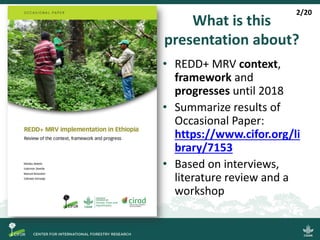
What is this
presentation about?
• REDD+ MRV context,
framework and
progresses until 2018
• Summarize results of
Occasional Paper:
https://www.cifor.org/li
brary/7153
• Based on interviews,
literature review and a
workshop
2/20
Outline
• Context
o History
o Forest definition
o Functions of MRV
o Spatial data
• Framework
o Institutional arrangements
o Social aspects
• Progress:
o Current implementation
o Challenges and
opportunities
3/20
CONTEXT
4/20
History (1)
Pre-REDD+ (1970s – 2010)
• High deforestation and land degradation
• Reforestation and afforestation promoted
• Farmers encouraged to plant trees
• PFM to increase community engagement
Post REDD+ (2010 – present)
• GTP and CRGE
• MEFCC established (became EFCCC in 2018)
• Start of REDD+, including REDD+ MRV
5/20
History (2)
• 2013 - 2018: REDD+ readiness with financial support from
Forest Carbon Partnership Facility, Norway, UK
• 2013: ToR for developing capacities for national MRV
system
• 2014: NFI launched
• 2015: New forest definition
• 2016: MRV unit established in the ministry
• 2017: institutional framework is developed for REDD+
MRV implementation; Final FRL submission to UNFCCC
MRV Milestones (2010 – present)
6/20
Forest definition
Ethiopia’s FRL FAO’s Forest Resource
Assessment
Land spanning at least 0.5 ha,
covered by trees (incl bamboo)
attaining a height of at least 2m
and a canopy cover of at least
20% or trees with the potential to
reach these thresholds in situ in
due course
Land spanning more than 0.5
hectares with trees higher than 5
meters and a canopy cover of
more than 10 percent, or trees
able to reach these thresholds in
situ. It does not include land that
is predominantly under
agricultural or urban land use.
7/20
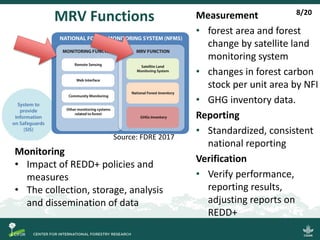
MRV Functions
Monitoring
• Impact of REDD+ policies and
measures
• The collection, storage, analysis
and dissemination of data
Measurement
• forest area and forest
change by satellite land
monitoring system
• changes in forest carbon
stock per unit area by NFI
• GHG inventory data.
Reporting
• Standardized, consistent
national reporting
Verification
• Verify performance,
reporting results,
adjusting reports on
REDD+
8/20
Source: FDRE 2017
Spatial data and ground survey
5 interelated spatial datasets
1. LULC change map (2013)
2. Forest/non forest map
o Forest: high forest, riverine forest, dense woodland, plantation, bamboo
o Non-forest: agriculture, shrubland, grassland, builtup, bare land, water, no
data
3. Forest area change (AD): average of annual forest loss and gain in
hectares, 2000 and 2013
4. Carbon stock assessment (EFs)
o 3 carbon pools: above, below ground and deadwood
o 4 biomes: moist Afromontane forest, dry Afromontane forest, Combretum-
Terminalia dry forest, Acacia-Commiphora dry forest
5. Forest Reference Level (2000-2013), based on 3 components: extent
of forest area, AD, EF
9/20
FRAMEWORK
10/20
General framework
• Decentralized management of REDD+ MRV
• Defined roles and responsibilities at federal,
regional and local levels
• MRV unit’s responsibilities
o produce, verify and disseminate forest statistics (AD, EF)
o oversee overall REDD+ MRV activities
• Permanent MRV entities at federal and regional
levels
• National REDD+ secretariat and regional
counterparts are project-based
11/20
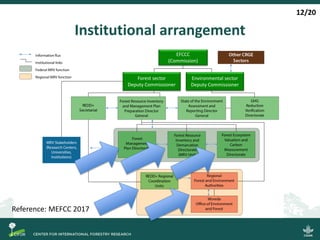
Institutional arrangement
EFCCC
(Commission)
Forest sector
Deputy Commissioner
Environmental sector
Deputy Commissioner
Reference: MEFCC 2017
12/20
Participation of local communities (1)
• Need to explore and test participatory
monitoring approaches for MRV – highlighted
in R-PP.
• Necessary to sustain forest monitoring
activities, reduce cost, and empower local
communities
• Still no engagement of local communities in
REDD+ MRV; initiatives on forest monitoring in
Participatory Forest Management (PFM).
13/20
Participation of local communities (2)
3 issues:
• Social safeguards: SIS prepared but not yet
implemented
• Benefit sharing: different initiatives for Result
Based Payments (OFLP, Bale Ecoregion) but
need for a harmonised approach
• Sustaining participation: need good
motivation and incentive to participate
14/20
PROGRESS
15/20
Based on the discussions during the MRV workshop, October 6th, 2017, Addis Ababa
Current implementation
• Crucial MRV deliverables:
o LULC map
o NFI completed
o carbon stock data (EF) generated
o national forest cover change (AD) analysed using Landsat
imagery
o national SIS being developed
• National REDD+ MRV institutional arrangements have been
established
• Policies, guidelines for NFI and NFMS have been developed
• Human capacity and MRV facilities are being built, in
collaboration with FAO (in country MRV capacity building)
and WGCF, through training
16/20
Challenges (1)Sectoral
• Weak inter-sectoral coordination
• Ministry (2013)  commission (2018) = possible implications on the
coordination role of the commission for CRGE MRV activities
Technical
• Limited capacity for MRV of forest degradation
• Limited incentives to maintain trained staff and avoid turnover
• Insufficient in-country technical capacity to run the system
Buy-in from local and national stakeholders
• Little tangible action to enhance local people participation and to
integrate participatory MRV into the national MRV system framework
• Sustainable financing through direct national support is still needed to
ensure national ownership
17/20
Challenges (2)
Safeguards
• Operationalizing SIS is still needed
• Information sharing on SIS needs to be done at the local level for
better engagement
• Need better recognition of local communities’ rights on forests
• Need to enforce implementation of environmental safeguards
Benefit sharing
• BSM activities still in a pilot stage, need to be developed at
national level
• Risk of raising expectations
• Local people need to be better engaged in the BSM development
18/20
Opportunities
• Government’s endorsement of an institutional framework for
REDD+ MRV: important to ensure government’s ownership and
sustainability of the MRV system
• The recognition of the forestry sector’s vital role in the CRGE
should allow a stronger political buy-in of Ethiopia’s REDD+ MRV
• Ethiopia’s REDD+ MRV system development
o Brings financial support to national capacity building on forest
observation
o Generates robust data about the sector
o Helps modernize the forestry sector development and planning
o Improves data transparency (MRV web portal)
• National MRV capacity building (WGCF-NR) = opportunity to build
local spatial data infrastructure and human capacity -> ensure
sustainability
19/20
cifor.org
forestsnews.cifor.org
ForestsTreesAgroforestry.org
THANK YOU / አመሰግናለሁ
CONTACT: M.BOISSIERE@CGIAR.ORG

REDD+ MRV in Ethiopia

  • 1.
    REDD+ MRV in Ethiopia Reviewof the context, framework and progress Manuel Boissière, Solomon Zewdie, Melaku Bekele, Stibniati Atmadja Nexus Hotel, Addis Ababa, 5 April 2019
  • 2.
    What is this presentationabout? • REDD+ MRV context, framework and progresses until 2018 • Summarize results of Occasional Paper: https://www.cifor.org/li brary/7153 • Based on interviews, literature review and a workshop 2/20
  • 3.
    Outline • Context o History oForest definition o Functions of MRV o Spatial data • Framework o Institutional arrangements o Social aspects • Progress: o Current implementation o Challenges and opportunities 3/20
  • 4.
  • 5.
    History (1) Pre-REDD+ (1970s– 2010) • High deforestation and land degradation • Reforestation and afforestation promoted • Farmers encouraged to plant trees • PFM to increase community engagement Post REDD+ (2010 – present) • GTP and CRGE • MEFCC established (became EFCCC in 2018) • Start of REDD+, including REDD+ MRV 5/20
  • 6.
    History (2) • 2013- 2018: REDD+ readiness with financial support from Forest Carbon Partnership Facility, Norway, UK • 2013: ToR for developing capacities for national MRV system • 2014: NFI launched • 2015: New forest definition • 2016: MRV unit established in the ministry • 2017: institutional framework is developed for REDD+ MRV implementation; Final FRL submission to UNFCCC MRV Milestones (2010 – present) 6/20
  • 7.
    Forest definition Ethiopia’s FRLFAO’s Forest Resource Assessment Land spanning at least 0.5 ha, covered by trees (incl bamboo) attaining a height of at least 2m and a canopy cover of at least 20% or trees with the potential to reach these thresholds in situ in due course Land spanning more than 0.5 hectares with trees higher than 5 meters and a canopy cover of more than 10 percent, or trees able to reach these thresholds in situ. It does not include land that is predominantly under agricultural or urban land use. 7/20
  • 8.
    MRV Functions Monitoring • Impactof REDD+ policies and measures • The collection, storage, analysis and dissemination of data Measurement • forest area and forest change by satellite land monitoring system • changes in forest carbon stock per unit area by NFI • GHG inventory data. Reporting • Standardized, consistent national reporting Verification • Verify performance, reporting results, adjusting reports on REDD+ 8/20 Source: FDRE 2017
  • 9.
    Spatial data andground survey 5 interelated spatial datasets 1. LULC change map (2013) 2. Forest/non forest map o Forest: high forest, riverine forest, dense woodland, plantation, bamboo o Non-forest: agriculture, shrubland, grassland, builtup, bare land, water, no data 3. Forest area change (AD): average of annual forest loss and gain in hectares, 2000 and 2013 4. Carbon stock assessment (EFs) o 3 carbon pools: above, below ground and deadwood o 4 biomes: moist Afromontane forest, dry Afromontane forest, Combretum- Terminalia dry forest, Acacia-Commiphora dry forest 5. Forest Reference Level (2000-2013), based on 3 components: extent of forest area, AD, EF 9/20
  • 10.
  • 11.
    General framework • Decentralizedmanagement of REDD+ MRV • Defined roles and responsibilities at federal, regional and local levels • MRV unit’s responsibilities o produce, verify and disseminate forest statistics (AD, EF) o oversee overall REDD+ MRV activities • Permanent MRV entities at federal and regional levels • National REDD+ secretariat and regional counterparts are project-based 11/20
  • 12.
    Institutional arrangement EFCCC (Commission) Forest sector DeputyCommissioner Environmental sector Deputy Commissioner Reference: MEFCC 2017 12/20
  • 13.
    Participation of localcommunities (1) • Need to explore and test participatory monitoring approaches for MRV – highlighted in R-PP. • Necessary to sustain forest monitoring activities, reduce cost, and empower local communities • Still no engagement of local communities in REDD+ MRV; initiatives on forest monitoring in Participatory Forest Management (PFM). 13/20
  • 14.
    Participation of localcommunities (2) 3 issues: • Social safeguards: SIS prepared but not yet implemented • Benefit sharing: different initiatives for Result Based Payments (OFLP, Bale Ecoregion) but need for a harmonised approach • Sustaining participation: need good motivation and incentive to participate 14/20
  • 15.
    PROGRESS 15/20 Based on thediscussions during the MRV workshop, October 6th, 2017, Addis Ababa
  • 16.
    Current implementation • CrucialMRV deliverables: o LULC map o NFI completed o carbon stock data (EF) generated o national forest cover change (AD) analysed using Landsat imagery o national SIS being developed • National REDD+ MRV institutional arrangements have been established • Policies, guidelines for NFI and NFMS have been developed • Human capacity and MRV facilities are being built, in collaboration with FAO (in country MRV capacity building) and WGCF, through training 16/20
  • 17.
    Challenges (1)Sectoral • Weakinter-sectoral coordination • Ministry (2013)  commission (2018) = possible implications on the coordination role of the commission for CRGE MRV activities Technical • Limited capacity for MRV of forest degradation • Limited incentives to maintain trained staff and avoid turnover • Insufficient in-country technical capacity to run the system Buy-in from local and national stakeholders • Little tangible action to enhance local people participation and to integrate participatory MRV into the national MRV system framework • Sustainable financing through direct national support is still needed to ensure national ownership 17/20
  • 18.
    Challenges (2) Safeguards • OperationalizingSIS is still needed • Information sharing on SIS needs to be done at the local level for better engagement • Need better recognition of local communities’ rights on forests • Need to enforce implementation of environmental safeguards Benefit sharing • BSM activities still in a pilot stage, need to be developed at national level • Risk of raising expectations • Local people need to be better engaged in the BSM development 18/20
  • 19.
    Opportunities • Government’s endorsementof an institutional framework for REDD+ MRV: important to ensure government’s ownership and sustainability of the MRV system • The recognition of the forestry sector’s vital role in the CRGE should allow a stronger political buy-in of Ethiopia’s REDD+ MRV • Ethiopia’s REDD+ MRV system development o Brings financial support to national capacity building on forest observation o Generates robust data about the sector o Helps modernize the forestry sector development and planning o Improves data transparency (MRV web portal) • National MRV capacity building (WGCF-NR) = opportunity to build local spatial data infrastructure and human capacity -> ensure sustainability 19/20
  • 20.
    cifor.org forestsnews.cifor.org ForestsTreesAgroforestry.org THANK YOU /አመሰግናለሁ CONTACT: M.BOISSIERE@CGIAR.ORG