Global Education and
Development Process
Dr Hafiz Kosar
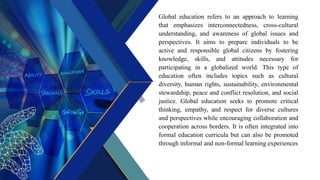
Global education refers to an approach to learning
that emphasizes interconnectedness, cross-cultural
understanding, and awareness of global issues and
perspectives. It aims to prepare individuals to be
active and responsible global citizens by fostering
knowledge, skills, and attitudes necessary for
participating in a globalized world. This type of
education often includes topics such as cultural
diversity, human rights, sustainability, environmental
stewardship, peace and conflict resolution, and social
justice. Global education seeks to promote critical
thinking, empathy, and respect for diverse cultures
and perspectives while encouraging collaboration and
cooperation across borders. It is often integrated into
formal education curricula but can also be promoted
through informal and non-formal learning experiences
Global education aims to foster an understanding of global
interconnectedness, promote respect for diversity, and empower
individuals to contribute positively to a sustainable and peaceful world.
Some of the main objectives of global education include the following:
Objectives of Global Education...
Promoting Intercultural
Understanding
Developing Global
Citizenship:
Globaleducationseekstoenhanceunderstanding
and app reciation of diverse cultures, traditions,
and perspectives worldwide. It encourages
individuals to recognize similarities and
differencesamongpeoplesandtorespectcultural
diversity.
Global education aims to cultivate a sense of
global citizenship, where individuals feel
connected to and responsible for the well-
being of people and the planetbeyond their
immediatecommunities or national borders. It
emphasizes the importance of ethical decision-
making, social justice, and human rights.
Objectives of Global Education...
Fostering Critical Thinking
and Inquiry Skills:
Promoting Sustainable
Development:
Global education encourages critical thinking,
analyticalskills,andtheabilitytoevaluateinformation
from multiple sources. It empowers individuals to
question assumptions, examine complex global
issues, and develop informed perspectives on global
challengessuchaspoverty,inequality,climatechange,
andconflict.
Global education advocates for sustainability and
environmental stewardship by raising awareness of
interconnected global challenges, such as climate
change, resource depletion, and environmental
degradation.
Objectives of Global Education...
Encouraging Dialogue and
Collaboration:
Empowering Individuals to
Take Action:
Global education fosters dialogue, cooperation, and
collaboration across cultures, countries, and
communities. It promotes communication skills
,empathy,andactivelistening,enablingindividualsto
engage in constructive dialogue, resolve conflicts
peacefully,andworktogethertoaddresssharedglobal
challenges.
GE empowers individuals to become agents of
positive change in their communities and beyond. It
provides opportunities for civic engagement, social
activism, and volunteering, enabling individuals to
contribute to sustainable development, social
justice, and peacebuilding efforts locally and
globally.
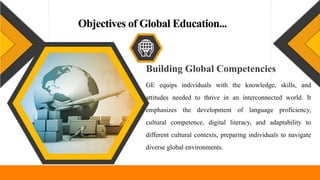
Building Global Competencies
GE equips individuals with the knowledge, skills, and
attitudes needed to thrive in an interconnected world. It
emphasizes the development of language proficiency,
cultural competence, digital literacy, and adaptability to
different cultural contexts, preparing individuals to navigate
diverse global environments.
Objectives of Global Education...
The Global Education and
Development Process
The Global Education and Development
Process
The global education and development process
encompasses a wide range of initiatives, policies, and
practices aimed at improving educational outcomes and
fostering socio-economic development worldwide.
Here's an overview of some key aspects:
The Global Education and Development Process
Access to Education
01
02 Quality Education
One of the primary goals is to ensure that all
individuals, regardless ofOne of the primary goals is
to ensure that all individuals, regardless of their
background or circumstances, have access to quality
education. This includes initiatives to address
barriers such as poverty, gender inequality,
disabilities, and geographic isolation.
It's not just about access but also about the quality of
education provided. Efforts are made to enhance the
quality of teaching and learning, curriculum
development, infrastructure, and educational
resources.
The Global Education and Development Process
Equity and Inclusion
03
04 Lifelong Learning
Education should be inclusive and equitable. Efforts
are directed towards reducing disparities in access to
education and ensuring that marginalized groups
such as girls, ethnic minorities, children with
disabilities, and refugees have equal opportunities to
learn.
Recognizing that education is a lifelong process,
initiatives promote continuous learning opportunities
for people of all ages, from early childhood
education to adult literacy programs.
The Global Education and Development Process
Skill Development and Training
05
06 Teacher Training and Professional Development
Education plays a crucial role in equipping
individuals with the skills and knowledge needed to
participate effectively in the workforce and
contribute to economic development. Vocational
training and technical education programs are often
emphasized alongside traditional academic
education.
Investing in teachers is essential for improving
educational outcomes. Programs for teacher training and
professional development aim to enhance teaching skills,
update pedagogical approaches, and support the well-
being of educators.
The Global Education and Development Process
Technology in Education:
07
08
Partnerships and Collaboration:
E-Technology can be a powerful tool for expanding
access to education, improving learning outcomes,
and fostering innovation in teaching methods.
Efforts are made to integrate technology into
educational systems and provide digital resources
and infrastructure.
Addressing global education challenges requires
collaboration among governments, non-governmental
organizations, international agencies, private sector
actors, and local communities. Partnerships facilitate
resource mobilization, knowledge sharing, and
coordinated action.
The Global Education and Development Process
Policy and Advocacy:
09
10
Monitoring and Evaluation:
Policy frameworks at the national and international
levels play a crucial role in shaping education and
development agendas. Advocacy efforts aim to raise
awareness, mobilize political will, and influence
policy decisions to prioritize education and
development goals.
It's important to track progress towards education and
development objectives and identify areas for
improvement. Monitoring and evaluation mechanisms
help assess the effectiveness of interventions, identify
best practices, and inform future policy and
programming.
How is Global Education Implemented?
10
1. Integrating global themes into traditional subjects:
For example, a math teacher might use data from around the
world to teach about statistics, or a history teacher might
compare and contrast different countries' responses to climate
change.
2. Project-based learning:
Students can work on projects that address global issues, such
as designing a sustainable city or creating a campaign to raise
awareness about a human rights issue.
How is Global Education Implemented?
10
3. Study abroad programs:
Spending time studying or volunteering in another country
can be a transformative experience that helps students
develop a global perspective.
4. Technology:
Online platforms and virtual exchange programs can connect
students with peers from around the world to collaborate on
projects and learn from each other.
Thank You
hafeezkausar.hashmi@gmail.com
https://www.facebook.com/kausar0791
https://www.linkedin.com/in/dr-hafiz-kosar-284484186/
92-314-3205571

Global Education and Development Process.pptx

  • 1.
    Global Education and DevelopmentProcess Dr Hafiz Kosar
  • 2.
    Global education refersto an approach to learning that emphasizes interconnectedness, cross-cultural understanding, and awareness of global issues and perspectives. It aims to prepare individuals to be active and responsible global citizens by fostering knowledge, skills, and attitudes necessary for participating in a globalized world. This type of education often includes topics such as cultural diversity, human rights, sustainability, environmental stewardship, peace and conflict resolution, and social justice. Global education seeks to promote critical thinking, empathy, and respect for diverse cultures and perspectives while encouraging collaboration and cooperation across borders. It is often integrated into formal education curricula but can also be promoted through informal and non-formal learning experiences
  • 3.
    Global education aimsto foster an understanding of global interconnectedness, promote respect for diversity, and empower individuals to contribute positively to a sustainable and peaceful world. Some of the main objectives of global education include the following: Objectives of Global Education...
  • 4.
    Objectives of GlobalEducation... Promoting Intercultural Understanding Developing Global Citizenship: Globaleducationseekstoenhanceunderstanding and app reciation of diverse cultures, traditions, and perspectives worldwide. It encourages individuals to recognize similarities and differencesamongpeoplesandtorespectcultural diversity. Global education aims to cultivate a sense of global citizenship, where individuals feel connected to and responsible for the well- being of people and the planetbeyond their immediatecommunities or national borders. It emphasizes the importance of ethical decision- making, social justice, and human rights.
  • 5.
    Objectives of GlobalEducation... Fostering Critical Thinking and Inquiry Skills: Promoting Sustainable Development: Global education encourages critical thinking, analyticalskills,andtheabilitytoevaluateinformation from multiple sources. It empowers individuals to question assumptions, examine complex global issues, and develop informed perspectives on global challengessuchaspoverty,inequality,climatechange, andconflict. Global education advocates for sustainability and environmental stewardship by raising awareness of interconnected global challenges, such as climate change, resource depletion, and environmental degradation.
  • 6.
    Objectives of GlobalEducation... Encouraging Dialogue and Collaboration: Empowering Individuals to Take Action: Global education fosters dialogue, cooperation, and collaboration across cultures, countries, and communities. It promotes communication skills ,empathy,andactivelistening,enablingindividualsto engage in constructive dialogue, resolve conflicts peacefully,andworktogethertoaddresssharedglobal challenges. GE empowers individuals to become agents of positive change in their communities and beyond. It provides opportunities for civic engagement, social activism, and volunteering, enabling individuals to contribute to sustainable development, social justice, and peacebuilding efforts locally and globally.
  • 7.
    Building Global Competencies GEequips individuals with the knowledge, skills, and attitudes needed to thrive in an interconnected world. It emphasizes the development of language proficiency, cultural competence, digital literacy, and adaptability to different cultural contexts, preparing individuals to navigate diverse global environments. Objectives of Global Education...
  • 8.
    The Global Educationand Development Process
  • 9.
    The Global Educationand Development Process The global education and development process encompasses a wide range of initiatives, policies, and practices aimed at improving educational outcomes and fostering socio-economic development worldwide. Here's an overview of some key aspects:
  • 10.
    The Global Educationand Development Process Access to Education 01 02 Quality Education One of the primary goals is to ensure that all individuals, regardless ofOne of the primary goals is to ensure that all individuals, regardless of their background or circumstances, have access to quality education. This includes initiatives to address barriers such as poverty, gender inequality, disabilities, and geographic isolation. It's not just about access but also about the quality of education provided. Efforts are made to enhance the quality of teaching and learning, curriculum development, infrastructure, and educational resources.
  • 11.
    The Global Educationand Development Process Equity and Inclusion 03 04 Lifelong Learning Education should be inclusive and equitable. Efforts are directed towards reducing disparities in access to education and ensuring that marginalized groups such as girls, ethnic minorities, children with disabilities, and refugees have equal opportunities to learn. Recognizing that education is a lifelong process, initiatives promote continuous learning opportunities for people of all ages, from early childhood education to adult literacy programs.
  • 12.
    The Global Educationand Development Process Skill Development and Training 05 06 Teacher Training and Professional Development Education plays a crucial role in equipping individuals with the skills and knowledge needed to participate effectively in the workforce and contribute to economic development. Vocational training and technical education programs are often emphasized alongside traditional academic education. Investing in teachers is essential for improving educational outcomes. Programs for teacher training and professional development aim to enhance teaching skills, update pedagogical approaches, and support the well- being of educators.
  • 13.
    The Global Educationand Development Process Technology in Education: 07 08 Partnerships and Collaboration: E-Technology can be a powerful tool for expanding access to education, improving learning outcomes, and fostering innovation in teaching methods. Efforts are made to integrate technology into educational systems and provide digital resources and infrastructure. Addressing global education challenges requires collaboration among governments, non-governmental organizations, international agencies, private sector actors, and local communities. Partnerships facilitate resource mobilization, knowledge sharing, and coordinated action.
  • 14.
    The Global Educationand Development Process Policy and Advocacy: 09 10 Monitoring and Evaluation: Policy frameworks at the national and international levels play a crucial role in shaping education and development agendas. Advocacy efforts aim to raise awareness, mobilize political will, and influence policy decisions to prioritize education and development goals. It's important to track progress towards education and development objectives and identify areas for improvement. Monitoring and evaluation mechanisms help assess the effectiveness of interventions, identify best practices, and inform future policy and programming.
  • 15.
    How is GlobalEducation Implemented? 10 1. Integrating global themes into traditional subjects: For example, a math teacher might use data from around the world to teach about statistics, or a history teacher might compare and contrast different countries' responses to climate change. 2. Project-based learning: Students can work on projects that address global issues, such as designing a sustainable city or creating a campaign to raise awareness about a human rights issue.
  • 16.
    How is GlobalEducation Implemented? 10 3. Study abroad programs: Spending time studying or volunteering in another country can be a transformative experience that helps students develop a global perspective. 4. Technology: Online platforms and virtual exchange programs can connect students with peers from around the world to collaborate on projects and learn from each other.
  • 17.