Writing Learning Material
and Textbook: Level PhD
Making Learning Inclusive: Adapting for Everyone
Dr.Hafiz Kosar
Introduction:
In today's schools, it's really important to recognize and celebrate the
differences among students. This means making sure that our
teaching methods work well for all kinds of learners. We call this
"inclusive education," and it's about changing the way we teach so that
every student can do their best.
In education, diversity means lots of things, like how each person likes
to learn, where they come from, the languages they speak, and how
they think. It's not just a nice idea; it's crucial for giving everyone a fair
chance at a good education.
Introduction:
Adapting our learning materials is a big part of this. It means
changing the way we teach to meet the needs of all students.
We can do this by using something called "differentiated
instruction."
This means tailoring what we teach, how we teach it, and how
we test it to fit each student's needs and interests. Everyone
has different strengths and challenges, so this helps teachers
use a variety of ways to help everyone learn.
Introduction....
Technology today gives us amazing tools to make learning personal. Things like digital
platforms, adaptive learning technologies, and interactive resources let us change our
teaching to fit how each student learns best. This not only helps students learn, but it also
lets teachers give extra help to those who need it.
Adapting learning materials isn't just about differences in how students learn. It's also about
including different perspectives, cultures, and histories in what we teach. This makes
students feel like they belong and helps them succeed in a world that values including
everyone.
As we explore how to adapt learning materials, we'll look at how technology helps, why
understanding different cultures is important, and ways to help students with different
learning abilities. By embracing the diversity in our schools, we can create an environment
where every student can succeed and develop important skills like thinking critically, being
empathetic, and loving to learn.
Differentiate Content
1.1
Understanding learners and their diverse learning needs
is a critical aspect of effective teaching. By recognizing
and addressing the unique characteristics, abilities, and
preferences of each learner, educators can create a more
inclusive and adaptive learning environment. Here are
strategies to differentiate content and make learning
accessible to everyone:
Learn More
Know Your Students:
Pre-assessment:
01
02
Learning Profiles: Understand the diverse learning profiles of your students. Consider
factors such as learning styles, preferences, strengths, and areas for improvement.
Multiple Intelligences: Howard Gardner's theory of multiple intelligences suggests that
people have different strengths and ways of learning. Incorporate a variety of activities
that cater to different intelligences.
Use pre-assessment tools to gauge students' prior knowledge and skills.
This allows you to tailor your instruction to meet individual needs and avoid
unnecessary repetition of content.
Flexible Grouping:
Tiered Assignments:
03
04
Implement flexible grouping strategies, such as collaborative learning,
peer tutoring, or individualized instruction. This allows students to work at
their own pace and benefit from diverse perspectives.
Provide tiered assignments with varying levels of complexity to
accommodate different readiness levels. This allows students to choose
tasks that match their skill levels and challenge them appropriately.
Differentiated Instruction:
05
Differentiate instruction based on students' needs. This could involve
altering the pace, depth, or complexity of content delivery to meet individual
learning requirements.
Universal Design for Learning (UDL):
Varied Resources:
06
07
Implement principles of UDL, which involves designing learning material and
instruction that is accessible to all students. This includes providing
multiple means of representation, engagement, and expression.
Offer a variety of learning resources, such as textbooks, videos,
interactive simulations, and hands-on activities. This accommodates
different learning preferences and styles.
Technology Integration:
08
Leverage educational technology to provide personalized learning
experiences. Educational apps, online resources, and interactive multimedia
can cater to diverse learning needs.
Scaffolded Instruction:
Continuous Feedback:
09
10
Provide ongoing feedback to students, allowing them to understand their
progress and make necessary adjustments. Tailor feedback to individual learning
styles and preferences.
Provide ongoing feedback to students, allowing them to understand their progress
and make necessary adjustments. Tailor feedback to individual learning styles and
preferences.
Encourage Self-Reflection:
11
Foster a culture of self-reflection where students can identify their learning
preferences and strengths. Encourage them to advocate for their own learning
needs.
Collaboration with Support Services:
12
Work closely with support services, such as special education and counselling,
to ensure that individualized learning plans are effectively implemented.
Provide Multiple Levels of
Difficulty
1.2
Learn More
Creating a textbook with multiple levels of
difficulty is a great way to make learning more
inclusive, catering to a diverse range of students
with varying abilities and learning styles. Here are
some strategies to achieve this:
Clear Organization and Progression:
Tiered Assignments:
01
02
Organize the content in a clear and logical sequence, with each chapter
building on previous knowledge.
Clearly label different difficulty levels or sections so that students can easily
identify and choose the appropriate level.
Develop tiered assignments or activities that provide varying levels of complexity
within a single topic or concept.
Offer different sets of questions or problems with increasing difficulty, allowing
students to choose the level that best suits their abilities.
Visual Aids and Multimedia:
Varied Reading Levels:
03
04
Incorporate visual aids, illustrations, and multimedia resources that can assist
learners at different levels.
Use diagrams, charts, and videos to enhance understanding, especially for
visual or auditory learners.
Provide content written at different reading levels within the same textbook. This
can be achieved through the use of sidebars, footnotes, or separate sections.
Include glossaries or annotations to explain complex terms or concepts, ensuring
accessibility for all students.
Flexible Assessments:
05
Design assessments that allow for flexibility in difficulty. For example, include a
mix of multiple-choice, short answer, and open-ended questions.
Consider offering alternative assessment methods such as projects, presentations,
or practical applications to accommodate different learning styles.
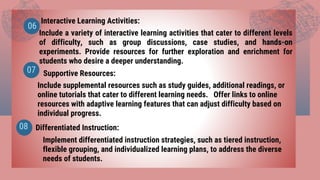
Interactive Learning Activities:
Supportive Resources:
06
07
Include a variety of interactive learning activities that cater to different levels
of difficulty, such as group discussions, case studies, and hands-on
experiments. Provide resources for further exploration and enrichment for
students who desire a deeper understanding.
Include supplemental resources such as study guides, additional readings, or
online tutorials that cater to different learning needs. Offer links to online
resources with adaptive learning features that can adjust difficulty based on
individual progress.
Differentiated Instruction:
08
Implement differentiated instruction strategies, such as tiered instruction,
flexible grouping, and individualized learning plans, to address the diverse
needs of students.
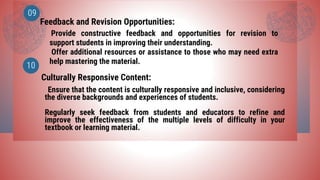
Feedback and Revision Opportunities:
Culturally Responsive Content:
09
10
Provide constructive feedback and opportunities for revision to
support students in improving their understanding.
Offer additional resources or assistance to those who may need extra
help mastering the material.
Ensure that the content is culturally responsive and inclusive, considering
the diverse backgrounds and experiences of students.
Regularly seek feedback from students and educators to refine and
improve the effectiveness of the multiple levels of difficulty in your
textbook or learning material.
Offer Scaffolding and Support
1.3
Learn More
Scaffolding can have different meanings
depending on the context. In general, the term
scaffolding implies a temporary and supportive
structure or framework that facilitates a process,
whether it be in construction, education, software
development, or other contexts. Here are a few
common meanings
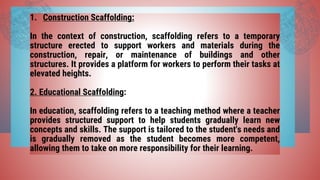
1. Construction Scaffolding:
In the context of construction, scaffolding refers to a temporary
structure erected to support workers and materials during the
construction, repair, or maintenance of buildings and other
structures. It provides a platform for workers to perform their tasks at
elevated heights.
2. Educational Scaffolding:
In education, scaffolding refers to a teaching method where a teacher
provides structured support to help students gradually learn new
concepts and skills. The support is tailored to the student's needs and
is gradually removed as the student becomes more competent,
allowing them to take on more responsibility for their learning.
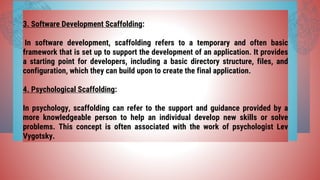
3. Software Development Scaffolding:
In software development, scaffolding refers to a temporary and often basic
framework that is set up to support the development of an application. It provides
a starting point for developers, including a basic directory structure, files, and
configuration, which they can build upon to create the final application.
4. Psychological Scaffolding:
In psychology, scaffolding can refer to the support and guidance provided by a
more knowledgeable person to help an individual develop new skills or solve
problems. This concept is often associated with the work of psychologist Lev
Vygotsky.
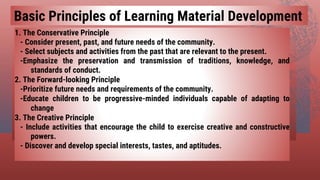
1. The Conservative Principle
- Consider present, past, and future needs of the community.
- Select subjects and activities from the past that are relevant to the present.
-Emphasize the preservation and transmission of traditions, knowledge, and
standards of conduct.
2. The Forward-looking Principle
-Prioritize future needs and requirements of the community.
-Educate children to be progressive-minded individuals capable of adapting to
change
3. The Creative Principle
- Include activities that encourage the child to exercise creative and constructive
powers.
- Discover and develop special interests, tastes, and aptitudes.
Basic Principles of Learning Material Development
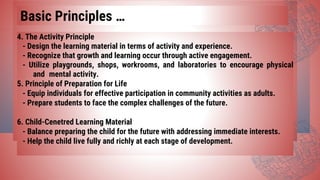
4. The Activity Principle
- Design the learning material in terms of activity and experience.
- Recognize that growth and learning occur through active engagement.
- Utilize playgrounds, shops, workrooms, and laboratories to encourage physical
and mental activity.
5. Principle of Preparation for Life
- Equip individuals for effective participation in community activities as adults.
- Prepare students to face the complex challenges of the future.
6. Child-Cenetred Learning Material
- Balance preparing the child for the future with addressing immediate interests.
- Help the child live fully and richly at each stage of development.
Basic Principles …
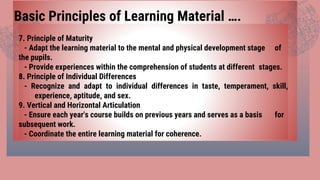
7. Principle of Maturity
- Adapt the learning material to the mental and physical development stage of
the pupils.
- Provide experiences within the comprehension of students at different stages.
8. Principle of Individual Differences
- Recognize and adapt to individual differences in taste, temperament, skill,
experience, aptitude, and sex.
9. Vertical and Horizontal Articulation
- Ensure each year's course builds on previous years and serves as a basis for
subsequent work.
- Coordinate the entire learning material for coherence.
Basic Principles of Learning Material ….
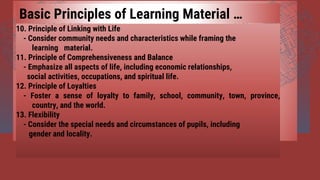
10. Principle of Linking with Life
- Consider community needs and characteristics while framing the
learning material.
11. Principle of Comprehensiveness and Balance
- Emphasize all aspects of life, including economic relationships,
social activities, occupations, and spiritual life.
12. Principle of Loyalties
- Foster a sense of loyalty to family, school, community, town, province,
country, and the world.
13. Flexibility
- Consider the special needs and circumstances of pupils, including
gender and locality.
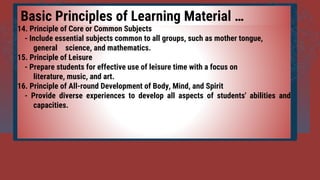
Basic Principles of Learning Material …
14. Principle of Core or Common Subjects
- Include essential subjects common to all groups, such as mother tongue,
general science, and mathematics.
15. Principle of Leisure
- Prepare students for effective use of leisure time with a focus on
literature, music, and art.
16. Principle of All-round Development of Body, Mind, and Spirit
- Provide diverse experiences to develop all aspects of students' abilities and
capacities.
Basic Principles of Learning Material …
Thank
You
Contact us:
hafeezkausar.hashmi@gmail.com
https://www.facebook.com/kausar0791
https://www.linkedin.com/in/dr-hafiz-kosar-284484186/
+92-314-3205571

Writing Learning Material and Textbook Level PhD (1).pptx

  • 1.
    Writing Learning Material andTextbook: Level PhD Making Learning Inclusive: Adapting for Everyone Dr.Hafiz Kosar
  • 2.
    Introduction: In today's schools,it's really important to recognize and celebrate the differences among students. This means making sure that our teaching methods work well for all kinds of learners. We call this "inclusive education," and it's about changing the way we teach so that every student can do their best. In education, diversity means lots of things, like how each person likes to learn, where they come from, the languages they speak, and how they think. It's not just a nice idea; it's crucial for giving everyone a fair chance at a good education.
  • 3.
    Introduction: Adapting our learningmaterials is a big part of this. It means changing the way we teach to meet the needs of all students. We can do this by using something called "differentiated instruction." This means tailoring what we teach, how we teach it, and how we test it to fit each student's needs and interests. Everyone has different strengths and challenges, so this helps teachers use a variety of ways to help everyone learn.
  • 4.
    Introduction.... Technology today givesus amazing tools to make learning personal. Things like digital platforms, adaptive learning technologies, and interactive resources let us change our teaching to fit how each student learns best. This not only helps students learn, but it also lets teachers give extra help to those who need it. Adapting learning materials isn't just about differences in how students learn. It's also about including different perspectives, cultures, and histories in what we teach. This makes students feel like they belong and helps them succeed in a world that values including everyone. As we explore how to adapt learning materials, we'll look at how technology helps, why understanding different cultures is important, and ways to help students with different learning abilities. By embracing the diversity in our schools, we can create an environment where every student can succeed and develop important skills like thinking critically, being empathetic, and loving to learn.
  • 5.
    Differentiate Content 1.1 Understanding learnersand their diverse learning needs is a critical aspect of effective teaching. By recognizing and addressing the unique characteristics, abilities, and preferences of each learner, educators can create a more inclusive and adaptive learning environment. Here are strategies to differentiate content and make learning accessible to everyone: Learn More
  • 6.
    Know Your Students: Pre-assessment: 01 02 LearningProfiles: Understand the diverse learning profiles of your students. Consider factors such as learning styles, preferences, strengths, and areas for improvement. Multiple Intelligences: Howard Gardner's theory of multiple intelligences suggests that people have different strengths and ways of learning. Incorporate a variety of activities that cater to different intelligences. Use pre-assessment tools to gauge students' prior knowledge and skills. This allows you to tailor your instruction to meet individual needs and avoid unnecessary repetition of content.
  • 7.
    Flexible Grouping: Tiered Assignments: 03 04 Implementflexible grouping strategies, such as collaborative learning, peer tutoring, or individualized instruction. This allows students to work at their own pace and benefit from diverse perspectives. Provide tiered assignments with varying levels of complexity to accommodate different readiness levels. This allows students to choose tasks that match their skill levels and challenge them appropriately. Differentiated Instruction: 05 Differentiate instruction based on students' needs. This could involve altering the pace, depth, or complexity of content delivery to meet individual learning requirements.
  • 8.
    Universal Design forLearning (UDL): Varied Resources: 06 07 Implement principles of UDL, which involves designing learning material and instruction that is accessible to all students. This includes providing multiple means of representation, engagement, and expression. Offer a variety of learning resources, such as textbooks, videos, interactive simulations, and hands-on activities. This accommodates different learning preferences and styles. Technology Integration: 08 Leverage educational technology to provide personalized learning experiences. Educational apps, online resources, and interactive multimedia can cater to diverse learning needs.
  • 9.
    Scaffolded Instruction: Continuous Feedback: 09 10 Provideongoing feedback to students, allowing them to understand their progress and make necessary adjustments. Tailor feedback to individual learning styles and preferences. Provide ongoing feedback to students, allowing them to understand their progress and make necessary adjustments. Tailor feedback to individual learning styles and preferences. Encourage Self-Reflection: 11 Foster a culture of self-reflection where students can identify their learning preferences and strengths. Encourage them to advocate for their own learning needs. Collaboration with Support Services: 12 Work closely with support services, such as special education and counselling, to ensure that individualized learning plans are effectively implemented.
  • 10.
    Provide Multiple Levelsof Difficulty 1.2 Learn More Creating a textbook with multiple levels of difficulty is a great way to make learning more inclusive, catering to a diverse range of students with varying abilities and learning styles. Here are some strategies to achieve this:
  • 11.
    Clear Organization andProgression: Tiered Assignments: 01 02 Organize the content in a clear and logical sequence, with each chapter building on previous knowledge. Clearly label different difficulty levels or sections so that students can easily identify and choose the appropriate level. Develop tiered assignments or activities that provide varying levels of complexity within a single topic or concept. Offer different sets of questions or problems with increasing difficulty, allowing students to choose the level that best suits their abilities.
  • 12.
    Visual Aids andMultimedia: Varied Reading Levels: 03 04 Incorporate visual aids, illustrations, and multimedia resources that can assist learners at different levels. Use diagrams, charts, and videos to enhance understanding, especially for visual or auditory learners. Provide content written at different reading levels within the same textbook. This can be achieved through the use of sidebars, footnotes, or separate sections. Include glossaries or annotations to explain complex terms or concepts, ensuring accessibility for all students. Flexible Assessments: 05 Design assessments that allow for flexibility in difficulty. For example, include a mix of multiple-choice, short answer, and open-ended questions. Consider offering alternative assessment methods such as projects, presentations, or practical applications to accommodate different learning styles.
  • 13.
    Interactive Learning Activities: SupportiveResources: 06 07 Include a variety of interactive learning activities that cater to different levels of difficulty, such as group discussions, case studies, and hands-on experiments. Provide resources for further exploration and enrichment for students who desire a deeper understanding. Include supplemental resources such as study guides, additional readings, or online tutorials that cater to different learning needs. Offer links to online resources with adaptive learning features that can adjust difficulty based on individual progress. Differentiated Instruction: 08 Implement differentiated instruction strategies, such as tiered instruction, flexible grouping, and individualized learning plans, to address the diverse needs of students.
  • 14.
    Feedback and RevisionOpportunities: Culturally Responsive Content: 09 10 Provide constructive feedback and opportunities for revision to support students in improving their understanding. Offer additional resources or assistance to those who may need extra help mastering the material. Ensure that the content is culturally responsive and inclusive, considering the diverse backgrounds and experiences of students. Regularly seek feedback from students and educators to refine and improve the effectiveness of the multiple levels of difficulty in your textbook or learning material.
  • 15.
    Offer Scaffolding andSupport 1.3 Learn More Scaffolding can have different meanings depending on the context. In general, the term scaffolding implies a temporary and supportive structure or framework that facilitates a process, whether it be in construction, education, software development, or other contexts. Here are a few common meanings
  • 16.
    1. Construction Scaffolding: Inthe context of construction, scaffolding refers to a temporary structure erected to support workers and materials during the construction, repair, or maintenance of buildings and other structures. It provides a platform for workers to perform their tasks at elevated heights. 2. Educational Scaffolding: In education, scaffolding refers to a teaching method where a teacher provides structured support to help students gradually learn new concepts and skills. The support is tailored to the student's needs and is gradually removed as the student becomes more competent, allowing them to take on more responsibility for their learning.
  • 17.
    3. Software DevelopmentScaffolding: In software development, scaffolding refers to a temporary and often basic framework that is set up to support the development of an application. It provides a starting point for developers, including a basic directory structure, files, and configuration, which they can build upon to create the final application. 4. Psychological Scaffolding: In psychology, scaffolding can refer to the support and guidance provided by a more knowledgeable person to help an individual develop new skills or solve problems. This concept is often associated with the work of psychologist Lev Vygotsky.
  • 18.
    1. The ConservativePrinciple - Consider present, past, and future needs of the community. - Select subjects and activities from the past that are relevant to the present. -Emphasize the preservation and transmission of traditions, knowledge, and standards of conduct. 2. The Forward-looking Principle -Prioritize future needs and requirements of the community. -Educate children to be progressive-minded individuals capable of adapting to change 3. The Creative Principle - Include activities that encourage the child to exercise creative and constructive powers. - Discover and develop special interests, tastes, and aptitudes. Basic Principles of Learning Material Development
  • 19.
    4. The ActivityPrinciple - Design the learning material in terms of activity and experience. - Recognize that growth and learning occur through active engagement. - Utilize playgrounds, shops, workrooms, and laboratories to encourage physical and mental activity. 5. Principle of Preparation for Life - Equip individuals for effective participation in community activities as adults. - Prepare students to face the complex challenges of the future. 6. Child-Cenetred Learning Material - Balance preparing the child for the future with addressing immediate interests. - Help the child live fully and richly at each stage of development. Basic Principles …
  • 20.
    7. Principle ofMaturity - Adapt the learning material to the mental and physical development stage of the pupils. - Provide experiences within the comprehension of students at different stages. 8. Principle of Individual Differences - Recognize and adapt to individual differences in taste, temperament, skill, experience, aptitude, and sex. 9. Vertical and Horizontal Articulation - Ensure each year's course builds on previous years and serves as a basis for subsequent work. - Coordinate the entire learning material for coherence. Basic Principles of Learning Material ….
  • 21.
    10. Principle ofLinking with Life - Consider community needs and characteristics while framing the learning material. 11. Principle of Comprehensiveness and Balance - Emphasize all aspects of life, including economic relationships, social activities, occupations, and spiritual life. 12. Principle of Loyalties - Foster a sense of loyalty to family, school, community, town, province, country, and the world. 13. Flexibility - Consider the special needs and circumstances of pupils, including gender and locality. Basic Principles of Learning Material …
  • 22.
    14. Principle ofCore or Common Subjects - Include essential subjects common to all groups, such as mother tongue, general science, and mathematics. 15. Principle of Leisure - Prepare students for effective use of leisure time with a focus on literature, music, and art. 16. Principle of All-round Development of Body, Mind, and Spirit - Provide diverse experiences to develop all aspects of students' abilities and capacities. Basic Principles of Learning Material …
  • 23.